Showing posts sorted by relevance for query 2008 financial crisis. Sort by date Show all posts

Tuesday, May 26, 2020

Growth and distribution after the 2007–2008 US financial crisis: who shouldered the burden of the crisis?

Mathieu Dufour and Özgür Orhangazi

Keywords: financial crisis; Great Recession; 2008 crisis

Published in print:Apr 2016


Category:Research Article


Pages:151–174

Download PDF (785.7 KB)

The post-1980 era witnessed an increase in the frequency and severity of financial crises around the globe, the majority of which took place in low- and middle-income countries. Studies of the impacts of these crises have identified three broad sets of consequences. First, the burden of crises falls disproportionately on labor in general and low-income segments of society in particular. In the years following financial crises, wages and labor share of income fall, the rate of unemployment increases, the power of labor and labor unions is eroded, and income inequality and rates of poverty increase. Capital as a whole, on the other hand, usually recovers quickly and most of the time gains more ground. Second, the consequences of crises are visible not only through asset and income distribution, but also in government policies. Government policies in most cases favor capital, especially financial capital, at the expense of large masses. In addition, many crises have presented opportunities for further deregulation and liberalization, not only in financial markets but in the rest of the economy as well. Third, in the aftermath of financial crises in low- and middle-income economies, capital inflows may increase as international capital seeks to take advantage of the crisis and acquire domestic financial and non-financial assets. The 2007–2008 financial crisis in the US provides an opportunity to extend this analysis to a leading high-income country and see if the patterns visible in other crises are also visible in this case. Using the questions and issues typically raised in examinations of low- and middle- income countries, we study the consequences of the 2007–2008 US financial crisis and complement the budding literature on the ‘Great Recession.’ In particular, we examine the impacts of the crisis on labor and capital, with a focus on distributional effects of the crisis such as changes in income shares of labor and capital, and the evolution of inequality and poverty. We also analyse the role of government policies through a study of government taxation and spending policies, and examine capital flow patterns.


Full Text

1 INTRODUCTION

The post-1980 era witnessed an increase in the frequency and severity of financial crises around the globe (Eichengreen 2001; Reinhart and Rogoff 2011). Apart from the large amount of literature that examines the causes of these crises, another line of research has concerned itself with the consequences of financial crises. Three broad findings emerge from the latter, which focuses on low- and middle-income country experiences, as this is where most of the major financial crises have taken place in the last couple of decades. First, the burden of crises falls disproportionately on labor in general and low-income segments of society in particular. In the years following financial crises, wages and labor share of income fall, the rate of unemployment increases, the power of labor and labor unions is eroded, and income inequality and rates of poverty increase (Diwan 2000; 2001; Jayadev 2005; Onaran 2007). Capital as a whole, on the other hand, usually recovers quickly and most of the time gains more ground. Second, the consequences of crises are visible not only through asset and income distribution, but also in government policies. Government policies in most cases favor capital, especially financial capital, at the expense of the rest of society. In addition, many crises have presented opportunities for further deregulation and liberalization, not only in financial markets but in the rest of the economy as well (Crotty and Lee 2001; Harvey 2003; Duménil and Lévy 2006; Dufour and Orhangazi 2007; 2009). Third, in the aftermath of financial crises in low- and middle-income economies, capital inflows often increase as international capital seeks to take advantage of the crisis and acquire domestic financial and non-financial assets (Wade and Veneroso 1998; Dufour and Orhangazi 2007; 2009).

The 2007–2008 financial crisis in the US provides an opportunity to extend this analysis to a leading high-income country and see if the patterns visible in other crises are also visible in this case. Using the questions and issues typically raised in examinations of low- and middle-income countries as an entry point to look at the experience of the US economy in the aftermath of the 2007–2008 financial crisis provides a fresh perspective on that crisis and allows for an original contribution to the gradually emerging literature on the consequences of the US financial crisis and the ‘Great Recession’ (for example, Oleinik 2013; Wolff 2013). In this paper, we empirically investigate the outcome using broad indicators such as changes in inequality and poverty, and then compare the fortunes of labor and capital after the crisis. We find that unemployment has substantially increased and labor incomes have fallen, but the income share of capital and profitability continued to increase after the crisis. While the US did not need an external bailout, such as those the IMF provided during earlier financial crises in less-developed countries, the US government and the Federal Reserve (FED) provided unprecedented amounts of support to the economy. Since they were not constrained by an external structural adjustment program and since the FED has the power to issue an international reserve currency, the outcomes of the crisis in this regard differed from other experiences. However, capital inflows peaked during the crisis, suggesting that it opened business opportunities for international capital in similar ways as previous crises did.

The rest of the paper is organized as follows. In Section 2 we look at the emergence of the 2007–2008 US financial crisis and the path of some important macroeconomic indicators before and after the crisis. In Section 3 we turn our attention to the distributional effects of the US financial crisis and then compare this with the impacts of the crisis on capital. We compare the changes in income shares of labor and capital before shifting our attention to changes in inequality and poverty. Section 4 focuses on the role of government policies through an analysis of government taxation and spending policies. After discussing the change in capital flows in Section 5, we conclude in Section 6 with a discussion of our overall findings and further research areas.

Saturday, November 29, 2025

Nobel economist reveals how Trump is setting up a 'rerun' of the 2008 financial crisis


Economist Paul Krugman at FIDES 2023 in Rio de Janeiro, Brazil
 on September 25, 2023 (A.PAES/Shutterstock.com)

November 28, 2025 | 
ALTERNET


The Wall Street meltdown of September 2008 gave the United States its worst financial crisis since the Great Depression of the 1930s. Both then-President George W. Bush and his successor, Barack Obama, drew criticism for supporting the costly Wall Street bailout, but both of them maintained that the bailout was necessary in order to prevent the Great Recession from worsening.

In a Substack column posted on November 28, liberal economist Paul Krugman made a comparison between the 2008 financial crisis and the current 2025 economy, and laid out a variety of Trump administration policies that he warns could lead to a "future financial crisis" — from a cryptocurrency bubble to undermining the independence of the U.S. Federal Reserve.

"The clear lesson of 2008 is that effective financial regulation is essential," Krugman emphasizes. "For three generations after the great bank runs of 1930-31, America avoided 'systemic' banking crises — crises that threaten the whole financial system, as opposed to individual institutions. This era, which Yale's Gary Gorton calls the Quiet Period, was the result of New-Deal-era protections — especially deposit insurance — and regulations that limited banks' risk-taking. But post-1980, finance was increasingly deregulated."

Krugman adds, "In particular, the government failed to extend bank-type regulation to shadow banks that posed systemic bank-type risks. And the crisis came."

According to Krugman, Trump and his allies haven't learned the lessons of The Great Recession.

"In a way," Krugman explains, "the laxity that made the 2008 crisis possible was understandable. By the 2000s, nobody in government or the financial markets remembered what a real financial crisis was like. And no, watching 'It's a Wonderful Life' on Christmas Day doesn't count. But here we are in 2025, and 2008 wasn't that long ago. Many of us still have vivid memories of the gut-wrenching panic that gripped the world when Lehman fell. Yet Donald Trump's allies and cronies are now moving rapidly to dismantle the precautionary regulations introduced after 2008 to reduce the risk of future financial crises ... But key players in Congress, within the administration, and, alas, at the Federal Reserve, are apparently determined to make a 2008 rerun possible."

"The MAGA war on financial stability is being waged largely on two fronts. First, there's an ongoing effort within some parts of the Federal Reserve to drastically weaken bank supervision — oversight of banks to prevent them from taking risks that could threaten the financial system. The Fed has multiple roles: in addition to setting interest rates, it also has primary responsibility for bank supervision," Krugman continued. "The Fed is supposed to be quasi-independent, and so far, it has preserved its interest-rate-setting independence in the face of intense pressure by Trump to cut rates. Yet a Trumpian agenda is attempting to overtake the Fed's bank supervision operations…. The second front of MAGA's war on financial stability is on behalf of the crypto industry…. Along with its many other sins, the Trump administration is doing its best to make a future financial crisis more likely."

Paul Krugman's full Substack column is available at this link.

Monday, October 17, 2022

CRIMINAL CAPITALI$M
Credit Suisse to pay $495 mn in US to settle securities case


Issued on: 17/10/2022

Subprime mortages were at the heart of the 2008 financial crisis
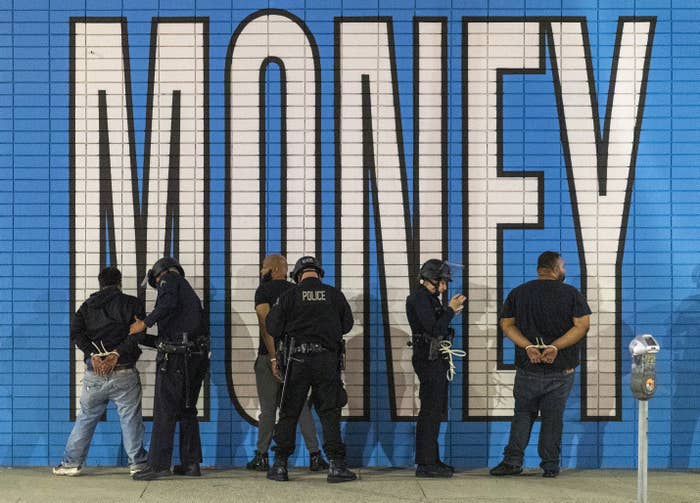
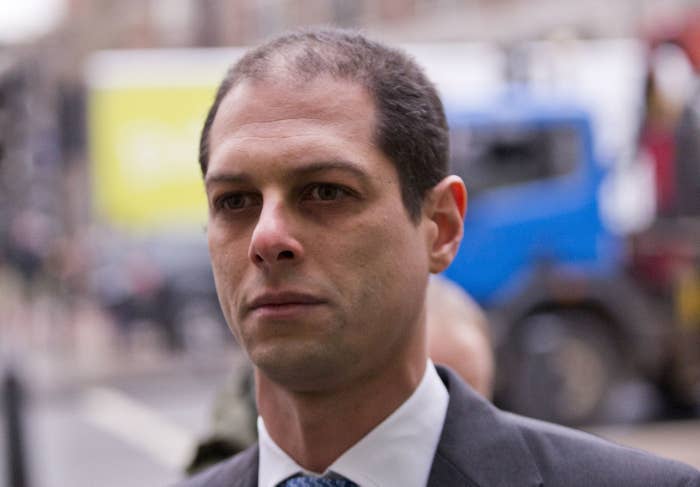
Zurich (AFP) – Credit Suisse said Monday it would pay $495 million to settle a row over mortgage-backed securities dating back to the 2008 financial crisis.

Switzerland's second-biggest bank said it had agreed with New Jersey authorities to make the "one-time payment... to fully resolve claims" for compensation, and said it had already provisioned the amount.

In the claim filed in 2013, Credit Suisse was criticised for not having provided sufficient information on the risks relating to $10 billion of mortgage-backed securities.

Subprime mortgages, credit granted to borrowers often with poor credit histories or insufficient income, were packaged into financial products and sold to investors.

But as borrowers defaulted on many of those mortgages, investors had no way of telling what portion of the loans in the derivatives were bad.

Those products were at the heart of the 2008 financial crisis, which sparked a global recession and brought the international financial system to the brink of collapse.

Credit Suisse said the final settlement with the New Jersey Attorney General allowed it "to resolve the only remaining RMBS (residential mortgage-backed securities) matter involving claims by a regulator and the largest of its remaining exposures on its legacy RMBS docket".

Shares rose after the statement on the SMI, the flagship index of the Swiss Stock Exchange.

Speculation has been growing ahead of an update scheduled by the new chief executive for later this month.

According to the Financial Times, the bank is considering not only disposals in its investment bank but also the sale of some of its domestic activities in Switzerland.
Financial crisis fines

In January 2017, US authorities forced Credit Suisse to pay out $5.28 billion over its role in the subprime crisis -- three years after it was fined $2.6 billion for helping Americans avoid taxes.

Last year, Credit Suisse also paid $600 million to financial guarantee insurer MIBA to settle other long-running litigation connected to the US subprime mortgage crisis.

The bank said last January it was increasing the provisions set aside for the MBIA case and others involving mortgage backed securities by $850 million.

Some of the world's biggest banks have also faced legal claims after the 2008 financial crash.

German banking giant Deutsche Bank agreed in December 2016 to pay $7.2 billion to settle a case with the US Department of Justice.

And British banking giant Barclays reached a deal in 2018 to pay a US fine of $2 billion over a fraud case involving subprime mortgage derivatives.

The Bank of America meanwhile agreed to a $17 billion deal with US authorities in 2014 to settle claims it sold risky mortgage securities as safe investments ahead of the 2008 financial crisis.

© 2022 AFP

Wednesday, June 03, 2020

As Thousands Of Protesters Are Arrested, “The Crimes Of The Rich Are Not Prosecuted”

At least 5,600 people have been arrested since the George Floyd protests began; just one US banker was sentenced to prison for the 2008 financial crisis.

Venessa WongBuzzFeed News Reporter
Reporting From New York, New York June 2, 2020,

David Mcnew / Getty Images

People are arrested during demonstrations over the death of George Floyd on June 1, 2020 in Los Angeles.

As state and federal politicians send a surge of police and soldiers to confront the nationwide protests that emerged over the last week, the number of people arrested has already surpassed the number of white-collar criminals federally prosecuted in all of 2019.

The quickly rising tally is a reminder that while some forms of theft and devastation are punished, others draw little response at all; the criminal justice system is designed to make it easy to prosecute some types of crimes and not others. At least 5,600 people around the country have already been arrested during the protests, while just 359 white-collar crimes were federally prosecuted in the entire month of January, down 25% from 2015 levels.

Meanwhile, President Trump told governors dealing with protests on Monday: “You have to arrest and try people.”

The number of arrests is certain to rise as the protests continue and the National Guard is deployed on the streets. The rapid surge, which happened within days of the protests beginning, contrasts with the Trump administration’s light-touch approach to enforcing financial crimes, with federal white-collar prosecutions on track to reach an all-time low this year.

“If prosecutions continue at the same pace for the remainder of ... 2020, they are projected to fall to 5,175 — almost half the level of their Obama-era peak,” according to TRAC, a research group at Syracuse University that tracks federal law enforcement patterns.

Politicians and law enforcement have declared zero tolerance for looting as protests go on. Alleged financial crimes by major corporations, meanwhile, almost always end up with no one being prosecuted, and often with the companies paying the government a settlement in return for it dropping the case. Wells Fargo, for example, agreed to pay $3 billion to settle its fake account scandal, which led to customers being charged unexpected fees and likely damaged their credit scores. Bank of America paid $16.65 billion to settle claims of fraud over its role in the economic carnage caused by the 2008 financial crisis.


Matt Dunham / AP
Former Credit Suisse executive Kareem Serageldin, the only Wall Street banker to go to jail for the 2008 financial crisis.

“People are being arrested for what — peaceful protesting and being at the wrong place at the wrong time? Getting caught breaking a window?” asked Geert Dhondt, associate professor at the John Jay College of Criminal Justice. “The larger crimes, and the larger harm to society, goes unpunished.”

There have already been at least 5,600 arrests since peaceful protests and violent demonstrations erupted around the country in response to the death of George Floyd, according to estimates by the Associated Press. Some were arrested for failing to obey orders from law enforcement, stealing, obstructing traffic, or disturbing the peace. In Minnesota, 150 were arrested Sunday and early Monday for breaking the 8 p.m. curfew.

“Tactically a lot of the [protest] arrests are just for order keeping. So they’re not worried about prosecuting these folks, they’re arresting them to get them off the streets and trying to maintain control,” said Jesse Jannetta, senior policy fellow at the Urban Institute. “One question being put in front of us by the protests is, Who does the law tend to protect versus people who are constantly being enforced on by the law? Low-income communities, particularly predominantly African American communities, have a ton of police presence.”


John Legend@johnlegend
Meanwhile, billions of dollars of exploitation, fraud and other white collar crime happens with no arrests, no police involvement, nothing. We need to divest in our entire system of overincarceration and overpolicing. We are not made safer or closer to justice by any of it.11:59 PM - 30 May 2020
Reply Retweet Favorite

The outsized police reaction to the George Floyd protests echoes the response to the Occupy movement that followed the 2008 financial crisis. More than 7,700 protesters were arrested, according to the site OccupyArrests.com; only one US banker was sentenced to prison for their role in the financial crisis, which led to 10 million families losing their homes.

Berkeley professor and former labor secretary Robert Reich tweeted, “More peaceful protestors and journalists have been jailed in the past week than all the bankers who were jailed for fraud during the financial collapse.”


Robert Reich@RBReich
More peaceful protestors and journalists have been jailed in the past week than all the bankers who were jailed for fraud during the financial collapse.05:33 PM - 31 May 2020
Reply Retweet Favorite

“What happened in the financial crisis caused huge amounts of harm, but that’s not thought about the same way,” said Jannetta. “George Floyd, our understanding is he tried to use a fake $20 bill … So is there equality of protection and is there equality of enforcement? And I think when you look across these things, the answer isn’t yes.”


Dhondt said this inequality is only growing with every crisis. “Who does the real looting in society? Someone who smashes a window or private equity firms that buy up companies in crisis and sell off their parts and destroys thousands of people’s lives?”

“The crimes of the rich are not prosecuted; they’re ignored,” Dhondt added, “even though they do a lot more harm than a few broken windows.”


Venessa Wong is a technology and business reporter for BuzzFeed News and is based in New York.

Sunday, April 05, 2020


Coronavirus shock vs. global financial crisis — the worse economic disaster?

The coronavirus outbreak, which has put the global economy under a lockdown, is being compared to the 2008-09 downturn. But in some industries, the virus may have already caused the biggest meltdown in history.


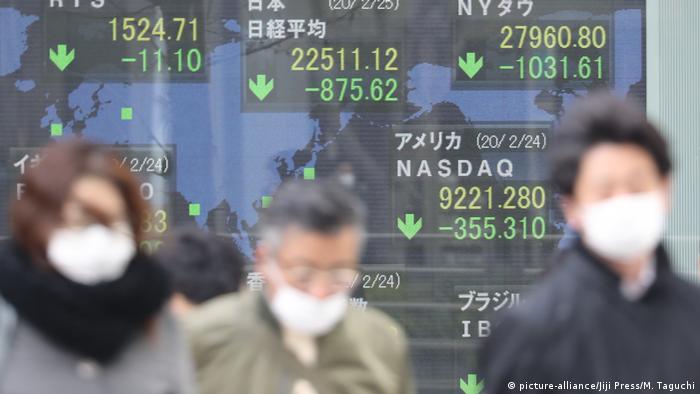
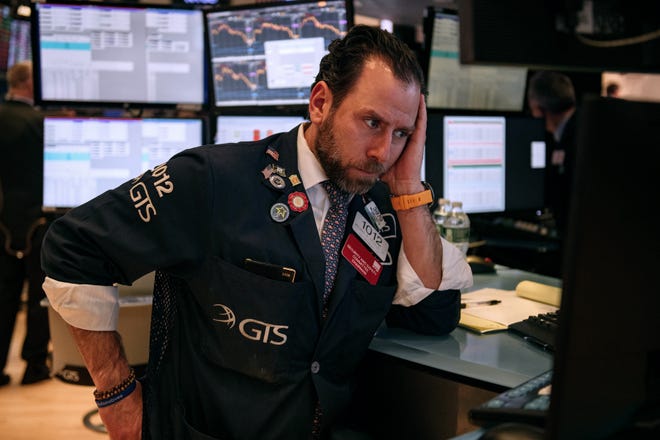
The economic upheaval caused by the COVID-19 outbreak has revived memories of the 2008-09 global financial crisis (GFC): recession chatter, bloodbath on global stock markets, governments and central banks loosening the purse strings.

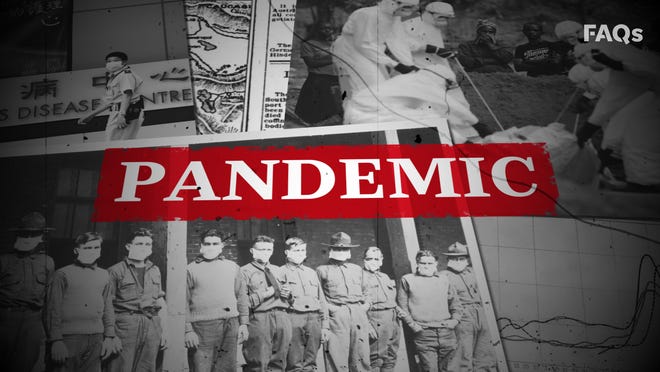
The pandemic, which has claimed thousands of lives across continents, has virtually brought the world economy to a standstill with millions of people placed under lockdown and global supply chains thrown into disarray due to the virus wreaking maximum havoc in China — the world's factory.

While many are already comparing the current crisis to the 2008-09 recession, most experts do not expect it to be as bleak and are forecasting the global economy to swiftly recover in the second half of the year, provided the outbreak fizzles out by then. Yet, the novel coronavirus has dealt historic blows to the airline industry and oil markets. DW asked experts to compare the economic damage caused by the two crises.

Aviation industry

The aviation industry, suffering from cut-throat competition, price wars and poor financial health, has been clobbered hardest by the pandemic, which has virtually ground air travel to a halt and threatens to bankrupt most airlines. British Airways CEO Alex Cruz described the situation as a "crisis of global proportions like no other we have known."

"Some of us have worked in aviation through the global financial crisis, the SARS outbreak and 9/11. What is happening right now as a result of COVID-19 is more serious than any of these events," he said in a memo to staff.

Several prominent airlines are seeking state relief to help them weather the current turbulence.

"When we see well-capitalized airlines like Lufthansa making statements about the need for state support, then we know things must be bad," Rob Morris, global head of consultancy at Ascend by Cirium, told DW. "Clearly, for every airline globally the objective for 2020 will be to survive through this crisis. I fear there are many who will not be able to achieve that, and we will almost certainly start to see some significant airline failures shortly."

Oil industry


The oil markets are in no better shape. Global oil consumption is expected to witness its biggest fall in history, hurt by a temporary ban on travel, factory shutdowns and other measures to contain the virus. The fall in oil demand could easily outstrip the loss of almost 1 million barrels a day during the 2008-09 recession, Bloomberg reported. Compounding problems is an ongoing price war launched by Saudi Arabia which has pledged to flood an already oversupplied market with cheap crude. Oil prices have fallen by more than 50% this year.

"In 2008-09 we had a demand shock, and inventories built. This [current crisis] looks likely to have a bigger impact, partly because there is a lot of uncertainty still around and partly because it is both a demand and supply story," Philip Jones-Lux, energy market analyst at JBC Energy, told DW. "The industry has been supposedly readying itself for a 'lower for longer' scenario, but the current market and outlook are beyond anything that could be reasonably prepared for and we are likely to see some real pain inflicted if prices remain in the $30-a-barrel range."

Financial sector


The housing market, which was propped up by cheap loans offered to households by banks, was the epicenter of the 2008-09 crisis. The bursting of housing bubbles in the US and in other countries such as the UK, Spain and Ireland brought major global banks, which did not have enough capital to withstand the shock, to their knees. The banks paid a price among other things for bundling subprime mortgages into complex, opaque derivatives to maximize profits. This time, the banks are in a much better position thanks to increased regulation.

"The 2008-09 crisis was far more severe because the global financial system was far more fragile. Banks were not as well-capitalized as they are today particularly in the United States," Sara Johnson, IHS Markit executive director, told DW. "While today there are concerns with rising nonfinancial corporate debt, I'd say the magnitude is not as severe as in 2008-09."

But banks, especially the European ones which have been struggling to boost profits at a time in an ultra-low interest rate environment, are nevertheless feeling the heat. They are bracing for further interest rate cuts and loan defaults. Experts are also flagging a possible sovereign debt default by Italy, which is in a state of lockdown to contain the spread of the virus. European banks are holding more than €446 billions ($497 billions) of sovereign and private Italian debt, according to Bloomberg.

Global economy


The collapse of US lender Lehman Brothers in 2008 fueled the most painful global economic downturn since the Wall Street Crash of 1929. The sustained, severe recession saw global output contract by 1.8% in 2009 compared with an expansion of 4.3% in 2007. Millions of jobs were lost, hurting global consumer spending. While the current crisis could cost the global economy up to $2 trillion this year, according to UN estimates, it's still not expected to push the world into a contraction.

"Our view is that this is a much more temporary shock that is going to have less significant and longstanding negative impacts on the global economy than the global financial crisis," Ben May, director of global macro research at Oxford Economics, told DW. "It's not that as if you don't go out today because you're worried about catching the virus, the money that you didn't spend today will be saved forever, it's more likely to be spent in the future unless something dramatic changes...When you look at past episodes of virus outbreaks or natural disasters, you know typically discretionary spending returns at a later point."

International trade


The coronavirus shock could not have come at a worse time for global trade which has been reeling from trade tensions between the US and China, the world's biggest economies. But the current blow is still not a severe as the one dealt by the crisis 10 years back.

"The global financial crisis was kind of endogenous in the economic system meaning that there was a strong capital stock distortion in some countries and there was a problem of over-indebtedness. These two roots of a crisis are much harder to cure than the situation that we are facing today where we have an interruption of production structures, which in principle are fundamentally sound," Stefan Kooths, head of forecasting at the Kiel Institute for the World Economy, told DW.

"So, even if the coronavirus crisis leads to a deep meltdown in terms of production, the chances of getting out of this recession rather sooner than later are much better than in the global financial crisis."


Tuesday, March 10, 2020

Trump Can’t Handle the Truth
And neither can the rest of America’s right.


By Paul Krugman, Opinion Columnist 
March 9, 2020

Over the weekend Donald Trump once again declared that the coronavirus is perfectly under control, that any impressions to the contrary are due to the “Fake News Media” out to get him. Question: Does anyone have a count of how many times he’s done this, comparable to the running tallies fact checkers are keeping of his lies?

In any case, we’ve pretty clearly reached the point where Trump’s assurances that everything is fine actually worsen the panic, because they demonstrate the depths of his delusions. Even as he was tweeting out praise for himself, global markets were in free-fall.

Never mind cratering stock prices. The best indicator of collapsing confidence is what is happening to interest rates, which have plunged almost as far and as fast as they did during the 2008 financial crisis. Markets are implicitly predicting not just a recession, but multiple years of economic weakness.

And at first I was tempted to say that our current situation is even worse than it was in 2008, because at least then we had leadership that recognized the seriousness of the crisis rather than dismissing it all as a liberal conspiracy.

When you look back at the record, however, you discover that as the financial crisis developed right-wingers were also deeply in denial, inclined to dismiss bad news or attribute it to liberal and/or media conspiracies. It was only in the final stages of financial collapse that top officials got real, and right-wing pundits never did.

Let’s take a trip down memory lane.

The 2008 financial crisis was brought on by the collapse of an immense housing bubble. But many on the right denied that there was anything amiss. Larry Kudlow, now Trump’s chief economist, ridiculed “bubbleheads” who suggested that housing prices were out of line.

And I can tell you from personal experience that when I began writing about the housing bubble I was relentlessly accused of playing politics: “You only say there’s a bubble because you hate President Bush.”

When the economy began to slide, mainstream Republicans remained deeply in denial. Phil Gramm, John McCain’s senior economic adviser during the 2008 presidential campaign, declared that America was only suffering a “mental recession” and had become a “nation of whiners.”

Even the failure of Lehman Brothers, which sent the economy into a full meltdown, initially didn’t put a dent in conservative denial. Kudlow hailed the failure as good news, because it signaled an end to bailouts, and predicted housing and financial recovery in “months, not years.”

Wait, there’s more. After the economic crisis helped Barack Obama win the 2008 election, right-wing pundits declared that it was all a left-wing conspiracy. Karl Rove and Bill O’Reilly accused the news media of hyping bad news to enable Obama’s socialist agenda, while Rush Limbaugh asserted that Senator Chuck Schumer personally caused the crisis (don’t ask).

The point is that Trump’s luridly delusional response to the coronavirus and his conspiracy theorizing about Democrats and the news media aren’t really that different from the way the right dealt with the financial crisis a dozen years ago. True, last time the crazy talk wasn’t coming directly from the president of the United States. But that’s not the important distinction between then and now.

No, what’s different now is that denial and the resulting delay are likely to have deadly consequences.

It’s not clear, even in retrospect, how much better things would have been if right-wingers had recognized economic reality in 2008. Years of deregulation and lax enforcement had already weakened the financial system, and it was probably too late to head off the coming crisis.

Virus denial, by contrast, squandered crucial time — time that could have been used to slow the coronavirus’s spread. For the clear and present danger now isn’t so much that large numbers of Americans will get sick — that was probably going to happen anyway — but that the epidemic will move so fast that it overloads our hospitals.

By not instituting widespread testing from the start, the U.S. has ensured that there are now cases all over the country — we have no idea how many — and that the virus will spread rapidly. And even now there is no hint that the administration is ready for the kinds of public health measures that might limit the pace of that spread.

Oh, and when it comes to the economic response, it’s worth noting that basically everyone on the Trump economic team was totally wrong about the 2008 crisis. It seems to be a job requirement.

The bottom line is that like so much of what is happening in America right now, the coronavirus crisis isn’t just about Trump. His intellectual and emotional inadequacy, his combination of megalomania and insecurity, are certainly contributing to the problem; has there ever been a president so obviously not up to the job? But in refusing to face uncomfortable facts, in attributing all bad news to sinister conspiracies, he’s actually just being a normal man of his faction.

In 2020 we’re relearning the lessons of 2008 — namely, that America’s right-wingers can’t handle the truth.

The Times is committed to publishing a diversity of letters to the editor. We’d like to hear what you think about this or any of our articles. Here are some tips. And here’s our email: letters@nytimes.com.

PAUL KRUGMAN’S NEWSLETTER
Get a better understanding of the economy — and an even deeper look at what’s on Paul’s mind.

Paul Krugman has been an Opinion columnist since 2000 and is also a Distinguished Professor at the City University of New York Graduate Center. He won the 2008 Nobel Memorial Prize in Economic Sciences for his work on international trade and economic geography. @PaulKrugman

Tuesday, April 07, 2020

It may feel like 2008 all over again, but here's how the coronavirus crisis is different

Paul DavidsonNathan BomeyJessica Menton USA TODAY


A plunging stock market. The widening shadow of recession. Fed interest rate cuts and government stimulus.

It's beginning to feel a lot like 2008 again. And not in a good way.

For many Americans, the stomach-churning market drops and growing recession talk of the past few weeks – triggered by the global spread of the coronavirus – are reviving memories of the 2008 financial crisis and Great Recession.

Take a breath. While the toll the infection ultimately takes on the nation isn’t clear, the economic upheaval caused by the outbreak will likely not be nearly as damaging or long-lasting as the historic downturn of 2007-09.

“A recession is not inevitable,” says Gus Faucher, chief economist of PNC Financial Services Group. “If we do get a recession, it is likely to be brief and much less severe than the Great Recession.”

For one thing, the 2008 financial crisis and recession resulted from years of deeply rooted weak spots in the economy. That’s not the case now.

“What we’re seeing is caused by something external to the economy,” Faucher says.

“It’s closer to a natural disaster,” says Kathy Bostjancic, director of U.S. Macro Investors Services at Oxford Economics.


Partly as a result, the economy’s major players – consumers, businesses and lenders – are much better positioned to withstand the blows and bounce back.

Here’s a look at how the current crisis compares with the meltdown more than a decade ago.

The cause

The Great Recession. The bruising downturn was set off by an overheated housing market. Banks and other lenders approved mortgages – including many to buyers who weren’t qualified, driving up home prices to stratospheric levels. The banks bundled the mortgages into securities and sold them to other financial institutions.

When home prices began spiraling down, millions of Americans stopped making mortgage payments and lost their homes while the banks that held the securities were pushed to the brink of bankruptcy.

Widespread layoffs in real estate, construction and banking hammered consumer spending and led to deeper job losses throughout the economy. Bank lending was virtually frozen, grinding the gears of the economy to a near halt. The problems had been simmering in the housing market and banking system for years.

Current crisis. The coronavirus, which originated in China late last year, has sparked today’s economic hazard. There are now more than 100,000 cases worldwide, most of them in China, and the death toll has topped 4,000. In the U.S., more than 800 people have been infected and 28 have died.

Because far fewer people are affected than in 2007-2009, the economic toll has been limited so far. The travel and tourism industry has suffered the most, with businesses canceling conferences and trade shows and consumers scrapping vacation plans. Disruptions to deliveries of manufacturing parts and retail goods from China could temporarily shut down American factories and leave store shelves empty.

As Americans avoid more public places, the virus is likely to hurt sales at restaurants, malls and other venues. There are some signs retailers are already taking a hit. In the last week of February, foot traffic to Walmart stores fell 16.5% compared with the previous week, according to consumer data firm Cuebiq. In the same week, however, traffic to Costco stores rose 7.7%.

Household debt

Great Recession. Since banks freely doled out credit for mortgages, auto loans and credit cards, household debt climbed to a record 134% of gross domestic product, according to Oxford Economics and the Federal Reserve. Americans had been saving just 3.6% of their income at the end of 2007. As Americans worked down that debt, spending fell sharply.

Current crisis. Household debt is at a historically low 96% of GDP. Households are saving about 8% of their income. All of that means they can handle a brief slump and continue spending at a reduced level.

“Consumers are in good shape,” Faucher says.

Job losses

Great Recession. Nearly 9 million Americans lost their jobs in the downturn. Unemployment more than doubled to 10%.

Current crisis. Losses are likely to total in the thousands, with travel and tourism and manufacturing enduring much of them, Bostjancic says. The 3.5% unemployment rate, a 50-year low, could rise to 3.8% to 4.1%, says Diane Swonk, chief economist of Grant Thornton.
How long it lasts

Great Recession. With millions out of work and household and business spending decimated, the downturn lasted 18 months.

Current crisis. Assuming the number of cases peak in the next few months and abates by summer, Swonk says any downturn is likely to last six months or so.


The economy

Great Recession. The economy contracted in five of six quarters during the slump, falling as much as 8.4% in late 2008.

Current crisis. Most economists expect the virus to shave growth by one or two percentage points over the next couple of quarters.
The stock market

Great Recession: The stock market plummeted 57% during the crisis.

Current crisis. The stock market hasn’t seen the same sizable drop that the broader market suffered in the depths of the financial crisis. The Standard & Poor's 500 slid 14.9% from its Feb. 19 record through Tuesday, teetering on the brink of a bear market, or a drop of 20% from a peak.

Corporate health

Great Recession. Corporations had $5.8 trillion in rated debt as of March 31, 2009, according to S&P Global Ratings. Less than two-thirds, or about 65%, was investment grade, which ratings agencies determined was highly likely to be repaid.

A wide variety of companies, including financial institutions, automakers and retailers, collapsed as their revenues plunged.

In the automotive sector, for example, manufacturers cut about 278,400 jobs, or about 29% of their collective workforce from January 2008 to January 2010, automakers and suppliers, according to the Bureau of Labor Statistics.

Automotive companies are particularly vulnerable to economic downturns because people can often hold off on buying new vehicles until conditions improve. U.S. auto sales plunged during the Great Recession.

Current crisis. Corporations had $9.3 trillion in rated debt in 2019, according to S&P Global Ratings.

But a higher percentage of corporate debt today is considered to be investment grade at 72%.

That said, conditions for repayment are clearly deteriorating. “The stress has been very, very quickly accelerating,” said Sudeep Kesh, head of credit markets research for S&P Global Ratings, adding that “there’s a flight to quality” as investors pile into U.S. Treasurys and highly-rated corporate bonds.

The major sector most likely to fail to make payments on time, as of 2019, was the automotive industry, where about 4 in 5 companies have debt rated as speculative.

Another sector facing significant risk is the retail industry, where department stores, mall-based retailers and many other shops have already been struggling.

Though the oil-and-gas sector is expected to be hit hard by the sharp decline in oil prices, the industry is heading into this crisis in decent shape. Only 31% of oil-and-gas companies had debt rated as junk in 2019.

Banking regulations

Great Recession. Flaws in oversight and weak regulations at Wall Street's largest investment banks were other contributing factors to the financial crisis. Some experts point to the repeal of the Glass-Steagall Act, which once kept commercial and investment banking separate.

The financial regulation, which had helped mitigate risks posed by big banks, was passed in 1933 in the midst of the Great Depression and was later repealed in 1999. The move effectively allowed banks to become even larger, or "too big to fail."

Regulators including the Federal Reserve failed to crack down on questionable mortgage practices that didn't take into account a borrower's ability to repay a loan. The central bank had a looser set of rules for mortgage lenders and fewer protections for home buyers that some experts argue contributed to abusive lending.

Current crisis. The global financial crisis ushered in sweeping changes to how the U.S. government regulates the banking industry. The new era, which included the Dodd-Frank Act in 2010, required banks to have more cash in reserves to provide a cushion in case the financial system faced economic shocks.

In the U.S., banks with more than $100 billion in assets are required to take the Federal Reserve’s “stress tests,” a move that ensures financial firms have the capital necessary to continue operating during times of economic duress.

The magnitude of the challenges the economy faces aren’t as dire as the obstacles during the Great Recession, experts say.

“It’s a difference in severity,” says Yung-Yu Ma, chief investment strategist at BMO Wealth Management. “Capital requirements have put banks in a much more comfortable position to be able withstand a major shock.”

To be sure, banks’ profitability could be threatened in the near term if they are forced to tighten lending standards. A historic drop in bond yields recently could pressure banks further because it tends to hurt their profitability.

Some financial institutions, typically regional banks, could face some obstacles over the coming months if they are lending money to energy companies. Those stocks have been pummeled recently following a precipitous drop in crude prices. But larger banks likely won’t face major risks since they are typically more diversified and aren’t concentrated in one sector, Ma says.

“This isn’t a financial crisis,” says Jonathan Corpina, senior managing partner at broker-dealer Meridian Equity Partners. “This is a global epidemic. This isn’t a flaw in the system that we’re uncovering like the subprime mortgage debacle.”
The Fed

Great Recession: The Federal Reserve’s key interest rate was at 5.25% in 2007 as worries about the housing meltdown grew. That gave the central bank plenty of room to slash the rate to near zero by late 2008. The Fed also launched unprecedented bond purchases to lower long-term rates, such as for mortgages.

Current crisis: The Fed’s benchmark rate is at a range of just 1% to 1.25%, giving officials little room to cut. And 10-year Treasury rates are already below 1%, raising questions about the effectiveness of a renewed bond-buying campaign.

The stimulus

Great Recession: The downturn inflicted pain throughout the economy, and so Congress passed a sweeping stimulus. The $787 billion American Recovery and Reinvestment Act doled out tax savings and credits to individuals and companies; provided funding for healthcare centers and schools; assisted low-income workers; and approved massive upgrades to transportation, energy and communications networks.

Current crisis: The damage this time is more contained and lawmakers are discussing more targeted measures, such as helping the beleaguered travel industry and offsetting income losses for hourly workers by expanding paid sick leave and unemployment insurance.
Housing

Great Recession: During the housing bubble that began in the 1990s, home prices more than doubled by 2006 before crashing, according to the National Association of Realtors. The housing market remained in the doldrums through 2012.

Current crisis: Although prices have risen steadily in recent years, they’re just 22% above their peak. Homes aren’t overpriced, Faucher says. That means with mortgage rates low, housing can help offset troubles in the rest of the economy.

Wednesday, November 17, 2021

Could An Energy Crunch Lead To A Worldwide Financial Crisis?

  • Reduced capital investment in upstream sources for new supplies of petroleum, match the similar scenario of the 2008-9 financial crisis

  • Spending on fossil fuels has declined precipitously from 2014, reaching a bottom only last year

  • The action of governments and activist shareholders to foster so-called "green energy" alternatives through edicts, tax subsidies, and regulatory barriers have discouraged upstream investment in oil and gas

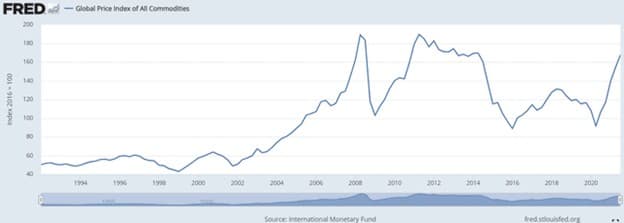
  • Two of the things that precipitated the financial crisis of 2008 were a leveraged asset bubble in housing and a maturing commodities super-cycle

There is a case that can be made that the present day liquidity profile and reduced capital investment in upstream sources for new supplies of petroleum, match the similar scenario of the 2008-9 financial crisis. In recent times, and partially as a result of the global pandemic, huge infusions of cash have been pumped into the market to achieve a number of objectives. Commodities began an extreme pricing upswing last year as a result of this cash infusion and pent-up demand from the shut-down phase of the pandemic. As a result, not only are there strong parallels to 2008, but current conditions are even more exaggerated as we approach 2022, thanks to continued governmental and financial intervention in the markets. In this article, we will examine some of the key causes of the 2008 financial meltdown, and compare them against relevant data in the present day. We will then tie that to current data on petroleum supplies and production to make our final case about the likelihood of a severe global financial crisis.

Lack of capital investment in upstream petroleum supplies

If you follow the news you will become quickly and acutely aware that things are different on the global energy front. Strikingly different from just a year ago. One of the things that drives the conversation is the speed at which the market has flipped from assuming that oil would be plentiful and low priced well into the future to just the inverse. There was even a catch-phrase to describe this scenario, used as recently as March of 2020-Lower For Longer.

So what happened? As you can see below spending on fossil fuels has declined precipitously from 2014, reaching a bottom only last year. Estimates vary from between $600 bn to $1.0 Trillion of capital has been lost to oil and gas extraction since 2014.

WSJ- Chart by author

Two primary reasons have been the cause of most of this capital restraint. The first is prices well below an acceptable rate of return for oil companies for much of this period. Lower for Longer carried an enormous financial impact onto the balance sheets of oil producers, and they did what oil companies do when oil prices drop. They stopped spending...on oil and gas. Even now, with prices that are much higher, domestic oil companies are choosing to pay down debt, buy back their stock, and raise dividends as opposed to increasing their capital budgets. This was discussed in detail in an OilPrice article in September.

The second principle chilling effect on global fossil fuel investment has been the action of governments and activist shareholders to foster so-called "green energy" alternatives through edicts, tax subsidies, and regulatory barriers. Following the Paris Accords, signatories have moved swiftly to reward investment in these alternative energy sources, primarily-wind, solar, and biomass. This, despite the fact that many of these alternative technologies are still evolving, and lack supporting infrastructure. We have in effect, "jumped" into the pool and then checked for water. We explored the actions by European governments in this OilPrice article.

International companies like, Shell, (NYSE:RDS.A), (NYSE:RDS.B) and BP, (NYSE:BP) are doing some of the same things, but also are diverting capital to renewable energy projects in an effort to reduce the carbon footprint of their operations. In a moment of candor and clarity, in response to an activist investor pushing the company to spin off its legacy assets, Shell CEO, Ben van Beurden said-

The needs of Shell’s customers, and the company’s efforts to pivot away from fossil fuels, were better served by keeping its range of assets and businesses. In particular, he said the company’s legacy oil-and-gas assets were needed to fund its investments in lower-carbon energy.

WSJ

These companies are also scaling down their carbon-based operations, monetizing assets up and downstream. Shell in particular has led the way with their sale of their Permian assets to ConocoPhillips, (NYSE:COP). BP is considering further steps, but has not made any big moves in this regard recently. These actions will result in their portfolios becoming less carbon intensive as the alternative energies they are investing in now, come online mid-decade. Will they be as profitable? Doubts have emerged, but this is a question for a future article.

One need not worry about the financial viability of these green energy projects, over the short run at least, as there are ample government stipends in place to pay all or part of their costs. Domestically, and across the pond, governments have paved the road for a green energy transition. The market has already decided about this capital shifting as relates to these companies, bidding up their share prices by about half since the first of the year.

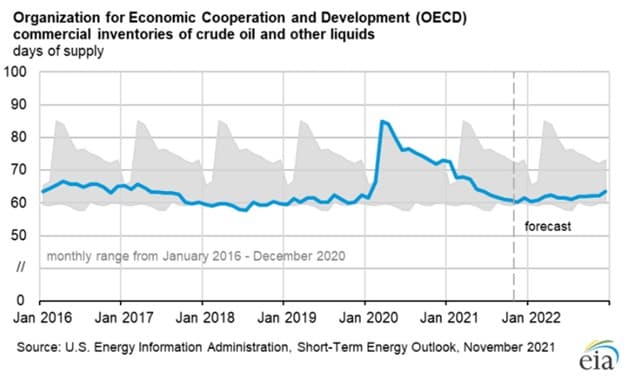
The problem for world energy consumption is that oil remains a fundamental driver of energy security globally and demand is running ahead forecasts with demand above 100 mm BOPD. Prices have gone higher. Much higher, and that could be problematic for the stability of the financial system if the thesis we are constructing comes into play.

EIA

We see oil demand rebounding strongly as we come out of the global recession precipitated by the pandemic. Global growth-we add 120 mm people to the planet yearly, and pent up demand are the drivers here. It comes at the worst possible time for storage volumes, both domestically and internationally. In the U.S. we are near the bottom of 5-year averages for this time of year. 425 mm bbl may sound like a lot, but at 21.5 mm BOPD of consumption, it's less than a 20-day supply.

To no great surprise, European petroleum stocks are down at similarly low levels.

EIA

The great global liquidity influx and a commodity boom

Liquidity or lack thereof is stuff of which financial crises are made. If you hark back to 2008-the last financial crisis that wasn't related to the now winding down pandemic, an increasingly seized up financial system brought global markets to their knees as it metastasized. Liquidity in the form of massive government intervention righted the ship and by early 2009 green shoots were appearing in the market.

Two of the things that precipitated the financial crisis of 2008 were a leveraged asset bubble in housing and a maturing commodities super-cycle. Growth in commodities brought on by the Chinese economic boom led to oil topping out at nearly $150 per bbl in 2008. This boom continued to mid-2014, with oil regaining $110 bbl before succumbing to OPEC's desire to retake market share from U.S. shale producers, and lower growth in the Chinese market. Oil became plentiful as OPEC opened the taps, and prices stayed low for the next 6-years.That is one key difference from 2008 that will tend to extend and exacerbate a downturn if it occurs. Oil is not plentiful and prices are spiking.

FRED

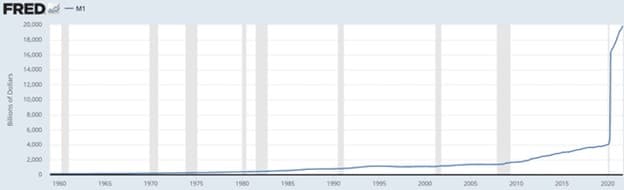
We are now seeing an asset pricing bubble on a scale never before seen. In the span of a year and a half, the money supply has increased from $4.5 trillion to nearly $20 trillion, and there is more coming. The recently passed Infrastructure Plan will bring another couple of trillion of direct and ancillary spending. The Build Back Better plan waiting in the wings for a reconciliation passage will add another $2.0 to $3.5 trillion to the Fed's balance sheet.

FRED

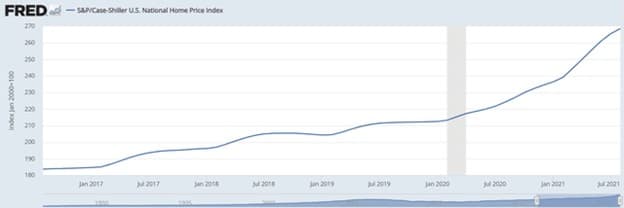
In the past 5-years the median U.S. home price has climbed 68% with much of that coming since the first of the year. Anyone who doesn't recognize the effervescence, or bubbliness in that number may have napped during Econ 101. You can argue that the world has changed since Covid rode the jet stream west, but there is no argument that house prices have not out-stripped wages of this time period.

Once again, FRED is helpful here as it reveals the median household cannot afford an entry level home at $270K. A buyer at the median level with a $25K down payment will only qualify for a $231K house.

FRED

In summary, the present situation has close parallels to the financial crisis of 2008. We think that the current situation may have consequences that are more extreme, as the amount of liquidity pumped into the system is vastly higher. Further, the stockpiles of energy are much lower than in the 2008 time frame, thanks in some measure to the diversion of capital toward renewables, the restraint of capital due to low prices, government intervention, and a rebounding element of demand.

Climate policy will directly impact economic growth

We are already beginning to see the second-order effects of the climate policies being adopted in the wake of the Paris Accords and its offspring the COP-26 love fest in Glasgow this year. I am referring, of course to the energy crisis in the UK, brought on by unanticipated underperformance of wind farms, and under-investment and early retirement of petroleum energy sources, over the last few years. This has all been pretty well documented, and I am not going to belabor them further now.

One of the things that astounds me about the green energy movement is the number of unasked, or unanswered questions related to its full spectrum adoption. Assumptions have been blithely put forward as fact with no supporting evidence. In fact, if you do ask questions you are labeled a "climate denier," and ignored or canceled.

So what is one assumption that seems to have not been entirely thought through? Let's start with the plan for wind power to provide up to 40% primary electricity generation by 2030, now codified virtually around the world in tax and carbon policy. I ran across a calculation by William Lacey on another site that was quite revelatory. I am paraphrasing his work on that site here in the next couple of paragraphs.

Can this really be done? A study promulgated by Arcelor Mittal, the world's leading steel producer is revealing.

“Steel will play an important role in all renewables, including and especially solar and wind. Each new MW of solar power requires between 35 to 45 tons of steel, and each new MW of wind power requires 120 to 180 tons of steel.”

Source

According to the OECD the global capacity to make steel rests at about 2.5 mm metric tons. If we are going to replace the electricity supplied by fossil fuels, about 131 billion MWH, we would need to generate another 6 bn tons of steel. Or about 2.5X the annual present capacity of the global industry. Are we really going to divert 100% of the steelmaking capacity of the planet to building wind farms for 2.5 years? What about copper? What about other metals used in EV battery production. These are profound questions that just don't get asked.

After Lacey

In summary, I think the unasked questions will begin to be asked at some point. Will it be when some entity wants to build a car plant, and is told, "Sorry we don't have the power generating capacity." It is going to happen. It is "baked" into this cake from the under-investment in fossil fuels.

Your takeaway

I said at the beginning there is a reasonable case that a financial crisis could result from the lack of upstream investment we have discussed so far, and the continuing bashing of the industry that is vital to maintaining our standards of living. As I've noted and world events are beginning to reveal, the hour is very late in terms of being able to respond to a prolonged price spike, or physical shortage of oil. A renewed will accompanied by some acknowledgement of just how vital oil and gas are to our energy security might shorten the effects that could possibly emerge from a financial crisis. But, that is not the trend presently.

Even today, when the ink is barely dry on the Infrastructure bill, our political leaders are sending mixed messages as fuel prices spike. In an even more ironic dichotomy of thought, Middle-East producers are being asked to pump more to ease global energy prices. A request...plea, that they not so politely rejected in their recent meeting. At the same time, U.S. domestic producers are being hamstrung with enhanced regulationsreduced permitting, threats of a carbon tax on fuels, and being starved of capital by key nominees. You can't make this stuff up.

Even the hedge fund Green Energy zeitgeist, Larry Fink of Blackrock is back-peddling a bit on his dire pronouncements, and now acknowledges that-shock-horror, we are totally dependent on oil and gas. As an oily, it’s kind of fun to see Larry squirm a bit.

In summary, I am not predicting a financial crisis. I am saying there are strong parallels today to a recent past crisis, and that if one occurs tightness of the energy supply from lack of upstream investment could play a role in its depth and duration. 

By David Messler for Oilprice.com