Showing posts sorted by relevance for query AARON COPLAND. Sort by date Show all posts

Sunday, November 06, 2022

Aaron Copland: Left Populist Composer

Aaron Copland (Photo Credit:  Erich Auerbach/Getty Images 1965)

In the mid-20th century (say, 1930-1970), orchestral music played a much more prominent role in national culture–both in the U.S. and the U.S.S.R.–than it does today.  In part, the advent of radio in the 1920s could bring live concerts to a mass audience.  Radio networks attracted top-notch musicians and conductors; the NBC Symphony Orchestra, led at different times by super-stars such as Toscanini and Stokowski, had millions of listeners weekly–listeners who would become familiar with Copland as well as Sibelius, Shostakovich and Tchaikovsky.

With the Great Depression (ca. 1929-1942), the majority of Americans, disgusted with the stock speculations of super-rich investors which had led to massive unemployment and poverty, was to some extent radicalized–and that was reflected in many of FDR’s New Deal programs.  The working person, whether farmer or factory worker, was appreciated with a renewed respect: honest labor, not stock-manipulation.  John Steinbeck’s The Grapes of Wrath (1939), about the desperate plight of a family of displaced tenant-farmers who end up half-starving as fruit-pickers in California, became an instant classic (and remains so today).

These economic hardships, brought on by the panic-stricken collapse of inflated share-values, affected almost everyone–and many turned, for the first time, to promoting labor rights or even socialist politics.  The famous General Motors sit-down strikes (1936-1937), which paralyzed operations at several plants for over 40 days, made the United Auto Workers (UAW) a force to be reckoned with.

In the Thirties, painters like Norman Rockwell and Thomas Hart Benton celebrated the pride of honest working people who were joining in the common cause of economic democracy.  In 1944, President Roosevelt accordingly called for just such an “economic bill of rights,” which would supplement the guarantee of liberties of the original Bill of Rights (appended to the Constitution at the insistence of Thomas Jefferson).

How did all these events affect musical composition?  In the Twenties, strongly influenced by Paris-based modernists such as Stravinsky, young Americans who had studied there wrote in a daring, somewhat dissident style (epater le bourgeois!).  Aside from George Gershwin, who had written a jazz-inflected piano concerto as well as a lyrical, humanistic opera about a slave couple (Porgy and Bess), the young Aaron Copland (1900-1990) wrote avant-garde, jarring and startling pieces such as his Symphonic Ode and Organ Symphony.

All this was to change after The Crash.  A beleaguered, out-of-work working-class forged a strong, genuine sense of class solidarity (and pride).  Unions were once again doing battle, and winning (although unemployment remained in high double-digits through the Thirties).  Copland, a socialist like so many artists and writers of that time, attained meteoric fame when he created his own, unique, folk-populist style in contemporary orchestral music.

In the Thirties, emulating Stravinsky’s early career, he mostly wrote ballet scores–in his case, for famed choreographers such as Agnes deMille and Martha Graham.  Using ingenious orchestration and folk-like dance rhythms, Copland achieved what some still regard as masterpieces: Rodeo (the cowboy’s sense of freedom on the open plains), Billy the Kid (the colorful exploits of the misunderstood, free-spirited “outlaw”) and, above all, Appalachian Spring (the joys of newlyweds beginning a new life on a rustic Pennsylvania homestead).  Unmistakably American-populist, these lively pieces proved exceedingly popular: brilliant yet spare orchestration, pastoral serenity and rollicking exuberance, these works sound as fresh and optimistic today as when they were written.  The populism was of the left, because, like some Soviet works of the same period, these works celebrated those who, figuratively speaking, made a livelihood, in rural-pastoral simplicity without being capitalists.

With Pearl Harbor (December 1941), and an American commitment to defeating the fascist Axis powers, Copland remained the leading contemporary American composer, and wrote his deceptively simple yet rousingly affirming Fanfare for the Common Man (1942).  While other composers were commissioned to write fanfares, none achieved anything like the popularity of Copland’s piece.  In the immediate post-war period, he even incorporated it–much as Beethoven incorporated the “Ode to Joy” in the finale of his universal-humanistic Symphony no. 9–into the finale of his Third Symphony (1946).  The symphony’s wonderful passages of pensive lyricism, countered by an unstoppable, almost delirious exuberance and optimism, no doubt reflected the popular sentiment of post-war triumphalism and renewed hope.  The Symphony retains its freshness of brilliant moods and textures, but in hindsight seems to me somewhat untimely given the shadows of Hiroshima and Nagasaki.  (One might add that, back then, ethnocentric Americans readily accepted the dehumanizing stereotypes of what the late Edward Said called “Orientalism”).

In the years that followed, Copland continued to reconcile his American populism with a left-socialist orientation.  For the second anniversary of the founding of the United Nations, he wrote a somber, almost hymn-like, orchestral piece called Preamble to a Solemn Occasion, which served as powerful musical accompaniment to an international reaffirmation of the UN Charter and the Universal Declaration of Human Rights.  (It is well worth reading about the sad fate of U.S. diplomat Alger Hiss, a key figure in the founding of the UN, who was framed as a Soviet spy and sent to prison.)

During that post-war period of anti-Communist hysteria, Copland, like so many artists and writers who had joined socialist organizations, actively supported the 1948 presidential candidacy of ultra-leftist Henry Wallace on an alternative Progressive Party ticket.  Meanwhile, he wrote one of his finest orchestral pieces, A Lincoln Portrait, which daringly included eloquent passages from some of Lincoln’s most moving, almost-radical speeches extolling a kind of democratic socialism.  This piece, wonderfully lyrical and inspirational, has been recorded and narrated by countless speakers, ranging from Maya Angelou to Gore Vidal.

Conservatives insisted that the piece, originally scheduled to be performed at Eisenhower’s presidential inauguration in 1953, be dropped from the program.  Copland was blacklisted, and shortly thereafter ordered to appear before Sen. Joe McCarthy’s red-baiting internal security subcommittee.  Without naming names, Copland managed to survive the brief ordeal with great aplomb.  Later, Copland recalled that a Foreign Service official recounted to him that when the piece was performed in Venezuela, ending with Lincoln’s words that “government of the people, by the people, and for the people, shall not perish from the earth,” the massive audience went wild with enthusiasm, started public demonstrations against the repressive dictator Jimenez, and successfully deposed him soon thereafter.

The left-populist compositions of Aaron Copland in no way compromised his high artistic standards of originality, melodic inventiveness, and ingenious orchestration.  The works I have mentioned have by now been recorded dozens of times by dozens of orchestras, even up to the present.  Although his optimistic worldview–of freedom and dignity, economic fairness and equal rights, and the triumphant exultation of the defiant human spirit–may seem sadly anachronistic, the overflowing freshness and vitality of his music even now offers a powerfully felt experience of humanity vigorously experiencing the joy of being free and alive

Intellectual historian and psychoanalytic anthropologist, William Manson (Ph.D., Columbia) has published numerous scholarly books and papers, and is a longtime contributor to Dissident Voice. Read other articles by William.

Aaron Copland - Fanfare For The Common Man 
 From the New York Philharmonic's "Young People's Concerts" television series. Ep. 2 "What is American Music?" Original broadcast February 1st, 1958 

Aaron Copland conducting Leonard Bernstein, then the conductor of the NY Philharmonic, gives a small presentation about what he feels defines American music before introducing Mr. Copland.


ELP's adaptation of Aaron Copland's composition was released as a three minute single reaching No. 2 in the UK singles chart. This is the full recording.http://apple.co/29r79ab


Sunday, February 23, 2025

Kennedy Center reeling from 'stunning' ticket sales collapse after Trump takeover: report

WILL HE MAKE IT INTO A RODEO

Tom Boggioni
February 22, 2025 
RAW STORY

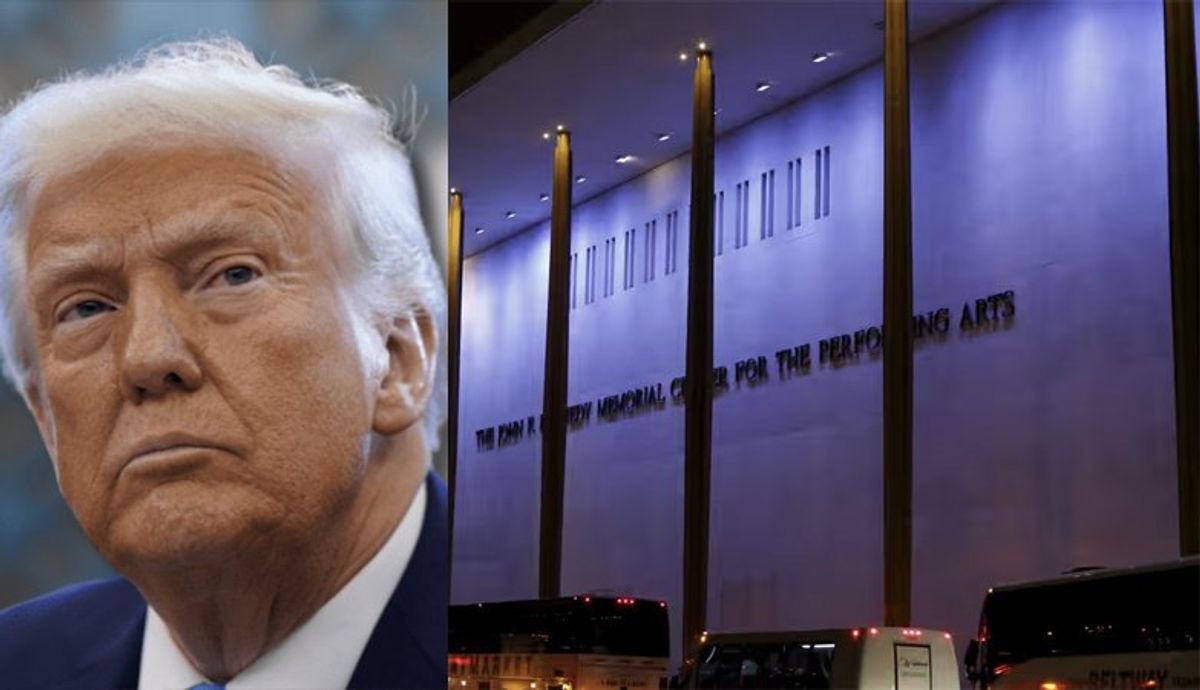
Donald Trump, Kennedy Center for the Performing Arts
 (Photos by Yuri Gripas, Elizabeth Frantz for Reuters)

A decision by Donald Trump to fire everyone and wrest control of the John F. Kennedy Center for the Performing Arts on the banks of the Potomac has led to an alarming downward spiral in ticket sales and artists canceling performances in protest.

After returning to the Oval Office, the president ousted the art institution’s leadership and packed the the board of trustees with loyalists before designating his proxy, Richard Grenell, to run the operation.

With the change, White House press secretary Karoline Leavitt boasted, "The Kennedy Center learned the hard way that if you go woke, you will go broke. President Trump and the members of his newly-appointed board are devoted to rebuilding the Kennedy Center into a thriving and highly respected institution where all Americans, and visitors from around the world, can enjoy the arts with respect to America’s great history and traditions.”

As the Washington Post reported on Saturday, the "go broke" part now appears to be a problem as longtime attendees spend their entertainment dollars elsewhere.

According to the Post's Travis Anderson, "In the week following Trump’s announcement, ticket sales dropped by roughly 50 percent compared to the previous week, a stunning aberration, according to several Kennedy Center staff members who spoke on the condition of anonymity out of fear of reprisal."

That drop in tickets sold has scheduled artists weighing whether to pull out of appearances.

Case in point, Canadian mystery writer Louise Penny pulled the plug on her scheduled appearance, writing on Facebook, "In DC, but in the wake of Trump taking over, I have pulled out. It was, of course, going to be a career highlight. But there are things far more important than that.”

You can read more here.


IRONY 
THE GREATEST MODERN AMERICAN COMPOSER OF THE 2OTH CENTURYAARON COPLAND WAS A COMMUNIST

Sunday, December 17, 2023

Leonard Bernstein And I Loved The Same Man. Here's What Bradley Cooper's 'Maestro' Doesn't Show.

Peter Napolitano
Sat, December 16, 2023 

Leonard Bernstein makes notations to a musical score in 1955.

Leonard Bernstein makes notations to a musical score in 1955.

On a Sunday in November 1986, I was getting ready to visit Tommy, my dear friend and sometimes lover. He was in the final stages of AIDS-related lymphoma and about to leave New York City for good, and he wanted to see me one last time.

The phone rang. It was him.

“Hey, Peter,” he said. “Listen, I just found out that someone else is coming over today around the same time. I hope that’s OK.”

“Well, I could come later if you ...”

“No! I want you to be here, especially after he leaves. Peter ... it’s Lenny!”

Lenny was Leonard Bernstein, the legendary conductor and composer of “West Side Story.” Tommy was Thomas Cothran, his former lover, close friend and collaborator, who was entrusted to supervise and edit the composition and initial performances of “Mass,” Bernstein’s oratorio.

Since I became aware of “Maestro,” the Bernstein biopic directed by and starring Bradley Cooper, which is currently in theaters before it premieres Wednesday on Netflix, I’ve thought about Lenny and Tommy — and the day Bernstein and I both said goodbye to him — more than I have in almost 40 years. Now that I’ve seen the movie, I think of little else.

From its promotion and reviews (mostly raves), I knew “Maestro”primarily focused on the decadeslong relationship between Bernstein and Felicia Montealegre, his wife and the mother of his three children, and that Tommy would be portrayed by Gideon Glick. Since the story is primarily told chronologically, beginning in the 1940s, and Tommy didn’t meet Lenny until the ’70s, the movie is more than half over when he’s introduced to Lenny at a party in the Bernstein home.

From left: Gideon Glick, who plays Tommy Cothran in

From left: Gideon Glick, who plays Tommy Cothran in "Maestro"; Carey Mulligan, who plays Felicia Montealegre; and Bradley Cooper, who plays Bernstein, pose in New York on Nov. 27.

Within a minute or two after this first meeting, Felicia, portrayed by Carey Mulligan, is shown discovering the two men kissing in a hallway. I know this didn’t happen. According to Tommy (and verified by Humphrey Burton in his 1994 biography of Bernstein), they first met at a party in a mutual friend’s home in San Francisco, where Tommy was the musical director of a local classical radio station. Lenny was in California without Felicia, working on a revival of “Candide.” Tommy and Lenny became lovers during that visit and remained so for the next seven years. However, in the film, the role Tommy played in the Bernstein marriage is seen entirely from Felicia’s point of view, and much of what transpired is left out. Here’s what else is missing, as I remember Tommy telling me.

During the creation of ”Mass,” which premiered in 1971, and for five years afterward, Tommy was a most welcome, constant presence in the daily lives of the entire Bernstein family, and he got along well with everyone, including Felicia. He and Lenny worked on many projects together, keeping their sexual relations secret. Eventually, Felicia did discover them being “intimate.” Tommy never told me exactly what happened, but he did say that after Felicia learned about their relationship, she gave Lenny an ultimatum: He had to choose between her and Tommy. Lenny chose Tommy. In 1976, the Bernsteins separated.

Although the details were kept secret from the press and general public, Lenny and Tommy lived and traveled together openly, creating a scandal in the classical music and theater communities of the time. None of this is in the film. When Felicia was diagnosed with cancer in 1977, Lenny left Tommy, reconciled with his wife, and cared for her until her death. Lenny and Tommy did not become lovers again, but remained close friends and confidants. By 1986, Tommy was diagnosed with AIDS. Lenny was now losing Tommy, too. And so was I.

As I made my way down to Greenwich Village that cold November afternoon to say goodbye, I thought about the warm day in May a year and a half earlier when I first met Tommy.

I had recently been diagnosed with HIV, which at the time was a death sentence. Tommy was sitting on a bench on the pier off Christopher Street, gazing at the Hudson River. He was very thin, as was his sandy brown hair, and his Irish good looks were marred by the beginnings of facial wasting — even then a telltale sign of HIV. The sight of him saddened and frightened me.

Suddenly, with a big smile on his face, he started to wave. Did I know him? No, he was waving past me at a small boat going by with a bunch of nearly naked young men crowded aboard. I laughed. He looked at me and called me over.

Bernstein and Montealegre, his wife, are pictured in 1959.

Bernstein and Montealegre, his wife, are pictured in 1959.

We talked while sharing the joint he was smoking. Despite his apparent illness, there was a vitality — a smart sparkle to everything he said and did — that captivated me. He seemed to like me too, and as the afternoon waned into evening, he invited me to his home, a studio walk-up apartment at 94 Christopher St., between David’s Pot Belly, a popular hamburger joint, and the even more popular Häagen-Dazs ice cream shop. His place was all bricks and books, and had a big brass bed. There was a kitchen with a bathtub and a small bathroom next to it.

We smoked another joint. We had sex, but aside from that, what I remember the most from that day and those first months together was the joy of finding someone who knew what I was going through — who was living it too — but refused to dwell on it or even talk about it. Instead, we discussed books and plays and music and tennis. (He was obsessed with Martina Navratilova.)

So positive was Tommy’s attitude that one day he proudly told me that he had joined the gym around the corner. Although it was primarily patronized by massive bodybuilders, Tommy wasn’t fazed. His gaunt face glowed as he told me how fascinating it was to work out with them. (“Everything about them is so round.”)


When I arrived at Tommy’s that Sunday, my amusing memories yielded to the task at hand. I found myself becoming jealous and annoyed with Bernstein. I did not want to share this last visit with anyone, least of all a living legend who had played a far more important role in Tommy’s life than I did!

Tommy was propped up in bed, a fur cap on his bare head and a fur blanket enveloping his emaciated body. Greeting me with a big grin, he reminded me of a Russian soldier in a marionette version of “The Nutcracker” I once saw as a child. He introduced me to his home care attendant, who made me a cup of tea and then spent most of the time I was there reading in the bathroom.

Tommy looked tired, but that old sparkle was there. He told me how generous Bernstein had been during his long illness, paying the rent for his apartment and his medical expenses. A few weeks before, Tommy had asked him for a final favor: He wanted to be taken to Tibet to die. I was stunned, but I understood why. Tommy had traveled the world with Lenny, and Tibet was the place that made the greatest impression on him. He wanted to go back there with the love of his life to transition in peace. Lenny had promised him that he would try his best to grant his wish, and today Tommy would find out if it was going to happen.

Bernstein is shown in a recording studio in New York in 1974.

Bernstein is shown in a recording studio in New York in 1974.

When Lenny arrived, he wasn’t alone. His musical assistant at the time was with him. At first, I thought this was insensitive — bringing a young man along who was doing the same job your dying lover once had. Then I realized that, like Tommy, perhaps Lenny, too, needed a close friend to give him support on this sad occasion.

Lenny, who was wearing his trademark black cape and carrying his walking stick, seemed much older than when I had briefly met him the first time, after a concert that Tommy and I attended the year before. He shook my hand and then went to the bed and gently kissed Tommy on the forehead. He sat on the opposite side of the bed from me so that Tommy was close to both of us. Lenny’s assistant remained discreetly in the background.

The three of us chatted a bit, but I don’t remember much of the conversation. All I recall is the way Tommy and Lenny looked at each other and touched each other with love and sadness, but also with humor and rueful acceptance. Watching them, I was ashamed of my resentment toward sharing this moment with Lenny. I realized that I was the intruder and was relieved when they asked me and Lenny’s assistant to go downstairs for a while. On our way out, I heard a deep sob. I’m not sure whose it was.

When we returned, Lenny was in the bathroom. I didn’t need Tommy to tell me what the answer was about Tibet. He shrugged and held up his hands in a “what can you do?” gesture. I took his hand. The toilet flushed. I released Tommy’s hand, but he put it back.

As Lenny entered the room, I could see that he had been crying. He wiped his face with a handkerchief. He saw me and looked surprised, as if he had forgotten I was there. Then he held out his hand and took mine.

“Goodbye. Thanks for looking after him.”

He put on his cape, picked up his stick, then went to the other side of the bed, took Tommy’s free hand, held it, kissed him again on the lips, whispered something to him, and, with his assistant by his side, departed.

Bernstein appears at a press conference in Paris in June of 1986, the same year that the author spoke with him in Tommy's apartment.

Bernstein appears at a press conference in Paris in June of 1986, the same year that the author spoke with him in Tommy's apartment.

I stayed with Tommy for a while longer, but he was totally exhausted, both emotionally and physically. I kissed him, told him I loved him, said goodbye and left.

Tommy died four months later. To my knowledge, Lenny never saw him again. Neither did I.

I learned more about the real Leonard Bernstein in one afternoon in that grubby Christopher Street walk-up than from all the books I’ve read and all of the stories I’ve heard — even the ones Tommy told me — and certainly more than I learned from seeing “Maestro.” There was none of the flamboyance, artistic temperament and self-absorbed ego so associated with him. All I saw that afternoon was kindness, tenderness, heartbreaking sadness and the undeniable evidence of a deep, complex and lasting love.

Anyone could see that Tommy and Lenny’s relationship was not a casual one defined solely by sexual attraction and activity — or inherently inferior to the commitment and permanence of a straight relationship. Yet, that’s exactly how LGBTQ couples were commonly perceived before Stonewall, AIDS and marriage equality. They still are, as evidenced by today’s growing anti-LGBTQ movement, which reduces all gay relationships to strictly sexual ones. Unfortunately, I fear that “Maestro” may unintentionally contribute to that stereotype.

Although the film is beautifully crafted with outstanding performances and appears to be a front-runner in the upcoming awards season, I find it a bit baffling that the screenplay gives such short shrift to all of Bernstein’s relationships with the men in his life, including Tommy and others he was romantically linked to, like David Oppenheim and Aaron Copland. None of these men has a scene alone with Bernstein in the film. They seem almost interchangeable, and the superficiality of their depictions robs the movie of the complexity and contemporary relevance that a more evenly focused treatment could have provided.

I’m sure the love story of Lenny and Felicia was a true and beautiful one — and obviously well worth telling — but so was the one between Lenny and Tommy. To show and tell only one while reducing the other to brief hints and flashes is exactly what the closeted world of the ’40s, ’50s and ’60s was like for so many gay and bisexual men. In today’s world, these can and should be told together. Each one enriches the other. I think Lenny, Tommy and, yes, even Felicia would have wanted it that way.

Writer/lyricist/director Peter Napolitano’s work has been published/produced by The New York Times (“Modern Love”), Dell Publishing, The York Theatre, The Glines, Theater for the New City, and Urban Stages. He is currently a recipient of a Guaranteed Income for Artists grant from Creatives Rebuild New York.

Saturday, December 26, 2020

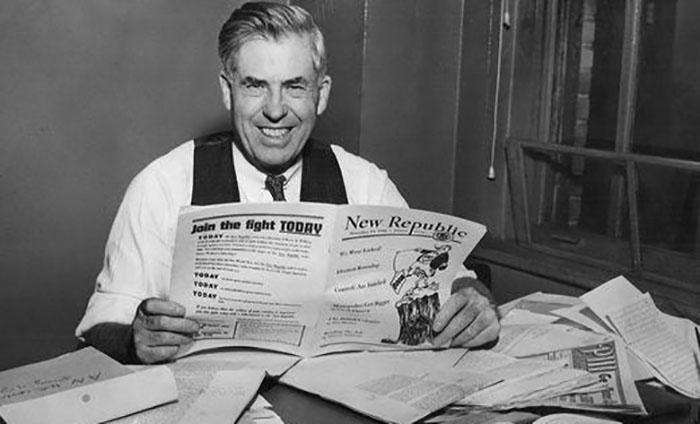
What did Henry Wallace stand for?

Henry Wallace was attacked and then dismissed because he proposed “a century of the common man and woman.” Almost eighty years of that century have passed since his dismissal, and his fight for the future is largely forgotten.


An excerpt from The Fight for the Soul of the Democratic Party: The Enduring Legacy of Henry Wallace's Anti-Fascist, Anti-Racist Politics by John Nichols,


In the summer of 1948, when his own fight against American fascism had been lost but he still refused to surrender the radical hope of a future framed by justice and peace, Henry Wallace would ask Pete Seeger to sing a favorite song. The words and music had been submitted by a young college instructor named Dick Blakeslee to the “People’s Songs” project that Seeger, Alan Lomax, Lee Hays and a handful of others launched after World War II to champion a revival of old folk music and new songs of work, struggle and idealism. Blakeslee’s lyrics sampled from Bible verses and ranged across American history. Yet his song closed in the moment, or, rather, in the moment that Wallace had hoped to create:


I was with Franklin Roosevelt’s side on the night before he died. He said, “One world must come out of World War Two, Yankee, Russian, white or tan,” he said, “a man is still a man. We’re all on one road, and we’re only passing through.”

As they traveled the backroads of North Carolina and the other segregated states where Wallace challenged racial hatred, Seeger would sing the words “a man is still a man.” Hundreds of miles to the north, a Jewish teenager from Montreal learned those words from a socialist summer-camp counselor. They inspired an interest in folk music that proved to be transforma- tive for Leonard Cohen. Years later, Cohen would add a slight variation to “Passing Through” as he sang the song from the concert stages of Europe and the Americas. After the line “One world must come out of World War Two” he would whisper “… ah, the fool.” Those who know something of Cohen’s wry romanticism, and the political penchants of the man who chal- lenged his adopted United States (“the cradle of the best and of the worst”) with the slyest protest song of his time (“Democracy Is Coming to the USA”), will recognize that this was no insult. Rather, it was an invitation to reconsider casual notions of wisdom and folly.

Wallace and Seeger barnstormed across the segregated South for a doomed third-party campaign for the presidency, that of a New Party, which came to be known as Progressive. They were demanding that the United States make real the promise of World War II as a liberation struggle meant to defeat fascism abroad and at home. They knew they were being portrayed as nostalgic New Dealers who refused to give up on the hope that died with Franklin Roosevelt; as dupes of the Soviet Union in a nascent Cold War; as naïve idealists. Yet they persevered, in the face of the physical violence of the Jim Crow South and the ideological violence of a dawning Red Scare. This was not just their own political project; it was the mission that FDR had outlined in the last months of his life.

“We cannot be content,” explained Roosevelt in the waning days of World War II, “no matter how high [the] general stand- ard of living may be, if some fraction of our people—whether it be one-third or one-fifth or one-tenth—is ill-fed, ill-clothed, ill-housed, and insecure.” Recognizing that “true individual freedom cannot exist without economic security and independ- ence,” the president warned, “necessitous men are not free men. People who are hungry and out of a job are the stuff of which dictatorships are made.” And he proposed to address the threat of future fascisms with “a second Bill of Rights under which a new basis of security and prosperity can be established for all— regardless of station, race, or creed.”

The Democratic Party that in 1940 nominated Roosevelt and Wallace would, as the decade wore on, abandon FDR’s certainty that “an economic declaration of rights, an economic constitutional order” was “the minimum requirement of a more permanently safe order of things.” But despite that surrender, Wallace refused to abandon the New Deal and the promise of Wendell Willkie’s manifesto One World and FDR’s Four Freedoms and Second Bill of Rights. He could not accept that an unjust order built upon the crumbling foundations of racism, monopoly and militarism would need to be maintained for decades, and then generations, because his own Democratic Party had lost its nerve—and its faith.

Wallace, a brilliant writer and thinker and an accomplished editor, cabinet member, vice president, presidential candidate and businessman, never suggested it would be easy to end segregation and sexism, address poverty and inequality, upend the military-industrial complex and avert nuclear war. Rather, with the support of Albert Einstein, W.E.B. Du Bois, a young Betty Friedan and a younger Noam Chomsky, he argued that this program was an urgent necessity that could not be cashiered as political concession or electoral compromise. His supporters circulated posters with the picture of an African-American youth and the message: “A black child born on the same day in the same city as a white child is destined to die 10 years earlier. … We are fighting for those 10 extra years.”

Wallace embraced a “new liberalism,” asserting: “A liberal is a person who in all his actions is continuously asking, ‘What is best for all the people—not merely what is best for me personally?’ Abraham Lincoln was a liberal when he said he was both for the man and the dollar, but in case of conflict he was for the man before the dollar. Christ was the greatest liberal of all when he put life before things.” He identified as a patriotic American who believed “in using in a nonviolent, tolerant and democratic way the forces of education, publicity, politics, economics, business, law and religion to direct the ever-changing and increasing power of science into channels which will bring peace and the maximum of well-being both spiritual and eco- nomic to the greatest number of human beings.”

These were not uncommon notions at a time when political leaders, having survived the Great Depression and thwarted Adolf Hitler, imagined a new world order of peace and prosperity, freedom and equality. Clement Attlee, Aneurin Bevan, Jennie Lee, a young Michael Foot, a younger Tony Benn and the British Labour Party preached another version of this social gospel as they set out to win the peace in 1945 with a “Let Us Face the Future!” campaign on behalf of a national health care system, the nationalization of basic industries and a redistribution of wealth from Downton Abbey elites to the toiling masses. Tage Fritjof Erlander, Einar Henry Gerhardsen and the Scandinavian social democrats echoed that message as they forged the model of the modern social welfare state. Jawaharlal Nehru, Bhimrao Ramji Ambedkar and Rajkumari Amrit Kaur joined their voices to the chorus as they saw off British colonialism and announced that “at the stroke of the midnight hour, when the world sleeps, India will awake to life and freedom.”

In America, however, Wallace was deemed dangerous by the Southern power brokers, the patronage bosses, the corporatists and the monopolists who were quite happy to bury the New Deal with FDR. The men who schemed to divert the postwar march of democracy disdained Henry Wallace. And he disdained them. Their corruptions, their calculations, he warned, were the stuff of “American Fascism.”

From the mid-1940s onward, Wallace was prepared to name the enemies of human progress. He shared Paul Robeson’s view that the danger for the United States in the postwar era lies “in the resurgent imperialist and profascist forces in our own country.” As the vice president of the United States, he did not hesitate to make the appropriate, yet too rarely spoken, connection between Hitler’s preachments about racial “purity” and the language of Southern segregationists who also spoke of a “master race.”

For Wallace, a breaking point came in the summer of 1943, after racial violence flared in Detroit, leaving thirty-four dead (including seventeen African Americans at the hands of the police). Wallace traveled to the city and addressed a mass meeting of labor and civic organizations. “We cannot fight to crush Nazi brutality abroad and condone race riots at home,” he told the crowd. “Those who fan the fires of racial clashes for the purpose of making political capital here at home are taking the first step toward Nazism.” Wallace warned: “There are powerful groups who hope to take advantage of the President’s concentration on the war effort to destroy everything he has accomplished on the domestic front over the last 10 years. Some people call these powerful groups ‘isolationists,’ others call them ‘reactionaries’ and still others, seeing them following in European footsteps, call them ‘American Fascists.'"

Those were jarring words from the vice president of the United States, but Henry Wallace chose them carefully. Starting when he was Roosevelt’s secretary of agriculture, Wallace studied foreign languages so that he could speak directly with the leaders and planners of the fight against Hitler and his Axis. He traveled widely and consulted often with those who had resisted the rise of fascism in Europe and who were resisting its pull in Latin America and Asia. He made a study of the threat, and he intended to speak about it in an American context. He proposed a broad definition of this charged term that could apply to the racists, warmongers and monopolists who manipulated media and politics to maintain their grip on America.

Speaking to that 1943 mass meeting in one of the nation’s great industrial centers, Wallace warned that “the people of America know that the second step toward fascism is the destruction of labor unions. There are midget Hitlers here who continually attack labor. There are other demagogues blind to the errors of every other group who shout, ‘We love labor, but…’ Both the midget Hitlers and the demagogues are enemies of America. Both would destroy labor unions if they could. Labor should be fully aware of its friends and of its enemies.”

Wallace ripped into industrialists. “We know that imperi- alistic freebooters using the United States as a base can make another war inevitable,” he warned. “Too many corporations have made money by holding inventions out of use, by holding up prices and by cutting down production.”

Could the schemes of the midget Hitlers, the imperialist freebooters, the American fascists be stopped? “Shouldering our responsibilities for enlightenment, abundant production and world cooperation, we can begin now our apprenticeship to world peace,” Wallace said. “There will be heart-breaking delays—there will be prejudices creeping in and the faint-hearted will spread their whispers of doubt. But … nothing will prevail against the common man’s peace in a common man’s world as he fights both for free enterprise and full employment.

“The world,” pledged Henry Wallace, “is one family with one future—a future which will bind our brotherhood with heart and mind and not with chains!”

Segregationists, the captains of industry and the big-city bosses of the Democratic Party set out to destroy Wallace, and for the most part they succeeded. They denied him the vice-presidential nomination at the 1944 Democratic National Convention and, by extension, the prospect of the presidency, for it was well understood that, were a Roosevelt-Wallace ticket to be re-elected in 1944, an ailing Roosevelt would in all likelihood be replaced by Wallace. They drove Wallace from the power- ful cabinet position that FDR had chosen for him, secretary of commerce, in the Truman administration. In the late 1940s, they elbowed the former vice president to the margins of American politics and then shoved him into the shadows. Eventually, they reimagined our history and our politics so aggressively, and so completely, that Wallace’s warnings were laughed off as a sort of political madness while generation after generation of centrist Democrats neglected fundamental economic and social challenges. Ultimately, FDR’s New Deal coalition collapsed and a yawning space was opened for the sort of “American fascist… who in case of conflict puts money and power ahead of human beings.” With the arrival of Donald Trump on the political scene—to the accompaniment of headlines like the CBC’s that asked: "Flirting With Fascism: America’s New Path?"—the full consequences of that failure reveal itself.

Wallace could be prophetic. He raised the prospect of a totalitarianism, of a soft fascism, lurking beneath the facade of democracy in the United States. What he suggested was unimaginable for many in his time, as it is for many in this time. Yet as the U.S. slides further down democracy indexes, even those compiled by corporate-friendly groups like The Economist Intelligence Unit, there must be a recognition that established norms are being diminished, that standards are being disregarded. Wallace urged us to be on the alert for moments such as this. More importantly, he outlined ideals and agendas for avoiding them.

There were those in his time who worshiped Wallace as a hero, and those today who do the same. But Wallace would have been the first to tell you about his flaws. He was constantly reassessing his stances, based on new information, and he was quite capable of acknowledging when he had been wrong. His mistakes are a part of his story. Indeed, they help us to make sense of why an exceptionally popular and extraordinarily talented American leader came so close to the presidency, only to be quickly and thoroughly marginalized.

Any political assessment of Wallace must look at the whole man. Even his sharpest critics acknowledged that Wallace was known for “modesty, human decency, competence, energy, and receptivity to new ideas,” as essayist Dwight Macdonald said. Wallace was confident that it was possible to reason to a better world. FDR described his vice president as “Old Man Common Sense,” but James Farley, the Democratic National Committee chairman, saw Wallace as “a wild-eyed fellow” who might scare away party backers in the South with his talk of eliminating the poll taxes and “white primaries” that locked in segregationist power. Certainly there was nothing of the traditional backslapping campaigner in Wallace. He arrived on the national scene with few political skills, and turned too frequently for counsel to others who lacked those skills. “I love him as much as you do,” novelist Dashiell Hammett confided to playwright Lillian Hellman, “but you simply cannot make a politician out of him.”

Yet Franklin Roosevelt did make a politician out of Henry Wallace, at a moment in 1940 when the 32nd president of the United States was under assault by conservatives in both parties. By choosing Wallace as his running mate, historian Doris Kearns Goodwin suggests, FDR elevated a leader who was “as strong or stronger than he was on those liberal issues” that mattered most then. Goodwin has argued that FDR promoted Wallace from his cabinet to the vice presidency not to be a party man but to be “a weapon against the conservatives.”

Wallace was against the conservatives, wherever he found them, and at every stage of his life. A born-and-bred “Party of Lincoln” Republican who became a Teddy Roosevelt Bull Moose Progressive in 1912, he then returned to the Republican fold and remained there until he embraced Wisconsin Senator Robert M. La Follette’s independent Progressive campaign of 1924. Wallace rejoined the Republicans and worked to steer the party to the left, in tandem with his influential father, who served as secretary of agriculture in the Harding and Coolidge administrations. As Herbert Hoover’s Republican presidency imploded in 1932, Wallace signed on with FDR and became the most ardent New Deal Democrat. After Roosevelt’s death and his expulsion from the inner circles of power and the Democratic Party, Wallace launched his New Party project, which became the Progressive Party, to mobilize the left for the 1948 election. Eventually, Wallace voted for Dwight Eisenhower because of the Republican president’s recognition that domestic programs would be cheated to feed the Pentagon, and because the old soldier saw the threat posed by the military-industrial complex. Toward the end of his life, Wallace displayed considerable enthusiasm for Lyndon Johnson’s Great Society programs. But before he died in 1965, Wallace was expressing dread over LBJ’s lurch toward war in Southeast Asia.

There were plenty of liberal Democrats who loved Wallace’s passions and policies but distanced themselves from his campaigning because they feared it was simply too bold for the times. Wallace brought some failures upon himself. He could be strategically inept. He erred in his assessments of particular people and particular policies, at home and abroad. He was a deeply religious man who explored the spiritual traditions of his own Christian faith and other traditions with an enthusiasm that sparked ridicule and concern. He was, as wise historians always say with a poignant pause, a complex man. With the exceptions of Thomas Jefferson, Abraham Lincoln, William Jennings Bryan and a handful of others, he was as fascinating a figure as the ferment surrounding the American presidency has yet produced. The story of how the editor of an Iowa agricultural journal, Wallace’s Farmer, became the most controversial vice president in the twentieth century has inspired fine biographies. In American Dreamer, former Iowa Senator John Culver and journalist John Hyde ably explain how the son of Calvin Coolidge’s Secretary of Agriculture came to define New Deal liberalism and mounted a doomed 1948 challenge to Truman as the nominee of a party that welcomed radicals, socialists and communists. Filmmaker Oliver Stone and historian Peter Kuznick collaborated on The Untold History of the United States, a 2012 book and television series; in it, they advanced the argument that, had Wallace remained on Roosevelt’s ticket and succeeded FDR in 1945, “there would not have been this Cold War. There would have been the continuation of the Roosevelt- Stalin working out of things. Vietnam wouldn’t have happened.” The Stone-Kuznick project was hailed by former Soviet President Mikhail Gorbachev and journalist Glenn Greenwald, savaged by neoconservatives and dismissed by Princeton history professor Sean Wilentz as “a skewed political document.” In truth, Wallace remains so controversial that every examination of the man inspires excitement and enthusiasm, objection and acrimony.

The debate about Wallace and a presidency that might have been has often distracted us from an understanding of what Wallace’s fights in the mid-1940s were about, and how they defined the Democratic Party. It is the purpose of this book to renew that understanding. The abandonment of progressive populism by the Democrats, along with the redistributionist policies that FDR developed and popularized, did much to destroy the New Deal coalition. Ronald Reagan would exploit it in the 1980s, winning landslide victories by drawing so-called “Reagan Democrats” to the extreme right. This opened a void in American politics that would be filled first by the self-serving politics of corporate “centrists” in both parties and then, as neoliberalism failed to answer the needs of the great mass of people, by the right-wing populism of Donald Trump. There are many wise observers who believe that the Democratic Party cannot be reformed. But a reflection on Wallace raises a question in this moment of political, economic and social ferment, of Bernie Sanders and Alexandria Ocasio-Cortez and resurgent democratic socialism and Elizabeth Warren’s promise of “big, bold structural change”: Might today’s Democratic Party take up where FDR and his vice president left off, and become an alternative to the overt and covert American fascism Wallace warned us about?

Answering this in the affirmative is the mission of an insurgency within the Democratic Party that has grown from Sanders’s 2016 presidential bid and the efforts of a new generation of activists who have often operated outside the political arena but now seek to transform debates about domestic and foreign policy This makes Wallace’s struggle more than an isolated story from an all-but-forgotten past.

Trump’s election created a sense of urgency. But Democrats must know something about how it all fell apart in order to see how it all might be put together again. It is easy to be drawn to the 1948 campaign, as it provided a rare glimpse of what multiparty competition might look like in a country dominated by the two “old parties” that so frustrated Wallace and his contemporaries, and that still frustrate the majority of Americans who tell pollsters they long for different and better political options. The 1948 race offered more plot twists than all but a handful of campaigns in American history, along with a dramatic conclusion that produced the greatest wrong headline of all time: “Dewey Defeats Truman.” Truman was, of course, not defeated, and his victory defined the Democratic Party going forward.

There have been significant examinations of the 1948 campaign in general and of Wallace’s crusade in particular. Curtis D. MacDougall’s deeply reported 1965 text, Gideon’s Army, tells an essential story, as does Thomas Devine’s thoughtful 2013 book, Henry Wallace’s 1948 Presidential Campaign and the Future of Postwar Liberalism. For those on the old left who remember it, and for a rising generation of young leftists, the 1948 campaign has become the electoral equivalent of the Spanish Civil War, where a Gideon’s Army of campaigners armed with leaflets and placards takes the place of the Abraham Lincoln Brigade. For guardians of the status quo, the 1948 campaign is something else altogether: a blunt instrument to pull out whenever they feel it necessary to warn against what Wallace described as a “keep the door open” popular-front politics that makes common cause with socialists, communists, social justice crusaders and radical reformers. The contention is less intense now than it was in the days when Democrats shuddered at the mention of the term “Wallace-ite” and its successor: “McGovernism.” History will circle back to the 1948 campaign and it will continue to evoke radically different interpretations of what was, and what might have been. More books will be written on Wallace’s presidential bid in general, and its courageous challenge to racism in particular.


John Nichols
19 May 2020

Reviews

“More than a history book—this is an examination of what progressives must do to retake our democracy. Nichols points the way toward how we can build a party based on peace, liberty, and justice for all.”

“Every progressive must read this book. John Nichols reminds us that Henry Wallace was the true heir to Roosevelt’s New Deal. He stood up against militarism, championed health care as a right, and fought for racial justice. When the party bosses denied Wallace a place on the Democratic Party’s 1944 ticket, they chose caution over a bold vision for ‘winning the peace’ with an Economic Bill of Rights and the Four Freedoms. As Nichols reveals, that set a pattern for compromise that sold the party and the nation short. Now, seventy-five years later, as progressives again fight for the soul of the Democratic Party, Nichols gives us the history and vision for a new progressive era.”

“Henry Wallace is a political figure—one of the giants of the mid-twentieth century—who has kind of been pushed out of the national political discussion … Nichols [tells us] that one of the reasons Wallace was not renominated in 1944 was because of his opposition to racism. The segregationists didn’t want him around.”

“Nichols is a remarkable thinker and writer. He recognizes that fights that were not won in the past by advocates of economic and racial justice and peace can now be won—if we are determined enough, and hopeful enough, to carry the struggle forward.”

“Nichols is so good at exploring the roots of U.S. radical politics, including our long socialist history. He puts the fights we’re in now into perspective—and gives us inspiration to carry on.”

“Henry Wallace thought we could avoid the Cold War internationally and work on addressing racism at home. He was ahead of his time, and he was punished for that. Maybe, now, we can recognize he was right about a lot of things.”

Wednesday, December 22, 2021

The year conspiracy theories yielded deadly consequences

It started with a riot and ended with people believing vaccines don't work.


Oscar Gonzalez
CNET 
Dec. 22, 2021 

Conspiracy theories aren't new. Theories about the JFK assassination have persisted for more than 50 years. Flat Earth has thousands of believers including a surprisingly significant percentage of millennials. This year, however, conspiracy theories yielded deadly consequences.

In 2021, the COVID-19 pandemic dragged on. Along with health and economic hardships, it also appears to have brought a growing interest in conspiracy theories.

"The COVID-19 pandemic has seen an explosion of disinformation online, around vaccinations, lockdowns and other health measures," said Simon Copland, a Ph.D. candidate at the Australian National University who studies misinformation on social media. "Much of this disinformation stems from other conspiracy theories, and there are now many more people being brought into the fold of these ideas after two years of frustration."

Those conspiracy theories flourished on social media and across the internet. While companies such as Facebook and Twitter put in place new policies meant to combat misinformation, it doesn't look like the problem will be going away.

Conspiracy theories about the 2020 election and COVID-19 vaccines stood out among the sea of crazy ideas this year for their real-world impact. While not all fringe-y ideas on their own are dangerous, conspiracy theories, fueled by misinformation on social media, contributed to the deadly Jan. 6 Capital riot and to hesitancy and outrage over COVID-19 vaccines and health policies meant to combat the pandemic.

A riot to ring in the new year


This year started with what both media members and former President Donald Trump have referred to as "The Big Lie," though for different reasons. Trump lost the 2020 election, but falsely claimed that the loss resulted from voting fraud. Social media platforms played whack-a-mole trying to curb the volume of election fraud posts but had a hard time keeping up.


Then-President Trump speaking at the "Stop the Steal" rally on Jan. 6. It was shortly after his speech that the rally-goers stormed the Capitol. Getty Images

On Jan. 6, the day Joe Biden was to be sworn in as president, thousands of Trump fans stormed the US Capitol after gathering for a "Stop the Steal" rally. Along with hundreds of injuries sustained by rioters and police, four attendees died: two from heart attacks, one from an accidental overdose and another from a fatal shot. All four were Trump supporters who believed the conspiracy theory that the former president didn't lose the election. There were also five Capitol police officers who have died since the riot: one from a stroke the day after, and four by suicide in the following months.

Some of the people at the riot were also confirmed supporters of QAnon, the far-right conspiracy theory purporting that Trump was engaged in a secret war against a cabal of Satanist Democrats and Hollywood celebrities. The QAnon movement continued on even when Biden took office, with some declaring multiple times that Trump was the secret president of the US. Some Q believers also spent part of November waiting for the return of John F. Kennedy Jr., the son of the assassinated president, who has been dead since 1999. In August, a man alleged that the QAnon conspiracy led him to kill his own children.

The pandemic some didn't believe was happening


But the conspiracy theories weren't just political. Even as COVID-19 vaccines started becoming more widely available in the US early in the year, public health officials worried they wouldn't have enough shots for everyone. Instead, they came across another problem: people spreading anti-vaccine misinformation that the shots were ineffective or even dangerous.

Factually incorrect memes and videos about vaccines spread on social media platforms such as Facebook, YouTube and TikTok, which has surged in popularity during the pandemic. Both medical professionals and frauds spreading misinformation shot up in popularity, finding an audience of people seeking voices that opposed the mountain of evidence showing vaccines are effective at preventing hospitalization and death from COVID-19.

The anti-vax conspiracy theories started off somewhat inane, with some claiming the vaccines contained magnets that caused metal to stick to their arms where they received the shot. This was debunked fairly easily.
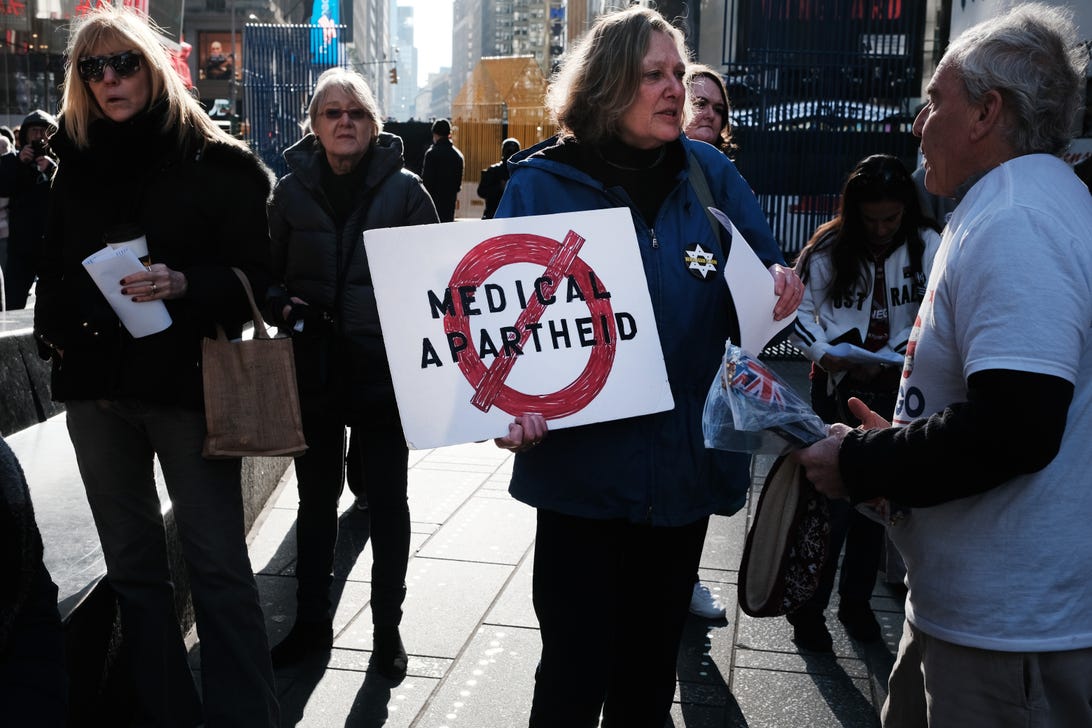
An anti-vax rally in New York City on Dec. 5.Getty Images


Conspiracy theorists ramped up the misinformation, claiming falsely that the vaccines were killing more people than they were saving. As "proof," some pointed to reports from the US Centers for Disease Control and Prevention's Vaccine Adverse Event Reporting System, a public health surveillance program to "detect unusual or unexpected reporting patterns of adverse events for vaccines." While VAERS does list cases of individuals experiencing side effects after vaccination, including death, the system doesn't confirm the vaccine was at fault.

Make no mistake, there can be side effects to the vaccines. The vast majority consist of flu-like symptoms, but some reactions do require a trip to the hospital. Still, the benefits of the vaccines far outweigh the risks of being unvaccinated and contracting COVID.

Misinformation about COVID-19 treatments also spread on social media, with the most popular concerning the antiparasitic drug ivermectin. There were some studies suggesting the drug could help those infected with the recovery process, but many of those were found to have inaccurate info, leading them to be redacted. More studies have shown ivermectin has no effect on COVID.

That didn't stop celebrities such as comedian Joe Rogan, UFC promoter Dana White and Aaron Rogers of the Green Bay Packers from telling people they took ivermectin after being infected with COVID. While these celebrities and others have taken a version of the drug for humans, there was an alarming number of people who took the livestock version, leading to an increase in calls to poison centers and two deaths due to overdose.

It's not possible to draw a clear line of causation between misinformation about COVID-19 and deaths from the virus. One board on Reddit purports to offer some insight on people who consumed these conspiracy theories. Called r/HermanCainAward -- a reference to the former Republican presidential candidate who died from COVID after attending a Trump rally -- the subreddit is filled with posts about people who shared misinformation about COVID-19 and later died from the virus, often told through screenshots of social media posts. They tend to follow a pattern: multiple screenshots of a person sharing misinformation about COVID, followed by posts where the individual says they've tested positive. The final image is usually of a family member or friends confirming the person died from the virus.

Will things be different in 2022?


It's apparent that conspiracy theories aren't going anywhere. Even if they get debunked, like those about the 2020 election and COVID vaccines, these theories have already spread too far, and it appears there's no stopping them.

"It would be really difficult to predict whether disinformation on social media platforms will get better or worse in the next year or so, but the indications are not good," Copland said, "These groups are becoming more intense. There is a good chance this will continue to grow."