Showing posts sorted by relevance for query AI DATA CENTERS. Sort by date Show all posts

Wednesday, January 15, 2025

Biden signs executive order that seeks to grow artificial intelligence infrastructure in the U.S.


By — Sarah Parvini, 
Associated Press
Jan 14, 2025 


LOS ANGELES (AP) — President Joe Biden on Tuesday signed an ambitious executive order on artificial intelligence that seeks to ensure the infrastructure needed for advanced AI operations, such as large-scale data centers and new clean power facilities, can be built quickly and at scale in the United States.

The executive order directs federal agencies to accelerate large-scale AI infrastructure development at government sites, while imposing requirements and safeguards on the developers building on those locations. It also directs certain agencies to make federal sites available for AI data centers and new clean power facilities. Those agencies will help facilitate the infrastructure’s interconnection to the electric grid and help speed up the permitting process.

WATCH: How artificial intelligence impacted our lives in 2024 and what’s next

In a statement, Biden said AI will have “profound implications for national security and enormous potential to improve Americans’ lives if harnessed responsibly, from helping cure disease to keeping communities safe by mitigating the effects of climate change.”

“However, we cannot take our lead for granted,” the Democratic president said. “We will not let America be out-built when it comes to the technology that will define the future, nor should we sacrifice critical environmental standards and our shared efforts to protect clean air and clean water.”

Under the new rules, the departments of Defense and Energy will each identify at least three sites where the private sector can build AI data centers. The agencies will run “competitive solicitations” from private companies to build AI data centers on those federal sites, senior administration officials said.

Developers building on those sites will be required, among other things, to pay for the construction of those facilities and to bring sufficient clean power generation to match the full capacity needs of their data centers. Although the U.S. government will be leasing land to a company, that company would own the materials it creates there, officials said.

With less than a week before President-elect Donald Trump takes office, a big question is whether the incoming administration will keep or rescind the new order. Much of the order’s focus is on reducing the bottlenecks of getting energy-hungry data centers connected to new sources of electricity.

“It has to be a priority because otherwise you’re going to have blackouts, you’re going to have citizens or businesses being affected by this,” said computer scientist Sacha Luccioni, climate lead at the AI company Hugging Face. “Making it easier to facilitate interconnection of infrastructure to the electric grid is kind of a no brainer that would be useful for the next administration, no matter what their priorities are in terms of sustainability or climate.”

Biden said the efforts are designed to accelerate the clean energy transition in a way that is “responsible and respectful to local communities” and does not add costs to the average American. Developers selected to build on government sites will be required to pay all costs of building and operating AI infrastructure so that development does not raise electricity prices for consumers, the administration said.

The orders also direct construction of AI data centers on federal sites to be done with public labor agreements. Some of the sites are reserved for small and medium-sized AI companies, according to government officials.

Government agencies will also complete a study on the effects of all AI data centers on electricity prices, and the Energy Department will provide technical assistance to state public utility commissions regarding electricity tariff designs that can support connecting new large customers with clean energy.

As part of the order, the Interior Department will identify lands it manages that are suitable for clean energy development and can support data centers on government sites, administration officials said.

“The volumes of computing power, electricity needed to train and operate frontier models are increasing rapidly and set to surge even more,” said Tarun Chhabra, deputy assistant to the president and coordinator for technology and national security. “By around 2028, we expect that leading AI developers will be seeking to operate data centers with as much as five gigawatts of capacity for training AI models.”

Deploying AI systems at scale also requires a broader network of data centers across different parts of the country, he said.

“From a national security standpoint, it’s really critical to find a pathway for building the data centers and power infrastructure to support frontier AI operations here in the United States,” he said, adding that building data centers in the U.S. will prevent “adversaries from accessing these powerful systems to the detriment of our military and our national security.”

WATCH: How Russia is using artificial intelligence to interfere in elections

That type of investment will also prevent the U.S. from growing dependent on other countries to access AI tools, Chhabra said.

The executive order comes on the heels of the Biden administration’s proposed new restrictions on exports of artificial intelligence chips, an attempt to balance national security concerns about the technology with the economic interests of producers and other countries. That proposal raised concerns of chip industry executives as well as officials from the European Union over export restrictions that would affect 120 countries.

Missing from the order is how to manage the water consumption of AI data centers. There is a growing concern in states with multiple data centers over how to balance the economic development they bring with their impact on water resources as they use vast amounts of water for cooling, said J. Alan Roberson, executive director of the Association of State Drinking Water Administrators.

“Across the country, everyone is trying to get a better idea of the impact of data centers on water use now and in the future,” he said.

The executive order could have instructed federal agencies to collect information about how much water data centers use to help state and local officials making zoning decisions about whether to allow them, but it did not, he added.

AP writers Matt O’Brien and Jennifer McDermott in Providence, Rhode Island contributed to this report.

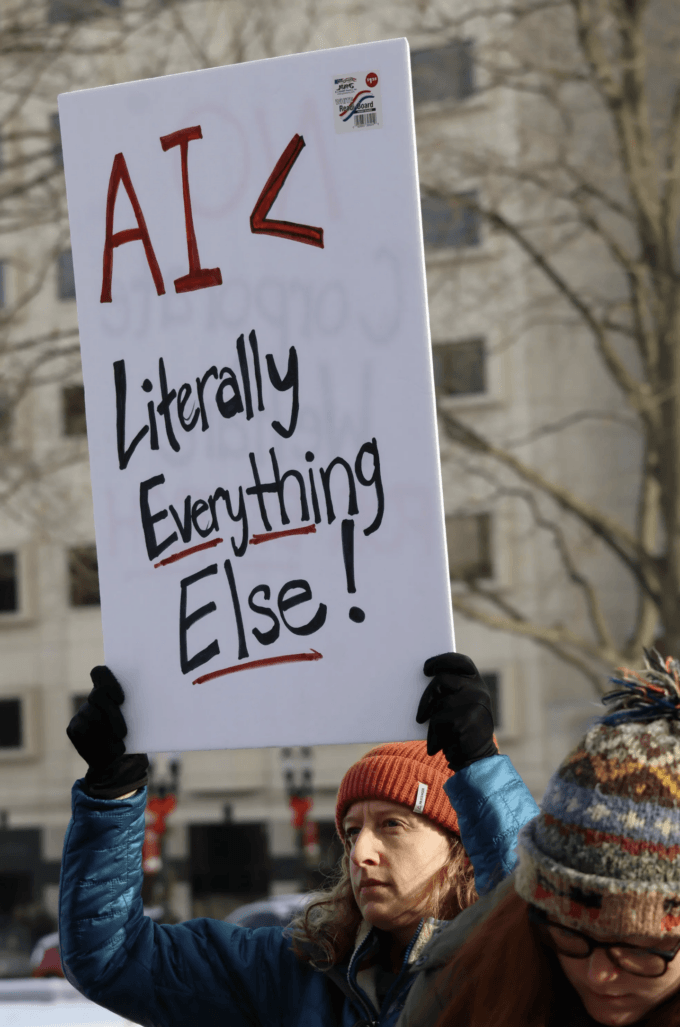
Left: FILE PHOTO: An AI (Artificial Intelligence) sign is seen at the World Artificial Intelligence Conference (WAIC) in Shanghai, China July 6, 2023. Photo by Aly Song/ Reuters/ File Photo

RelatedAs artificial intelligence rapidly advances, experts debate level of threat to humanity

By Paul Solman, Ryan Connelly Holmes
Hollywood’s video game performers head to picket line over artificial intelligence

By Sarah Parvini, Associated Press
Scientists harness power of artificial intelligence to battle wildfires

By Miles O'Brien
Go Deeperai
artificial intelligence
executive order
joe biden
By —

Sarah Parvini, Associated Press

Saturday, May 25, 2024

JPMorgan: Global AI Data Centers Will Consume Huge Amounts of Fresh Water


By ZeroHedge - May 23, 2024

While energy consumption of data centers steal the headlines, the water-intensive nature of their operations are overlooked.

Bluefield research: water consumption by global data centers (including on-site cooling and off-site power generation) has grown 6% annually from 2017 to 2022.

Immense water demand from data centers in areas where water resources are scarce could spark "increased competition can strain water availability, even causing data center closures."


Wall Street banks are in a frenzy over "The Next AI Trade," piling into the 'Powering up America' investment themes, whether that's power grid companies, commodities, such as copper, gold, silver, and uranium, and artificial intelligence chipmakers, to accommodate the explosion of generative artificial intelligence data centers anticipated nationwide through the end of the decade and beyond.

JPMorgan's Asia Pacific Equity Research desk is the latest bank to jump on AI trade in a note titled "Deep Dive into Power, Cooling, Electric Grid and ESG implications."


Focusing on AI data center power consumption is too repetitive at this point, considering we've laid it all out on a silver platter for premium ZH subs in the "The Next AI Trade" and "The Next AI Trade Just Hit An All-Time High."

As well as this real-world example... Goldman Finds Commercial Power Demand In Virginia Explodes Higher As 'Next AI Trade' Soars

Even Blackstone Chief Executive Officer Steve Schwarzman and BlackRock Chairman and Chief Executive Larry Fink have jumped onto the power grid and AI investment theme as there is plenty of upside in the years ahead - unless AI demand doesn't shit the bed.

Back to JPM's note, authored by analyst William Yang and his team, which near the end explained, "While data centers have been scrutinized for heavy electricity use, the water intensive nature of their operations has been comparatively overlooked."

Citing data from Bluefield Research, Yang said total water consumption by global data centers (including on-site cooling and off-site power generation) has grown 6% annually from 2017 to 2022. He said by 2030, water consumption could jump to 450 million gallons per day. To put this in perspective, that's 681 Olympic-sized pools of fresh water that will be needed each day to cool global data centers in about 4.5 years.


"By 2027, the same authors suggest that global AI demand may be accountable for 4.2 – 6.6 billion cubic meters of water withdrawal, more than the total annual water withdrawal of half of the United Kingdom when taking account of the combined scope 1 and scope 2 operational water withdrawal," Yang pointed out.

He said the immense water demand from data centers in areas where water resources are scarce could spark "increased competition can strain water availability, even causing data center closures."

Here are the various ways to cool data centers via water:


Much of the water usage at data centers is "because millions of gallons of water each day are evaporated in cooling systems designed to off-load server heat," the analysts said.

We'd love to know where the critics of crypto miners are now, as AI data centers are set to consume massive amounts of power and water.

Are any NGOs or Greta going to protest AI data centers? We doubt.

By Zerohedge.com

Friday, August 01, 2025

Consumers Are Footing the Bill for AI’s Insatiable Appetite for Energy

  • The rapid growth of data centers, particularly due to AI, is significantly increasing energy demand and jeopardizing clean energy initiatives by extending the life of fossil fuel plants and promoting new ones.

  • The issue is compounded by "phantom data centers," which inflate projected energy demand and give utilities leverage to expand fossil fuel infrastructure.

  • This surge in energy demand and the resulting infrastructure projects are projected to lead to higher energy bills for consumers, especially in the Southeast United States.

As data centers place more and more demand on global power grids, policy and economic priorities are shifting from creating more clean energy to creating more energy, period. Projected clean energy additions are simply not enough to meet the runaway demand of the global tech sector, meaning that climate goals could be at risk. 

The proliferation of artificial intelligence is causing massive increases in energy demand from data centers, and the areas that host them are struggling to keep up. A 2024 study from scientists at Cornell University found that generative AI systems like ChatGPT use up to 33 times more energy than computers running task-specific software. As a result, it is estimated that each AI-powered internet query consumes about ten times more energy than traditional internet searches. But these numbers are just our best guess – we don’t really know how much energy AI is sucking up, because the companies who are piloting AI platforms aren’t sharing those numbers

But we know that the overall picture is pretty grim. Last year, Google stated that the company’s carbon emissions had skyrocketed by a whopping 48 percent over the last five years. “AI-powered services involve considerably more computer power - and so electricity - than standard online activity, prompting a series of warnings about the technology's environmental impact,” the BBC reported last summer. While Google hasn’t publicly revised its goal of becoming carbon neutral by 2030, the tech firm has admitted that "as we further integrate AI into our products, reducing emissions may be challenging." 

Already, the uptick in energy demand from data centers is causing new plans for gas- and coal-powered plants as well as extending the life of existing fossil fuel operations across the United States. Utility Drive reports that “at least 17 fossil fuel generators originally scheduled for closure [are] now delaying retirement” due to data center demand, and that “utilities in Virginia, Georgia, North Carolina and South Carolina have proposed building 20,000 MW of new gas power plants by 2040” for the same reasons. 

The issue is particularly acute in the Southeast. Major utilities in Virginia, North Carolina, South Carolina and Georgia project that they will collectively add 32,600 MW of electrical load over the next 15 years. The Institute for Energy Economics and Financial Analysis reports that in Virginia, South Carolina and Georgia, “data centers are responsible for 65% to more than 85% of projected load growth.”

However, it could be the case that this projected demand growth is overblown, and that states will add extra gas power capacity – and therefore extra greenhouse gas emissions – unnecessarily. Because the competition for energy sources is so fierce between data centers, the project managers of new centers are likely to reach out to many different power providers at once with speculative connection requests, creating redundancies and a compounding issue of “phantom data centers.” This inflates demand and makes accurate projecting extremely difficult. 

A study published last year by Lawerence Berkley National Lab calculated exactly how big the phantom data center issue might be, and they found that projected energy demand could be as much as 255 terawatt-hours of energy higher than real energy demand. That’s enough energy to provide power to more than 24 million households.

However, it’s not in utilities’ interest to simplify interconnection processes and ferret out phantom data centers. In fact, the panic over rising energy needs from data centers is giving them great leverage to expand their businesses and push through huge fossil-fuel powered energy projects. Plus, while building new plants and extending the lives of old plants is costly, those costs will be borne by the ratepayers. 

Consumers across the U.S. – and especially in the data-center-laden Southeast – can expect their energy bills to rise in response. "We are witnessing a massive transfer of wealth from residential utility customers to large corporations—data centers and large utilities and their corporate parents, which profit from building additional energy infrastructure," Maryland People's Counsel David Lapp recently told Business Insider. "Utility regulation is failing to protect residential customers, contributing to an energy affordability crisis.”

By Haley Zaremba for Oilprice.com


Utilities, AI, and the Quiet Raid on Consumers

  • Utilities are quietly signing electricity deals with AI firms that shift major capital costs to regular customers.

  • Utilities are placing AI-related infrastructure in their regulated rate base, socializing risks and costs while offering AI firms preferential, often secretive, pricing.

  • Policymakers would be wise to force AI firms to build their own power infrastructure, shielding consumers from excessive costs.


Ok, we are cynical. The current electric utility policy environment is not exactly what you would call a level playing field, fairly balancing corporate and public interests. Quite the contrary. Right now, we have highly profitable (and politically influential) corporations facing underpowered civil servants in diminished regulatory agencies. State regulators are in a position to grant data centers and possibly other enormous users of electricity the opportunity to milk huge subsidies from unsuspecting consumers. How? By putting these vast new power-generating resources in the utility’s rate base, thereby socializing these enormous incremental costs, facilitated by pro-business politicians.

Harvard researcher (Daniel Oberhaus, “How AI Could Be Raising Your Energy Bill, ” Harvard Magazine, July/August 2025) cites more evidence that utilities are making AI power deals whose terms are not public that burden the rest of their customers. One utility plans to build several large power plants to serve a long term contract with an AI site, put the plants in their regulated rate base, but so far, no details on apportionment of costs have been released. Another large utility has been accused of offering a cut-rate deal to an AI firm with the full expectation that the rest of its customers would make up the profit differential. Stated simply, residential utility customers would be subsidizing corporate or AI  electricity usage. In addition, several AI centers announced deals in which they would take the output of existing deregulated stations. Those are perfectly above-board transactions, but not neutral to consumers who have to finance new power stations at current, relatively high prices to replace the output taken by AI. Just a guess, but we think that if AI adds 10% to system sales, it will add 30% to the fixed and capital costs of the utility, so if the AI firm gets a discount, who pays the higher costs? You guessed it.                                                    

Next, let’s consider a few wild thoughts.

For instance, might we be in an AI bubble, on par with the dot.com bubble and the power generator bubble, and way back, the bowling alley bubble? These economic or speculative bubbles burst because actual demand did not materialize to keep up with supply based on overly optimistic forecasts. As a result, entrepreneurs overbuilt or somebody came up with a better or cheaper product. “Of course”, you say, ”this time is different.” But someone always says that.

Let’s consider possibilities. First, the AI providers may have wildly overestimated electricity demand, which will leave a lot of underutilized AI data centers looking for ways to dodge those big power bills. Second, the Chinese will develop cheap, low powered AI related computer chips that make the US version look uneconomical. For example with electric vehicles, Tesla came first but Chinese auto makers have caught up fast and now offer superior products. As Andrew Carnegie supposedly and ungrammatically said, “Pioneering don’t pay.” Third, when quantum computing makes an earlier-than-expected appearance, will all those AI data centers become white elephants?

Mind you, we don’t object to building AI centers. Entrepreneurs should take chances and reap the rewards. We just object to making consumers subsidize this essentially speculative activity via their electric bills. Given the intricacies of the electric network, and cross subsidies in pricing, the divergence in cost between new and old plant, and the political pressure to give large corporations what they want via hidden extra charges in the customer's electric bill, we suggest that there is only one way to protect consumers from what AI will do to the grid. That is by requiring that AI and similar power guzzlers build their own generation and networks. Put all these new expensive generating assets behind the meter so to speak. That means build, not snatch existing stations that consumers will have to replace. That way, data centers will pay full freight and consumers will only have to deal with all the other costs increasingly burdening the utility network.

By Leonard Hyman and William Tilles for Oilprice.com


Sunday, January 04, 2026

Fracking Industry Executives Are Salivating Over the AI Data Center Boom


Data centers are driving a surge in the construction of power generation facilities involving fracked gas.
January 3, 2026
Aerial view of a data center being constructed.Gerville / Getty Images

Support justice-driven, accurate and transparent news — make a quick donation to Truthout today!

“The demand for power and for AI is like nothing I’ve ever seen.”

These words were uttered during an October earnings call, not by a wide-eyed tech executive, but by Jeff Miller, the CEO of Halliburton, one of the world’s biggest oilfield services corporations.

Like droves of other companies tied to the fracked gas industry, Halliburton is pivoting toward servicing the data center boom with new loads of methane-emitting, gas-fired power generation to feed the artificial intelligence (AI) bubble being stoked by Silicon Valley billionaires and allied corporate elites.

Halliburton is merely one of many fossil fuel companies that are striking deals to power the insatiable electricity needs of data centers. More specifically, the natural gas industry — frackers, gasfield services, pipeline companies, power suppliers — are positioning themselves as bold saviors ready to step in and meet AI’s bottomless energy demands.

In doing this, fracked gas companies are fully backed by the Trump administration, with its ideological dedication to fossil fuels and its cozy relationship with billionaire oil and gas donors. For its part, Big Tech is going along, largely sidelining its purported commitments to renewable energy.


Data Centers Devour Electricity. Private Equity Is Buying Utilities to Cash In.
The seizure of public utilities for the sake of profit may lead to a disaster for consumers — and the planet. By Derek Seidman , Truthout November 11, 2025


As the global climate emergency intensifies, none of this bodes well. Despite being sold as a “clean” fossil fuel, fracked gas emits loads of methane, one of the most potent greenhouse gases, and local communities — often rural, low-income, and predominantly Black — bear the brunt of the combined nexus of data center behemoths and fossil fuel power generation being constructed in their backyards.

“The natural gas industry is directly aligning with the data center industry.”


“The natural gas industry is directly aligning with the data center industry,” Tyson Slocum, the director of Public Citizen’s Energy Program, told Truthout. “From a climate perspective, and from a local environmental perspective, data centers represent a significant impediment to action on climate change.”

“Icing on the Cake”

Natural gas currently provides over 40 percent of the electricity for data centers, making gas-fired power stations their largest power source, according to the International Energy Agency.

The massive demand for electricity from data centers is driving a surge in the construction of power generation infrastructure fueled by natural gas.

One McKinsey analyst recently noted that over 100 gigawatts (GW) of new gas-fired projects are being planned. “To put that number in perspective,” he said, “over the last five years, the U.S. added only about 35 GW of gas,” meaning this is “almost triple what it was.”

Utilities announced a slew of new gas-fired power projects in 2025 — a factor that helps explain private equity’s rush to acquire utilities. Utility powering of data centers is expected to skyrocket by 22 percent this year.

Industry leaders are swooning. “It’s been 40 or 50 years, or so, since we’ve seen demand grow the way it’s growing and is expected to grow,” said one executive of energy giant NRG.

“AI is obviously a big part,” he added.

The core driver of the fracked gas industry over the past decade has been the booming production of liquified natural gas (LNG) for export, which has vastly accelerated since the Obama administration. Today, the U.S. leads the world in natural gas production and exports.

While LNG exports are unrivaled as “the demand driver and the profit center for the domestic natural gas industry,” says Slocum, data centers “provide a significant additional profit cushion.”

“Data centers are far and away the largest variable that is increasing electricity demand,” he said. “They’re sort of the icing on the cake.”

“Help Nourish That Appetite”

With 3 million miles of gas pipelines tightly networked across the country, Slocum says the fracked gas industry has positioned itself as the prime supplier for powering data centers.

This is seen through a flurry of data center deals struck by corporations across the fracked gas supply chain — independent drillers, oil and gas majors, pipeline companies, and oilfield services companies.

EQT, a top U.S. natural producer based in Western Pennsylvania, the heart of the vast Marcellus Shale formation, struck a deal to supply two huge data center hubs in Appalachia — the Shippingport and Homer City projects — with a combined 1.5 billion cubic feet per day of gas supplies.

“Just to put this in perspective, that’s enough natural gas to power two of New York City,” gloated EQT CEO Toby Rice, who also added that Homer City and Shippingport are “just the first steps of multiple steps in multiple projects.”

EQT is hardly alone. Fracking giants like EOG and Antero Resources are striking deals to position themselves to supply data centers. Comstock Resources, owned by Dallas Cowboys owner Jerry Jones, is partnering with utility giant NextEra to “keep the lights on at a plethora of data centers” in Texas, says Natural Gas Intelligence.

Chevron, the second-largest U.S. oil and gas company, is getting in the game. “AI data centers require massive amounts of energy to function,” the company gushed in a February press release.

But have no fear, they promised. “Chevron is tapping into natural gas to help nourish that appetite,” the oil giant declared, announcing a new deal to build gas-fired power plants for data centers.

“Unleashing American Energy”


While the massive energy demands of artificial intelligence are pulling the fracking industry toward data centers, the Trump administration’s policies are also playing a critical role.

“National policy under Trump is prioritizing fossil fuels for data center development” and “particularly natural gas,” Slocum told Truthout.

“It’s explicit in Trump’s July executive order on artificial intelligence, where he defines the criteria that data centers need to meet to qualify for expedited approval, and it lists every energy source except wind and solar,” Slocum added.

That July 2025 executive order, titled “Accelerating Federal Permitting of Data Center Infrastructure,” clearly emphasizes the role of fossil fuels in powering data centers. It defines “Covered Components” — the “materials, products, and infrastructure that are required to build Data Center Projects” — using language that foregrounds “energy infrastructure” like “natural gas pipelines or laterals” and “natural gas turbines” and “coal power equipment” with no mention of words like “wind” or “solar.”

As Slocum has written, “a data center proposed to be powered by wind and solar will not qualify for expedited treatment, whereas a fossil fuel powered facility would,” adding that fossil fuel-powered data centers could also qualify for direct federal subsidies.

This codification of national policy around fossil fuels as the core supplier of data centers aligns with Donald Trump’s campaign promise to “Drill Baby Drill” and his adamantly pro-fossil fuel January 2025 executive order on “Unleashing American Energy.”

Since taking office in January 2025, the Trump administration has gone to war against renewable energy, freezing permits around solar and wind projects and denigrating windmills.


Trump and the Fossil Fuel CEOs


Trump’s ideological commitment to feeding data centers with fossil fuel-powered electricity is wedded to his cozy relationship with the fracking billionaires who helped bankroll his 2024 reelection.

Trump saw oil and gas barons as a key constituency during his 2024 reelection campaign, and industry billionaires like Harold Hamm and Kelcy Warren showered Trump with millions in donations.

As Truthout has previously noted, Trump filled out his cabinet with fossil fuel executives and boosters, including Chris Wright, the fracking-liquid-guzzling former CEO of Liberty Energy, who Trump made energy secretary.

Since then, the fossil fuel industry has benefited handsomely from Trump’s policies of environmental deregulation and tax subsidies — and a bonanza of new business tied to data centers.

Warren is the co-founder and executive chairman of pipeline giant Energy Transfer and a longtime Trump ally. Energy Transfer is awash in new business supplying data centers from Texas to Arizona and is partnering with AI giants like Oracle.

Hamm is the founder and former CEO of fracking giant Continental Resources, and is a major Trump donor who is also backing Trump’s White House ballroom. He may be Trump’s biggest fossil fuel industry ally.

“Together,” writes The New York Times, Trump and Hamm “have remade federal policy to benefit oil and gas companies, including Mr. Hamm’s Continental, and put off the transition to greener alternatives like solar power and batteries.”

The Hamm Institute for American Energy, a research and policy hub funded by Hamm, who also serves on its board, has supported natural gas for powering AI and hosted an April event on “powering AI” that featured key Trump cabinet members leading the administration’s energy policies.

Liberty Energy — again, formerly led by Trump Energy Secretary Chris Wright — is also striking deals to power data centers in Pennsylvania.

“The only thing that’ll prevent us from leading in AI is the failure to build this electric generating capacity that needs to happen,” Wright recently raved to the Council on Foreign Relations, adding that he was “using emergency powers to stop [the] closure of coal plants” and “expediting the permitting of building of new plants.”


Big Tech’s Conformity


For its part, Big Tech has quickly backtracked on its net zero commitments as it embraces gas-fired power generation for data centers.

For example, Entergy, a power generation behemoth that relies mostly on fossil fuels, is currently constructing three massive gas-fired plants to power a $10 billion Meta data center in Louisiana.

Less than a decade ago, Meta CEO Mark Zuckerberg waxed about addressing the climate crisis. Fast forward to today, and headlines like “Meta goes all in on gas to power a mega data center” are being published, while Zuckerberg and Meta are being lambasted by lawmakers, energy analysts, and community groups.

This fits a larger pattern, which Truthout has reported on, of Silicon Valley CEOs backtracking on purported climate aims and criticism of Trump to remain the president’s good graces and profit off his policies.

“Trump demands conformity, and Big Tech is providing that conformity by turning its back on its traditional commitments to increase and rely upon renewable energy,” said Slocum.

Of course, all this will exacerbate the climate crisis. The production, transport, and burning of natural gas releases huge amounts of methane, which is 86 times more powerful than carbon dioxide at trapping heat in Earth’s atmosphere.


Under Trump, data centers are also giving new life to dying and dirty coal plants.

Under Trump, data centers are also giving new life to dying and dirty coal plants, and many data centers are backed up by super-polluting diesel generators that some fear could come to be used more frequently.

As journalist Adam Mahoney has reported, in states like South Carolina and Texas, Black households disproportionately bear the brunt of the data center boom and AI’s growing fossil fuel emissions trail, especially with on-site power generation.

Many communities are resisting both data centers and their dirty emissions — from Memphis, Tennessee, to Bessemer, Alabama, to Santa Teresa, Arizona.

To be sure, Big Tech firms are also partnering on some projects with renewable energy sources to service data centers. While U.S. data centers are overwhelmingly powered by fossil fuel sources, the International Energy Agency notes that the proportion of solar, wind, and other renewables involved will increase going into the 2030s and beyond.

But this raises another question: Do we really want the renewable energy transition to be dominated by — and wasted on meeting — the profit-centered priorities of Big Tech and Wall Street firms and their fixation with the unproven, supposed wonders of AI


This article is licensed under Creative Commons (CC BY-NC-ND 4.0), and you are free to share and republish under the terms of the license.

Derek Seidman is a writer, researcher and historian living in Buffalo, New York. He is a regular contributor for Truthout and a contributing writer for LittleSis.


Wednesday, September 03, 2025

U.S. Utilities Are Baffled by Phantom Data Centers

  • US electric utilities are struggling to accurately forecast future power demand due to numerous speculative data center interconnection requests that may not materialize.

  • The practice of AI-focused tech groups filing power requests with multiple utilities for a single potential data center project creates "phantom" demand, making accurate capacity planning difficult.

  • Overestimating demand could lead to utilities overbuilding new capacity, potentially at the expense of American ratepayers who are already experiencing rising electricity prices.


America’s electric utilities are preparing for the surge in electricity demand coming with the data centers powering AI. Utilities have increased investments as they see unprecedented demand growth in the coming years after two decades of flat U.S. electricity consumption.   

But they are grappling with increased levels of uncertainty because not all requests for interconnection they receive will materialize in actual data centers, necessitating electricity supply.  

Phantom Data Centers

Hyperscalers and AI-focused tech groups are sounding out the utilities in the areas they are considering for future data centers, and are filing requests for interconnection of one data center with several utilities in several areas. 

The huge number of requests does not paint an accurate—or full—picture of the power needs of the technology giants because companies tend to inquire about data center power supply with at least three utilities in different areas. 

Of these three requests for new power capacity, only one will become a project for which agreements will be signed. Analysts and utilities cannot reliably say how much new capacity is needed, considering that one data center project pitches electricity supply requests to different utilities in different states.

After one site is picked, all the other previously proposed locations – and the interconnections – will never be built. These would be “phantom” data centers, which will never see the light of day, but which are currently haunting the projections and plans of the U.S. utilities. 

So, electric utilities face a high degree of uncertainty over future revenues as the boom of AI data centers generates widely varying forecasts of peak demand in many areas across the country. 

If utilities overestimate their future demand, they risk overbuilding new capacity that will not be met by consumption. A possible overbuild would come at the expense of the American ratepayers, who have already seen electricity prices rising at a faster pace than U.S. inflation over the past three years.

Puzzled Utilities  

The phantom data centers and the speculative projects are making projections difficult for utilities. 

For example, Sempra’s Texas-based utility Oncor said its active large commercial and industrial (LC&I) interconnection queue as of June 30, 2025, was about 38% higher than at the same time last year. As of June 30, Oncor’s active LC&I interconnection queue had 552 requests, which includes approximately 186 gigawatts (GW) from data centers and over 19 GW of load from diverse industrial sectors. 

American Electric Power Company, which serves over 5 million customers in 11 states, said it now has 24 GW of firm customer commitments for incremental load by the end of the decade, up from 21 GW previously, thanks to data center growth, reshoring, and manufacturing.

“Beyond the 24 gigawatts, customers are also actively seeking to connect approximately 190 gigawatts of additional load to our system. This is five times our current system size of 37 gigawatts,” AEP president and CEO William J. Fehrman said on the Q2 earnings call. 

U.S. power utilities are investing a record amount of money into transmission and grid connection. But current forecasts of AI-driven power demand vary so much that there is a massive margin of error, analysts and utility officials told Reuters Events in June.

The U.S. market faces “a moment of peak uncertainty,” according to Rebecca Carroll, Senior Director of Market Analytics at energy advisor Trio.

The latest report from the U.S. Department of Energy (DOE) puts data center consumption at anywhere between 6.7% and 12% of total U.S. electricity by 2028.

“The report estimates that data center load growth has tripled over the past decade and is projected to double or triple by 2028,” DOE said.

However, there is a huge difference between double or triple growth in data center load.

This has prompted utilities to demand clear demand estimates from data centers for future connections and power purchase agreements (PPAs), to reduce the risk of getting demand and/or prices wrong.

AI Drives U.S. Power Demand Growth

“We know not all of that is going to come online, but even a fraction of that is significant,” AEP’s chief financial officer, Trevor Mihalik, said on the earnings call.  

U.S. power utilities have announced billions of dollars in capital plans for the next few years and are getting a lot of requests from commercial users, most notably Big Tech, for new power capacity in many areas next to planned data centers. 

Onshoring of manufacturing activity and AI-related data centers are driving an increase in U.S. electricity consumption, Goldman Sachs said in a report earlier this year. 

U.S. electrical power demand is expected to rise by 2.4% each year through 2030, with AI-related demand accounting for about two-thirds of the incremental power demand in the country, the investment bank said. 

The world’s biggest economy will need all energy sources to ensure power demand is met. Natural gas is the biggest near-term winner of AI advancements, but renewables will also play a key role in powering the data centers of next-generation computing, analysts say. 

By Tsvetana Paraskova for Oilprice.com 


AI Energy Demand Is Soaring but Not Because of Consumer Queries

  • Nearly half of U.S. electricity demand growth by 2030 will come from AI-driven data centers, with consumers absorbing higher costs.

  • AI companies provide little to no transparency on energy use or emissions, leaving regulators and consumers in the dark.

  • While AI could eventually offset emissions through innovation, today it is fueling both rising utility bills and climate concerns.

Artificial intelligence (AI) is eating up more and more energy all the time as large language models become increasingly complex and pervasive. In the United States, nearly half of all growth in electricity demand between now and 2030 will come from data centers, driven by the AI boom. But the problem isn’t your daily queries to ChatGPT – it’s indiscriminate AI integration in technologies and services that are far outside the end-users' control. Yet, it’s consumers who are footing the bill for soaring energy demand. 

We don’t know exactly how much energy large language models are consuming, because AI companies aren’t required to disclose the information. As a result, the vast majority of them do not, and the sector is characterized by opacity when it comes to environmental impact. As of May, 84 percent of all large language model traffic was conducted on AI models with zero environmental disclosure. While many researchers are trying to calculate AI’s energy footprint, it’s a difficult task – especially because models are changing all the time, generating shifts in terms of both increased complexity and increased efficiency. 

“It blows my mind that you can buy a car and know how many miles per gallon it consumes, yet we use all these AI tools every day and we have absolutely no efficiency metrics, emissions factors, nothing,” says Sasha Luccioni, climate lead at an AI company called Hugging Face. “It’s not mandated, it’s not regulatory. Given where we are with the climate crisis, it should be top of the agenda for regulators everywhere,” she went on to say.

But while we don’t know exactly how much energy AI models use, we do know that it’s a lot. “AI’s integration into almost everything from customer service calls to algorithmic “bosses” to warfare is fueling enormous demand,” reports the Washington Post. “Despite dramatic efficiency improvements, pouring those gains back into bigger, hungrier models powered by fossil fuels will create the energy monster we imagine.”

That being said, there are many things that we as consumers do each and every day that contribute far more to global greenhouse emissions. A handful of AI queries per day is negligible compared to other common and under-scrutinized practices. Watching TV and streaming videos on the internet is likely a far greater culprit of energy usage if your lifestyle is anything close to the average American’s. And your work commute is surely generating much more greenhouse gas emissions.

Put simply, the spike in energy demand from AI models is not consumers’ fault – but it is their problem. While tech companies are consuming more and more energy each year to power their AI ambitions, common consumers are footing the bill. Not only are consumers paying the literal price for AI expansion, but they will also have to bear the burden of the sector’s environmental impacts. Silicon Valley's backtracking on climate pledges, for example, will directly impact global communities, whether or not they ever benefit from AI.

"We are witnessing a massive transfer of wealth from residential utility customers to large corporations—data centers and large utilities and their corporate parents, which profit from building additional energy infrastructure," Maryland People's Counsel David Lapp recently told Business Insider. "Utility regulation is failing to protect residential customers, contributing to an energy affordability crisis.”

On the other hand, AI is gaining efficiency all the time and will be instrumental to reshaping global industries, including the energy sector, to be greener. Large language models can help advance technological breakthroughs for significant emissions gains, with noted potential for innovations in batteries and solar power. The International Energy Agency reports that increased emissions from data centers could even eventually be offset if AI is used to lower emissions from other sectors. 

We’re currently in the messy exploration stages of a global transformation, and the up-front costs in terms will be – and already are – high. Training large language models is incredibly energy- and resource-intensive. But as AI advances, we will get much better at learning how to optimize it, and it could be a net benefit – even in terms of emissions – further down the road. But until then, consumers will be paying the price.

By Haley Zaremba for Oilprice.com