Showing posts sorted by relevance for query NAFTA. Sort by date Show all posts

Wednesday, July 08, 2020

Will the New NAFTA Make the Pandemic Worse for Mexicans?

For Mexican workers, farmers, and the poor, the pandemic and the new treaty replacing NAFTA are a devastating one-two punch.

Published on
by
Elva Nora Cruz is the sister of a fired Sindicato Mexicano de Electricistas (SME) member, and sits with Triqui women protesting violence in Oaxaca under a tent in Mexico City’s central square, the zocalo (Photo: David Bacon)
In the debate over the U.S. Mexico Canada Agreement, the new trade treaty replacing NAFTA that went into effect on July 1, many promises were made about the effectiveness of its labor protections.  Supposedly, they will protect the labor rights of Mexican workers, which will free them to push for better wages and conditions.
These promises are reminiscent of those made when the original NAFTA was debated over a quarter of a century ago. At the time, its corporate backers insisted it would lead to prosperity for workers and farmers, who would no longer be obligated to leave home to find work in the United States.
Whether the old treaty created better conditions—for workers in the maquiladora factories on the border, for Mexican migrants toiling in U.S. fields, or for farmers in the communities from which the migrants come—is more than an economic issue. In the era of the pandemic, the record of the old treaty must be examined to determine as well its responsibility for life and death. Did the changes it provoked make Mexicans more vulnerable to the virus? And because it continues the same economic regime, the new agreement cannot avoid raising the same questions.
The Impact on Mexico
NAFTA had a devastating impact on Mexican workers, farmers, and the poor, and its labor and environmental side agreements did nothing to protect them. The problem lies in the agreement’s purpose—to facilitate the penetration of U.S. capital in Mexico. By taking down barriers to investment and the activity of U.S. corporations, it instituted cataclysmic political and economic changes. The current trade agreement shares NAFTA’s purpose and will have the same impact.
The 1990 report by the U.S. Congress’ Commission for the Study of International Migration and Cooperative Economic Development recommended that the United States negotiate a free trade agreement with Mexico in order to deter migration. But even this report warned, “It takes many years—even generations—for sustained growth to achieve the desired effect,” and in the meantime would create years of “transitional costs in human suffering.”
Mexico’s “years of sustained growth” turned out to be a tiny 1.2-2 percent, whose benefits were reaped by a billionaire class that multiplied while real income for workers and farmers fell. The consequences were clearest in the displacement that suffering caused. It set millions of Mexicans into motion as migrants, which now exposes them to the virus.
Three million farmers were displaced by corn dumping, to allow U.S. corporations like Cargill and Archer Daniels Midland to take over Mexico’s corn market. Mexico lost its CONASUPO stores serving farmers and the poor, and Wal-Mart became the country’s largest employer. Waves of privatization, mandated to provide opportunities for banks and investors, cost the jobs of hundreds of thousands as Mexico threw open its economy. As investment increased, the income of Mexicans declined.
Investment had health consequences beyond unemployment. The prelude to COVID came in 2009, with the spread of the H1N1 virus, or swine flu. In Mexico some call it the NAFTA flu, because the agreement provided the vehicle for Smithfield Foods to fill the Perote Valley in Puebla with hog farms. The virus started in a valley town, La Gloria.  Its source was the intense concentration of pigs and their waste. The waste from Smithfield’s U.S. operations was so considerable it led to prohibitions even by the conservative government of North Carolina.
By moving south Smithfield did not just escape environmental protections. It became so dominant that one of every four meals of pork eaten in Mexico now comes from this company’s farms and its imports from the United States. But 125,000 Mexicans lost jobs in pig farming in the process, and people got sick and died from the virus all over Mexico. NAFTA’s environmental side agreement did nothing to help the people of the Perote Valley stop the company’s depredations. The new USMCA makes no change in the Perote Valley and would do nothing to prevent a similar situation in the future.
The failure of NAFTA’s labor side agreement was even more complete. Not a single independent union won bargaining rights, nor a single fired worker reinstated, because of a NAFTA complaint. That abysmal record continues today. The Mexican miners union has been on strike at the huge Cananea copper mine since 2007. The treaty had no impact on regaining their rights. Instead, NAFTA’s freeing of investment to move across borders helped the mine’s owner. The wealthy Larrea family bought the ASARCO mines in Arizona, and forced the miners’ cross-border allies, the United Steel Workers, out on strike there as well. NAFTA’s goal of freeing investment didn’t guarantee labor rights; it jeopardized them. The new agreement has precisely the same goal.
Migrants Also Suffer
Complaints of labor violations weren’t made just about Mexico. Some were filed over the violation of workers’ rights in the United States. A number were filed on behalf of Mexican immigrants, including the massive firing of immigrant workers during organizing drives by Washington apple workers and Maine egg farm workers. Cases were even filed against the U.S. government itself for denying immigrants protections under U.S. labor standards. None resulted in any concrete action. The side agreement’s last case was just settled this week, when seafood workers were told that their H-2B visa status did not protect them against discrimination because they are women. According to the Centro de los Derechos de Migrantes, in 2016 “we submitted a complaint under the NAFTA labor side accord, arguing systemic sex-based discrimination in guest worker programs.” Four years later, Mexico’s National Administrative Office assured the workers they could report any discrimination to ICE or read about their rights in brochures.
The forced migration of these workers, who today are endangered by COVID-19, was a product of NAFTA and its displacing impact in Mexican communities. The number of Mexicans forced to cross the border to find work went from about 4.5 million to 12.5 million in the NAFTA era. The Trump administration now seeks to channel that flow of people. It has cut off visas for family reunification, the achievement of the civil rights movement when it won the end of the bracero program and the passage of the Immigration and Nationalities Act of 1965. As a result of Trump’s recent orders, however, displaced people can now only come legally as H-2A guest workers in agriculture. Growers brought a quarter of a million of these workers into U.S. fields last year, and even more are being brought this year, in the middle of the COVID crisis.
The Southern Poverty Law Center called the H-2A program “Close to Slavery” in a report, and its abuses have been widely documented.  NAFTA, while it produced this forced migration, had no impact on protecting the rights of migrants. The current trade agreement has no protection either.  In the era of the pandemic, that can be deadly.
In March, over 70 H-2A guest workers were infected in the barracks of Stemilt Fruit Company in central Washington State because they are housed in crowded barracks, sleeping in bunk beds that make social distancing impossible. Yakima County, one of the main destinations for these H-2A workers, has the highest rate of infection of any county on the west coast. Yet Washington State told growers that putting those migrants into barracks with bunk beds was acceptable. Growers therefore don’t have to spend money on building new housing, although workers are paying the price. The old treaty offered no protection for them, and the new treaty will not protect them either.
The lack of effectiveness of either treaty in advancing the interest of workers is tied to the power imbalance between the United States and Mexico. Both NAFTA and the USMCA cement in place the relationship in which U.S. corporations dominate decisions in Mexico affecting Mexican workers. Recent struggles by workers on the border against the virus and poverty wages have made that clear.
AMLO’s Response
One of the first acts by Andres Manuel Lopez Obrador (AMLO) after he was inaugurated president in December 2018 was to mandate the doubling of wages in the border factories. In Matamoros, tens of thousands of workers went on strike after their U.S. employers and Mexican partners simply refused to obey the law. The government, however, seemed afraid to use its considerable power to force maquiladora employers to comply.
When the COVID-19 crisis started, the Mexican government ordered U.S.-owned factories to stop production, many of them auto assemblers and plants in the Pentagon’s supply chain. Again, companies simply refused to comply until their own workers went on strike and forced them to close the doors. At least twelve people died in the Lear auto parts plant alone. Then the U.S. ambassador, the State Department, and the executives of big U.S. defense and auto corporations leaned on the government in Mexico City. AMLO folded under the pressure and allowed them to restart production, even though workers will get sick and die as a result.
The leverage that the agreements have given the United States is very disturbing. The growth of U.S. production in Mexico has made the Mexican government dependent on keeping that sector operating. This doesn’t just affect the past governments that were notoriously pro-corporate. Mexicans elected AMLO because he promised to end this neoliberal dependence and make life in Mexico more attractive for Mexicans. But the U.S. government and companies have been able to use their leverage to pressure him to reverse those promises. Trump threatened to shut the border and forced Mexico to agree to illegally keep applicants for asylum, including women and children, in camps. NAFTA provided no means to stop Trump from doing this, and the new treaty won’t do that either.
Now this popularly elected president is going to Washington to greet Trump before the election, hat in hand, desperate to see this new trade agreement implemented. But signing the new treaty and a White House visit are not creating friendship with Mexico. Instead, the celebratory visit is a bitter blow to Mexicans in the United States who have felt the sting of Trump’s rhetoric.
“Trump conditioned his support for the USMCA on Mexico keeping quiet and taking in thousands of deported Mexicans, putting their sons and daughters in cages,” declared a bitter statement by the Binational Front of Indigenous Organizations. “How is it possible,” it asked Lopez Obrador, “that you, who won the election in Mexico on a progressive platform of change for our country, have become a collaborator with Donald Trump, who from the time he was a candidate never hid his racism and hatred towards us?”
Juvencio Rocha Peralta, executive director of the Association of Mexicans in North Carolina, accused Lopez Obrador of “paying homage” to Trump while ignoring the havoc in communities of migrants caused by the virus. “What we need from you are jobs in our home towns, so that our national economy no longer depends on remittances from our labor here.”
Abandoning a path of development in its own national interest, Mexico has signed a trade treaty that subordinates its health policies during a pandemic to the needs of U.S. corporations. Mexico’s migration policies cater to the labor demands of U.S. growers and the political demands of the U.S. right wing. This dependence is exacting a terrible price, measured in the deaths of maquiladora workers in border factories and migrants in U.S. fields.
David Bacon
David Bacon is a writer, photojournalist, and former union organizer. He is the author of Illegal People: How Globalization Creates Migration and Criminalizes Immigrants (2008), Communities Without Borders (2006), and The Children of NAFTA: Labor Wars on the US/Mexico Border (2004). In his latest project, Living Under the Trees, Bacon is photographing and interviewing indigenous Mexican migrants working in California's fields.

Wednesday, November 24, 2021

PAID FOR BY KENNEY & UCP
KXL Pipeline Company Exploits NAFTA Provision to File $15 Billion Claim Against US

"NAFTA's legacy of granting multinational corporations special rights to sue governments taking action to protect the environment lives on."


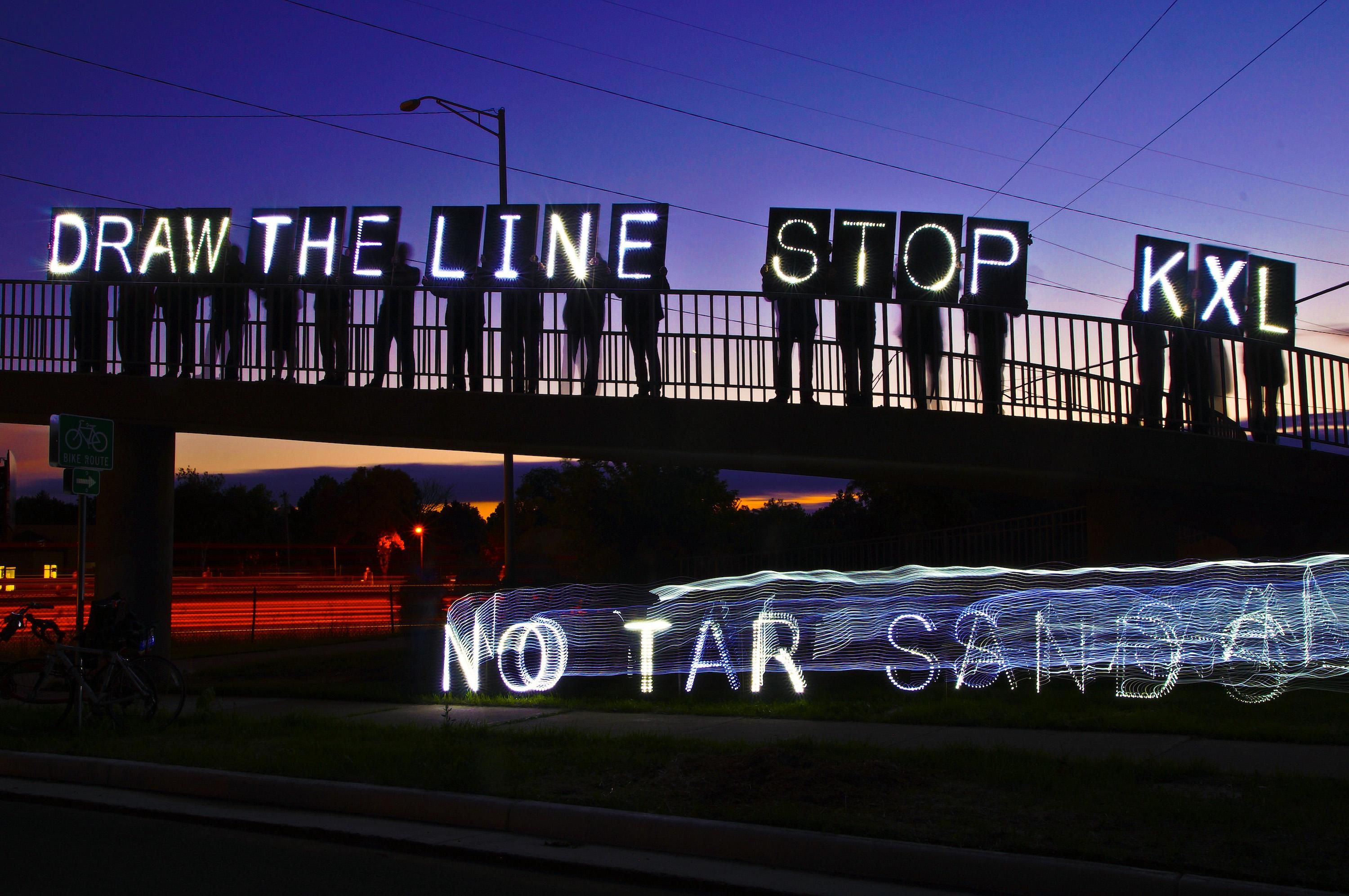
Climate activists hold signs against the Keystone XL project at a September 20, 2013 protest. 
COMMONDREAMS
November 24, 2021

The Canadian company behind the canceled Keystone XL pipeline filed a formal request for arbitration this week under the North American Free Trade Agreement to seek over $15 billion in economic damages over the Biden administration's revocation of the cross-border oil project's permit.

In its Monday filing, TC Energy criticizes the permit's cancellation as "unfair and inequitable" and argues the U.S. government should pay damages for the "regulatory roller coaster" the company endured while seeking to build the pipeline.

"Action on the climate crisis will require trade reforms, including killing these investor provisions."

Erin LeBlanc, a lecturer at the Smith School of Business in Kingston, Ont. told CBC News that amount represents "the largest claim for a Canadian organization against the U.S. government."

The company said in a statement announcing its filing that it "has a responsibility to our shareholders to seek recovery of the losses incurred due to the permit revocation, which resulted in the termination of the project."

The pipeline project, which would have transported tar sands from Alberta, Canada to the U.S. Gulf Coast, was first proposed in 2008. Following sustained grassroots pressure, the Obama administration ultimately rejected the pipeline—prompting a since-dropped NAFTA claim. That permit rejection was reversed by the fossil fuel-promoting Trump administration.

President Joe Biden then canceled the permit in his first hours in office—a move attributed to relentless Indigenous-led activism and heralded by climate groups as "a huge win for the health and safety of Americans and our planet."

Related Content

After 'Incredible First Steps' on KXL and Paris, Biden Urged to 'Go Further' on Climate
Jessica Corbett

In July, a month after it declared the project dead, TC Energy filed its intent to use the NAFTA Chapter 11 investor-state dispute settlement (ISDS) provisions to recoup perceived economic losses.

As such, the new filing is not surprising, author and water rights expert Maude Barlow noted in a Tuesday tweet. "This awful practice," she added, referring to the ISDS mechanism, "was grandfathered in the old NAFTA."

While the ISDS provision of NAFTA was "gutted" under the replacement U.S.-Mexico-Canada Agreement (USMCA), the company is making a "legacy" NAFTA claim. According to advocacy group Public Citizen, ISDS is "totally rigged" in favor of corporations.

As the group explains on its website:


Under ISDS, [a tribunal of three corporate lawyers] can order U.S. taxpayers to pay corporations unlimited sums of money, including for the loss of "expected future profits" that the corporation would have earned in the absence of the public policy it is attacking.

The multinational corporations only need to convince the lawyers that a law protecting public health or the environment violates their special “trade” agreement rights. The corporate lawyers' decisions are not subject to appeal. And if a country does not pay, the corporation can seize a government's assets—bank accounts, ships, airplanes—to extract the compensation ordered.

Addressing the TC Energy-U.S. government dispute, Bloomberg reported that "the tribunal cannot compel a country to change its laws over the matter nor force approval of the pipeline, but it could award damages for lost profits and costs incurred by the company."

In a Tuesday tweet, Ben Lilliston, director of rural strategies and climate change at the Institute for Agriculture and Trade Policy, put TC Energy's filing in the context of the planetary climate emergency.

"NAFTA's legacy of granting multinational corporations special rights to sue governments taking action to protect the environment lives on," he wrote. "Action on the climate crisis will require trade reforms, including killing these investor provisions."

Our work is licensed under Creative Commons (CC BY-NC-ND 3.0). Feel free to republish and share widely.

Monday, July 03, 2023

Ottawa urged to back U.S., not TC Energy, in $15B lawsuit over demise of Keystone XL

A progressive public policy think tank is urging the federal government to side against oil and gas transmission giant TC Energy in its ongoing dispute with the United States over the ill-fated Keystone XL project.

The Calgary-based company is seeking to recoup US$15 billion in lost revenue from the on-again, off-again cross-border pipeline expansion, which President Joe Biden killed off for good in 2021 on his first day as commander-in-chief. 

The lawsuit is based on the investor-state dispute rules in the now-expired NAFTA, as well as that deal's successor, the U.S.-Mexico-Canada Agreement, which included a three-year extension of those rules for so-called "legacy" investors.

A new report to be released Wednesday by the Canadian Centre for Policy Alternatives recommends Ottawa back the U.S. defence: that TC Energy has no legal recourse under North American trade rules, past or present.

"Though the TC Energy dispute pits a Canadian company against the U.S. state, it does not follow that it is in Canada's interest for TC Energy to prevail," the report reads. 

Rather, it argues, the case represents an important chance for both governments to defend their ability to pursue climate-friendly public policy without being forced to "unjustly" enrich impacted investors. 

"The Keystone XL case is a clear example of a company wanting to be compensated for making a risky bet," wrote senior researcher Stuart Trew and Queen's University professor Kyla Tienhaara, the report's co-authors. 

The gamble, they say, was on the 2020 re-election of former president Donald Trump, who championed and resurrected the project in 2017 after it had been rejected by the Obama administration two years earlier.

"This bet didn't play out."

Ottawa is keeping tabs on the Keystone XL case, said Shanti Cosentino, a spokesperson for International Trade Minister Mary Ng. But she equivocated on the question of whether the government would pick a side. 

"We are actively monitoring this case and expect this dispute to play out through the legal mechanisms established," Cosentino said in a statement.

"This government has always and will continue to advocate for Canadian commercial interests abroad."

The dispute is being heard by the International Centre for Settlement of Investment Disputes, a World Bank offshoot based in Washington, D.C., that registers dozens of investor-state clashes from around the globe each year. 

At the moment, it's about jurisdiction: TC Energy wants to apply the now-defunct investor-state dispute settlement mechanism in NAFTA, which expired in 2020, since the project traces its lineage as far back as 2008. 

The company hopes to use a three-year grace period for NAFTA disputes that was included in the new USMCA, known in Canada as CUSMA. By the report's count, some 15 investors including TC Energy lodged their disputes after NAFTA expired but before the grace period ended April 30. 

Five of those cases, including Keystone XL, are based on alleged violations of NAFTA rules that occurred after the agreement expired — in TC Energy's case, Biden's decision to withdraw the presidential permit in January 2021.

The U.S., however, is arguing that the grace period was not intended as a "sunset clause" for NAFTA disputes, but "an orderly way to resolve prior disputes" that were left outstanding after the deal's expiration. 

"The U.S. argues that, had the CUSMA parties wanted to simply extend NAFTA's investment rules and ISDS procedures for another three years, they would have done so through a boilerplate sunset clause," the report says. 

TC Energy is disputing that interpretation, arguing it hasn't been floated before and that there is no evidence to suggest that U.S., Canadian and Mexican negotiators envisioned anything other than a sunset clause for resolving disputes. 

There is more at stake than just TC Energy's eye-popping damages claim, the report says: An early dismissal of the suit would mitigate the ongoing cost of the global energy transition, not just for the U.S. but the rest of the planet. 

A host of other legacy cases under the USMCA rules are still outstanding, and amount to compensation claims in excess of US$23 billion. 

"This is why Canada’s next move, and that of Mexico, is so important," the report says.

"A win for TC Energy would send a devastating message to countries around the world, most of which cannot afford to finance the transition to clean energy while also paying off the fossil fuel industry."

Canada has two options to influence the tribunal, the report notes. 

One is to work with the U.S. and Mexico on an official, binding interpretation of the rules from the USMCA Free Trade Commission, while the other would be a "non-party submission" directly to the tribunal itself. 

"Due to the novelty of the U.S. argument and its fundamental importance to the operation of the CUSMA, a no-show from Canada at this stage of the arbitration would signal to the tribunal that the U.S. position on the legacy provisions is not credible," the report says. 

"It would also demonstrate that the government is more interested in bowing to the interests of the oilpatch than in the correct interpretation of treaties."

This report by The Canadian Press was first published June 28, 2023.

Sunday, August 21, 2022

Jared Kushner memoir chronicles frustrations of negotiating trade deal with Canada

CBC
Sat, August 20, 2022 

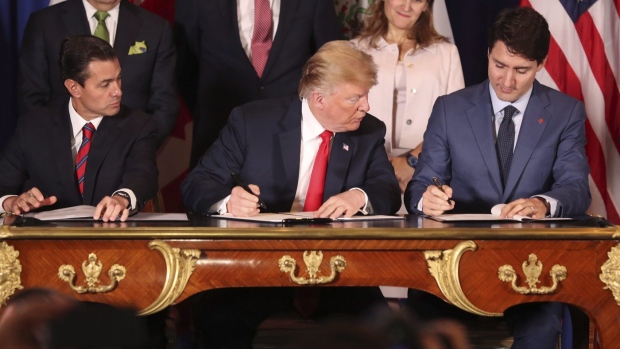
Kushner, right, as his father-in-law announces a new NAFTA deal on Oct. 1, 2018.
 It was a rocky ride getting there. (Kevin Lamarque/Reuters - image credit)

Members of the Trump administration would rant at their Canadian counterparts during the renegotiation of NAFTA about the frequency of leaks that appeared in the press.

The Americans insisted those trade talks be allowed to unfold discreetly at the negotiating table. They avoided news conferences, rarely spoke to reporters and let Donald Trump's occasional ill-tempered tweets speak for the U.S.

A new memoir lays out the U.S. perspective on those closed-door talks.

The book by presidential son-in-law and senior-staffer Jared Kushner earned the literary equivalent of a ritualized execution in a vividly unflattering New York Times book review that mocked its wooden writing and wilful blindness to the seedier aspects of the Trump legacy.

The book does fill in some gaps on a significant historical event for Canada: it describes the false-starts in the trade talks; frustrations with the Canadians; and how the deal wound up with two tongue-twisting acronyms for a name.

Breaking History, Kushner's book, describes a method to Trump's madness, crediting the president's sporadic threats to cancel NAFTA with creating valuable pressure on Canada and Mexico.

It also acknowledges the madness in the method.

An angry tweet from Trump stalled talks before they even began. In early 2017, the North American countries planned an amicable announcement of new trade negotiations at a three-country event at the White House.

When Kushner called Prime Minister Justin Trudeau's chief of staff to confirm plans, Katie Telford asked whether it was still on: "Didn't you see his tweets this morning?"

In fact, Kushner had not seen his father-in-law's public threat to cancel meetings with the Mexican leader unless Mexico paid for a new border wall; the meeting was cancelled.

Later in the day he said Trump realized that might have been a mistake and half-jokingly told Kushner: "I can't make this too easy for you."


Carlos Barria/Reuters

The tweets, then the drama

Months later, there was another bumpy launch. Trump asked staff to draw up documents to terminate the original NAFTA.

Trump was actually undecided about whether to go through with it when someone — Kushner suspects it was White House trade skeptic Peter Navarro — leaked the news to the Politico website, hoping to pressure the president to do it.

Aspects of what happened next are already public knowledge: Trudeau and his Mexican counterpart Enrique Peña Nieto called Trump, pleading with him not to, warning it would cause chaos, and after a frantic few hours everyone agreed to launch renegotiation talks.

What's less well-known is that Trump engineered those calls, according to the book.

What had happened was the pro-trade Agriculture Secretary Sonny Perdue had already persuaded Trump not to cancel NAFTA; he showed Trump a large map and explained it would crush farmers in the rural areas that support him.

Trump needed a face-saving way to back down from his threat.

The solution? Get those foreign leaders on the phone to plead with him; Kushner called Telford and a Mexican colleague and said their bosses should urgently phone Trump.

"Sensing that Trump was looking for a solution, I [said]: 'What if I get President Peña Nieto and Prime Minister Trudeau to call right now and ask you not to cancel NAFTA, and then you can put out a statement that says you will give them time to negotiate,'" Kushner wrote.

"The immediate crisis abated."


That was in April 2017. Formal talks began later that summer. After months of negotiations, the Americans grew increasingly annoyed at Canada 's alleged unwillingess to budge on key issues.

Kushner said he enlisted billionaire businessman Steve Schwarzman to call Trudeau and tell him the Canadians were taking a serious risk: "They are playing chicken with the wrong guy," he said he told Schwarzman.

He said the businessman called him back a few hours later: "Trudeau, he said, 'Got the message loud and clear.'"

A Canadian team flew down to Washington and Telford says there were three impediments to a deal: U.S. steel tariffs on Canada, the need for a dispute mechanism, and dairy.


Kevin Lamarque/Reuters

U.S. team erupts at Freeland

The book describes how U.S. officials grew annoyed in the final bargaining sessions with Canada's lead politician in the talks, Chrystia Freeland.

It's been reported that one American erupted up at Freeland for slow-walking during those sessions, losing his patience when she started discussing whaling rights for Inuit people.

The book places the U.S. narrative on the public record.


"An increasingly frustrating series of negotiations," is how Kushner described it. He said Freeland would read notes scribbled in ink on her hand, then let her officials spar with U.S. trade chief Robert Lighthizer over the technical details.

"All the while [she was] refusing to commit to any substantive changes," Kushner wrote.

"Following this theater, she would walk to the steps of the USTR [U.S. Trade Representative] building and hold an outdoor press conference, uttering platitudes like 'I get paid in Canadian dollars, not U.S. dollars.'"

At this point the U.S. prepared for two outcomes: a Mexico-U.S. deal or a three-country one. Kushner says Peña Nieto also told Trudeau his representatives were moving too slowly and that Mexico would sign.

Then, on Sept. 26, Trump trashed Freeland at a press conference and threatened to punish Canadian autos with tariffs.

Kushner writes: "Less than an hour later, the Canadians gave us an offer in writing. After 16 months of stalling, they were finally ready to talk specifics."

Yet when he showed the Canadian offer to Lighthizer, the U.S. trade chief said: "This is all rubbish! They don't want to make a deal." Kushner said he suggested calling Telford to explain why it was unworkable: "'No,' Lighthizer shot back."


Kevin Lamarque/Reuters

'I want it to be called the USMCA'


After meetings the next morning, however, Kushner called Telford, and they settled some longstanding irritants. Trudeau's chief of staff called back an hour later and said: "The prime minister is going to take the deal."

With the deal done, Trump made one final request.

"I want it to be called the USMCA, like [the] U.S. Marine Corps."

Freeland and the rest of the Canadian government have refused to use that name, continuing to call it, "the new NAFTA," or by the acronym, CUSMA.


Kushner credits the president's style for producing a better deal for the U.S.: the new agreement sets caps on low-wage auto production in Mexico; lets slightly more U.S. dairy into Canada; and forces once-a-decade reviews of the pact.

"Negotiating a trade deal is like a game of chicken, with real consequences. The other side has to believe you are going to jump off a cliff. We succeeded because Trump was absolutely prepared to terminate NAFTA — and Mexico and Canada knew it," he writes. "His style made many people uncomfortable, including his allies in Congress, foreign leaders and his own advisers, but it led to unprecedented results."

One Canadian official involved in the talks said Ottawa knew exactly what it was doing by stalling: Canada was aware the U.S. wanted a deal quickly, before late 2018.

Canadian official: We intentionally drained the clock

Trump's team hoped to conclude talks while Republicans still controlled Congress before the 2018 midterms, and before a new Mexican president took office.

"The truth is we were draining the clock," said one Canadian involved. "Trudeau never instructed us to make a final deal. He always said [get] the right deal or no deal."

The Canadian government was more circumspect when asked for an on-the-record comment about Kushner's book: in an emailed statement, a spokeswoman for Freeland said the Canadian team worked hard for a good deal and was vindicated by its firm approach.

The juicier parts of Kushner's book include chronicles of rampant back-stabbing and turf wars in the Trump White House.


Kevin Lamarque/Reuters

In particular, he portrays ex-aide Steve Bannon as a volatile schemer who set out to get Kushner fired by leaking unflattering half-truths about him to the press.

He writes that Bannon dishonestly brands himself as the keeper of the Trumpian ideological flame, and Kushner as a liberal interloper, when, in reality, Bannon joined the Trump team late in the 2016 campaign, long after his policies were set.

Sidestepping Jan. 6

The historic events of Jan. 6, 2021, barely merit a mention. Kushner says he was travelling back from the Middle East and didn't realize until late in the day the seriousness of the storming of the Capitol.

Leah Millis/Reuters

The New York Times review assailed Kushner's book as self-servingly selective, its prose soulless, sidestepping the key unflattering details of Trump's political epitaph.

"Kushner almost entirely ignores the chaos, the alienation of allies, the breaking of laws and norms, the flirtations with dictators, the comprehensive loss of America's moral leadership, and so on," said the review.

"This book is like a tour of a once majestic 18th-century wooden house, now burned to its foundations, that focuses solely on, and rejoices in, what's left amid the ashes: the two singed bathtubs, the gravel driveway and the mailbox. Kushner's fealty to Trump remains absolute."

Thursday, January 30, 2025

 Economy

Source: Labor Notes

In his nine years in the auto industry, Ben Hinsey has seen a lot of misplaced blame. The threat of job cuts is always looming.

In fact, Hinsey transferred into his current job at the Stellantis Jeep factory in Toledo, Ohio, when his previous one at the Chrysler Toledo Machining Plant evaporated in a 2017 wave of layoffs. He now installs instrument panels and serves as a float, moving from job to job to cover absences.

Hundreds of thousands of auto jobs have disappeared from the U.S. since the North American Free Trade Agreement in 1994 and its successor, the U.S.-Mexico-Canada Agreement (USMCA), often known as NAFTA 2.0. Wages plummeted as bosses threatened to close plants and move work south of the border.

Many U.S. auto workers resent Mexican workers. “A lot of the spin on NAFTA is just like, ‘It screwed the U.S.,’” Hinsey said. “But not really; it screwed over the workers everywhere.”

President Trump recently announced he wants to renegotiate the USMCA now, well ahead of the required review in 2026.

FORCED TO MIGRATE

There’s a widespread misconception that American workers’ loss was Mexican workers’ gain. In reality, the only winners were multinational corporations. Average wages for Mexican auto workers were cut in half between 1994 and 2016.

To show how NAFTA hurt workers everywhere, Hinsey points to the flood of cheap U.S. corn to Mexico. Mexican farmers paid the price—they couldn’t compete with mechanized farms that the U.S. government was subsidizing to the tune of $5 billion per yearTwo million people lost their land, land that had often sustained families for generations.

With no better options, millions of Mexican workers went north in search of jobs. Some competed for scarce and low-paying maquiladora jobs and agricultural work along the border; many found their way to the U.S. and low-paid work in the fields or slaughterhouses.

Hinsey feels a kinship with these workers because his family, too, once owned a small farm, and lost it during the Great Depression. “Some of those people found jobs at factories in Toledo,” he said. “That’s the history of why I work in auto plants.”

THE RIGHT TO ORGANIZE

The USMCA continued the NAFTA framework of eliminating most tariffs on products traded between the U.S., Mexico, and Canada.

But it also did something new: it mandated labor law reforms in Mexico that independent union activists had been demanding for decades—establishing labor courts and requiring a secret-ballot vote to legitimate all existing collective bargaining agreements, an effort to rid workers of pro-boss “protection contracts”—though these changes have not yet yielded the surge in unionization that activists had hoped for.

A key provision is the rapid-response mechanism, which allows unions and workers to bring complaints against employers who violate workers’ right to organize in Mexico. Facilities found to be in violation face sanctions and ultimately may lose access to the U.S. market.

In the auto sector, the USMCA requires that 75 percent of a vehicle be made of parts from one of the three countries—up from 62.5 percent under NAFTA—and that 40 to 45 percent be made by workers earning at least $16 per hour.

“The labor chapter has been the strongest of any trade agreement in the world,” said Paul Bocking, with the Humanity Fund of the United Steelworkers (the international solidarity arm of the Canadian USW). “That doesn’t say very much. It’s a very low bar, because trade agreements by their definition are about facilitating rights and powers to capital.”

UNIONS THAT BACK THE BOSS

Although on paper about 13 percent of Mexican workers are unionized, many of them have for decades struggled under “protection contracts,” imposed by employer-friendly “unions” without worker input—and often even without their knowledge.

These pro-employer unions suppress wages and stifle efforts at seeking true representation, eroding the floor for labor standards.

As long as workers in Mexico make only a fraction of U.S. wages, bosses will leverage the threat to drive down standards. “That was part and parcel of the contract givebacks that affected the United Auto Workers for decades,” said Scott Houldieson, an electrician who has worked at Ford Chicago Assembly for 35 years. “We were always being told that we were lucky we have our jobs, and ‘Take this bad contract, the company’s in trouble now.’ But always lurking behind that was the threat of moving product to Mexico.”

“Our members, who get paid roughly $35 an hour, have been asked to somehow figure out how they can compete with workers that make $3 an hour,” said Jason Wade, an assistant to UAW President Shawn Fain. “Those workers should be paid either the exact same or in close proximity to what American workers earn, because they’re creating the same value for those companies.

“These companies cannot continue to be allowed to ‘compete’ based on how badly they screw over and pit Mexican and U.S. workers against each other.”

A HIGH-STAKES REVIEW

Under the USMCA’s review clause, the three countries must convene and consider whether to modify, extend, or withdraw from it. The first deadline is July 1, 2026.

President Donald Trump’s second term adds uncertainty. Trump has vowed to impose a 25 percent tariff on Mexico and Canada; this would almost certainly violate the USMCA, which is premised on duty-free trade between the three countries.

Trump has also threatened a 200 percent tariff on John Deere if the company continues to shift production to Mexico—a charge the company denies despite relentless layoffs over the past year, and despite its stated plans to shift the manufacturing of skid steer loaders and compact track loaders from Iowa to Mexico by 2026.

EMPTY THREATS?

But many observers believe Trump’s threats are empty. “If Trump puts punitive tariffs on Mexican imports to the United States, it will destroy the supply chains of the U.S. auto industry,” said Jeff Hermanson, former organizing director of the Solidarity Center in Mexico.

“Every U.S. auto manufacturer, including the Big Three and companies like Volkswagen, Tesla, Hyundai, and Kia, depend on components and parts manufactured in Mexico,” Hermanson said.

“Every Dodge Ram Hemi V-8 engine is made in Mexico, for example. Transmissions, axles, brakes, interiors, windshields are imported from Mexico, made by workers earning one-tenth the wages of U.S. auto workers. Tariffs on these goods will either cut off the supply or significantly raise the price of the final product, or both.”

Analysts for Barclays bank say Trump’s tariff plan “could wipe out effectively all profits” from the Big Three automakers.

Mexican President Claudia Sheinbaum signalled that Mexico could reciprocate through tariffs on U.S. goods. Mexico’s Minister of Economy Marcelo Ebrard warned that these tariffs would lead to the loss of 400,000 U.S. jobs, calling the move “a shot in the foot.”

Meanwhile Canadian Prime Minister Justin Trudeau scrambled to meet with Trump after the threats, but returned home without any commitments in place, despite other leaders’ fawning efforts to contrast Canada with Mexico. Weeks later, Trump threatened to annex Canada.

LABOR’S DEMANDS

The review process presents an opportunity to improve on the agreement, if organized labor can coalesce around demands. During the initial USMCA negotiations, labor won significant improvements.

The rapid-response mechanism has allowed thousands of workers to assert their rights and create independent unions, breaking from the tradition of pro-employer unionism. But the mechanism is limited in scope: it applies only to workers in Mexico.

“We’d like to see that expanded out to all of North America,” said Lana Payne, president of Unifor, Canada’s largest private sector union. Suppose her union could work with the Canadian government to file a complaint against, for instance, Mercedes for abusing workers’ rights in Alabama—and if the company didn’t shape up, block it from selling cars in Canada?

Even within Mexico, the mechanism deals only with the rights to free association and collective bargaining—so safety on the job, gender violence, and the treatment of immigrants fall outside its purview.

Also, only certain industries are covered, said Sandra Polaski, a member of the Independent Mexico Labor Expert Board created by Congress as part of the USMCA. She would like it to cover agriculture, a sector where “there are enormous violations of worker rights,” she says, “in both the U.S. and Mexico, and probably in Canada as well.”

And even where a facility is found to be in violation, there’s nothing stopping it from dodging its obligations by packing up shop and leaving the country. That’s what happened at VU Manufacturing, in the border state of Coahuila, where auto parts workers voted to form an independent union.

After two rapid-response petitions established that VU was denying workers’ rights to organize and bargain, the U.S. and Mexico landed on a course of remediation: the company must affirm its neutrality and non-interference in union activities, discipline HR staff, and promptly report any further violations. Instead, the Michigan-based company simply shut down the facility—leaving hundreds of workers blacklisted and without legally mandated severance pay.

GOOD ORGANIZING TERRAIN

Mexican workers have held wildcat strikes and organized in the face of smears and intimidation. They’ve built independent, fighting unions—ousting management-aligned protection unions at General Motors’ Silao plant, Saint Gobain auto parts facility in Cuautla, Morelos, and Goodyear’s San Luis Potosí facility, and waging a sustained strike at Caterpillar’s Nuevo Laredo facility.

But it’s an uphill climb. The government’s message about new labor rights still hasn’t reached millions. Organizers are up against deeply entrenched wariness; unions have a reputation for colluding with the boss. Workers have faced vote tampering, retaliation, and threats of violence.

Mexico’s independent unions are largely new institutions, and can hire only a handful of organizers. The workers centers that support nascent organizing campaigns have ambitious goals and shoestring budgets.

“Before the labor law reforms, workers didn’t have a voice or a vote,” said Gabriel Mendoza of the independent union at the Saint-Gobain materials plant in Morelos. “A company made arrangements with the union leader, and workers’ input didn’t matter. If they tried to organize, they’d be fired.”

And even now, “workers’ right to free association is often violated,” said Joaquin Guzman, the union’s general secretary. “Workers are fired, and in the worst cases, they and their families are threatened by charro [corrupt] unions.

“Workers still live with fear. To some degree they fear being fired, but much more so they fear the death threats against them and their families. We’d like to see the reform [through USMCA] have greater emphasis on that area.”

A NEW C.I.O.?

To reverse the downward trend of wages across the continent, North American unions will have to offer serious support to organizing in Mexico. Hermanson sees an opportunity like the U.S. in the 1930s, when unionists determined to unionize large numbers of blue-collar workers formed what would become the Congress of Industrial Organizations.

“The CIO hired 100 organizers,” he said. “And as a result, there was a UAW, there were rubber workers, steel workers, electrical workers, farm equipment workers, furniture workers—all of these industries were organized with 100 organizers. Mexico is equally good terrain for that kind of mass organizing campaign.”

“If North America is all gonna be one market, then unions need to be able to coordinate across it,” Hinsey said.