Showing posts sorted by relevance for query PKK/YPJ/YPG KURDS. Sort by date Show all posts

Saturday, May 11, 2019


SYRIA YPJ YPG KURDISH SDF BACKGROUNDERS IDLIB 

SYRIAN KURDS AS AU.S. ALLY
 Cooperation & Complication
CONTENTS 
Acronyms |
 IV 
Preface | Patrick Clawson 
V Making Rojava More like the KRG | David Pollock
 1 U.S. Ties with Turkey and the Syrian Kurds | Soner Cagaptay 12 
The Syrian Opposition and the PYD | Andrew J. Tabler 20
 Arabs in the PYD-Controlled Area | Fabrice Balanche 29 
Iraqi Kurds and Syrian Kurds | Bilal Wahab 39 
Russia, Syrian Kurds, and the Assad Regime | Anna Borshchevskaya 46 
U.S. Policy and the PYD | Patrick Clawson 52
  

Syrian Democratic Forces (SDF) - Institute for the Study of War

Nov 22, 2016 - and PYD are affiliated with the Kurdistan Workers' Party (PKK), a ... approximately 25,000 fighters across northern Syria.2 ... The Syrian Democratic Forces (SDF) is the U.S.'s most effective partner fighting .... 2017, http://www.washingtoninstitute.org/uploads/Documents/pubs/. PolicyFocus150_Clawson.pdf.
Jun 24, 2017 - ethnic minority, formulating around 2 million people or 8% of Syrian .... considers, ―The Syrian Kurds, the much-praised ally of the US and the ...... ―The reason for Washington'smove to support the Kurdish ..... http://www.washingtoninstitute.org/uploads/Documents/pubs/ ... 2.pdf (Accessed 23/06/17).

Nov 30, 2016 - www.washingtoninstitute.org/uploads/Documents/pubsPolicyFocus150_Clawson.pdf. 3 Roy Gutman, “New allies in northern Syria don't seem ...
Middle East Research Institute 1186 Dream City Erbil, Kurdistan Region of Iraq T: +964 .... 2 The PKK-linked Armed Structures in Syria and Shingal District .
Turkey's actions shaped a new kind of relationship between militants and ... Article 2, Volume 7, Issue 1 - Serial Number 23, Spring 2018, Page 49-86 XML ... Syrian Kurds as a U.S. Ally: Cooperation and Complications, Policy Focus 150, the ... .washingtoninstitute.org/uploads/Documents/pubs/PolicyFocus150_Clawson.pdf.


Feb 20, 2019 - The Kurdish YPG are one of the many factions that will have to be accommodated in ... general locations: the Kurdish-dominated north and northeast, Idlib province ... The presence of US forces ensured the SDF's protection.


Sep 21, 2018 - While some claim that an end to the conflict in Idlib marks the final stage of the ..... Soldiers from Kurdish People's Protection Units (YPG) and Women's .... (SDF) led by the People's Protection Units (YPG), the Kurdish armed ...


Feb 28, 2019 - Divergences over the fate of Idlib became clear at a 14 February ... Democratic Forces (SDF), which includes the Kurdish YPG militia, and the ...


Dec 24, 2018 - Only Idlib and the territories east of the Euphrates river remain out of the ... The Kurdish YPG is the backbone of the SDF and is linked to the 


Nov 16, 2015 - The inclusion of YPG-aligned brigades such as the Kurdish Front and the .... When the SDF announced its formation in Idlib and Aleppo ...


Thursday, January 30, 2025

KURDISTAN

The revolution in North and East Syria after the fall of Assad


Published 

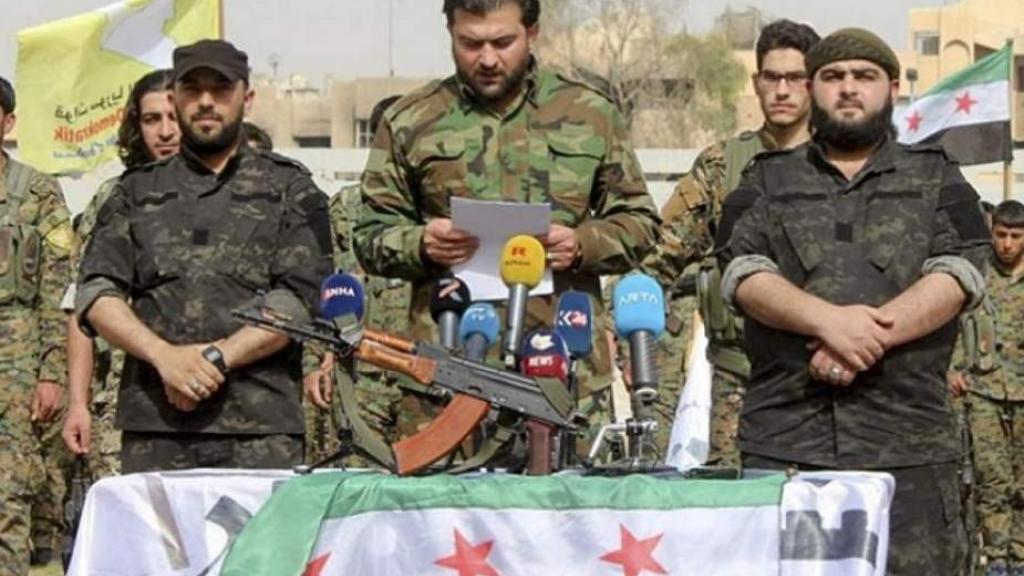
SDF and Free Syria flag

The revolution in North and Eastern Syria began in 2012 among Kurds living there, but spread to involve other nationalities in the area.

The Kurds were oppressed under the Bashar al-Assad regime. Many were denied Syrian citizenship. Land was taken from Kurds and given to Arab settlers. The Kurdish language was discriminated against. Kurdish political organisations were repressed.

The outbreak of the revolution in other parts of Syria in 2011 weakened the regime and allowed Kurdish political organisations to operate more freely.

In July 2012 there was an uprising in Kurdish areas, led by the Democratic Union Party (PYD). There was little resistance from Assad regime troops, most of whom surrendered without a fight.

In Kobani, for example, a mass of people assembled outside the army base as a delegation informed soldiers that if they gave up their weapons, their safety would be guaranteed. The soldiers agreed. Some returned to their homes in other parts of Syria, while others stayed in Kobani.1

Rojava revolution

The Kurdish area of North and East Syria is known as Rojava (meaning western Kurdistan). The uprising came to be referred to as the “Rojava revolution”.

The PYD initiated the creation of democratic structures. Base level organisations were called communes. In the countryside, a commune might be a village. In the cities, a commune might comprise a few hundred households on the same street. Each commune elected representatives to a higher level body.2

The PYD promotes equality for men and women. For example, communes and other organisations were required to have male and female co-chairs. The PYD also promotes the inclusion of all ethnic and religious groups in the democratic structures.

The PYD led in the creation of armed forces to defend the revolution. They created the People’s Protection Units (YPG) and Women’s Protection Units (YPJ). The latter is an all-women armed force.

In the rest of Syria, the popular uprising turned into a civil war. Peaceful protests were violently repressed. So, many opponents of the regime took up arms.

The problem was that weapons and money for the rebels came from Turkey and the Gulf States, who tended to support the most reactionary rebel groups, including Arab chauvinists hostile to Kurdish rights and Islamist groups hostile to religious minorities and the secular PYD. Turkey was particularly opposed to Kurdish self-determination and supported groups that were hostile to Rojava.

Daesh

The PYD distrusted both the Assad regime and many of the rebel groups. It tried to stay out of the fighting between the regime and the rebels. However, Rojava came under attack from some Turkish-backed groups. In 2014 Rojava was attacked by Daesh, or the so-called Islamic State.

Daesh captured large areas of Iraq and Syria, including Mosul, Iraq’s second largest city, after the Iraqi army collapsed there. Daesh also attempted to capture Kobane, but was driven back by Kurdish fighters and some Arab Free Syrian Army fighters.

Worried about the rise of Daesh, the United States formed an alliance with the YPG and YPJ to fight against Daesh. This was paradoxical, because the US was also supporting Turkey in its war against the Kurdistan Workers’ Party (PKK) in Turkey and northern Iraq.

The PYD follows the ideas of imprisoned PKK leader Abdullah Ocalan. The Turkish government views the PYD and PKK as essentially the same. Yet the US was supporting Turkey against the PKK while supporting the YPG and YPJ against Daesh.

Over the next few years Daesh was driven out of North and East Syria. The alliance between the YPG and YPJ and some Arab groups led to the formation of the Syrian Democratic Forces (SDF). As the war against Daesh continued, more Arabs joined the SDF. With each successful push against Daesh, more areas populated by Arabs came under SDF control.

To highlight the multi-ethnic character of North and East Syria, the Kurdish name Rojava was replaced by Democratic Autonomous Administration of North and East Syria (AANES). On the other hand, Turkey named its Syrian proxies the Syrian National Army.

In 2018, Turkey invaded Afrin, a predominantly Kurdish area in northern Syria. The SDF resisted the Turkish invasion of Afrin for more than two months, but the light weapons of the SDF were no match for the aircraft and tanks of the Turkish armed forces.

Although helping the SDF fight Daesh, the US did not help the SDF fight the Turkish invasion of Afrin. This showed the limitations of the alliance: the US has no interest in defending the revolution.

In 2019, Turkey invaded a strip of land along the border in northern Syria. Since then, Turkey and its SNA proxy have continued their attacks on AANES-controlled areas.

Syria’s future

Hay’at Tahrir al-Sham (HTS) became the dominant force in Idlib province, in north-western Syria. HTS was allied with Turkey, but not totally under Turkey’s control; it was relatively independent. In November 2024, HTS launched an offensive against the Assad regime, leading to its rapid collapse.

At the same time, Turkey and the SNA stepped up their attacks on AANES. They captured some areas west of the Euphrates river, including the towns of Tal Rifaat and Manbij. These forces are currently trying to cross the Euphrates, but the SDF is resisting this offensive. There is a battle for control of the Tishrin dam.

Meanwhile, AANES is putting forward its ideas for the future of Syria as a whole. They call for a National Dialogue Congress, which would involve “political and social organizations, as well as ethnic, religious and cultural groups” that could develop a “common social contract”.3

They also call for the liberation of the areas under Turkish occupation and for the new government in Damascus to join them in this struggle.

HTS is unlikely to agree to AANES’s proposals, but there is hope that they will gain an audience among the Syrian people beyond the north and east.

Based on a talk given to an online discussion about Syria organised by the moderators of the Marxmail discussion list.

  • 1

    Revolution in Rojava, by Michael Knapp, Anja Flach, and Ercan Ayboga, Pluto Press, 2016, page 54

  • 2

    Revolution in Rojava, p.87

  • 3

    “Peoples’ Assembly of North-East Syria presents six principles for Syrian Constitution”, ANF English https://anfenglishmobile.com/rojava-syria/peoples-assembly-of-north-east-syria-presents-six-principles-for-syrian-constitution-77461

Wednesday, August 13, 2025


IMPERIALIST TURKIYE OUT OF SYRIA!

Syrian Kurdish YPG should stop delaying Syria integration, Turkey says

"The YPG/SDF must stop its policy of playing for time," Fidan told a joint press conference with his Syrian counterpart Asaad al-Shibani in Ankara.

KURDS, DRUZE, ALAWITES & CHRISTIANS WANT A PLURALIST DECENTRALIZED STATE


Members of Kurdish People's Protection Units (YPG) stand guard as Women’s Protection Unit (YPJ) and Kurdish internal security forces conduct a security operation in al-Roj camp, Syria, April 6, 2025
.(photo credit: REUTERS/Orhan Qereman)ByREUTERSAUGUST 13, 2025 16:18

The Kurdish YPG militia, which spearheads the US-backed Syrian Democratic Forces (SDF), should stop "playing for time" and abide by its integration agreement with the Syrian government, Turkey's Foreign Minister Hakan Fidan said on Wednesday.

NATO-member Turkey has been one of Syria's main foreign allies after the ousting of Bashar al-Assad last year, while it considers both the SDF and YPG as terrorist organizations.

The SDF, which controls much of northeast Syria, signed an agreement with Damascus in March to integrate into the Syrian state apparatus.

"The YPG/SDF must stop its policy of playing for time," Fidan told a joint press conference with his Syrian counterpart Asaad al-Shibani in Ankara.

"Just because we approach (the process) with good intentions does not mean we don't see your little ruses," Fidan said.

KURDISH FIGHTERS from the People’s Protection Units (YPG) run across a street in Raqqa, Syria in July. (credit: GORAN TOMASEVIC/REUTERS)Fidan visited Damascus last week, following clashes between the SDF and Syrian government forces in Manbij and Aleppo, and after weeks of tensions between Israel and Syria over fighting between Druze and Bedouin forces around Sweida last month.


Turkey views the YPG as an extension of the PKK"A new era has begun in the region and there's a new process in Turkey. They should benefit from those positive developments," Fidan said, referring to the Kurdistan Workers Party (PKK) militant group's decision to disarm and disband.

Turkey views the YPG as an extension of the PKK but the YPG has said the disarmament call of jailed PKK leader Abdullah Ocalan did not apply to it, contradicting Ankara's view.

"We witness some developments in Syria that we find hard to tolerate," Fidan said. "We see that members (of the YPG) who came from Turkey, Iraq and Iran have not left Syria."

Shibani criticized the SDF for holding a conference which called for a review of the constitutional declaration issued earlier this year by Syrian President Ahmed al-Sharaa and said it sought to exploit the events in Sweida. He also called the conference a violation of the agreement to integrate the SDF into state institutions.

The SDF has been in conflict with Turkey-backed Syrian armed groups in northern Syria for years. Ankara has carried out several incursions against the YPG in the past and controls swathes of territory in northern Syria.

Saturday, July 29, 2023

Turkey drone attack kills 4 PKK members in Iraqi Kurdistan: Kurdish officials


HEWLÊR-Erbil, Iraqi Kurdistan region,— A drone strike carried out by Turkey on Friday resulted in the death of four suspected Kurdistan Workers Party (PKK) members and injured one in Iraq’s northern province of Sulaimani, the Iraqi Kurdistan’s counterterrorism service said in a statment.

Turkey has been involved in a long-standing campaign against PKK militants and the Syrian Kurdish YPG militia in both Iraqi Kurdistan (Bakur) and Syrian Kurdistan (Rojava), labeling them as “terrorist” groups.

The incident on Friday occurred at approximately 8:00 pm when a Turkish army drone targeted the vehicle of the PKK fighters near the village of Rangina in Sharbazher district, north of Sulaimani. The attack led to the death of four militants, and one was wounded. The vehicle was hit twice within a span of 10 minutes, as reported by Iraqi Kurdistan’s anti-terrorism services.

In May, there were two separate raids in Iraqi Kurdistan’s Sinjar district that killed six Yazidi fighters affiliated with the PKK. Local security officials attributed these strikes to Ankara.

Earlier, in late February and early March, there were more strikes in the region, which the anti-terrorism service attributed to Turkey. These attacks killed fighters from the Sinjar Resistance Units, a movement that formed to combat the Islamic State group after their atrocities against thousands of Yazidi men and women.

Turkey’s military activities in the region have led to accusations of tolerance by both the Iraqi federal authorities and the Kurdistan regional government, who seek to maintain close economic ties with Turkey.

There is an upcoming visit by Turkey’s President Recep Tayyip Erdogan, which Iraqi Prime Minister Mohammed Shia al-Sudani’s office mentioned on Tuesday without providing a specific date. The meeting is expected to focus on economic matters and address the sensitive issue of water.

Baghdad has raised concerns about the impact of upstream dams constructed by Turkey on major rivers shared with Iraq, exacerbating water shortages in the drought-hit country in recent years.

In 1984, the PKK took up arms against the Turkish state, aiming to secure greater autonomy in Turkish Kurdistan for the Kurdish minority, which accounts for over 22.5 million of the country’s 85-million population. However, the Turkish state has consistently denied their constitutional existence and their demand for autonomy. The conflict has resulted in the loss of over 40,000 lives, including both Turkish soldiers and Kurdish guerrillas.

Copyright © 2023 Ekurd.net. All rights reserved

Turkish drone kills 4 SDF members in Syrian Kurdistan: SDF


QAMISHLO, Syrian Kurdistan,— A Turkish  drone strike near the Turkey-Syria border killed on Friday four members of the Syrian Democratic Forces (SDF), the autonomous Kurdish administration in Syrian Kurdistan (Rojava) said.

In recent weeks, Turkey has escalated its drone attacks on regions controlled by the Kurdish administration in Syria, carrying out these strikes on a regular basis.

The SDF, backed by the United States, played a significant role in driving out Islamic State group fighters from Syria’s last remaining territories in 2019.

According to a press release by the SDF, the drone attack on Friday targeted a village in the Amuda region, resulting in the loss of four fighters from a self-defense group.

The Syrian Observatory for Human Rights, a UK-based war monitor with reliable sources on the ground, reported that the drone struck a training camp in Hasaka province, killing four SDF members and injuring eight. This was the second Turkish drone strike in Hasaka within 24 hours, with a previous attack on Thursday claiming the lives of three SDF fighters when their vehicles were targeted near the border.

Ankara views the People’s Protection Units (YPG), the dominant faction within the SDF, as an extension of the banned Kurdistan Workers’ Party (PKK). On Friday, On Friday, another Turkish drone attack killed four alleged PKK members in Iraqi Kurdistan.

Three employees of the autonomous Kurdish administration killed on June 20th by a Turkish drone strike.

Figures from the Syrian Observatory indicate that, since the start of the year, Turkish drone strikes have caused the loss of 48 lives in Kurdish-majority areas, comprising 10 civilians and 35 members of the SDF or allied fighters.

Additionally, Turkey has conducted several ground operations since 2016 to displace Kurdish forces from northern Syrian border areas.

Since 2016, Ankara has launched three incursions into northern Syria, capturing extensive stretches of Kurdish land and penetrating around 30 kilometers into the country. These military operations primarily focused on targeting the U.S.-backed Syrian Kurdish YPG militia.

The Kurdish Democratic Union Party (PYD) and its powerful military wings, the YPG/YPJ, have earned recognition as the most effective fighting force against the Islamic State (IS) in Syria. The United States has provided them with arms to support their efforts. The YPG, serving as the backbone of the Syrian Democratic Forces (SDF), serving as the de facto army for the autonomous Kurdish administration in Syrian Kurdistan (Rojava), has successfully captured large areas of Syria from the Islamic State.

In 2013, the Syrian Kurdish Democratic Union Party (PYD), which serves as the political wing of the Kurdish People’s Protection Units (YPG), established three autonomous Cantons named Jazeera, Kobani, and Afrin, establishing a Kurdish government across Syrian Kurdistan. Later, on March 17, 2016, Kurdish and Arab authorities jointly declared the formation of a “federal region” comprising these semi-autonomous areas within Syrian Kurdistan.

Subsequently, on January 20, 2018, Turkey initiated a military operation against the YPG in the Kurdish canton of Afrin. This operation was backed by Syrian Islamic mercenary fighters, resulting in the YPG being forced out of Afrin on March 18.

On September 6, 2018, the Democratic Autonomous Administration of North and East Syria was declared in Ain Issa. Ever since, the Autonomous Administration has been responsible for implementing the principles of democratic confederalism in various municipalities and regions across North-East Syria.

The worldwide-respected PYD-led Autonomous Administration in northern Syria operates under a secular and decentralized self-rule model, with a strong emphasis on promoting equality between men and women, fostering direct democracy, and prioritizing environmental responsibility.

Turkey opposes and fears the establishment of an autonomous region for the Kurds in northern Syria similar to the Kurdish region in northern Iraq or the creation of an independent Kurdish state, according to experts.

Copyright © 2023 Ekurd.net. All rights reserved