Showing posts sorted by relevance for query PRIVATIZED WAR. Sort by date Show all posts

Tuesday, April 21, 2020

DONALD TRUMP AND ERIK PRINCE'S PRIVATIZATION OF WAR


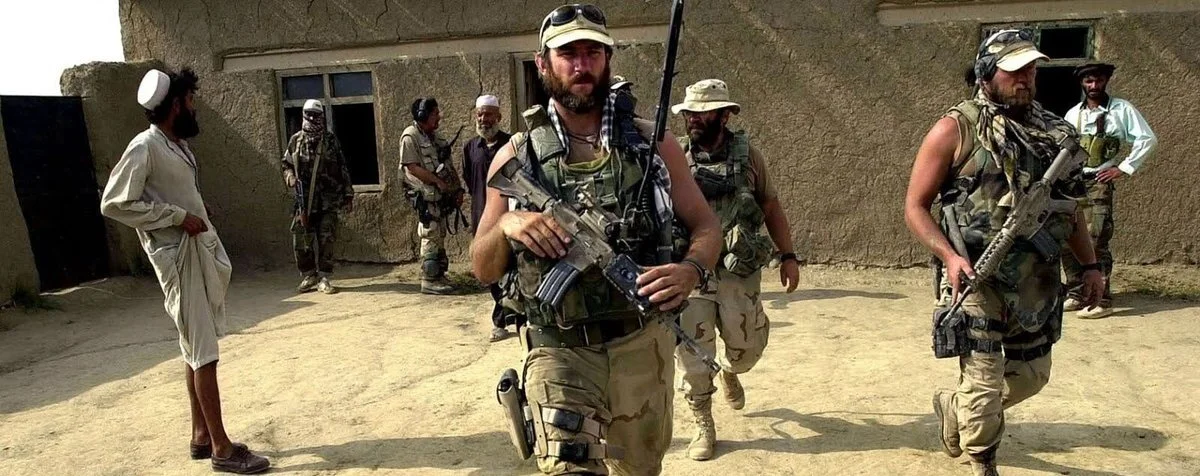
(Pictured: Corporate mercenaries in Afghanistan)

By James Richard Marra

During my career as a business analyst, I learned much about why and how some businesses succeed while others fail. Failure may result from higher wage levels, employee health insurance costs, or market conditions. Nevertheless, it generally occurs due to poor management: owner incompetence, arrogance, and greed, insensitivity to fundamental business factors and best practices, or a flawed understanding of their markets and competitors.

I bring this up because the neofascist governance in Washington and its corporate partners are wooing Americans toward another imperial catastrophe in the Middle East, this time involving Iran. For these capitalists, much is never enough. So as expected, the military-technology-surveillance complex (MTSC) wishes to expand its profitable productive capacity into new or under-exploited war-commodity markets. The success of this expansion depends upon careful attention to geographic, material, and operational considerations. Best business practices demand that the MTSC develops a sound plan by first consulting experts in these areas. These factors might include those identified by the famous military theorist Carl von Clausewitz. For von Clausewitz, the three pillars of warfare are strategy, operations, and tactics. Within the MTSC’s production and marketing plans, these required military functions are transformed into profitable exchange values - money. If this program is managed well, the sky is the limit. If not, failure will likely come.

With these thoughts in mind, we might consider the case of Erik Prince, the ex-Navy Seal and founder/CEO of the failed and criminally mercenary service provider Blackwater. In 2018, Prince, the brother of Education Secretary, and public-education privatizer, Betsy DeVos, approached the Trump Administration with a proposal to privatize the Afghan War. Prince’s dog-and-pony show claimed that the war could be waged more economically and efficiently, while deploying fewer troops in smaller specialized units.

Neofascists, like Steve Bannon, invited further discussion and exploration. This is not surprising because fascism of any sort, including today's neofascism, is an artful alliance of an anti-conventional and zealous "Leader," a hyper-nationalistic culture, and an exceptionally exploitative form of capitalism. Trump's fascism gets its "neo" in part from the fact that today's capitalism is largely unfettered, "neoliberal," finance-and-service-dominated, and monopolized. This current form differs from the manufacturing capitalism that dominated the world economy from the 1920s to the 1980s. Furthermore, history reminds us that, while Hitler disliked “industrialists,” he admired Henry Ford to the extent that, in 1938, he bestowed upon him the Grand Cross of the German Eagle.

Now, capitalism opposes worker control over their labor power. The military command structure epitomizes this, as unions are banned and the demands made upon military labor (soldiers) go unquestioned. Likewise, fascist governance requires that workers absolutely obey the will of the political Leader, as it is transformed into the productive operations in which workers participate.

Both Prince and Bannon recognized a profitable business opportunity enabled by the structural efficiencies fascism offers within a privatized war market. In this model, military needs are continually identified and marketed by the Leader and the MTSC through their political minions and the capitalist media. Once workers are indoctrinated to the benefits of war, the MTSC transforms those needs into corresponding commodities. Vast amounts of capital are provided by taxes largely levied upon the working class. Politically trumped up fears of the working class not only provide a market incentive, but also mobilize workers’ labor power, both on and off the battlefield.

Trump’s military and other members of the MTSC balked at Prince’s scheme. Generals Mattis, Kelly, and McMaster ensured that Prince’s folly was a non-starter. Given this, a question arises: How could a neofascist mercenary's neofascist proposal to a neofascist Leader fail? Prince is neither an idiot nor a novice. His operational capabilities have been successfully field-tested, are marshaled by a highly skilled cadre of special-forces experts, and bolstered by significant international technical and political support.

It occurs to me that Prince’s business failure significantly resides in his misunderstanding of the contemporary war market and its players. He doesn’t understand his competitors’ collective business model, its functional role within the neofascist governance, or its monopolistic structure. Prince’s arrogance leads him to believe he can slither his way directly to the top of the neofascist food chain, biting off a prime piece of the war market without complaint from the big players. That might work if the market were immature, and competition largely relevant to profitability. But today’s market is both mature and well organized. Leading participants synergistically avoid price wars, fight unions and organizing efforts, fund think tanks and lobbyists, contribute to the campaign coffers of servile politicians, and meet together at national and global conferences to determine market rules.

Dominant corporations viscously defend themselves from the competitive risks presented by new and less mature companies. Thus, corporations join in a “co-respective” market behavior that largely guarantees their continuing control and profitability.

Alex Hollings asks:


So why didn’t Trump...a business man that values bottom-line savings, sign off on it?...Steve Bannon, Trump’s recently fired chief strategist, was said to support Prince’s plan, but the Generals Mattis, Kelly, and McMaster have all dismissed it. For those in Bannon’s corner, they argue it’s because he’s the outsider, free from the political pressures of the military industrial complex.

A congressional aide attending the meeting reported, “The adults hate it.”

There is another potential problem, although one that might offer a silver lining for Prince: the laws that govern American wars. These pesky laws make it more difficult for any privatized war business to control production, supply, and operational management. For a privatized war commodity to be successful, businesses require that civilian leadership regularly deliver new war-needs, which would motivate market demand. While both Democrats and Republicans are quick to fund occasional “short” wars, that isn’t enough. What is needed is a government that will go to war as unhesitatingly and continually, as Hitler did devouring the nations of Europe. A fascist leadership is ideal because it considers war to be among the noblest of human endeavors, and resists conventional or legal restraints imposed by “decadent” liberal democracies.

However, today’s renewed calls for limits upon the now imperial presidency from the American left illustrate the business risk represented by not appreciating the vicissitudes involved in political strategy. Prince’s short-term thinking led him to largely ignore the fact that presidents come and go. Public opinion changes with the lifting of a TV remote, and politicians the chase political winds like a bloodhound after a jackrabbit through a lush Kentucky meadow. Prince failed to appreciate that his business success hinged on controlling the dance card at a capitalist senior prom to which he is not invited.

My references to “neofascism” may annoy some folks: "You’re calling Trump a neofascist just because you don’t like his politics!” Although I find Trump's politics uniquely vile, that fact doesn’t inform my understanding of a “Futurist”-inspired fascism. To understand Futurism, let's allow it to speak for itself.

Futurists wish to


...sing the love of danger, the habit of energy and boldness.

...extol aggressive movement, feverish insomnia, the double-quick step, the somersault, the box on the ear, the fisticuff.

...to destroy the museum, the libraries, to fight against moralism, feminism and all opportunistic and utilitarian malignancy.

...glorify war - the only health-give [sic] of the world - militarism, patriotism, the destructive arm of the Anarchist, the beautiful ideas that kill, and contempt for woman.

These pleasantries might well have come from Donald Trump or one of his torch-bearing neo-Nazi devotees. But, they are offered by the founder of the Futurist movement, Filippo Tommaso Marinetti, in Futurist Aristocracy (1923), edited by the Italian Futurist Nanni Leone Castelli. As such, they illuminate a frightening Futurist thread between contemporary Trumpian neofascism and its historical roots. Benito Mussolini was a Futurist of sorts, and was seen by many contemporaries, Italian or otherwise, as the epitome of the aggressive and spontaneous Futurist hero. Here are a few priceless insights from Benito Mussolini’s (with Giovanni Gentile) 1932 article “Doctrine of Fascism.”


[Fascism]...repudiates the doctrine of Pacifism....[W]ar alone brings up to their highest tension all human energies and puts the stamp of nobility upon the peoples who have the courage to meet it.

For Fascism the tendency to Empire, that is to say, to the expansion of nations, is a manifestation of vitality...

Fascism attacks the whole complex of democratic ideologies and rejects them both in their theoretical premises and in their applications or practical manifestations. [F]ascism denies that the majority, through the mere fact of being a majority, van [sic] rule human societies; it denies that this majority can govern by means of a periodical consultation; it affirms the irremediable, fruitful and beneficent inequality of men, who cannot be leveled by such a mechanical and extrinsic fact as universal suffrage.

Against individualism, the Fascist conception is for the State; and it is for the individual in so far as he coincides with the State, which is the conscience and universal will of man in his historical existence.

Fascism, in short, is not only the giver of laws and the founder of institutions, but the educator and promoter of spiritual life. It wants to remake, not the forms of human life, but its content, man, character, faith. And to this end it requires discipline and authority that can enter into the spirits of men and there govern unopposed.

These happy thoughts tighten the historical thread that connects Mussolini’s historical fascism to Trump’s regime, as transmitted through pseudo-intellectuals like Steve Bannon and Sebastian Gorka. This fascist mentality now commands the most powerful military force in human history. Trump’s behavior in both deed and word is a litany of fascist, and therewith Futurist, virtues.

Possessing the legal and political prerequisites for endless warfare, war enterprises need capital to fuel ongoing accumulation. War profiteers understand that citizens purchase war commodities in the sense that they accede to the Constitutional requirement that they pay war costs through taxation. In the current war market, temporary wars no longer provide the required market potential or capital. Fighting temporary wars no longer makes market sense. Instead, the working class must purchase a product that is always urgently needed, requiring continuing maintenance, like the family car. To ensure the needed profitability, war is sold as an indispensable civic need, based upon a continually present danger. That danger comes conveniently from “terrorists,” a term whose meaning is so muddled that it can apply to anyone, anywhere, anytime, anyhow.

With the proper social and political indoctrination, and product marketing, citizens happily surrender their Constitutional right to decide against whom, where, when, and how they sacrifice themselves to the god of imperial war. They are invited by a monopoly of war service providers to choose between column A or column A. Americans now enjoy a neofascist Leader in the White House, and a semi-fascist congress willing to pass mushrooming military budgets. If there were a Constitutional challenge to this state of affairs, the matter would be decided by a Supreme Court infested with neoliberal sycophants. Thus, endless war, as always under capitalism, becomes a good business investment, and therefore good governance.

Under Trump's neofascism, the Leader commands the “supply side” of the war market. Taxes on war businesses are deeply cut, while those enterprises become decreasingly deregulated and increasingly empowered. Under contemporary capitalism, the distinction between the sales effort, which invents new needs, and commodity production is largely dissolved. With the rise of a privatized war market, the traditional relationship between democratic governance and the “invisible” divine hand that supposedly guides markets is, to echo Mussolini, "repudiated." The MTSC is now fully absorbed within the structural operations of the governance, and vice versa. The business role of the Leader is to manage a permanent war-marketing project that inspires the continuing development of new war commodities. Thus, the US Defense Department is “deconstructed” (to use one of Bannon’s favorite words), only to emerge refreshed as the Fannie Mae of American global capitalist dominance.

In sum, Prince’s business proposal was ill conceived, misinformed, and poorly timed. It suffered from management problems that most failed businesses experience. While Prince, like Trump, may have obtained some measure of business success by bullying the defenseless and lying about much, both have left an ultimate legacy of business failure and bankruptcy. Unfortunately, Trump was provided a place at the head of the capitalist table by a rapacious Republican Party and its white nationalist supporters. It will remain to be seen if Prince learns some lessons and abandons his unprofitable arrogance in favor of sound business judgment. For the sake of the American working class, I hope that won’t happen.

Saturday, March 21, 2020

War Profiteering is Real

by SARAH ANDERSON

The prospect of war with Iran is terrifying.

Experts predict as many as a million people could die if the current tensions lead to a full-blown war. Millions more would become refugees across the Middle East, while working families across the U.S. would bear the brunt of our casualties.

But there is one set of people who stand to benefit from the escalation of the conflict: CEOs of major U.S. military contractors.

This was evident in the immediate aftermath of the U.S. assassination of a top Iranian military official on January 2. As soon as the news reached financial markets, these companies’ share prices spiked.

Wall Street traders know that a war with Iran would mean more lucrative contracts for U.S. weapons makers. Since top executives get much of their compensation in the form of stock, they benefit personally when the value of their company’s stock goes up.

I took a look at the stock holdings of the CEOs at the top five Pentagon contractors (Lockheed Martin, Boeing, General Dynamics, Raytheon, and Northrop Grumman).

Using the most recent available data, I calculated that these five executives held company stock worth approximately $319 million just before the U.S. drone strike that killed Iranian leader Qasem Soleimani. By the stock market’s closing bell the following day, the value of their combined shares had increased to $326 million.

War profiteering is nothing new. Back in 2006, during the height of the Iraq War, I analyzed CEO pay at the 34 corporations that were the top military contractors at that time. I found that their pay had jumped considerably after the September 11 attacks.

Between 2001 and 2005, military contractor CEO pay jumped 108 percent on average, compared to a 6 percent increase for their counterparts at other large U.S. companies.

Congress needs to take action to prevent a catastrophic war on Iran. De-escalating the current tensions is the most immediate priority.

But Congress must also take action to end war profiteering. In 2008, John McCain, then a Republican presidential candidate, proposed capping CEO pay at companies receiving financial bailouts. He argued that CEOs relying on taxpayer funds should not earn more than $400,000 — the salary of the U.S. president.

That commonsense notion should be extended to all companies that rely on massive taxpayer-funded contracts. Senator Bernie Sanders, for instance, has a plan to deny federal contracts to companies that pay their CEOs excessively. He would set the CEO pay limit for major contractors at no more than 150 times the pay of the company’s typical worker.

Currently, the sky’s the limit for CEO pay at these companies — and the military contracting industry is a prime offender. The top five Pentagon contractors paid their top executives $22.5 million on average in 2018.

CEO pay restrictions should also apply to the leaders of privately held government contractors, which currently don’t even have to disclose the size of their top executives’ paychecks.

That’s the case for General Atomics, the manufacturer of the MQ-9 Reaper that carried out the assassination of Soleimani. Despite raking in $2.8 billion in taxpayer-funded contracts in 2018, the drone maker is allowed to keep executive compensation information secret.

We do know that General Atomics CEO Neal Blue has prospered quite a bit from taxpayer dollars. Forbes estimates his wealth at $4.1 billion.

War is bad for nearly everyone. But as long as we allow the leaders of our privatized war economy to reap unlimited rewards, their profit motive for war in Iran — or anywhere — will persist.


JANUARY 17, 2020
More articles by:SARAH ANDERSON

Meet the Corporate War Profiteers Making a Killing on Trump's Attacks on Iran

As long as the top executives of our privatized war economy can reap unlimited rewards, the profit motive for war in Iran—or anywhere—will persist.

by Sarah Anderson

We can put an end to dangerous war profiteering by denying federal contracts to corporations that pay their top executives excessively. (Photo: Chris Devers / Flickr)

CEOs of major U.S. military contractors stand to reap huge windfalls from the escalation of conflict with Iran. This was evident in the immediate aftermath of the U.S. assassination of a top Iranian military official last week. As soon as the news reached financial markets, these companies’ share prices spiked, inflating the value of their executives’ stock-based pay.

I took a look at how the CEOs at the top five Pentagon contractors were affected by this surge, using the most recent SEC information on their stock holdings.

Northrop Grumman executives saw the biggest increase in the value of their stocks after the U.S. airstrike that killed Qasem Suleimani on January 2. Shares in the B-2 bomber maker rose 5.43 percent by the end of trading the following day.

Wesley Bush, who turned Northrop Grumman’s reins over to Kathy Warden last year, held 251,947 shares of company stock in various trusts as of his final SEC Form 4 filing in May 2019. (Companies must submit these reports when top executives and directors buy and sell company stock.) Assuming Bush is still sitting on that stockpile, he saw the value grow by $4.9 million to a total of $94.5 million last Friday.

New Northrop Grumman CEO Warden saw the 92,894 shares she’d accumulated as the firm’s COO expand in value by more than $2.7 million in just one day of post-assassination trading.

Lockheed Martin, whose Hellfire missiles were reportedly used in the attack at the Baghdad airport, saw a 3.6 percent increase in price per share on January 3. Marillyn Hewson, CEO of the world’s largest weapon maker, may be kicking herself for selling off a considerable chunk of stock last year when it was trading at around $307. Nevertheless, by the time Lockheed shares reached $413 at the closing bell, her remaining stash had increased in value by about $646,000.

What about the manufacturer of the MQ-9 Reaper that carried the Hellfire missiles? That would be General Atomics. Despite raking in $2.8 billion in taxpayer-funded contracts in 2018, the drone maker is not required to disclose executive compensation information because it is a privately held corporation.

We do know General Atomics CEO Neal Blue is worth an estimated $4.1 billion—and he’s a major investor in oil production, a sector that also stands to profit from conflict with a major oil-producing country like Iran.


Suleimani’s killing also inflated the value of General Dynamics CEO Phebe Novakovic’s fortune. As the weapon maker’s share price rose about 1 percentage point on January 3, the former CIA official saw her stock holdings increase by more than $1.2 million.

Raytheon CEO Thomas Kennedy saw a single-day increase in his stock of more than half a million dollars, as the missile and bomb manufacturer’s share price increased nearly 1.5 percent. Boeing stock remained flat on Friday. But Dennis Muilenberg, recently ousted as CEO over the 737 aircraft scandal, appears to be well-positioned to benefit from any continued upward drift of the defense sector.

As of his final Form 4 report, Muilenburg was sitting on stock worth about $47.7 million. In his yet to be finalized exit package, the disgraced former executive could also pocket huge sums of currently unvested stock grants.

Hopefully sanity will soon prevail and the terrifyingly high tensions between the Trump administration and Iran will de-escalate. But even if the military stock surge of this past Friday turns out to be a market blip, it’s a sobering reminder of who stands to gain the most from a war that could put millions of lives at risk.

We can put an end to dangerous war profiteering by denying federal contracts to corporations that pay their top executives excessively. In 2008, John McCain, then a Republican presidential candidate, proposed capping CEO pay at companies receiving taxpayer bailouts at no more than $400,000 (the salary of the U.S. president). That notion should be extended to companies that receive massive taxpayer-funded contracts.

Sen. Bernie Sanders, for instance, has a plan to deny federal contracts to companies that pay CEOs more than 150 times what their typical worker makes.

As long as we allow the top executives of our privatized war economy to reap unlimited rewards, the profit motive for war in Iran—or anywhere—will persist.


Sarah Anderson directs the Global Economy Project of the Institute for Policy Studies, and is a co-editor of Inequality.org. @Anderson_IPS

Military spending: 20 companies profiting the most from war
Samuel Stebbins and Evan Comen
24/7 Wall Street

There was a 1.1 percent increase in global military spending in 2017, according to the Stockholm International Peace Research Institute.

The global rise was driven partially by a $9.6 billion hike in U.S. arms expenditure – the United States is the world’s largest defense spender by a wide margin. Though it is yet unclear what the growing arms investments will mean for international relations, major defense contractors around the world stand to benefit.

Total arms sales among the world’s 100 largest defense contractors topped $398 billion in 2017 after climbing for the third consecutive year. Notably, Russia, one of the countries with the fastest growing militaries over the last decade, became the second largest arms-producing country, overtaking the United Kingdom for the first time since 2002. The United States’ position as the top arms-producing nation in the world remains unchanged, and for now unchallenged.

The United States is home to five of the world’s 10 largest defense contractors, and American companies account for 57 percent of total arms sales by the world’s 100 largest defense contractors, based on SIPRI data.

Maryland-based Lockheed Martin, the largest defense contractor in the world, is estimated to have had $44.9 billion in arms sales in 2017 through deals with governments all over the world. The company drew public scrutiny after a bomb it sold to Saudi Arabia was dropped on a school bus in Yemen, killing 40 boys and 11 adults. Lockheed’s revenue from the U.S. government alone is well more than the total annual budgets of the IRS and the Environmental Protection Agency, combined.

24/7 Wall St. reviewed data provided by the Stockholm International Peace Research Institute to identify the companies profiting most from war. Companies were ranked based on arms sale revenue. Chinese companies were not considered due to lack of sufficient data. Total 2017 revenue and arms sales were provided by SIPRI. Profits and total sales came from fiscal year 2017 annual financial disclosures filed with the U.S. Securities and Exchange Commission or published independently. Employee counts are the most recent available estimates, and are in some cases from corporations’ 2018 financial disclosures.


20. Textron


• Country: United States
• Arms sales: $4.1 billion
• Total sales: $14.2 billion
• Profit: $1.2 billion
• Employees: 35,000

Textron, based in Providence, Rhode Island, is one of 11 American companies to rank among the world's largest defense contractors. The company ranks 20th among companies profiting the most from war in 2017 with $4 billion in arms sales through its subsidiaries, which include Bell Helicopter and Textron Systems.Though the majority of Textron's revenue comes from deals in the United States and Canada, the company also does business in the Middle East, Asia, and Europe. Textron defense products include armored vehicles, unmanned aircraft, and attack helicopters.

While it is one of the largest defense companies in the world, over 70 percent of Textron's revenue comes from commercial deals. The company's non-military subsidiary aircraft brands include Cessna and Beechcraft.

19. Naval Group• Country: France
• Arms sales: $4.1 billion
• Total sales: $4.2 billion
• Profit: $36.5 million
• Employees: 13,429

French industrial conglomerate Naval Group sold $4.1 billion worth of arms in 2017, among the most of any company worldwide. One of the oldest companies on this list, Naval Group's business activities date back to the early 17th century, when the group built the French Navy's Mediterranean and Atlantic fleets. Today, Naval Group is the leading provider of naval defense systems in Europe.

Some of the major innovations throughout the company's history include the launch of La Gloire, the first ironclad steam frigate, in 1858, and the launch of Le Redoutable, the first ballistic nuclear submarine, in 1967. In recent years, some of the company's most lucrative contract work has included the delivery of the FREMM Tahya Misr frigate to the Egyptian Navy, completed in 2015, and a commitment to build 12 submarines for the Royal Australian Navy, awarded in 2016.

18. Leidos
• Country: United States
• Arms sales: $4.4 billion
• Total sales: $10.2 billion
• Profit: $242.0 million
• Employees: 31,000

Nearly half of the $10.2 billion in revenue of Virginia-based technology company Leidos in 2017 came from its defense and intelligence division. The company's services include IT infrastructure, data analytics, cyber security, logistics, surveillance vehicle and equipment development and maintenance, and consulting. Its defense clients include the U.S. Air Force, Army, Navy, and NATO.

Though the majority of the company's revenue comes from contracts outside of the defense industry, the company's history with the federal government goes back almost to its founding in 1969. The following year, Leidos won a contract with the Defense Nuclear Agency, now known as the Defense Threat Reduction Agency.

17. Rolls-Royce

• Country: United Kingdom
• Arms sales: $4.4 billion
• Total sales: $19.3 billion
• Profit: $5.3 billion
• Employees: 50,000

Rolls-Royce Holdings is separate from Rolls-Royce Motor Cars, the luxury automobile manufacturer, having sold the Rolls-Royce brand name and logo to German group BMW in 1998. While Rolls-Royce Holdings sold $4.4 billion worth of military products and services in 2017 – making it the 17th largest defense contractor in the world – weapons manufacturing accounts for a relatively small share of the company's total revenue. Today, the largest share Rolls-Royce Holdings' revenue comes from civil aerospace, followed by power systems, defense aerospace, marine, and nuclear technology.

Some of Rolls-Royce's major defense contracts in 2017 included renewals with the U.S. Department of Defense for supporting approximately 3,000 engines on aircraft such as the C-130 Hercules and T-45 Goshawk, and engine orders from the Japanese Self-Defense Force for its new V-22 Osprey fleet.

16. Honeywell International


• Country: United States
• Arms sales: $4.5 billion
• Total sales: $40.5 billion
• Profit: $1.7 billion
• Employees: 114,000

New Jersey-based Honeywell International sells its software and consulting services in a range of industries, including health care, oil and gas, manufacturing, and industrials. In addition, defense contracts accounted for about 11 percent of the company's 2017 revenue. For decades, Honeywell has had a contract with the U.S. Army to develop longer range weapons systems, operating systems for unmanned aerial vehicles, and missile navigation systems. The company has also manufactured over 6,000 T55 engines, which the Army uses in its iconic heavy-lift Chinook helicopter. The company has an ongoing partnership with the Army for maintaining and overhauling the engines.

Honeywell has defense contracts with foreign governments as well, inking a deal with the U.K. in 2016 to install navigation systems in the British Army's AJAX armored fighting vehicles.


15. United Shipbuilding Corp.

• Country: Russia
• Arms sales: $5.0 billion
• Total sales: $5.6 billion
• Profit: $101.0 million
• Employees: 80,000

The United Shipbuilding Corporation was established in March 2007 in accordance with a decree from Russian President Vladimir Putin. The state-owned defense contractor sold $5.0 billion worth of arms in 2017, the third most of any Russian company and among the most of any worldwide. Arms sales accounted for 89 percent of USC's total revenue for the year.

In July 2014, USC was added to a list of companies banned from doing business in the United States by the U.S. Department of the Treasury. The sanctions were imposed in response to Russia's continued support for separatists in eastern Ukraine.

14. United Aircraft Corp.

• Country: Russia
• Arms sales: $6.4 billion
• Total sales: $7.7 billion
• Profit: $325.3 million
• Employees: 98,000

Since the breakup of the Soviet Union in 1991, Russia has been transitioning to a privatized economy. The defense industry, however, remains almost entirely state-owned. The United Aircraft Corporation was established by decree of Russian President Vladimir Putin in early 2006. While the company manufactures civil and special purpose aircraft, over 80 percent of its $7.7 billion in revenue in 2017 came from arms sales. UAC's military aircraft include MiG, Sukhoi, and Yak fighter jets. Though based in Russia, UAC has partners in India and Italy.

13. Huntington Ingalls Industries


• Country: United States
• Arms sales: $6.5 billion
• Total sales: $7.4 billion
• Profit: $479.0 million
• Employees: 38,000

Shipbuilder Huntington Ingalls Industries of Newport News, Virginia, is the sole manufacturer of nuclear-powered aircraft carriers in the United States and is responsible for 70 percent of the U.S. Navy's current marine fleet. According to SIPRI, HII brought in $6.5 billion in defense revenue in 2017, the eighth most of any U.S. company and 13th most worldwide. Some of the major contracts awarded to HII in 2017 included upgrades the Arleigh Burke-class guided missile destroyer Jack H. Lucas, development on the U.S. Navy's new Columbia-class submarines, and providing nuclear waste cleanup services at the Los Alamos National Laboratory in New Mexico.

In addition to manufacturing nuclear-powered aircraft carriers and submarines, surface combatants, amphibious assault and transport vehicles, and Coast Guard Cutters, HII offers technical solutions services in such fields as information technology and oil and gas engineering. Non-defense related activities accounted for 13 percent of HII revenue in 2017.
12. L-3 Technologies

• Country: United States
• Arms sales: $7.8 billion
• Total sales: $9.8 billion
• Profit: $693.0 million
• Employees: 31,000

L-3 Communications changed its name to L-3 Technologies on Dec. 31, 2016. The $7.8 billion in arms sales the company made in 2017, according to SIPRI estimates, was effectively unchanged from the previous year. The company's operations include intelligence, surveillance, and reconnaissance products and services in the United States, Canada, Europe, and Australia. The company's communication technology is integrated to the Predator and Global Hawk drones and is used in U.S. Army communication infrastructure. L-3 also designs power distribution systems and communication technology used by the U.S. Navy's Virginia-class submarine.

in 2017, contracts with foreign governments totaled $1.4 billion in sales, a fraction of the $6.3 billion in contracts L-3 had with the Department of Defense.
11. United Technologies Corp.

• Country: United States
• Arms sales: $7.8 billion
• Total sales: $59.8 billion
• Profit: $4.9 billion
• Employees: 240,000

Largely through its subsidiary brands Collins Aerospace and Pratt & Whitney, United Technologies is one of the largest defense contractors in the world. Collins Aerospace designs and sells advanced systems for military helicopters, including rescue hoists, autopilot systems, and laser guided weapon warning systems. Pratt & Whitney designs and manufactures engines currently in use by 34 militaries worldwide. In the U.S. military, the F-22 Raptor, F-16, and F-15 fighter jets, as well as the C-17 Globemaster III, are just a few of examples of military aircraft powered by Pratt & Whitney engines.

In late 2018, United Technologies announced plans to split into three independent companies. The company's defense division will remain under the United Technologies name, while the Otis Elevator Company and Carrier HVAC company will break off as independent entities. 


10. Almaz-Antey

• Country: Russia
• Arms sales: $8.6 billion
• Total sales: $9.1 billion
• Profit: $422.6 million
• Employees: 129,000

Established in 2002 under the direction of Russian President Vladimir Putin, Almaz-Antey is the largest known state-owned defense contractor, as measured by revenue, in the world. Almaz-Antey primarily manufactures surface-to-air missile systems for use by the Russian military. Due to increasing domestic and foreign demand, Almaz-Antey's arm sales rose 17 percent from 2016 to 2017, one of the largest increases of any defense company. The Moscow-based contractor had $8.6 billion in arms sales in 2017, according to SIPRI. This was the most of any Russian company and the 10th most worldwide – the highest position occupied by a Russian company since SIPRI began tracking international arms sales.

In July 2014, Almaz-Antey was added to a list of companies banned from doing business with the United States by the U.S. Department of the Treasury. The sanctions were imposed against the company for its involvement in Russia's continued support for separatists in eastern Ukraine and occupation of Crimea.

9. Leonardo

• Country: Italy
• Arms sales: $8.9 billion
• Total sales: $13.0 billion
• Profit: $310.3 million
• Employees: 45,134

Named after the Tuscany-born Renaissance man, Leonardo is the only Italian company to rank among the world's largest defense contractors. The company has products and services in multiple branches of defense, including land and naval electronics, information systems, helicopters, jet aircraft, and unmanned aerial vehicles. Leonardo also manufactures weapons systems, torpedoes, and ammunition for naval and land artillery. Leonardo products and services are used in 150 countries. After Italy, the company's largest customers are the U.K., U.S., and Poland.

8. Thales

• Country: France
• Arms sales: $9.0 billion
• Total sales: $17.8 billion
• Profit: $931.1 million
• Employees: 65,000

This Paris-based contractor, which offers products and services in land, air, sea, and cyber defense, went from the world's ninth largest defense contractor in 2016 to eighth largest in 2017 after its total arms sales jumped 7 percent from $8.4 billion to $9.0 billion. Late last year, the company announced a deal with the French Navy to install seven new radar systems on frigates for missile fire control. When released, 2018's figures may show even more growth for the company. As of the first quarter of 2018, the value of all orders increased 34 percent from the first quarter of 2017.

7. Airbus Group

• Country: Trans-European
• Arms sales: $11.3 billion
• Total sales: $75.2 billion
• Profit: $3.3 billion
• Employees: 133,671

Though the company's primary business is in commercial and private aircraft, Airbus is the second largest defense contractor in Europe. Airbus has taken orders for over 600 of its Eurofighter Typhoon jet from a number of countries, including Austria, Saudi Arabia, Kuwait, and Qatar. The company has also taken hundreds of orders for its A400M and C295 transport aircraft. Airbus makes secure communication devices for a client list that includes NATO and the French Navy. Like many other companies on this list, Airbus is involved in cybersecurity and has worked with defense departments of countries across Europe to protect vulnerable systems from cyber threats.

6. General Dynamics Corp.

• Country: United States
• Arms sales: $19.5 billion
• Total sales: $31.0 billion
• Profit: $2.9 billion
• Employees: 105,600

Incorporated in 1952, General Dynamics has sold a wide range of armaments, including missiles, warships, submarines, and rockets to all branches of the U.S. military since its beginning. In 2017, the Falls Church, Virginia, contractor sold $19.5 billion worth of arms, the fifth most of any U.S. company and the sixth most of any company worldwide. In 2017, the company received a $5.1 billion contract to design and develop a prototype of the Columbia-class submarine and delivered the latest iteration of the Abrams tank to the U.S. Army. GD is also the company behind the new Arleigh Burke-class Destroyer and Zumwalt-class guided-missile destroyer, developed and built at its plant in Bath, Maine. Like a number of other companies on this list, GD also provides communications, IT, and cyber security products and services.


5. Northrop Grumman Corp.

• Country: United States
• Arms sales: $22.4 billion
• Total sales: $25.8 billion
• Profit: $2.0 billion
• Employees: 85,000

The company now known as Northrop Grumman was founded in Hawthorne, California, in 1939. The company built its first aircraft, the N-3PB patrol bomber, for the Norwegian Air Force in 1940, and it has since expanded into four primary business sectors: aerospace systems, innovation systems, mission systems, and technology services. Northrop Grumman pioneered the Flying Wing concept – an aircraft with no tail or definitive fuselage in which most of the crew, payload, and equipment is situated in the main wing structure – and incorporated the technology in its B-2 stealth bomber line.

According to SIPRI, Northrop Grumman made $22.4 billion in arms sales in 2017, the fourth most of any company in the United States and the fifth most of any company worldwide. Some of the major contracts won by Northrop Grumman in 2017 include a $750 million deal to provide maintenance services for the U.S. Army's Special Electronic Mission Aircraft fleet and a $265 million deal to provide maintenance and logistics support for the U.S. Air Force's Battlefield Airborne Communications Node system.
4. BAE Systems

• Country: United Kingdom
• Arms sales: $22.9 billion
• Total sales: $23.5 billion
• Profit: $1.1 billion
• Employees: 83,200

BAE Systems is the largest defense contractor based in the United Kingdom, and the fourth largest in the world. The company builds ground combat vehicles – including the Challenger 2, the main battle tank for both the British Army and Royal Army of Oman – for different situations and clients. The company is also in the early years of a decade-long contract with the U.K.'s Royal Air Force to support its fleet of Typhoon fighter jets, and it is assisting in the continued development of the F-35 fighter jet in a partnership with U.S. companies Northrop Grumman and Lockheed Martin.

While many other companies on this list also have a lucrative deals with private and commercial clients, 98 percent of BAE Systems' 2017 revenue came from arms deals.
3. Raytheon

• Country: United States
• Arms sales: $23.9 billion
• Total sales: $25.3 billion
• Profit: $2.0 billion
• Employees: 67,000

The third largest defense contractor in the world, Raytheon is a missile defense and long-range precision weapons maker headquartered in Waltham, Massachusetts. Through customers in over 80 countries, the company reported $25.3 billion in revenue in 2017, 94 percent of which came from arms sales and defense contracts. The United States and many of its allies rely on the company's radars and ballistic missile interceptors as part of their defense strategy. Raytheon also makes a wide range of air-to-surface, surface-to-air, air-to-air, and surface-to-surface precision guided missiles, in addition to bombs, torpedoes, and tactical small-arms sights.


2. Boeing

• Country: United States
• Arms sales: $26.9 billion
• Total sales: $93.4 billion
• Profit: $8.2 billion
• Employees: 153,000

Boeing made $26.9 billion in arms sales in 2017, according to SIPRI, the second most of any company worldwide. Defense contracts accounted for 29 percent of Boeing's revenue, a far smaller share than most companies among world's 10 largest military contractors. A bulk of Boeing's revenue comes from commercial aircraft such as the 737, 747, 767, 777, and 787 families. In 2017, Boeing completed 763 commercial aircraft deliveries – an industry record – and won over 900 orders to grow its order backlog to a total of 5,864 airplanes.

Boeing won in 2017 the first international order, from Japan, of a KC-46 aerial refueling aircraft, whose design is based on the commercial 767 airplane. Other major defense contracts and continuations of previous contracts won by Boeing in 2017 include the manufacturing of 27 P-8 Poseidon aircraft, 36 advanced F-15 fighters, and 268 Apache helicopters.


1. Lockheed Martin Corp.

• Country: United States
• Arms sales: $44.9 billion
• Total sales: $51.0 billion
• Profit: $2.0 billion
• Employees: 105,000

Lockheed Martin is by far the largest defense contractor in the world. In 2017, the Bethesda, Maryland, company made $44.9 billion in arms and defense contracts, nearly twice the amount of arms sales at Boeing, the second largest defense contractor. The company makes a wide range of military aircraft, including the F-16, F-22, and F-35 fighter jets, as well as sonar technologies, ships, missile defense systems, and missiles used by the Navy. More than $35 billion of Lockheed Martin's arm sales in 2017 came from the U.S. government, more than the entire budget of the Internal Revenue Service and Environmental Protection Agency combined.

Net sales are expected to have climbed even higher in fiscal 2018. In late 2018, the company was awarded a $22.7 billion contract for 106 F-35 fighter jets for the U.S. military and another 89 for ally nations.

24/7 Wall Street is a USA TODAY content partner offering financial news and commentary. Its content is produced independently of USA TODAY.

NOT 2023 BUT CURRENT 2020 MILITARY SPENDING 

Saturday, January 15, 2005

War! What's it Good For? Profit

IRAQ
THIS WAR IS ABOUT PRIVATIZATION

Ok enough of this crap, about contractors. Lets call a spade a spade, these so called contractors are hired guns; mercenaries attached to the US military. So why isn't the media calling them that? Cause the news would read different. Lets take Fallujah for instance if you heard or read or watched a news broadcast that said four heavily armed mercenaries were ambushed and killed by residents of Fallujah, well that would have a different spin than calling them contractors.
Contractors imply some guys in coveralls working driving a truck or building something or serving food to someone. It does not imply a guy in military khakis carrying weapons. Mercenaries are hired killers however, and calling them contractors as if they were another truck driver, is clever and disingenuous and the media has played right into this rhetorical slight of hand.
Iraq is Bush and the Republicans first full scale Privatized war. Sure mercenaries have been used in other recent conflicts but not on this scale. Bremers role in Iraq is to privatize all existing state owned industries and civil infrastructure.
The military is being supported by 10,000 mercenaries from companies in the US and UK. The UK is the largest supplier of mercenaries, it has several of the largest companies, made up of former SAS, special ops personnel.
The US has recently seen a boom in private security/mercenary companies all headquartered in Virginia around the CIA and Pentagon. These companies are made up of ex US military personnel and ex CIA.
To say that these folks don't understand the military code they once served is ridiculous. The reality is they are outside the Uniform Code of Justice because the US Congress did NOT declare War in Iraq. However in 2000 the US Congress passed a law that would put these 'civilian' mercenaries under Military oversight, they just haven't applied it.
Mercenaries (Military Contractors sic) are part of the overall effort of the US to contract out all the support services in its operations in Iraq. Troop suppliers are contracted out, field operations contain military personnel supported by contracted out food, medical and material supply personnel. Infrastructure is being built by private contractors such as Bechtel and Halliburton. Much of this is not just oil pipelines, but the schools and hospitals, electrical generating stations, etc.
Sure the US says its building hospitals and schools, but lets look at what they are building, private hospitals and private schools. The ideology of privatization and contracting out, so called free enterprise is behind the destruction and reconstruction of Iraq. Saddam was the excuse. The reasons for the war are many, oil security, Israel’s security, most importantly what Bush and his Republicans bring to Iraq is in the words of Senator Elizabeth Dole: "a free market." So privateers are running the country under the protection of mercenaries and US troops.
What about the workers in Iraq? They are not allowed to organize unions under a 1987 law passed by Saddam. Since the state controlled all enterprises all workers were made government employees under the law.
Bremer has continued to use this law to disallow free collective bargaining in Iraq. Independent unions have arisen and workers have gone on strike only to be told by the Coalition Government and its Finance ministry they have no right to strike or unionize. US military forces have attacked union offices in Baghdad.
There are no union or worker representatives present in the Governing Council nor has the UN made any effort to include the workers and their unions in the new government coming into effect in July.Yet the ILO is part of the UN and has not been called in to review the conditions of the working class in Iraq.
This is reality of the war in Iraq, it is to take over the infrastructure of the country, remove it from state control and sell it off to the highest bidder, which is exactly what Bremer and Company are currently doing. State run industries are being sold off at fire sale prices with no concern for the workers in those industries.
Lets look at where all the billions of dollars to rebuild Iraq are going
Mercenaries cost $100,000 a year
Contracted Truck Drivers (like James Halwell) $1000 a week
Average Iraqi Oil worker- $160 a month
This is the real outrage of Bush's Privatization war.
Until the media ends its complicity with the US government by calling mercenaries "contractors" the people of Canada, the US and the UK will continue to be hoodwinked as badly as the Iraqi prisoners.

Printed online at Indymedia, Resist.ca, Rabble.ca, and excerpted in Alberta Views, September 2004


Don't Call them Contractors
Dear Editor
Lets call a spade a spade, these so called military 'contractors' are hired guns; mercenaries, attached to the US military. So why isn't the media calling them that? Cause the news would read different.
Lets take Fallujah for instance if you heard or read or watched a news broadcast that said four heavily armed mercenaries were ambushed and killed by residents of Fallujah, well that would have a different spin than calling them contractors.
Contractors imply some guy in coveralls working driving a truck or building something or serving food to someone. It does not imply a guy in military kahkis carrying weapons. Mercenaries are hired killers however, and calling them contractors as if they were another truck driver is clever and disingenuous, and the media has played right into this rhetorical slight of hand.
The military is being supported by 10,000 mercenaries from companies in the US and UK. The UK is the largest supplier of mercenaries, it has several of the largest companies, made up of former SAS, special ops personnel.
The US has recently seen a boom in private security/mercenary companies all headquartered in Virginia around the CIA and Pentagon. These companies are made up of ex US military personnel and ex CIA.
To say that these folks don't understand the military code they once served is ridiculous. The reality is they are outside the Uniform Code of Justice because the US Congress did NOT declare War in Iraq. However in 2000 the US Congress passed a law that would put these 'civilian' mercenaries under Military oversite, they just haven't applied it.
Until the media ends its complicity with the US government by calling mercenaries "contractors" the people of Canada, the US and the UK will continue to be hoodwinked as badly as the Iraqi prisoners.


Seeing the Forest for the Trees
Thesis on The Kosovo Crisis and the Crisis of Global Capitalism

(originally written May 1999, Bill Clinton set the stage for George W. to invade Afganistan and Iraq for humanitarian purposes.)

The current undeclared war being conducted by NATO against Yugoslavia on behalf of the Kosovo Albanians has been seen as a political act. Both left and right wing commentators those in favour of the war and those opposed have posed their arguments in political and humanitarian terms.
The fact that this war is a direct result of the current crisis of global capitalism, has been overlooked if not out right ignored by those debating on either side of the war.
That politics should be divorced from economics as well as their military implications reveals the short comings of current left wing analysis and critique.
One reason is that this war is happening in our time, at this moment in history.
It is hard to stand back and look at the larger picture, when an immediate
response is demanded by the situation.
But this war is just one more low intensity conflict that has occurred since the collapse of the Soviet Union. And in fact more of them will occur as the contradictions of capitalism expand exponentially through the process of global neo-liberalization and the creation of international trading blocs.
A political-economic interpretation of this war is needed to put this moment in its historical context, free of the prejudices of the current power politics at play but by no means ignoring them or their influence.
The current war in Yugoslavia has stabilized the global financial capital market.
The justifications for the war are irrelevant propaganda, the real reason is fourfold:
The launch of the Euro Dollar and the development of the European Union as a perceived threat to American geo-political and military hegemony, and the subsequent need to expand that hegemony in Europe via NATO.
The collapse of the Russian and Asian economies which created a deflationary economic cycle (stagflation).
The increasing exponential boom bust cycle on Wall Street, where the market breaks 10,000 crashes and booms again to 11,000 points all occurring during the war.
The need to destroy excess production in order to stabilize the world market and expand the neo-liberal trade accords and trading blocs, which had been stalled by a mass movement world wide in opposition to those accords. This is a ‘bombing’ war, aimed at the destruction of production capabilities in Yugoslavia weaking it for a Marshall like reconstruction plan via the European Union, and the need for the United States to rid itself of large amounts of costly armaments.
The old adage that when capitalism reaches a crisis it uses war as a way of stabilizing itself should not surprise us at the end of the 20th Century. The fact that capitalism as a global market no longer needs to create ‘World Wars’ but can function with low intensity wars, to do this, is what is new.
Hard on the heals of a year long market depression in Asia, and the complete collapse of the Russian economy in the spring of this year, the world capitalist system now faced a deflationary cycle, mass overproduction and stagflation, economic terms not used since the 1930’s.
The launch of the Eurodollar and the creation of the European Union, added a new trading bloc challenge to American Economic and Political hegemony. The subsequent expansion of euro-capitalists like the Dahlmer-Benz/Chrysler merger are symptomatic of trading bloc hegemonic struggles in this period of global expansion of the capitalist world system.
Both the crash of the Asian trading blocs and the expansion of the EU trading bloc produced a bust on Wall Street.
Since the war began Wall Street has subsequently broken the 10,000 and 11,000 point mark. War is the health of capital and its state.
Most commentators have focused on the political/humanitarian issues around this war. These are not the prime factors for this war, they are the propaganda issues that are used to arouse the support of the various publics.
Like the war against Iraq, which was a low intensity conflict a test ground for the latest in American weapons technology, this war is more about global financial capitalism than about geo-politics or territorial acquisition. The war against Iraq, and the subsequent war in the Sudan, were about maintaining American corporate hegemony over oil. In Iraq’s case the war was to curtail the pending dumping of billions of gallons of oil onto the market which would have disastrous economic consequences for the Transnational Oil Companies and their OPEC client states.
It was a war to maintain market share.

The international intervention in the Sudan, was also an oil war, in order to secure
a stable political and economic situation for predominately American Trans-National Oil companies in the region.
The fact that limited intervention was conducted by the United Nations in Rwanda, was due to the lack of support French Imperialism garnered for its geo-political and economic interests in the region. Destabilization of this region , which is rich in oil, heavy metals and other mineral resources, was in the vested interests not of French Imperialism but its competitors in the European Union and of course the United States.
Yugoslavia is the current victim of the neo-liberal agenda.
Mass mobilizations against the third world debt, the MAI and other trade accords as well as calls for capital controls (such as the Tobin Tax) had been garnering strength and legitimacy when the war was declared.
The war immediately resulted in a boom on Wall Street thus thwarting the very real danger of a deflationary drive towards stagflation in the United States. It allowed the U.S. to reassert its hegemony via NATO over the European Union. And it allowed Russia to be a player in European geo-politics providing a momentary stabilization in its economic and political spiral towards chaos.
The war now allows the United States a greater say in the power politics of dividing up the Balkans, which had been until now dominated by the EU and its most powerful member; Germany.
Conversely it has worked in favour of stabilizing the Euro, as well as cementing the EU as a political as well as economic alliance, with Britain acting as the voice of Europe backing it’s American allies.
Canada’s role in supporting NATO’s war, reveals the depth and dangers of the corporate trade agreements and economic blocs like APEC, NAFTA, the WTO.
These accords, as well as our membership in NATO, compelled the Liberal Government to act as a comprador nation to American Imperialism, completely negating our ability to act independently as a member of the UN Security Council with the right to veto.
This is a market driven war, it is about trade agreements and the expansion of neo-liberal globalization and economic stabilization. National sovereignty, ethnic cleansing and the creation of Balkan democracy are so much propaganda masking the real reason for this war; to remedy the contradictions of an overheated global capitalist world system facing a pending global depression.

Also see:http://www.columbia.edu/cu/sipa/REGIONAL/ECE/flaws.pdf
The fatal flaws underlying NATO'S intervention in Yugoslavia
By Lt Gen Satish Nambiar (Retd.)
USI, New Delhi April 6, 1999


Thursday, June 26, 2025

 How the US and Israel Used Rafael Grossi to Hijack the IAEA and Start a War on Iran


IAEA Director General Grossi discusses Iran with former Israeli PM Bennett, June 3, 2022  (GPO)

Rafael Grossi, Director General of the International Atomic Energy Agency (IAEA), allowed the IAEA to be used by the United States and Israel—an undeclared nuclear weapons state in long-term violation of IAEA rules—to manufacture a pretext for war on Iran, despite his agency’s own conclusion that Iran had no nuclear weapons program.

On June 12, based on a damning report by Grossi, a slim majority of the IAEA Board of Governors voted to find Iran in non-compliance with its obligations as an IAEA member. Of the 35 countries represented on the Board, only 19 voted for the resolution, while 3 voted against it, 11 abstained and 2 did not vote.

The United States contacted eight board member governments on June 10 to persuade them to either vote for the resolution or not to vote. Israeli officials said they saw the U.S. arm-twisting for the IAEA resolution as a significant signal of U.S. support for Israel’s war plans, revealing how much Israel valued the IAEA resolution as diplomatic cover for the war.

The IAEA board meeting was timed for the final day of President Trump’s 60-day ultimatum to Iran to negotiate a new nuclear agreement. Even as the IAEA board voted, Israel was loading weapons, fuel and drop-tanks on its warplanes for the long flight to Iran and briefing its aircrews on their targets. The first Israeli air strikes hit Iran at 3 a.m. that night.

On June 20, Iran filed a formal complaint against Director General Grossi with the UN Secretary General and the UN Security Council for undermining his agency’s impartiality, both by his failure to mention the illegality of Israel’s threats and uses of force against Iran in his public statements and by his singular focus on Iran’s alleged violations.

The source of the IAEA investigation that led to this resolution was a 2018 Israeli intelligence report that its agents had identified three previously undisclosed sites in Iran where Iran had conducted uranium enrichment prior to 2003. In 2019, Grossi opened an investigation, and the IAEA eventually gained access to the sites and detected traces of enriched uranium.

Despite the fateful consequences of his actions, Grossi has never explained publicly how the IAEA can be sure that Israel’s Mossad intelligence agency or its Iranian collaborators, such as the Mojahedin-e-Khalq (or MEK), did not put the enriched uranium in those sites themselves, as Iranian officials have suggested.

While the IAEA resolution that triggered this war dealt only with Iran’s enrichment activities prior to 2003, U.S. and Israeli politicians quickly pivoted to unsubstantiated claims that Iran was on the verge of making a nuclear weapon. U.S. intelligence agencies had previously reported that such a complex process would take up to three years, even before Israel and the United States began bombing and degrading Iran’s existing civilian nuclear facilities.

The IAEA’s previous investigations into unreported nuclear activities in Iran were officially completed in December 2015, when IAEA Director General Yukiya Amano published its “Final Assessment on Past and Present Outstanding Issues regarding Iran’s Nuclear Program.”

The IAEA assessed that, while some of Iran’s past activities might have been relevant to nuclear weapons, they “did not advance beyond feasibility and scientific studies, and the acquisition of certain relevant technical competences and capabilities.” The IAEA “found no credible indications of the diversion of nuclear material in connection with the possible military dimensions to Iran’s nuclear program.”

When Yukiya Amano died before the end of his term in 2019, Argentinian diplomat Rafael Grossi was appointed IAEA Director General. Grossi had served as Deputy Director General under Amano and, before that, as Chief of Staff under Director General Mohamed ElBaradei.

The Israelis have a long record of fabricating false evidence about Iran’s nuclear activities, like the notorious “laptop documents” given to the CIA by the MEK in 2004 and believed to have been created by the Mossad. Douglas Frantz, who wrote a report on Iran’s nuclear program for the Senate Foreign Relations Committee in 2009, revealed that the Mossad created a special unit in 2003 to provide secret briefings on Iran’s nuclear program, using “documents from inside Iran and elsewhere.”

And yet Grossi collaborated with Israel to pursue its latest allegations. After several years of meetings in Israel and negotiations and inspections in Iran, he wrote his report to the IAEA Board of Governors and scheduled a board meeting to coincide with the planned start date for Israel’s war.

Israel made its final war preparations in full view of the satellites and intelligence agencies of the western countries that drafted and voted for the resolution. It is no wonder that 13 countries abstained or did not vote, but it is tragic that more neutral countries could not find the wisdom and courage to vote against this insidious resolution.

The official purpose of the International Atomic Energy Agency, or IAEA, is “to promote the safe, secure and peaceful use of nuclear technologies.” Since 1965, all of its 180 member countries have been subject to IAEA safeguards to ensure that their nuclear programs are “not used in such a way as to further any military purpose.”

The IAEA’s work is obviously compromised in dealing with countries that already have nuclear weapons. North Korea withdrew from the IAEA in 1994, and from all safeguards in 2009. The United States, Russia, the United Kingdom, France and China have IAEA safeguard agreements that are based only on “voluntary offers” for “selected” non-military sites. India has a 2009 safeguard agreement that requires it to keep its military and civilian nuclear programs separate, and Pakistan has 10 separate safeguard agreements, but only for civilian nuclear projects, the latest being from 2017 to cover two Chinese-built power stations.

Israel, however, has only a limited 1975 safeguards agreement for a 1955 civilian nuclear cooperation agreement with the United States. An addendum in 1977 extended the IAEA safeguards agreement indefinitely, even though the cooperation agreement with the U.S. that it covered expired four days later. So, by a parody of compliance that the United States and the IAEA have played along with for half a century, Israel has escaped the scrutiny of IAEA safeguards just as effectively as North Korea.

Israel began working on a nuclear weapon in the 1950s, with substantial help from Western countries, including France, Britain and Argentina, and made its first weapons in 1966 or 1967. By 2015, when Iran signed the JCPOA nuclear agreement, former Secretary of State Colin Powell wrote in a leaked email that a nuclear weapon would be useless to Iran because “Israel has 200, all targeted on Tehran.” Powell quoted former Iranian President Mahmoud Ahmadinejad asking, “What would we do with a nuclear weapon? Polish it?”

In 2003, while Powell tried but failed to make a case for war on Iraq to the UN Security Council, President Bush smeared Iran, Iraq and North Korea as an “axis of evil,” based on their alleged pursuit of “weapons of mass destruction.” The Egyptian IAEA Director, Mohamed ElBaradei, repeatedly assured the Security Council that the IAEA could find no evidence that Iraq was developing a nuclear weapon.

When the CIA produced a document that showed Iraq importing yellowcake uranium from Niger, just as Israel had secretly imported it from Argentina in the 1960s, the IAEA only took a few hours to recognize the document as a forgery, which ElBaradei immediately reported to the Security Council.

Bush kept repeating the lie about yellowcake from Niger, and other flagrant lies about Iraq, and the United States invaded and destroyed Iraq based on his lies, a war crime of historic proportions. Most of the world knew that ElBaradei and the IAEA were right all along, and, in 2005, they were awarded the Nobel Peace Prize, for exposing Bush’s lies, speaking truth to power and strengthening nuclear non-proliferation.

In 2007, a U.S. National Intelligence Estimate (NIE) by all 16 U.S. intelligence agencies agreed with the IAEA’s finding that Iran, like Iraq, had no nuclear weapons program. As Bush wrote in his memoirs, “…after the NIE, how could I possibly explain using the military to destroy the nuclear facilities of a country the intelligence community said had no active nuclear weapons program?” Even Bush couldn’t believe he would get away with recycling the same lies to destroy Iran as well as Iraq, and Trump is playing with fire by doing so now.

ElBaradei wrote in his own memoir, The Age of Deception: Nuclear Diplomacy in Treacherous Times, that if Iran did do some preliminary research on nuclear weapons, it probably began during the Iran-Iraq War in the 1980s, after the US and its allies helped Iraq to manufacture chemical weapons that killed up to 100,000 Iranians.

The neocons who dominate U.S. post-Cold War foreign policy viewed the Nobel Prize winner ElBaradei as an obstacle to their regime change ambitions around the world, and conducted a covert campaign to find a more compliant new IAEA Director General when his term expired in 2009.

After Japanese diplomat Yukiya Amano was appointed as the new Director General, U.S. diplomatic cables published by WikiLeaks revealed details of his extensive vetting by U.S. diplomats, who reported back to Washington that Amano “was solidly in the U.S. court on every key strategic decision, from high-level personnel appointments to the handling of Iran’s alleged nuclear weapons program.”

After becoming IAEA Director General in 2019, Rafael Grossi not only continued the IAEA’s subservience to U.S. and Western interests and its practice of turning a blind eye to Israel’s nuclear weapons, but also ensured that the IAEA played a critical role in Israel’s march to war on Iran.

Even as he publicly acknowledged that Iran had no nuclear weapons program and that diplomacy was the only way to resolve the West’s concerns about Iran, Grossi helped Israel to set the stage for war by reopening the IAEA’s investigation into Iran’s past activities. Then, on the very day that Israeli warplanes were being loaded with weapons to bomb Iran, he made sure that the IAEA Board of Governors passed a resolution to give Israel and the U.S. the pretext for war that they wanted.

In his last year as IAEA Director, Mohamed ElBaradei faced a similar dilemma to the one that Grossi has faced since 2019. In 2008, U.S. and Israeli intelligence agencies gave the IAEA copies of documents that appeared to show Iran conducting four distinct types of nuclear weapons research.

Whereas, in 2003, Bush’s yellowcake document from Niger was clearly a forgery, the IAEA could not establish whether the Israeli documents were authentic or not. So ElBaradei refused to act on them or to make them public, despite considerable political pressure, because, as he wrote in The Age of Deception, he knew the U.S. and Israel “wanted to create the impression that Iran presented an imminent threat, perhaps preparing the grounds for the use of force.” ElBaradei retired in 2009, and those allegations were among the “outstanding issues” that he left to be resolved by Yukiya Amano in 2015.

If Rafael Grossi had exercised the same caution, impartiality and wisdom as Mohamed ElBaradei did in 2009, it is very possible that the United States and Israel would not be at war with Iran today.

Mohamed ElBaradei wrote in a tweet on June 17, 2025, “To rely on force and not negotiations is a sure way to destroy the NPT and the nuclear non-proliferation regime (imperfect as it is), and sends a clear message to many countries that their “ultimate security” is to develop nuclear weapons!!!”

Despite Grossi’s role in U.S.-Israeli war plans as IAEA Director General, or maybe because of it, he has been touted as a Western-backed candidate to succeed Antonio Guterres as UN Secretary General in 2026. That would be a disaster for the world. Fortunately, there are many more qualified candidates to lead the world out of the crisis that Rafael Grossi has helped the U.S. and Israel to plunge it into.

Rafael Grossi should resign as IAEA Director before he further undermines nuclear non-proliferation and drags the world any closer to nuclear war. And he should also withdraw his name from consideration as a candidate for UN Secretary General.

Medea Benjamin and Nicolas J.S. Davies are the authors of War in Ukraine: Making Sense of a Senseless Conflict, published by OR Books, November 2022.  Medea Benjamin is the cofounder of CODEPINK for PEACE, and the author of several books, including Inside Iran:  The Real History and Politics of the Islamic Republic of Iran. Nicolas J.S. Davies is an independent journalist, a researcher for CODEPINK and the author of Blood on our Hands:  The American Invasion and Destruction of IraqRead other articles by Medea Benjamin and Nicolas J.S. Davies.

Bombs Away


“Iran, the bully of the Middle East, must now make peace. If they do not, future attacks will be far greater and a lot easier,” said President Trump as he addressed the American people shortly after announcing he was bombing Iran. I was too young to watch my political leaders spiral themselves into the war in Iraq – I was only old enough to be able to comprehend the final toll: one million Iraqis died because my country couldn’t help itself from another power grab in the Middle East. I can’t help but feel that the same thing is happening all over again.

Myself, and countless other Americans, are ashamed at how many people have been killed in our name or with our tax dollars. The comfy politicians in Washington condescend to us — that our concern for human life actually goes against our own interests — as if Palestinians and Iranians do more to hurt Americans than the politicians and billionaires who gutted out industry, automated our jobs, privatized education, and cut social services. In our daily life, the people who actually hate us only become more obvious.

Last week before it was absolutely clear that the US would formally enter the war, public opinion polls came out that a vast majority of Americans did not want the US to go to war. This was not the case in the lead up to the war in Iraq. Times and opinions have changed amongst the masses, but that didn’t seem to matter to anyone in the White House yesterday.

In the aftermath of 9/11, our leaders were awfully good at convincing Americans that they needed revenge for what happened. Even if it wasn’t logical, even if it didn’t make sense — we invaded two countries that had nothing to do with 9/11. Revenge is often carried out in a blind rage, and I would say that characterized US actions in Iraq, given the barbaric nature of how the war was carried out, how many civilians died, and with a fallout that’s done very little for “strategic security interests”. I would say that it was a “blind rage” if its violence wasn’t so calculated — specifically to enrich a handful of Americans. It did succeed in that endeavor, and American families had their sons and daughters sent home in body bags so Haliburton’s stock could skyrocket. The Iraqi people, with unsolicited promises to be “liberated” from Saddam, got nothing but grief and trauma that continues twenty years later. It was perhaps hard to justify all of that to the public; American public opinion has changed a lot, and so has US-led warfare as a result of that shift.

So, Donald Trump has made it obvious (in case it wasn’t before) that the consent of the governed doesn’t hold any weight in the United States of America. However, it’s still an interesting thing to examine in our current context. Despite a barrage of lies about nuclear weapons (like Saddam’s WMDs) and images of scary, oppressive mullahs (like the ‘dictator Saddam’) Americans still opposed a US war on Iran. If Americans were to leverage this public opinion against war in a meaningful way, by taking some sort of step past having a stance in their heads, what would it challenge? What would it look like? Will Americans oppose – at a large enough scale, US warfare that looks slightly different than it did in 2003?

US warmaking is more subtle to the American public, but not less deadly to the countries we impose it on. Trump insisted in his address to the nation that he has no plans to keep attacking Iran as long as they “negotiate”. This is after Israel killed Iranian negotiators with US approval, and after Iran had made clear their terms of negotiating that the US just couldn’t accept. There’s no definition about what Iranian compliance would look like, setting the stage for further bombing campaigns whenever Trump decides. There might not be troops on the ground or a US military occupation, but a war they refuse to call one is still functionally a war. It still kills people. It still destabilizes countries.

The US fights wars with money, private contractors, and “offensive support”. Only pouring into the streets to oppose sending troops to fight on behalf of Israel against Iran might not be the demand that becomes most pressing in the coming days and weeks. For example, will Americans oppose a war with Iran if it’s primarily conducted from the air?

There’s also a large sector of the American public that still morally supports Israel’s military in one way or another, whether it be overtly or with silence on the subject. Some of them might also make up the large portion of society that opposes the US going to war. For the last two years, as Israel has carried out its genocide campaign against Palestinians in Gaza, the US has been building up Israel’s military, sending off billions of our tax dollars to make sure Israel was perfectly poised for the moment it decided to kill Iranians. Whether the public who opposes war with Iran likes it or not, their support for Israel as a military ally will directly contradict their opinion opposing war with Iran. You can’t have your cake and eat it too, if we want to put it simply.

On the other side, Israel’s war crimes in Gaza also might have something to do with why opposition to the war on Iran is so prevalent. Because the back-up justification for attacking Iran, made by the ruling class, in case the nuke lies didn’t work, was portraying Iran’s leaders as scary, irrational, and evil boogeymen. The ruling class, decrying an evil Hitler-esque foreign leader in Iran, is now the boy crying wolf. We were told the same things about the leaders in Libya and Iraq to justify our country bombing of theirs. The result was Libyan, Iraqi, and to a lesser extent, American blood pooling in the streets. On top of that collective memory, we’ve seen our government entrench itself with Netanyahu — a commander of a military that’s killed countless Palestinians and a handful of Americans without any condemnation from our government. If there are murderous and unjust dictators in the Middle East, one of them is named Benjamin Netanyahu, and we are told he’s our greatest ally, and acting on behalf of Israel is acting in the best interest of Americans. Now, even if the US wanted the war on Iran all along, it appears to the world that Israel pulled us into the war – people do not like that, rightfully so.

If Americans who are against the war can reject these new forms of hybrid warfare as much as they reject the traditional forms of warfare, and the sectors of the public still sympathetic to Israel see the blatant contradictions in front of their eyes — then perhaps this public opinion could mean something real. Furthermore, it’s been made clear that the American ruling class will not change course solely because the people they “serve” oppose what they are doing. They’ve also demonstrated that they are willing to jail and deport people who disagree with them and their foreign policy escapades. The genocide in Gaza has made it clear that Americans standing against the actions of their government do so at great personal risk. Do Americans disagree with US involvement in the war enough? Do they disagree to the point where they are willing to experience threats, jail time, repression, physical harm, or other forms of violence? In the case of a war that could turn nuclear with an untethered Israel and Trump Administration at the helm, I sincerely hope so. 

Danaka Katovich is CODEPINK's national co-director. Danaka graduated from DePaul University with a bachelor's degree in Political Science in November 2020. Read other articles by Danaka, or visit Danaka's website.

US Bombs Have Impacted Foundation of Global Security Order


Destroying peace. Illustration: Liu Rui/GTDestroying peace. Illustration: Liu Rui/GT

On Saturday local time, the US announced that it had launched airstrikes on three nuclear facilities in Iran. This marks the first time the US has officially intervened militarily in this round of the Iran-Israel conflict, drawing widespread shock from the international community. UN Secretary-General António Guterres said on social media that the move was “a dangerous escalation in a region already on the edge – and a direct threat to international peace and security.” China’s Foreign Ministry also strongly condemned the US attacks on Iran. US action, which seriously violates the purposes and principles of the UN Charter and international law, not only heightens tensions in the Middle East but also risks triggering a wider crisis.

Attacking nuclear facilities is extremely dangerous. Due to their unique nature, damage to such sites could lead to severe nuclear leaks, potentially resulting in humanitarian disasters and posing grave risks to regional safety. The tragic past lessons of the Chernobyl and Fukushima nuclear accidents already showed that the consequences of nuclear leaks don’t pose a threat to a single country – they impact neighboring nations and the global security environment.

By using “bunker-buster” bombs to “accomplish what Israel could not,” the US has deliberately escalated the level of weaponry used, pouring fuel on the flames of war and pushing the Iran-Israel conflict closer toward an uncontrollable state.

What the US bombs have impacted is the foundation of the international security order. By attacking nuclear facilities under the safeguards of the International Atomic Energy Agency (IAEA), Washington has set a dangerous precedent. This action, in essence, bypasses both the UN Security Council and the IAEA framework, attempting to unilaterally “resolve” the Iranian nuclear issue through force. This is a serious violation of the purposes and principles of the UN Charter and international law, as well as a rejection of the principled position of the international community, including China and the European Union, which has dealt with the Iranian nuclear issue through multilateral negotiations for many years. Washington’s boast of close cooperation with Israel “as a team” confirms its nature of dragging its ally against international morality and multilateralism.

For Iran, the strike is a blatant provocation. After responding that it “reserves all options to defend its sovereignty, interests and people,” Tehran on Sunday launched the powerful Kheibar Shekan missile targeting Israel for the first time. According to media reports, Ismail Kowsari, a member of the National Security Commission of the Parliament in Iran, said the country’s parliament voted to approve the closure of the Strait of Hormuz. Iran’s Supreme National Security Council is expected to weigh in and make a final decision on the matter. Iran is located in the choke point of the Strait of Hormuz, which around one-fifth of the world’s total oil and gas consumption transits through. Once this channel is blocked by the war, international oil prices are bound to fluctuate dramatically, while global shipping security and economic stability will face serious challenges.

The US military’s “direct involvement” has further complicated and destabilized the Middle East situation, drawing more countries and innocent civilians into the conflict and forcing them to face a loss. Even the Associated Press called the airstrikes on Iran’s nuclear facilities a “perilous decision,” while the New York Times warned that US military action against Iran would “bring risks at every turn.” What is also receiving a lot of attention is that due to US strike on Iran, Yemen’s Houthis announced it would resume attacks on US ships in the Red Sea. The region is already entangled in a complex web of sectarian divisions, proxy wars and external interventions. The facts show that US involvement is causing the Iran-Israel conflict to spill over. Within just one day, international investors rushed to sell off risk assets, and discussions of a “sixth Middle East war” surged across media platforms, reflecting the global community’s growing anxiety over the region’s spiraling instability.

China has consistently opposed the threat and abuse of using force. It advocates resolving crises through political and diplomatic means. In a recent phone call with Russian President Vladimir Putin, Chinese President Xi Jinping put forward a “four-point proposal” regarding the Middle East situation: promoting a cease-fire and ending the hostilities is an urgent priority; ensuring the safety of civilians is of paramount importance; opening dialogue and negotiation is the fundamental way forward; and efforts by the international community to promote peace are indispensable. This proposal reflects China’s long-standing and farsighted security vision. History in the Middle East has repeatedly shown that external military intervention never brings peace – it only deepens regional hatred and trauma. The false logic behind US coercion by force runs counter to peace. Hopefully, the parties involved, especially Israel, will implement an immediate cease-fire, ensure the safety of civilians and open dialogue and negotiation to restore peace and stability in the region.

Global Times, where this article was first published, takes great pains to present facts and views that could help the readers better understand China. Read other articles by Global Times, or visit Global Times's website.

The United States at War in the Middle East —Again


Monday 23 June 2025, by Dan La Botz


The United States has joined Israel in its war on Iran, increasing the chances for a wider regional war, one that could become a forever-war quagmire as the Iraq War did. President Donald Trump sent B-2 bombers to drop bunker-buster bombs on nuclear facilities in Fordo and Natanz while a submarine launched Tomahawk missiles at another facility in Istfahan. Democrats condemned Trump for violating the Constitution which says that only Congress can declare war, and Alexandria Ocasio Cortez suggested that he should be impeached for that, though it is not clear how many Democrats actually oppose the bombing or joining the war.


While the U.S. is now at war with Iran, the United States has been deeply implicated in Israel’s war on Iran for some time. Trump has been a staunch ally of Benjamin Netanyahu in his recent wars on Palestine and Israel’s attacks on Lebanon, Yemen, and Syria. Trump approved Israel’s attack on the Islamic Republic, and may have given it the green light before it occurred. The United States provides Israel with about $3.5 billion dollars in military aid each year, hundreds of billion since the country’s founding, money used to buy U.S.-made planes, bombs, missiles, tanks, and guns.

Trump campaigned for president and built his Make America Great Again (MAGA) movement, promising that he would end U.S. involvement in foreign wars. He suggested he would use the threat of America’s military might to maintain order around the globe. He put himself forward as a peacemaker, arguing he could end the war between Russia and Ukraine and between Israel and Gaza in short order. He called upon Iran to negotiate with Israel to reach a peaceful settlement. His MAGA advisors like Steve Bannon and Tucker Carlson have been fiercely opposed to America entering the war, as is the movement’s base. Trump has now called for regime change, a taboo until now among his MAGA followers. But so far, they seem to be sticking with him.

Trump has warned Iran that if it responds by attacking U.S. troops in the Middle East, it will face even more devastating strikes. The United States has 40,000 troops in 19 bases in the region, most in eight permanent bases in Bahrain, Egypt, Iraq, Jordan, Kuwait, Qatar, Saudi Arabia and the United Arab Emirates. The Bahrain base, for example, home to the U.S. Navy’s Fifth Fleet, has 9,000 military and civilian personnel. Iran and its allies have the ability to target these facilities, to damage them, and to take the lives of U.S. fighters. If that were to happen, Trump’s MAGA base might rebel against him.

It is not clear what will happen in Iran now. Just as when the United States launched its war on Iraq in 2003—one of the “forever wars,” lasting until 2011—the war in Iran could become an inextricable quagmire. The U.S war on Iraq, which led to a civil war estimated to have killed between 100,000 and one million people. Iran is a theocratic state ruled by Ayatollah Ali Khamenei, head of the executive, legislative, and judicial branches of government and of the state religion. His Islamic regime has killed thousands and imprisoned tens of thousands who participated in several anti-government protests since 1999. Now weakened by war, the regime could collapse, possibly leading to a civil war between the powerful Islamic Revolutionary Guard and the Iranian people who want change.

In the United States, there have already been anti-war protests in a number of cities from San Jose, California, to Milwaukee, Wisconsin, to New York City. Following the U.S. bombing on June 21, groups such as 50501, an organizer of anti-Trump demonstrations, called for nationwide protests on Sunday June 22, but that was short notice and temperatures at 100 F and thunderstorms inhibited protests. But anti-war demonstrations are sure to come. We on the left will be in them.

21 June 2025 - updated 22 June 2025

Attached documentsthe-united-states-at-war-in-the-middle-east-again_a9064-2.pdf (PDF - 900.1 KiB)
Extraction PDF [->article9064]
the-united-states-at-war-in-the-middle-east-again_a9064.pdf (PDF - 900.1 KiB)
Extraction PDF [->article9064]


Dan La Botz was a founding member of Teamsters for a Democratic Union (TDU). He is the author of Rank-and-File Rebellion: Teamsters for a Democratic Union (1991). He is also a co-editor of New Politics and editor of Mexican Labor News and Analysis.

International Viewpoint is published under the responsibility of the Bureau of the Fourth International. Signed articles do not necessarily reflect editorial policy. Articles can be reprinted with acknowledgement, and a live link if possible.