
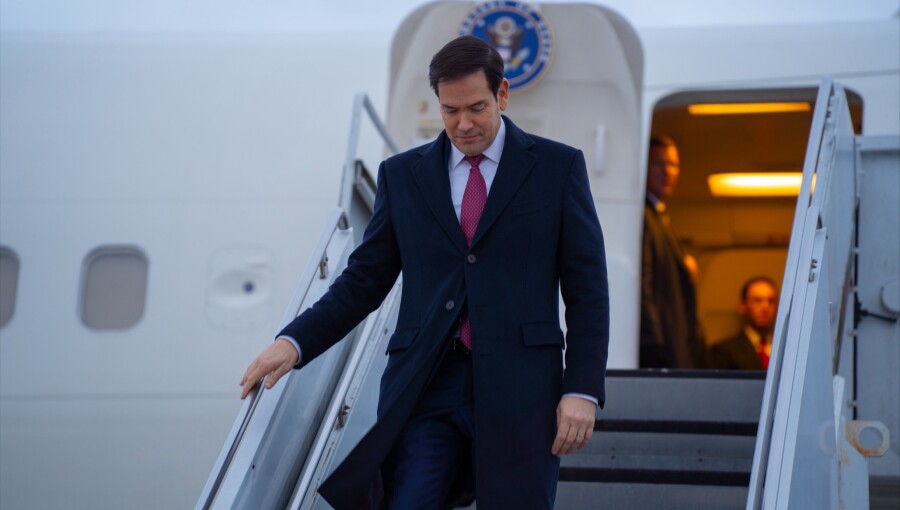
US Secretary of State Marco Rubio outlined Washington's post-Maduro blueprint for Venezuela on January 7, unveiling plans to seize up to 50mn barrels of the country's oil - which President Trump had previously signalled - whilst asserting what he said is "tremendous control and leverage" over Caracas's interim administration.
Rubio spoke to reporters, with Defence Secretary Pete Hegseth at his side, after delivering classified briefings to both chambers of Congress, detailing a strategy beginning with "stabilisation" to prevent chaos, followed by "recovery" to integrate Venezuela into global markets, and concluding with a "transition" phase aimed at political reconciliation and institutional reconstruction.
The plan makes plain Washington's determination to reshape Venezuela according to American interests whilst, for now, shelving the democratic opposition movement led by Nobel Laureate María Corina Machado, whose electoral mandate has been nullified in favour of working with Chavista figures willing to accommodate US demands.
"The bottom line is that there is a process now in place where we have tremendous control and leverage over what those interim authorities are doing and are able to do," Rubio said.
The initial phase centres on what Rubio characterised as a "quarantine" of Venezuela's oil sector, granting Washington decisive influence over the country's economic lifeline. US forces seized a Russian-flagged tanker on January 7 in the North Atlantic between - Scotland and Iceland - as part of ongoing operations to intercept Venezuelan crude. This built on the dramatic January 3 military raid that extracted Maduro from Caracas.
Echoing an earlier statement by Trump, Rubio said the White House is finalising arrangements to appropriate between 30mn and 50mn barrels of Venezuelan crude for sale "at market rates, not at the discounts Venezuela was getting." The proceeds, he insisted, would be "handled in such a way that we will control how it is disbursed in a way that benefits the Venezuelan people, not corruption, not the regime."
White House spokeswoman Karoline Leavitt told reporters that Washington maintains "maximum influence" over acting president Delcy Rodríguez's interim government and has already begun marketing seized Venezuelan crude globally. The oil includes both previously sanctioned reserves and hydrocarbons aboard intercepted vessels, which Caracas has agreed to release under pressure.
"The interim authorities have agreed to release that oil to the US, so it will arrive in our country very soon," Leavitt said, adding that Venezuela "will no longer send illegal drugs to the US" or facilitate criminal cartels.
Meanwhile, Venezuela's state oil company PDVSA has announced it is negotiating crude sales to the United States "within the framework of existing commercial relations."
US Energy Secretary Chris Wright, however, made clear that Washington intends to control Venezuelan oil sales "indefinitely," floating a sanctions waiver to facilitate exports.
Analysts noted that directing shipments toward American refineries would reduce risks of production cuts because of Venezuela's limited storage capacity, constituting additional leverage for the US. Though Venezuela claims roughly one-fifth of global oil reserves, experts warned that rapidly increasing output faces substantial obstacles including deteriorated infrastructure and political uncertainty.
The economic leverage extends beyond oil seizures. Secretary Rubio stated during private congressional briefings that Venezuela faces financial insolvency within weeks if it is unable to offload petroleum reserves currently sitting in tankers: this is a vulnerability Washington that intends to fully exploit whilst maintaining its embargo.
According to Reuters, the administration has also threatened to seize Rodríguez's financial assets, which it claims to have located in Qatar, though Qatari officials have denied she holds accounts there.
The second phase focuses on "ensuring that American, Western and other companies have access to the Venezuelan market in a way that's fair," Rubio said, signalling Washington's determination to position US petroleum firms as primary beneficiaries of Venezuela's vast reserves—the largest proven deposits globally at approximately 303bn barrels.
Simultaneously, Rubio announced plans for a "reconciliation process" offering pardons to opposition figures, freedom for nearly 900 political prisoners, and return of millions of exiles "to rebuild civil society." But this vision conspicuously omits any timeline for elections or restoration of democratic governance, instead opting for continued US oversight of interim Chavista administrators.
The approach reflects confidential CIA analysis, reported by The New York Times, suggesting that maintaining senior regime figures rather than promoting the Machado-led opposition would best secure stability during the period Washington requires for establishing American companies' operations without committing ground forces to Venezuela.
That calculation has left Machado, whose stand-in candidate Edmundo Gonzalez won more than two-thirds of votes in widely disputed 2024 elections according to independent monitors, relegated to exile whilst offering futile gestures including surrendering her Nobel Peace Prize to President Trump, who dismissed her as lacking sufficient "respect" within Venezuela.
Rubio's plan hinges on cooperation from the precarious three-way power structure now governing Venezuela: Rodríguez, whom the Trump administration views as a pragmatic technocrat and the most moderate figure; Defence Minister Vladimir Padrino López, who controls the armed forces; and Interior Minister Diosdado Cabello, the regime's brutal enforcer and the real wild card in the pack, who commands intelligence services accused of crimes against humanity.
Reuters reported earlier today that Washington has warned Cabello, the most ideologically committed and unpredictable of the three, that defiance could bring consequences matching or exceeding those visited upon Maduro. Yet targeting him risks provoking armed pro-regime militias called colectivos into violent action, precisely the chaos scenario the stabilisation phase aims to prevent.
Trump has also demanded that Venezuela sever ties with China, Russia, Iran and Cuba as conditions for oil sector access, according to ABC News. However, whether figures like Cabello, who spent two decades building Chavismo's repressive apparatus, will ultimately accept American dictation remains deeply uncertain.
Rubio acknowledged that whilst phases would overlap, the ultimate outcome rests with Venezuelans themselves. "In the end, it will be up to the Venezuelan people to transform their country," he said. A statement that rings hollow, given the White House's decision to sideline the opposition movement that actually won Venezuelan votes in favour of negotiating with authoritarian figures willing to accommodate American petroleum interests.
US lays out plan for marketing Venezuelan oil after Maduro ouster
By AFP
January 7, 2026
A woman walks past a mural of oil pumps in Caracas on January 7, 2026 - Copyright AFP Juan BARRETO
Beiyi SEOW
The United States on Wednesday laid out what it called an “energy deal” with Venezuela, saying it will partially roll back sanctions to allow the sale of oil products from the South American country.
The details, shared in a Department of Energy fact sheet, came days after Washington captured Venezuelan leader Nicolas Maduro, leaving his deputy and other allies in charge.
US President Donald Trump has since announced that the interim leaders have agreed to US-managed marketing of 30-50 million barrels of crude, repeatedly adding that his country will “run” Venezuela despite having no forces on the ground.
Venezuela’s state petroleum firm said Wednesday that talks for the sale of crude oil to the United States had begun, after Washington’s demand for access to the country’s reserves following Maduro’s ouster.
“Negotiations are under way with the United States for the sale of volumes of oil within the framework of existing commercial relations between the two countries,” the firm, PDVSA, said in a statement.
US Energy Secretary Chris Wright said Wednesday that Washington will control the sales of Venezuelan oil “indefinitely,” telling an event in Miami that it needed leverage and control of these sales to drive necessary changes in Venezuela.
Venezuela claims to sit on about a fifth of the world’s oil reserves.
– US ‘discretion’ –
Already, the US government has started marketing Venezuelan crude oil internationally, the Energy Department noted on Wednesday.
It added that all proceeds from the sale of this crude oil and oil products will “first settle in US controlled accounts at globally recognized banks.”
“These funds will be disbursed for the benefit of the American people and the Venezuelan people at the discretion of the US government,” the department said, without providing further details.
The sales will also “continue indefinitely,” the fact sheet added.
Wright separately told CNBC the United States was merely controlling the marketing and flow of funds into Venezuela, maintaining that the money will largely be used to benefit Venezuelan people.
“We’re not stealing anyone’s oil,” he added.
Meanwhile, US diluting agents will flow into Venezuela as needed to “mix, upgrade, and optimize” production of Venezuela’s very heavy crude.
Wright, a former oil and gas executive, said it would require “tens of billions of dollars and significant time” to get Venezuela’s production back to historical highs of over three million barrels per day.
Observers have also pointed out that a quick ramp-up of output would be hamstrung by issues including Venezuela’s creaking infrastructure, low prices and political uncertainty.
– Sanctions rollback –
For now, Washington is “selectively rolling back sanctions to enable the transport and sale of Venezuelan crude and oil products to global markets,” the Energy Department said.
Among other efforts, the United States plans to authorize the import of certain oil field equipment, parts and services to Venezuela, and said it would work to improve the electricity grid to aid oil production.
Separately, the White House told reporters Wednesday that the United States has “maximum leverage” over Venezuela’s interim authorities.
Trump is expected to meet with US oil executives on Friday to discuss plans for Venezuela’s oil sector, Press Secretary Karoline Leavitt told a briefing.
On Saturday, US special forces snatched Maduro and his wife from Caracas and whisked them to New York to face trial on drug charges.
Washington appears to be relying on a naval blockade of Venezuelan oil exports, and the threat of potential further force, to ensure the cooperation of interim leader Delcy Rodriguez.
The Trump administration “is going to be spending just as much time running Venezuela as they are running America,” Sen. Chris Murphy said in an address to voters. “That’s terrible news for you.”
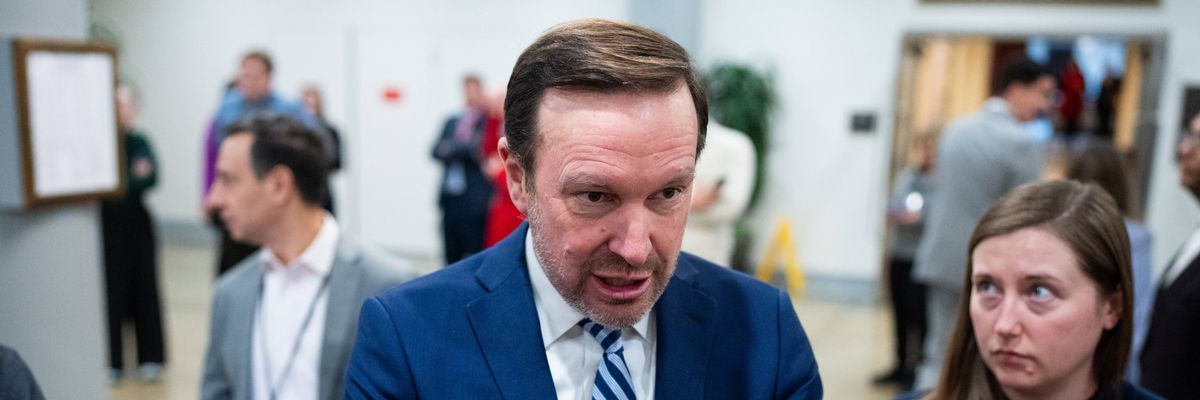
Sen. Chris Murphy (D-Conn.) speaks to reporters in Washington, DC on January 6, 2026.
(Photo by Bill Clark/CQ-Roll Call, Inc. via Getty Images)
Julia Conley
Jan 07, 2026
COMMON DREAMS
Democratic lawmakers were stunned as they emerged from a briefing Wednesday with Trump administration officials on the White House’s plan for Venezuela following the US invasion last week—a meeting that marked the first time all members of the US Senate and House were briefed on the details of the attack and President Donald Trump’s intentions going forward in the South American country.
“We learned a lot, I’m glad we had the briefing,” a visibly shaken Sen. Chris Murphy (D-Conn.) told reporters. “But this is going to be a very rough ride for the United States.”
The senators and later members of the House were briefed by officials including Secretary of State Marco Rubio, Defense Secretary Pete Hegseth, Attorney General Pam Bondi, CIA Director John Ratcliffe, and Joint Chiefs of Staff Chair Dan Caine.
As Rubio told the press after the meeting, the lawmakers learned about a three-step process the White House is planning, starting with an effort to “stabilize” Venezuela by seizing and selling 30-50 million barrels of oil and then controlling how the proceeds are dispersed.
The US will then ensure “American, Western, and other companies have access to the Venezuelan market in a way that’s fair” before ensuring that the third step is “one of transition,” claimed Rubio.
Murphy said the proposal amounts to “stealing the Venezuelan oil at gunpoint for a period of time, undefined, as leverage to micromanage the country.”
“This is an insane plan,” he said after the briefing. “The scope and insanity of that plan is absolutely stunning.”
In a video he posted on social media, Murphy spoke directly to US voters about how Trump’s plan represents not only “corruption” that will benefit the president’s “energy industry and Wall Street friends” and a “failure to learn lessons” from the US wars in Iraq and Afghanistan, but also an abandonment of working families across the US.
“This is going to be a multi-billion-dollar effort which is going to take money—your money—but also enormous time,” said the senator. “Donald Trump, the White House, everybody there is going to be spending just as much time running Venezuela as they are running America. That’s terrible news for you, for the American taxpayer. Because there’s huge problems here at home. Healthcare premiums, prices going up, and now the United States government is going to be spending most of its time on many days running the country of Venezuela.”
Rep. Jared Moskowitz (D-Fla.) told reporters after the House’s classified briefing that “there has to be a timeline for elections,” while Rep. Jason Crow (D-Colo.) said, “It’s like they’ll wave a magic wand and things will turn out the way they want.”
Numerous polls have shown that Trump’s escalation against Venezuela, which has also included dozens of boat bombings since September that have killed more than 100 people whom the White House claimed were trafficking drugs to the US, is broadly unpopular with Americans. Nearly two-thirds of respondents to a Quinnipiac University survey said last month that they opposed US military operations in Venezuela.
“Across America, people are just saying, what the hell is going on?” Senate Minority Leader Chuck Schumer (D-NY) said after the briefing. “We need answers as to how long this is going to last. We need answers to how many troops, how much money, are there guardrails, things we don’t do, and a number of things that we had talked about were very troubling.”
Sen. Elizabeth Warren (D-Mass.) was among the lawmakers who said the White House briefing made clear that Congress must hold public hearings on the Trump administration’s operations in Venezuela, adding that oil companies—who Trump openly said on Sunday were informed of the military strike and capture of Maduro before they happened—“seem to know more about Trump’s secret plan to ‘run’ Venezuela than the American people.”
Sen. Tim Kaine (D-Va.) added that the US is “four months into a sustained military operation” and has killed more than 200 so-called “enemies.”
“American troops have been injured,” he said. “We have the US forces arranged around Venezuela. Yet neither the House nor the Senate have been willing to hold a single public hearing.”
Making a a war “legal” doesn’t make it just or moral. Legal wars still kill and maim innocent people, still destroy communities, still create intense hatred that guarantees future wars.
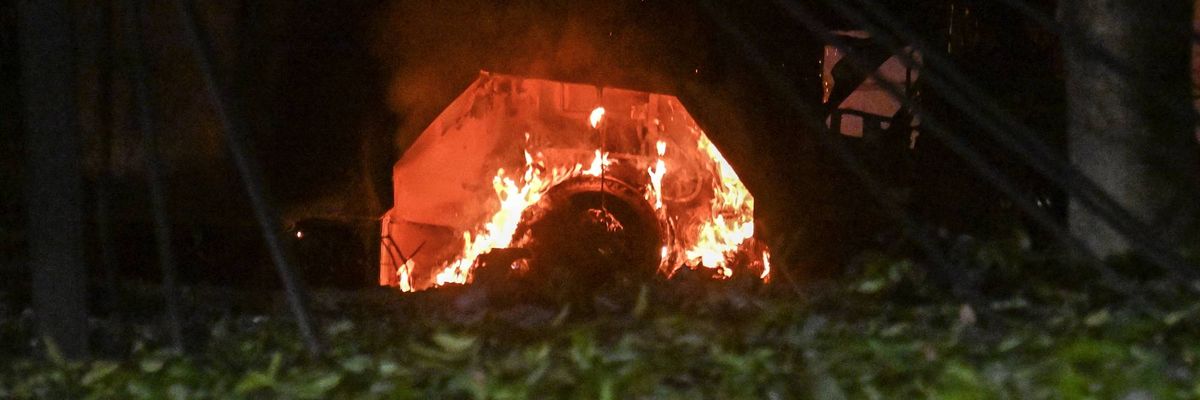
A vehicle burns at La Carlota air base in Caracas after a series of explosions on January 3, 2026.
(Photo by Juan Barreto/ AFP via Getty Images)
Robert C. Koehler
Jan 08, 2026
Oh good. Now we have a war to focus on. Everyone’s tired of Epstein by now, and tired of the possibility that the bad guy may be, ho hum, our own national leader, aka, the commander in chief.
So the commander in chief has stepped in for the sake of the public good, bestowing on America a far more traditional enemy to hate and fear and let dominate the headlines: narco-terrorists.
I’m still trying to grasp the fact that President Donald Trump has actually invaded Venezuela. He’s no longer simply bombing boats in the ocean. The US military bombed Caracas on January 3 and broke into the home of the country’s president, Nicolás Maduro, and his wife Cilia Flores. They were kidnapped and extradited to the United States, where they are now on trial for drug trafficking—as though that was the moral purpose of the invasion.
Obviously it wasn’t. As The Intercept notes:
This is a clear-cut act of military aggression, a brazen violation of international law, and a textbook example of unreconstructed 19th-century colonialism.
Donald Trump now says that the US will “run” Venezuela and “take” the country’s vast oil reserves.
I’m in sync with the enormous outrage over this invasion, both here in the US and around the world. Where I back away slightly, however, is when a critic points out that Trump’s military action was “illegal,” because he invaded Venezuela without congressional approval. When I read this kind of criticism, I feel an inner alarm go off. Making a a war “legal” doesn’t make it just or moral. Legal wars still kill and maim innocent people, still destroy communities, still create intense hatred that guarantees future wars. In other words, war itself is always the core of the wrong.
In no way am I saying I oppose self-defense, or even retaliation. I’m saying, instead, that I believe we need to rethink what self-defense actually means.
What, oh what, is power? We live in a world that is armed against itself with preposterous enormity—nuclear armed against itself, for God’s sake. Violent response is embedded in the way we think, regarded as the nature of protection. Where’s my gun? And it’s likely to be the first response to a perceived threat, especially at the national level. And anyone who dares to question this is easily belittled as crying: “Gosh, can’t we all just get along?”
I took aim, so to speak, at this cynicism in a poem I wrote some years ago, called “Can’t We All Just... Oh Forget It,” which begins:
The cynics
play with their sticks
and knives, mocking
the merciful, the naïve,
the cheek turners.
Can’t we all just . . .
oh, forget it.
But maybe the answer
is yes,
if we undo the language,
the easy smirkwords
that belittle
our evolving...
Belittle our evolving! Disagreement—conflict—is often incredibly complex. Simply “eliminating” it, shooting it out of existence, may be a tempting course of action, but it solves nothing. Instead, we have to understand it. And every time we understand the reasons for a conflict—and figure out how to rectify and transcend those reasons—we evolve.
Consider these words about the Venezuela invasion by Jordan Liz:
Ultimately, whether it’s removing Maduro or invading Cuba, Mexico, or Colombia, none of these actions will solve the drug crisis because they fail to tackle the root cause: public suffering. While there are many reasons people turn to drugs, the lack of adequate healthcare, poverty, homelessness, social stigmas about drug use, and criminalization are the leading factors. People turn to drugs when their governments and communities turn their back on them. Drug cartels, like any other capitalist enterprise, exploit these people’s hopes and desires for their own gain.
...If Trump really cared about the drug crisis, he would be working tirelessly to solve the affordability crisis—not denying its existence or spending billions on battleships.
War is not the answer, even if it’s legal.

Trump's Venezuela pitch to oil execs has 'a lot of challenges' to overcome: analysis
Ewan Gleadow
January 8, 2026
RAW STORY
A plan for the United States to control oil refineries in Venezuela has "a lot of challenges" to overcome, according to gas and oil industry insiders.
One anonymous inside in touch with White House officials, when speaking to CNN, suggested Donald Trump's plan is far from "reality" and will likely face more problems than the administration is prepared for.
The unnamed source said, "The United States will have a lot of challenges thinking that they’re just going to bring US companies down into Venezuela and they’re going to operate and turn this around. That’s not reality." Insiders were just as perplexed by the plan as Democratic Party lawmakers, with one saying the administration's plan is unlike anything they had seen before.
Democratic Rep. Melanie Stansbury said, "I have never in my entire life in public service and as a former (Office of Management and Budget) employee, ever heard of anything like this." Even former diplomats are puzzled by the plan for Venezuela.
One anonymous source shared, "The US Treasury is not set up to handle commercial transactions like this. The Treasury takes in receipts from people who pay taxes, tariffs and fees."
"They take in money in a way that is consistent with its legally authorized mission and then it disperses those in a way which is governed by law."
Part of the problem lay in assurances to the private sector from the administration, which a former senior sanctions policy advisor to the Treasury Department's Office of Foreign Assets believes will derail Trump's Venezuelan oil plans.
Roxanna Vigil said, "Right now, the private sector has nothing official to go on to have any sort of assurance, or any sort of confidence that whatever is going to happen, how is it going to be authorized based on US sanctions."
"My biggest concern related to all of this is how are the Venezuelan people going to benefit? Because the most vulnerable player in all of this and the one that so far has had the least say is the Venezuelan people."
An unnamed administration official says previous experiences with oil in Venezuela may have put off some companies. Hugo Chavez nationalized oil companies in 2007 and subsequently seized their assets. This is a move some in the industry have not forgotten.
The insider said, "“It’s not clear yet what we we’ll offer them to spend the billions needed to rebuild the infrastructure, and it’s clearly a risk."
Ewan Gleadow
January 8, 2026
RAW STORY
A plan for the United States to control oil refineries in Venezuela has "a lot of challenges" to overcome, according to gas and oil industry insiders.
One anonymous inside in touch with White House officials, when speaking to CNN, suggested Donald Trump's plan is far from "reality" and will likely face more problems than the administration is prepared for.
The unnamed source said, "The United States will have a lot of challenges thinking that they’re just going to bring US companies down into Venezuela and they’re going to operate and turn this around. That’s not reality." Insiders were just as perplexed by the plan as Democratic Party lawmakers, with one saying the administration's plan is unlike anything they had seen before.
Democratic Rep. Melanie Stansbury said, "I have never in my entire life in public service and as a former (Office of Management and Budget) employee, ever heard of anything like this." Even former diplomats are puzzled by the plan for Venezuela.
One anonymous source shared, "The US Treasury is not set up to handle commercial transactions like this. The Treasury takes in receipts from people who pay taxes, tariffs and fees."
"They take in money in a way that is consistent with its legally authorized mission and then it disperses those in a way which is governed by law."
Part of the problem lay in assurances to the private sector from the administration, which a former senior sanctions policy advisor to the Treasury Department's Office of Foreign Assets believes will derail Trump's Venezuelan oil plans.
Roxanna Vigil said, "Right now, the private sector has nothing official to go on to have any sort of assurance, or any sort of confidence that whatever is going to happen, how is it going to be authorized based on US sanctions."
"My biggest concern related to all of this is how are the Venezuelan people going to benefit? Because the most vulnerable player in all of this and the one that so far has had the least say is the Venezuelan people."
An unnamed administration official says previous experiences with oil in Venezuela may have put off some companies. Hugo Chavez nationalized oil companies in 2007 and subsequently seized their assets. This is a move some in the industry have not forgotten.
The insider said, "“It’s not clear yet what we we’ll offer them to spend the billions needed to rebuild the infrastructure, and it’s clearly a risk."
COMMENT: US control of Venezuelan oil can earn Indian refineries optimal margins
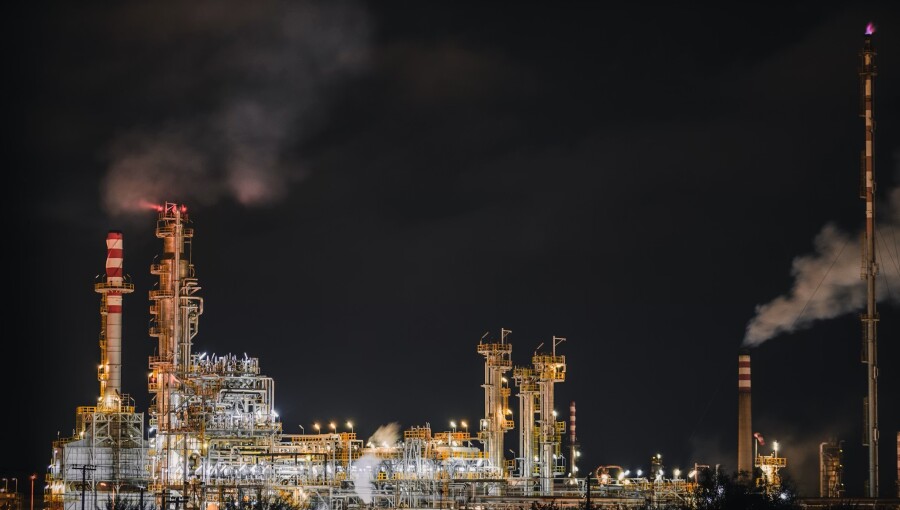
The January 3 2026 capture of Venezuelan President Nicolás Maduro and subsequent US claims of control over Caracas's oil sector positions certain Indian companies from both the public and private sector in the limelight.
Most affected are likely to be Reliance Industries (NSE:RELIANCE), a private company which owns India’s biggest and most diversified refining facility and state owned ONGC Videsh (NSE:ONGC), that leads much of India’s participation in foreign oil and gas projects.
While it was already on an upward trajectory even before the US special operation in Venezuela, the event nonetheless triggered Reliance shares to touch a 52 week high and revealed just how much of an impact the US’s unrelated actions can have on India's refining economics.
For Reliance, whose Jamnagar complex in India represents the world's most sophisticated crude-processing facility, access to Venezuelan heavy crude at a $5–$8 discount to Brent pricing constitutes a major refining margin enhancement opportunity with potential earnings upside that capital markets are now calibrating into equity valuations.
According to a report by The Economic Times, India once imported 400,000 barrels per day from Caracas, establishing a natural commercial partnership predicated on processing economics, not geopolitical or ideological alignment. US sanctions imposed on Venezuela in 2019 eliminated this supply stream overnight. By 2025, Venezuelan crude represented only 28,000 barrels per day, according to a report by Moneycontrol.
The collapse reflects both sanctions enforcement and the logistical impracticality of processing extremely heavy crude without access to critical diluent chemicals the US embargo restricted. Reliance Industries bore the operational penalty of this sanctions regime more severely than any of its domestic competitors in the Indian market.
The company's Jamnagar refining complex is a 1.4mn barrel per day facility incorporating proprietary cracking and coking capacity, and was architecturally engineered for Venezuelan heavy-sour crude processing, exploiting crude-grade arbitrage that commodity market economics rendered uniquely profitable for complex refiners.
When Venezuelan supplies evaporated, Reliance shifted procurement toward lighter crude grades, sacrificing the margin differential that comes from converting low priced heavy barrels into high value diesel and other petroleum products. The financial implications cut directly through to quarterly earnings. Gross refining margins (GRM), the spread between refined product output value and crude input cost contracted sharply during the 2019-2025 sanctions period as Reliance operated Jamnagar at suboptimal crude chemistry.
Heavy crude discount structures typically confer 2–3% points of GRM advantage versus light crude operations. For a refinery processing 1.4mn barrels daily at $2–3 per barrel margin differential, this represents $28–42mn in quarterly earnings opportunity cost, or approximately $112–168mn annually. Over six years, the cumulative earnings impact of Venezuelan crude unavailability approaches $700mn in foregone margin generation.
The US takeover scenario inverts this arithmetic. Should sanctions relief materialise and Venezuelan production recover to commercial viability which is according to a report in Financial Review, currently collapsing at 930,000 barrels per day from nearly 2.5mn barrels per day in 2012, Reliance regains access to the margin-accretive crude that Jamnagar was designed to process.
Indian state owned ONGC Videsh’s prospective dividend recovery adds a distinct financial leverage that will have the Indian government just as interested as the private sector. ONGC Videsh holds 40% participating interest in Venezuela’s San Cristobal oilfield and 11% participation in the Carabobo-1 project. Yet the earnings upside window narrows against production recovery headwinds.
Venezuela's infrastructure has also likely deteriorated during six years of US sanctions, combined with the capital intensive requirement to rebuild extraction, processing, and export infrastructure. This may suggest that crude exports may not reach commercially significant volumes before 2027–2028.
Even then, production will likely plateau at 500,000–800,000 barrels per day which is substantially below the pre sanctions production architecture, creating competitive bidding among Indian refiners such as Reliance, partly Russian owned Nayara Energy, and Indian state owned Indian Oil (NSE:IOC), among others for limited heavy crude volumes.
Venezuela’s ultra-heavy and super-sour Orinoco sludge will be manna from heaven for US refineries for decades to come
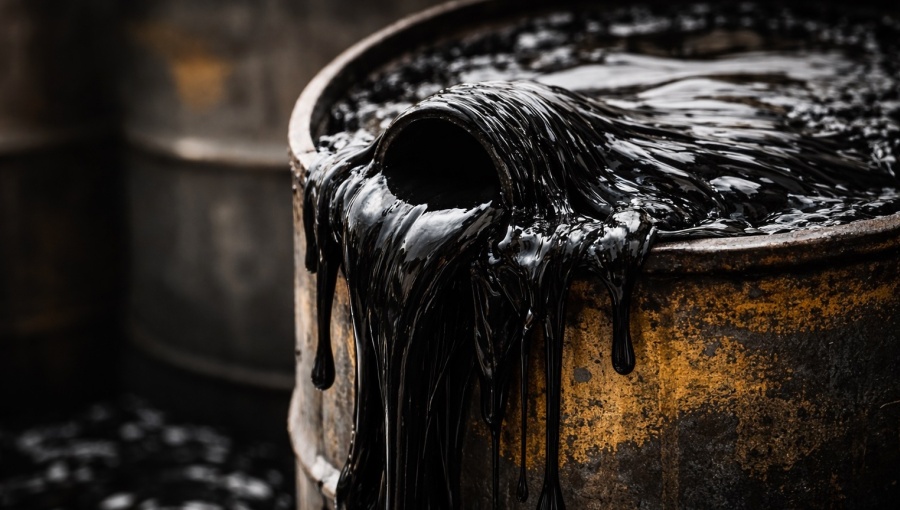
Donald Trump’s grab of Venezuela’s oil is not just about making money. He is also grabbing an ultra heavy grade of highly sulphurous oil that is very difficult to refine. That sounds bad and normally it would be. But in the 1990s the US oil industry was convinced that the era of simply light sweet oil was over and built new refineries to process heavy and sour blends being produced in the Gulf. Today about 70% of US refining capacity is designed primarily to handle heavier crude grades rather than light, sweet crude.
The shale revolution upended that bet by producing plentiful fresh supplies of light sweet oil. Trump has grabbed Venezuelan oil as he needs to feed the starving industrial monster that was specifically designed to eat only what Venezuela produces and can’t easily or efficiently process the light blends. That industrial monster must feed the US economy because now the shale party is about to end. Shale production will not stop, but analysts agree that the boom is over. 2024 was the first year since the revolution began in 2010 that annual production of shale oil showed a decline.
Despite Trump's bluster, the decision to capture Venezuela oil production is actually totally rational and is important for US national security interests.
Back in the 1990s US firms began to look at Venezuela's ultra-heavy, very sulphurous and toxic metal-heavy sludge coming out of Venezuela’s Orinoco Belt and saw it as the future of the oil industry.
Future reserves were geographically concentrated in the Middle East or were “Trash Grades” like the Canadian Bitumen oil sands, Venezuelan Extra-Heavy Orinoco sludge and the Mexican Maya blend from the massive Cantarell field.
The oil majors invested billions into refineries to process it and for a time it worked. And it was not only Venezuela, as Mexico was always producing the similar “Maya” heavy grade of crude. US refiners like Valero, Chevron, and LyondellBasell decided that to stay profitable, they had to spend billions upgrading their facilities. And initially it worked. The unpopular heavy grades could be bought at steep discounts while the refined products went at market rates, creating huge margins.
And then Venezuela itself got in on the act. The state-owned Petróleos de Venezuela S.A. (PDVSA) bought a 50% stake in the US refiner CITGO in 1986 and completed a full takeover in 1990. CITGO owned refineries in Lake Charles, Los Angeles and Corpus Christi, Texas, and was contractually obliged to retool to handle Venezuela’s Orinoco sludge.
The logic was that the Gulf of Mexico basin was destined to be the global hub for processing heavy oil.
Dubbed the Apertura Petrolera (Oil Opening), Caracas sought to attract capital and expertise to manage its technically demanding reserves. The Apertura Petrolera was a Venezuelan government initiative during the 1990s that successfully liberalised the nationalised oil industry to attract foreign investment, technology, and operational expertise.
The policy, framed through Operating Service Agreements and Strategic Associations, offered extraordinary fiscal incentives. These deals, which included low royalty rates “as low as 1%”, underpinned the construction of the upgraders needed to turn Orinoco sludge into exportable synthetic crude and added roughly one million barrels per day to Venezuela’s production capacity by the end of that decade.
Venezuela was sitting on top of the oil world with the US refineries and companies as its close partner. Then it all went pear-shaped.
Hugo Chávez came to power and got greedy. He argued that the Apertura undermined national sovereignty and enacted a new law doubling oil royalties from 16% to 30%. He also insisted that any future oil project must be majority state-owned by the state company PDVSA. In 2006 the government declared the earlier contracts illegal and ordered their conversion into mixed enterprises, stripping partners of their shares. The death blow to the Apertura came on February 26, 2007, when Chávez signed Decree 5200. Foreign firms had to accept a minority stake (max 40%) in the new ventures or leave the country.
Some companies — including Chevron, Total, BP and Statoil — stayed under the new terms. Others, notably ExxonMobil and ConocoPhillips, refused and saw their assets expropriated, kicking off a storm of lawsuits that froze Venezuela assets abroad and killed the investment climate stone dead.
Capital fled. Brains were drained. Oil production collapsed. And infrastructure went into terminal decline. Venezuela went from being the richest country in Latin America in the 1970s to the poorest by the noughties.
As shale production fades, the old refineries come back to the fore. Venezuela’s copious deposits – more three times larger than Russia’s – will feed once more. A lot has been made of the $100bn-plus cost of modernising Venezuela’s oil industry and the decade-long time scale needed to effect those investments. But access to reserves the size of Venezuela’s will ensure the longevity of the US oil industry for multiple decades and ensure its place as a leader for at least several generations.

No comments:
Post a Comment