DW with AP, Reuters
08/01/2026
Donald Trump and Colombia's Gustavo Petro held a "cordial" talk amid tensions over the US attack on neighboring Venezuela. Petro has called the attack an "abhorrent" violation of Latin American sovereignty.

Trump's testy ties with Petro
The surprise change of tone came days after Trump called Petro a "sick man who likes making cocaine and selling it to the United States," in the wake of the US operation that ousted Venezuelan leader Nicolas Maduro.
When asked by a reporter last weekend whether the US would carry out a similar operation on Colombia, Trump said, "It sounds good to me."
Trump has also warned other Latin American countries including Cuba and Mexico in the wake of the Venezuelan operation.
Petro, a leftist leader, has frequently clashed with Trump ever since the US president returned to office last year. Petro denounced the weekend raid in Caracas, calling it an "abhorrent" violation of Latin American sovereignty.
Amid an ongoing spat, the Trump administration has leveled sanctions against Petro and other members of his family, accusing him of failing to curb the flow of cocaine into the US.
Colombia has long been America's staunchest ally in Latin America, and at the center of the US counternarcotics strategy abroad.
Petro confirms talks with Trump
Petro told protesters late Wednesday — whom he'd asked to mobilize against US military threats — that he had spoken with Trump.
"We have spoken by phone for the first time since he became president," Petro told supporters gathered at a rally in the capital, Bogota.
"I talked about two things: Venezuela and the issue of drug trafficking," he said, adding he had requested a restart of dialogue between the two countries.
The phone call was "cordial" and "respectful," a source in Petro's office told Reuters.
Edited by: Zac Crellin

Roshni Majumdar Roshni is an editor and a writer at DW's online breaking news desk.
Donald Trump and Colombia's Gustavo Petro held a "cordial" talk amid tensions over the US attack on neighboring Venezuela. Petro has called the attack an "abhorrent" violation of Latin American sovereignty.

Gustavo Petro said he spoke to Donald Trump about Venezuela and drug trafficking issue (FILE: April 2025)Image: Emilio Flores/Anadolu/picture alliance
US President Donald Trump appeared to strike a change in tone late on Wednesday after a friendly phone call with Colombian President Gustavo Petro, one of the US president's fiercest critics.
"It was a great honor to speak with the president of Colombia, Gustavo Petro, who called to explain the situation of drugs and other disagreements that we have had," Trump wrote on his social media site.
"I appreciated his call and tone, and look forward to meeting him in the near future," Trump said, while inviting Petro to the White House.
US President Donald Trump appeared to strike a change in tone late on Wednesday after a friendly phone call with Colombian President Gustavo Petro, one of the US president's fiercest critics.
"It was a great honor to speak with the president of Colombia, Gustavo Petro, who called to explain the situation of drugs and other disagreements that we have had," Trump wrote on his social media site.
"I appreciated his call and tone, and look forward to meeting him in the near future," Trump said, while inviting Petro to the White House.
Trump's testy ties with Petro
The surprise change of tone came days after Trump called Petro a "sick man who likes making cocaine and selling it to the United States," in the wake of the US operation that ousted Venezuelan leader Nicolas Maduro.
When asked by a reporter last weekend whether the US would carry out a similar operation on Colombia, Trump said, "It sounds good to me."
Trump has also warned other Latin American countries including Cuba and Mexico in the wake of the Venezuelan operation.
Petro, a leftist leader, has frequently clashed with Trump ever since the US president returned to office last year. Petro denounced the weekend raid in Caracas, calling it an "abhorrent" violation of Latin American sovereignty.
Amid an ongoing spat, the Trump administration has leveled sanctions against Petro and other members of his family, accusing him of failing to curb the flow of cocaine into the US.
Colombia has long been America's staunchest ally in Latin America, and at the center of the US counternarcotics strategy abroad.
Petro confirms talks with Trump
Petro told protesters late Wednesday — whom he'd asked to mobilize against US military threats — that he had spoken with Trump.
"We have spoken by phone for the first time since he became president," Petro told supporters gathered at a rally in the capital, Bogota.
"I talked about two things: Venezuela and the issue of drug trafficking," he said, adding he had requested a restart of dialogue between the two countries.
The phone call was "cordial" and "respectful," a source in Petro's office told Reuters.
Edited by: Zac Crellin
Roshni Majumdar Roshni is an editor and a writer at DW's online breaking news desk.
Colombia, Cuba and Mexico: Are these Trump's next targets?
Following the attack on Venezuela and the capture of Nicolas Maduro, the US has been threatening other countries in the region. But they have reacted with defiance. Following Maduro's capture, the Colombian government sent security forces to the border in preparation for a potential influx of refugees from neighboring Venezuela
Colombia is "very sick," and its government is run by "a sick man who likes making cocaine and selling it to the United States," US President Donald Trump told reporters on Sunday. Asked about a military intervention in Colombia, he responded: "Sounds good to me!"
Gustavo Petro's response to Trump's threat was not long in coming. The Colombian president had already frequently fired back at attacks from Trump or Elon Musk on social media, and this time Petro also went all out on the platform X.
"Every soldier in Colombia now has an order: any commander of the security forces who gives preference to the US flag over the Colombian flag will be immediately dismissed from the institution on the orders of the base, the troops and myself. The order to the security forces is not to shoot at the people, but at the attacker," Petro wrote, before calling on Trump to "stop slandering" him while urging Latin American countries to unite or risk being "treated as a servant and slave."
"The president takes the attacks very personally and therefore responds more as Gustavo Petro than as president," Sandra Borda, political scientist and professor at the University of the Andes in Bogota, told DW. "Yet he only has the support of a third of the population, his base, for this provocative discourse. Those who are not left-wing, and especially the business sector, which is very dependent on trade with the US, find Petro's reaction inappropriate. It did not go down well with them."
The US is "baring its teeth" at Colombia, said Borda, and Venezuela's neighbor is taking the US government's threats against its president much more seriously following the arrest of Nicolas Maduro. The Trump administration has never made any secret of the fact that it considers left-wing governments in South America a problem and the continent the United States' backyard.
With regard to Colombia, the strategy could be to simply play for time and hope for a victory for the ultra-right-wing candidate Abelardo de la Espriella, who is believed to be friendly to the US, in the presidential election in May — although the left-wing candidate Ivan Cepeda is ahead in all polls. The right-wing camp is fragmented and could do everything in its power to prevent Cepeda from winning in a possible runoff election. Petro is constitutionally barred from running again.
"I don't believe that there will actually be a military strike or military intervention in Colombia. But the US is, of course, already exerting influence," Stefan Peters, director of the German-Colombian peace institute CAPAZ in Bogota, told DW.
However, Peters pointed out that Trump has already made comments that affected the election campaigns in Argentina and Honduras. "Trump's statement on Colombia alone, made rather casually on his plane, has had a huge impact. And, of course, there is a calculated motive behind it," Peters argued.
Cuba: Lack of Venezuelan oil intensifies struggle for survival
"Cuba now has no income. They got all of their income from Venezuela, from the Venezuelan oil. They're not getting any of it. Cuba literally is ready to fall," Trump told reporters on his plane on Sunday.
At least outwardly, President Miguel Diaz-Canel did not appear particularly concerned when he accused the US of "fascist state terrorism" and "imperialist barbarism" at a Sunday rally in Havana in front of thousands of supporters.
"No, gentlemen imperialists, this is not your 'backyard'… We do not recognize the Monroe Doctrine, nor the kings or emperors above us," he said. "For the sake of Venezuela, as well as for the sake of Cuba, we are ready to give even our blood, even our life, but we will not back down. Now is not the time of half measures; it is the time of certainty and choice of sides in the face of fascism and imperial barbarism. Down with imperialism!"
But for Cuba expert Bert Hoffmann, Cuba is the biggest loser following the US military strike in Venezuela.
"The situation is already very tense, and the loss of Venezuelan oil is dramatically exacerbating the energy crisis. This oil accounted for 70% of all Cuba's oil imports," said Hoffmann, a political scientist at the GIGA German Institute of Global and Area Studies in Hamburg. "There is no one in Cuba who is not deeply concerned about this, both among the population and the government. So the crisis will continue to worsen."
This suggests that the strategy of attempting to bleed Cuba dry economically could work. Even now, everyday life for Cubans is difficult: There are hourslong power outages, a daily struggle for food, medicine and fuel, and a futile wait for visitors following a massive slump in the country's most important source of income, tourism. The Cuban government is now trying to find replacements for oil supplies from Venezuela, and according to Hoffmann, is looking to Russia, Arab states, Iran or Algeria.
"The most likely scenario is that the political leadership will make every effort to keep the ranks so tightly closed that the dissatisfaction of the population will ultimately find no political expression," Hoffmann told DW.
So far, the power apparatus in Cuba appears to have maintained great unity.
"The Communist Party, the military, and the security apparatus are closely intertwined," said Hoffmann. "As long as no cracks appear there, this elite will remain relatively firmly in the saddle."
He also said he believes Cuba cannot hope for significant assistance from Russia and China — there will be some support, but not to the extent of open confrontation with the United States. Hoffmann does not believe the US will intervene militarily in the immediate future.
"Economic pressure measures could be tightened once again, for example with sanctions against ships calling at Cuba," he said. "But after what we have seen in Venezuela, a full naval blockade is also conceivable in the medium term."
Mexico: 'Trump whisperer' has to excel in diplomacy
"She is very afraid of the cartels," Trump said of Mexican President Claudia Sheinbaum in an interview with Fox News on Saturday. "I've asked her many times, 'Would you like us to eliminate the cartels?'" Sheinbaum, he claimed, had declined. "So we have to do something, because in my opinion the real number of deaths [from drug use] is 300,000 a year."
The left-wing Mexican president has so far managed to contain the US president with great diplomatic skill, even earning her the nickname the "Trump whisperer."
Speaking to journalists on Monday, Sheinbaum said she did not see a hypothetical US intervention in Mexico as likely, even though Trump had insisted on it during calls between the two leaders.
DW
07/01/2026
Following the attack on Venezuela and the capture of Nicolas Maduro, the US has been threatening other countries in the region. But they have reacted with defiance.

Image: Raul Arboleda/AFP
Colombia is "very sick," and its government is run by "a sick man who likes making cocaine and selling it to the United States," US President Donald Trump told reporters on Sunday. Asked about a military intervention in Colombia, he responded: "Sounds good to me!"
Gustavo Petro's response to Trump's threat was not long in coming. The Colombian president had already frequently fired back at attacks from Trump or Elon Musk on social media, and this time Petro also went all out on the platform X.
"Every soldier in Colombia now has an order: any commander of the security forces who gives preference to the US flag over the Colombian flag will be immediately dismissed from the institution on the orders of the base, the troops and myself. The order to the security forces is not to shoot at the people, but at the attacker," Petro wrote, before calling on Trump to "stop slandering" him while urging Latin American countries to unite or risk being "treated as a servant and slave."
"The president takes the attacks very personally and therefore responds more as Gustavo Petro than as president," Sandra Borda, political scientist and professor at the University of the Andes in Bogota, told DW. "Yet he only has the support of a third of the population, his base, for this provocative discourse. Those who are not left-wing, and especially the business sector, which is very dependent on trade with the US, find Petro's reaction inappropriate. It did not go down well with them."
The US is "baring its teeth" at Colombia, said Borda, and Venezuela's neighbor is taking the US government's threats against its president much more seriously following the arrest of Nicolas Maduro. The Trump administration has never made any secret of the fact that it considers left-wing governments in South America a problem and the continent the United States' backyard.
With regard to Colombia, the strategy could be to simply play for time and hope for a victory for the ultra-right-wing candidate Abelardo de la Espriella, who is believed to be friendly to the US, in the presidential election in May — although the left-wing candidate Ivan Cepeda is ahead in all polls. The right-wing camp is fragmented and could do everything in its power to prevent Cepeda from winning in a possible runoff election. Petro is constitutionally barred from running again.
"I don't believe that there will actually be a military strike or military intervention in Colombia. But the US is, of course, already exerting influence," Stefan Peters, director of the German-Colombian peace institute CAPAZ in Bogota, told DW.
However, Peters pointed out that Trump has already made comments that affected the election campaigns in Argentina and Honduras. "Trump's statement on Colombia alone, made rather casually on his plane, has had a huge impact. And, of course, there is a calculated motive behind it," Peters argued.
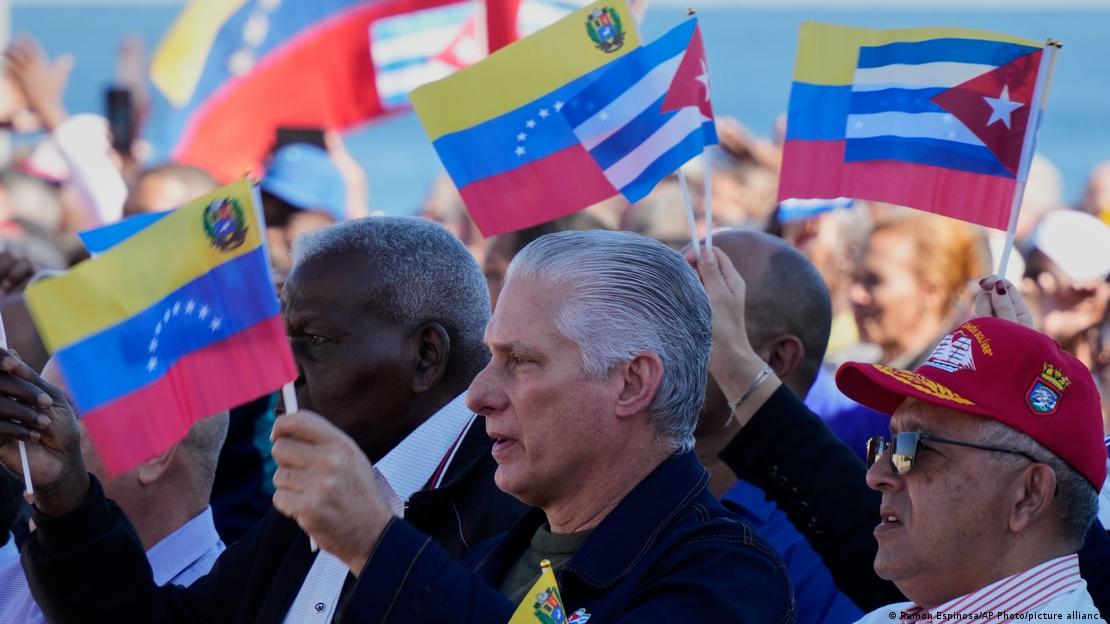
Cuban President Miguel Diaz-Canel did not appear particularly concerned at weekend rallies in HavanaImage: Ramon Espinosa/AP Photo/picture alliance
Cuba: Lack of Venezuelan oil intensifies struggle for survival
"Cuba now has no income. They got all of their income from Venezuela, from the Venezuelan oil. They're not getting any of it. Cuba literally is ready to fall," Trump told reporters on his plane on Sunday.
At least outwardly, President Miguel Diaz-Canel did not appear particularly concerned when he accused the US of "fascist state terrorism" and "imperialist barbarism" at a Sunday rally in Havana in front of thousands of supporters.
"No, gentlemen imperialists, this is not your 'backyard'… We do not recognize the Monroe Doctrine, nor the kings or emperors above us," he said. "For the sake of Venezuela, as well as for the sake of Cuba, we are ready to give even our blood, even our life, but we will not back down. Now is not the time of half measures; it is the time of certainty and choice of sides in the face of fascism and imperial barbarism. Down with imperialism!"
But for Cuba expert Bert Hoffmann, Cuba is the biggest loser following the US military strike in Venezuela.
"The situation is already very tense, and the loss of Venezuelan oil is dramatically exacerbating the energy crisis. This oil accounted for 70% of all Cuba's oil imports," said Hoffmann, a political scientist at the GIGA German Institute of Global and Area Studies in Hamburg. "There is no one in Cuba who is not deeply concerned about this, both among the population and the government. So the crisis will continue to worsen."
This suggests that the strategy of attempting to bleed Cuba dry economically could work. Even now, everyday life for Cubans is difficult: There are hourslong power outages, a daily struggle for food, medicine and fuel, and a futile wait for visitors following a massive slump in the country's most important source of income, tourism. The Cuban government is now trying to find replacements for oil supplies from Venezuela, and according to Hoffmann, is looking to Russia, Arab states, Iran or Algeria.
"The most likely scenario is that the political leadership will make every effort to keep the ranks so tightly closed that the dissatisfaction of the population will ultimately find no political expression," Hoffmann told DW.
So far, the power apparatus in Cuba appears to have maintained great unity.
"The Communist Party, the military, and the security apparatus are closely intertwined," said Hoffmann. "As long as no cracks appear there, this elite will remain relatively firmly in the saddle."
He also said he believes Cuba cannot hope for significant assistance from Russia and China — there will be some support, but not to the extent of open confrontation with the United States. Hoffmann does not believe the US will intervene militarily in the immediate future.
"Economic pressure measures could be tightened once again, for example with sanctions against ships calling at Cuba," he said. "But after what we have seen in Venezuela, a full naval blockade is also conceivable in the medium term."
Mexico: 'Trump whisperer' has to excel in diplomacy
"She is very afraid of the cartels," Trump said of Mexican President Claudia Sheinbaum in an interview with Fox News on Saturday. "I've asked her many times, 'Would you like us to eliminate the cartels?'" Sheinbaum, he claimed, had declined. "So we have to do something, because in my opinion the real number of deaths [from drug use] is 300,000 a year."
The left-wing Mexican president has so far managed to contain the US president with great diplomatic skill, even earning her the nickname the "Trump whisperer."
Speaking to journalists on Monday, Sheinbaum said she did not see a hypothetical US intervention in Mexico as likely, even though Trump had insisted on it during calls between the two leaders.
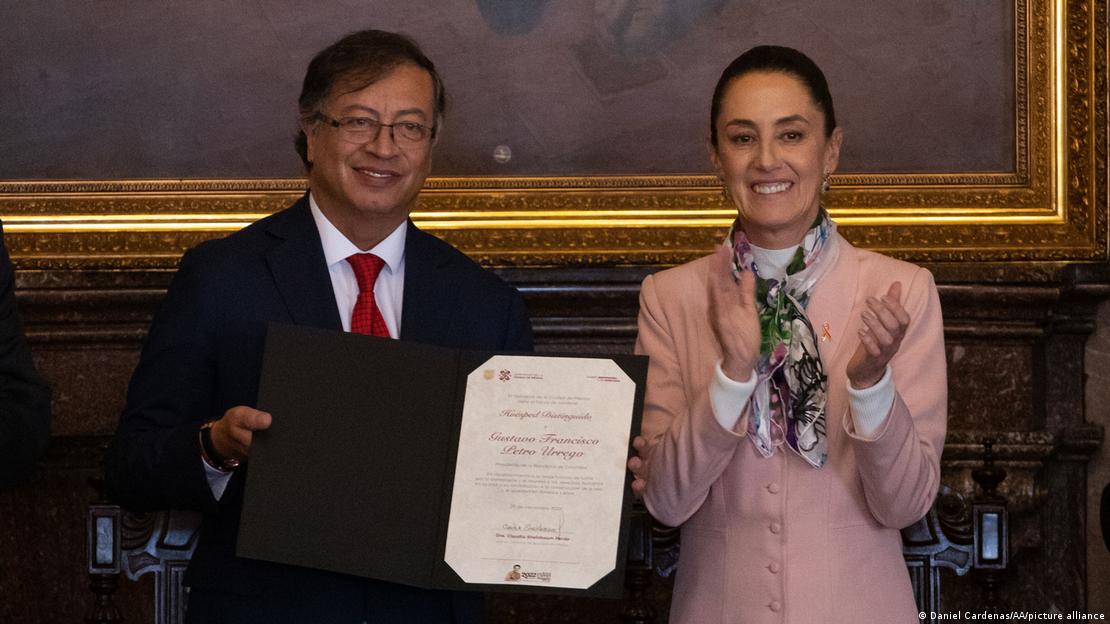
Colombian President Gustavo Petro and Mexico's Claudia Sheinbaum have been defiant in the face of Trump's threatsImage: Daniel Cardenas/AA/picture alliance
"I don't believe in an invasion; I don't even think it's something they're taking very seriously," Sheinbaum said. "It is necessary to reaffirm that in Mexico the people rule, and that we are a free and sovereign country — cooperation, yes; subordination and intervention, no."
"The worst-case scenario is not that Trump threatens Mexico with military action," an op-ed in Mexico's largest newspaper, El Universal, wrote. "The worst-case scenario is that there are Mexicans who begin to wish for such an attack and applaud it."
This sums up the damage caused by Trump's threats toward Colombia, Cuba and Mexico. Even if the US does not attack any of the three countries, Washington's intimidation attempts are not failing to have an effect on society.
For Sheinbaum, that means she will have to continue her diplomatic balancing act of confidently representing Mexico's interests while not upsetting her large neighbor, despite the increasingly difficult circumstances. For now, this will continue until June 11, when the opening match of the FIFA World Cup will take place in Mexico City, hosted by Canada, Mexico and the US. The guest of honor will undoubtedly be Trump.
This article was originally written in German.
"I don't believe in an invasion; I don't even think it's something they're taking very seriously," Sheinbaum said. "It is necessary to reaffirm that in Mexico the people rule, and that we are a free and sovereign country — cooperation, yes; subordination and intervention, no."
"The worst-case scenario is not that Trump threatens Mexico with military action," an op-ed in Mexico's largest newspaper, El Universal, wrote. "The worst-case scenario is that there are Mexicans who begin to wish for such an attack and applaud it."
This sums up the damage caused by Trump's threats toward Colombia, Cuba and Mexico. Even if the US does not attack any of the three countries, Washington's intimidation attempts are not failing to have an effect on society.
For Sheinbaum, that means she will have to continue her diplomatic balancing act of confidently representing Mexico's interests while not upsetting her large neighbor, despite the increasingly difficult circumstances. For now, this will continue until June 11, when the opening match of the FIFA World Cup will take place in Mexico City, hosted by Canada, Mexico and the US. The guest of honor will undoubtedly be Trump.
This article was originally written in German.

No comments:
Post a Comment