Ukraine’s wartime grid offers ten lessons in energy resilience, IEA says
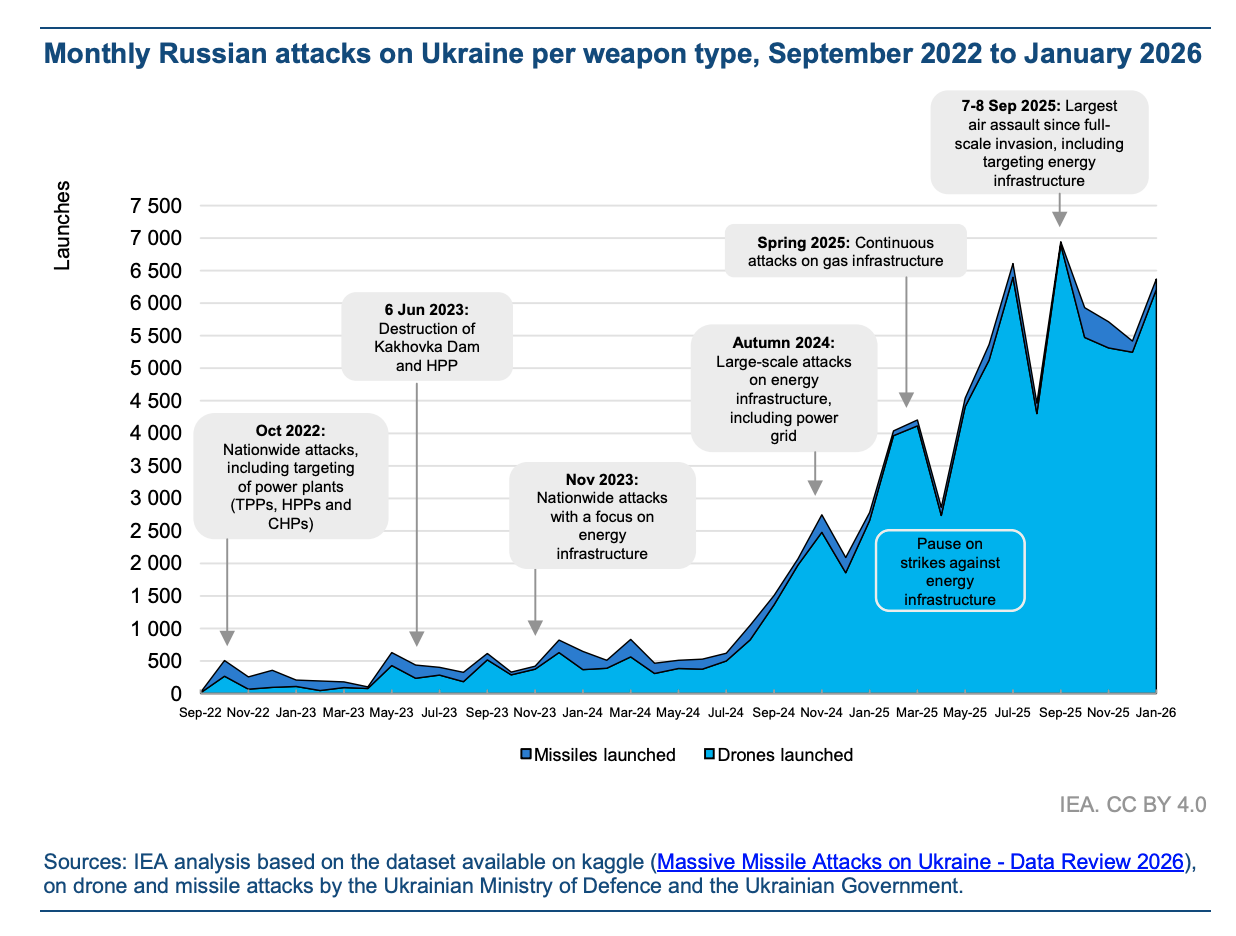
Ukraine’s struggle to keep the lights on under sustained Russian bombardment this winter has yielded ten core lessons for energy security that policymakers worldwide would be wise to study, according to a new report from the International Energy Agency.
The study, Energy System Resilience, distils insights from Ukraine’s efforts since Russia’s full-scale invasion in 2022 to withstand physical and cyber-attacks on its power infrastructure.
The IEA argues that “ensuring energy security encompasses both long-term and short-term dimensions”, combining infrastructure investment and supply diversification with the capacity to cope with shocks that exceed standard planning assumptions.
“Since Russia’s full-scale invasion in 2022, Ukraine has worked to protect its energy sector and to increase its ability to withstand and rapidly recover from Russia’s attacks on its energy infrastructure,” the report says. The lessons, it adds, apply not only to wartime conditions but also to “cyberattacks, physical attacks on infrastructure, extreme and severe weather, and unexpected infrastructure failures”.
The IEA’s ten lessons from Ukraine
Energy security must combine long-term investment with short-term resilience.
Decentralisation enhances system resilience.
Flexibility and rapid repair capacity are critical.
Cybersecurity must be treated as core infrastructure protection.
Clear governance and coordination improve crisis response.
Diversification of supply reduces systemic vulnerability.
Strategic reserves and spare equipment are essential.
Demand-side management can stabilise stressed systems.
International partnerships strengthen resilience.
Planning must assume events beyond historical norms.
Energy security must combine long-term investment with short-term resilience
The IEA stresses that energy security is not simply about building more infrastructure or diversifying fuel sources. “The long-term dimension involves securing sufficient infrastructure investment and diverse supply sources,” the report notes. But the short-term dimension — resilience — focuses on a system’s ability to cope with events that exceed standard planning conditions. Ukraine’s experience shows that even well-developed systems require contingency planning for extreme scenarios.
Decentralisation enhances system resilience
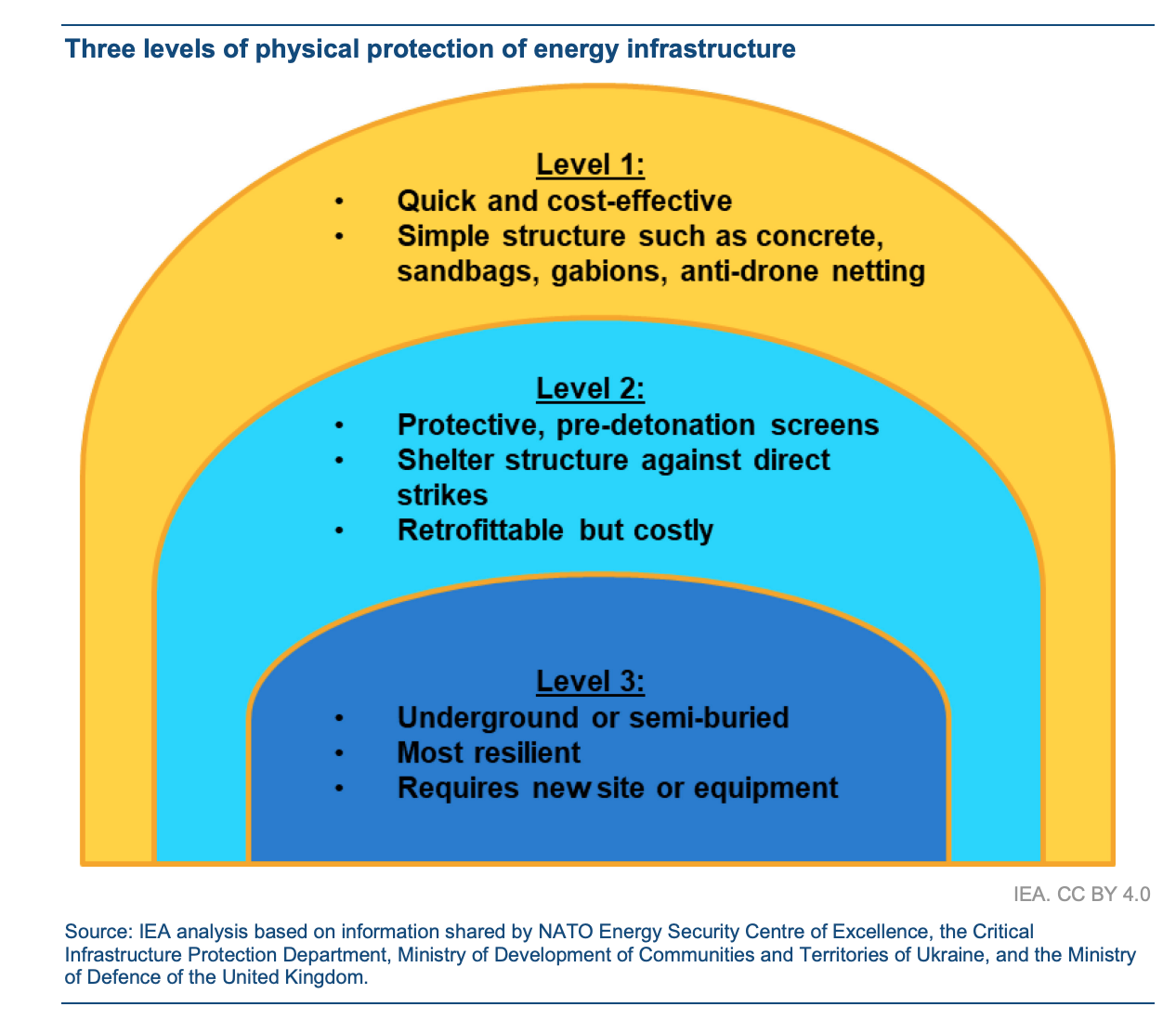
Ukraine has accelerated plans to decentralise its power system, reducing reliance on large, centralised generation facilities that are vulnerable to missile strikes. The IEA’s roadmap for decentralising Ukraine’s power system highlights how distributed generation, microgrids and local energy resources can reduce the risk of cascading failures. Smaller, dispersed assets are harder to disable simultaneously and easier to restore.
Flexibility and rapid repair capacity are critical
A key wartime adaptation has been the development of rapid repair teams and modular replacement strategies. The ability to restore damaged substations or transmission lines within days, rather than months, has limited blackouts. The report underscores the importance of pre-positioned spare parts and trained emergency crews capable of operating under extreme conditions.
Cybersecurity must be treated as core infrastructure protection
Ukraine has faced persistent cyberattacks alongside physical strikes. The IEA argues that digital security should be integrated into core resilience planning, not treated as an auxiliary concern. Strengthened monitoring, redundancy in control systems and regular stress testing have become central to protecting grid operations.
Clear governance and coordination improve crisis response
Crisis management structures have evolved to ensure swift coordination between government, grid operators and private utilities. The IEA emphasises that clarity in roles and responsibilities speeds decision-making during emergencies and reduces duplication or delay.
Diversification of supply reduces systemic vulnerability
Ukraine’s pre-war energy mix included significant nuclear and thermal generation. Wartime disruption has reinforced the value of diversification across technologies and import routes. The lesson extends to other countries seeking to reduce exposure to single suppliers or fuels.
Strategic reserves and spare equipment are essential
The report highlights the importance of stockpiling critical components such as transformers and grid equipment. When attacks damaged infrastructure, access to spare parts determined recovery speed. Strategic reserves, often neglected in peacetime, proved decisive.
Demand-side management can stabilise stressed systems
Ukraine has relied on managed outages and demand reduction measures to prevent system collapse during peak stress periods. The IEA notes that demand flexibility — including industrial load shifting and public conservation campaigns — can buy time during acute shortages.
International partnerships strengthen resilience
The IEA has worked closely with Ukraine, publishing a 10-point plan ahead of the 2024–2025 winter, followed by a 2025–2026 update. “This has provided Ukraine with critical assistance, while also offering invaluable real-world lessons that can inform resilience planning for IEA Member countries and beyond,” the report says. European industry has collaborated with Ukrainian firms, sharing technology and learning from operational experience under attack.
Planning must assume events beyond historical norms
Perhaps the most striking lesson is that resilience planning must go beyond traditional risk models. The report identifies the need to prepare for high-impact, low-probability events — whether war, extreme weather or systemic cyber disruption — rather than relying solely on historical averages.
The IEA concludes that Ukraine’s experience offers practical guidance for countries confronting an era of heightened geopolitical tension and climate volatility. “This report distils key lessons from Ukraine’s experience that can inform energy system resilience efforts worldwide,” it states.
As energy infrastructure becomes increasingly digitised and decentralised, the distinction between peacetime reliability and wartime resilience is narrowing. Ukraine’s battered grid has become an unintended laboratory — one whose lessons may shape global energy security planning for years to come.

No comments:
Post a Comment