Showing posts sorted by date for query CHRETIEN AFRICA. Sort by relevance Show all posts

Saturday, November 01, 2025

Canadian Hypocrisy Taints Anand’s Condemnation of Violence in Sudan


On Tuesday, foreign affairs minister Anita Anand condemned atrocities reportedly committed by the Rapid Support Forces (RSF) in western Sudan. She failed to mention a Canadian company’s involvement or Canada’s historical support for violence in the northeast African country.

The Canadian-owned Streit Group has provided armored vehicles to the RSF. Long based in southern Ontario, the Streit Group’s operations in the UAE have recently supplied the RSF, which has been armed and backed by Abu Dhabi since it fought Ansar Allah (Houthis) in Yemen. Canadian officials have directly assisted the Streit Group.

Canada has exported hundreds of millions of dollars in weapons to the UAE in recent years. Additionally, Canadian diplomats and the military have promoted firms selling their wares at the Abu Dhabi-based International Defense Exhibition and Conference (IDEX), the largest arms fair in the Middle East and North Africa.

Canada has longstanding ties to violence in Sudan, as I detail in Canada in Africa: 300 years of Aid and Exploitation. Prime Minister Jean Chretien and his government defended the US’s illegal bombing of the Al-Shifa pharmaceutical facility in August 1998, which was supposed to be producing chemical weapons. It wasn’t. Echoing US Secretary of State Madeleine Albright’s statement that “we have a legal right to self-defense,” foreign affairs minister Lloyd Axworthy said, “when you come into this very murky and very dangerous area of dealing with terrorism, nations have a right to defend themselves.” The bombing left millions of Sudanese without medicines and is thought to have caused many thousands of unnecessary deaths.

One hundred years earlier, Canada backed another bout of foreign violence in Sudan. Four hundred Canadians traveled halfway across the world to beat back anti-colonial resistance in Khartoum in 1884. When Britain occupied Egypt, it took control of the Sudan, which had been under Egyptian rule for half a century. But indigenous forces increasingly challenged foreign rule. Tens of thousands of Sudanese laid siege to British/Egyptian-controlled Khartoum from March 1884 to January 1885. After cutting the 60,000-person city off from its supplies, the indigenous forces wrested control of Khartoum from the famed English General Charles Gordon.

As a result, 385 Canadian boatmen were recruited to transport soldiers and supplies to rescue Gordon and defend Britain’s position on the upper Nile. Arguing in favor of the expedition, the Globe and Mail’s predecessor claimed, “the Dark Continent is to be the next great theater upon which the dominant races of man are destined to play a conspicuous and important part.”

Despite failing to save Gordon or maintain control of Khartoum, British forces left a great many dead. In one battle, 300 to 400 Sudanese died, with 14 killed on the Egyptian/British side. In another confrontation, 1,100 Sudanese lost their lives, in contrast to the 74 British/Egyptian fighters who died.

While Britain had overwhelming superiority of arms, moving men and supplies up the river Nile was incredibly laborious. As such, the Sudanese “Mahdist” forces captured Khartoum before the British reinforcements reached the city. With Gordon dead and the expedition having various logistical difficulties, they put off attempting to recapture Khartoum.

Though defeated in the Sudan, the British were ultimately undeterred. A decade later, in Queen Victoria’s words, they “avenged” the death of Gordon and secured control of the Upper Nile. Royal Military College (RMC) graduate Lieutenant James Jay Bleecker Farley participated in the 1896 Dongola Expedition into northern Sudan. Up to 1,000 Mahdist soldiers were killed by the British-led forces (20 Egyptians died on the British side). In a speech at the Kingston, Ontario-based RMC, Farley described participating in several skirmishes. “One of our patrols, after a very exciting chase, succeeded in capturing three ‘suspicious looking (n-word),’ but they only turned out to be harmless villagers and rather badly frightened ones at that.”

Montreal-born Sir Edouard Percy Girouard made a significant contribution to the reconquest of Sudan. The RMC graduate and former junior civil engineer with the Canadian Pacific Railway oversaw the construction of two hard-to-build rail lines from southern Egypt towards Khartoum. Queen Victoria’s Little Wars explains, “The problems involved in building a railway into a desert inhabited by hostile tribesmen were formidable. Railway experts and experienced soldiers alike agreed that it was an impractical idea, but [British commander Herbert] Kitchener disagreed, and Girouard made it a reality.”

The railway allowed British forces to bypass 800 km of treacherous waterways, making it much easier to move troops and supplies than a decade earlier during the time of the Canadian Voyageurs. The British reconquest of the Sudan was a slaughter. At least three Canadians participated in the final battle at Omdurman, where some 11,000 Sudanese were killed and 16,000 wounded.

Forty-eight British/Egyptian soldiers were killed, and about 400 were wounded. According to Winston Churchill and other witnesses, at least 100 injured Sudanese were murdered after the battle. Additionally, British gunboats shelled civilians in Omdurman, and the city was subsequently looted.

After successfully laying track towards Khartoum, Girouard was appointed president of the Egyptian State Railway and was given the British military’s prestigious Distinguished Service Order. Some considered Girouard’s contribution to the reconquest of the Sudan second in importance only to General Kitchener. The Montrealer later became colonial governor of both Northern Nigeria and Kenya. There’s a mountain in Banff National Park, as well as a plaque and building at RMC, named in Girouard’s honor.

The ongoing celebration of Percy Girouard is a sign of how little Canada truly cares about violence against Sudanese, and our foreign minister condemning it while allowing Canadian arms to fuel it just adds to our international reputation as hypocrites.

Monday, August 04, 2025

Diplomats Informed That Trump Refugee Program 'Intended for White People' Only: Report

Trump earlier this year lobbed baseless accusations at South African President Cyril Ramaphosa that his government was engaging in "genocide" against white farmers.


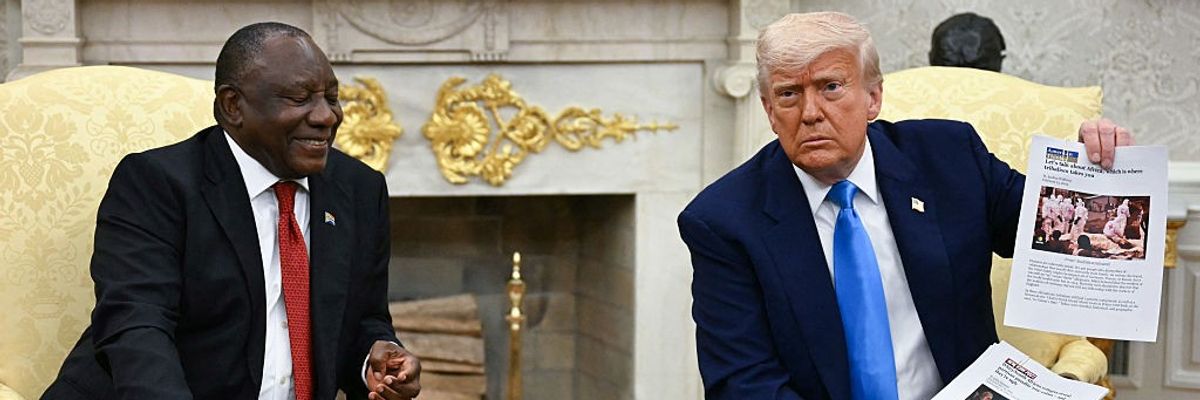
U.S. President Donald Trump meets with South African President Cyril Ramaphosa in the White House in Washington, D.C., on May 21, 2025.
 (Photo: Jim Watson/AFP via Getty Images)

Brad Reed
Jul 25, 2025
COMMON DREAMS

A Friday report from Reuters claims that a senior Trump administration official recently informed diplomats in South Africa that a refugee program set up by U.S. President Donald Trump earlier this year was explicitly intended for white people.

According to Reuters, American diplomats in South Africa earlier this month asked the U.S. State Department whether it was allowed to process refugee claims from South African citizens who spoke the Afrikaans language but who were of mixed-race descent.

The diplomats received a response from Spencer Chretien, the senior bureau official in the State Department's Bureau of Population, Refugees, and Migration, who informed them that "the program is intended for white people," writes Reuters.

The State Department told Reuters that the scope of the program is actually broader than what was outlined in Chretien's message and that its policy is "to consider both Afrikaners and other racial minorities for resettlement," which lines up with guidance posted earlier this year stating that applicants for refugee status under the program "must be of Afrikaner ethnicity or be a member of a racial minority in South Africa."

Trump back in February issued an executive order establishing a refugee program for what the order described as "Afrikaners in South Africa who are victims of unjust racial discrimination." The president also lobbed baseless accusations at South African President Cyril Ramaphosa this past May that his government was engaging in "genocide" against white farmers in his country.

The notion that whites in South Africa face severe racial discrimination, let alone the threat of genocide, is difficult to square with the reality that white South Africans own three-quarters of the private land in the nation despite being a mere 7% of the population.

Dara Lind of the American Immigration Council, reacting to the Reuters report, explained on social media platform Bluesky the reasons that Trump's refugee program for Afrikaners is highly unusual. Lind pointed to the fact that the United States government at the moment is still trying to block refugees who have already gone through a two-year vetting process from entering the country, whereas it let many Afrikaner refugees into the country after a mere two weeks of vetting.

"Two years of vetting is insufficient, but two weeks is enough to know if someone will 'be assimilated easily'—as admin officials said when the Afrikaners came," she observed.

Wednesday, February 26, 2025

Why Canada must look beyond the U.S. to Africa’s economic boom

The economic surge of a youthful Africa offers Canada a chance to diversify trade beyond the erratic United States.

20 YEARS AGO PM CHRETIEN MADE AFRICA
A CANADIAN TRADING PARTNER


Workers unload cargo at Lamu Port in Kenya shortly after it opened in 2021. It was built by the China Communications Construction Company ZHANG NANFANG /XINHUA/THE CANADIAN PRESS)


by Zack Ahmed 
February 26, 2025
POLICY OPTIONS


As Canadians prepare to choose their next government in the face of a protectionist and unpredictable White House, Canada risks turning inward as it stands on guard for its economy and jobs.

While this might seem like the intuitive move when facing such an unfamiliar and erratic landscape, Canada may be overlooking a largely untapped economic behemoth staring at us from across the Atlantic.

No matter who wins the next election and whether they form a majority or a minority in Parliament, debates surrounding the economy and immigration will shape the national dialogue. All the while, much attention will unavoidably continue to be directed south of the border.
A rising economic power

All these events and their intended and unintended consequences provide a unique moment to up Canada’s engagement with Africa – for mutual benefit.

Initiatives such as the Feminist International Assistance Policy (FIAP) and Canada-Africa Economic Cooperation Strategy (CA-ECS) were introduced by the current Liberal government. Still, Canada’s engagement with African nations remains limited in breadth, nuance and co-ordination.

Africa’s rapid demographic and economic boom presents an extraordinary opportunity as well as corresponding challenges.

Africa’s population boom is one of the most striking developments in the 21st century. According to the United Nations Economic Commission for Africa, the continent will be home to roughly 2.5 billion people by 2050, many of whom will be under the age of 25.

This represents not only a vast consumer base, but also a burgeoning pool of entrepreneurial talent and a potential workforce that could spur innovation across multiple sectors. At the same time, the Intergovernmental Panel on Climate Change (IPCC) warns that Africa is already grappling with disruptions tied to climate change – from droughts and floods to resource scarcity – which invariably fuels conflict and displacement at large scales.

Economic data paints a clear picture that Africa merits closer attention and greater cooperation. In recent years, countries such as Ethiopia and Côte d’Ivoire have posted GDP growth rates that outpace the global average, showing that African economies are poised to become drivers of global prosperity.

And while free trade in North America appears to be coming apart at the seams, the African Continental Free Trade Area (AfCFTA), an ambitious initiative uniting 1.5 billion people within a single market, is projected to be worth more than US$3.4 trillion, radically transforming Africa’s trade and economic landscape.

For Canada, which has traditionally relied on the United States as its chief trading partner, these developments suggest that failing to open greater dialogue with Africa runs the risk of missing out on valuable opportunities for trade, investment and innovation.
Trade diversification and climate

With protectionist currents rising not just in the U.S. but around the world, a future-oriented approach to trade diversification is in Canada’s best interest. This has been further amplified by the re-election of a mercantilist President Donald Trump and his tariff rattling threats.

A more balanced approach that actively incorporates emerging African markets can help reduce Canada’s exposure to such risks.

Such an initiative could involve a specialized task force within Global Affairs Canada that focuses on opening up new trade partnerships with AfCFTA member states. Collaborating with Export Development Canada would help ease financial risks and provide support for Canadian businesses seeking entry into these dynamic new markets.

Climate security is another realm in which Canada has much to gain by working collaboratively with African nations.

Climate change already influences migration patterns, fuels resource-driven conflicts, and strains humanitarian systems – challenges that extend far beyond national borders. By forging consensus on climate adaptation, water resource management, and renewable energy, Canada could bolster regional stability while also opening new market possibilities for its clean-energy and tech sectors.

These joint efforts might take shape under a Canada-Africa Climate Security Partnership, bringing together government agencies, NGOs, businesses, and academic institutions to share knowledge, build capacity and develop early warning systems for climate-related emergencies.
The power of the African diaspora

Equally pivotal is the role of the African diaspora in Canada. Immigration has been a cornerstone of this country’s growth, and Africa offers unique avenues for cross-continental innovation and collaboration.

Skilled professionals in fields such as healthcare, engineering and technology can help Canadian businesses tailor products and services to local markets and navigate potential cultural and regulatory barriers. Encouraging diaspora-led trade missions and entrepreneurial accelerators, supported by local and provincial governments, could foster meaningful alliances that benefit both Canada and African economies.

Immigration, Refugees and Citizenship Canada might explore more specialized pathways and scholarship programs to bring African professionals and students to Canada, thereby enriching our talent pool and strengthening bonds between the two regions.

Ultimately, viewing Africa solely through the lens of economic potential or humanitarian assistance is too limiting. Its youthful population and evolving institutions point to great untapped potential for transatlantic collaboration.

By respecting African ownership of local development priorities and by engaging in long-term, capacity-building partnerships, Canada can position itself not just as a donor or a market-seeker but as a genuine long-term ally in Africa’s ongoing transformation.

Looking ahead, the next government has a rare opportunity to recalibrate Canada’s foreign policy strategy in a way that better aligns with a rapidly changing global order. By diversifying trade beyond traditional partners, strengthening ties through climate security initiatives, and fully harnessing the power of the African diaspora, Canada can safeguard its own economic and geopolitical interests while becoming a key contributor to Africa’s development goals.


Zack Ahmed is a SSHRC doctoral fellow in global governance at the Balsillie School of International Affairs and a researcher with MIFOOD Networks. With more than 14 years of experience in public policy, global governance and international development, he has worked on cross-sectoral projects - spanning private, public, and non-profit organizations across Africa and Canada.

Monday, October 16, 2023

Canada’s Complicity With Crimes Against Humanity in Gaza

By Yves EnglerOctober 16, 2023
Source: Originally published by Z. Feel free to share widely.

Director General of Strategic Planning, Canadian Armed Forces, signs the IDF-CAF annual work-plan in 2019, which reflects the robust MIL2MIL engagement between the two countries. Image: IDF Spokesperson's Unit photographer

Melanie Joly traveled to Israel to support its genocidal policies in Gaza. The trip will go down as one of the more shameful moments in Canada’s odious anti-Palestinian history.

Amidst the brutal siege of Gaza foreign affairs minister Joly traveled to Israel Friday. After meeting her Israeli counterpart, Eli Cohen, Canada’s top diplomat tweeted, “I reiterated our support for Israel’s right to self-defence”. In describing the meeting, Israel’s foreign minister boasted, “We continue to mobilize the world for the fight against Hamas! I met today with Canada’s Foreign Minister Melanie Joly, who also came to support Israel.”

In the hours before Joly released her tweet, Israel demanded that half the population of Gaza move to the southern part of the narrow coastal strip. Additionally, Israeli defence minister Yoav Gallant boasted about cutting off water, food, fuel and electricity to the open-air prison. Gallant declared, “Gaza won’t return to what it was before. We will eliminate everything.” For his part, Israeli President Isaac Herzog rejected the idea that there are civilians in Gaza declaring the 2.2 million living there collectively responsible for Hamas’ attack. “It’s not true this rhetoric about civilians being not aware, not involved. It’s absolutely not true,” he said. “They could have risen up, they could have fought against that evil regime which took over Gaza in a coup ‘détat.”

Alongside the genocidal statements and strengthened siege, Israel has fired over 6,000 rockets at a territory about the size of Montreal. During the past week they’ve killed 2,400 Palestinians, including 750 children. According to the Palestinian health ministry, 45 families have been entirely removed from the Gaza civil registry. The UN estimates that one million Palestinians have been displaced in Gaza.

Even if Israel were to stop its crimes against humanity tomorrow, Gazans would reel for years from the damage already inflicted. But everything suggests the apartheid state plans to escalate its murderous onslaught. Thousands more will likely be killed as Israel seeks to cleanse the southern part of the strip (most in Gaza are refugees from Zionist ethnic cleansing in 1947–48). According to US investigative journalist Seymour Hersh, Israeli officials are debating employing Joint Direct Attack Munition bombs capable of killing everyone within “one-half mile” from the dropping site.

Understanding full well the war crimes Israel is committing, Canada’s foreign minister greenlit their violence during her visit. As she talked about Israel’s “right to defend itself”, Joly, Justin Trudeau and other Canadian officials have refused to condemn Israel’s war crimes.

Despite claims the entire conflict began nine days ago, Hamas’ violence doesn’t explain the Liberal’s anti-Palestinian policies. The Trudeau government has expanded the Canada-Israel free trade agreement, organized a pizza party for Canadians fighting in the Israeli military, voted against over 60 UN resolutions upholding Palestinian rights, sued to block proper labels on wines from illegal settlements and created a special envoy to deflect criticism of Israeli abuses. During a 2018 visit to Israel former foreign affairs minister Chrystia Freeland announced that should Canada win a seat on the United Nations Security Council it would act as an “asset for Israel” on the Council.

The Trudeau government has been little different than Stephen Harper on Israel. But their policy also reflects a much deeper history. At the time of confederation Canada’s preeminent Zionist was Ottawa businessman Henry Wentworth Monk. A Christian, Monk began the Palestine Restoration Fund to buy Palestine from the Ottoman Empire and called for the British to establish a “dominion of Israel” similar to the dominion of Canada. In the 1978 book Canada and Palestine, Zachariah Kay notes: “Monk believed that Palestine was the logical center of the British Empire, and could help form a confederation of the English-speaking world.”

In subsequent decades Monk’s idea became increasingly popular, with leading politicians repeatedly citing a mix of Christian and pro-British rationale to support Zionism.

Canada helped realize the 1917 Balfour Declaration, a crass expression of British colonial thought granting Palestine to European settlers. Fresh from leading the First World War Anglo-French conquest of German West Africa, Québec City-born Lt-Gen. Charles Macpherson Dobell commanded a force that attempted to seize Gaza during the Sinai and Palestine Campaign. As many as 400 Canadians (about half recruited specifically for the task) also fought in British General Edmund Allenby’s Jewish Legion that helped conquer modern day Israel/Palestine.

Canada’s most significant contribution to Palestinian dispossession was its central role in imposing the unjust 1947 UN partition plan. External Affairs Lester Pearson promoted Zionist objectives in two different UN forums dealing with the matter and Canada’s representative on the United Nations Special Committee on Palestine, which was dispatched to the region to propose a solution for the British mandate, and is considered the lead architect of the partition plan. The UN partition plan gave the Zionist movement 55% of historic Palestine despite the Jewish community being less than a third of the population and owning 7% of the land. A huge boost to the Zionist movements’ desire for an ethnically-based state, partition legitimated the displacement of at least 700,000 Palestinians.

Hundreds of Canadian World War II veterans fought to ethnically cleanse Palestine. During the 1948 war Israel’s small air force was almost entirely foreign. At least 53 Canadians were part of it including Montreal’s Sydney Shulemson who is considered the “father of the Israeli Air Force”.

With the exception of Israel’s 1956 invasion of Egypt with Britain and France, Canada has supported Israel’s multiple foreign invasions and bombings.

For decades Canada’s intelligence agencies have worked closely with their Israeli counterparts. The Communications Security Establishment has long spied on Palestinians and shared the intelligence with Israel. For their part, Mossad agents have used Canadian passports to carry out numerous foreign assassinations. “A member of an Israeli hit squad that mistakenly killed a Moroccan waiter in Norway in 1973 had posed as a Canadian,” reported the Canadian Jewish News.

Maybe Canada’s least anti-Palestinian Prime Minister, Jean Chretien signed a free trade accord with Israel in 1997. In an implicit recognition of the occupation, CIFTA includes the West Bank as a place where Israel’s custom laws are applied.

While government ministers and opposition politicians justify it as a response to Hamas violence, Canada’s support for Israeli barbarity is routine. Joly’s encouragement of genocidal policies in Gaza reflects a long anti-Palestinian history by a fellow settler state, which, like Israel, is a key cog in the US Empire.

That is Canada’s reality. Until we acknowledge this truth and struggle to overcome it, we will never be a force for good in the world.


Yves Engler’s latest book is Stand on Guard for Whom?: A People’s History of the Canadian Military.

Saturday, March 05, 2022


Ukraine No-Fly Zone “could lead to end of human civilization”

Canadians calling for a no-fly zone over Ukraine have lost the plot. Unless their real aim is nuclear war.

Recently, former Conservative cabinet minister Chris Alexander, New Brunswick education minister Dominic Cardy and former Chief of the Defence Staff Rick Hillier have raised the idea of creating a “no-fly zone” (NFZ) over Ukraine. “We’re calling on all governments of the world to support creating a no fly zone over Ukraine,” declared Michael Shwec, president of the Ukrainian Canadian Congress, at a rally in Montréal. Ukrainian President Volodymyr Zelensky and US Congressman Adam Kinzinger have also called for NATO to adopt a NFZ.

A NFZ over Ukraine means war with Russia. It would force the US or NATO to shoot down Russian planes.

A war between Russia and NATO would be horrendous. Both the US and Russia have thousands of nuclear weapons. Highlighting the dangers, Paul Street wrote on Counterpunch that “any elected official calling for a No-Fly Zone over Ukraine should be forced to rescind that call or resign for advocating a policy that could lead to the end of human civilization.”

Fortunately, Canada’s defence minister Anita Anand and White House Press Secretary Jen Psaki have rejected the idea of an NFZ. “It would essentially mean the US military would be shooting down planes, Russian planes,” said Psaki. “That is definitely escalatory, that would potentially put us in a place where we are in a military conflict with Russia. That is not something the president wants to do.”

Even when the target is not a nuclear power, Canadian-backed NFZs have created death, destruction and escalation. After killing thousands of Iraqis in 1991 the US, UK, France and Canada imposed a NFZ over northern and southern Iraq. Over the next 12 years US and British warplanes regularly bombed Iraqi military and civilian installations to enforce the NFZs.

On different occasions Canada sent naval vessels and air-to-air refueling aircraft to assist US airstrikes. Canadian air crew on exchange with their US counterparts also helped patrol the NFZs.

After a September 1996 US strike to further destroy Iraq’s “air-defence network” Prime Minister Jean Chretien said the action was “necessary to avert a larger human tragedy in northern Iraq.” Five years later Chretien responded to another bombing by stating, “if the Iraqis are breaking the agreement or what is the zone of no-flying, and they don’t respect that, the Americans and the British have the duty to make sure it is respected.”

Twelve years after enforcing the NFZs the US/UK launched a full-scale invasion of Iraq. Hundreds of thousands were killed.

In March 2011, Washington, Paris and some other NATO countries convinced the United Nations Security Council to endorse a plan to implement a NFZ over Libya (China, Germany, Russia, Brazil and Turkey abstained on the vote). Begun under the pretext of saving civilians from Muammar Gaddafi’s terror, the real aim was regime change. The UN “no-fly zone” immediately became a license to bomb Libyan tanks, government installations and other targets in coordination with rebel attacks. With a Canadian general leading the mission, NATO also bombed Gaddafi’s compound and the houses of people close to him. The military alliance defined “effective protection” of civilians as per the UN resolution, noted Professor of North African and Middle Eastern history Hugh Roberts, as “requiring the elimination of the threat, which was Gaddafi himself for as long as he was in power (subsequently revised to ‘for as long as he is in Libya’ before finally becoming ‘for as long as he is alive’).” Thousands, probably tens of thousands, died directly or indirectly from that conflict. Libya has yet to recover and the conflict spilled south into the Sahel region of Africa.

While they may sound benign, NFZs have generally elicited violence. Russia’s invasion of Ukraine is a terrible violation of international law that is likely to have deleterious consequences for years to come. But escalating the conflict through a no-fly zone will only make it worse. It could lead to a cataclysmic nuclear war.

• On March 4 I will be participating in a panel on “Cutting through the Spin: Russia’s invasion, NATO’s provocation and Canada’s complicity”. 

Facebook

Yves Engler is the author of 12 books. His latest is Stand on Guard For Whom? — A People’s History of the Canadian Military.  Read other articles by Yves.

Wednesday, May 09, 2007

Nationalism Will Not Stop North American Union


The drive to further Fortress North America is gaining ground with through the Security and Prosperity Partnership (SPP) Also known as the North American Union. It is the natural follow up to NAFTA, driven by the events of 9/11.

Unfortunately the response so far has been that of narrow nationalism and the wailing over the death of sovereignty.

In the U.S. it has been led by nativist populist Lou Dobbs, and in Canada by left nationalist Maude Barlow, making strange bedfellows indeed.
DOBBS: There are rising concerns in Canada about the SPP, the so-called Security and Prosperity Partnership which some think is directly the foundation for something called the North American Union. The Bush administration is pretty excited about that, saying the initiative is meant to increase security and prosperity for all of North America. Opponents, however, say the initiative is nothing less than a plan to create a North American Union that would eliminate sovereignty for all three nations.

As Christine Romans now reports, grassroots opposition is rising in Canada.

(BEGIN VIDEOTAPE)

CHRISTINE ROMANS, CNN CORRESPONDENT (voice over): In Ottawa, author and activist Maude Barlow has unrestrained contempt for the Security and Prosperity Partnership. She's concerned about a grab for Canada's natural resources and a watering down of its regulations and benefits by the biggest corporations doing business in North America. And that's just for starters.

MAUDE BARLOW, THE COUNCIL OF CANADIANS: If Canadians and Americans and Mexicans, ordinary people, saw what these guys are talking about, including one trade bloc, one security perimeter, one -- you know, everybody agreeing with George Bush's foreign policy, and don't ask any questions -- you know, lowest common denominator environmental standards, I don't think they would go for it.

ROMANS: Her group, the Council of Canadians, has published a citizens guide called "Integrate This," denouncing the deep integration agenda between the United States, Mexico and Canada. The stated goal established by presidents Bush, Fox and Prime Minister Paul Martin is integration by 2010. Harmonizing regulations for a safer, more prosperous North America.

But Barlow recently testified before a parliamentary trade committee that the SPP "... is quite literally about eliminating Canada's ability to determine independent regulatory standards, environmental protections, energy security, foreign, military, immigration and other policies."

Among the Canadians left, a growing fear that big business is drafting government policy behind closed doors.

BRUCE CAMPBELL, CANADIAN CENTER FOR POLICY ALTERNATIVES: This is a vast initiative. It's an umbrella for a whole bunch of initiatives. There's 20 working groups and initiatives totaling about 300. And very little is known really about the nitty-gritty of these. We have a superficial knowledge, but I think we need -- we need to know more.

ROMANS: He's hoping all three legislative bodies will insist on oversight.

(END VIDEOTAPE)

ROMANS: It's just emerging as an issue now before Canada's lawmakers, driven by progressives and Canadian nationalists. In the U.S., the (INAUDIBLE) opposition is dominated by border control advocates. Strange bedfellows, they both agree, but both are wondering why more people aren't raising questions. Canadian immigration opponents promise plenty of noise as the next trilateral meeting of leaders approaches in Canada this time -- Lou.

DOBBS: The new -- the new world order that this president's father talked about with such great enthusiasm seems to be high on the agenda in this administration. It's remarkable to me, the arrogance, the idea of just simply throwing away the nation's sovereignty. But they're trying to do so in many ways.


But like opposition to NAFTA this narrow nationalism fails to address the real nature of this agreement and thus is unable to effectively offer any alternative.

For narrow nationalism has already been defeated by the continental reality of the trading blocs created as a result of the evolution of the WTO.
It was begun in the 1970's with the creation of the Trilateral Commission and has evolved since then into a new global order of capital integration and a new era of inter-capital imperialism.

The New World Order was declared by George Bush I and the result has been almost two decades of transformation of the nation state into the corporatist state. That is where the State is a partner with the private sector, the ultimate P3 is globalization.

The agenda of the corporatist state is to access large amounts of public funds accessible for private investment, such as public pension funds/Social Security.

It is replacing the Fordist Welfare State in the U.S. and the social security state in social democratic countries like Canada and Mexico. It is creating blended economies of trading blocs in Latin America, Europe, Asia, and ultimately at its source; North America. Left out is Africa which remains the cheap goods, labour and raw resource colony of the New World Order, and the place they can invest.

Immigration Bill Advances North American Union
By Cliff Kincaid
Apr 29, 2007

Rep. Edward Royce, a high-ranking conservative California Republican, said over the weekend that a White House-backed amnesty plan for illegal aliens has provisions which undermine the national sovereignty of the U.S. and help facilitate development of a North American Union, much like the European Union that supersedes the sovereignty of 27 European countries.

He vowed to defy the White House and mobilize House Republicans against the bill, backed by what he called the "open borders lobby."


This is a new development in the decadence of the period of State Captialism. Ultimately as corporations replaced governments in providing services, they developed the need for trade agreements that allowed for their access to these services intra and internationally.

The dialectic was that globalization required nation states to promote it, but through a new form of governance, one modeled on corporate agreements rather than on binding national and international models of governance. APEC, the WTO, the GATTS, etc. are all corporate treaties signed by two parties, the State and its corporate allies. They are not international trade agreements solely between governments, and their dispute resolution boards are made up of corporate as well as judicial lawyers.


A group supporting North American integration is preparing to hold its annual "North American Model Parliament" for students from the United States, Canada and Mexico.

The North American Forum on Integration, or NAFI, is scheduled to hold "Triumvirate," in Washington, D.C., May 20–25.

NAFI, according to the group's website, is as a non-profit organization based in Montreal, dedicated to "address the issues raised by North American integration as well as identify new ideas and strategies to reinforce the North American region."

The group's support of North American integration is documented by an objective listed to "identify the elements of the North American agenda which would allow the consolidation and reinforcement of the North American region."

A variety of issues pertinent to the formation and operation of a North American Community are debated by the mock parliament, including expanding immigration, stimulating investment in Mexico and revising NAFTA to move in the direction of becoming a regional government.

This year's Triumvirate themes are listed as the creations of a customs union, water management, human trafficking and telecommunications in North America.

Last year's Triumvirate 2006 was held in the Mexican Senate.

Triumvirate 2005, the first NAFI mock North American Parliament, was held in Ottawa, Canada.

As WND reported, Raymond Chretien, the president of the Triumvirate and the former Canadian ambassador to both Mexico and the U.S., was quoted as claiming the exercise was intended to be more than academic.

"The creation of a North American parliament, such as the one being simulated by these young people, should be considered," he told WND.

The recent development of TILMA, a labour, capital, agreement between Alberta and B.C. which allows for NAFTA regulations to be applied in the two provinces as a way of breaking traditional inter provincial barriers is another example of the NAU being put into practice.

The North American Union is the child of the privateers and neo-cons despite the opposition of the traditional right in the U.S. In Canada the right has always admired the U.S. and been contientalist, it is the left who has been nationalistic.

Preserving America’s Freedom

Wood’s actions in Idaho were the first successful and visible manifestations of a groundswell of opposition to the NAU that has materialized in recent months. Led by members of the John Birch Society (of which this magazine is an affiliate), concerned grass-roots activists have succeeded in raising awareness at the local and state level of the dangers presented by the SPP and the move toward further North American integration. As a result of these efforts, resolutions opposing a North American Union have been introduced in 18 states as we go to press. So far, resolutions opposing the SPP and NAU efforts of the federal government have been passed by state legislatures in Idaho and Montana. But it is in Idaho that opposition to the SPP had its first great success.

North American Union

One example is the reaction to evidence that U.S. officials are laying the groundwork for a North American entity, sometimes called a "North American Community" or "North American Union" of the U.S., Canada and Mexico in economic and other spheres. I attended a Washington conference devoted to developing a North American legal system that included literature outlining the creation of a North American Supreme Court. Lou Dobbs of CNN had me on his show recently to talk about it. "It's clear that you're as astounded as I am and as my colleagues are that more people in the media are not focusing on this issue," he said. Indeed, it is a story with dramatic implications for the survival of our nation as a sovereign entity. Yet, Dobbs is the only major media figure to consider the issue newsworthy. Conservative radio host Michael Medved openly ridiculed those who are covering the issue, and Fox News won't touch it.

In the latest developments, Judicial Watch, the public interest law firm, has uncovered federal documents indicating that secretive "working groups" in the Security and Prosperity Partnership (SPP), a Bush Administration initiative, are working on a "One Card" concept to facilitate cross-border movement between the three countries. The SPP is being sold to the public as an attempt to help business, but the documents indicate a far-reaching effort to erase national borders and even national identity. Previous documents released by Judicial Watch through the Freedom of Information Act reveal a strategy called "evolution by stealth" to undermine the sovereignty of the three countries. That suggests a determined effort to keep this from the American people.

It may be difficult for the rest of the media to continue ignoring the controversy because opposition to the SPP is growing not only in the U.S. but Canada and Mexico. In fact, activists, academics, union officials, politicians and journalists from Canada, Mexico and the United States were in Ottawa from March 31-April 1 to organize opposition to the initiative. Judi McLeod of the Canada Free Press reports sources close to Canadian Prime Minister Stephen Harper as saying that he is firmly against Canada being part of any North American Union and that Canadian sovereignty is "everything" to him.

Actually what right winger Judi McLeod said in her article was far less flattering of Harper, and more to my point;

"This newspaper had been told by trusted sources that Canadian Prime Minister Stephen Harper is against the NAU. But not only is Harper's silence on the NAU deafening, his top ministers attend NAU meetings."

Mar. 31, 2006: At the Summit
of the Americas in Cancun,
Canada (under new Prime
Minister Stephen Harper) along with the
U.S. and Mexico release the Leaders' Joint
Statement. The statement presents six action
points to move toward a North American
Union, aka a North American Community.
These action points include:
1) Establishment of a Trilateral Regulatory
Cooperative Framework,
2) Establishment of the North American
Competitiveness Council (NACC),
3) Provision for North American Emergency
Management,
4) Provision for Avian and Human
Pandemic Influenza Management,
5) Development of North American Energy
Security,
6) Assure Smart, Secure North American
Borders.
The release of the new Fraser Institute study by Preston Manning and Mike Harris shows that the conservative corporatist lobby embraces the North American Union, unlike their social conservative counterparts.

Canada must reduce trade and ownership barriers, integrate economy with U.S., say Manning and Harris

Canada needs to fully open its economy and drop restrictions on foreign ownership in all business sectors including banking, financial services and telecommunications, Preston Manning and Mike Harris say in a new policy paper released today by independent research organizations The Fraser Institute and the Montreal Economic Institute.

The two also call for eliminating Canada’s supply boards and agricultural subsidies, establishing a customs union and common external tariff with the United States, and reforming Canada’s approach to foreign aid.

International Trade Liberalization

Freer international trade offers the most effective means of increasing Canadian prosperity and sustaining essential social services. Manning and Harris propose eliminating protectionist measures from supply management to business subsidies, systematic privatization of government export promotion and development programs, elimination of ideologically driven efforts to diversity trade patterns and partners, and fully opening up the domestic market to international competition.

Maximizing the Benefits of Strong Canada-US Relations

Whether Canadians like it or not, Canada's influence in the world depends to a large extent on its ability to gain and exert influence in Washington. Harris and Manning propose a Canada-US Customs Union involving a common external tariff, a joint approach to the treatment of third-country goods, a fully integrated energy market, a common approach to trade remedies and border security, and an integrated government procurement regime.

The solution lies not in narrow nationalism but in the labour movement creating a continental opposition to the NAU by focusing on the environment. It is not the Kyoto protocol perse that is the weak link in the Harper Bush push for a North American Union, it is government regulation they oppose. The push is for deregulation, to have national standards meet the lowest common denominator.

Regulations pertaining to food and pesticides, environmental issues by any other name, being subjected to not only NAFTA but the SPP protocols as well.

Better break out the veggie-scrubbers: Canada is set to raise its limits on pesticide residues on fruit and vegetables for hundreds of products.

The move is part of an effort to harmonize Canadian pesticide rules with those of the United States, which allows higher residue levels for 40 per cent of the pesticides it regulates.

Differences in residue limits, which apply both to domestic and imported food, pose a potential "trade irritant," said Richard Aucoin, chief registrar of the Pest Management Regulatory Agency, which sets Canada's pesticide rules.

Canadian regulators and their U.S. counterparts have been working to harmonize pesticide regulations since 1996, as part of the North American Free Trade Agreement.

Now the effort is being fast-tracked as an initiative under the Security and Prosperity Partnership (SPP), a wide-ranging plan to streamline regulatory and security protocols across North America.

The SPP's 2006 report identified stricter residue limits as "barriers to trade."

When it comes to the environment, environmental health, green house gas reductions, the three Amigos oppose tougher regulations. It is this that is the weakness in ruling class plans for a Continental union. And the source of real opposition to the SPP. It is not a narrow nationalist response but a global solidarity alternative to corporate globalization.


Asserting that “global warming has transformed the issue of pollution into the ultimate health and safety issue,”

United Steelworkers (USW) president Leo W. Gerard on May 7 told the North American Labor Conference on Climate Crisis that regulating both carbon emissions and trade more stringently are essential for addressing the global climate crisis.


“Labor, environmental and human rights standards are at the core of our vision for making the global economy work for workers,” Gerard told more than 300 delegates. “They should become the new gold standard for how nations trade with each other.”


Gerard characterized the Labor Movement’s vision of addressing global warming as fundamentally at odds with the approach of giving away the right to emit carbon pollution to the world’s giant corporations and letting them make immense profits by trading and acquiring those rights without ever addressing the basic inequalities in our global economy.


“We need to use regulation of global warming and trade to lift two billion people out of poverty around the world,” he said. “To do that, we’ll need to regulate a lot of economic activity — from power plants to fuel efficiency to energy efficiency — and we’ll need to use this regulation as a powerful tool to improve workers’ lives, both here in North America and across the globe. The struggle for sustainability is not just about cleaning up the planet. It’s about engaging in raising standards of living over the long term – creating a world that has the capacity to solve the divisions of wealth and poverty that are the drivers of international conflict.”

To create a real opposition to capitalist contientalism and globalization a new movement of the Cooperative Commonwealth must be built.


An alternative form of stateless socialism based on community self management is the only solution to the crisis of capitalism with its attempts to privatize and commodify the world while avoiding the social and environmental costs of its actions.


Technocracy offered a possible alternative industrial model of contientalism under self management, the IWW and the Socialist Industrial Unionism of DeLeon offered models of self management of Fordist production. Combined they offer a real alternative to the current models of capitalism. See my paper: The Administration of Things: 20th Century North American Economic Models for A Post Capitalist Society, Socialist Industrialization, Syndicalism and Technocracy


While the cooperative commonwealth offers a political economic model of a market without the state.


See:

Deep Integration

Origins of the Captialist State In Canada

Time For A Canadian Steel Workers Union

Will Canadian Labour Accept Free Trade?

Cold Gold

Mittal Plays Monopoly


Find blog posts, photos, events and more off-site about:
, , , , , , , , , , , , , , , , , , , , , , ,
, , , , , , , , , , ,, , , , , , , , , , , , ,, , , , , , , , , , , , , , , ,,,,, , , , , , , , , , , , , , , , , , ,,