Showing posts sorted by relevance for query CHRETIEN AFRICA. Sort by date Show all posts

Monday, July 11, 2005

G8 Summit on Africa Is Chretien's Legacy


It's not often many Canadians have anything nice to say about the Liberals or the regime of Chretien and Martin, but all Canadians should be proud of their efforts which bore fruit last week in Scotland at the G8.

In all the backslapping last week at the G8 whether it was Bono and Geldolf or Blair and Bush, they forgot the agenda on Africa was set three years ago in Kananaskis by Canadian PM Jean Chretien.

He reduced the usual three day love fest to thirty hours with a single focus; Africa. G8 summit takes to its roots This was the Canadian commitment to Africa. To kick the butts of the other G8 leaders to get down to business or as Chretien said at the time, in his own inimical way;

"We will walk the talk of the Africa Action Plan," adding, "There will be some people who will say it's not enough. But it's a departure - you could see the reaction of the African leaders. They were excited."


The leaders promised to reduce by $19 billion US the debt of 22 African countries that follow "sound economic policies and good governance." On top of other debt relief, that represents a reduction of $30 billion US for Africa, or two-thirds of the continent's debt. Chretien, in his closing news conference, said Canada will spend $6 billion over five years "to allow Africa to find its way out of poverty. The plan is in response to a document drafted by African leaders - called the New Partnership for Africa's Development, or NEPAD - that is meant to address cynicism from donor countries that aid to Africa is too-often lost in a sinkhole of Swiss bank accounts and questionable projects. "G-8 leaders commit to landmark plan to help break Africa's cycle of poverty


This was followed up the next year with a G8 meeting with African leaders,
NOTES FOR REMARKS BY PRIME MINISTER JEAN CHRÉTIEN WELCOMING PARTICIPANTS OF G8 NEPAD ROUNTABLE

So while the media and the pundints applauded Tony Blair for inviting African leaders to the Scotland G8 meeting last week, Chretien had already done so back in 2002, with a follow up meeting in 2003. Canada set the agenda for this round of talks, Blair was basking in the glow of Chretiens efforts.

CHRéTIEN, BLAIR STRUGGLE TO MAKE G-8 SUMMIT MEANINGFUL FOR AFRICA

In fact all Tony had going for him was he was hosting PM and had gotten a commitment from his old friend George Bush II to throw a little more money inthe pot, a pot already set up by Chretien three years ago.
Chretien Presses Bush on Aid to Africa

Bono who recently said he wanted to kick Paul Martins butt seems to foget the praise he heaped on both Martin and Chretien at the Leadership Convention in 2003 that saw Martin take over from Chretien. "Bono applauded Chretien's efforts in a recent letter, saying "From the perspective of a pesky Irish rockster, your leadership in Africa will be a legacy that lives on and flourishes way beyond your time in office."

Martin in his quest to match Chretiens generosity declared that Canada would be the first country to fund production of generic Aids drugs for Africa, something the US and its pharmaceutical company lobbies have opposed.

"The appearance of U2's Bono at the Liberal leadership convention has not only drawn attention to what has become more of a celebration than a race, it shows where new Liberal leader Paul Martin is focused, according to UN AIDS envoy Stephen Lewis. Lewis said he believes that having Bono at the convention signals Martin's commitment to a Canadian initiative to get generic AIDS drugs to Africa as well as an increase in foreign aid -- two projects he said Martin could pursue more vigorously than his predecessor. "I think Paul Martin is completely committed to generic drugs legislation," Lewis told CTV.ca News. "And I think that by having Bono at the Liberal convention, Paul Martin is giving the signal that we're likely to be contributing more to the resources of the Global (AIDS) Fund." Bono and Martin join forces on aid to Africa

How quickly they forget. Geldof and Bono, have put pressure on the G8 leaders to live up to their commitments, and while Canada has not fully made a commitment to .07 funding by 2015,(again a target originally made by another Liberal PM, Lester B. Pearson) the efforts of Canada to make Africa the issue at the G8 to come up with a generic AIDS plan, and to look at breaking down trade barriers, is more than done by any other country to date, including by Tony come lately.

If Martin was realistic, heck even pragmatic, in telling Bono and Geldof that Canada would not make a commitment, regardless of the surplus, to .07% now, it's because he put on the mantel of Fianance Minister. And he told Bono and Geldof, Canada will contribute what it actually can, which was increased with the passing of the Better Balanced Budget of the NDP. Not what we might need for PR purposes, and summit photo ops, but what we realistically can. On top of the commitments we have already made over the last three years.


This then is the legacy of the Chretien Government, that Africa would become a focus of the G8 and of the world three years after Chretien made it His issue.

Something that we can all be proud of, and in our usual Canadian way, sit back and say others can take credit for what was another Canadian first.

While the Liberals and Chretien are tainted with Adscam, the real legacy of the last decade of the Chretien regime will be the success or failure of the world to deal with the crisis in Africa.

But Chretien will at least be able to take credit for making the industrial countries of the G8 take the plight of Africa seriously. Without his efforts Blair, Bono and Geldoff would not have been able to make it the issue of this G8 meeting.

Damn I almost feel like I have been possesed by the spirit of Warren Kinsella. But hey credit where credit is due, and Canada and Chretien did not get enough credit this week for what happened at the G8 meeting in Scotland.

But what else is new, eh?

Wednesday, February 26, 2025

Why Canada must look beyond the U.S. to Africa’s economic boom

The economic surge of a youthful Africa offers Canada a chance to diversify trade beyond the erratic United States.

20 YEARS AGO PM CHRETIEN MADE AFRICA
A CANADIAN TRADING PARTNER


Workers unload cargo at Lamu Port in Kenya shortly after it opened in 2021. It was built by the China Communications Construction Company ZHANG NANFANG /XINHUA/THE CANADIAN PRESS)


by Zack Ahmed 
February 26, 2025
POLICY OPTIONS


As Canadians prepare to choose their next government in the face of a protectionist and unpredictable White House, Canada risks turning inward as it stands on guard for its economy and jobs.

While this might seem like the intuitive move when facing such an unfamiliar and erratic landscape, Canada may be overlooking a largely untapped economic behemoth staring at us from across the Atlantic.

No matter who wins the next election and whether they form a majority or a minority in Parliament, debates surrounding the economy and immigration will shape the national dialogue. All the while, much attention will unavoidably continue to be directed south of the border.
A rising economic power

All these events and their intended and unintended consequences provide a unique moment to up Canada’s engagement with Africa – for mutual benefit.

Initiatives such as the Feminist International Assistance Policy (FIAP) and Canada-Africa Economic Cooperation Strategy (CA-ECS) were introduced by the current Liberal government. Still, Canada’s engagement with African nations remains limited in breadth, nuance and co-ordination.

Africa’s rapid demographic and economic boom presents an extraordinary opportunity as well as corresponding challenges.

Africa’s population boom is one of the most striking developments in the 21st century. According to the United Nations Economic Commission for Africa, the continent will be home to roughly 2.5 billion people by 2050, many of whom will be under the age of 25.

This represents not only a vast consumer base, but also a burgeoning pool of entrepreneurial talent and a potential workforce that could spur innovation across multiple sectors. At the same time, the Intergovernmental Panel on Climate Change (IPCC) warns that Africa is already grappling with disruptions tied to climate change – from droughts and floods to resource scarcity – which invariably fuels conflict and displacement at large scales.

Economic data paints a clear picture that Africa merits closer attention and greater cooperation. In recent years, countries such as Ethiopia and Côte d’Ivoire have posted GDP growth rates that outpace the global average, showing that African economies are poised to become drivers of global prosperity.

And while free trade in North America appears to be coming apart at the seams, the African Continental Free Trade Area (AfCFTA), an ambitious initiative uniting 1.5 billion people within a single market, is projected to be worth more than US$3.4 trillion, radically transforming Africa’s trade and economic landscape.

For Canada, which has traditionally relied on the United States as its chief trading partner, these developments suggest that failing to open greater dialogue with Africa runs the risk of missing out on valuable opportunities for trade, investment and innovation.
Trade diversification and climate

With protectionist currents rising not just in the U.S. but around the world, a future-oriented approach to trade diversification is in Canada’s best interest. This has been further amplified by the re-election of a mercantilist President Donald Trump and his tariff rattling threats.

A more balanced approach that actively incorporates emerging African markets can help reduce Canada’s exposure to such risks.

Such an initiative could involve a specialized task force within Global Affairs Canada that focuses on opening up new trade partnerships with AfCFTA member states. Collaborating with Export Development Canada would help ease financial risks and provide support for Canadian businesses seeking entry into these dynamic new markets.

Climate security is another realm in which Canada has much to gain by working collaboratively with African nations.

Climate change already influences migration patterns, fuels resource-driven conflicts, and strains humanitarian systems – challenges that extend far beyond national borders. By forging consensus on climate adaptation, water resource management, and renewable energy, Canada could bolster regional stability while also opening new market possibilities for its clean-energy and tech sectors.

These joint efforts might take shape under a Canada-Africa Climate Security Partnership, bringing together government agencies, NGOs, businesses, and academic institutions to share knowledge, build capacity and develop early warning systems for climate-related emergencies.
The power of the African diaspora

Equally pivotal is the role of the African diaspora in Canada. Immigration has been a cornerstone of this country’s growth, and Africa offers unique avenues for cross-continental innovation and collaboration.

Skilled professionals in fields such as healthcare, engineering and technology can help Canadian businesses tailor products and services to local markets and navigate potential cultural and regulatory barriers. Encouraging diaspora-led trade missions and entrepreneurial accelerators, supported by local and provincial governments, could foster meaningful alliances that benefit both Canada and African economies.

Immigration, Refugees and Citizenship Canada might explore more specialized pathways and scholarship programs to bring African professionals and students to Canada, thereby enriching our talent pool and strengthening bonds between the two regions.

Ultimately, viewing Africa solely through the lens of economic potential or humanitarian assistance is too limiting. Its youthful population and evolving institutions point to great untapped potential for transatlantic collaboration.

By respecting African ownership of local development priorities and by engaging in long-term, capacity-building partnerships, Canada can position itself not just as a donor or a market-seeker but as a genuine long-term ally in Africa’s ongoing transformation.

Looking ahead, the next government has a rare opportunity to recalibrate Canada’s foreign policy strategy in a way that better aligns with a rapidly changing global order. By diversifying trade beyond traditional partners, strengthening ties through climate security initiatives, and fully harnessing the power of the African diaspora, Canada can safeguard its own economic and geopolitical interests while becoming a key contributor to Africa’s development goals.


Zack Ahmed is a SSHRC doctoral fellow in global governance at the Balsillie School of International Affairs and a researcher with MIFOOD Networks. With more than 14 years of experience in public policy, global governance and international development, he has worked on cross-sectoral projects - spanning private, public, and non-profit organizations across Africa and Canada.

Monday, August 14, 2006

Foreign Aid Or War Profiteering

Canada's reputation at home for being generous to the developing world is a myth. Under Chretien the Liberal Government adopted the motto of Body Shop Inc. ; "Trade Not Aid". And despite the high profile pronouncements of his successor; Paul Martin, we now have our aid directed towards helping the American Empire in the Middle East. The result is war profiteering not humanitarian aid.

Canada has a mediocre record on helping the world's poor, thanks in part to its weapons sales to Saudi Arabia and miserly foreign aid, says an exhaustive ranking released yesterday.This country stood 10th among the world's 21 richest nations, according to the assessment by the Centre for Global Development and Foreign Policy magazine.In 2004, the latest year for which figures were available, Canada donated $72 million to Iraq — its largest support for any country. But Iraq and the other top recipient, Afghanistan, aren't even on the list of 25 most-needy priority countries designated by Ottawa.Canada failing world's poor, report says


Despite the photo ops of Bono and Paul our investments in Africa as trade or aid have decreased. And Canadian foreign aid was not enhanced by either the Liberals or the Harpocrites, it was in the NDP pre-election Budget. Which the Harpocrites kept in their budget.

DEVELOPMENT ASSISTANCE
• Canada pledged to double development assistance to
Africa between 2003-4 and 2008-9. In 2003-4, Canadian
development assistance to Africa was $637m, which would
increase to $1.275b in 2008-9.
• Once multilateral payments are averaged over the two
years, between 2004 and 2005 Canadian development
assistance to Africa decreased by $10m, from $854m to
$844m.41 Canadian NGO’s are confident that data for
fiscal year 2005/06 will be stronger with aid to Africa
continuing on an upwards trend.
• In January 2006 Prime Minister Harper pledged to increase
development assistance overall to the OECD average GNI
percentage level which was 0.47% in 2005, but should be
significantly greater in 2010. Harper did not specify what
portion of that would go to Africa, but if he kept to the
approach adopted by the G8 since Kananaskis, which we
would encourage, then he would be making an increased
commitment to Africa over his predecessor Prime Minister
Martin. Harper also pledged support for the 0.7% goal
during 2005. We await timetabled plans to meet this goal
by 2015.
• Canada still ties 43% of its development assistance, which
severely reduces the efficiency of Canadian bilateral
development assistance flows.
• In order to stay on track with its commitment to double
development assistance to Africa, Canada must increase
ODA to Africa in 2006 by not less than $144m, to a total
of $988m.

Also See

AFRICA


Find blog posts, photos, events and more off-site about:
, , , , , , , , , , , ,

Thursday, November 30, 2006

Our Jean

Ms Jean then inspected a guard of honour mounted by a contingent from the Ghana Army and thereafter interacted with the Ministers of State and members of the Diplomatic Corps.

At the end of her interaction with the Ministers of State and members of the Diplomatic Corps, Ms Jean’s attention was caught by the drumming, dancing and acrobatic display by the cultural group.

Apparently enthused by the display, she went to the group to pay her compliments but ended up dancing, to the admiration of the dignitaries.

According to the programme for her visit, Ms Jean will hold bilateral talks with President Kufuor at the Castle and visit places, including the Kofi Annan International Peacekeeping Training Centre and the Supreme Court, as well as Canada-funded projects.

The visit is significant, as this year marks the 100th anniversary of the first major Canadian presence in Ghana’s history.

Besides, Ghana is the first country to receive Canadian development assistance and the country is the third largest trading partner of Canada in sub-Saharan Africa.
Canada has decided to give 480 million Canadian dollars to Ghana in support of the country’s development budget annually.

The decision followed the classification of Ghana, from among 14 other African countries, as a country of concentration for Canada’s development assistance.

Receiving the Governor General of Canada, Ms Michelle Jean, at the Castle, Osu, yesterday, President J.A. Kufuor explained that Canada had decided to select a few countries to receive substantial development assistance, instead of spreading the assistance to many countries.

Out of the 25 countries selected by Canada world-wide, 14 of them are in Africa. Ms Jean is in the country for a five-day official visit.


I have to agree with John Murney on this. Our Governor General is making a difference because she is different than other GG's in the Commonwealth.

She is a woman, yep we have had them before, she is a Hatian immigrant a Quebecois and black. And she is touring Africa.
And as you can see in the picture above she is not afraid to shake her booty. To get down with the ordinary folks.

Michaelle Jean only 2nd foreigner after Mandela to address Mali's parliament

The forgotten contient. Whose poverty is exasperated by its historic exploitation by the old colonial empires and Islam, and now by climate change created by the developed world but impacting on Africa. So there seems to be no outcry against her trip to Africa unlike the outcry over the last GG's globe hopping.

She has drawn attention to accomplishments in a variety of areas including peacekeeping, successful businesses that have been launched by community savings-and-loan institutions, a new skills-training centre, and agriculture and health programs that have helped save a disaster-plagued Malian village.

Most of those projects have benefited from the involvement of Canadians, either through government aid or the help of businesses or ordinary citizens.

Jean said earlier this week that she wants to prove to Canadians that the $1.5 billion spent annually by the federal government on aid to Africa does make a difference.


Jean has been outspoken as well.Denouncing slavery as Africa celebrates the official end of Colonial based Slavery on the contient, though many countries still practice this offense against humanity.

At a state luncheon given by Algeria's president, Jean spoke of her deeply personal attachment to Africa as a black Haitian-born descendent of slaves. It was the prelude to a sombre pilgrimage Jean plans to make next week in Ghana, where she will take a symbolic step through the infamous Door of No Return.

Thousands of Africans passed through that gated archway as they were whisked from a seaside fortress onto slave ships that carried them to their fate in the Americas.

"My ancestors were torn from their lives," Jean told a diplomatic audience in a speech Monday in Algiers.

"(They were) stripped of themselves, of their language, their name, their memory, their history, of their basic dignity as women and men, and were reduced to slavery and deported to the Americas. . . .

"This trip is especially meaningful and emotional for me. And I am delighted that my first state visits have brought me to this continent - to which I feel forever bound by history, by heart and by blood."

Michaelle Jean wept softly for several minutes Wednesday as she stared out from a seaside castle that still literally reeks from the stench of slavery.

The passing of generations hasn't erased the fetid trace of bodily waste in the dark, dank dungeons of Elmina castle where tens of thousands of human beings were stored like cattle.

The Governor General, a Haitian-born descendant of slaves, triggered a chain reaction of tears from her entourage as she broke into sobs while touching the rusty iron gate of the so-called the Door of No Return.

Her ancestors left this continent in shackles, piled like "pieces of ebony" into the rickety slave ships bound for Haiti. They survived the long march to the coast and spent weeks chained in the clammy castle, before being branded with the insignia of their owners and then herded through the door to waiting slave ships.

Tour guide Charles Adu Arhin told her the women were starved and subjected to frequent rapes. They lived in their own filth and were punished for resisting rape by being chained to heavy cannon balls and left in the blazing tropical sun.

"I stood in the women's room where they were jailed and thought of my own ancestors," Jean, visiting as part of a three-week African tour, said later. "I was very troubled."

The fort was built by the Portuguese in the 1400s, who used it first for trading gold and salt, before realizing humans were a far more valuable commodity. When the Dutch took over the fort in the 1500s, they increased the export of slaves by nearly threefold.

It wasn't until the late 1800s that the transatlantic slave trade was finally stopped. By then, an estimated 17 million Africans had been carried across the ocean.

Now, the Ghanaian government is embarking on a controversial tourism campaign called Project Joseph, after the biblical figure who was betrayed by his brothers and sold into slavery, and who forgave them many years later. The project is a tourist program aimed at the global black diaspora in an effort to draw people here to rediscover their roots.

An apology for the country's historical role as slave raiders is part of the campaign.

Trailing a large entourage of Canadian delegates, Ghanaian officials and media from both countries, Arhin led Jean to the dungeon where slaves were once led to the waiting boats.

"The people who entered here knew they would not return," he said. "But thank God you've returned."

and calling for womens rights.

There were some uncomfortable grumbles and glances in Mali's parliament yesterday when Michaelle Jean urged the African country to extend unprecedented rights to its women.The handful of elected females beamed and cheered on Canada's Governor General from their seats.

One leading newspaper columnist compared her with sporting greats Muhammad Ali and Pele.

Gov. Gen. Michaelle Jean's speech to the Malian parliament earned front page coverage in most of the country's newspapers. Her plea on behalf of women's rights earned the lion's share of the attention and the banner headlines. "There is no governance without equality between men and women," was the cover headline of L'Independant, quoting Jean.

And for celebrating Canada's real Foreign Affairs successes not by sending troops to Afghanistan to fight Americas war but by helping an impoverished African village renew itself. For a measly $35,000 intial investment.Which is a far cry from the $9 billion it is expected we will spend in the war in Afghanistan. This is real reconstruction. Africa is where Canada can make a real difference. And it is Chretien's legacy, something the Tories won't talk about.


African village lauds Canada for lending helping hand
Assistance has made world of difference

BENIELI, Mali — An African village that has endured a near- biblical string of hardship found a few good reasons to throw a party Sunday.

Hunger once ran rampant in the mud and straw huts that sprinkle this craggy Malian plateau. Droughts were common and still are.

Then there was the locust plague that devastated crops and stripped every leaf off every tree last year.

The children's bloated bellies spoke to widespread malnourishment. Many never stood a chance of even making it that far.

Pregnant women frequently died by the highway as they walked or rode carts pulled by donkeys for 18 kilometres to the closest birthing centre.

But the crowd of 1,000 festive locals who clapped, danced and sang with Gov. Gen Michaelle Jean on Sunday spoke proudly of better days ahead.

“ We can only thank Canada," said Oumarta Tapily, the mayor of a conglomeration of area hamlets.

Villagers gave the governor general a goat with a Canadian flag stuck into its collar, which Jean petted affectionately but did not plan to take home with her.

The turning point in this village began with Yaiguere Tembely, who started a women's group and sought help for women in the surrounding area several years ago.

“ We needed to do something," she said in an interview.

“ So I went looking for partners . . . and somebody told me about the Canadians."

Her first priority was to launch a contraceptive program that would prevent the spread of AIDS and help control population growth. She got that help at the Canadian embassy seven years ago.

Then came the microfinance program. And the cereal banks that stabilized grain prices. And the health centre.

All are Canadian contributions that have turned the page on some of the misery.

A male nurse stands outside the health centre, built with $ 50,000 from Canada but run with local funds. The walls of this stone- cement block are splashed with posters full of information about contraceptives and HIV.

This is where the women of Benieli and surrounding towns now come to bear their children. The 29- year- old nurse praises God and says no woman has died in childbirth since the centre opened two years ago.

Behind the centre is a new grain mill that towers over the village. The local women bought it with profits from their new businesses selling soap, clothing and vegetables.

Those business ventures were launched with loans from the new microfinance program. The Canadian funded institution has a 100 per cent loan- repayment rate and has seen its value grow to $ 350,000, from an initial Canadian investment of $ 35,000.

The food shortage was also crippling this community, with observers reporting children so hungry they could not speak or walk. They reported one five- year- old who weighed just 13 pounds.

Canadians introduced the villagers to vendors who could provide betterquality millet, onion and potato seeds, and helped dig ditches to reduce soil erosion.

Malnutrition rates now stand at three per cent, a huge improvement over the near- ubiquitous hunger of just a few years ago.

See:

Africa

Microcredit


Find blog posts, photos, events and more off-site about:
, , , , , , , , , , , ,

Sunday, September 17, 2006

Barca mba Barzaak.

They come ashore in boats barely alive. A perilous journey at sea. Cuban refugees welcomed by their compatriots in Flordia? No. The migration is from Africa, economic refugees from basketcase economies, landing in Fortress Europe on the shores of Spain. The situation is a crisis of the failure of globalization, all boats are not lifted up as capitalism expands its markets.


"Barca mba Barzaak", the migrants say before jumping into the rickety wooden boats - "Barcelona or the Afterlife".

Which is why capitalism's vast armies of the unemployed, as Marx called them, are now migrating to Europe and the U.S. This then is the other face of globalization. The ugly reality that the WTO and other Free Trade deals have not benefited Africa as they have the new fordist economies of Asia.

In Africa the economic boats have not been lifted up by globalization in fact their economies are sinking, or else the multitude would not be taking to real boats to find work in Europe. With that work they can send money home. Money needed for survival, for capital to even run a farm or small business.

Until there is a fordist capitialist economy in Africa it will continue to export humans instead of goods.But such an economy would put Africa, like the new capitalist economies in Asia, in competition with Europe, the U.S. and Asia. And that would not fit the new Imperialist agenda.

Africa is the cheap labour source for Asian economies like China. It is the cheap bread basket for Europe and the U.S. It is a resource rich, capital poor source of mineral wealth for the big Mining and Petroleum companies. Africa is seen as a market for export to, as the boom in cellphones shows. It's poverty is insured by competing Imperialist capitals despite their hand wringing charity.

It is not in their interests to create a capitalist economy in Africa, tying World Bank and IMF investment first to privatization of state capitalist enterprises, a colosal failure, and now to moral economic blackmail.

In Africa of the 21st century we see the same evolution of capitalism that was experienced in 19th Century India. It took over a century before India became today what Marx had predicted for it then. In Africa that process of creation of a capitalist economy is occuring despite local politicians, religion, or Imperialist hinderance. How many human sacrifices it will take to create it is the question. In this more technologically advanced period let us hope it is faster than occured in India.


This decline of Indian towns celebrated for their fabrics was by no means the worst consequence. British steam and science uprooted, over the whole surface of Hindostan, the union between agriculture and manufacturing industry. These two circumstances – the Hindoo, on the one hand, leaving, like all Oriental peoples, to the Central Government the care of the great public works, the prime condition of his agriculture and commerce, dispersed, on the other hand, over the surface of the country, and agglomerated in small centers by the domestic union of agricultural and manufacturing pursuits – these two circumstances had brought about, since the remotest times, a social system of particular features – the so-called village system, which gave to each of these small unions their independent organization and distinct life.

These small stereotype forms of social organism have been to the greater part dissolved, and are disappearing, not so much through the brutal interference of the British tax-gatherer and the British soldier, as to the working of English steam and English free trade. Those family-communities were based on domestic industry, in that peculiar combination of hand-weaving, hands-spinning and hand-tilling agriculture which gave them self-supporting power. English interference having placed the spinner in Lancashire and the weaver in Bengal, or sweeping away both Hindoo spinner and weaver, dissolved these small semi-barbarian, semi-civilized communities, by blowing up their economical basis, and thus produced the greatest, and to speak the truth, the only social revolution ever heard of in Asia.

Now, sickening as it must be to human feeling to witness those myriads of industrious patriarchal and inoffensive social organizations disorganized and dissolved into their units, thrown into a sea of woes, and their individual members losing at the same time their ancient form of civilization, and their hereditary means of subsistence, we must not forget that these idyllic village-communities, inoffensive though they may appear, had always been the solid foundation of Oriental despotism, that they restrained the human mind within the smallest possible compass, making it the unresisting tool of superstition, enslaving it beneath traditional rules, depriving it of all grandeur and historical energies. We must not forget the barbarian egotism which, concentrating on some miserable patch of land, had quietly witnessed the ruin of empires, the perpetration of unspeakable cruelties, the massacre of the population of large towns, with no other consideration bestowed upon them than on natural events, itself the helpless prey of any aggressor who deigned to notice it at all. We must not forget that this undignified, stagnatory, and vegetative life, that this passive sort of existence evoked on the other part, in contradistinction, wild, aimless, unbounded forces of destruction and rendered murder itself a religious rite in Hindostan. We must not forget that these little communities were contaminated by distinctions of caste and by slavery, that they subjugated man to external circumstances instead of elevating man the sovereign of circumstances, that they transformed a self-developing social state into never changing natural destiny, and thus brought about a brutalizing worship of nature, exhibiting its degradation in the fact that man, the sovereign of nature, fell down on his knees in adoration of Kanuman, the monkey, and Sabbala, the cow.

England, it is true, in causing a social revolution in Hindostan, was actuated only by the vilest interests, and was stupid in her manner of enforcing them. But that is not the question. The question is, can mankind fulfil its destiny without a fundamental revolution in the social state of Asia? If not, whatever may have been the crimes of England she was the unconscious tool of history in bringing about that revolution.

Then, whatever bitterness the spectacle of the crumbling of an ancient world may have for our personal feelings, we have the right, in point of history, to exclaim with Goethe:

“Sollte these Qual uns quälen
Da sie unsre Lust vermehrt,
Hat nicht myriaden Seelen
Timur’s Herrschaft aufgezehrt?”

[“Should this torture then torment us
Since it brings us greater pleasure?
Were not through the rule of Timur
Souls devoured without measure?”]
[From Goethe’s “An Suleika”, Westöstlicher Diwan]

Karl Marx


Missing the target


Heather Stewart
Sunday August 27, 2006
The Observer


Debt relief deals worth a total of $100bn have failed to tackle the problems of the poor countries they are meant to help, according to new research.

G8 leaders promised debt write-offs worth $40bn at last year's Gleneagles summit as part of a worldwide push to 'make poverty history'; but the authors of a report presented at the annual conference of the European Economic Association in Vienna this weekend say that, for many countries, indebtedness is a symptom of deeper issues.

Nicolas Chauvin of Princeton University, and Aart Kraay of the World Bank, examined the debt relief programmes offered to 62 poor countries since the late 1980s. They found that, in general, writing off debt has little impact on public spending or gross domestic product per capita, and many recipients slide back into the red again and again.

'We find very little evidence that debt relief has had any impact on the level or composition of public spending. Nor do we find that debt relief has led to improvements in policy or increases in investment rates,' the paper says.

'To put it plainly, in these countries debt is not the real problem but a symptom of deeper structural problems,' said Chauvin. 'Unless debt relief changes these underlying problems, it is likely that it will be followed by debt re-accumulation, in turn necessitating further debt relief.'

Twenty of the countries in the study received six or more write-offs in the 15-year period, trapped in a vicious circle by what the authors call 'persistent country characteristics', and returning for help repeatedly. Nicaragua had a total of 10 waves of debt relief, while Mali, Tanzania and Senegal all had eight.

Chauvin said the research didn't prove that debt relief was a waste of money - but it did show that multi-billion-dollar debt cancellation alone was unlikely to be effective.

The authors also found that, in general, debt relief hadn't been directed to the poorest countries in the world, or to those that are the most indebted.


Police evict Africans in raid on France's biggest squat

Police yesterday stormed the biggest squat in France, evicting hundreds of west African families from a squalid, disused hall of residence at one of France's elite universities. The decaying, five-storey Building F on the campus of the Ecole Normale Supérieure in the south Paris suburb of Cachan, had become a symbol of France's social and racial divide.

Sound of the angry sea

Their governments cannot stop them. Neither can the EU, where the desperate west African migrants are headed.

The very real possibility of death at sea, perhaps as high as one in ten, seems little disincentive. Rather, it is an accepted part of a high risk equation: "Barca mba Barzaak", the migrants say before jumping into the rickety wooden boats - "Barcelona or the Afterlife".

"They see Spain as their El Dorado, even though the gates to El Dorado are firmly shut," said DJ Awadi, a hugely popular Senegalese rapper who has become an unlikely champion of the migrants' cause, after releasing a hit internet single and slideshow that captures their plight.

"It shows that these young people have lost all hope at home."

Some 12,300 African migrants, including thousands of Senegalese, have made the perilous sea journey this year to the Canary Islands, which is Spanish territory and is seen as a gateway to Europe.

That is more than double the figure for the whole of 2005. And more than 1,000 people, mainly young men who have paid thousands of dollars to middlemen and carry the hopes and dreams of their families, are thought to have died at sea, while attempting the crossing since January.

In recent months, Senegal has become the main launching point for the migrants, who come from all over West Africa, and DJ Awadi said that he felt obliged to do something to bring the debate about emigration and its causes into the open.

So last month he recorded Sunugaal, which means 'Our boat' in the local Wolof language. In the song, he rails against the Senegalese government for the mass unemployment, political arrests and corruption that have driven the youth to desperation.

"All your beautiful words, all your beautiful promises, we always wait for them," he raps angrily in the chorus.

"You promised me that I would have a job, you promised me that I would never be hungry,
You promised me a future, up to now I still see nothing,
That's why I decided to flee, that's why I break myself in a dugout,
I swear it! I can't stay here one more second,
It is better to die than to live in such conditions, in this hell."

While the music is catchy and the lyrics powerful, it was the decision to release it on the web, with an accompanying slideshow, that has made it such a hit.


The D-day package from Senegal to Spain


West Africans are paying hundreds of pounds for a perilous 1,200-mile trip by open boat

In pictures: The crisis in Los Cristianos


Angelique Chrisafis in Los Cristianos and Claire Soares in Dakar
Saturday September 9, 2006
The Guardian


Illegal immigrants aboard a fishing boat at the port of Los Cristianos in Tenerife
Illegal immigrants aboard a fishing boat at the port of Los Cristianos in Tenerife. Photograph: Philippe Desmazes/Getty


As sunbathers lay on the beach beneath towering hotels and British tourists browsed in a souvenir shop called Bloody Hell Offer On Ciggies, a strange vessel slowly floated into shore past the jet-skis and Jolly Roger pirate ships of Tenerife's prime package holiday resort.

The small, canoe-shaped African boat heaved with the weight of more than 100 people, staring exhausted at Los Cristianos, the concrete holiday metropolis that was their first glimpse of Europe. They had been on the Atlantic for 15 days with a single Yamaha motor and no cover from the sun.

This was the fifth boat of the day carrying men in various states of desperation. As supplies had dwindled some had gone without food for five days, others had not drunk for two days. The few who could no longer bear it had dipped a plastic mug into the sea and drunk the salt water, which had dehydrated them further and started to play tricks with their brain. Others had skin raw and bleeding from wet clothes rubbing against them for days on end - "a mixture of burns from the sea salt and the petrol from the boat's engine", said a local doctor. The unlucky ones before them had wounds so infected that limbs had to be amputated.

"Thank you father and mother," was painted in French on the side of one brightly decorated boat, towed into the port by the coastguard before police helped the men into a Red Cross field hospital. "I have left my family behind, I'm scared, but I thank God I'm alive," said a man waiting in a line for a coach that would take the group to a nearby detention camp. He had paid more than a year's savings to risk his life by sailing for two weeks through this breach in Fortress Europe. But he felt it was worth risking the 1,200-mile sea-journey that has drowned between 500 and 3,000 west Africans in makeshift wooden boats this year. All he wanted was a job. The migrants' motto in Wolof, the Senegalese language, is "Barca ou Barzakh" - "Barcelona or the afterlife".

In the past week around 3,000 illegal immigrants from west Africa have reached the Canary Islands by boat, taking advantage of a window of perfect sailing conditions from the coast of Senegal and Mauritania. Around 23,000 made it to the Spanish archipelago this year, five times the total for the whole of last year. Most have arrived in Tenerife.

"This is Spain's worst humanitarian crisis since the civil war," said Adán Martín, president of the Canaries' regional government. The former army barracks being used as detention centres across the Canaries are overflowing and the measures to patrol the coastlines are inadequate, he said. More than 700 teenagers who have arrived on boats without their parents have had to be made wards of the Spanish state. But accommodation for them is so full that a camp is being built at the top of Tenerife's mountain.

Spain's prime minister, José Luis Rodríguez Zapatero, this week vowed to expel the "cheating" immigrants. But almost all arrive without papers and refuse to reveal their nationality in order to avoid repatriation. Most are from Senegal which has no repatriation treaty with Spain, others are from Mali, Mauritania, Gambia and Guinea Bissau.

After the men have spent 40 days in a holding camp, the Spanish have no option but to release them, often flying them to cities such as Madrid or Valencia and leaving them on the street with a sandwich, no money and a paper requesting they leave Spain, which is easy to ignore. Hundreds have made their way to Barcelona where there is a large Senegalese community to help them. Others slip into illegal employment.

Those arriving say the passage to the Canary Islands in an open fishing boat, known as a "pirogue" or "cayuco", is referred to in Senegal as the "D-day package" after the Normandy landings. For at least £400 per person, a boat of 60 or more passengers will set out with petrol for the motor, rice, biscuits and water and gas bottles to cook and keep warm. Seventeen people died last month when a gas bottle exploded. Most of the passengers cannot swim and are scared of water so sit rigidly in one place getting sores on their backs and shoulders from rubbing against the wood.

The trip can take a week to two weeks, but there have been cases of boats getting lost and taking 20 days. Many of the boats have a global positioning device, but some malfunction. Earlier this year one boat washed up on the other side of the Atlantic in Barbados with 11 desiccated corpses on board.

High in the mountainous pine forest of northern Tenerife, Mamadou Gueye, 17, who recently arrived by boat, sat at a school desk in a teenage holding centre concentrating on his Spanish lesson.

"I'm the oldest of four, I had to come here to help my parents," Mamadou said. "It's just a normal part of life. At home everyone knows someone who has left by boat. I came in a pirogue with 140 people, none of whom I knew. We sailed for a week, eating rice. When the waves got high, the others said: 'Don't worry, as soon as we get to Spanish waters, our suffering will be over'. When I left my father said to me, 'If you need to cheer yourself up, think about football. Say your prayers, don't fight other boys and behave well.' I'll stay for five years and then go home to beautiful Senegal."

Senegal, despite its relative stability, has an unemployment rate of 40% and half the population is under 18. Of 11 million Senegalese, around 3 million are living abroad. Most are working illegally and sending home £363m in official remittances a year - equivalent to 9% of the country's GDP.

In Los Cristianos, locals in bikinis line up at the port to watch as each new boat comes in. "Soon our kids will be learning African history at school, not Spanish, and there will be no jobs for them," said one woman. A poll by Spanish radio station Cadena Ser found 89% of Spaniards thought too many people were arriving.

A handful of immigrants whose corpses came ashore in boats are buried in Tenerife's capital's cemetery in graves marked "unknown immigrant". Many locals are sad that the blue expanse around the islands are now known as the watery graves of Africa. "It's not the image we'd want," said a Spanish tourist from Bilbao.


See:

Migration

Multitude

Africa

Globalization

Fordism

Development Versus Population Growth

Water War

IWD Economic Freedom for Women


Find blog posts, photos, events and more off-site about:
, , , , , , , , ,
, , , , , , , , , , , , , ,

, , , , , ,, , , , , , , , ,

, , , , , ,, , , , , , ,


Monday, August 04, 2025

Diplomats Informed That Trump Refugee Program 'Intended for White People' Only: Report

Trump earlier this year lobbed baseless accusations at South African President Cyril Ramaphosa that his government was engaging in "genocide" against white farmers.


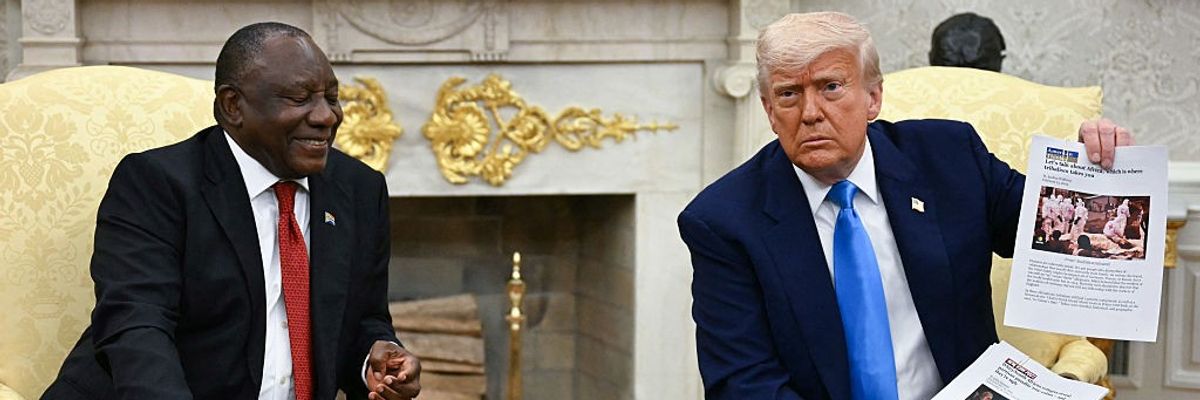
U.S. President Donald Trump meets with South African President Cyril Ramaphosa in the White House in Washington, D.C., on May 21, 2025.
 (Photo: Jim Watson/AFP via Getty Images)

Brad Reed
Jul 25, 2025
COMMON DREAMS

A Friday report from Reuters claims that a senior Trump administration official recently informed diplomats in South Africa that a refugee program set up by U.S. President Donald Trump earlier this year was explicitly intended for white people.

According to Reuters, American diplomats in South Africa earlier this month asked the U.S. State Department whether it was allowed to process refugee claims from South African citizens who spoke the Afrikaans language but who were of mixed-race descent.

The diplomats received a response from Spencer Chretien, the senior bureau official in the State Department's Bureau of Population, Refugees, and Migration, who informed them that "the program is intended for white people," writes Reuters.

The State Department told Reuters that the scope of the program is actually broader than what was outlined in Chretien's message and that its policy is "to consider both Afrikaners and other racial minorities for resettlement," which lines up with guidance posted earlier this year stating that applicants for refugee status under the program "must be of Afrikaner ethnicity or be a member of a racial minority in South Africa."

Trump back in February issued an executive order establishing a refugee program for what the order described as "Afrikaners in South Africa who are victims of unjust racial discrimination." The president also lobbed baseless accusations at South African President Cyril Ramaphosa this past May that his government was engaging in "genocide" against white farmers in his country.

The notion that whites in South Africa face severe racial discrimination, let alone the threat of genocide, is difficult to square with the reality that white South Africans own three-quarters of the private land in the nation despite being a mere 7% of the population.

Dara Lind of the American Immigration Council, reacting to the Reuters report, explained on social media platform Bluesky the reasons that Trump's refugee program for Afrikaners is highly unusual. Lind pointed to the fact that the United States government at the moment is still trying to block refugees who have already gone through a two-year vetting process from entering the country, whereas it let many Afrikaner refugees into the country after a mere two weeks of vetting.

"Two years of vetting is insufficient, but two weeks is enough to know if someone will 'be assimilated easily'—as admin officials said when the Afrikaners came," she observed.