It’s possible that I shall make an ass of myself. But in that case one can always get out of it with a little dialectic. I have, of course, so worded my proposition as to be right either way (K.Marx, Letter to F.Engels on the Indian Mutiny)
(Oregon Capital Chronicle) — The U.S. Environmental Protection Agency will allow gas stations to sell a blended fuel containing 15% ethanol into the summer season in an effort to lower gas prices, Administrator Lee Zeldin said Wednesday.
The blend, known as E15, is usually barred in many Midwest states over the summer to reduce smog, though the federal government has routinely in recent years issued waivers to allow summer sales. The move, which ethanol producers applauded, could prevent a spike in prices at the pump during the war with Iran that has scrambled oil markets.
“EPA is working with our federal partners to reduce unnecessary costs and uncertainty and ensure that gas prices remain affordable for all Americans through the summer,” Zeldin said in a statement. “This emergency action will provide American families with relief by increasing fuel supply and consumer choice.”
Bipartisan officials in corn-producing states had sought the waiver, and continue to push for year-round availability of the product. Ethanol is manufactured from corn and other plant materials.
Move wins praise from industry, officials
Seven Midwestern governors — Republicans Kim Reynolds of Iowa, Mike Kehoe of Missouri, Jim Pillen of Nebraska and Larry Rhoden of South Dakota and Democrats Tim Walz of Minnesota, JB Pritzker of Illinois and Tony Evers of Wisconsin — signed a March 6 letter to Zeldin requesting the waiver.
More recently, the top Democrat on the U.S. Senate Agriculture Committee also endorsed the move.
“With gas prices spiking, now’s the time to make E15 available year-round,” Minnesota U.S. Sen. Amy Klobuchar, said in a March 19 statement. “It will help lower costs and decrease our dependence on foreign oil.”
U.S. Rep. Adrian Smith, a Nebraska Republican, also applauded Wednesday’s announcement, and called on Congress to make the policy permanent.
Ethanol industry groups also approved of the waiver. Geoff Cooper, the president and CEO of the national ethanol advocacy group Renewable Fuels Association, said the move was “exactly what the supply chain needs right now.”
“President Trump and Administrator Zeldin understand that year-round E15 is a solution that can extend domestic fuel supplies and reduce pump prices for hardworking American families,” Cooper said. “With geopolitical conflict roiling energy markets worldwide, we applaud President Trump and Administrator Zeldin for acting quickly and decisively to combat potential fuel shortages and help keep a lid on gas prices this summer.”
Iowa Renewable Fuels Association Executive Director Monte Shaw also thanked the administration in a statement.
“With rising fuel prices and a war in the Middle East, this is the worst time to force retailers to bag E15 pumps. E15 adds home-grown supply and reduces prices for consumers,” he said.
Iran war disrupts oil market
Gas prices have risen since President Donald Trump launched strikes against Iran on Feb. 28. Transport through the Strait of Hormuz has been limited due to threats from Iran during the conflict.
White House press secretary Karoline Leavitt noted at Wednesday’s press briefing the waiver was a part of the administration’s response to rising fuel costs during the war.
“Obviously the administration is coming up with creative new solutions by the day to keep the price of oil stable, something the president wants to see,” she said.
Trump will also welcome nearly 1,000 farmers to the White House for a National Agriculture Day event on Friday, where the president plans to promote his record on the issue, Leavitt said.
The E15 waiver will be in effect May 1 through May 20. Twenty days is the longest period a single waiver can be applied under the Clean Air Act, the EPA said in the press release. The move signals the administration views further waivers as an option as restrictions ramp up
over the summer.
Shauneen Miranda contributed to this report.
Oregon Capital Chronicle
The Oregon Capital Chronicle, founded in 2021, is a professional, nonprofit news organization. We focus on deep and useful reporting on Oregon state government, politics and policy. Staffed by experienced journalists, the Capital Chronicle helps readers understand how those in government are using — or abusing — their power, what’s happening to taxpayer dollars, and how citizens can stake a bigger role in big decisions.
Wednesday, March 25, 2026
From stillage to storage: Researchers turn bourbon byproducts into supercapacitors
Researchers converted bourbon distillery waste (left image) into electrodes for supercapacitors (right image) that store more energy per kilogram than commercial devices.
ATLANTA, March 25, 2026 — The state of Kentucky produces 95% of the world’s bourbon, and all that bourbon leaves behind an enormous amount of waste grain, called stillage. Now, researchers at the University of Kentucky have developed a process to transform that stillage into electrodes. With the bourbon byproduct electrodes, they created supercapacitors that could store more energy than similarly sized commercial devices.
The researchers will present their results at the spring meeting of the American Chemical Society (ACS). ACS Spring 2026 is being held March 22-26; it features nearly 11,000 presentations on a range of science topics.
Josiel Barrios Cossio, a graduate student who will be presenting the work, first learned about the scale of American whiskey’s waste problem while working on a research traineeship to examine food, energy and water issues in Kentucky. “From the final volume of bourbon produced, you get 6 to 10 times that amount of stillage as waste,” says Barrios Cossio, “so it's a big deal."
This stillage is a sloppy mash that’s typically sold to farmers as livestock feed or a soil additive. But it is difficult to transport while wet, and it is expensive to dry.
One alternative solution is to directly convert the soupy stillage into more valuable carbon materials using a technique called hydrothermal carbonization, which is like high-intensity pressure cooking. “We could take the stillage as it is, in a dispersion with a lot of water,” says Barrios Cossio, “and use that disadvantage as an advantage.”
The team was interested in carbon materials because they make good electrodes for supercapacitors, a type of energy storage device. Hydrothermal carbonization could offer a plant-based waste as the source for these electrodes. Previous research demonstrated that agricultural byproducts like corn fibers could be converted into carbon materials with this type of heating, but the strategy hasn’t been tried with bourbon stillage, which is made of a blend of grains that must include corn.
So, Barrios Cossio and Marcelo Guzman, a chemist at the University of Kentucky and the principial investigator for the project, set out to convert their local distilleries’ waste into electrodes for supercapacitors.
The first step was to engage with distillery owners, build trust and convince them to let the researchers into their facilities to take samples and “do something fun with it,” says Barrios Cossio. The University of Kentucky chemists have built relationships with distilleries from Kentucky to Illinois and even Canada to use their waste.
The team transformed the soggy stillage into a fine black powder by treating the waste product with heat and pressure in a 10-liter reactor. From there, the black powder was heated, for example, to 392 degrees Fahrenheit (200 degrees Celsius) in a furnace, either on its own to form hard carbon, or with potassium hydroxide to 1,472 F (800 C) to form activated carbon. Hard carbon is like graphite but with carbon sheets that are less neatly stacked, which makes it ideal for adsorbing more lithium ions to boost energy storage capability. Activated carbon is extremely porous, meaning it can store large amounts of charge, and therefore energy, within its large internal surface area.
For a proof-of-concept, the team made double-layer capacitors by sandwiching a liquid electrolyte between activated carbon electrodes. In tests, these coin-sized supercapacitors could store up to 48 watt hours per kilogram, which was on par with commercially available ones.
The researchers also experimented with hybrid lithium-ion supercapacitors, which are designed to compromise between the fast discharge speeds of capacitors and the higher energy storage of batteries. So, they built devices with one capacitor-type activated carbon electrode and one battery-type hard carbon electrode, which were both infused with lithium ions. These stillage-derived supercapacitors stored up to 25 times the energy per kilogram as conventional versions.
The lithium-ion supercapacitors are also a new example of using one agricultural source for two different electrodes in a single device. “It was a huge discovery for me that you can make hybrid devices from this waste,” says Barrios Cossio. “Hybrid devices are not common. Not common and not easy to make.”
The researchers' next steps are to study the energy storage mechanisms of their stillage-derived supercapacitors to optimize them for commercialization. Their goal is to develop larger versions of the supercapacitors, so that one day, this technology could help stabilize the electrical grid as more renewable energy sources are incorporated.More immediately, the team will pursue life cycle analysis as well as economic and technological feasibility evaluations to assess the sustainability of converting distillery waste into energy storage devices.
Overall, the team is excited to have found a prototype solution for a local issue in collaboration with Andrea Balducci’s group at the Friedrich Schiller University Jena, Germany. “This project allowed us to link with a real-world problem with industries at our state level,” says Guzman, “And that was super cool.”
The research was funded by the U.S. National Science Foundation and the University of Kentucky.
Visit the ACS Spring 2026 program to learn more about this presentation, “Bourbon whiskey waste-derived carbons for electric double layer and Lithium-Ion supercapacitors,” and other science presentations.
###
The American Chemical Society (ACS) is a nonprofit organization founded in 1876 and chartered by the U.S. Congress. ACS is committed to improving all lives through the transforming power of chemistry. Its mission is to advance scientific knowledge, empower a global community and champion scientific integrity, and its vision is a world built on science. The Society is a global leader in promoting excellence in science education and providing access to chemistry-related information and research through its multiple research solutions, peer-reviewed journals, scientific conferences, e-books and weekly news periodical Chemical & Engineering News. ACS journals are among the most cited, most trusted and most read within the scientific literature; however, ACS itself does not conduct chemical research. As a leader in scientific information solutions, its CAS Division partners with global innovators to accelerate breakthroughs by curating, connecting and analyzing the world’s scientific knowledge. ACS’ main offices are in Washington, D.C., and Columbus, Ohio.
To automatically receive press releases from the American Chemical Society, contact newsroom@acs.org.
Note to journalists: Please report that this research was presented at a meeting of the American Chemical Society. ACS does not conduct research, but publishes and publicizes peer-reviewed scientific studies.
Title Bourbon whiskey waste-derived carbons for electric double layer and Lithium-Ion supercapacitors
Abstract Bourbon is an American whiskey almost entirely crafted (95%) in Kentucky (KY). Distilleries have increased by 250% over the past 15 years in KY, leading to significant new challenges. One of the industry’s biggest challenges is the spent grain (stillage). For every barrel of bourbon produced, it is estimated that six to ten barrels of stillage remain. Here, bourbon stillage is transformed into carbon materials for conventional (electric-double-layer) and hybrid (lithium-metal-ion) supercapacitor electrodes. The bourbon stillage transformation involves hydrothermal carbonization, hydrochar pyrolysis, and activation with steam, carbon dioxide, phosphoric acid, and potassium hydroxide (KOH). Activated carbons and hard carbons derived from bourbon whiskey waste are physicochemically and electrochemically characterized, and the connection between structure and electrochemical performance is discussed. Physicochemical characterizations include Raman and FTIR spectroscopies, XRD, TGA, SEM-EDS, and nitrogen physisorption analysis. The electrochemical performance was evaluated using cyclic voltammetry, galvanostatic charge/discharge, and electrochemical impedance spectroscopy. Electric Double-Layer supercapacitors (EDLCs) assembled with KOH-activated carbon (AC) demonstrate excellent cyclability (96% capacitance retention after 15,000 cycles), and similar to current commercially available devices, specific energy (14-34 Wh/kg) and power (1,660-3,997 W/kg) densities at variable specific current (0.1-10 A/g). Experiments show that hybrid Lithium-ion Capacitors (LiC) assembled with prelithiated hard carbon and AC displayed energy densities of 66-93 Wh/kg and power densities of 4412-4531 W/kg at current densities ranging from 0.1 to 10 A/g. This research presents an innovative, potentially scalable, and sustainable strategy for repurposing bourbon stillage into efficient, green, and high-performance materials for energy storage applications, with the potential to be adopted by the entire whiskey and ethanol production industry.
Tuesday, December 09, 2025
Maersk is Proceeding with Ethanol Tests After First Successful Trial
Dual-fuel feeder ship Laura Maersk provides a testing ground for the new fuels (Maersk)
Maersk reports it completed a first, successful trial of blending ethanol into methanol to create an alternative fuel for its vessels. It plans to proceed with increased levels of ethanol and 100 percent ethanol tests as it explores steps to enlarge the availability and sourcing pool for alternative fuels for its dual-fuel vessels.
One of the challenges Maersk and other shipowners have pointed to is the availability of methanol and other alternative fuels and the ability of suppliers to expand production to meet the potential needs of the shipping industry. Maersk looks to run trials that could develop alternatives that can continue to supply the company as it moves forward with its decarbonization efforts.
The mixing of ethanol and methanol is possible because they are both alcohols, and there is a longstanding history dating back to the 1970s when ethanol was first used to extend gasoline supplies. Many countries use a 10 percent ethanol mix for cars, while the United States and Brazil supply approximately 80 percent of the ethanol.
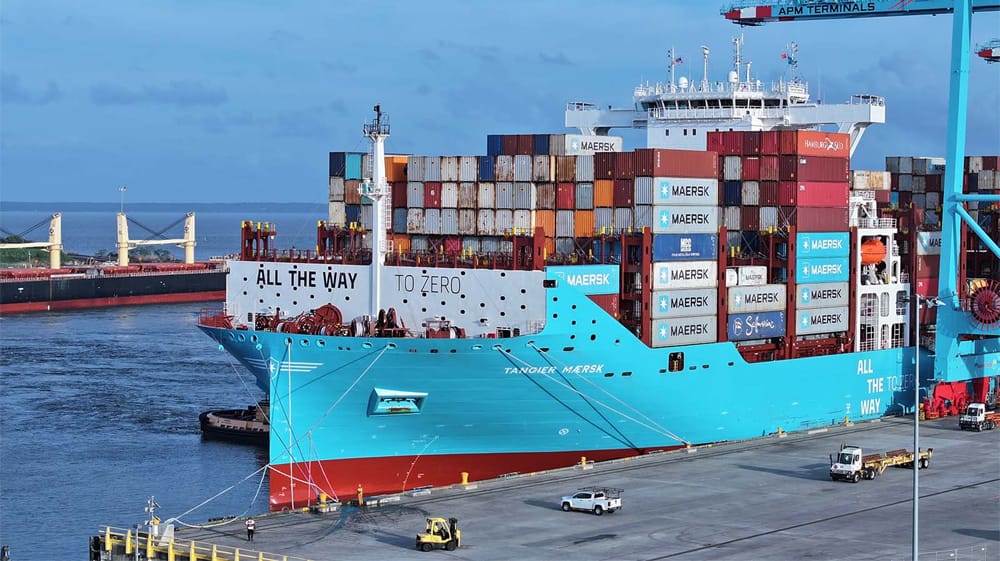
Maersk launched its dual-fuel feeder vessel Laura Maersk (32,600 dwt) in 2023 for operations in the Baltic region. It has provided a test bed for methanol, which the company points out has been used for three years with no issues.
The first trial with E10, a 10 percent ethanol–90 percent methanol blend, began in October and supplied the Laura Maersk with fuel for a month to a month and a half. They report that performance was not compromised and confirmed that ethanol can be safely and effectively integrated into the fuel mix. Among the issues they were monitoring were ignition quality, the way the fuel was burning, corrosion, and the impact on emissions. They monitored for changes in NOx emissions.
Based on the confirmation in the first test, Maersk now plans to test E50, a 50-50 blend of ethanol and methanol. In addition, beyond the E50 trials, the company plans to conduct a trial using 100 percent ethanol.
Maersk currently has 19 dual-fuel vessels operating and more scheduled for delivery. It will also begin in 2027 using time-chartered dual-fuel LNG vessels. The company highlights that it is expanding its low-emission fuel options, including bio- and e-methanol, biodiesel, and with the LNG vessels liquified biomethane.
Wednesday, November 26, 2025
Study finds lower emissions from higher-ethanol gasoline
The E15 blend tested by UCR will also lower gasoline prices, says Governor’s office
California residents will soon get some price relief at the pump and reductions in harmful vehicle emissions, thanks in part to a landmark UC Riverside vehicle emissions study.
Scientists at the university’s College of Engineering Center for Environmental Research and Technology, or CE-CERT, found that increasing the ethanol content in California gasoline from the allowable 10% to 15% cut harmful vehicle emissions, including small declines in nitrogen oxides (NOx), which are a primary precursor to ground-level ozone formation, and more significant reductions in particulate emissions.
The study, completed in 2023, was instrumental to Gov. Gavin Newsom’s approval of legislation this month to allow a 15% ethanol blend of gasoline at California fueling stations while the state continues research on whether the blend can meet state clean air requirements.
The 15% ethanol blend is also expected to reduce the price of a gallon by as much as 20 cents, a separate study by UC Berkeley and the U.S. Naval Academy found. This is because ethanol, made mostly from domestically grown corn and soybeans, is less costly than gasoline made from crude oil.
The UCR research was led by Georgios Karavalakis, a professor of chemical and environmental engineering, who oversaw state-of-the-art emission testing at CE-CERT, an off-campus research facility in Riverside on Columbia Avenue.
Karavalakis’ team first assembled a fleet of 20 passenger cars and light-duty trucks that was representative of the gasoline vehicles now on the state’s roadways.
“We carefully selected the vehicles to represent high-volume sales vehicles in California or vehicles of different standards,” Karavalakis said. “We wanted to get specific vehicles with specific standards and specific mileage.”
The researchers also carefully designed the test fuel so it would represent the kind of gasoline used throughout California. Karavalakis’ team collected gasoline samples from three different refineries in Southern California and one refinery in the Bay Area, then blended them together in equal amounts to create the final fuel used in the study.
The vehicles on each fuel were driven over repeated cycles on a testing device called a chassis dynamometer, following federally accepted procedures.
While nitrogen oxides, a key ingredient in smog, showed no significant change, the study revealed that emissions of carbon monoxide, total hydrocarbons, and non-methane hydrocarbons declined with the E15 blend. Notably, emissions of particulate matter — tiny airborne particles that pose significant health risks — also dropped significantly when cars burned E15.
“Ethanol helps provide a much cleaner combustion because it has oxygen,” Karavalakis said. “That's why you have reductions in particulate emissions and in ultrafine particles, which are the very, very small particles that can be easily inhaled. They can also penetrate very deep in your respiratory system.”
The findings carry implications for California’s long-standing ethanol blend wall — a regulatory cap that limits ethanol content in gasoline to 10%. The state has been cautious about raising the limit due to concerns about air pollution in regions like the South Coast Air Basin and the San Joaquin Valley, which regularly fail to meet federal smog and particulate standards.
The study’s evidence may help regulators reconsider.
“Higher ethanol blends, as well as other low-carbon and zero-carbon biofuels, must be part of the mix for a sustainable and clean transport sector that will coexist with other proven clean technologies, such as battery electric vehicles,” Karavalakis said.
Karavalakis said the impacts go beyond saving a few dollars at the pump.
“It’s not only the consumer, but the industry as well,” he said. “We're talking about a domestically produced biofuel by American farmers that they will now have to produce more of to meet the needs of California. This practice will also contribute to energy security.”
Because ethanol is renewable, it has a lower carbon footprint than unblended gasoline. It is typically made from corn or cellulosic biomass. Its combustion releases carbon dioxide that was absorbed from the atmosphere during plant growth, effectively recycling carbon rather than adding new fossil-based carbon dioxide to the atmosphere.
Though California has restricted ethanol content in gasoline to 10%, the U.S. Environmental Protection Agency allows E15 for use in all 2001 and newer vehicles, and the E15 blend is available in 31 states at over 3,000 gas stations. The UCR study may provide the kind of data state regulators need to support broader E15 adoption in California.
The UCR study was published in the journal Fuel and is available online.
The title of Karavalakis’ paper is “Expanding the ethanol blend wall in California: Emissions comparison.” Published in the journal Fuel by Elsevier LTD, the UCR co-authors are Tianbo Tang, Cavan McCaffery, Tianyi Ma, Peng Hao, Thomas Durbin, and Kent Johnson.
“There’s growing momentum to expand the use of lower-carbon fuels in California,” Karavalakis said. “This study shows that doing so can bring real emissions benefits — not just in theory, but on the road.”
Oman is promoting the adoption of a green hydrogen maritime corridor from a loading terminal in Duqm through to the port of Amsterdam as an initiative to support the International Maritime Organisation achieve its Net Zero greenhouse gas targets by 2050. Green hydrogen is to be produced on a net-zero basis using energy from solar and wind farms in the hinterland of Duqm, and processed in the port area.
Development of a pioneering transmission corridor to take the fuel through to Europe will necessitate the solution of a number of regulatory and technical problems associated with the adoption of hydrogen for bunkering. It is anticipated that it will, in turn, prepare the way for the rollout of hydrogen supply chains as an integral element of critical maritime infrastructure.
The green hydrogen maritime corridor initiative was the subject of an agreement between the Netherlands and the Sultanate of Oman made in May, when Sultan Haitham visited the Netherlands on a state visit. Sultan Haitham made a similar agreement when visiting Belgium last year, and the corridor concept thus also embraces offload points in the Port of Antwerp, with an onward shipment network to the Port of Duisburg on the Rhine. A similar green hydrogen maritime corridor is under development to link Algeciras in Spain with Rotterdam.
For the concept to be realized, and then utilized across the whole of the global maritime community, the project will need to create a harmonized safety regulation regime for hydrogen bunkering. Technical standards and solutions also need to be developed to support hydrogen-fueled ship operations, and the handling of hydrogen terminal operations in port. These issues, and the current lack of international standards, are already being considered by the Maritime Technologies Forum. A project management framework also needs to be developed to support the launch of port infrastructure development projects, the lack of which, from a financial and engineering perspective, is a hindrance to efficient progress.
In August, BP upped its stake in one of the green hydrogen consortia awarded contracts to operate through Duqm, increasing its share in the Hyport Duqm green hydrogen project to 49 percent, with Belgium’s DEME and the Omani sovereign wealth fund OQ each retaining a 25.5 percent stake.
The Hydrom Duqm project is in the pre-engineering design phase, and commercial operations utilizing the green hydrogen maritime corridor to Europe are scheduled to commence in 2030. It is too early to estimate which of the consortia awarded green hydrogen mandates will be the first into production, but BP’s move underlines the oil major’s confidence in Oman’s overall green hydrogen strategy.
Molgas Completes Full Acquisition of Titan Clean Fuels
Titan ship-to-ship bunkering of Ritz-Carlton Yacht Collection's Ilma
Molgas Energy Group (“Molgas”), backed by infrastructure investor InfraVia, has finalized the full acquisition of Titan Energy Holding, parent company of Titan Clean Fuels (“Titan”). The transaction, which follows Molgas’ initial 45% minority stake, marks a major step forward in the Group’s strategic growth in the clean marine fuels sector.
Titan is a leading independent supplier of liquefied biomethane (LBM/bio-LNG) and LNG, serving both maritime and industrial customers. Its fleet of small-scale bunkering vessels operates across key global markets, with a strong base in the Northwest European region. Titan’s LNG bunkering operations will merge with Molgas’ existing operations in Norway and all truck-to-ship supply across Norway and continental Europe will now be combined.
With the integration of Titan, the Molgas Energy Group now operates a fleet of seven LNG bunkering vessels and manages a proprietary network of over 70 road-fuelling stations, with more than 200 points of sale including associated partner stations. This expanded footprint positions Molgas as a pan-European leader in downstream LNG and bio-LNG solutions for industrial, road transport, and marine customers.
The acquisition comes at a time of accelerating momentum for clean fuels. LNG and bio-LNG are increasingly recognized as scalable, low-emission alternatives that can play a vital role in decarbonizing both shipping and heavy-duty road transport. With tightening regulations, like EU ETS and FuelEU Maritime, and therefore growing demand for sustainable energy, Molgas and Titan are well-positioned to lead the transition toward cleaner mobility and logistics.
Following the transaction, Niels den Nijs will lead Molgas’ Marine Business as Executive Vice President, Marine. He will oversee all marine activities, delivering integrated end-to-end ship-to-ship and truck-to-ship bunkering services across Europe.
Sofoklis Papanikolaou, CEO of Molgas, commented: “Niels and the Titan team started as true pioneers, showing remarkable innovation and have grown Titan into one of the sector’s most reliable LNG bunkering operators. The success of our initial collaboration laid the groundwork for this acquisition, which significantly extends our reach and capabilities. We are welcoming to the group a very experienced team, with leading specific expertise in marine fuels and decarbonisation. Together, we will build a robust platform to deliver LNG and bio-LNG solutions across Europe and beyond.”
Niels den Nijs, CEO of Titan, added: “From the start, our partnership with Molgas was a strong strategic fit and I’m very happy to join their board. By joining forces fully, we substantially strengthen our balance sheet and joint commercial reach. Together, we will scale our clean fuel solutions for the maritime sector at a time of accelerating demand and regulatory tail winds. This integration allows us to better serve our long-term customers with an unrelenting focus on our mission: to deliver economical fuel at scale to help decarbonize shipping.”
Athanasios Zoulovits, Partner at InfraVia Capital Partners, said: “As the maritime industry undergoes a major transformation, Titan’s expertise positions Molgas to lead in delivering scalable clean marine fuel solutions. We are proud to support Molgas in its mission to accelerate the energy transition across industrial, mobility, and maritime markets.”
Jogchum Brinksma, Chairman of the board, Titan concluded: “It has been a pleasure to oversee the steep growth of Titan as chairman of the board and I am extremely pleased with these partners for Titan. This move will help propel the company towards a globally important strategic position, rising to the scale needed to lead the alternative fuels transition.”
While Titan is open to supplying customers with any alternative fuels that can realistically deliver towards decarbonization today, it recognises the practical route to net-zero shipping emissions that LNG, LBM and e-methane offer right now. It collaborates with shipowners and operators to create clean fuel delivery programs that are flexible, safe, and cost-effective today.
The products and services herein described in this press release are not endorsed by The Maritime Executive.
Maersk Tests Adding Ethanol to Methanol to Enlarge Fuel Availability
Laura Maersk, a smaller feeder ship, provides a test ground for Maersk now with the ethanol-methanol blend (Maersh)
Maersk reports it is continuing to test new steps that it can use to address issues within the supply of alternative fuels. The latest trial is using a blend called E10 (10 percent ethanol mixed into the methanol supplied to its dual-fuel vessel) as a possible means of enlarging the availability and sourcing pool of methanol for its dual-fuel fleet.
The company reports the test has recently begun on the Laura Maersk, its smaller (2,100 TEU) methanol dual-fuel feeder ship operating in the Baltic region. The company says that for three years the vessel has operated on methanol with no problems. The smaller ship provides them a test ground to explore new concepts that might be applied to the larger 16,000 TEU dual-fuel vessels in the future.
The trial of E10 involves mixing 10 percent ethanol into the fuel being loaded onto the Laura Maersk with 90 percent methanol. The current bunkering with E10 they report will provide a month to a month and a half of operating data.
They will be looking at a range of issues to see if the ethanol mix creates differences versus the operating experience over the past three years. Specifically, they will look at ignition quality, the way the fuel is burning, and if there are issues or differences in corrosion and lubricity (friction).
A critical area they will also be looking at is the emissions. Are there differences versus pure methanol combustion? The impact of the E10 on NOx emissions, the company also says, is critical.
Maersk and others in the industry have confirmed that the availability of methanol remains one of the key challenges in the adoption of the alternative fuel. Operating a shorter route within the Baltic and Scandinavia has permitted Maersk to use the Laura Maersk for tests.
The company will study the data from the E10 trial. They will consider how it might impact the operation of the larger vessels as Maersk continues the introduction of the big dual-fuel methanol containerships. It completed the introduction of the first series in May 2025 with a dozen large vessels, and it has also converted one large vessel to methanol capabilities.