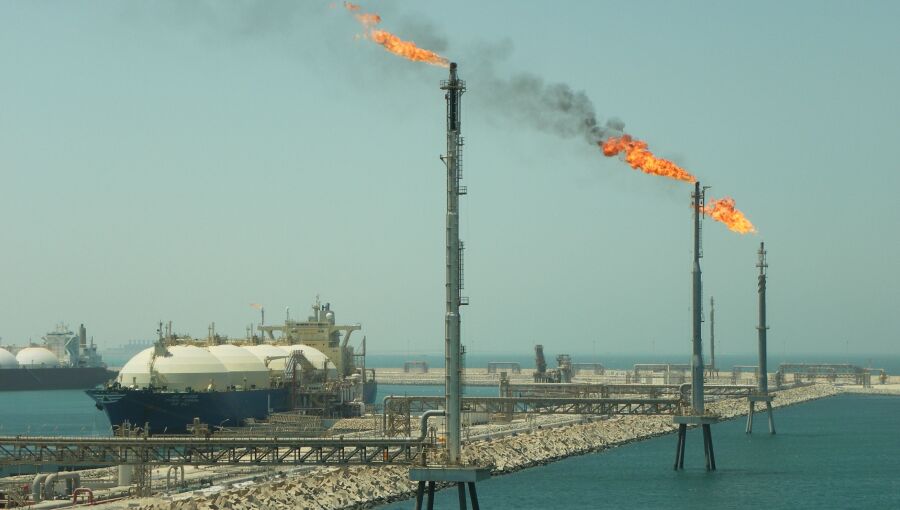
The Shot Nobody Heard
On March 2, 2026, the world’s largest liquefied natural gas facility went dark. QatarEnergy’s Ras Laffan Industrial City, a sprawling complex on the northeastern coast of Qatar that processes the colossal reserves of the North Field gas reservoir, halted all production following a wave of Iranian drone strikes. The state energy company declared force majeure two days later, freeing itself from contracted supply obligations to customers across Europe and Asia. It was, by any measure, a seismic economic event. And yet the full significance of what had been lost barely registered in the mainstream financial press.
The conversation that followed was dominated, predictably, by LNG. Energy markets convulsed.
European gas futures spiked. Asian buyers scrambled for alternative cargoes. QatarEnergy CEO
Saad al-Kaabi confirmed to Reuters that the damage, described by his own executives as “extensive”, had knocked out approximately 17% of Qatar’s LNG export capacity, representing an estimated $20bn in lost annual revenues. The cost of repairing the damaged trains was put at $26bn, with a recovery timeline measured not in months but in years, ranging from three to five years according to QatarEnergy’s own assessment.
But buried beneath the LNG story was a revelation with far more profound implications for the global economy: the same facility was simultaneously the world’s second-largest producer of helium. And with Ras Laffan offline, roughly one-third of the planet’s helium supply had vanished overnight.
What Helium Actually Does, And Why Nothing Else Can
To most people, helium is the gas that fills party balloons. To the semiconductor industry and by direct extension, to the entire edifice of modern artificial intelligence, it is something closer to oxygen. Without it, advanced chip manufacturing at sub-5-nanometre geometries, the frontier on which the AI race is being fought, is simply not possible.
Semiconductor manufacturing requires ultra-pure helium at multiple critical stages. During lithography, the process by which circuit patterns are etched onto silicon wafers with extraordinary precision helium is injected between the wafer and its carrier to dissipate heat and prevent warping. In extreme ultraviolet (EUV) lithography, the technology that enables the production of the most advanced chips now powering AI accelerators, helium maintains the near-perfect vacuum environments and cooling systems without which the process fails entirely. Helium is also the only gas suitable for leak detection in these hermetically sealed environments, and it is used in the purging of process chambers where the presence of any reactive gas would destroy a wafer batch worth hundreds of thousands of dollars.
Unlike nitrogen or argon, which can be substituted in various industrial applications, helium has no viable replacement in semiconductor-grade manufacturing. As a noble gas, it is chemically inert, its atomic radius is the smallest of any element stable at industrial temperatures, and its thermal conductivity is uniquely suited to the precision demands of modern fabs. As chip geometries continue to shrink and EUV adoption expands across the industry, each wafer actually consumes more helium than the last generation. Demand is not linear; it is accelerating.
Beyond semiconductors, helium’s industrial reach is vast and largely unappreciated.
Healthcare systems depend on it critically: MRI machines require approximately 1,500 litres of liquid helium to cool their superconducting magnets, and the healthcare sector accounts for roughly 30% of all global helium consumption. Aerospace propulsion and rocket testing programs, including those operated by NASA, SpaceX, and Blue Origin, use helium to purge fuel lines and pressurise propellant tanks. The fibre optics industry uses it to draw glass filaments. Scientific research from particle physics at CERN to NMR spectrometry in pharmaceutical laboratories depends on its cryogenic properties. Even the food industry employs helium in modified atmosphere packaging to extend shelf life. The entertainment industry uses it for everything from concert rigging to LED cooling systems. The loss of a third of the global supply does not affect one sector; it threatens all of them simultaneously.
The Golden Thread: Helium, Chips, and the AI Trillion-Dollar Stack
To understand the true scale of what is now at risk, one must map the architecture of the global AI investment chain and trace helium’s role through every link.
The global semiconductor industry is, by conservative estimates, already a $600bn annual market, with projections placing it at $1 trillion in revenues before the end of the decade. This industry is the physical substrate of the artificial intelligence revolution. Every large language model, every AI accelerator deployed in a data centre, every GPU cluster running inference on demand exists because of chips manufactured at the atomic scale in a handful of facilities concentrated in Taiwan, South Korea, the United States, and Japan.
TSMC, the Taiwan Semiconductor Manufacturing Company, is the single most strategically critical node in this chain. It produces approximately 90% of the world’s most advanced logic chips, and it is the sole foundry for NVIDIA’s AI accelerators, the GPUs that have become the defining hardware of the AI era. NVIDIA’s market capitalisation recently exceeded $3 trillion, making it among the most valuable companies in history, built almost entirely on the insatiable demand for AI compute. TSMC also manufactures the processors inside Apple’s iPhone and MacBook product lines, AMD’s Ryzen and Instinct series, and Qualcomm’s Snapdragon chips.
South Korea is the second great pillar. Samsung and SK Hynix together produce the overwhelming majority of the world’s High Bandwidth Memory (HBM), the specialist DRAM chips that are stacked alongside NVIDIA’s GPUs in AI accelerators and are, in many ways, just as indispensable as the GPU itself. Without HBM, an NVIDIA Blackwell or Hopper chip cannot function at AI-relevant speeds. Samsung and SK Hynix also produce the NAND flash memory inside virtually every consumer device on Earth, from smartphones to cloud storage systems.
Here is where the helium thread becomes the golden thread. South Korea sourced 64.7% of its helium from Qatar in 2025. The Ras Laffan facility supplied Samsung’s M15 and M16 memory manufacturing plants and SK Hynix’s facilities directly, via long-term contracts with industrial gas distributors including Linde, Air Liquide, Messer, and Iwatani. With Ras Laffan offline, a monthly shortfall of 5.2 million cubic metres of helium has appeared in the market. Spot prices doubled within days of the initial shutdown and are expected to continue rising.
The semiconductor demand for helium is not static. With TSMC, Samsung, and Intel all ramping EUV-based manufacturing nodes under government-backed CHIPS Act programs and their international equivalents, the industry’s helium consumption is projected to grow by 15-20% annually through the end of the decade. The crisis has arrived at precisely the moment of maximum vulnerability.
The GCC’s Enormous Stake and the Bitter Irony
Iran’s IRGC, whether by design or miscalculation, has struck with particular force at a target that is intimately connected to the investment portfolios of its Gulf neighbours. The irony is almost too precise to be accidental.
The Gulf Cooperation Council states have, over the past several years, positioned themselves as among the most significant sovereign investors in the global AI and semiconductor ecosystem. Abu Dhabi’s MGX fund, with ambitions reaching $100bn in assets under management, has invested directly in OpenAI, NVIDIA, and data centre infrastructure. The UAE’s G42, backed by Abu Dhabi sovereign wealth, signed deals granting access to 500,000 NVIDIA chips. Saudi Arabia’s Public Investment Fund, through its Alat subsidiary, has committed $100bn by 2030 to advanced electronics manufacturing, including a $10bn AI chip partnership with AMD and a separate partnership with NVIDIA to supply hundreds of thousands of Blackwell-generation GPUs to the Kingdom’s Humain AI initiative. Qatar’s own sovereign wealth vehicle, the Qatar Investment Authority, positioned itself as an anchor investor in Ardian Semiconductor, a dedicated chip investment fund.
These are not passive financial positions. They represent a collective sovereign bet measured in hundreds of billions of dollars on the AI and semiconductor industries as the defining growth driver of the coming decade. And those industries sit downstream of a helium supply chain that Iran has now partially severed, originating in Qatar’s own backyard. The attacker has struck at the infrastructure that underpins the wealth creation strategy of the entire region.
Stored Reserves, Shrinking Buffers, and the Coming Crunch
The immediate response from chip industry executives has been measured. TSMC confirmed that it maintains more than two months of helium inventory and sources from multiple suppliers. SK Hynix stated publicly that it had diversified its procurement and secured adequate short-term reserves. South Korea’s Ministry of Trade, Industry and Resources launched an emergency review of supply dependencies across 14 critical semiconductor materials, with helium and bromine — another input sourced heavily from the region — at the top of the list.
But the composure of these initial statements should not be mistaken for security. Analysts who have examined the actual inventory levels with granular precision paint a more alarming picture.
South Korea holds approximately six months of helium inventory at normal production rates. The critical qualifier is ‘normal.’ HBM production for AI accelerators has been running at exceptional intensity throughout 2026, with NVIDIA’s Blackwell demand absorbing virtually all available memory capacity. At current burn rates, the effective buffer for Korean fabs is closer to three to four months before real production cutbacks become unavoidable placing the acute phase of the crisis in the late summer or early autumn of this year.
Fitch Ratings warned in a note on March 17 that “credit risk would worsen if supply shortages exceeded inventory buffers, resulting in higher-cost sourcing, increased working-capital needs and production prioritisation.” Bank of America analysts noted that helium demand is concentrated in high-value, mission-critical applications where “supply security is typically prioritised over price,” allowing suppliers to push pricing substantially higher during disruptions. Linde and Air Products, the dominant industrial gas distributors, have already seen share prices rise 14 to 15% year-to-date — a telling signal of where the smart money sees the crisis heading.
Airgas, a major US helium distributor, declared its own force majeure on March 17 and moved immediately to prioritise healthcare customers, telling semiconductor clients to expect as little as half their normal monthly deliveries, with an immediate surcharge of $13.50 per hundred cubic feet. The rationing has begun.
The Revenue Mathematics of Catastrophe
The financial arithmetic of this crisis is sobering. QatarEnergy’s CEO has confirmed that the damaged infrastructure representing 17% of LNG export capacity and 14% of helium output generates an estimated $20bn in lost annual revenues, across LNG, helium, condensate, LPG, naphtha, and sulphur. The cost of rebuilding the destroyed LNG trains is put at $26bn, with a recovery timeline of three to five years at minimum.
Over a five-year shutdown of the affected capacity, the cumulative revenue loss to QatarEnergy could approach $100bn.
The downstream cost to the semiconductor industry is harder to quantify with precision, but analysts provide suggestive parameters. A 60 to 90 day severe helium squeeze could push delivered helium costs for the most exposed buyers by 25 to 50% , with the sharpest impact on those with weaker long-term contract protection. If the disruption forces Korean fabs to reduce output on lower-margin chips and potentially even begin rationing production runs on higher-value AI memory the
financial consequences ripple instantly through the entire NVIDIA-AMD AI accelerator supply chain, into data centre expansion programs, and ultimately into the earnings guidance of every major technology company that has committed to aggressive AI infrastructure investment.
Morgan Stanley’s Head of Asia Technology Research, Shawn Kim, articulated the systemic risk precisely: “A disruption in the Strait of Hormuz wouldn’t automatically halt chip production, but it could ripple through power costs, materials supply, and the economics of building AI infrastructure.” The $650bn in planned AI investments globally that Bloomberg mapped out earlier this year all sit downstream of a supply chain whose critical vulnerability has just been exposed.
The Broader Cascade: Beyond Chips and AI
The helium crisis does not begin and end with semiconductors. Its breadth across industries reveals just how deeply a single invisible gas is woven into the fabric of the modern economy.
In healthcare, the consequences are already visible. The medical imaging sector — which accounts for roughly 30% of global helium consumption is acutely exposed. MRI machines require approximately 1,500 liters of liquid helium to cool their superconducting magnets, with periodic top-ups throughout the machine’s operational life. Helium shortages historically translate directly into delayed or cancelled MRI procedures, deferred hospital upgrades, and rising diagnostic costs that fall hardest on patients in lower-income healthcare environments. “There will be MRIs that go down,” one senior industry figure told Euronews this week. In India, where helium is imported almost entirely from Qatar, healthcare system administrators are already preparing for higher scan costs and supply chain disruption to essential consumables.
In aerospace, SpaceX, Blue Origin, and Rocket Lab all depend on helium for rocket propulsion systems for purging fuel lines, pressurising propellant tanks, and testing systems under controlled conditions. Delays in helium availability translate directly into launch schedule slippage, with cascading consequences for commercial satellite programs and government space contracts.
In scientific research, particle physics facilities, pharmaceutical NMR laboratories, and university research programs have historically been among the first casualties of helium shortages. Research at Harvard, MIT, and comparable institutions was suspended during the 2012 and 2019 helium crises. A prolonged shortage in 2026 would interrupt entire programs of fundamental research at the moment when competition with China in AI and quantum computing research is most intense.
In food processing, modified atmosphere packaging — which extends shelf life for fresh produce, meat, and prepared foods — relies on helium blends in some applications. In the entertainment and events industry, precision cooling systems and high-altitude rigging balloons use helium in volumes that, while small by industrial standards, are practically irreplaceable.
Yet the outsized significance of the semiconductor and AI crisis dwarfs all of these. Healthcare, aerospace, and research are serious; the disruption of the AI hardware supply chain is potentially systemic. The chip industry is not merely an industry; it is the infrastructure upon which every other industry’s digital transformation now depends. A prolonged, severe helium shortage that forces fabs to reduce output does not just cost NVIDIA or Samsung revenue. It delays the AI buildout that every major corporation, every government digital strategy, and every sovereign wealth fund’s investment thesis has been predicated upon.
Can the Industry Pivot? The Uncomfortable Truth
The uncomfortable answer is: not quickly, and not completely. Several alternative helium sources exist. The United States is the world’s largest producer, primarily through reserves in Texas, Kansas, and Wyoming. Algeria is a significant secondary producer. Russia holds substantial reserves. But the capacity to ramp these sources to compensate for the sudden loss of a third of global supply is simply not there.
Building new helium extraction and liquefaction infrastructure is a multi-year proposition. Helium is a byproduct of natural gas processing, not a standalone product; you cannot build a helium plant without a compatible gas field. Qualifying new suppliers through the semiconductor industry’s rigorous purity and reliability standards adds further time. Phil Kornbluth, the industry’s most respected independent analyst, was blunt: “Your best-case scenario would be you’re back producing some helium in six weeks. As it looks right now, that’s highly unlikely.”
Some progress is being made at the margins. Samsung has deployed a Helium Reuse System (HeRS) on select production lines since 2025, capable of recovering and recycling used helium with projected savings of roughly 18.6% of total annual consumption if fully deployed. Siemens Healthineers and Philips have been developing helium-free MRI technology for years, though deployment at scale remains limited. These are meaningful steps, but they are mediumterm solutions to what is now an immediate crisis.
Russia holds large helium reserves, primarily at the Amur processing facility in Eastern Siberia. But engaging Russian suppliers at scale requires navigating a labyrinth of sanctions, compliance risk, and geopolitical exposure that most Western and Asian corporations are unwilling to accept. China, which has been aggressively building domestic helium production capacity, is in no mood to share its strategic reserves with a West that has been weaponising export controls against its own semiconductor industry.
The industry is not staring into the abyss today. It is staring at a 90-day countdown, at the end of
which, if QatarEnergy has not resumed production and the Strait of Hormuz remains constrained, the choices become genuinely painful.
The Asymmetric Logic of Iran’s Strike
For those who study asymmetric warfare and Iran’s IRGC has become its most accomplished practitioner the strategic logic of the Ras Laffan strikes is elegant in its brutality. A conventional military adversary measures success in territory captured or forces destroyed. The IRGC measures it in cascading economic costs imposed on an adversary’s extended network and few single targets in the world economy offered a higher return on disruption than the Ras Laffan complex.
A single facility hit has simultaneously: disrupted European energy security, shocked Asian LNG import markets, triggered force majeure on contracts stretching from Italy to South Korea, imperilled the GCC’s sovereign investment strategies in AI and semiconductors, constrained the medical imaging capacity of dozens of countries, and injected uncertainty into a $3 trillion company’s supply chain. The UAE’s industry minister Sultan Al Jaber described Iran’s attacks as “global economic warfare,” adding that “energy flows are being weaponised.” He was right, but the description was incomplete. It is not only energy flows. It is the invisible gas that nobody wrote about, flowing silently through the pipes of the most advanced industrial civilisation in history, that has been weaponised too.
What Executives Must Confront
When the supply chain executives of the chip and AI industry fully process the implications of what has occurred at Ras Laffan, their most acute challenge will not be explaining a missed quarter to their boards. It will be confronting the foundational assumption error that has governed their industry for a decade: that geopolitical risk was someone else’s problem, and that just-in-time supply chains could be managed through diversification spreadsheets rather than genuine resilience architecture.
The helium dependency on Qatar was not a secret. The Semiconductor Industry Association warned explicitly in 2023 that a helium supply disruption would “likely cause shocks to global semiconductor manufacturing.” That warning was filed, noted, and largely ignored. The cost of ignoring it is now being calculated in real time.
The questions that will define boardroom conversations in Seoul, Taipei, Santa Clara, and Riyadh over the coming weeks are searching and uncomfortable. How long does the actual inventory last at real production rates? What is the contractual exposure if force majeure declarations cascade through the industrial gas distribution chain? Can delivery timelines for NVIDIA’s Blackwell architecture be maintained, and what happens to data centre expansion commitments if they cannot? Which customers get priority allocation, and who absorbs the cost of being deprioritised? How does a $100bn sovereign AI strategy in Riyadh or Abu Dhabi remain on track when the physical hardware it depends upon cannot be manufactured at scale?
These are not hypothetical questions. They are live, they are urgent, and the window for acting ahead of the crisis rather than inside it is narrowing rapidly.
The Unwritten Story of a Written Crisis
The Economist noted this week that “a dangerous contradiction is evident in markets”: investors are unnerved by war, yet asset prices remain staggeringly optimistic. The contradiction deepens when one examines the helium story, because this particular risk is almost entirely unpriced.
Markets have absorbed the LNG disruption. They have begun to factor in energy price volatility. They have not yet priced a multi-year constraint on one-third of global helium supply into the valuations of NVIDIA, TSMC, Samsung, SK Hynix, or any of the AI infrastructure companies whose capital programmes depend on an uninterrupted flow of advanced chips. When that reckoning arrives and it will, whether in three months, six months, or twelve — it will not feel like a supply chain adjustment. It will feel like a correction in assets that had been priced for a world in which the physics of chip manufacturing were immune to the violence of geopolitics.

No comments:
Post a Comment