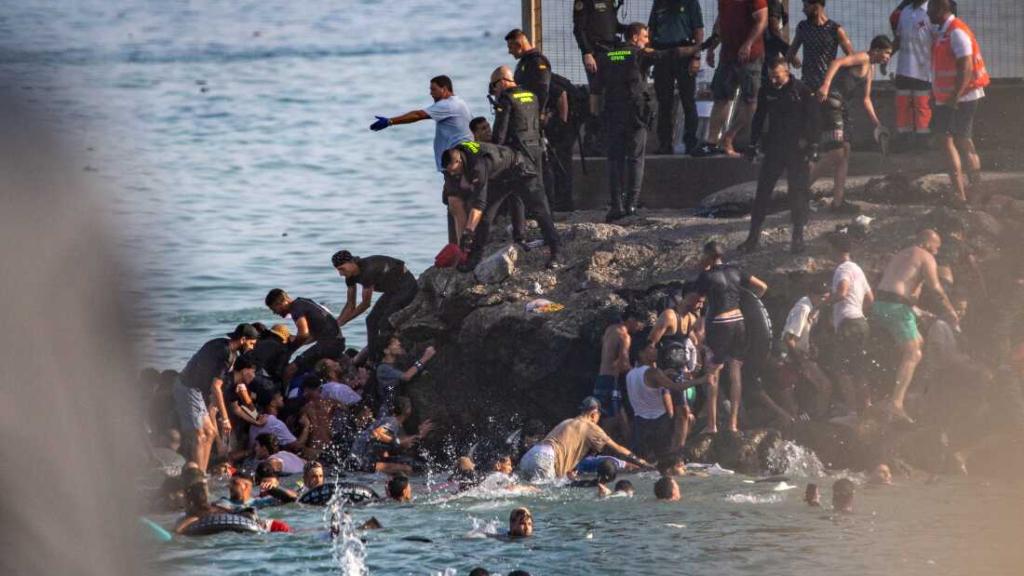
Seventy-two bodies came out of the water at Tarajal, and the sea kept giving some of them back through the weekend. They drowned in sight of Europe, in the fourteen-kilometer channel where the Mediterranean meets the Atlantic, reaching for a seven-square-mile scrap of Spain on the African shore. Most were young men. Some were children. They died over three days at the end of July, crushed against a breakwater barrier or pulled under while swimming around it, and within forty-eight hours of the last of them entering the water more than forty-eight thousand of the living had turned and walked back into Morocco.
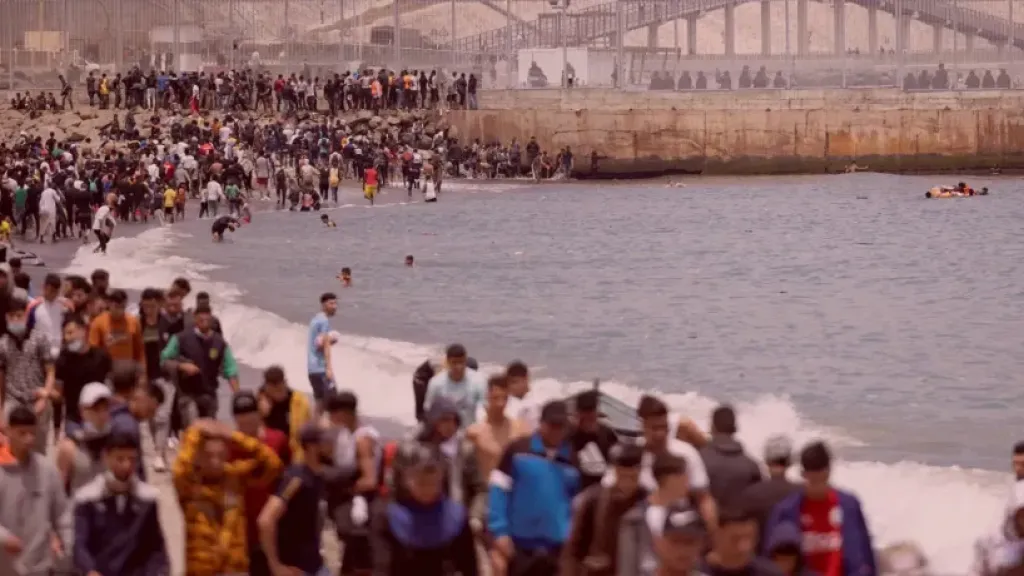
Between fifty and sixty thousand people crossed into Ceuta in seventy-two hours. The enclave holds about ninety thousand. In three days its population rose by seventy percent and then drained away, a tide come in and gone out on command. Spain’s prime minister called the crossing an attack and a violation of the country’s territorial integrity, and sent in the army.
Tides do not take instruction. States do. A crowd of sixty thousand does not gather the way weather gathers. It gathers because people are told where and when, because they travel, some of them from the far side of a country, because they arrive together, and because the security apparatus of one of the most heavily policed states in North Africa elects not to stop them. Each of those is a decision, and the decisions were Rabat’s to make.
The men who died did not come from the towns nearest the fence. They came from across Morocco, converging on Fnideq, the border town facing Ceuta, because the summons to gather there ran ahead of them across the social networks in the days before. Moroccan outlets described the convocation without embarrassment: an intense digital campaign calling young men to the border, Facebook groups passing along the swimming route around the barrier, people arriving from every part of the country within hours. None of it was concealed. In a state whose services read the networks as closely as any in the region, none of it went unseen.
The proof that this was a decision, and not a flood, lies eleven months back. In September 2024 the identical summons went out, the same calls, the same crowds, the same town, and Moroccan riot police dispersed them night after night until the attempt broke apart. The border held that year because Rabat had decided it would hold. The apparatus that closed it in 2024 did not evaporate before July 2026. It stood aside. At the fence last week, reporters from the Ceuta daily El Faro watched Moroccan soldiers wave the men through, and set down the obvious: a crossing on this scale was impossible unless the cordons let it happen. The Spanish police unions used a harder word than passivity. They called it blackmail, a pressure operation proper to a hybrid war.
Then the kingdom proved what it had chosen not to do. The moment Rabat judged the operation finished, it assembled overnight a fleet of buses and carried the crowds out of Fnideq to cities across the country, quickly and without incident. A government that can charter a bus fleet on a Friday night to empty a border town could have closed the road into it on the Wednesday. It did not close the road. The passivity was not weakness. It was the weapon.
The trucks belong in the record, and belong there carefully. Footage circulated of young men delivered toward the border in trucks while Moroccan agents looked on, and the footage became the crisis’s central image. Spain’s fact-checkers at Newtral could not geo-locate the main unloading clip to Ceuta and found AI-forged fakes moving in the same stream, while Moroccan state media labored to recast the same footage as an interception rather than a release. The clips are contested, and the contest is the evidence. Organized transport was filmed in the presence of the security forces, and a state apparatus moved in real time to govern how that transport was seen. The logistics and the management of the image ran on one clock. That is the signature of an operation, not a stampede.
The method had been set down in advance, in Washington, in the spring. On the twelfth of March, Michael Rubin, senior fellow at the American Enterprise Institute, former Pentagon official, called on Donald Trump and Marco Rubio, through the Middle East Forum, to recognize Ceuta and Melilla as occupied Moroccan territory. Spain, he wrote, “remains a colonial power, running colonies across the Strait of Gibraltar on the northern coast of Morocco.” The grievance he named was not colonial injustice. It was that Sánchez had just recalled Spain’s ambassador from Israel and kept silent on Iran. Recognition would right a historical wrong, Rubin argued, on the model of Trump’s first-term recognition of Moroccan sovereignty over the Western Sahara, the transaction that bought Rabat’s signature on the Abraham Accords. The enclaves were the nearest lever, and he pulled it.
Four days on, he turned from Washington to Rabat. Morocco should gather, he wrote, send bulldozers to the border, and enter the two enclaves unarmed to raise the flag, the 1975 Green March run a second time, when Hassan II walked 350,000 civilians into the Spanish Sahara. And he answered the one objection that matters before anyone could raise it. An assault on the enclaves would not summon NATO, because Article 6 of the alliance treaty excludes territory south of the Tropic of Cancer. “Neither Ceuta, Melilla, nor the Canary Islands would trigger a NATO response,” he wrote, “just as NATO would not need respond to an attack on Hawaii or Puerto Rico.” A former Pentagon man had put the method on the page, unarmed masses moving on the fences, and priced the alliance’s silence into it beforehand. That is not opinion. It is a man who has thought through the morning after and wants it known the matter is in hand.
Within a month the method had a sponsor inside the United States government. On the first of April, Mario Díaz-Balart, Republican of Florida, chairman of the House subcommittee that funds American diplomacy, among the closest congressional allies of the Secretary of State, told the Spanish daily El Español that the enclaves are not “in the geographic territory of Spain” but “in the territory of Morocco,” their fate to be “established, negotiated, and discussed between friends and allies.” In three weeks the annexation of two pieces of Europe had travelled from a think-tank column to the chair of an appropriations subcommittee. It had stopped being commentary. It was policy learning its lines.
Why Spain, and why now, Trump has put on the record more than once and taken no trouble to disguise. In the spring Madrid refused the United States the use of the Rota and Morón bases for the strikes on Iran, holding that the war had no footing in international law, then closed its airspace to the American aircraft flying the campaign. Sánchez called the war an extraordinary mistake. And Spain stood alone among the allies in rejecting NATO’s new five-percent spending target. For each of these Trump promised to make Madrid pay, by name and out loud. In October he vowed to make Spain pay “twice as much” in trade, adding, “I’m actually serious about that.” In March, after the airspace closure, he said Spain “has been terrible” and would face a total trade cutoff. In July, at the Ankara summit, he called it a wasted cause: “Cut off all trade with Spain, please, including visits.”
The threat kept breaking against the same wall. Trade for Spain is settled in Brussels, by the European Commission, for all twenty-seven at once. No American president can tariff Spain alone; he can only strike the Union, which bargains as a bloc precisely so that none of its members can be cut from the herd. The weapon Trump reached for was blunted by the very thing that makes Europe Europe. What remained to him was a pressure Brussels could not intercept, a border belonging to Spain and to no one else, facing a kingdom that owed Washington for the Western Sahara and wanted the enclaves for its own. The tariff was taken off the table. The border was what lay on it.
That three actors wanted the same thing does not prove they moved together, except that in April the design was set out in full in the Israeli press, not as anyone’s inference but as the author’s own plan. On the twenty-fifth, Ynet, among Israel’s largest news sites, carried an analysis by Amine Ayoub, a fellow of the same Middle East Forum that ran Rubin’s appeals, under a title that hides nothing: “Abraham Accords reach the Strait: how Israel can help Morocco reclaim its north.” Spain’s refusal of the bases, its NATO record, Sánchez’s posture, these, Ayoub wrote, had opened a genuine crack in Spain’s strategic armor over the enclaves, and into it Israel, Morocco’s consequential new partner, was “uniquely positioned to press.” He set out three channels by which Israel could carry Rabat’s claim: direct diplomatic signaling, amplification through Washington’s corridors, and the public shaming of Spain for recognizing a Palestinian state while holding African ground four centuries older than Israel.
Then Ayoub wrote the line that closes the distance between all of it. To help Morocco take the enclaves, he argued, would serve the Abraham Accords and punish a NATO member that had chosen obstruction over partnership at the alliance’s most critical hour. Punish, his word, not an interpreter’s. He named the prize as well: Morocco, across the Strait of Gibraltar, holds the key to one of the world’s vital maritime chokepoints. The same piece set down the scaffolding beneath the claim. The Abraham Accords had turned Morocco from a quiet interlocutor into a formal military partner of Israel, the two signing a joint military work plan in January 2026. Washington designates Morocco a Major Non-NATO Ally and has signed a fresh ten-year defense roadmap with Rabat, even as it threatens to suspend from the alliance the ally that will neither fund nor serve it. And it noted what the other reports had noted: an internal Pentagon email, reported by Reuters in April, weighing suspension of Spain from NATO outright, and Defense Secretary Pete Hegseth’s open contempt for the European allies who declined to join the campaign in the Strait of Hormuz.
So the network narrates its own logic in the open. A think-tank fellow writes the method and disarms the alliance objection. A congressman close to the Secretary of State ratifies the territorial claim. An allied newspaper, through a second fellow of the same institute, casts the whole thing as a punishment of Spain and names the chokepoint as the reward. No order need be cut, no meeting held, no cable sent. The incentive was published, in English, across three countries, over six weeks in the spring, and every party that needed to read what Washington would reward could read it. The crossing was a market answering a price posted in plain view.
Then watch what the authors of the price did with the dead. Within hours of the breach the United States State Department blamed not Rabat, which had opened its border, but Madrid, which had taken the blow, citing Spain’s deliberate efforts to enable illegal migration into Europe, an inversion so complete it accused the struck of striking itself. Trump called the drownings a talking point for the midterms. And Europe turned upon itself precisely as the design required. France ordered new checks on its Spanish border. Italy imposed controls of its own. Senior figures across the continent called for Spain’s suspension from the Schengen zone, and the president of the European Commission, looking upon seventy-two corpses, pronounced the images unacceptable and reminded Spain that none may enter the union without honoring its rules. The member state that had absorbed the attack was lectured for having been attacked.
The reaction was not a by-product of the operation. It was the product. The commentators who spent the weekend turning drowned men into an argument about invasion did not arrive at that frame by accident; it was handed to them. Threat and scarcity are the levers that most reliably shut off judgement and switch on obedience, and the word invasion fuses the two into a single picture. Take the word and you take everything welded to it, the border as a body assaulted, the strongman as the only cure, mercy recast as weakness. The migrants were the ammunition. The fear of the European public was the target. And the politicians demanding Spain’s expulsion from Schengen performed, without pay and with appetite, the fracturing the operation existed to cause.
One man refused the part written for him. Sánchez, who might have blamed Morocco and handed his attackers the rupture they were engineering, did not. He said the line to Rabat had stayed open and credited Moroccan forces with later clearing the crowds. Read for structure and not for manners, the restraint is not innocence. It is the discipline of a man who grasps that the crossing was aimed at his standing in Europe as much as at his fence, and who will not surrender the diplomatic break that would finish the work. His contempt he kept for the selfish European response, the “selfish, polarizing and unlawful reaction” of the allies who turned on him inside a day. He was not complaining of rudeness. He was describing the payload as it landed.
Stand back and Ceuta stops being an accident and becomes a method. Washington holds a structural interest, seldom stated and steadily served, in a Europe that is fractured rather than sovereign, dependent rather than free, a field of clients rather than a rival. And the surest road to fracture is not to confront the whole but to find a seam, or make one, and press across it until the parts turn upon each other. This is not a claim Ceuta asks to be believed on faith. It is a mechanism already visible elsewhere, under other names.
Against Iran the instrument is sanctions and strikes meant to cut a state from its economy and its people, on the wager that internal collapse does the work an invasion cannot. Against Russia the rupture of 2022 severed Europe from Russian energy, and the party most lastingly weakened by that severance was Europe itself, now buying American gas at American prices, its industry bleeding, its dependence on Washington deepened in the very act of being told it was being defended. That is the recurring tell: a fracture sold as security that leaves the fractured more dependent than before. Across the wider Middle East the same logic runs in gentler dress as the Abraham Accords, realigning a region about a Washington-Jerusalem axis, and now, on the open testimony of the Ynet piece, reaching across the Strait for Europe’s southern edge.
The Forum does not even confine the pattern to Spain. On the second of August, while the bodies were still being drawn from the sea at Tarajal, its front page carried a fresh appeal from within its own ranks, that Israel should support independence for New Caledonia, France’s Pacific territory. The template holds from target to target: find a Western holdout’s exposed possession, dress its severance as the righting of a historical wrong, and let the loss fall on a European state judged insufficiently obedient. The Forum prints its purpose on its own masthead. It exists, it says, to promote American interests and to protect the West from threats. The enclaves and the archipelago are entries in that ledger.
The instrument changes, sanctions, energy, a recognition deal, a border left open, and the object holds. A Europe that cannot agree how to answer sixty thousand people at a single enclave cannot mount an independent line on Iran, on Palestine, on trade, on its own defense. In one day, one pressure operation at one breakwater produced Europeans demanding a member state’s partial expulsion from its own zone of free movement. That is not the accident of American policy. On the evidence gathered here it is the aim.
Which returns the matter to the water. Ceuta sits on the Strait of Gibraltar, the western door of the Mediterranean, fourteen kilometers of sea through which a quarter of the world’s shipping passes. Whoever holds the enclaves and the Moroccan shore lays a hand on that door. This is why the seam was worth the widening, and why the Ynet writer named the chokepoint, and not the enclaves, as the prize. The seventy-two dead at Tarajal are what a quarrel over airspace looks like when a superpower cannot reach its target through the front door and reaches it through the sea. Rabat has done this before, loosening the same border in retaliation in 2021. The mechanism is old. What is new in 2026 is that the script was written in Washington, the punishment named in Tel Aviv, and the whole of it published, months ahead, for anyone willing to lay the pages side by side and read the dates in order.
The panic now pumped through Europe is real in its effect and manufactured in its origin. The drowned were real. The crisis was not found. It was made, and the record of its making sits in the open, on the letterhead of a think tank, a newspaper, and a congressional office, waiting on someone to set the pages beside one another and read.
Thomas Karat writes investigative work published at karat.substack.com and the Libertarian Institute, drawing on a corporate career and academic training as a behavior analyst to examine how institutions manufacture consent and influence.




.png)