Showing posts sorted by date for query PELE VOLCANO. Sort by relevance Show all posts

Wednesday, December 24, 2025

HEGSETH'S KULT OF WAR

INL advances Department of War’s Project Pele demonstration microreactor with first TRISO fuel delivery


ARES INVOKES PELE THE VOLCANO GODDESS


DOE/Idaho National Laboratory
Project Pele 

image: 

INL operations staff members prepare to unload casks containing TRISO fuel that will power Project Pele. The project is led by the Department of War’s Strategic Capabilities Office in partnership with BWXT, the Department of Energy and INL.

view more 

Credit: Idaho National Laboratory


IDAHO FALLS, Idaho — The recent delivery of advanced nuclear fuel to the Idaho National Laboratory’s Transient Reactor Test Facility marks a major milestone for Project Pele, a first-of-its-kind mobile microreactor prototype designed to provide resilient power for military operations.

The fuel, known as tri-structural isotropic (TRISO) particle fuel, is made from uranium, carbon and oxygen, formed into a small kernel. This kernel is coated in multiple layers — including silicon carbide — that make it extremely durable under high heat, radiation, and corrosive conditions. Thousands of these poppy seed-sized particles are combined into compact fuel forms used in advanced reactors like the one being developed under Project Pele by the Department of War’s Strategic Capabilities Office.

The first delivery of TRISO fuel for the future demonstration reactor was celebrated today by INL, the Strategic Capabilities Office, the U.S. Army, BWX Technologies Inc. (BWXT), and the U.S. Department of Energy (DOE) who are collaborating on the fuel project.

“This milestone reflects years of dedicated effort by the Office of Nuclear Energy’s Advanced Gas Reactor TRISO Fuel Qualification Program to fabricate and qualify TRISO fuel using world-class capabilities at INL’s Advanced Test Reactor and Materials and Fuels Complex, and Oak Ridge National Laboratory — capabilities that exist nowhere else in the world,” said John Wagner, INL director. “That investment is now enabling Project Pele to move forward with the speed and confidence our national security demands to accelerate American innovation and demonstrate the leadership that will define this era of nuclear energy.”

“We’re thrilled to see the Project Pele microreactor design continue to make forward progress,” added principal Deputy Assistant Secretary for Nuclear Energy Mike Goff. “This is a great example of how we can accelerate innovation in advanced nuclear fuels and technologies through collaborative partnerships.”

The event featured remarks from Department of Energy, the Department of War’s Strategic Capabilities Office and BWXT leaders, along with a ceremonial signing of a commemorative photograph. It also highlighted the collaborative efforts of federal and private-sector partners in advancing reliable energy solutions for defense applications.

“The completion of the production and delivery of the first batch of TRISO fuel is an important milestone for Project Pele, and it further accelerates the administration’s objectives to enable private sector investment, innovation, development and use of advanced nuclear technologies,” said David Schurr, the Strategic Capabilities Office’s project manager for Pele.

“This is the first TRISO microreactor fuel delivered at its final destination,” added Jeff Waksman, principal deputy assistant secretary of the Army for Installations, Energy and Environment. “Project Pele is a transformational leap toward Gen-IV nuclear power, and the Army’s Janus Program will follow on to deliver affordable, reliable, commercial nuclear power to ensure that our critical infrastructure has power even if the electric grid is disrupted.


\


Friday, August 22, 2025

Underwater volcano off Oregon coast could erupt by the end of the year, researchers say, but nothing ‘looks imminent’

When it does erupt, it likely won’t pose a threat to human life.

Kate Murphy, Reporter
Thu, August 21, 2025 


Underwater volcano Axial Seamount. (National Science Foundation)

An underwater volcano off the coast of Oregon that was forecast to erupt sometime this year doesn’t look imminent, according to volcanologists who are closely monitoring it.

The Axial Seamount is located about 300 miles off the coast of Oregon in the Pacific Ocean, and it’s 4,900 feet below the surface of the sea along the Juan de Fuca Ridge. For comparison, its depth is about two-and-a-half times the height of One World Trade Center in New York City, which is 1,776 feet, according to the U.S. Geological Survey.

It’s the most active submarine volcano in the northeast Pacific. In the last 30 years that it’s been monitored, three eruptions have occurred: in 1998, 2011 and 2015, according to researchers Bill Chadwick at Oregon State University and Scott Nooner at the University of North Carolina at Wilmington.

“Our forecast of an eruption at Axial Seamount by the end of the year still stands, but I have to say nothing looks imminent,” Chadwick told KOIN on Wednesday. Yahoo contacted Chadwick for an updated confirmation of this assessment and is awaiting a response.

Here’s what else to know about the underwater volcano.
Does the underwater volcanic eruption pose a serious threat?

No. Due to the Axial Seamount’s great depth underwater, combined with its relatively gentle lava flow style, it doesn’t pose a threat to human life, ocean travel or property, the U.S. Geological Survey says.

“For the size of eruptions we’ve seen in the last 20 years … if you were on top of it on a boat, you would never know it,” Chadwick previously told local media.

However, the next eruption will help researchers better understand and forecast how volcanoes erupt on land.

Why is it forecast to erupt this year?


Inflation in an underwater volcano happens when magma accumulates below the sea floor and pushes the surface of the volcano upward, Chadwick explained at a 2024 seminar. One of the signs that an eruption of Axial Seamount might happen this year is that the volcano reached the same inflation levels from when it erupted in 2015, back in January.

But as of July, “the rate of inflation has been slowly decreasing all year,” Chadwick wrote in a blog on the OSU website that details the eruption forecast.

Researchers also monitor seismic activity near the volcano through instruments and cables that extend from the U.S. coast. In June, there were more than 2,000 earthquakes recorded near Axial Seamount in a single day, which is a sign that an eruption could be imminent.

A new benchmark deployed at the base of the western caldera wall of the Axial Seamount volcano. (NOAA)

Additionally, in July, the tsunami wave from the 8.8 magnitude earthquake near Russia’s Kamchatka Peninsula "triggered the automated alerts we have in place to notify us when an eruption might be starting,” even though it wasn’t actually an eruption, according to Chadwick’s blog post.

“We can only wait and see, but nothing seems imminent at the moment since the rate of unrest keeps wavering up and down, up and down,” Chadwick writes. “Of course, we don’t really know what it will take to trigger the next eruption and exactly when that will happen. But hopefully we’ll learn more about that triggering process by the monitoring we are doing now.”


Scientists play a waiting game with a giant volcano off the West Coast

N'dea Yancey-Bragg and Elizabeth Weise, 
USA TODAY
Wed, August 20, 2025


Scientists play a waiting game with a giant volcano off the West Coast

Hundreds of miles off the coast of Oregon, Deb Kelley watched a pod of dolphins swim past the research vessel Atlantis as the sun set on the Pacific Ocean.

But beneath the calm seas lurked a behemoth: Axial Seamount, a massive volcano 4,500 feet below the ocean’s surface. Kelley and her team are in the middle of a maintanence mission, working nearly 24 hours a day for weeks to recover and restore the instruments that keep tabs on the volcano, which scientists believe will erupt in 2025.

Kelley, director of the Regional Cabled Array, is not so sure.

USA TODAY reported on the volcano in May, and not much has changed since then, other than a slight decline in some of the prescursors to eruption. Researchers say they still don't know what it will take to trigger the next eruption or exactly when it will happen.

"We can only wait and see, but nothing seems imminent at the moment since the rate of unrest keeps wavering up and down, up and down," Bill Chadwick, a volcanologist with Oregon State University who’s part of a team that’s studying the volcano, wrote in a July 30 blog post.

What's happening with Axial Seamount? 'Not much'

A reservoir has been refilling with magma since its last eruption in 2015, gradually inflating and causing the volcano to rise. Eventually, the pressure will become so great that it will open up and lava will pour out.

Kelley said there have been some indications that an eruption is coming, like submarine hydrothermal vents beginning to boil. The hot water is attracting sea life that prefer warm, nutrient-rich waters.

But "not much" has been happening with the volcano lately, Chadwick wrote.

The rate of inflation has been slowly decreasing all year. There was a brief spike in seismic activity - including one day in June with over 2,000 earthquakes - but that has dwindled to an average of 100 per day.

"All those indications from previously was that it would erupt, but those have all slowed down now," Kelley said.

What happens when the volcano erupts?

When the volcano erupts, it will spew enormous amounts of lava into the ocean for days or even months.

Kelley said the lava flow could potentially cause tens of thousands of explosions and billions of microbes will stream out onto the sea floor like flakes from a snowblower.

But Axial Seamount is not a threat to humans. It won't trigger a tsunami or earthquakes on land, and even a person in a boat directly above it likely wouldn't notice, Chadwick previously said.

But it will provide researchers a virtually unprecedented opportunity to watch what happens when the lava flows.

"We're never there in the right place, in the right time to know that's happening," Kelley said. "So this is a phenomenal opportunity to gain a lot of insights about major processes operating on our planet."

Research facing Trump cuts

Axial is the world’s most extensively studied undersea volcano because more than 660 miles of undersea cables crisscross it, sending a steady stream of real-time data about the area to scientists. The Regional Cabled Array includes more than 140 instruments that are constantly monitoring it.

The work is part of a larger ocean monitoring effort by the Ocean Observatories Initiative, which maintains more than 900 ocean-based instruments to address critical questions about the world's oceans, funded by the National Science Foundation.

But that work may now be under threat. The National Science Foundation's budget for fiscal year 2026 proposed slashing the initiative's budget by 80% in its tenth year, the organization said in June.

Kelley said its not yet clear how the cuts will affect her projects, but she hopes to be back out on the waters above Axial next summer.

"We don't know how that what the cuts will be, what the budget will be, and how that funnels down to us yet," Kelley said. "So we have hope. I always have hope, it's just in my nature to do so."


One of the world's most active volcanoes in this US state is about to erupt again

JULIA JACOBO
Wed, August 20, 2025 

One of the most active volcanoes in the world is living up to its reputation as it gears up for another eruption.

An eruption at Hawaii's Kilauea volcano is imminent, based on current activity, according to the U.S. Geological Survey. Lava fountains -- jets of lava that are sprayed into the air during an eruption -- are expected to begin flowing between Wednesday and Saturday.

MORE: Eruption at Hawaii's Kilauea volcano sends lava shooting 1,000 feet in air


Kilauea began to show signs of eruption on Monday, when deflation was recorded on two tiltmeters, instruments used to measure the tilting or rotation of a structure or the ground surface, according to the USGS.

M. Patrick/USGS - PHOTO: On Aug. 18, 2025, two USGS scientists and two researchers from the University of Colorado hiked to an overview of the north vent in Halemaʻumaʻu crater at Kīlauea volcano to confirm if lava was moving up inside the vent.More

Continued tremors and what's known as "glow" at Kilauea indicate that magma remains relatively high in the north vent of the volcano, according to the USGS. In addition, "elevated degassing continues from the vent."

"The onset and persistence of glow suggest that magma is close to the surface," the USGS said in its latest update.

MORE: Kilauea, active Hawaiian volcano, could erupt like a 'stomp-rocket toy,' new study suggests

The current volcano alert level is at "Watch" or "Orange" level, indicating heightened or escalating unrest and an increased potential for eruption, according to the USGS.

Once the eruption begins, it will be the 31st time Kilauea has erupted since December. In some of the eruptions, lava was seen shooting up to 1,000 feet from the volcano's vent.

USGS - PHOTO: This close-up view of the Kīlauea summit eruption's north vent was captured during an uncrewed aircraft system (UAS) overflight conducted by Hawaiian Volcano Observatory scientists on Aug. 18, 2025.More

Magma has been using the same pathway to gather in a chamber under the Halemaumau Crater since Dec. 23, making the eruptions "intermittently active" within the crater, according to the USGS.

The last eruption ended on Aug. 6 after 12 hours of continuous fountaining, according to the USGS. Lava fountains reached up to 165 feet and covered 80% of the crater floor.

The eruption was characterized by episodic lava fountaining not seen since the 1980s, according to the USGS.

Kilauea has erupted dozens of times since 1952. Eruptive activity was nearly continuous along the volcano's East Rift Zone between 1983 and 2018.


H. Weiss-Racine/USGS - PHOTO: On August 18, the goal field observations confirmed that lava was moving up inside the vent. While perched lava was not observed, lava spatter was visible intermittently during gas pistoning events.More

High levels of volcanic gas -- including water vapor, carbon dioxide and sulfur dioxide -- is a major hazard of concern.

Strands of volcanic glass known as "Pele's hair", are present throughout the summit area of Hawaiʻi Volcanoes National Park and can spread by wind, even after fountaining has ended, according to the USGS.

Kilauea's caldera rim surrounding the Halemaʻumaʻu crater has been closed to the public since 2007 due to such hazards.

Friday, June 09, 2023

PRAISE PELE
As tourists flock to view volcano’s latest eruption, Hawaii urges mindfulness, respect


By JENNIFER SINCO KELLEHER
today

Kilauea erupts after 3-month pause

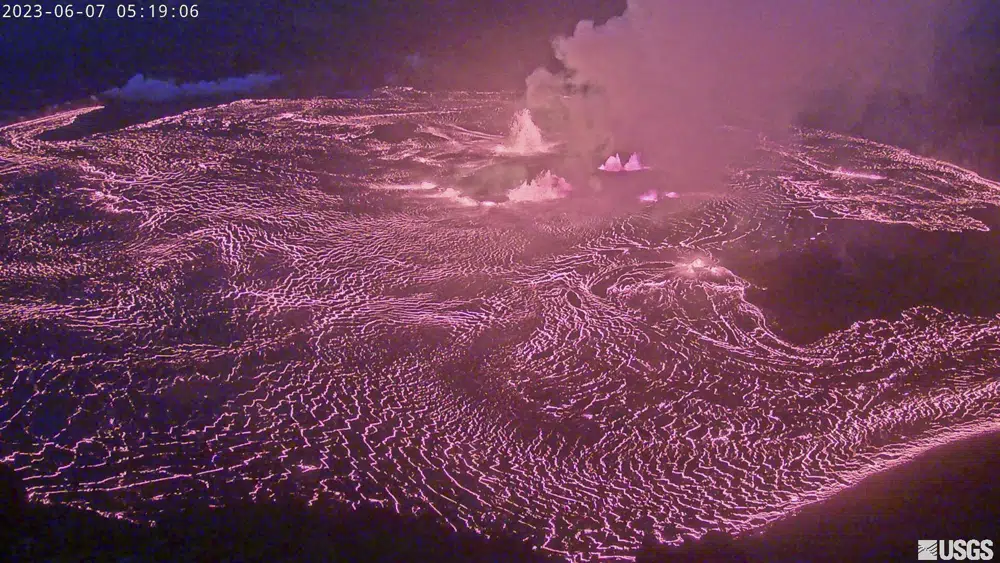
Kilauea, one of the most active volcanoes in the world, began erupting on Wednesday after a three-month pause, displaying spectacular fountains of mesmerizing, glowing lava that's a safe distance from people and structures in a national park on the Big Island. (June 7)


HONOLULU (AP) — Hawaii tourism officials urged tourists to be respectful when flocking to a national park on the Big Island to get a glimpse of the latest eruption of Kilauea, one of the world’s most active volcanoes.

Kilauea, Hawaii’s second-largest volcano, began erupting Wednesday after a three-month pause.

The U.S. Geological Survey’s Hawaiian Volcano Observatory on Thursday lowered Kilauea’s alert level from warning to watch because the rate of lava input declined, and no infrastructure is threatened. The eruption activity is confined to the closed area of Hawaii Volcanoes National Park.

“Out of respect for the cultural and spiritual significance of a volcanic eruption and the crater area for many kamaʻāina, the Hawaiʻi Tourism Authority urges mindfulness when planning a visit to the volcano,” the agency said in a statement Wednesday night, using a Hawaiian word often used for Hawaii residents.

For many Native Hawaiians, an eruption of a volcano has a deep yet very personal cultural significance. Some may chant, some may pray to ancestors, and some may honor the moment with hula, or dance. Hawaiians ask that people keep a respectful distance.

“Don’t just get out your camera and take photos. Stop and be still and take it in,” said Cyrus Johnasen, a spokesperson for Hawaii County who is Hawaiian. “It’s something that you can’t pay for. In that moment, you are one with Hawaii.”

In recognizing the sacredness of the area, he also urged visitors to not take rocks, refrain from horseplay and leave plants alone.

“A lot of plants up there are native,” he said. “Just be mindful that you will leave a footprint. The idea is you leave one that’s small as possible.”

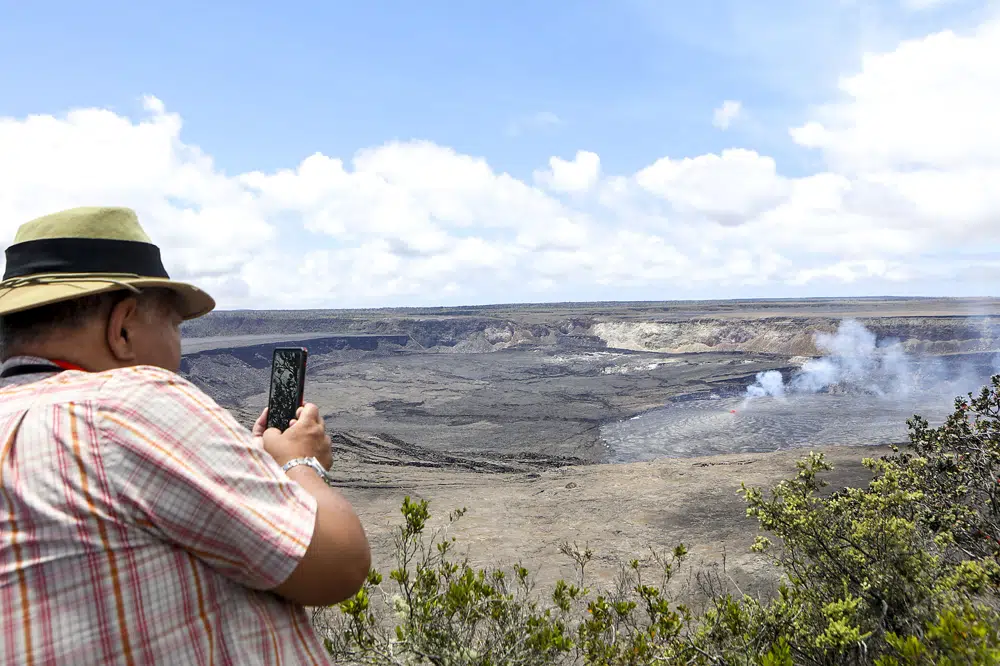
Word of Kilauea’s lava fountains spread quickly, bringing crowds to the park. “Expect major delays and limited parking due to high visitation,” said a warning on the park’s website Thursday.

There was no exact count available, but officials estimated the first day and night of the eruption brought more than 10,000 people, which is more than triple the number of visitors on a normal day when Kilauea isn’t erupting, park spokesperson Jessica Ferracane said.

Several thousand viewers were watching the USGS’s livestream showing red pockets of moving lava Thursday morning.

“We were on social media, and we saw that it was actually going off while we’re here, so we made the drive from the Kona side,” Andrew Choi, visiting with his family from Orange County, California, told the Hawaii Tribune-Herald. “This feels so ridiculously lucky. We’ve never seen anything like this.”

Park officials suggested visiting at less-crowded times before 9 a.m. or after 9 p.m.

Scientists expect the eruption to continue and remain confined to the Halemaumau crater in the park.

Early Wednesday, lava fountains were as high as 200 feet (60 meters) and decreased to 13 feet to 30 feet (4 meters to 9 meters) in the afternoon, according to the observatory.

“People here on Hawaii Island are getting a spectacular show,” Mayor Mitch Roth said. “And it’s happening in a safe place that was built for people to come view it.”


In this image provided by the U.S. Geological Survey, an eruption takes place on the summit of the Kilauea volcano in Hawaii, Wednesday, June 7, 2023. Hawaii tourism officials urged tourists to be respectful when flocking to a national park on the Big Island to get a glimpse of the latest eruption of Kilauea, one of the world's most active volcanoes. (U.S. Geological Survey via AP)

Friday, January 06, 2023

Hawaii’s Kilauea volcano erupts again, summit crater glows

Associated Press
January 6, 2023 
Kilauea volcano in Hawaii has erupted again for the second time in less than. a year.

Hawaii’s Kilauea began erupting inside its summit crater Thursday, the U.S. Geological Survey said, less than one month after the volcano and its larger neighbor Mauna Loa stopped releasing lava.

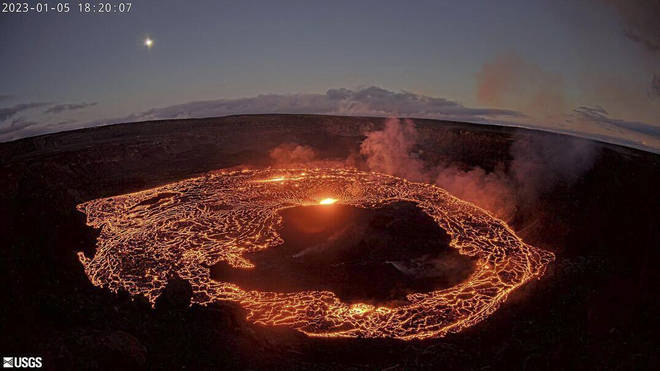
The Hawaiian Volcano Observatory detected a glow in webcam images indicating Kilauea had begun erupting inside Halemaumau crater at the volcano’s summit caldera, the agency said.

Kilauea’s summit is inside Hawaii Volcanoes National Park and away from residential communities.

Earlier Thursday, the U.S. Geological Survey raised the alert level for Kilauea due to signs that magma was moving below the summit surface, an indication that the volcano might erupt.

Kilauea is one of the world’s most active volcanoes. It last erupted for 16 months starting in September 2021. For about two weeks starting Nov. 27, Hawaii had two volcanoes spewing lava side by side when Mauna Loa erupted for the first time in 38 years. Both volcanoes stopped erupting at about the same time
.
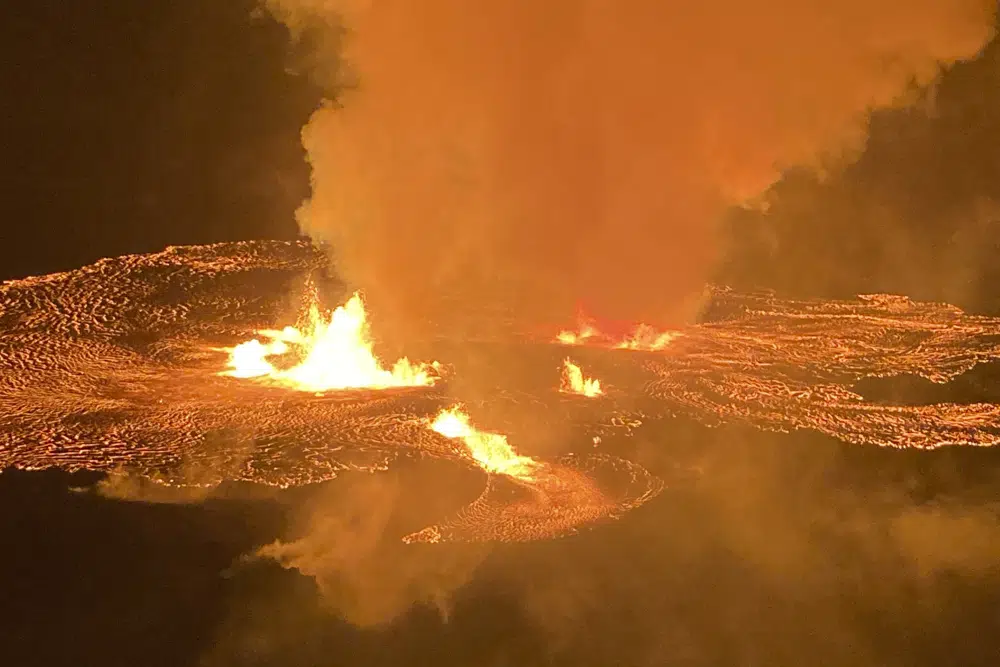
Images of Kilauea volcano spewing lava on Jan. 5, 2023.AP

During the twin eruption, visitors to Hawaii Volcanoes National Park were able to see lava from both eruptions at the same time.

“It was a beautiful eruption, and lots of people got to see it, and it didn’t take out any major infrastructure and most importantly, it didn’t affect anybody’s life,” said Ken Hon, the Hawaiian Volcano Observatory’s scientist in charge.

Mauna Loa lava didn’t pose a threat to any communities, but got within 1.7 miles (2.7 kilometers) of a major highway connecting the east and west sides of the island. A 2018 Kilauea eruption destroyed more than 700 residences.

The observatory planned to continue monitoring the volcanoes for signs of renewed activity. Hon previously said there is generally a three-month “cooling off” period before scientists consider an eruption to be complete.

The alert level for the volcano was raised due to magma moving below the surface of the mountain’s summit.

It was unclear what connection there could be to the volcanoes stopping their eruptions around the same time. The volcanoes can be seen at the same time from multiple spots in Hawaii Volcanoes National Park near Kilauea’s caldera.

What do you think? Be the first to comment.

Scientists planned to look at data to study the relationship between the two volcanoes, Hon previously said.

For Native Hawaiians, volcanic eruptions have deep cultural and spiritual significance. During Mauna Loa’s eruption, many Hawaiians took part in cultural traditions, such as singing, chanting and dancing to honor Pele, the deity of volcanoes and fire, and leaving offerings known as “hookupu.”


Summit crater glows as Hawaii’s Kilauea volcano erupts again

6 January 2023, 07:54

Hawaii’s Kilauea volcano, from the west rim of the summit caldera, looking east
Hawaii-Volcano. Picture: PA

The Hawaiian Volcano Observatory detected a glow in webcam images.

Hawaii’s Kilauea has begun erupting inside its summit crater, the US Geological Survey said – less than one month after the volcano and its larger neighbour Mauna Loa stopped releasing lava.

The Hawaiian Volcano Observatory detected a glow in webcam images, indicating Kilauea had begun erupting inside Halemaumau crater at the volcano’s summit caldera, the agency said.

Kilauea’s summit is inside Hawaii Volcanoes National Park and away from residential communities.

Hawaii’s Kilauea began erupting inside its summit crater on Thursday, the US Geological Survey said
Hawaii’s Kilauea began erupting inside its summit crater on Thursday, the US Geological Survey said (US Geological Survey/AP)

Kilauea is one of the world’s most active volcanoes. It last erupted for 16 months starting in September 2021. For about two weeks starting on November 27, Hawaii had two volcanoes spewing lava side by side when Mauna Loa erupted for the first time in 38 years. Both volcanoes stopped erupting at about the same time.

Earlier on Thursday, the US Geological Survey raised the alert level for Kilauea due to signs magma was moving below the summit surface, an indication the volcano might erupt.

During the twin eruption, visitors to Hawaii Volcanoes National Park were able to see lava from both eruptions at the same time.

“It was a beautiful eruption and lots of people got to see it and it didn’t take out any major infrastructure and, most importantly, it didn’t affect anybody’s life,” said Ken Hon, the Hawaiian Volcano Observatory’s scientist in charge.

Mauna Loa lava did not pose a threat to any communities but got within 1.7 miles of a motorway connecting the east and west sides of the island. A 2018 Kilauea eruption destroyed more than 700 homes.

The observatory plans to continue monitoring the volcanoes for signs of renewed activity. 

Mr Hon previously said there is generally a three-month “cooling off” period before scientists consider an eruption to be complete.

It was unclear what connection there could be to the volcanoes stopping their eruptions at around the same time. The volcanoes can be seen at the same time from multiple spots in Hawaii Volcanoes National Park near Kilauea’s caldera.

Scientists planned to look at data to study the relationship between the two volcanoes, Mr Hon previously said.

For Native Hawaiians, volcanic eruptions have deep cultural and spiritual significance. During Mauna Loa’s eruption, many Hawaiians took part in cultural traditions, such as singing, chanting and dancing to honour Pele, the deity of volcanoes and fire, and leaving offerings known as “hookupu”.

By Press Association


Tuesday, December 06, 2022

PELE BE PRAISED
Aerial images used to map lava from Mauna Loa eruption in Hawaii

Aerial footage of lava flowing from Mauna Loa volcano

VIDEO
abc.net.au/news/aerial-images-map-lava-mauna-loa-eruption-hawaii/101742310COPY LINKSHARE


Scientists are using satellites and helicopters to map lava flows from the Mauna Loa volcano, and say they're seeing the lava continue its slow progress across the Big Island.

The Mauna Loa on the island of Hawaii, which is the world's largest active volcano, has erupted for the first time in 38 years.
Aerial image of fissure 3 erupting on the north-east rift zone of Mauna Loa(Supplied: Hawaiian Volcano Observatory)

Officials were initially concerned that lava flowing down the side of the volcano would head toward the South Kona district.

Scientists later assured the public that the eruption migrated to a rift zone on Mauna Loa's north-east flank and was not threatening any communities.
Lava fountains measured by field crews reached heights of 40 metres, with bursts of 100 metres.(Supplied: L. Gallant/Hawaiian Volcano Observatory)

As the eruption reaches its second week, the lava flow marches slowly north toward the Daniel K. Inouye Highway, which remains open to traffic in both directions.
Image taken during a helicopter overflight and shows a lava flow branching after it cuts across the Mauna Loa Access Road.(Supplied: L. Gallant/Hawaiian Volcano Observatory)

"There's no signs of the flow stopping at any immediate term because activity up at that event on the north-east drift zone continues steadily," US Geological Survey Geologist Mike Zoeller said.

"We still see high rates of lava fusion into the upper lava channels in that region."
Aerial view of the fissure 3 lava channel, measured to be moving at 8.2-11 metres per second.(Supplied: L. Gallant/Hawaiian Volcano Observatory)

In some places the lava has been advancing at about 20 meters per hour. In channels closer to the vent it advances at 8.2-11 metres per second.

Mauna Loa, rising 4,169 metres above sea level, is the much larger neighbour to Kilauea volcano, which erupted in a residential neighbourhood and destroyed 700 homes in 2018.

Mauna Loa volcano erupts in Hawaii

Hawaii County Civil Defense Administrator Talmadge Magno has reminded visitors to stay safe and maintain the respect and be aware of the local surroundings to the community.

AP/ABC

PELE


Monday, December 05, 2022

WATCH: U.S. Geological Survey adds livestream, new webcam views of Hawaii's Mauna Loa eruption

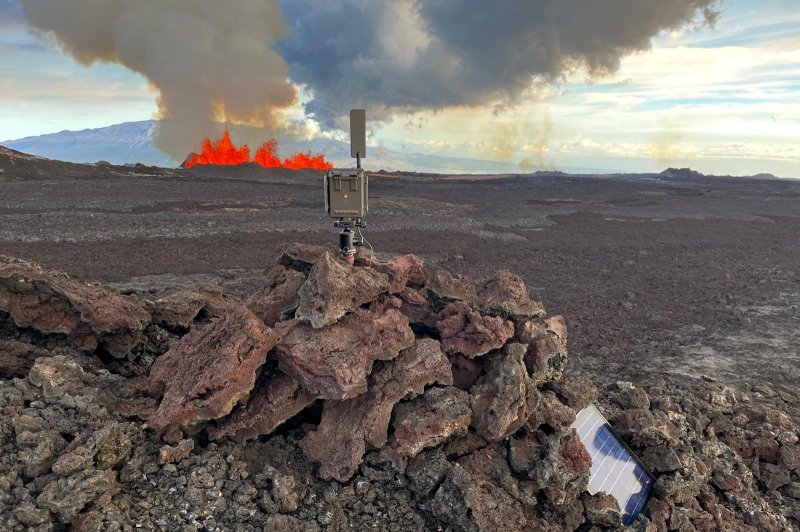
Image of a webcam deployed to monitor the Northeast Rift Zone eruption of Mauna Loa. Photo courtesy of K. Mulliken/USGS

Dec. 3 (UPI) -- The U.S. Geological Survey on Saturday announced that it has added several new webcam views and a livestream of the eruption of Hawaii's Mauna Loa volcano.

Mauna Loa, one of the five volcanoes that form Hawaii's Big Island, began erupting on Monday for the first time in 38 years.

The Hawaiian Volcano Observatory, a division of the USGS, said in a statement Saturday that it had added the webcams which can be viewed online.

At the time of publication on Saturday, the livestream showed lava erupting from Fissure 3 on the northeast rift zone of the volcano.

RELATED Lava from Hawaii's Mauna Loa volcano eruption flows out of rift zone

The camera is located east of the fissure and looks west.


"The webcams are operational 24/7 and faithfully record the dark of night if there are no sources of incandescence or other lights," the USGS said in a disclaimer with the livestream on YouTube.

"Thermal webcams record heat rather than light and get better views through volcanic gas. At times, clouds and rain obscure visibility."

RELATED Mauna Loa, Kilauea volcanos erupting at same time in Hawaii

The USGS said in a statement Saturday evening that there has been "little change" in the eruption over the past 24 hours.

"Fissure 3 is generating a lava flow traveling to the north toward the Daniel K. Inouye Highway (Saddle Road) that has reached relatively flatter ground and slowed down significantly over the past several days, as expected," the statement reads.

Fragments of Pele's hair, which are strands of volcanic glass, have been wafted great distances and have been reported as far Laupāhoehoe.

Sunday, December 04, 2022


Thursday, December 01, 2022

Lava erupting from Hawaiian volcano Mauna Loa threatens critical highway


ABC News
JULIA JACOBO
Wed, November 30, 2022 

The lava flowing out of Mauna Loa, the world's largest active volcano located on Hawaii's Big Island, is inching closer to a main highway, according to officials.

The lava is flowing out of Fissure 3 in the northeast rift zone and is now just 3.6 miles from Saddle Road, a main highway that runs east to west through the center of the island and a route often used to travel between Kona and Hilo, the U.S. Geological Survey tweeted just before 10 a.m. local time.

MORE: A recent history of volcanic eruptions and their impact, as Mauna Loa erupts

Volcanic gas plumes are lofting high and vertically into the atmosphere, according to the Hawaii County Civil Defense.

Fissure 3 remains the dominant source of the lava and is feeding flows that are moving downslope toward the highway, according to the USGS. Around 7 a.m. local time, the lava fountains were reaching up to 82 feet, the USGS confirmed. Lava fountains have also formed at Fissure 4, which is emitting smaller fountains of hot magma and is also flowing downslope toward the road.


PHOTO: A satellite image shows lava flowing from Hawaii's Mauna Loa Volcano in Hawaii, Nov. 28, 2022. (Maxar Technologies via Reuters)

PHOTO: A river of lava flows down from Mauna Loa, Nov. 28, 2022, near Hilo, Hawaii. (Marco Garcia/AP)

Both fissures are feeding flows that are advancing northeast at .08 miles per hour toward the highway.

The flows are approaching a relatively flat area and will begin to slow down, spread out and inflate, according to the Hawaii County Civil Defense. It could take another two days for the lava to reach the highway, officials said.

MORE: Scientists observe 2 new lava flows on Mauna Loa, the world's largest active volcano

However, seismic detection of tremors in the location of the currently active fissures, indicates that magma is still being supplied and activity is likely to continue, according to the Hawaii County Civil Defense.

Emergency managers are beginning to ramp up planning, as the lava threatens the main route to travel east and west on the island, Talmadge Magno, an administrator for the Hawaii County Civil Defense, said on Wednesday. Magno is especially concerned about the "thousands of residents and visitors" who have flocked to the highway to view the eruptions, which are exacerbating the safety hazards, he said.

PHOTO: People pose for a photo in front of lava erupting from Hawaii's Mauna Loa volcano, Nov. 30, 2022, near Hilo, Hawaii. (Gregory Bull/AP)

In addition, Pele's hair, or strands of volcanic glass, are falling in the Saddle Road area, officials said.


Dramatic video released by the USGS shows the volcano dispelling a nearly six-story wall of exploding lava.


Ash and lava began spewing out of the volcano on Sunday around 11:30 p.m. and has continued into Wednesday.

This is the first time Mauna Loa has erupted in nearly 40 years. The last time it erupted was in March and April 1984. The volcano is so large it takes up more than half of the Big Island

MORE: Tongan volcano eruption 'largest ever recorded,' New Zealand scientists say

Geologists do not expect any activity outside of the northeast rift zone, and there are still no threats to populated areas, as there are no homes downslope from the northeast rift zone, according to the USGS.

PHOTO: In this long camera exposure, cars drive down Saddle Road as Mauna Loa erupts in the distance, Nov. 28, 2022, near Hilo, Hawaii. (Marco Garcia/AP)

PHOTO: Brian Lichtenstein, takes a photo in front of lava erupting from Hawaii's Mauna Loa volcano, Nov. 30, 2022, near Hilo, Hawaii. (Gregory Bull/AP)

Since the eruption is occurring to the northeast, where the peak's slope seaward is more gentle, it would take weeks of a continuous eruption for it to reach Hilo, Michael Poland, research geophysicist for the USGS Cascades Volcano Observatory, told ABC News earlier this week.

However, officials have advised residents at possible risk from Mauna Loa lava flows to review preparedness and refer to Hawaii County Civil Defense information for further guidance.

ABC News' Jennifer Watts contributed to this report.

Tuesday, January 04, 2022

Why don’t we throw all our trash into a volcano and burn it up?

Volcanoes might seem like nature’s incinerators, but using them to burn up trash would be dangerous and disrespectful to indigenous people who view them as sacred.

Credit: Pixabay.

It’s true that lava is hot enough to burn up some of our trash. When Kilauea erupted on the Big island of Hawaii in 2018, the lava flows were hotter than 2,000 degrees Fahrenheit (1,100 Celsius). That’s hotter than the surface of the planet Venus, and hot enough to melt many rocks. It’s also as hot as waste incinerators, which usually burn garbage at 1,800 to 2,200 F (1,000-1,200 C).

But not all lavas are the same temperature. The eruptions in Hawaii produce a type of lava called basalt. Basalt is much hotter and more fluid than the lavas that erupt at other volcanoes, like the thicker dacite lava that erupts at Mount St. Helens in Washington state. For example, the 2004-2008 eruption at Mount St. Helens produced a lava dome with surface temperatures less than about 1,300 F (704 C).
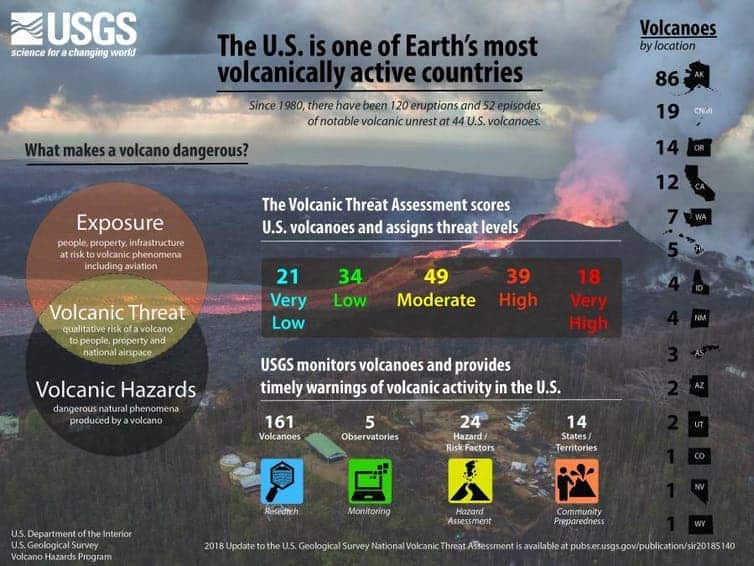
There are 161 volcanoes in 14 U.S. states and territories. Scientists monitor them and warn nearby communities if they see signs that a volcano may erupt. USGS

Beyond temperature, there are other good reasons not to burn our trash in volcanoes. First, although lava at 2,000 degrees F can melt many materials in our trash – including food scraps, paper, plastics, glass and some metals – it’s not hot enough to melt many other common materials, including steel, nickel and iron.

Second, there aren’t many volcanoes on Earth that have lava lakes, or bowl-like craters full of lava, that we could dump trash into. Of all of the thousands of volcanoes on Earth, scientists know of only eight with active lava lakes. They include Kilauea, Mount Erebus in Antarctica and Nyiragongo in the Democratic Republic of the Congo. Most active volcanoes have craters filled with rocks and cooled lava, like Mount St. Helens, or with water, like Crater Lake in Oregon.

The third problem is that dumping trash into those eight active lava lakes would be a very dangerous job. Lava lakes are covered with a crust of cooling lava, but just below that crust they are molten and intensely hot. If rocks or other materials fall onto the surface of a lava lake, they will break the crust, disrupt the underlying lava and cause an explosion.

This happened at Kilauea in 2015: Blocks of rock from the crater rim fell into the lava lake and caused a big explosion that ejected rocks and lava up and out of the crater. Anyone who threw garbage into a lava lake would have to run away and dodge flaming garbage and lava.


An eruption from the Cumbre Vieja volcano on the Spanish island of La Palma on Sept. 30, 2021, produced clouds of toxic gas.

Suppose it was possible to dump trash safely into a lava lake: What would happen to the trash? When plastics, garbage and metals burn, they release a lot of toxic gases. Volcanoes already give off tons of toxic gases, including sulfur, chlorine and carbon dioxide.

Sulfur gases can create acidic fog, which we call “vog,” for “volcanic fog.” It can kill plants and cause breathing problems for people nearby. Mixing these already-dangerous volcanic gases with other gases from burning our trash would make the resulting fumes even more harmful for people and plants near the volcano.

Finally, many indigenous communities view nearby volcanoes as sacred places. For example, Halema’uma’u crater at Kilauea is considered the home of Pele, the native Hawaiian goddess of fire, and the area around the crater is sacred to native Hawaiians. Throwing trash into volcanoes would be a huge insult to those cultures.

Emily Johnson, Research Geologist, US Geological Survey. This article is republished from The Conversation under a Creative Commons license. Read the original article.