Tuesday, March 10, 2026


Scientists confirm 2025 as third-hottest year on record

Scientists confirm 2025 as third-hottest year on record
Scientists confirmed that 2025 was the third-hottest year on record, with global temperatures reaching about 1.4C above pre-industrial levels despite the cooling influence of La Niña. / bne IntelliNews
By Ben Aris in Berlin March 9, 2026

Global temperatures in 2025 ranked as the third-highest on record, according to analyses released by three major climate monitoring agencies, highlighting the continued acceleration of human-driven warming despite cooling influences from natural climate cycles, Bloomberg reports.

Data published on January 14 by the European Union’s Copernicus Climate Change Service, the UK Met Office and the US-based Berkeley Earth group showed that 2025 trailed only 2024 and 2023 in global heat levels. The findings indicate that last year remained exceptionally warm even as a La Niña phase in the equatorial Pacific Ocean — which typically suppresses global temperatures — developed during the year.

The result suggests that the warming effect of greenhouse gas emissions is increasingly overwhelming natural climate variability. “Human-caused warming is now really overwhelming inter-annual natural variability” in weather, said Daniel Swain, a climate scientist in the University of California’s Agriculture and Natural Resources division.

According to the agencies, global temperatures in 2025 were between 1.41C and 1.47C above the 1850-1900 pre-industrial average. Copernicus estimated the year at 1.47C above that baseline, while Berkeley Earth placed it at 1.44C and the UK Met Office calculated 1.41C.

The data also indicate that the average global temperature over the past three years has exceeded 1.5C above pre-industrial levels for the first time, breaching the symbolic threshold set by governments in the 2015 Paris Agreement. Copernicus estimates the world could fully surpass the 1.5C warming mark by mid-2029, around 13 years earlier than projected when the agreement was signed.

Researchers at Berkeley Earth said recent temperature trends suggest a potential acceleration in warming. “The warming spike observed from 2023-2025 has been extreme, and suggests an acceleration,” the group wrote.

Scientists say multiple factors may be contributing to the recent surge in temperatures, including reductions in reflective low-level clouds and a decline in sulphur pollution from shipping — emissions that previously had a cooling effect on the atmosphere.

Other datasets broadly support the findings. The US National Aeronautics and Space Administration recorded 2025 as marginally warmer than 2023, tying the two years as the second-hottest on record in its dataset. The National Oceanic and Atmospheric Administration found 2025 to be slightly cooler than 2023 but noted that the upper ocean — the top 700 metres — reached the highest temperatures ever recorded.

Extreme heat was widely felt across the planet. At least half of the world’s land areas experienced an above-average number of heat-stress days in 2025, defined as conditions that feel like at least 32C. In Greenland, temperatures in May climbed more than 12C above average in some areas, causing ice to melt 12 times faster than usual on May 19.

Because global greenhouse gas emissions continue to rise, scientists note that the past 11 years have been the 11 hottest on record, while the warmest 25 years have all occurred since 1998.

February fifth-warmest on record globally despite cold Europe

10.03.2026


Photo: John Walton/PA Wire/dpa


February was unusually cold in Europe but ranked as the fifth-warmest globally since records began, according to the European Union's Copernicus Climate Change Service.

Average global air temperature reached 13.26 degrees Celsius in February, 0.53 degrees above the 1991–2020 average, the service said in its monthly report published on Tuesday. Compared with the pre-industrial period of 1850–1900, the month was 1.49 degrees warmer.

Parts of western Europe and North Africa were hit by a series of intense storms and heavy rainfall. France, Spain, Portugal and Morocco experienced severe flooding that caused deaths, significant damage and the loss of livelihoods for many people.

Flooding also affected other regions worldwide, including Australia, Mozambique and Botswana.

The extreme weather events highlighted the growing impacts of climate change and the need for global action, said Samantha Burgess, Copernicus' strategic lead for climate.

In Europe, the average land temperature in February was minus 0.07 degrees, slightly below the 1991–2020 average. Western, southern and south-eastern Europe recorded above-average temperatures, while colder-than-usual conditions were observed in Scandinavia, the Baltic States and north-western Russia.

Europe's winter as a whole, covering December to February, was among the two coldest of the past 13 years. However, it was still 0.09 degrees warmer than the 1991–2020 average.

The Copernicus Climate Change Service regularly publishes data on global surface temperatures, sea ice and precipitation, based on computer-generated analyses that integrate billions of measurements from satellites, ships, aircraft and weather stations worldwide.

German police say meteorite damaged homes near Koblenz

08.03.2026


Photo: Thomas Frey/dpa


Fragments of a meteorite caused damage to roofs and houses in western Germany on Sunday evening.

Police said they received reports of damage from Koblenz and areas nearby at 7 pm (1800 GMT).

"At around 7 p.m. this evening, a burnt-out celestial body struck the roof of a residential building in the Güls district of Koblenz. No one was injured," a police spokesman said. "According to the information available to us, there is no longer any danger."

Police were deployed to the scene after widspread concern and confusion about a mysterious light. Many shared images on social media from the states of North Rhine-Westphalia, Hesse, Rhineland-Palatinate, Saarland and Baden-Württemberg.

Some reported seeing a "brightly lit projectile with a short flash of fire" or a "fireball in the sky," police in Kaiserslautern said.

Some suggested it could have been a rocket. However, there was "no evidence of a security-related incident," officers said.

Survey: World's lakes threatened by large animal invasion

08.03.2026, FPA


Photo: Christoph Reichwein/dpa


By Walter Willems, dpa

The world's freshwater lakes are under increasing threat by the proliferation of dozens of invasive species of large animals, according to the first ever global assessment.

From hippos in Colombia to spectacled caimans in China, researchers in Berlin identified a total of 93 freshwater "megafauna species" that were introduced outside their natural range and are now damaging the fragile ecosystem of their new habitat.

This is almost half (43%) of all 216 species found in the study of newly introduced animals weighing 30 kilograms or more, the Leibniz Institute of Freshwater Ecology and Inland Fisheries (IGB) reported in the study published in the scientific journal One Earth on Friday.

Such introductions affect 142 countries and regions on all continents except Antarctica, the team reported.

The United States has the highest number of introduced freshwater megafauna species with 52, followed by China (28), Canada (23), Russia (19) and Belgium (18). Germany is close behind with 17 such invasive species.

Unlike smaller animals, which are often introduced into new waters unnoticed, for example because they attach themselves to ship hulls or are transported by birds, large species are deliberately brought into foreign territories – often because of presumed economic advantages.

According to the study, of the 59 non-native large freshwater animals for which benefits have been documented, 26 also have negative impacts – almost half. This particularly affects large fish species such as carp, salmonids and catfish.

The researchers cited the example of Nile perch (Lates niloticus) in Africa’s Lake Victoria, where the species was introduced in the 1960s to support the local fishing industry.

Instead, the rapid spread of the voracious predators, which can weigh up to 200 kilograms, decimated stocks of native fish.

Many fishermen lost their livelihoods, and according to researchers, chronic malnutrition among children and mothers increased in the surrounding communities.

In addition to reduced food security, the study also cites risks in Europe from aggressive or poisonous species, damage to property and infrastructure, and dangers to human health as possible disadvantages.

In Germany and France, injuries were caused by the poisonous peacock stingray (Potamotrygon motoro), which was imported from South America and is popular among hobby aquarists.

Such harmful effects of introducing large freshwater animals – especially on vulnerable or marginalized local communities – are often complex and require long-term observation to understand their extent, said study leader Fengzhi He.

Compared to the benefits, the negative effects on the local population in many regions may be underestimated, he said.

Loud protests at reading by German feminist Alice Schwarzer

MISDIRECTED PROTEST

08.03.2026 DPA


Photo: Christiane Bosch/dpa


A reading by German feminist Alice Schwarzer at the Deutsches Schauspielhaus theatre in the northern port city of Hamburg was repeatedly disrupted by protests on Sunday.

Several times, people ran onto the stage and shouted something to the audience. The demonstrators were booed by the audience.

The protesters accused her of being transphobic and racist and of promoting an exclusionary radical feminism.

Schwarzer remained seated on the stage throughout and calmly waited out the protests. Later, she said: "We are here to listen to each other, to exchange ideas. We don't have to agree at all."

Even before the reading began, more than 100 people had loudly protested against the event outside the venue and held banners.

In the evening, Schwarzer read from her new book "Pure feminism. 99 words" in front of several hundred visitors. Additionally, the publicist and founder of the magazine "Emma" wanted to engage with questions from the audience in a conversation with actress and co-author Nina Gummich.

Her appearance at the theatre had been criticized in advance by several hundred theatre makers in an open letter. They had called on the venueto cancel the event.

The Hamburg theatre stuck to the reading, calling Schwarzer a contentious and argumentative person, and one "who not only seeks debate but also engages in discussions."

Diversity of opinion is essential for democracy, the theatre said. "We do not support silencing Alice Schwarzer and denying her the opportunity to openly discuss her views."


Mercedes-Benz set to launch revamped 1,000km-range hydrogen truck

10.03.2026 dpa


Photo: Dirk Weyhenmeyer/MediaPortal Daimler Truck AG/dpa


Daimler says it plans to launch a small series of its latest hydrogen-powered long-range Mercedes-Benz truck at the end of this year.

Following successful tests of the first GenH2 prototypes, Daimler is set to produce a small series of a hundred NextGenH2 vehicles in Germany from the end of 2026 and enter customer service.

Delivery trucks, still largely dependent on fossil fuels, are associated with massive emissions damaging climate and health, however major manufacturers have been moving closer to zero-emissions heavy-duty transport.

The Rhenus logistics group is among a small group of hauliers testing an initial five prototype trucks for a year in everyday conditions. Based in Duisburg, the vehicle is on the road almost around the clock in real logistics operations.

Other users include DIY chain Hornbach, Teva Germany (with its pharmacutical brand Ratiopharm), Reber Logistik and DHL postal services.

The routes include regional trips of around 150 kilometres and long-distance trips of up to around 650 kilometres.

As with the previous model, liquid hydrogen enables the fuel-cell truck to cover a range of well over 1,000 kilometres before refuelling.

The NextGenH2 Truck uses two tanks with up to 85 kg of hydrogen, which can be refuelled in between ten and 15 minutes.

According to Daimler Truck, the NextGenH2 Truck combines proven technologies such as the Cellcentric fuel cell and liquid hydrogen tanks with advanced solutions for safety and a more compact design.

"As an international logistics service provider, we want to demonstrate that climate protection and efficient transport logistics can go hand in hand," said Mercedes-Benz truck chief executive Achim Puchert.

In the initial trial phase, the fuel-cell trucks covered more than 225,000 km in total, with average hydrogen consumption ranging between 5.6 and 8.0 kg per 100 km, depending on use case, and an average combined vehicle weight between 16 and 34 tons.

The NextGenH2 Truck looks outwardly similar to the battery-electric Mercedes-Benz eActros 600 and shares its aerodynamic cabin. The lorry features an integrated electric axle, multimedia cockpit and modern safety assistants.

Daimler Truck said the combination of fuel cell, buffer battery and electric drive axle ensures dynamic power delivery, low noise levels and high recuperation performance when braking or driving downhill.

Germany's RWE, Munich Airport partner on 10-year offshore wind deal

10.03.2026, 13:06 Uhr

photo: Rolf Vennenbernd/dpa

German energy company RWE announced on Tuesday that it has entered into a 10-year contract with Munich Airport to supply energy from offshore wind.

The power purchase agreement will procure offshore wind power from RWE's Nordseecluster A wind farm in the North Sea, RWE said. The wind farm is expected to begin operations in early 2027.

Under the agreement, the airport will receive 40 gigawatt hours of electricity per year, equivalent to about 40 million kilowatt hours.

The electricity will be supplied from RWE's Nordseecluster A offshore wind farm, which has a total capacity of 660 megawatts and is currently under construction in the North Sea, about 50 kilometres north of the island of Juist.

The agreement is expected to help Munich Airport reduce carbon dioxide emissions by about 13,000 metric tons annually.

RWE is currently trading 2.48% higher at €54.62 ($63.57) on the XETRA.


EU chief: Phasing out nuclear power was 'strategic mistake'
DW with AFP, Reuters
Published on 

Ursula von der Leyen said the European Union was "completely dependent" on expensive and volatile fossil fuel imports. She has announced new ambitions to harmonize nuclear regulations and roll out smaller reactors.


Ursula von der Leyen made the comments at a nuclear summit in France
Image: Abdul Saboor/AP Photo/Reuters/dpa/picture alliance

European Commission President Ursula von der Leyen said on Tuesday that Europe's turn away from nuclear power had been a "strategic mistake" that was now exposed by the Iran war.

"This reduction ‌in the share of nuclear was a choice, I believe that it was a strategic mistake for Europe to turn its back on a reliable, affordable source of low-emissions power," von der Leyen said at the opening of a nuclear energy summit near Paris.

"For fossil fuels, we are completely dependent on expensive and volatile imports. They are putting us at a structural disadvantage to other regions," she added.

It comes as the US-Israeli war against Iran has damaged major oil refineries and led to the closure of the Strait of Hormuz — a shipping route that is a major chokepoint for the world's oil supply.

Von der Leyen called the war "a stark reminder" of the vulnerabilities that come with being dependent on fossil fuel imports.

Von der Leyen, Macron call for energy independence

At the summit, von der Leyen announced a €200 ($230 million) fund for European nuclear innovation.

She said that "while in 1990, one-third of Europe's electricity came from nuclear, today it's only close to 15%".

Germany was one country that aggressively wound down its nuclear generation in the wake of the 2011 Fukushima disaster. Its neighbor, France, continued to embrace the technology which now accounts for more than two thirds of its electricity production.


"Nuclear power is key to reconciling both independence — and thus energy sovereignty — with decarbonization, and thus carbon neutrality," French President Emmanuel Macron said at the summit.

"We can see it in our current geopolitical context: when we are too dependent on hydrocarbons, they can become a tool of pressure, or even of destabilization."

France has in recent years sourced much of its unenriched uranium from Kazakhstan, Australia, Namibia and politically volatile Niger .

According to EU nuclear agency Euratom, Canada provided 34% of the bloc's uranium in 2024, the most recent year on record, followed by Kazakhstan with 24% and Russia with around 15%.

What measures did EU leaders propose?

Von der Leyen announced a goal of rolling out small modular reactors (SMRs) across the EU by 2030 and harmonizing regulations between member states.

Unlike traditional reactors which produce around 1,0000 megawatts (MW), SMRs produce around 300 MW but are more affordable and quicker to build because they can be mass produced in factories.

"The logic is very clear. When it is safe to deploy, it has to be simple to deploy all across Europe," von der Leyen said.


Macron proposed standardizing reactor designs across Europe — a move that could benefit France's state-owned nuclear giant EDF which has lost out on contracts in recent years.

In 2024, the Czech Republic awarded a tender to build a new power plant to South Korea's KHNP, which France's EDF tried and failed to block in court.

Meanwhile, Greek Prime Minister Kyriakos Mitsotakis said his country plans to "lead the conversation" on using nuclear power to decarbonize shipping.

Anti-nuclear protesters storm stage

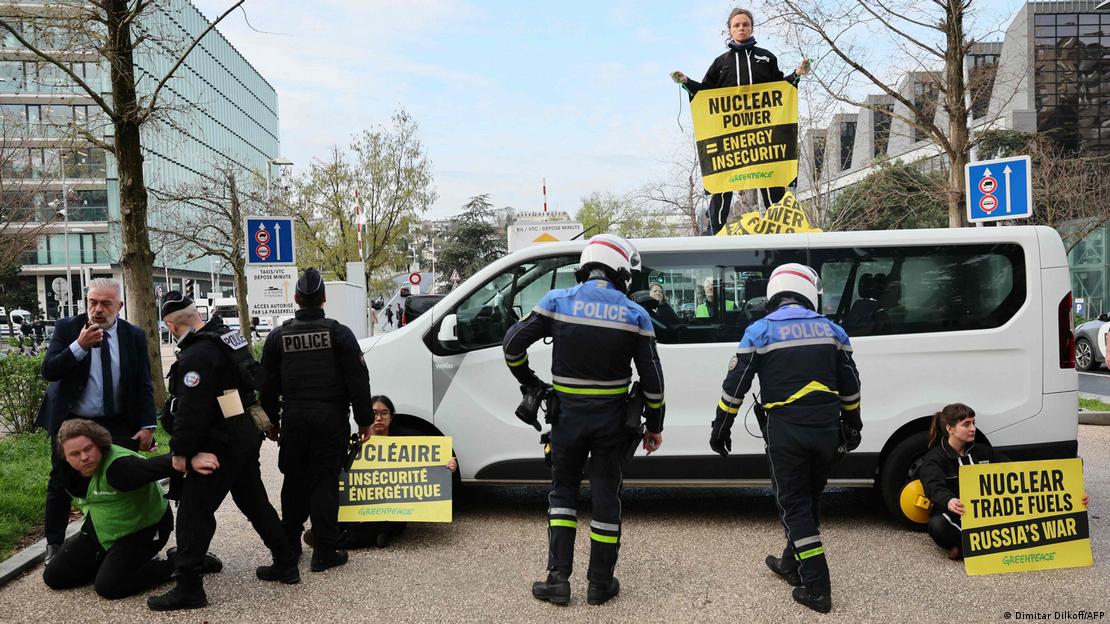
Two Greenpeace activists stormed the stage at the start of the summit, interrupting Macron and International Atomic Energy Agency chief Rafael Grossi as they were greeting heads of state.

The protesters held banners that read "Nuclear Power = Energy Insecurity" and "Nuclear power fuels Russia’s war."

One of them asked Macron, "Why are we still buying uranium from Russia?" ​to which the president made the claim: "We produce nuclear power ourselves."

Meanwhile, around a dozen Greenpeace activists also blocked vehicles as they arrived at the summit.

Greenpeace activists blocked vehicles arriving at the summit in France
Image: Dimitar Dilkoff/AFP

Edited by: Rob Turner
Zac Crellin Journalist and editor based in Germany

EU Commission unveils plan for small nuclear reactors by early 2030s

10.03.2026, dpa


Photo: Dati Bendo/European Commission/dpa


By Doris Pundy and Michael Evers, dpa

European Commission President Ursula von der Leyen unveiled her plans to expand nuclear energy production, including the deployment of small modular reactors (SMRs), in the EU to ensure an affordable and climate-friendly electricity supply.

"In the last years, we see a global revival of nuclear energy and Europe wants to be part of it," von der Leyen said on Tuesday at the second international summit on nuclear energy in Boulogne-Billancourt near Paris.

"This is why today we are presenting a new European strategy for small modular reactors," she said.

Her aim is to have operational SMRs in the European Union by the early 2030s. The small reactors should "play a key role alongside traditional nuclear reactors in a flexible, safe and efficient energy system."

SMRs refer to reactors with an output of up to 300 megawatts, compared with the approximately 1,000 megawatts produced by most nuclear power plants. Their components can be manufactured in factories in series.

In order to drive forward the development of mini nuclear power plants, regulations are to be harmonized across the bloc, von der Leyen said.

"The logic is very clear. When it is safe to deploy, it has to be simple to deploy all across Europe," she said.

The commission is to support investments in the technology with a €200 million ($233 million) guarantee.

The summit also featured opening remarks from French President Emmanuel Macron and the chief of the International Atomic Energy Agency (IAEA), Rafael Grossi.

A number of heads of state and government have been invited to the summit, hosted by France, which draws most of its electrical energy from nuclear plants. Germany is not represented at government level and has closed its nuclear plants, but will continue to follow the discussions.

On Tuesday, von der Leyen expressed regret over the reduction of nuclear energy production in several EU countries.

"While in 1990, one-third of Europe's electricity came from nuclear, today it's only close to 15%," she said.

"This reduction in the share of nuclear was a choice. And in hindsight, it was a strategic mistake for Europe to turn its back on a reliable, affordable source of low-emission power."

Australia: 5 Iran Women's national team players granted asylum


Felix Tamsut 
DW with AP, Reuters
Published on 

The five Iranian women football players will be allowed to stay in Australia due to concerns about their safety if they returned home.

Iran's national team made headlines after not singing the anthem at the Asia Cup
Image: Nigel Owen/Action Plus/IMAGO


Five Iranian women's national team players were granted humanitarian visas in Australia amid fears of persecution back home.

"Australians have been moved by the plight of these brave women," Australian Prime Minister Anthony Albanese said at a press conference on Tuesday.

"They're safe here, and they should feel at home here," he added.

According to Albanese, all other members of Iran's squad are welcome to receive help, but it was up to them to accept the offer.

Australian police took the five Iran squad members from their hotel in Gold Coast, moving them to a "safe location" after their asylum requests.

Supporters of the Iran national team react to the team's bus
Image: Dave Hunt/AAP/IMAGO

Home Affairs Minister Tony Burke, who met the five players upon the completion of their humanitarian visas, said they were "excited" about their future lives in Australia.

"I don't want to begin to imagine how difficult that decision is for each of the individual women, but certainly last night it was joy, it was relief," Burke said.
Trump calls for players to be granted asylum

This came after US President Donald Trump said he had spoken to Albanese about the players. Trump also posted on his Truth Social account that Australia should give the players asylum and that the US would take them in if Canberra wouldn't.

Trump added they'd be killed should they return back home.

The reason for the call was the fact that Iran's players received attention for not singing their country's national anthem ahead of their first Asian Cup game against South Korea.

Many believed the move was in criticism of the Iranian regime amidst the US-Israel war on the country.

Back in Iran, the Iranian national team faced criticism, with one state television commentator accusing them of being "wartime traitors," sparking worries over the players' safety.
Local fans held banners in support of the protests against the Iranian regime
Image: Matthew Starling/Sports Press Photo/IMAGO


The following game, against hosts Australia, the Iran players sang the anthem while saluting, a move many critics of Iran's Islamic regime believed they had been forced to carry out.

After Iran's elimination from the Asia Cup following their the loss to the Philippines in their third match, calls from around the world grew to make sure the footballers would be granted asylum in Australia, preventing them from facing the potential backlash and sanctions back in Tehran.

Edited by: Dmytro Hubenko
\
Felix Tamsut Reporter for DW News


'Don’t Steal This Book': Authors protest AI at London Book Fair with ‘empty’ book

'Don’t Steal This Book': Authors protest AI at London Book Fair with ‘empty’ book
Copyright Canva

By David Mouriquand
Published on 

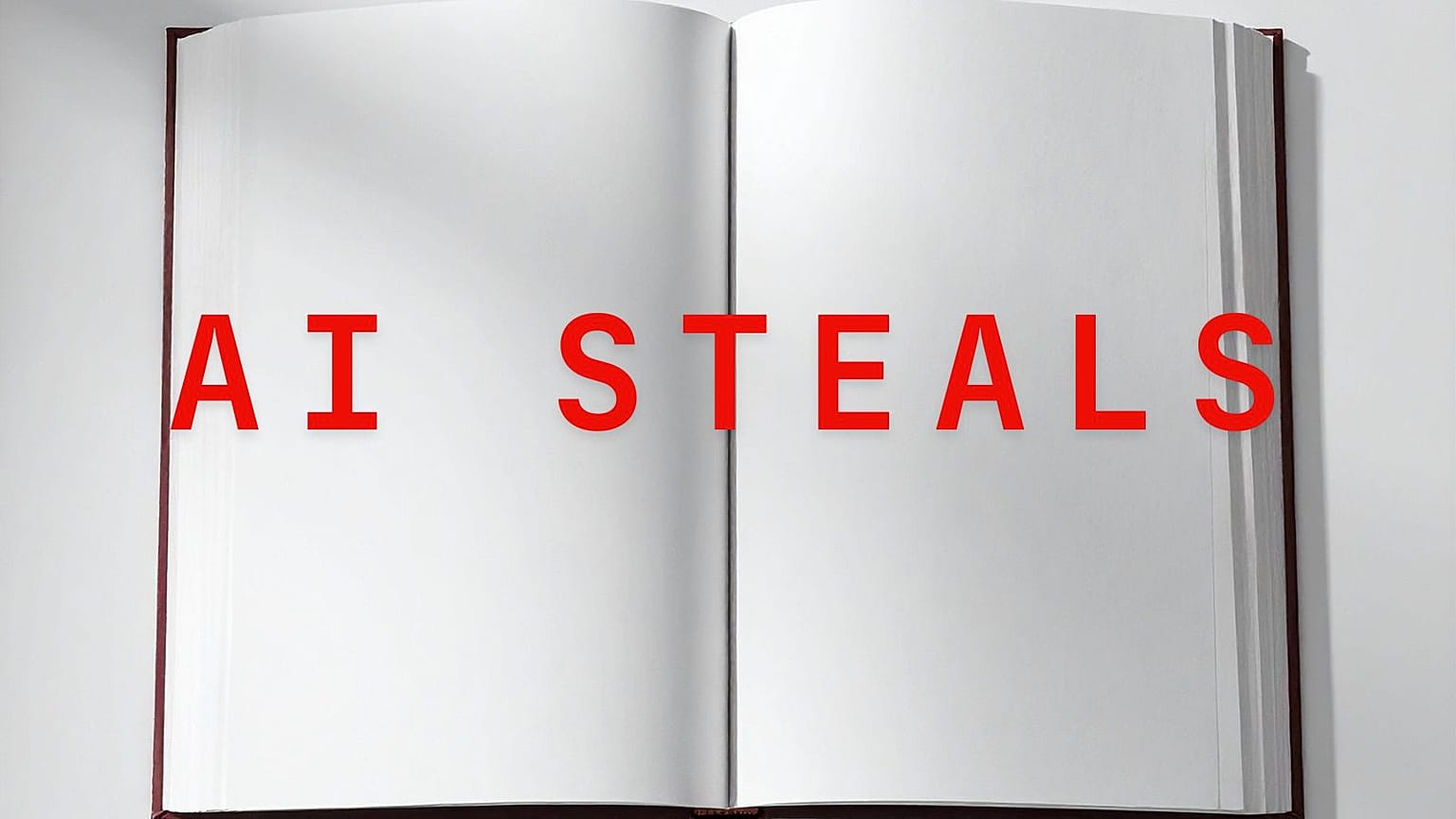
Thousands of authors feature in a new "empty" book titled “Don’t Steal This Book” - a protest over AI firms using creative professionals’ work without their permission.

“The UK government must not legalise book theft to benefit AI companies,” reads the back cover of a new book being distributed at this year’s London Book Fair.

A treatise on the existential threat that artificial intelligence represents for writers? A compendium of artists’ experiences as they face an uncertain future?

In many ways, yes: it’s an “empty” book in which the only content is a list of the names of thousands of authors, who have published “Don’t Steal This Book” as a way to protest against AI firms using their work without their permission.

Among the illustrious names are Kazuo Ishiguro, Richard Osman, Alan Moore, Marian Keyes, Malorie Blackman, Philippa Gregory and Mick Herron. You can read the full list of authors involved on dontstealthisbook.com.

The website states: “AI companies are building their products by copying millions of books without permission or payment. The UK government is considering legalising this large-scale theft. We urge them to rule this out. AI companies should pay for books, like everyone else.”

The statement adds: “If they don’t, this is what we’ll be left with: empty pages, writers without pay, and readers deprived of the next book they’ll love.”

"Don't Steal This Book - A Plea From Authors" dontstealthisbook.com

The organiser of the book, Ed Newton-Rex, a composer and campaigner for protecting artists’ copyright, told the Guardian that the AI industry was “built on stolen work … taken without permission or payment”

“This is not a victimless crime – generative AI competes with the people whose work it is trained on, robbing them of their livelihoods,” said Newton-Rex. “The government must protect the UK’s creatives, and refuse to legalise the theft of creative work by AI companies.”

The distribution of “Don’t Steal This Book” comes just one week before the UK government is due to issue an assessment on the economic cost of proposed changes in copyright law.

The Guardian notes that British artists have responded with outrage at the main government proposal in the consultation, which proposes letting AI firms use copyright-protected work without the owner’s permission – unless the owner has signalled that they want to opt out.

UK ministers must deliver an economic impact assessment by 18 March, as well as a progress update on a consultation about the legal overhaul.

This year's London Book Fair takes place from 10 - 12 March.


French AI startup AMI raises $1B to develop 'universal intelligent systems'


French artificial intelligence startup AMI on Tuesday said it has raised $1 billion to develop AI systems designed to understand the physical world "in the way animals and humans do", unlike the language-based models behind chatbots such as ChatGPT. The company said it expected to produce "fairly universal intelligent systems" within five years.

Issued on: 10/03/2026 - 
By: FRANCE 24

Co-founder of French artificial intelligence startup AMI Yann LeCun attends the World Economic Forum annual meeting in Davos on January 23, 2025. © Fabrice Coffrini, AFP

French artificial intelligence startup AMI, co-founded by Meta's former chief AI scientist Yann LeCun, announced Tuesday it has raised $1 billion to develop models able to understand the physical world.

This first funding round for AMI (Advanced Machine Intelligence) was carried out by five investment funds and attracted investment from several big groups, including Toyota, Nvidia and Samsung.

Notable names in tech, including former Google CEO Eric Schmidt and Amazon founder Jeff Bezos, also bought in.

LeCun told AFP that, with the funding round complete, AMI would bring aboard 20-30 people "in the very short term".

He and five co-founders plan to "shift into a higher gear" on developing "world models", or AI systems designed to understand the physical world.

Unlike the text-based large language models (LLMs) behind chatbots like ChatGPT and Gemini, such AIs should understand the world "in the way animals and humans do," he added.

"Yann LeCun is turning a new page in artificial intelligence. This is the France of researchers, builders and the bold. Bravo!" President Emmanuel Macron posted on X.

Based in Paris with offices in New York, Singapore and Montreal, AMI was valued at around $3.5 billion before this funding round.
'Paradigm shift'

LeCun announced his departure from Meta in November, after 12 years with the owner of Facebook, Instagram and WhatsApp.

He now serves as AMI's non-executive chairman, while Alexandre Lebrun is the Paris-based startup's CEO.

Within three to five years, AMI plans to produce "fairly universal intelligent systems" that could be used for almost any task requiring intelligent machines, such as autonomous driving and robotics, LeCun said.

"I am very clearly in the camp that believes we need a paradigm shift" from the AI reliance on LLMs, he told AFP.

LeCun has been a vocal critic of major AI developers' laser focus on LLMs, which was one reason for why he left Meta – although he insists he still has "a good relationship with Mark Zuckerberg".

AMI's work will take up where LeCun left off with research at Meta on a new AI architecture dubbed JEPA.

"It's a direct continuation of that project," he said.

Researchers hope world models will allow AI systems to analyse and predict the behaviour of complex systems, such as a jet engine, a power plant or the organs of a human patient.

LeCun, a dual French-American citizen who remains a computer science professor at New York University, said AMI would focus on research and development in its first year.

Discussions with corporate partners could be held within six to 12 months, he added.

(FRANCE 24 with AFP)