Monday, March 30, 2026

EU fisheries ‘under strain’ as conflict and costs bite, warns Commissioner Kadis


By Méabh Mc Mahon
Published on 

Kadis warned of growing anxiety among EU governments as costs rise and markets remain volatile. “There’s real nervousness across the sector."

Europe’s fisheries and aquaculture sectors are facing growing strain from geopolitical tensions and rising costs, EU fisheries chief Costas Kadis has warned.

Speaking on Europe Today, Kadis said urgent support is needed to keep the industry competitive. “The challenges are mounting,” he said, pointing to the impact of Middle East conflict on seafood markets, supply chains and coastal communities.

The more pressing concern, he said, is economic pressure on the sector. Some operators have already shut down due to thin margins and soaring fuel prices.

“They were barely profitable before. Now they simply can’t absorb the extra costs,” he said.

The European Commission is considering short-term support via the bloc’s maritime funding tools, similar to measures introduced after Russia’s invasion of Ukraine.

Kadis warned of growing anxiety among EU governments as costs rise and markets remain volatile. “There’s real nervousness across the sector,” he said.

He urged a coordinated EU response and faster progress on energy transition to reduce exposure to future shocks.

“We need a united European approach to support the sector—and we must speed up the shift away from energy dependence,” he said, adding that long-term resilience depends on cutting vulnerability to external crises.

Cyprus ‘back to normal’ after Iran drone hit

Addressing recent security concerns in Cyprus linked to the Iran conflict, Kadis said the situation had stabilised.

“Things are improving. There have been no further incidents since the initial attack, and life is returning to normal,” he said.

Some EU Council presidency events were postponed during the unrest, but Kadis expects business to resume as usual from April.

SPACE/COSMOS


Meet the Artemis II astronauts preparing for humanity's return to the Moon

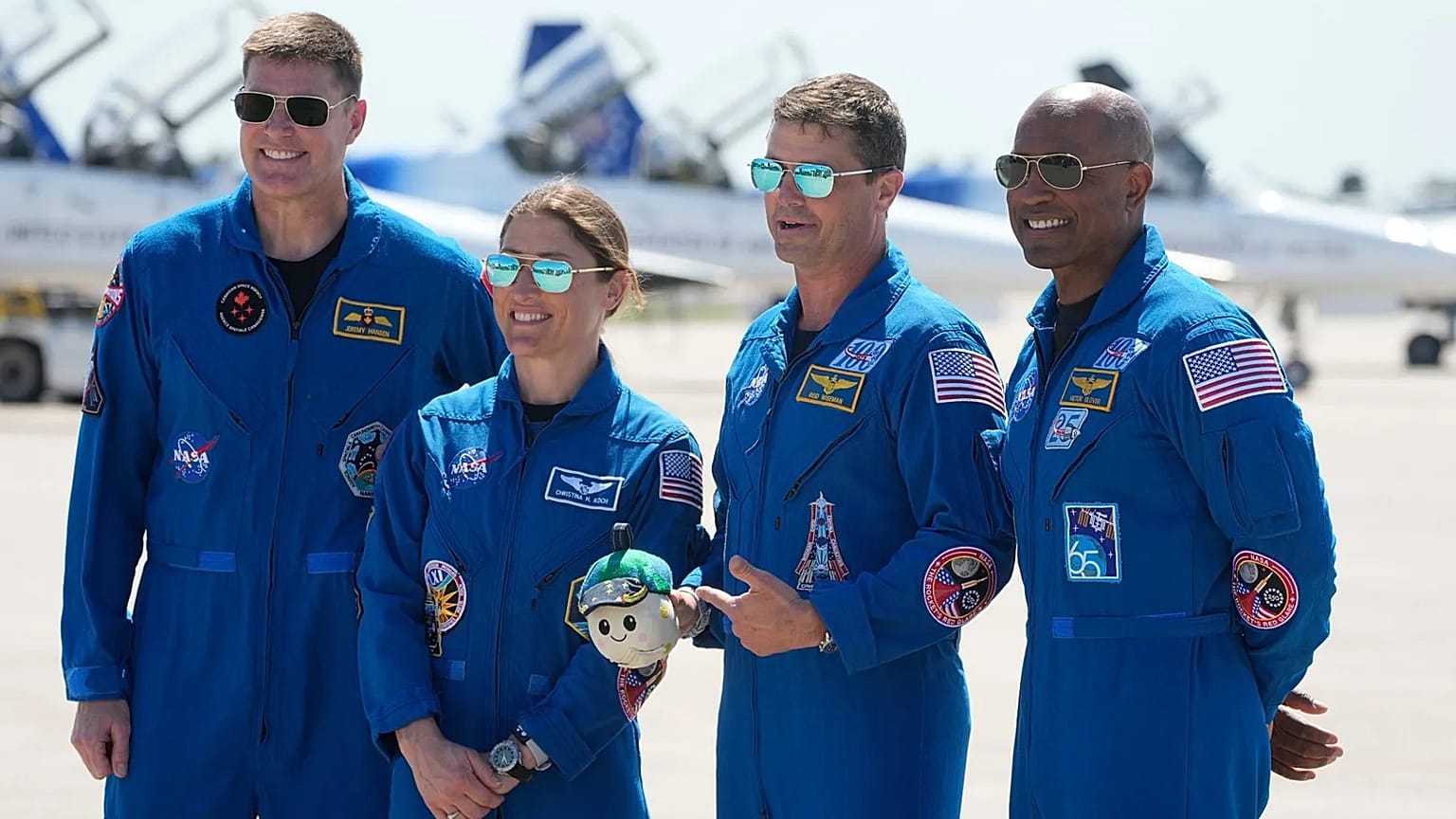
Artemis 2 crew members, from left, Mission Spc. Jeremy Hansen, of Canada, Mission Spc. Christina Koch, Commander Reid Wiseman, and Pilot Victor Glover pose for a photo.
Copyright AP Photo/Chris O'Meara

By Anna Desmarais
Published on 

Four astronauts from the United States and Canada are about to take off on the Artemis II mission that will circle the Moon.

The Artemis II mission is set to take off as early as April 1, according to the US' National Aeronautics and Space Administration (NASA).

It will send four astronauts on an approximately 10-day journey around the Moon to test the Orion spacecraft, which will land on the Moon in future missions.

The astronauts who will take part will not land on the Moon this time, but their mission will take them thousands of kilometres deeper into space than the Apollo astronauts went for the original Moon landings of the 1960s and 1970s.

"We are getting very, very close [to launch], and we are ready," said Lori Glaze, acting associate administrator for NASA's Exploration Systems Development Mission Directorate, in a press conference over the weekend. "All of our operations have been going smoothly, it's been going very well."

Four astronauts from the United States and Canada make up the team for the Artemis mission. Ahead of the launch, they are reviewing emergency procedures and spending time with their families at the Kennedy Space Centre in Florida.

They are also staying in quarantine to make sure they stay healthy before liftoff, which could be any day between April 1 and 6.

This is who will go on the Artemis II mission.

Commander Reid Wiseman

Reid Wiseman, a retired Navy captain, was serving as NASA's chief astronaut three years ago when he was asked to lead the crew.

Wiseman had previously spent more than five months at the International Space Station in 2014 as part of the 40th launch. But his teenage daughters had "zero interest" in seeing him launch again.

“We talked about it and I said, ‘Look, of all the people on planet Earth right now, there are four people that are in a position to go fly around the Moon,” he said. “I cannot say no to that opportunity.”

The toughest part is not leaving his family, but “it's the stress that I’m putting on them,” he said. Wiseman has been a single father since 2020, when his wife Carroll passed away from cancer.

Wiseman was selected to join NASA as one of nine candidates in 2009 to start astronaut training after his military career. At the time, he was a lieutenant commander in the US Navy.

He has often said he wanted to be an astronaut after going to a Space Shuttle launch in person as a child.

Pilot Victor Glover

Before any launch, Victor Glover makes it a point to listen to two songs: Gil Scott-Heron’s “Whitey on the Moon” and Marvin Gaye’s “Make Me Wanna Holler” from the white-dominated Apollo era.

To Glover, they are songs from the white-dominated Apollo era of US space flight that "capture what we did well, what we did poorly."

Glover, one of NASA's few Black astronauts, said that he sees his place on the mission as a "force for good," and a chance to inspire others to get into space.

In 2018, Glover was assigned to fly on the first operational flight of SpaceX's Crew Dragon capsule to the International Space Station, where he stayed at the station for more than six months. He was the first African-American crew member to stay on the ISS, local media reported at the time.

In Glover's previous career as a fighter pilot for the US Army, he logged over 3,000 flight hours in 40 different types of aircraft and flew in 24 combat missions.

Before this launch, he said he's spent more time preparing his four daughters for his launch than he has preparing himself.

Mission specialist Christina Koch

Christina Koch, a 47-year-old electrical engineer from North Carolina, holds the record for the longest single spaceflight by a woman at 328 days.

That mission, which saw her blast off to the International Space Station on March 14, 2019, was also when Koch was part of the all-female spacewalk. She and Jessica Meir left the ISS to do a lengthy series of upgrades to the station's power systems and physics observatories.

Koch's 328-day mission is used to study the physical, biological and mental effects of long-term space travel on women, according to Reuters.

More than any one individual, the Artemis II mission is “about celebrating the fact that we’ve arrived to this place in history” where women can fly to the Moon, she said.

Koch spent a year at a South Pole research station before getting the call from NASA. Between that and her space stint, she feels she's “inoculated” most of her family and friends.

“So far, I haven't gotten too many nerves from folks. Maybe my dog, but I've reassured her that it's only 10 days. It's not going to be as long as last time.”

Canadian fighter pilot Jeremy Hansen

Jeremy Hansen, a Canadian fighter pilot and physicist, is making his space debut.

He will also be the first Canadian to ever go to the Moon.

“Maybe I'm naive, but I don't feel a lot of personal pressure," Hanson told the Associated Press.

Hansen, 50, grew up on a farm in rural Canada before joining the Royal Canadian Air Force as a captain. He piloted aircraft such as the CF-18 from his base in Alberta. He had been promoted to the rank of colonel before getting the call from the Canadian Space Agency (CSA) in 2009.

Hansen has also undertaken NASA missions underwater, serving as an "aquanaut," to the Aquarius underwater laboratory in 2014. He lived in an underwater environment for seven days to simulate what conditions would be like in space and to test NASA's remote guidance systems.

He realises only now how much effort it took to send men to the Moon during Apollo.

“When I walk out, and I look at the moon now, it looks and feels a little bit farther than it used to be,” he said. “I just understand in the details how much harder it is than I thought it was, watching videos of it.”


Space Norway Launches Mimir 1, Giving Commercial Access to In-Orbit Testing

Space Norway

Published Mar 28, 2026 11:51 AM by The Maritime Executive


[By: Space Norway]

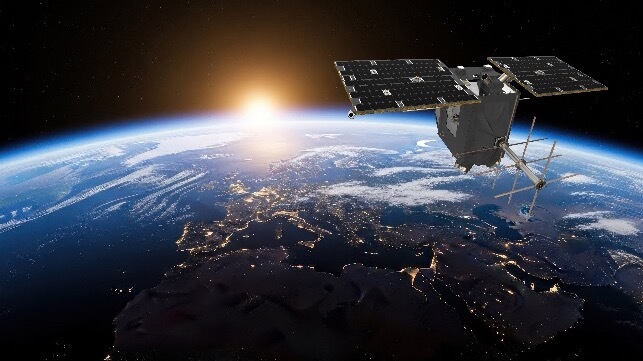
Rocket science for everyone? Almost. Space Norway is opening access to in-orbit testing with its new satellite, Mimir 1, launching on Sunday 29 March from Vandenberg Space Force Base in California. More than a satellite, Mimir-1 is a laboratory in space, designed to test new concepts in Earth observation, communications, and navigation and accelerate innovation through flexible, cost-effective access to orbit.

Mimir 1 is Space Norway’s first in-house developed satellite, designed, owned, and operated by the company. It was built and integrated by OHB Sweden, with both payloads developed in Norway.

“Mimir 1 represents a significant milestone for Space Norway. We are excited to see how the platform will enable new capabilities and deliver value not only for us, but for partners across the space sector,” said Marte Kalveland, Director of Earth Observation and Innovation at Space Norway.

Space Norway plans to make capacity available on Mimir 1 to other space industry stakeholders as well as academia. The satellite has therefore been designed for flexibility and ease of use, enabling more companies to test promising ideas in space. The design, construction and launch of satellites is time consuming, costly and requires specialised expertise. By booking capacity on board Mimir 1, companies with strong ideas for space-based services gain the opportunity to test their concepts before investing in their own satellite development and production.

The primary payload on board is a Software Defined Radio (SDR) with several different antennas covering a wide frequency range. What makes Mimir 1 unique is that it carries an onboard computer that can be programmed from the ground while the satellite is in orbit.

For traditional satellites, mission tasks are defined prior to launch and cannot be changed once in orbit. Mimir 1 takes a different approach, serving as a development platform rather than a conventional operational satellite. Flexibility and rapid development are central to the project, enabling Space Norway to support the development of new services and more advanced, better-defined payloads in the future.

The first experiment focuses on satellite-based Internet of Things (IoT) services. Space Norway will test IoT services in new frequency bands on behalf of the European Space Agency (ESA). The Mimir project is developing a user interface for planning different types of experiments involving both the satellite and ground terminals.

The secondary payload on board is a VDES (VHF Data Exchange System) communications system, developed for data exchange between vessels and satellites or coastal stations. The difference between AIS (Automatic Identification System) and VDES is that VDES enables two-way communication, whereas AIS is limited to one-way transmission. The Mimir payload is expected to make a significant contribution to ESA’s multinational VDES cooperation project.

Mimir 1 will operate in low Earth orbit and will be separated from the launch vehicle at an altitude of approximately 600 km. The satellite weighs 93 kg, has a wingspan of 2.3 metres and a planned operational lifetime of seven years.

At the same launch, the AISSat?4 satellite will also be sent into orbit on the same rocket from Vandenberg. This satellite will be operated by StatSat, a subsidiary of Space Norway. AISSat4 is owned by the Norwegian Coastal Administration (Kystverket), and StatSat currently operates four other satellites on behalf of them and the Norwegian Space Agency.

Follow the launch of both satellites at 12:20 CET:
www.launch.spacenorway.com

The above link will be active closer to launch.
 
AISSat?4:

  • Time from launch to separation: 55 minutes, separation at approximately 13:22
  • Time from separation to first ping (signal from the satellite): 1 hour

Mimir?1:

  • Time from launch to separation: 2 hours 18 minutes, separation at approximately 14:48
  • Time from separation to first possible ping: 1 hour 16 minutes, at approximately 16:04 

As always, satellite launches may be delayed in time and the timings may change.

The products and services herein described in this press release are not endorsed by The Maritime Executive.


MEPs rally behind Magyar in Hungarian elections despite ideological divides

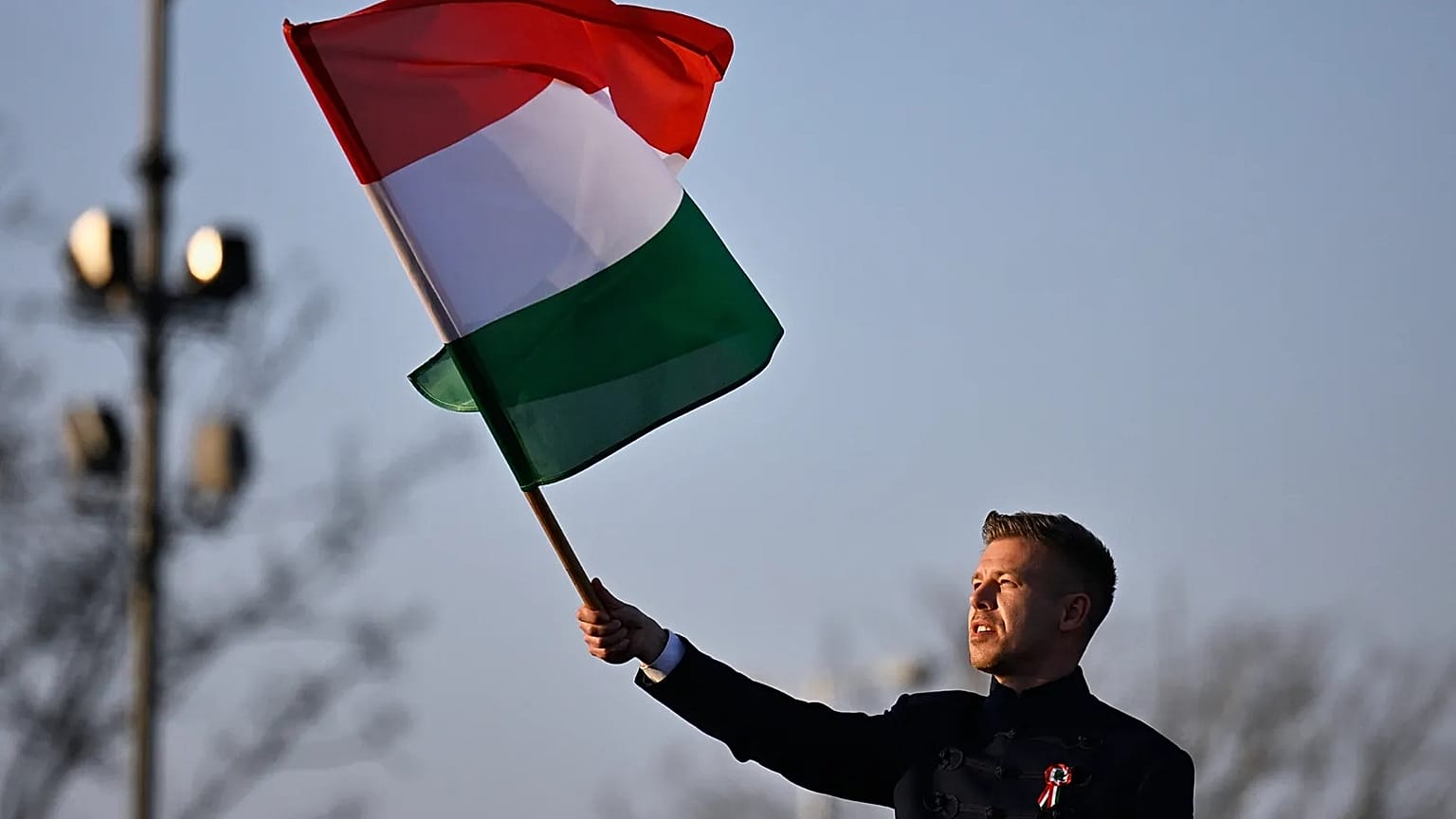
Opposition leader Péter Magyar is a member of the European Parliament since 2024
Copyright Copyright 2026 The Associated Press. All rights reserved

By Vincenzo Genovese & Sandor Zsiros
Published on 

A vast majority of European lawmakers hopes to see Orbán’s fall in the upcoming Hungarian elections, widely considered a watershed moment in Brussels. Even left-wing lawmakers are rooting for Orbán's rival, Péter Magyar, in a make-or-break vote for the future of Europe.

With two weeks to go until Hungary’s elections, the campaign is also heating up in Brussels.

While the European Commission has kept a low profile to avoid any controversy, European lawmakers are speaking up.

Euronews estimates that most parliamentary groups—together holding more than three-quarters of MEPs—are against Prime Minister Viktor Orbán and, to some extent, favor opposition leader Péter Magyar.

"This vote is an absolute game-changer," according to Andrey Kovatchev, a prominent member of the European People's Party. "The group is in full support of Tisza [Magyar's party]," he told Euronews, despite recent frictions on issues such as the EU-Mercosur trade deal. "Overthrowing Orbán is very important for the future of the EU."

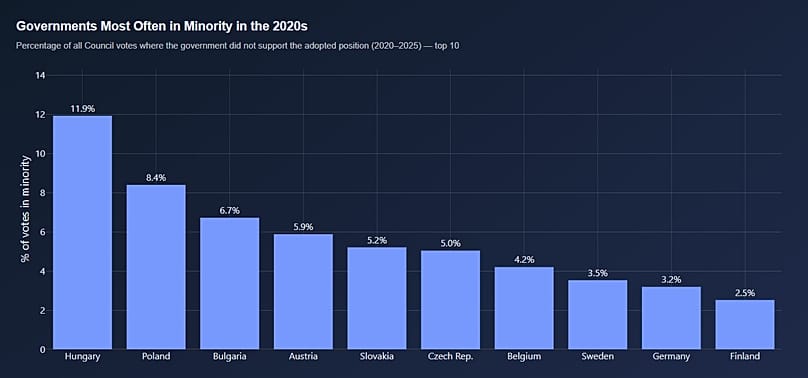
According to calculations made by the think tank EU Matrix, Hungary has been the country that most often sided against other member states' decisions in the 2020s, which could explain why many in Brussels would favour a more conciliatory government than Orban’s.

Several lawmakers agree that an Orbán defeat would spare Europe one of its most persistent internal challenges, particularly in light of recent revelations about the Hungarian foreign minister calling Russia's counterpart, Sergei Lavrov, before and after key EU meetings.

“Orbán has long acted as Putin’s man within the EU," German MEP Daniel Freund told Euronews. "His constant vetoes and political maneuvering are undermining European security."

Hungary has been against the decisions taken but the EU Council roughly one in ten times in 2020's
Hungary has been against the decisions taken but the EU Council roughly one in ten times in 2020's EU Matrix

A Fidesz defeat would be a victory for a vast majority of MEPs who have taken a firm position against Hungary’s government in recent years, criticizing corruption, the erosion of the rule of law, and crackdowns on press freedom and political opponents.

During the previous terms, lawmakers for example launched the Article 7 procedure against Hungary—which could ultimately strip the country of its EU voting rights— declared the country an “electoral autocracy,” and asked Budapest to forgo its turn in the Union’s rotating presidency.

In this legislature, the Parliament approved a report that harshly criticized judicial interference, corruption, misuse of EU funds, and attacks on civil society in the country

“[Orbán’s fall] would mean that the voters agree that the rule of law must be restored in Hungary,” Dutch MEP Tineke Strik, rapporteur for the file, told Euronews. “This can only be achieved with his defeat.”

Péter Magyar is everyone's hope, including the left

The Parliament’s opposition to Orbán translates into broad support for his opponent, Péter Magyar, leader of the Tisza party.

“The upcoming elections are decisive, a break-free momentum to return to a free, pluralistic democracy,” Renew Europe group President Valérie Hayer told Euronews, reflecting a widely shared view in the hemicycle, where Hungarian elections are seen as the most important vote of the year.

While Tisza belongs to the center-right European People’s Party, support for a change of government extends beyond right-wing political forces. Magyar has found backing among left-wing lawmakers, even though they oppose much of his stance on environment, migration, and LGBTQ+ issues.

Magyar’s rapid rise in the polls has led to a collapse in support for other opposition parties in Hungary, which had been the main political alternative to Orbán for years.

The Hungarian Socialist Party (MSZP) and Momentum have pulled out of the campaign, directing their supporters to vote for the strongest opposition candidate in each district, usually a Tisza member.

It is rather unusual for liberal and left-wing MEPs to be quietly rooting for a conservative, centre-right politician simply because he is considered more pro-European than the current prime minister.

“In an ideal world, I would like to see my Socialist colleague Klára Dobrev running Hungary," said French Socialist MEP Chloé Ridel, referring to Dobrev, a member of Hungary's socialist party, Demokratikus Koalíció. "But now the priority is getting rid of a corrupted regime, and therefore kick Orbán out."

She hopes that Orbán loses the elections to prevent him from “holding hostage the EU”, even though it is not guaranteed that his opponent would follow through on his campaign promises.

The Greens, who have been among the most vocal MEPs against the Budapest government in recent years, will use their social media “to call upon all Hungarians to go to the vote and bring this system down”, a MEP from the group said.

The Left in the European Parliament does not officially back any candidate, but “looks forward to the fall of Orbán,” a group representative told Euronews.

Who supports Orbán in the Parliament?

Despite a long line of detractors, Orbán still retains some supporters in the European Parliament and across the EU.

European nationalist leaders, including France’s Marine Le Pen and Italy’s Matteo Salvini, showed their support for the current Prime Minister during an event called The "Patriots’ Grand Assembly” on 23 March in Budapest.

Fidesz belongs to the Patriots for Europe (PFE or Patriots), the third-largest in the European Parliament, and Orbán’s government enjoys support even beyond his political allies, with over a hundred MEPs hoping for his reappointment as prime minister.

The Europe of Sovereign Nations (ESN), the other far-right group in the Parliament, will officially support Our Homeland Movement, a minor nationalist force that is part of the group and polls around 6%.

However, ESN MEPs say they admire Orbán for his hard line on migration, his anti-EU and anti-woke narrative.

"I hope that Fidesz remains in government, ideally in a coalition with our partners, as a corrective force. It is no secret that we maintain good relations with Viktor Orbán," Alternative for Germany (AfD) MEP Tomasz Froelich told Euronews, referring to a recent meeting between the Hungarian leader and AfD leader Alice Weidel.

The right-wing European Conservatives and Reformists (ECR) stop short of endorsing Orbán, although some parties within the group, such as Poland’s Law and Justice and Giorgia Meloni’s Brothers of Italy, do support him.

“Our group is not taking a united stand on the Hungarian elections,” co-chair Nicola Procaccini told Euronews, reflecting the different views among national delegations.


Architecture of Adaptability: Designing Vessels to Stand the Test of Time

Boksa

Published Mar 29, 2026 4:13 PM by Boksa Marine Design


The marine and maritime industries are currently navigating a sea of rapid technological evolution. For commercial and government vessel owner-operators, the pressure to design vessels that remain relevant for a 30- or 40-year-plus lifespan is industry standard. Whether driven by tightening emissions regulations, the promise of alternative fuels, or the competitive aspects of autonomous operations, the goal is to "future-proof" vessels.

However, in the world of naval architecture and marine engineering, true longevity is not found in a single "silver bullet" solution. Instead, it is the result of a holistic, customized design process that prioritizes flexibility and operational reality over one-size-fits-all promises.

The Complexity of Choice

"The idea of future-proofing can be a little misleading because it implies there is a universal solution, and if you do this, your vessel is going to be covered through for the next several decades," says Boksa Marine Design (BMD)’s President Jeff Kuenning.

In reality, the "best" technology is entirely dependent on the vessel’s specific mission, its marine domain, and its geographic infrastructure. For instance, while electric propulsion is transformative for a ferry on a fixed short-haul route with shore-power, it presents different hurdles for a river push boat.

"What happens when that system breaks down?" Kuenning asks. "They can't wait to fly a tech rep in to fix their system if they're moving along the Mississippi River."

Bridging the Knowledge Gap: The Value of Vendor Relationships

Many operators find themselves overwhelmed by the pace of innovation. Emerging solutions in carbon capture, hydrogen fuel cells, and batteries are hitting the market at record time. Oftentimes, operators do not have the internal resources to vet every new claim, which is why a partnership with an experienced multi-disciplinary engineering firm is essential.

Because firms like BMD maintain deep, technical relationships with global equipment vendors, they serve as a vital filter for the owner.

“We understand not only what a piece of equipment promises on a spec sheet, but how it actually impacts a vessel's design and performance,” says Luke Tiefenthaler, marine systems engineer at BMD.

Owners are increasingly seeking experts who can provide these holistic recommendations, leveraging strong vendor working relationships, practical implementation experience, and an understanding of how to turn complex vendor data into a clear roadmap that meets both short-term operational needs and long-term goals.

The Holistic Design Requirement

A vessel is not a collection of independent parts; it is a single integrated structure. Implementing new technologies often has cascading effects. Consider the impact of onboarding a new hybrid system:

- Weight & Stability: New power systems often weigh more and take up more space, requiring a recalculation of trim and performance.

- Systems Integration: Marine electrical engineers must manage complex power management systems that now govern not just auxiliary and hotel loads but propulsion as well.

- Structures & Auxiliaries: Increased weight may require structural reinforcement, while new power electronics often demand enhanced cooling and ventilation.

"This is why a holistic approach is critical. When naval architects, structural engineers, and systems integrators work in unison, they can identify trade-offs in real-time," says Tiefenthaler. "For example, if a chosen engine or propulsor adds a significant weight or space burden, the naval architect must adjust the hull design, structure, or arrangement to maintain speed, power, range, and/or stability.”
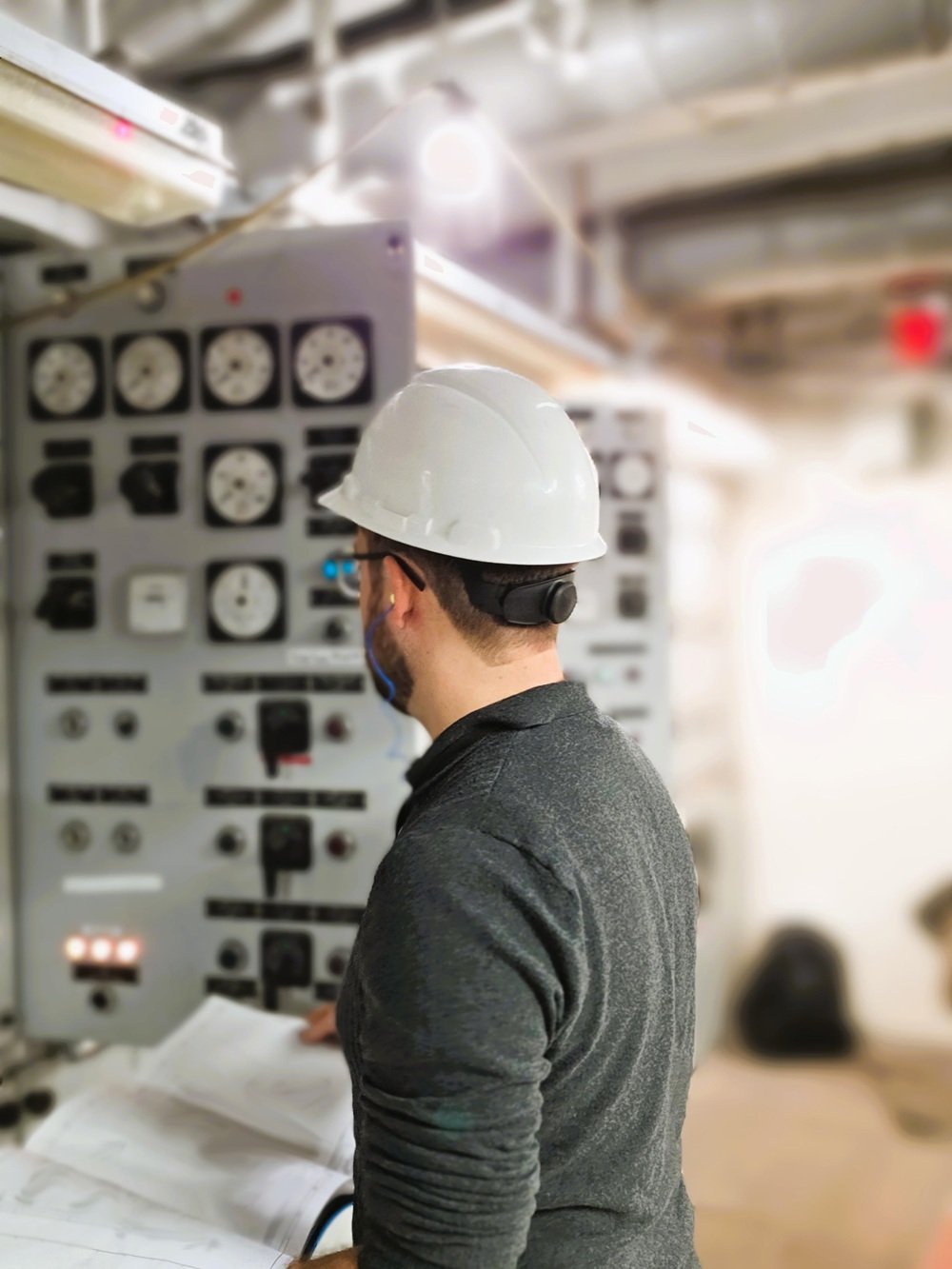
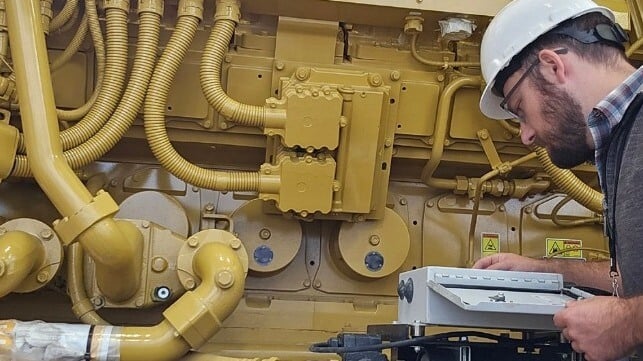
Boksa Marine Design's Marine Electrical Engineer Jordan Anger performs field verification on electrical upgrades to a switchboard.

Innovation You Can Implement Now

While much of this conversation focuses on the future, there are still gains that can be made today for new and existing vessels. In fact, there are technologies available now that don’t require extensive shipyard time or even taking the vessel out of the water.

From advanced fuel-flow meters and automated data-gathering sensors to software-based optimizations, these solutions can immediately reduce fuel consumption and wear on machinery.

"There are enhancements we can make right now to improve a vessel’s performance," says BMD’s Ethan Trupia, senior marine electrical engineer. "We can implement automated systems that fine-tune pumps and fans to run at their peak efficiency points, providing a real rate of return without a massive overhaul."

Flexibility Over Finality

If a design cannot be truly "fixed" for the next half-century, it can and should be made flexible. This involves designing margins into systems to accommodate future growth.

- Electrical Margins: Sizing electrical systems that incorporate additional reserve capacity and adding a more robust communications network to accommodate future data needs allow for the seamless addition of next-generation equipment down the line.

- Structural Allowances: Designing "drop-in" capability for emerging technologies allows an operator to adapt once the supporting infrastructure and regulations catch up.

- Regulatory Foresight: Understanding the trajectory of global emissions ensures a vessel won't be rendered obsolete by a sudden policy shift.

The Role of Systems Integration

As vessels become more computerized, the role of the systems integrator becomes paramount. However, innovation must be balanced with simplicity.

"There’s sometimes a tendency to overcomplicate things where it really benefits to have a voice in your ear to say, 'Let's simplify, let's standardize,'" says Tiefenthaler. “It’s also helpful to have historical knowledge of what’s worked well in the past, to help predict what might work best in the future.”

A resilient system is one that is straightforward to operate, easy to maintain, and backed by a robust redundancy plan.

Proving the Path Forward

The bridge between a conceptual future and an operational reality is built on data. Feasibility, risk, and detailed trade studies are critical “future-proofing” tools in proving that a customized solution will meet objectives, while also defining long-term needs for vessels. By evaluating ROI, engineers provide substantive value.

Ultimately, ensuring a vessel stands the test of time isn't about picking the newest technology; it’s about a deep technical partnership. It’s about understanding the "devil in the details" at the design level to avoid catastrophic issues later.

"Real longevity is achieved through flexible design, holistic integration, and a respect for operational reality," says Kuenning. "This allows us to design and build practical vessels that are ready for whatever the next 40 years may bring."

To learn more about preparing your vessels for future technologies and regulations, contact Boksa Marine Design for a customized consultation.

This message is sponsored by Boksa Marine Design.

The opinions expressed herein are the author's and not necessarily those of The Maritime Executive.

 

China Merchants Is the Latest to Withdraw from China’s Cruise Market

Chinese cruise ship
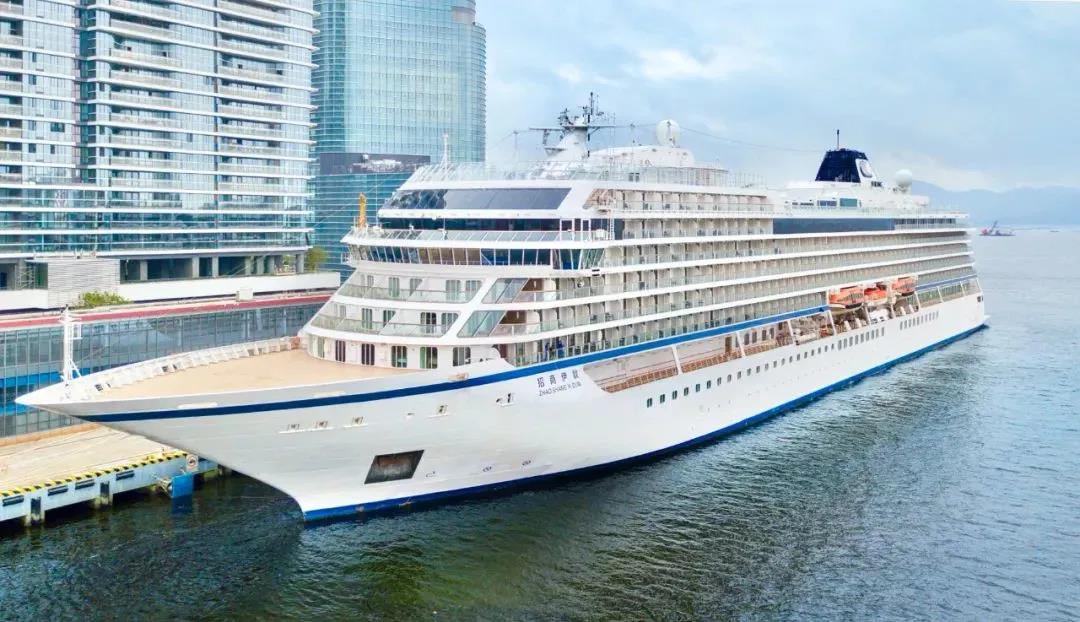
China Merchants Eden (Yi Dun) in Shanghai (China Merchants)

Published Mar 29, 2026 2:46 PM by The Maritime Executive


China Merchants, one of the country’s largest industrial companies and heavily involved in the maritime sector, has abandoned its efforts to develop a luxury Chinese cruise product. The company had launched a joint venture with Viking in 2021, acquiring one of Viking’s cruise ships, but recently put the cruise ship up for sale.

The company had reportedly paid nearly $400 million in 2021 as part of the joint venture to take control of the 745-foot Viking Sun (47,800 gross tons). Built by Fincantieri and introduced in 2017 as the fourth of Viking’s ocean cruise ships, the ship was rechristened Zhao Shang Yi Dun (China Merchants Eden). It was listed in February with the Beijing Equity Exchange, with a minimum price of RMB 2.9 billion (which, depending on exchange rates, could be as much as $420 million).

Bids were due by mid-March, with some speculation that Viking might reacquire the vessel, although it has been quietly removed from Viking’s webpage. China Merchants set strict terms requiring the buyer to remove all China Merchants branding from the ship within one month of completing the purchase, and they were prohibited from marketing the ship with any association or note of its past association with China Merchants. Further, it stated the Viking branding, the names of all the public spaces, including the restaurants aboard, and operating systems are licensed from Viking, but the license is not part of the sale. The buyer can negotiate a new agreement with Viking or relinquish the use of the licensed branding and systems.

The operation had been positioned as a high-end luxury cruise tailored to the Chinese market. However, when it launched in 2021, China was still closed due to the COVID-19 pandemic, and the ship was limited to coastal cruises. It sailed at different times from the ports of Shanghai, Shenzhen, and Tianjin. Pricing was reported to be at the high-end of the Chinese market, and extra tariff options aboard the ship further increased the total cost.

When China finally reopened cruising to the international market, the joint venture attempted to reposition Yi Dun from 5 to 8-day coastal cruises. They introduced a 15-day cruise to Japan and South Korea. Between September and November in 2024 and again in 2025, Viking marketed the ship to the international market for cruises from China. However, reports are that the ship often sailed with 600 passengers, significantly below its 930-passenger capacity, and continued to report financial losses.

For 2026, Viking had planned to reposition the Yi Dun to Europe. Viking had built a successful fly-cruise business from China with its river cruises in the past, devoting some ships to Chinese passengers.


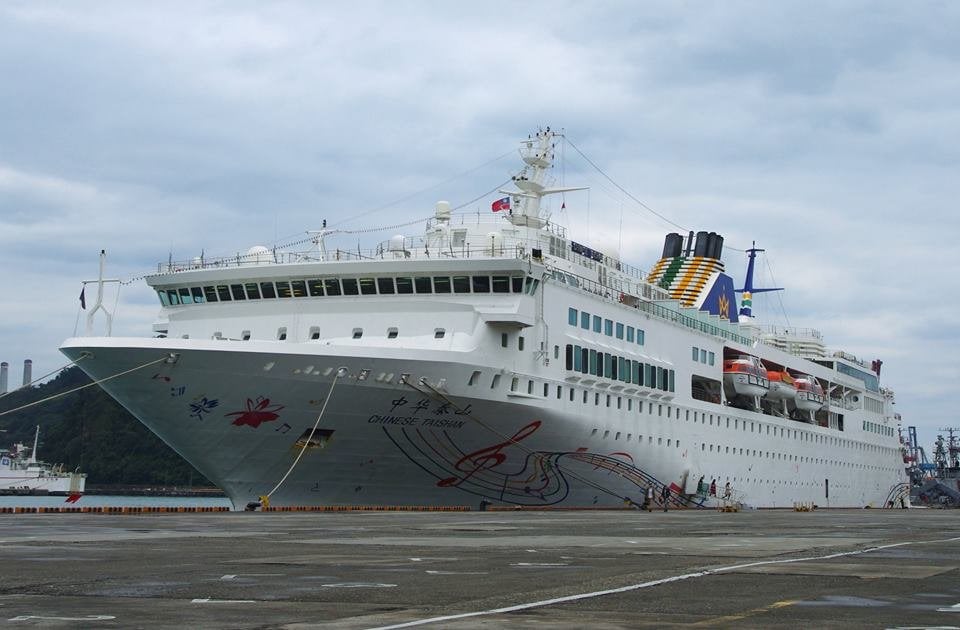
Chinese Taishan - Taiwan International Ports


China Merchants’ decision to exit the cruise market follows smaller companies, including ferry operator Bohai, which earlier this month reported its board of directors was putting its single cruise ship up for sale for $23 million. Bohai paid nearly $44 million in 2014 to acquire a cruise ship, Voyager (24,500 gross tons), from Carnival Corporation’s Costa. The ship entered service in 2000 and was acquired by Costa five years later when the original cruise line owners went bankrupt. She had sailed in China as the Chinese Taishan but, according to reports, never res

China’ Blue Dream Cruises, another small independent firm, went bankrupt earlier this year. It cited geopolitical tensions that had forced it to shift its itineraries away from Japan and South Korea. The company had two cruise ships, with reports that one was placed under arrest for debts, and both have been listed for sale. In addition, a former British cruise ship, which had been acquired by a regional tourism operation and launched as Piano Land, is heading to Spain in July for a new company. The operation was merged into a new Chinese cruise holding company, but the ship built in 1995 has aged out of the Chinese market due to a Ministry of Transport regulation that bars ships more than 30 years of age from operating from mainland China. 

Reports highlight that the Chinese consumer is mostly interested in family cruising and shorter trips focused on the destinations. MSC Cruises and Royal Caribbean International have been successful in re-entering the market with mega cruise ships with extensive amusements, which have a stronger appeal to the Chinese traveler. However, with a less developed marketing base, China remains a more challenging segment for the industry. Most of the Western cruise lines did not reposition ships to homeport in China after the pandemic. The Chinese cruise market, however, continued to show strong growth, with passenger levels up nearly 28 percent for the first 11 months of 2025, and China's Adora Cruises recently saw its second domestically built cruise ship floated ahead of a year-end delivery while the company placed an order for two ships and an option for a third, all to be built in China.


Stena RoRo Takes Delivery of the 13th E-Flexer from the China Merchants

Stena Ro-Ro

Published Mar 29, 2026 8:28 PM by The Maritime Executive


[By Stena RoRo]
 
 
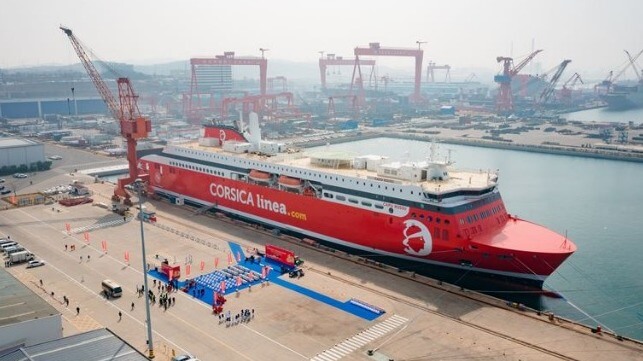
Stena RoRo has taken delivery of the 13th ship in the 15 ship series of E-Flexer RoPax ferries from the China Merchants Industry shipyard in Weihai, China. The ship, named Capu Rossu, was handed over to CORSICA LINEA following the delivery to Stena RoRo. The ship will start its commercial operation mid June and will trade between Marseille and Corsica.

GOTHENBURG, Sweden, March 28, 2026 /PRNewswire/ -- The E-Flexer-series is based on a design which is larger than the typical standard RoPax ferry and designed for flexibility. Each ship will be tailormade for the operators' technical and commercial needs. A highly optimized hull form, multifuel engines and the Battery Power Class notation as well as several other features make this ship one of the most economically friendly ever designed and built.

"Due to today's fast development of the hull form design and propulsion optimization in combination with the Battery Power systems we now start to install on our ships, it is clear that ordering of new ships will be the most important and strongest tool to reduce the CO2 emissions of the ferry industry", says Per Westling, CEO Stena RoRo.

Partnership with China Merchants Industry (CMI) Weihai Shipyard

The ship has been built by the China Merchants Industry Weihai shipyard in China. Stena RoRo has been cooperating with this shipyard since 2016 which has resulted in 19 orders so far. 15 of these have been E-Flexers, 2 NewMax RoRo ships and 2 C-Flexer RoRo ships.

"The cooperation between the CMI Weihai shipyard and Stena RoRo has been instrumental for the successful deliveries of ships and it has made it possible for us to deliver tailormade ships both to our own ferry operator Stena Line but also to several external ferry companies with the highest quality and in time," concludes Per Westling.


Basic specifications:

Length: 203 m

Draught: 6,5 m

Width: 27,8 m

Capacity: 1000 passengers and 2500 lane meters freight

The products and services herein described in this press release are not endorsed by The Maritime Executive.