Showing posts sorted by relevance for query NONES. Sort by date Show all posts

Thursday, October 05, 2023

America's nonreligious are a growing, diverse phenomenon. They really don't like organized religion

Mike Dulak grew up Catholic in Southern California, but by his teen years, he began skipping Mass and driving straight to the shore to play guitar, watch the waves and enjoy “the beauty of the morning on the beach,” he recalled. “And it felt more spiritual than any time I set foot in a church.”

Nothing has changed that view in the ensuing decades.

“Most religions are there to control people and get money from them,” said Dulak, now 76, of Rocheport, Missouri. He also cited sex abuse scandals, harming “innocent human beings,” in Catholic and Southern Baptist churches. “I can’t buy into that,” he said.

As Dulak rejects being part of a religious flock, he has plenty of company. He is a “none” — no, not that kind of nun. The kind that checks “none” when pollsters ask “What’s your religion?”

The decades-long rise of the nones — a diverse, hard-to-summarize group — is one of the most talked about phenomena in U.S. religion. The nones are reshaping America’s religious landscape as we know it.

In U.S. religion today, “the most important story without a shadow of a doubt is the unbelievable rise in the share of Americans who are nonreligious,” said Ryan Burge, a political science professor at Eastern Illinois University and author of “The Nones,” a book on the phenomenon.

The nones account for a large portion of Americans, as shown by the 30% of U.S. adults who claim no religious affiliation in a survey by The Associated Press-NORC Center for Public Affairs Research.

Other major surveys say the nones have been steadily increasing for as long as three decades.

So who are they?

They’re the atheists, the agnostics, the “nothing in particular.” Many are “spiritual but not religious,” and some are neither or both. They span class, gender, age, race and ethnicity.

While the nones’ diversity splinters them into myriad subgroups, most of them have this in common:

They. Really. Don’t. Like. Organized. Religion.

Nor its leaders. Nor its politics and social stances. That’s according to a large majority of nones in the AP-NORC survey.

But they’re not just a statistic. They’re real people with unique relationships to belief and nonbelief, and the meaning of life.

They’re secular homeschoolers in the Ozark Mountains of Arkansas, Pittsburghers working to overcome addiction. They’re a mandolin maker in a small Missouri River town, a former evangelical disillusioned with that particular strain of American Christianity. They’re college students who found their childhood churches unpersuasive or unwelcoming.

Church “was not very good for me,” said Emma Komoroski, a University of Missouri freshman who left her childhood Catholic religion in her mid-teens. “I’m a lesbian. So that was kind of like, oh, I didn’t really fit, and people don’t like me.”

The nones also are people like Alric Jones, who cite bad experiences with organized religion that ranged from the intolerant churches of his hometown to the ministry that kept soliciting money from his devout late wife — even after Jones lost his job and income after an injury.

“If it was such a Christian organization, and she was unable to send money, they should have come to us and said, 'Is there something we can do to help you?'” said Jones, 71, of central Michigan. “They kept sending us letters saying, ‘Why aren’t you sending us money?’”


Related video: America's nonreligious have become a growing phenomenon (The Associated Press)  Duration 6:35  View on Watch


Jones does believe in God and in treating others equally. "That’s my spirituality if you want to call it that.”

About 1 in 6 U.S. adults, including Jones and Dulak, is a “nothing in particular.” There are as many of them as atheists and agnostics combined (7% each).

Many embrace a range of spiritual beliefs — from God, prayer and heaven to karma, reincarnation, astrology or energy in crystals.

“They are definitely not as turned off to religion as atheists and agnostics are,” Burge said. “They practice their own type of spirituality, many of them.”

Dulak still draws inspiration from nature, and from making mandolins in the workshop next to his home.

“It feels spiritually good,” Dulak said. “It’s not a religion.”

Burge said the nones are rising as the Christian population declines, particularly the “mainline” or moderate to liberal Protestants.

The statistics show the nones are well-represented in every age group, but especially among young adults. About four in 10 of those under 30 are nones — nearly as many as say they’re Christians.

The trend was evident in interviews on the University of Missouri campus. Several students said they didn’t identify with a religion.

Mia Vogel said she likes “the foundations of a lot of religions — just love everybody, accept everybody.” But she considers herself more spiritual.

“I’m pretty into astrology. I’ve got my crystals charging up in my window right now,” she said. “Honestly, I’ll bet half of it is a total placebo. But I just like the idea that things in life can be explained by greater forces.”

One movement that exemplifies the “spiritual but not religious” ethos is the Twelve Step sobriety program, pioneered by Alcoholics Anonymous and adopted by other recovery groups. Participants turn to a “power greater than ourselves” — the God of each person’s own understanding — but they don’t share any creed.

“If you look at the religions, they have been wracked by scandals, it doesn’t matter the denomination,” said the Rev. Jay Geisler, an Episcopal priest who is spiritual advisor at the Pittsburgh Recovery Center, an addiction treatment site.

In contrast, “there’s actually a spiritual revival in the basement of many of the churches,” where recovery groups often meet, he said.

“Nobody’s fighting in those rooms, they’re not saying, ‘You’re wrong about God,’” Geisler said. The focus is on “how your life is changed.”

Scholars worry that, as people pull away from congregations and other social groups, they are losing sources of communal support.

But nones said in interviews they were happy to leave religion behind, particularly in toxic situations, and find community elsewhere.

Marjorie Logman, 75, of Aurora, Illinois, now finds community among other residents in her multigenerational apartment complex, and in her advocacy for nursing home residents. She doesn’t miss the evangelical circles she was long active in.

“The farther away I get, the freer I feel,” she said.

__

AP journalists Linley Sanders, Emily Swanson and Jessie Wardarski contributed.

___

Associated Press religion coverage receives support through the AP’s collaboration with The Conversation US, with funding from Lilly Endowment Inc. The AP is solely responsible for this content.

___

The poll of 1,680 adults was conducted May 11-15 using a sample drawn from NORC’s probability-based AmeriSpeak Panel, which is designed to be representative of the U.S. population. The margin of sampling error for all respondents is plus or minus 3.4 percentage points.

Peter Smith, The Associated Press

Friday, October 03, 2025

 Opinion

Nonreligious Americans might not be as spiritual as we thought
(RNS) — Our research shows that nonreligious Americans report being significantly less spiritual than people who identify with established traditions such as Christianity, Judaism or Islam.
(Photo by Helena Lopes/Pexels/Creative Commons)

(RNS) — When French intellectual Alexis de Tocqueville toured the United States in the early 19th century, he was struck by how religious Americans were. He linked that religiosity with the success of our young democracy, observing that “religion is the first of the political institutions in that country,” for “it facilitates the use of liberty.” Religion, he argued, provided a moral foundation – a lingua franca – that allowed liberty to flourish.

Two centuries after de Tocqueville’s visit, the American experiment has entered a new chapter. The biggest story in American religion in the last three decades is the increasing number of Americans who report they have no religious affiliation, commonly called “nones.” According to the General Social Survey, nones made up 5% of the country in 1991. By 2022, they comprised nearly one-third of the adult population. Over the same period, the share of people who said they never attend religious services rose from 12% to 33%. We are just beginning to see how these changes will affect our democracy.

In the wake of this seismic shift in the religious landscape, countless commentators have argued that many nones are replacing traditional practices like church attendance and prayer with spiritual alternatives such as yoga, meditation, astrology or even spin classes. The implication is that while 100 million Americans have abandoned organized religion, they are still people of faith, so de Tocqueville’s thesis still holds.


But in spite of the ubiquity of the phrase, “I’m spiritual but not religious,” our research has found that most American nones have not replaced religion with alternative spiritual practices. Through a grant from the John Templeton Foundation, we conducted a survey of over 12,000 Americans who identify as atheist, agnostic or nothing-in-particular to determine just how spiritual they are and what types of spiritual activities they engage in.


We found nonreligious Americans report being significantly less spiritual than people who identify with established traditions such as Christianity, Judaism or Islam. Among religious respondents, 62% said spirituality was “very important” to them compared with only 24% of nones. In contrast, 27% of the nonreligious said spirituality was “not at all important,” while just 4% of religious respondents said the same. In short, the religious are far more likely to report a deep well of spirituality than the nones.

That point was reinforced when we asked respondents to check boxes next to spiritual activities they engaged in over the prior month. Whether it be yoga, meditation, astrology, crystals or saging their home, we found no instance where nones were more likely to engage in an alternative spiritual practice than the religious control group in our sample. In fact, we found that 55% of nonreligious respondents selected none of eight possible spiritual activities. That’s a huge group of nones – over 50 million Americans – who don’t have a regular spiritual practice of any sort, our research shows.

Our data shows that 27% of nones said they practiced meditation in the last few weeks, and 15% had done yoga or astrology during the same time period. And the survey data reveals that while a lot of attention has been paid to alternative practices like using crystals and ingesting psychedelics for enlightenment, real engagement in those areas is actually rare: Less than 10% of nones engaged in either of those practices.

The conclusion that emerges from our survey is that a growing number of Americans who have walked away from churches, mosques and synagogues have not used their newfound freedom from religion to seek out new spiritual practices. In essence, they have traded religion for nothing at all.

But they don’t seem to be worse for it. For many religious Americans, there is a deeply held conviction that those who are neither religious nor spiritual must be living unsatisfied, meaningless lives. But our survey data strongly challenges that assumption. Among Protestants, 48% report being very satisfied with life — only slightly higher than the 46% among respondents who expressed no inclination toward religion or spirituality.


These results challenge assumptions about the future of American religious institutions. If nearly half of the nonreligious report high life satisfaction, the belief that faith is the only path to fulfillment becomes harder to defend. This raises difficult questions for religious leaders and believers. Tens of millions of Americans center their entire worldview on the conviction that an encounter with the divine gives life meaning and purpose. But when these true believers try to convince their friends and neighbors to join them in this way of thinking, they are met with little more than a shrug of the shoulders.

But this seismic shift in American life will change our democracy. Our research reveals a philosophical divide between people for whom faith is at the very heart of life and those who hardly think about it at all. And as Americans no longer share the lingua franca of religion — a widely held set of beliefs and a common language to articulate them — it becomes incumbent on our political and cultural leaders to find other areas of commonality to stabilize our democracy and reinforce our liberty before we sink further into polarization.

(Ryan Burge is a professor of practice at the John C. Danforth Center on Religion and Politics at Washington University and author, most recently, of “The American Religious Landscape: Facts, Trends, and the Future.” Tony Jones, a theologian and outdoorsman, is the author of “The God of Wild Places.” They co-direct the Making Meaning in a Post-Religious America Project. The views expressed in this commentary do not necessarily reflect those of RNS.)

Friday, September 23, 2022

Non-religious are hardline, easygoing or spiritual, says UK thinktank

Theos study comes as new census data expected to show increase in those describing themselves as non-religious

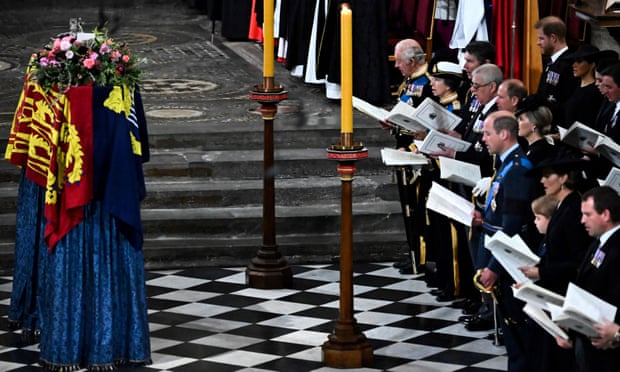
The state funeral for Queen Elizabeth II took place at Westminster Abbey
 at a time when increasing numbers of people are describing themselves as non-religious. 
Photograph: Reuters

Harriet Sherwood
THE GUARDIAN
@harrietsherwood
Fri 23 Sep 2022 

People who are not religious tend to fall into three groups: hardline, easygoing, and those who are spiritual while rejecting organised faith, according to a study.

Its findings come ahead of new census data on religious identity due this autumn, which is expected to show a further jump in the proportion of the population that describe themselves as non-religious.

Census results for Northern Ireland published this week showed an 80% increase in the number of people identifying as non-religious – a growth in the share of the population from 10% to 17%.

Data from the England and Wales 2021 census, due before the end of the year, are expected to see the proportion of non-religious people rising to more than a third of the population. In the 2001 census, the first time a question on religion was asked, 15% of people ticked the box for non-religion; in 2011, it was 24%.

But opinion polls suggest an even higher proportion of people are non-religious. The 2018 British Social Attitudes survey found 53% of respondents described themselves as non-religious. A survey of more than 5,000 people commissioned earlier this year by the Christian thinktank Theos produced the same figure.

In a forthcoming report, The Religion of ‘Nones’, Theos has examined the attitudes of non-religious people (termed “nones”, as in “none of the above” when questioned about religious identity).

It found that only about half (51%) of those who identify as non-religious said they do not believe in God, and a fifth (20%) said they definitely or probably believe in life after death. Almost one in six (17%) believe in the power of prayer.

There were three, broadly equal-sized clusters among the nones. “Campaigning nones” are hostile to religion, said Nick Spencer, senior fellow at Theos, who co-authored the report with Hannah Waite. “Their none-ness is part of their identity. Religion isn’t something you simply don’t belong to, it’s something you campaign against.”

The second sub-group, “spiritual nones”, were less atheistic and more spiritually open, said Spencer. “They’re saying: ‘I don’t belong to a religion, but I believe stuff and often I do stuff that’s indistinguishable from the kind of stuff that religious people do. It’s just that I don’t want to wear that particular label, I don’t want to belong to a particular institution.’ It’s a more bespoke form of spirituality.”

The third cluster, “tolerant nones”, were generally atheistic, but more accepting of religion than the first group. “They don’t see religion as evil, they’re a bit more live and let live,” said Spencer.

These were people who, on watching the Queen’s funeral earlier this week, “might have thought: ‘I don’t believe in this, but I do see the merit of marking great moments of state or indeed life with ceremony’.”

According to Theos’s research, women were more likely to be spiritual nones than men, and men were more likely to be campaigning nones than women. There was no marked gender imbalance among tolerant nones, but the age profile of this group was younger than other clusters.

The discrepancy between the percentage of people defining themselves as non-religious in Theos’s research and the expected census results could be attributed to a “pearly gates syndrome”, said Spencer.

“There’s a finality to the census that you don’t quite get with opinion polls – you can change your opinion, whereas the census is the census. When push comes to shove, people may be more inclined to have a religious identity.”

Linda Woodhead, head of the department of theology and religious studies at King’s College London, said this year’s census results would continue the trend of more people identifying as non-religious and fewer identifying as Christian.

“The churches have failed dramatically as moral authorities, with the abuse scandals being just the latest nail in that coffin,” she said in a lecture on the future of religion in Britain, organised by the Religion Media Centre.

“There is currently a free for all in the area of values leadership … The Queen did an excellent job of becoming a values leader of much greater stature than any Christian leader in the country.”

The Scottish census was conducted earlier this year, with data expected to be published in 2023.

Thursday, October 05, 2023

Highlights from AP-NORC poll about the religiously unaffiliated in the US


Thirty percent of Americans don't identify with a religious group — but not all of them are atheists or agnostics.

In fact, 43% of the group known as the “nones” say they believe in God, even if they largely dislike organized religion.

Those are among the findings of a new poll by The Associated Press-NORC Center for Public Affairs Research.

The poll of 1,680 adults was conducted May 11-15 using a sample drawn from NORC’s probability-based AmeriSpeak Panel, which is designed to be representative of the U.S. population. The margin of sampling error for all respondents is plus or minus 3.4 percentage points.

RELIGIOUS OR NOT

Thirty percent of adults identified with no religion. That group, commonly called nones, includes those identifying as atheist (7%), agnostic (7%) and nothing in particular (16%).

Sixty-four percent in the poll identified with a Christian tradition, including Protestant (25%), Catholic (19%), “just Christian” (18%) ,Mormon (1%) and Orthodox (less than 1%).

Other groups included Buddhist, Hindu, Jewish and Muslim (1% each) and something else (2%).

AGE GAP

Forty-three percent of those 18 to 29 are nones, while 52% identify as Christians and 4% are affiliated with other religions.

Adults over 60 are the most religious age group, but even among them, nearly 1 in 5 are nones.

GOD WITHOUT RELIGION

Forty-three percent of all nones professed belief in God or a higher power — including 61% of nothings in particular, 40% of agnostics and 4% of atheists. Overall, 79% of U.S. adults professed faith in God.

BELIEFS

About half of nothings in particular said they believe in angels, the power of prayer and heaven. So did about a quarter of agnostics. Agnostics and nothing in particulars were less likely to believe in hell or Satan. Almost no atheists believed in any of that.

But most agnostics (67%) and nothings in particular (79%), and 44% of atheists, agreed “some things can’t be explained by science or natural causes.”

UNCONVENTIONAL

Nothings in particular were at least as likely as other Americans to accept various beliefs and practices outside of the Judeo-Christian tradition, including astrology, yoga as a spiritual practice, reincarnation, spiritual energies in physical things, the interaction of spirits of the dead with the living and karma

GOOD OR BAD?

More Americans overall say the trend of people moving away from identifying with a religious group is a bad thing (37%) than that it’s a good thing, (23%), but 39% say it’s neither.

Among the nones, most atheists say it’s good (69%), compared with 52% of agnostics and only 36% of nothings in particular.

About half of those with a religious affiliation say it’s a bad thing.

SPIRITUAL BUT NOT RELIGIOUS

In addition to having no religious affiliation, about 9 in 10 nones also don’t consider themselves “religious.”

But about half of agnostics and those nothings in particular consider themselves “spiritual but not religious.” About two-thirds of nothings in particular consider themselves spiritual, religious or both. Eight in 10 atheists consider themselves neither.

WHY NOT RELIGIOUS?

Among the nones who say they are also not personally religious, 68% cited their dislike of organized religion as a very or extremely important reason. For 63%, a top reason is their dislike of the stances religious faiths take on social and political issues, while 54% say the same about reports of abuse or misconduct by religious leaders. Forty-six percent cite disbelieving in God as a top reason. That was true of 81% of atheists, but just 40% of agnostics and 32% of nothings in particular.

GENDER

Nearly two-thirds of atheists and 56% of agnostics are male, while 52% of nothings in particular are women.

RACE

Nones tend to be white, especially atheists. Nothings in particular are a somewhat more diverse subgroup, with a third of them identifying as Black, Hispanic, Asian, multiracial or with another racial or ethnic group other than white.

POLITICS

About two-thirds of atheists and agnostics identify as Democrats or lean toward the Democratic Party, as do half of nothings in particular, while 13% of atheists, 17% of agnostics and 22% of nothings in particular identify with or lean toward the Republicans.

EDUCATION

Forty-one percent of atheists have a college degree, compared with 34% of agnostics and 28% of nothings in particular (and 30% of U.S. adults overall).

WHERE TO FIND FULFILLMENT

Close to three-quarters of religious adults say their faith provides them with at least some meaning and fulfillment, including 46% who say it provides a lot.

While widespread majorities of atheists and agnostics get no fulfillment from religious faith, only 62% of those nothings in particular say the same.

Large majorities of people with and without a religious affiliation said they get at least some fulfillment from spending time outdoors, physical exercise and spending time with family and friends.

___

AP journalists Linley Sanders and Emily Swanson contributed to this report.

___

Associated Press religion coverage receives support through the AP’s collaboration with The Conversation US, with funding from Lilly Endowment Inc. The AP is solely responsible for this content.

Peter Smith, The Associated Press

Friday, September 09, 2022

'God-denying' women and self-replacing Christians: How religion changes birthrates

Religion News Service - Yesterday 

(RNS) — According to Bloomberg News, South Korea’s fertility rate dropped from .84 babies per woman to .81 in 2021, the lowest figure on record. If current trends continue, the number of people in South Korea will be the same in 2100 as it was in 1960. In response, the government has tripled the baby payment as a way to induce more childbearing.

This collapse in fertility is also evident in China and in many European countries, where the total population in many places has the potential to drop by half in the next eight years.

Religion has become a part of the conversation about declining birthrates. Recently, pastor and podcaster Dale Partridge tweeted about the “great sadness” of “God-denying” 39-year-old women who are intentionally single and childless who will realize in later years that they will have “a total sense of emptiness” for not finding a partner and having children.

For Partridge, rejecting the institutions of marriage and parenthood is to embrace a lifestyle that is antithetical to his understanding of God’s design for human beings — namely, that “they be fruitful and multiply.”

RELATED: When she doesn’t want a baby

But does religious belief actually have an impact on how people in the United States think and act about marriage and family? The General Social Survey has been asking questions about whether someone is married and whether they have children since the early 1970s. The results do point to religion as an important factor for many when it comes to making important life decisions.


'God-denying' women and self-replacing Christians: How religion changes birthrates© Provided by Religion News Service

In a GSS question about marital status, respondents are asked to identify as married, separated, divorced, widowed or never been married. In 1972, about 14% of the American population reported that they had never wed. Evangelicals were just a bit lower at 9%. However, those without a religious affiliation reported a much higher likelihood of never being married. In 1972, 36% of them had never walked down the aisle.

Over time, the portion of Americans who have remained single has clearly climbed. In 2021, nearly 3 in 10 adults said that they have not married — double the rate in 1972. Evangelicals have also seen a significant increase, with 19% never having wed.


Among the so-called nones — those unaffiliated with any religious organization — the share of people who have never married, at 42% in 2021, has increased, but the rise has been far more modest. Still, that’s about 12 percentage points above the national average.


'God-denying' women and self-replacing Christians: How religion changes birthrates© Provided by Religion News Service

Religion doesn’t only impact the likelihood of entering into matrimony. It can have profound impacts on other decisions, such as when to have children or the number of children to have. That’s clearly shown by the General Social Survey. In the early 1970s, evangelical households had a little more than 2.5 children on average. That was just slightly higher than the average American, who was having 2.3 children. Nones were much, much lower than that. In 1972, the average none had 1.4 children.

There’s unmistakable evidence of declining fertility rates in the data as well. The average respondent reported having 1.8 children in 2021, a dip of .5 over the last five decades. Evangelicals were also reporting declining birthrates between 1972 and 2000, but those numbers have slightly rebounded from there. The average evangelical has about 2.1 children now, slightly above the national average.

For nones, there is also decline in fertility, but it’s much less severe. According to the most recent data, the average none has about 1.3 children, a slight increase from two decades ago, but still 50% below the national average.


'God-denying' women and self-replacing Christians: How religion changes birthrates© Provided by Religion News Service

One curious development when talking about birthrates is the expanding trend of “child-free” individuals, who have declared they will never have children for a wide variety of reasons. There’s a community dedicated to these individuals on Reddit, boasting 1.5 million members.

This trend has yet to show up in the data, however. Looking at those who are at least 40 years old, little evidence supports the notion that the child-free movement has momentum in the general public. In the 1970s, about 13% of adults 40 or older had never had children. Today, it’s risen by perhaps 1 or 2 percentage points.

RELATED: The future of the church may belong to the fecund, but not the nuclear family

Even the nones are still having children, though their story is more complicated. In the 1970s, nearly 20% of nones were child-free before dipping slightly in the 1980s, and then peaking at 28% in the early 2000s. But from that point forward, nones 40 or older with no children dropped as a share of nones overall. They now make up about 20% of the group — 6 points higher than the national average, but far less than the nearly 15-point gap in 2004.

So while religion affects trends in marriage and offspring in sometimes unclear ways, the one loud message is for the nones: Their focus must be on conversion, not retention. While the unaffiliated nones have grown by leaps and bounds over the last three decades, their low birthrate means they will have to bring in new members who were raised in other faith traditions to maintain that momentum in the coming decades.

(Ryan Burge is an assistant professor of political science at Eastern Illinois University, a pastor in the American Baptist Church and author of “The Nones: Where They Came From, Who They Are, and Where They Are Going.” He can be reached on Twitter at @ryanburge. The views expressed in this commentary do not necessarily reflect those of Religion News Service.)

Ahead of the Trend is a collaborative effort between Religion News Service and the Association of Religion Data Archives made possible through the support of the John Templeton Foundation. See other Ahead of the Trend articles here.

Saturday, December 03, 2022

Why Americans are leaving their churches

For sociologist Stephen Bullivant, the question is why it took so long for the religious exodus to happen.

(RNS) — As many as a third of Americans now claim no religious affiliation, and British sociologist Stephen Bullivant has some ideas about why.

In his new book, “Nonverts: The Making of Ex-Christian America,” due this week from Oxford University Press, Bullivant reflects in often highly entertaining fashion about the trend lines. Although it’s full of statistics, “Nonverts” remains a lively read for ordinary people — a rare feat in a sea of dry data-driven books.

As a researcher, Bullivant wanted to know why Americans, once considered the exception to the secularization that has happened in Europe and elsewhere, are suddenly losing their religion.

And it is sudden, he notes. “This kind of religious change in a society doesn’t normally happen in the space of 20 or 30 years,” he told Religion News Service in a Zoom interview. “It’s been within the space of one or perhaps two generations that we’ve seen a sudden surge.”

In the 1990s, nonreligion began climbing from its baseline of around 7% of the population to what is between three and five times that figure now, depending on the survey. (All national surveys show the same rising trendline, but they differ as to the degree.)

From "Nonverts: The Making of Ex-Christian America" by Stephen Bullivant.

From “Nonverts: The Making of Ex-Christian America” by Stephen Bullivant

Bullivant says the majority of this shift is caused by people actively leaving the religion of their childhood (the “nonverts” of the title), not because they were born into nonreligious families (though that trend is coming).

“So there is a story about why there is this rise of the nones. But to me, the more interesting story is why it didn’t happen earlier.” Why did this change start not in the 1960s, when American culture was in a state of upheaval, but in the ’90s?

Politics, say other scholars, who see nonreligion as a backlash against the GOP’s “Contract with America” and the rise of the religious right. That’s likely part of it, Bullivant said, pointing to how quickly the American public changed its mind on gay marriage. But he looks to three other developments to help us understand why people are leaving the fold.

"Nonverts: The Making of Ex-Christian America" by Stephen Bullivant. Courtesy image

“Nonverts: The Making of Ex-Christian America” by Stephen Bullivant. Courtesy image

First, there was the end of the Cold War. For decades, “there was a big threat of ‘godless communism,’” making it hard for anyone with religious doubts to admit to them publicly. The social cost of being considered un-American was just too high, keeping the numbers of religious nones artificially low.

“Then suddenly the Cold War ends, and you have people able to admit to being nonreligious. In fact, by the time the New Atheists rise up in the mid-2000s, it’s no longer people with no religion who are the existential threat, but people with too much religion, especially extremist religion. The New Atheism is really interesting in how it positions itself as patriotic.”

A second factor is the sudden appearance of the internet, which made it possible for like-minded people to meet each other. “If you were brought up in small-town Kansas, you probably weren’t going to find other people who were having religious doubts. The internet opened up those spaces for people to play around with ideas, hang out with other people, and get really deep into various subcultures.”

The internet has been particularly important for people leaving conservative religions such as evangelical Protestantism or Mormonism. The Church of Jesus Christ of Latter-day Saints is actually the first main example Bullivant uses in the book, which is surprising because it’s such a tiny percentage of the population, around 1.5%.

Bullivant chose it because it’s a “canary in the coal mine” story — if even the Mormons are starting to bleed members, “that shows what a big issue this is for everyone else.” The erosion of Mormon attachment, he said, indicates “the breakdown of religious subcultures,” which has been especially profound in places such as Utah and southern Idaho where, in decades past, a person’s entire social and religious life could be spent around members of the LDS church.

The internet chips away at that enclave. “This was important for many of the Mormons I interviewed, who were encountering new things about Mormon history online. But even more than this, they’re starting to hang out with non-Mormons and ex-Mormons, people who are very much in your boat, and that becomes this other world you can inhabit.”

Around two-thirds of all nones in the US are nonverts (dark gray), meaning that they left a religion, rather than "cradle nones" (light grey), who were raised without religion. Over time, Bullivant expects cradle nones to become a larger share of the none population, as more Americans are born without a religion and don't switch into one.

Around two-thirds of all nones in the U.S. are “nonverts” (dark gray), meaning that they left a religion, rather than “cradle nones” (light gray), who were raised without religion. Over time, Bullivant expects cradle nones to become a larger share of the none population, as more Americans are born without a religion and don’t switch into one.

The third factor sounds like circular logic: The nones are rising because the nones are rising. But human beings are herd creatures, Bullivant explains in the book; we tend to do what our neighbors are doing. With every headline (like the one above) that heralds the seismic shift the nation is experiencing, more people become comfortable being nonreligious.

Bullivant himself bucks the trend. The 38-year-old researcher came from a family with no religion — “I wasn’t baptized, and that’s normal in Britain” — but deviated from that path by slowly coming to Catholicism as a student. He was doing the first of his two doctoral degrees (one in theology, the other in sociology) when he became friends with some Dominicans who would regularly invite him for dinner.

“In order to come to this guest dinner with loads of wine on a Sunday evening, you had to have gone to the Mass beforehand,” he said.

So he began attending Mass. He was impressed by the people he met, who were bright and kind. It was obvious that they lived what they believed and had made great sacrifices in order to become priests. Eventually, one of those friends offered to baptize him. So after a three-week research trip to Rome for his dissertation, Bullivant officially joined the Catholic Church. His wife is now also a member, and they are raising their four children as Catholics.

“So it’s strange: I do a lot of work on people leaving Catholicism. For every person in Britain who is raised nonreligious who becomes Christian, there’s something like 26 people who go the other way.”

It’s a helpful reminder that while social science charts trends that are sweeping and very real, each individual story is complex.

Related content:

“Allergic to religion”: Conservative politics can push people out of the pews, study shows

For US Mormons, religiosity has declined over time