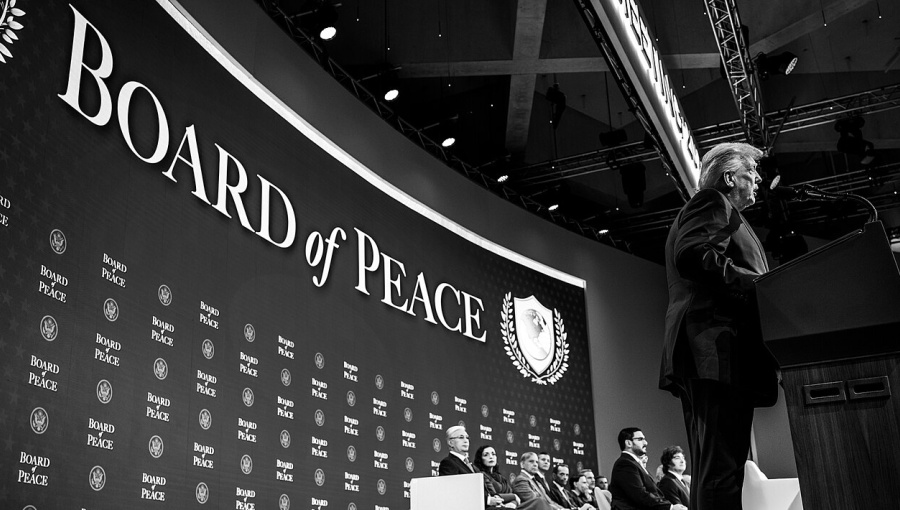
Until and unless it puts in some hard yards, the suspicion will be that Donald Trump’s Board of Peace (BoP) will turn out to be no more than a gimmick.
Nevertheless, such a prospect hasn’t stopped Central Asia’s big two, Kazakhstan and Uzbekistan, and neighbouring Mongolia from signing up as founding members of the BoP, of whom there are 20 in all. True, the Kazakhs, perhaps a little nervous that they’ll turn out to have joined a deadbeat organisation (a January 26 opinion piece by foreign policy analyst and columnist for The Washington Post, Max Boot, argues that the BoP is already floundering and likely to disappear and be soon forgotten) were quick to point out that they’ve gained a seat at the table without shelling out the billion-dollar membership fee (it turned out that the fee was only compulsory for those wanting to take out membership for more than an initial three-year term), but, like the Uzbeks and Mongolians, they are for ever looking out for ways of ensuring their affairs are not subject to any overbearing designs of major power neighbours Russia or China – and the BoP is one.
Saying “No” to Trump would certainly not be characteristic of the Central Asian pair or Mongolia, given that they tend to join any organisation going that offers a chance to broaden their multi-vector foreign policies, namely the diplomatic strategy often adopted by middle powers that sets out to maintain balanced, cooperative and non-aligned relations with multiple major, often rival, global powers.
To Trump, Central Asia and Mongolia make up a part of the world that is rich in natural resources, such as the critical minerals so vital to transition technologies in defence, aerospace, automotive and other industries including (whisper it quietly if you’re in the vicinity of the climate crisis denying White House) energy. As was demonstrated by the prevailing focus of last November’s Central Asia Five + US White House summit, Trump sees the region as offering business deals galore and, what’s more, trade and investment that could put Beijing’s nose out of joint.
Boot has an interesting line on how big a role business will play in the BoP’s activities, should Trump’s ambitions be realised, writing that “whatever the superficial differences between Trump’s contemplated annexation of Greenland and his attempt to create what the [BoP] invitation bills as ‘the most impressive and consequential Board ever assembled,’ they are manifestations of the same impulse: Trump wants to do whatever he wants, wherever he wants, unconstrained by any checks or balances, and he would like to make a lot of money doing it”.
Suffice to say, Trump’s ideas as to what the BoP can achieve are characteristically monumental.
Again, as Boot writes: “The U.N. Security Council presumably had no idea, when it approved in November the creation of the Board of Peace, that it was bringing into existence a potential competitor to the United Nations itself. The council’s intent was to create a Gaza governing mechanism free of Hamas control. That goal hasn’t been achieved: Hamas still controls half of Gaza (Israel has the other half), and it refuses to disarm. That makes it impossible to implement the White House’s pie-in-the-sky plan to transform the devastated war zone into a technology and tourism hub.”
However, if the BoP does start causing great ructions on the international scene, the observer can only expect the Kazakhs, Uzbeks and Mongolians to keep their heads well and truly down. This is a one-man show. Astana, Tashkent and Ulaanbaatar know the score – they should be seen, but not heard – and that suits them fine.
On the business side in Central Asia-US relations, Washington has lately stepped up its bid to lay claim to much of Kazakhstan and Uzbekistan’s tungsten resources in the face of sharp Chinese rivalry, while the end of last week even saw two senior US officials – US Secretary of the Army Daniel Driscoll and US Presidential Special Envoy for South and Central Asia Sergio Gore – visit the “hermit” nation of Turkmenistan, with both regional security and economic issues on the agenda (and perhaps also “Iran”, given Turkmenistan borders it to the north).
There are numerous deals to be done, but Trump will not get it all his own way – neither the Central Asian stans or Mongolia are in the business of unduly upsetting either Moscow or Beijing.
On the other hand, they certainly won’t want to unduly upset Trump. As political scientists Austin Sarat and Ruxandra Paul on January 26 wrote for The Hill: “Not since Woodrow Wilson conceived of a League of Nations in the wake of World War I has a single figure imagined himself capable of reordering the world. But, unlike Wilson’s design for the League, which contemplated shared decision-making, Trump’s Board of Peace ratifies his desire to run the world in accordance with his own morality and his own mind.”
Indonesia’s self-funded quest in the Gaza Peace Council backfires
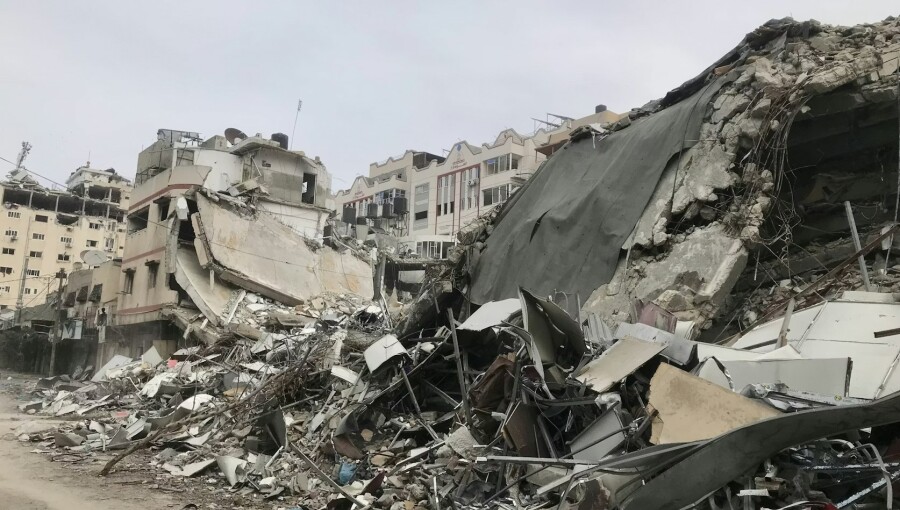
Indonesia officially announced its entry into the Gaza Peace Council at the World Economic Forum 2026 in Davos on January 22. The Gaza Peace Council is a Trump-backed initiative that, according to RRI, aims to safeguard a multilateral, humanitarian effort to reconstruct Gaza, RRI reports.
With the country’s seemingly ironic participation, a question arises: Was this the plan all along? Indonesia has been known to be a united front when it comes to supporting the liberation of occupied Palestine from the Israeli regime. But under President Prabowo Subianto’s leadership, Indonesia insists on not taking sides. Joining the Gaze Peace Council becomes a safe option.
What’s at stake
On the surface, the decision made sense. Indonesia, along with the United Arab Emirates, Jordan, Pakistan, and Saudi Arabia, cannot remain outside of the council as they took a vigilant stance on Palestinian issues. With political, security, and domestic stakes riding on the liberation issue, what’s left is the option to join. These countries have a strategic pattern, and it’s involving currying favour with Trump.
The general assumption is that the peace council was meant to ensure Gaza’s peace. But the board’s role kicks in with two bodies' mediation: the Gaza Executive Board and the National Committee for the Administration of Gaza (NCAG). The Gaza Executive Board has eleven members that Trump appointed, including Israel, but no Palestinian representatives. The NCAG, on the other hand, is a body made up of selected Palestinians with Arab and US partners, with the aim of Gaza’s rehabilitation and governance, returning the Palestinian Authority to Gaza.
During a meeting in Davos, Ali Shaath, NCAG’s High Representative, also stresses the Trump peace plan, indicating the Rafah crossing will be opened and the committed entry of humanitarian aid only after the return of the last hostage at Israel’s request. The next phase of the plan will include the deployment of the International Stabilisation Force and disarmament of Hamas, which many believe will defeat the purpose of the Palestinian liberation mission.
The advocates for the Gaza ceasefire, namely Egypt, Qatar, and Turkey, have now joined the same board, which continues to delude the peace effort.
Self-funded move is a statement
Following Indonesia’s decision to join the council, Minister of Defence, Sjafrie Sjamsoeddin stated that the country participates under a self-funded scheme. Sjamsoeddin said that it reflects Indonesia’s commitment to be a part of the international peace efforts independently, RRI reports.
The self-funded scheme will see the Indonesian Military (TNI) optimising its troops for the Peace Council mission. So far, the TNI commander has already presented one brigade as part of the preparation plan, followed by the plan to deploy one battalion.
A representative from the Ministry of Foreign Affairs lent her insight on the matter: “Indonesia's decision to join Trump’s so-called peace council is the country’s way to be involved directly in the discussion about Palestine’s future. From the government’s perspective, our position remains clear: We support a two-state solution and the establishment of a sovereign Palestinian state, with its people’s rights fully protected.” The source, who prefers to remain anonymous, added that the reason to join for Indonesia is so it can have a seat at the table and encourage a more balanced approach.
However, at the same time, the fact that the initiative is driven by the US leads to wide public disagreement and criticism, she noted.
Novaya Siantita, an Indonesian journalist, commented on the decision: “In my view, it feels like a move driven more by the need for validation than a genuine push for peace. Indonesia’s participation looks less like moral leadership and more like an attempt to appear active and relevant on the global stage, to get recognition for “doing something,” rather than actually changing anything.”
Presence without power
Despite painting the image of “peace for all”, Indonesian President Prabowo continues to receive backlash. A video showing the President stating that the suffering of Gazan people has significantly decreased is widely circulated. despite some reports still showing Israel’s continuous bombing. Tempo reports that this was a statement made in line with the country’s joining the Peace Council, signalling their national agenda.
“If people say this is purely for 'national interest’, then which nation are we talking about, because ordinary citizens don’t seem to gain anything from it. Without real influence over decisions or the agenda, joining this forum is just a presence without power. I think taking a risky political stance just to look strong internationally comes off as insecurity, paid for with public resources,” Novaya added.
Novaya continued to say what many Indonesians are expressing online: “Our tax money is distributed for a make-believe programme, with no certainties, led by a problematic leader. At a time when Indonesia has many urgent domestic needs, putting public money into something this unclear feels irresponsible. In the end, it risks becoming costly symbolism with no real benefit for peace, not for Gazans, and certainly not for Indonesians.”

No comments:
Post a Comment