SPACE/COSMOS
Humans head back toward Moon for first time in 50 years: Everything to know about NASA's Artemis II
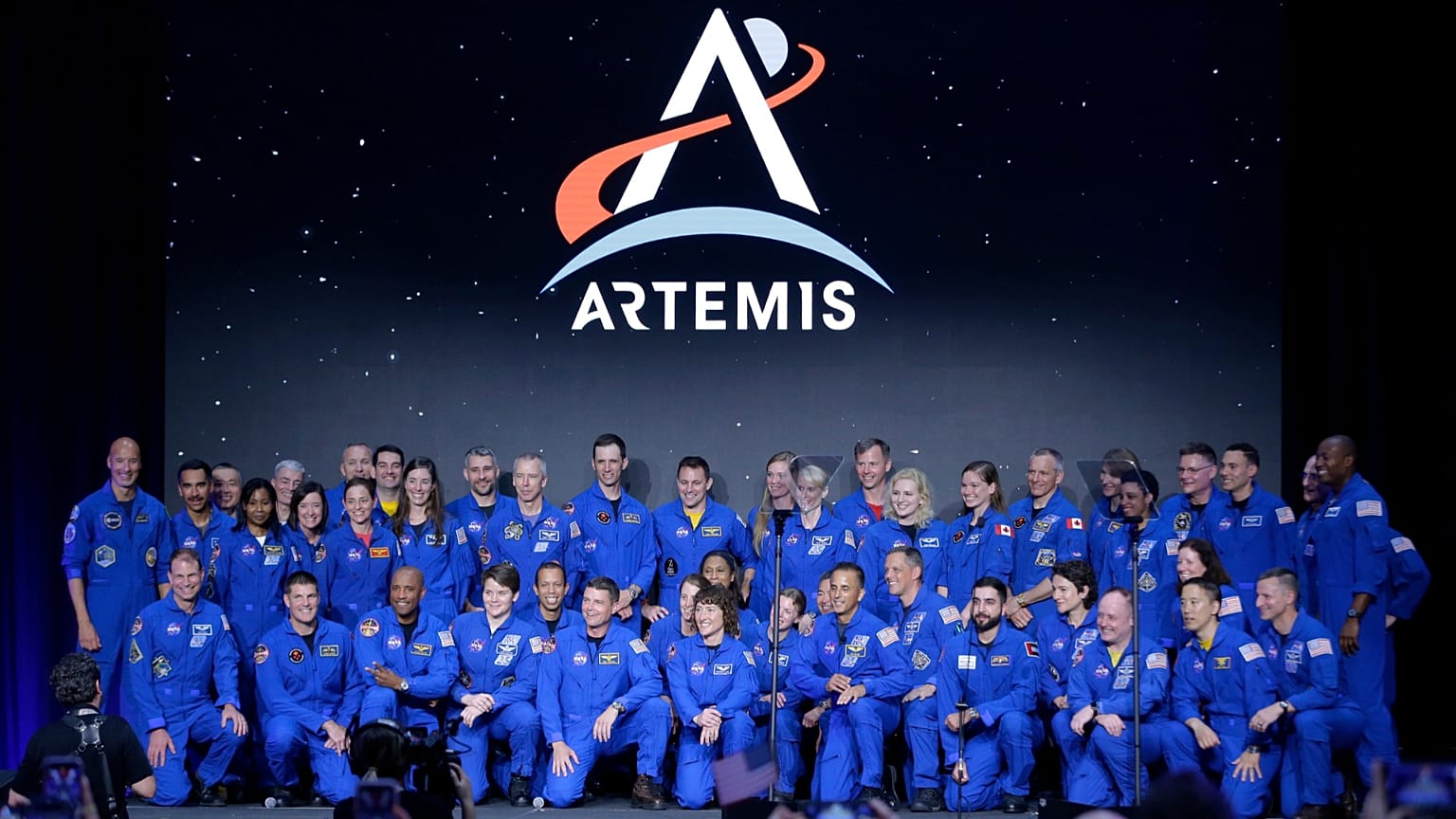
NASA Astronauts will soon be heading back to the Moon for the first time in 50 years - but why are they going, who’s going, and what will they get up to?
For the first time in more than half a century, humans are preparing to venture back towards the Moon.
NASA's Artemis II mission, scheduled for launch on 6 February this year, will send four brave astronauts on a daring journey around the Moon, before returning to Earth's atmosphere at a record speed of approximately 25,000 miles per hour (40,000 km/h).
While the voyage will not include a Moonlanding, it represents a key step in the United States' plan to establish a long-term human presence beyond low Earth orbit.
Here’s a full lowdown on the Artemis II mission and why you should be tuning in for when it launches.
What is Artemis II?
Artemis II is the second mission in NASA'as Artemis programme, launched in 2017 to return humans to the Moon and eventually send astronauts to Mars. It will also provide important data that will be used for future Moon missions
It follows Artemis I, an uncrewed test flight that successfully orbited the Moon in late 2022.
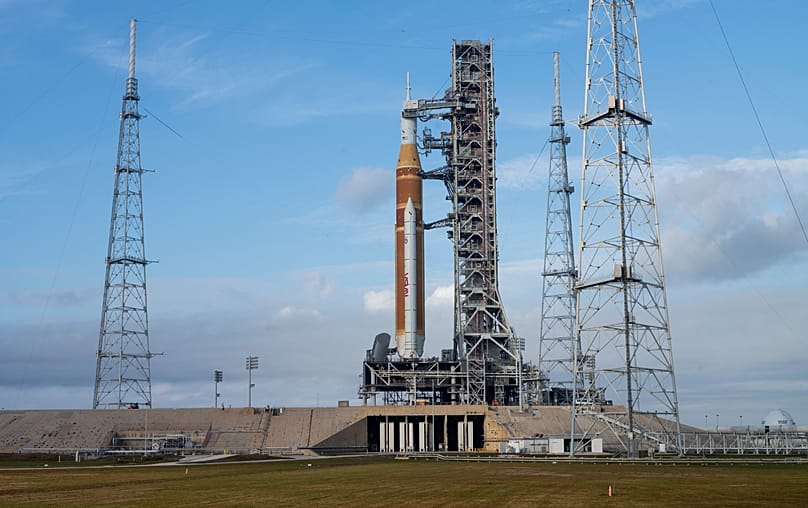
For Artemis II, astronauts will fly aboard NASA's newOrion spacecraft, launched on the Space Launch System (SLS) rocket.
It will be the first time humans have flown on either vehicle, and the first time any crew has travelled near the Moon since Apollo 17 in 1972.
Why won’t the mission land on the Moon?
Unlike later Artemis missions, Artemis II is not designed to put astronauts on the lunar surface. Instead, the crew will orbit the Moon, passing around its far side before returning to Earth.
The mission is intended as a full end-to-end test of the systems that will eventually be used for landing missions.
NASA is using Artemis II to prove that its spacecraft, rocket and life-support technologies are safe and reliable enough to carry humans into deep space.
Artemis II mirrors Apollo 8, the 1968 mission that first sent astronauts around the Moon without landing.
What is the significance of this mission?
Although it may appear modest compared with a Moon landing, Artemis II carries significant political and strategic weight.
Sending humans beyond low Earth orbit requires long-term funding commitments, reliable technology and sustained political support.
Crewed missions signal seriousness in a way robotic missions do not, giving international partners and commercial companies the confidence to align their own plans with NASA's timeline.
“This is a massive milestone for NASA and the Artemis programme because this is going to be the first time that a crew of humans will see the far side of the Moon, and is such an important milestone in NASA's eventual goal of getting two feet, human feet, back on the lunar surface," said John Pernet-Fisher, a research fellow at the University of Manchester.
"It's also exciting because it's a huge technological achievement. The huge new rocket and the spacecraft that they're riding in, and they're also going to be the fastest moving humans that have ever existed on reentry when they come back into the Earth's atmosphere. We expect them to be going about 25,000 mph," he added.
Who will be onboard?
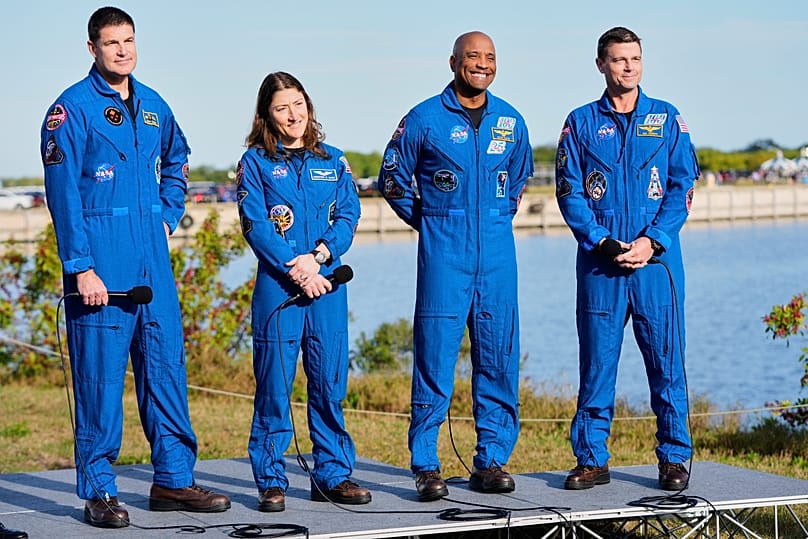
The Artemis II crew will consist of four astronauts, including three Americans, Reid Wiseman, Victor Glover, and Christina Koch, and one Canadian, Jeremy Hansen.
Canada’s participation highlights the international nature of the Artemis programme, which now includes more than 60 countries signed on to the Artemis Accords.
What will the astronauts do during the mission?
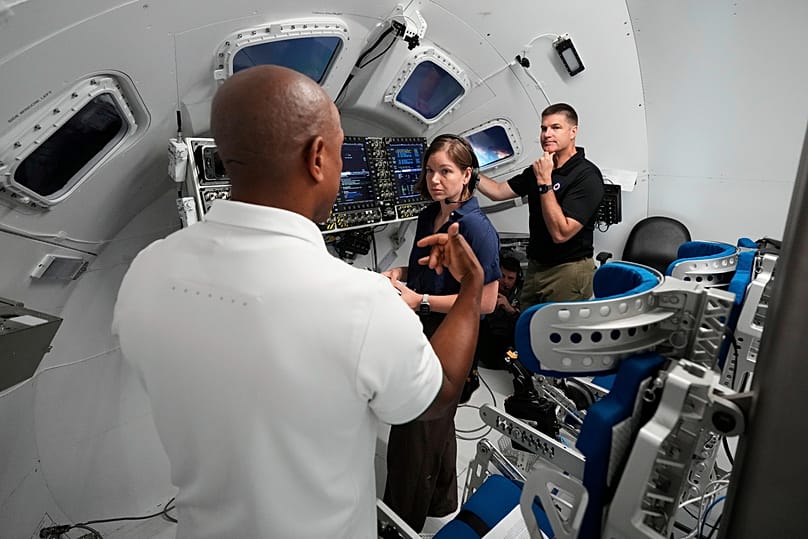
Shortly after launch, the crew will begin testing Orion’s core life-support systems, including air, water and safety equipment.
This will also be the first time astronauts test a deep-space toilet system - a notable upgrade from the Apollo era, when crews relied on so-called “relief tubes".
“SLS and the Orion module that’s going to sit atop it is basically the next generation of rocket technology," said Pernet-Fisher.
"So back in the Apollo days, we had the Saturn V with the Apollo module on top. These are the modern equivalents, and specifically the SLS, the Space Launch System, is designed to be such a large rocket that it’s actually capable of perhaps even going a bit further eventually in the future."
He said that if NASA continues on this path, "it could well see missions to Mars, it could see things going deeper into space, for instance, it's been suggested that it's powerful enough to reach Jupiter, for instance."
How long is the mission expected to last?
An estimated 10 days, from launch to splashdown.
What comes after Artemis II?
If the mission is successful, it will pave the way for Artemis III and future missions aimed at building a human presence on and around the Moon, including the Lunar Gateway space station.
Europe made
The Orion craft relies on the German-made European Service Module for air, water and propulsion. It is a cylindrical module that provides electricity, water, oxygen and nitrogen, as well as keeping the spacecraft at the right temperature and on course.
Airbus defence chief: Europe could make 'quantum leap' in space but must abandon 'grand schemes'
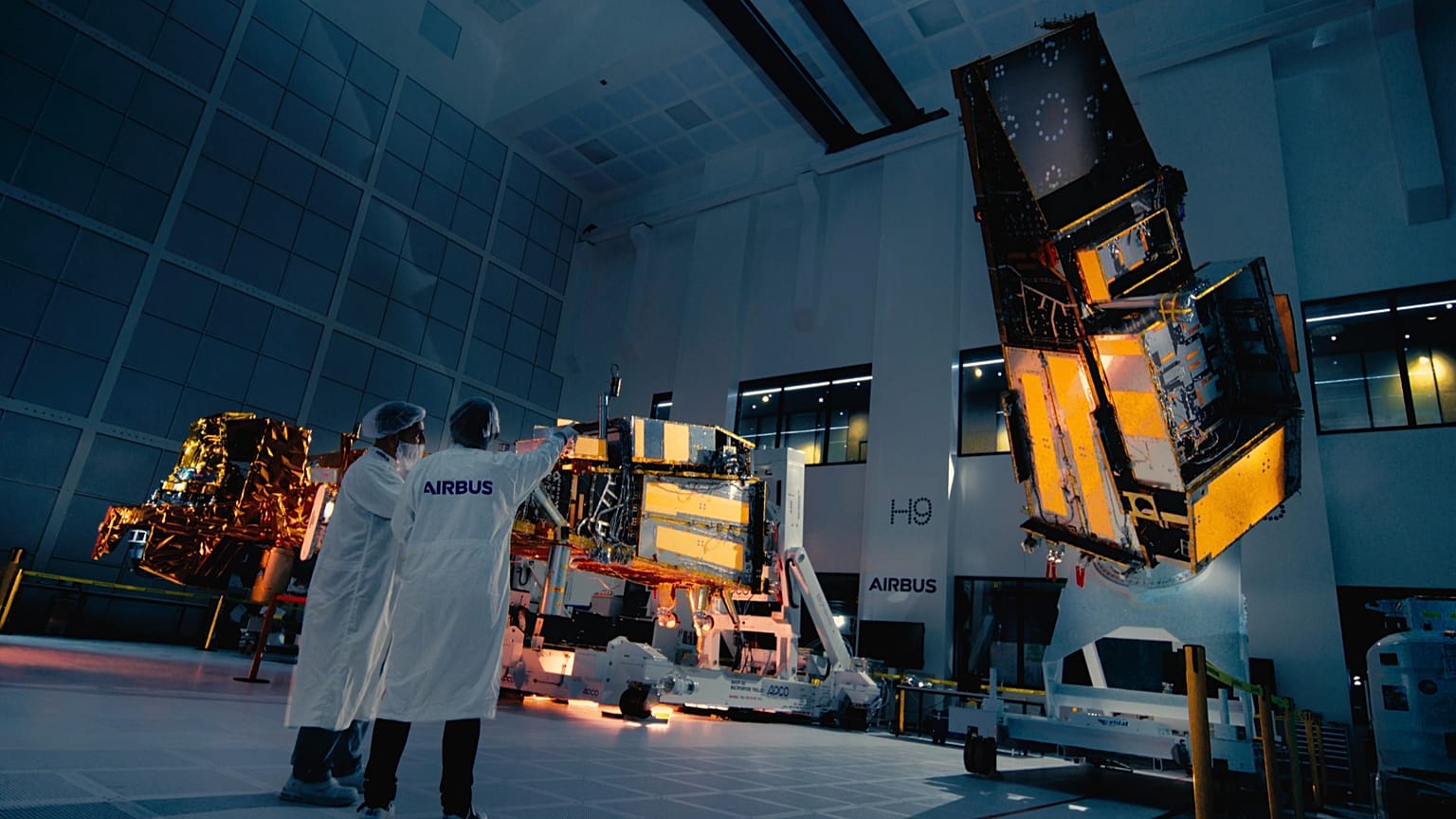
The EU's answer to Elon Musk's Starlink system will only be operational in 2029. As the CEO of Airbus Defence and Space sees it, the EU went about it completely the wrong way.
Europe has the chance to make a "quantum leap" in space technology over the coming years and boost its defences, but only if the EU stops wasting years on "grand schemes", Airbus Space and Defence CEO Michael Schöllhorn told Euronews.
The continent risks falling further behind in space unless it moves quickly from planning to action, Schöllhorn said.
“We have a gap when it comes to what I call active space defence, being able to act, protect, and counteract in space against adversaries that want to do something to our infrastructures, to our satellites,” he said.
The European Commission has pitched a so-called Space Shield as part of its Defence Readiness Roadmap, which aims to significantly bolster the bloc's ability to defend itself before 2030.
Space is seen as crucial to that effort, notably when it comes to intelligence, surveillance and reconnaissance as well as fast and secure communication. Strategic enablers, which include space assets, are now designated a priority area for investment by the European Commission.
For Schöllhorn, one of the problems that explains the space capability gap is one of scale, with European companies much smaller than their US counterparts. He attributes this to governments under-investing over the last several decades due to a lack of understanding about the strategic importance of space.
'A quantum leap' before 2030
The Commission's plan to rearm Europe aims to secure €800 billion of investment in the sector before 2030, especially in the nine priority areas that include strategic enablers, ammunition, air and missile defence, and drones.
Germany, which has opted against using any of the financial instruments the EU's executive has come up with to boost defence spending, has announced a €500 billion package for the next four years, including €35 billion for military space defence.
“What the Americans have always had is a budget at least 10 times (the size of the EU's). Even with everything that the Europeans are spending now, there's still at least three times higher budget in the US than compared to Europe – and that doesn't even take into account all the things that we call 'black programmes',” he said.
Airbus, Leonardo and Thales signed a Memorandum of Understanding in October 2025 to form a major joint venture that will merge their respective space activities into a single European space company. But even after joining forces, the resulting company would only be the fourth biggest in the world behind Lockheed Martin, SpaceX and Boeing, Schöllhorn said.
Still, he is upbeat about Europe's ability to catch up fast, telling Euronews that European industry will ultimately have the means and the capacity to meet the demand from member states.
"It depends again on the system, but I think before the decade’s over, we can have a quantum leap in terms of capability building,” he said – while warning that this can only happen if authorities provide industry with "practical definitions of programmes and solutions" so that companies can get started.
'Grand schemes on paper are worth nothing'
Schöllhorn also warned that excessive bureaucracy could undermine those ambitions, calling for the "unwinding" or "curbing back" of some regulations, and to rethink outdated rules that he said are no longer adapted because they were set up "when the world was totally different".
The way the EU went about defining its Infrastructure for Resilience, Interconnectivity and Security by Satellite (IRIS²) project "was an example of how not to do it", he said.
IRIS² is a planned multi-orbital constellation of 290 satellites that aims to support a large variety of governmental applications in surveillance, crisis management, connection and protection of key infrastructures as well as security and defence that was approved in 2024.
It is meant to be the EU's improved version of Elon Musk's Starlink, but is well behind that system's progress.
"Well, Starlink is on its third iteration," Schöllhorn said. "We, excuse me for saying it so clearly, thought politically so arrogantly that we can surpass them in one go in a few years. That's not a good definition of a programme."
Instead, he said, the EU should have acted fast by using what was already available and then building on that.
IRIS² is now expected to be operational in 2029.
Ultimately, Schöllhorn said, Europe must prioritise concrete action over lofty ambitions. "Grand schemes on paper are worth nothing," he said.
.jpg)
How a base on the moon might look (Image: NPO Lavochkin)
January 30, 2026
By World Nuclear News
Roscosmos has signed a contract with NPO Lavochkin for the creation of a Russian lunar power station by 2036 – with an expectation it will necessitate three missions to the Moon, in 2033, 2034 and 2035.
Roscosmos, Russia’s federal space agency, said the purpose of the nuclear power station on the moon would be “long-term power supply to consumers (moon rovers, observatory) of the Russian Lunar programme, as well as infrastructure facilities of the International Lunar Research Station (including facilities of foreign partners)”.
As part of the power plant project, which features Roscosmos, Rosatom and the Kurchatov Institute, there will be development of spacecraft, ground-based experimental testing, flight tests and deployment of infrastructure to the Moon. Roscosmos said the project was “an important step toward creating a permanent scientific lunar station and transitioning from one-time missions to a long-term lunar exploration programme”.
According to Interfax, Vasily Marfin, CEO of NPO Lavochkin, said during his presentation at the plenary session of the 50th Academic Readings on Cosmonautics in Memory of Korolev, the missions in 2033 and 2034 would be for support and infrastructure delivery, with the power module transported to the Moon in 2035.
He was reported to have stressed the complexity of the project and the uncertainties, and added: “The power module is being developed in cooperation with Rosatom and under the scientific supervision of the Kurchatov Institute.”
Russia and China have signed agreements over recent years to cooperate on the creation of a lunar base – with China National Space Administration and Roscosmos leading cooperation on the development of the International Lunar Research Station (ILRS).
A number of other countries, including Belarus, South Africa and Serbia, have signed up to participate in the project which, according to China’s official Xinhua news agency, is expected to be built in three phases in the 2030s.
It also reported in 2024 that Chinese researchers were considering basalt as a material to build the lunar base – using local materials on the moon would save large costs compared with sourcing materials from Earth.
The Reuters news agency reported last year on China’s ‘555’ plan – which aims to invite 50 countries, 500 international scientific research institutions, and 5,000 overseas researchers to join the ILRS.
There are also other projects looking at establishing permanent lunar bases, including using nuclear energy as a power source. Earlier this month NASA and the US Department of Energy said they had recently signed a memorandum of understanding to solidify their collaboration and advance the “vision of American space superiority” set out in an Executive Order signed by US President Donald Trump on 18 December. As well as “returning Americans to the Moon by 2028” – through the Artemis Program – this order includes deploying nuclear reactors on the Moon and in orbit, including the development of a lunar surface reactor by 2030.
In Europe, France’s Framatome and the Italian Agency for New Technologies, Energy and Sustainable Development, ENEA, announced last September that they were to explore advanced technological solutions for nuclear reactors to power future settlements on the Moon. Their memorandum of understanding covers three areas: studies regarding the fuel required for the reactor, with a view to ensuring both efficiency and safety; the development of new materials capable of withstanding the extreme conditions in space; and the use of additive manufacturing for reactor components.

No comments:
Post a Comment