It’s possible that I shall make an ass of myself. But in that case one can always get out of it with a little dialectic. I have, of course, so worded my proposition as to be right either way (K.Marx, Letter to F.Engels on the Indian Mutiny)
Friday, January 30, 2026
3D visualization of internal defects in concrete to help improve aging infrastructure
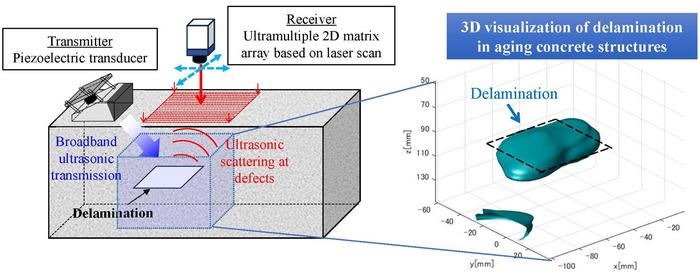
A Schematic illustration of the auto-frequency-adaptive PLUS for 3D visualization of internal defects in concrete structures (left), and 3D imaging results of delamination in highly attenuative materials (right).
An international research team led by Yoshikazu Ohara from Tohoku University's Graduate School of Engineering, in collaboration with Los Alamos National Laboratory in the United States, has made it possible to visualize hidden defects inside aging concrete infrastructure in 3D, potentially strengthening the efficiency of infrastructural maintenance.
Details of the research were published in the journal Applied Physics Letters on Janauary 26, 2026 and has been selected as a Featured Article.
Aging concrete in tunnels, bridges, and highways has led to a growing number of structural failures and accidents worldwide, with internal structural defects, typically undetectable by the naked eye, being responsible more often than not. Since visual inspection and hammer-sounding tests can only reveal surface defects and defects in shallow regions, structural engineers have turned to ultrasonic testing for inspections. This has been aided by the advance of ultrasonic phased array systems.
Ultrasonic phased array systems use multiple small ultrasonic transducers arranged in a single probe, allowing devices to steer and focus ultrasonic waves electronically. Originally designed for medical diagnostics, these systems create detailed cross-sectional images by sending pulses into a material and analyzing the echoes that return. Still, concrete exhibits extremely high ultrasonic attenuation, meaning the signal gets weaker the deeper you go, making it difficult for current phased-array systems to internally probe aging concrete structures.
Ohara and his team overcame this challenge by improving their previously developed PLUS system. Ohara says, "Our previous system combined a piezoelectric transmitter with a laser-based reception to create an ultra-multiple two-dimensional matrix array receiver. On this occasion, we advanced the technology by integrating a broadband transmission-reception system capable of automatically selecting the optimal frequency for inspection targets."
This "Auto-frequency-adaptive PLUS" successfully achieved three-dimensional visualization of a wide variety of internal defects in concrete.
This breakthrough makes it possible to visualize hidden defects inside aging concrete infrastructure in 3D, with the team expecting it to support the long-term sustainability of vital infrastructure. "By identifying hazardous regions that are otherwise undetectable, the technology enables repair efforts to be focused where they are most needed, improving maintenance efficiency," adds Ohara.
A new multifunctional composite made of carbon fiber-reinforced polymers (CFRP) and piezoelectric materials can use vibrations to self-detect tiny cracks. This material could be used in the aerospace, automotive, and construction industries to monitor structural health without the need of an external power source.
The technology was shared in a paper published in the International Journal of Smart and Nano Materials on January 9, 2026.
"CFRP is very strong and light. It's used in airplanes, wind turbines, and other large structures. However, it can fail suddenly when cracks grow inside. Finding these cracks early is difficult and many structures cannot easily use batteries or wired sensors. A self-powered sensing solution is strongly needed," said assistant professor Zhenjin Wang of Tohoku University.
To make CFRP smarter, the researchers integrated a piezoelectric nanocomposite that converts mechanical energy into electrical energy. The piezoelectric nanocomposite is made of piezoelectric nanoparticles and epoxy, which helps balance electrical performance and mechanical strength. For practical use in aircraft and energy systems, the team used a lead-free piezoelectric material, potassium sodium niobate (KNN), instead of conventional lead-based ceramics. This supports safer and more environmentally friendly sensing technologies.
"Our material turns vibration into information. Crack growth can be reflected in the timing of the wireless signals, which enables fully autonomous structural monitoring to support safer aircraft and energy systems," said Wang.
Researchers tested both the mechanical strength of the composite and its ability to generate electricity. Under vibration, the material produced an open-circuit voltage of up to 13.6 V. More importantly, when artificial cracks were introduced between the CFRP and the piezoelectric nanocomposite layers, the output voltage and resonant frequency decreased as the cracks became longer. This means the material does not only harvest energy, but it can also "sense" internal damage through changes in its electrical response.
Based on this behavior, the team proposes a new approach that combines energy harvesting, sensing, and structural health monitoring in a single material system. With the piezoelectric "brain," the CFRP can harvest electricity from vibration and use it to monitor key conditions such as acceleration and pressure, while sending the data wirelessly to a computer without any external power supply. In addition, internal damage such as delamination can be detected by analyzing changes in the timing of the received wireless signals.
"Today, inspections need sensors, wires, and power supplies. This new material works by itself. It reduces cost, weight, and maintenance, and improves safety in places where power is limited," said Wang. "In addition to supporting safer aircraft and energy systems, our research will help future smart materials research and advance battery-free sensor technology."
Looking ahead, researchers are thinking about the different ways this multifunctional composite could be used for next-generation self-powered structural health monitoring systems. Additional testing will be needed to confirm the durability and stability of the composite to determine its practical uses.

No comments:
Post a Comment