Showing posts sorted by relevance for query REPRODUCTIVE FREEDOM. Sort by date Show all posts

Friday, August 23, 2024

Commentary

Freedom—Harris’s message to America


Elaine Kamarck and William A. Galston
BROOKINGS INSTITUTE 
August 23, 2024

Many of the convention speeches invoked references to freedom.

Surprising some observers, Harris laid out a tough agenda on defense and foreign policy, promising to maintain the strongest and most lethal fighting force in the world, retain our leading position in NATO, defend Ukraine against Russian aggression, stand up against Iran and North Korea, and take democracy’s side in the struggle with tyranny.

Taken as a whole, Harris’s acceptance speech positioned her as a center-left Democrat in the mold of Joe Biden rather than Bernie Sanders.
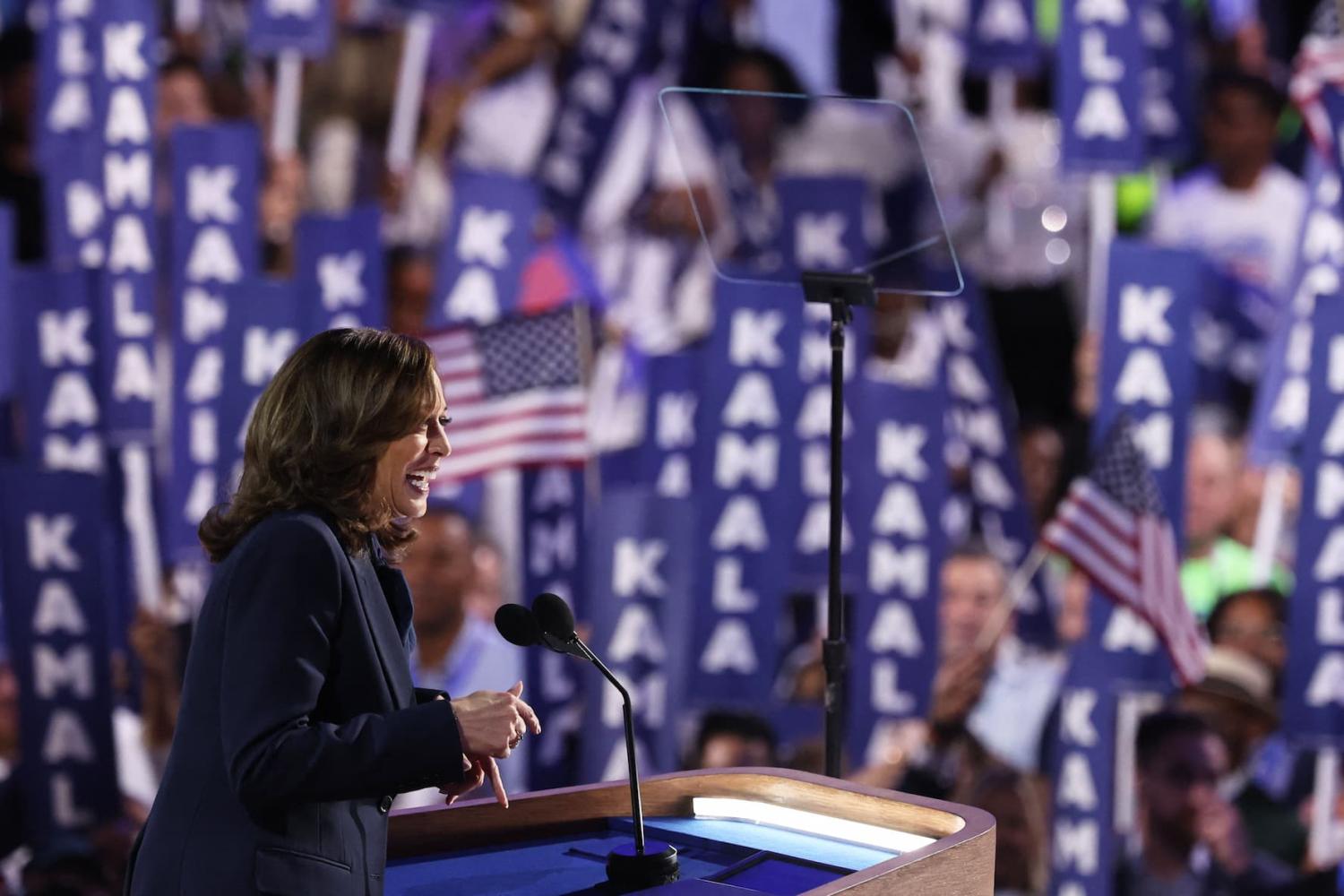
Democratic presidential nominee and U.S. Vice President Kamala Harris speaks on Day 4 of the Democratic National Convention (DNC) at the United Center in Chicago, Illinois, U.S., August 22, 2024. REUTERS/Mike Blake

Governance Studies Media Office
gsmedia@brookings.edu


In their 2024 national convention, Democrats reclaimed the mantle of freedom.

It’s about time.

The first indication was Vice President Harris’s choice of BeyoncĂ©’s song “Freedom” as her campaign anthem. It has been playing at her rallies and it played at the end of the film before her entrance onto the stage. In addition to placards that said, “Thank you Joe” or “Vote” or “Coach Walz,” the DNC had thousands of placards printed for the delegates to wave that simply read, “Freedom.” Many of the convention speeches invoked the term in some way. Governor Walz’s acceptance speech for the vice presidency was especially heavy on it:

“Freedom. When Republicans use the word freedom, they mean that the government should be free to invade your doctor’s office. Corporations—free to pollute your air and water. And banks—free to take advantage of customers.

“But when we Democrats talk about freedom, we mean the freedom to make a better life for yourself and the people that you love. Freedom to make your own health care decisions. And yeah, your kids’ freedom to go to school without worrying about being shot dead in the hall.”

Freedom was an especially welcome theme in this convention because, in recent political history, Democrats ceded freedom to the Republicans. This was wrong. Nothing is as central to America’s cultural DNA as freedom. After all, we as a nation were born out of a desire for freedom from King George.

One of the seminal speeches of the 20th century was President Franklin Delano Roosevelt’s 1941 State of the Union address. In it, he announced what he called the “Four Freedoms”—freedom of speech and expression, freedom of worship, freedom from want, and freedom from fear—principles that were incorporated into the war aims of the Allied Powers, and eventually into the UN’s Universal Declaration of Human Rights.

A generation later, the Civil Rights Movement marched for freedom from the oppression of segregation and unequal citizenship, goals that the modern Democratic Party embraced. After the Roe v. Wade decision was handed down in 1973, Democrats defended women’s freedom to choose against conservative attempts to restrict access to abortion, and even to prohibit it nationwide.


Since the 1980s, however, Republicans claimed freedom for themselves; starting with the presidency of Republican Ronald Reagan, they narrowed it to mean free markets and limited government. This redefinition rested on the argument that government represented the main threat to freedom, which is at best a half-truth. Yes, government can become oppressive. But weak government can also pose a threat to freedom. Citizens cannot live free from fear unless government minimizes threats to the security of persons and property as citizens act within the structure of law. They cannot enjoy freedom from want unless government protects markets from force, fraud, and threats to competition, and unless it protects individuals from economic privation. In his 1944 State of the Union, FDR declared: “Necessitous men are not free men. Men who are hungry and out of a job are the stuff of which dictatorships are made.”

Despite the power of such arguments, modern Democrats have found it difficult to persuade the electorate that they were the true champions of freedom. And then in 2022, the Supreme Court handed down the Dobbs decision, which overturned Roe v. Wade and jeopardized women’s freedom of choice across the nation. The reaction has been striking; with one decision, the government was suddenly in the middle of the most personal decisions women and men could make.

Since then, not a month has passed without some horror story making national news about a woman denied abortion care that could save her life and/or her fertility. On stage at the Democratic convention, some of these women told their heartbreaking stories. Since then, abortion has been on the ballot in seven states—many of which, like Kansas and Kentucky, are conservative, deep red states. And in every single instance, the pro-choice position won. Since then, abortion has played a major role in the Virginia legislative elections, the congressional midterm elections, and many special elections. In 2024, abortion referendums will be on the ballot in eight states, two of which, Arizona and Nevada, are swing states and where the issue may very well bring out young Democratic voters.

Against this backdrop, it’s not surprising that Harris’s speech spent more time on abortion than any other single policy issue. Her unique ability to prosecute this issue was evident back when she was a senator from California who asked then-Supreme Court nominee Brett Kavanaugh if he could think of a law that controlled men’s bodies. In addition to warning the country about Republican plans to take away reproductive freedom by enacting a national abortion ban and installing a national anti-abortion coordinator in the White House, Harris expanded on threats to freedoms.

“In this election, many other fundamental freedoms are at stake. The freedom to live safe from gun violence—in our schools, communities, and places of worship. The freedom to love who you love openly and with pride. The freedom to breathe clean air, drink clean water, and live free from the pollution that fuels the climate crisis. And the freedom that unlocks all the others. The freedom to vote.”

Beyond the articulation of a freedom agenda, the speech had other tasks, which Harris crisply carried out. She introduced herself to the country as a child of a middle-class family and declared that building a strong middle class would be one of the defining purposes of her administration. To that end, she advanced her vision of an “opportunity economy” where everyone would have a chance to compete and where success for some need not mean failure for others.

Harris took on inflation and immigration, two areas of potential vulnerability for her campaign. She promised to bring down prices of everyday goods and services and to attack the nation’s housing crisis. On immigration, she sought to turn the tables on Donald Trump, reminding her audience that he had subverted a bipartisan reform bill that would have helped secure the border.

Surprising some observers, Harris laid out a tough agenda on defense and foreign policy, promising to maintain the strongest and most lethal fighting force in the world, retain our leading position in NATO, defend Ukraine against Russian aggression, stand up against Iran and North Korea, and take democracy’s side in the struggle with tyranny. She articulated a firm pro-Israel stance while mentioning the suffering of Gaza’s inhabitants and endorsing Palestinians’ right to dignity and self-determination.

Taken as a whole, Harris’s acceptance speech positioned her as a center-left Democrat in the mold of Joe Biden rather than Bernie Sanders. It embraced what she termed the pride and privilege of being an American. And as if to show that Republicans have not cornered the market on patriotism and American exceptionalism, she told her audience that together, they had the opportunity to write the next chapter of the most extraordinary story ever told. She ended her speech in the most traditional way imaginable, by asking God to bless the United States of America.

Harris’s speech, which the convention received with unfeigned enthusiasm, did nothing to interrupt the momentum of one of the most explosive campaign launches in American history.


Authors


Elaine KamarckFounding Director - Center for Effective Public Management, Senior Fellow - Governance Studies@EKamarck


William A. GalstonEzra K. Zilkha Chair and Senior Fellow - Governance Studies

Wednesday, December 08, 2021

Filibuster Reform for Debt Ceiling Fight 
But Not Voting Rights or Reproductive Freedom?

"If our senators are willing to suspend the filibuster to protect our economy, they should be willing to suspend it to protect our democracy and our freedom to vote."


Advocates of killing the filibuster protest at the Manhattan office of Senate Majority Leader Chuck Schumer (D-N.Y.) on July 26, 2021. (Photo: Erik McGregor/LightRocket via Getty Images)


JESSICA CORBETT
COMMONDREAM
December 7, 2021

Progressives on Tuesday responded to reports that U.S. Senate leadership reached a deal to allow Democrats to raise the nation's debt ceiling by suggesting similar maneuvers on other key priorities for the party, from voting rights and reproductive freedom to gun violence prevention and immigration reform.

"Faced with the frightening prospect of the United States defaulting on our debt, the proposed solution is a convoluted legislative maneuver that highlights the Senate's growing dysfunction," said Sean Eldridge, president and founder of the progressive advocacy group Stand Up America.

"This deal makes clear the need to reform the filibuster to make the Senate work for the American people," he added. "If our senators are willing to suspend the filibuster to protect our economy, they should be willing to suspend it to protect our democracy and our freedom to vote."

In a tweet Tuesday, Stand Up America highlighted two specific pieces of legislation that Republicans in the evenly split Senate have prevented from reaching President Joe Biden's desk: the Freedom to Vote Act—a compromise that followed the twice-blocked, bolder For the People Act—and the John R. Lewis Voting Rights Advancement Act.

"Allowing the 33 voter suppression laws passed by state Republicans this year to go into effect isn't an option," the group said. "Senate Democrats must end the filibuster to pass the Freedom to Vote Act and the John Lewis Voting Rights Act. Our democracy depends on it."

Earlier in the day, responding to reporting by Punchbowl News, Stephen Spaulding of the group Common Cause noted that the deal "will increase pressure for doing something similar" on other top legislative issues.

Along with passing the voting rights bill named for the late John Lewis, the Democrat-controlled U.S. House of Representatives recently approved the Women's Health Protection Act, which has gained greater attention as the right-wing majority Supreme Court has heard arguments for a case that could reverse abortion rights affirmed by Roe v. Wade in 1973.

GOP state legislators' growing attacks on both voting rights and reproductive freedom this year have fueled demands for U.S. Senate Democrats to reform or fully kill the filibuster so they can swiftly advance legislation on both issues. However, a couple of key Democrats—namely Sens. Joe Manchin (W.Va.) and Kyrsten Sinema (Ariz.)—remain opposed to such a move.

Rather than Democrats taking broader action related to the filibuster or garnering Republican support to raise the debt ceiling before the rapidly approaching December 15 deadline, Senate leaders have settled on "a complicated legislative maneuver to help them stave off another high-stakes battle and prevent the U.S. government from experiencing a catastrophic default," according to The Washington Post.

The newspaper noted that each party's top Senate member—Majority Leader Chuck Schumer (D-N.Y.) and Minority Leader Mitch McConnell (R-Ky.)—"expressed a measure of confidence that they had the votes to proceed with their plans, while Speaker Nancy Pelosi (D-Calif.) put the House on track to adopt the measure Tuesday evening."

Politico reported that "at a party leadership meeting on Tuesday, McConnell pitched his lieutenants on a convoluted strategy that would require at least 10 Republicans to approve legislation that would later allow Senate Democrats to raise the debt ceiling by a simple majority vote. Though Republicans would still be facilitating an easier debt ceiling increase for Democrats by carving out an exception to the Senate's supermajority requirement, it's increasingly likely enough Republicans view it as the least-bad scenario."

Explaining that filibuster rules would be suspended for about a month to increase the debt ceiling, Politico added:

But it would require Democrats to raise the debt ceiling to a specific number rather than suspend it for a length of time, such as through the election.

Republicans can tout that as a key concession, while Democrats successfully rebuffed Republicans' efforts to force them to use the more cumbersome budget reconciliation process to raise the debt ceiling. The debt increase would likely range from $1.5 trillion to $2 trillion to ensure Congress won't have to address the debt again before November midterms, according to several people familiar with the matter.

While Politico noted that this is "a stunning turnaround for McConnell," another Republican leader made clear the maneuvering is a political calculation.

"I'm going to support Democrats raising the debt ceiling without Republican votes," Sen. John Cornyn (R-Texas) told the outlet on Tuesday. "To have Democrats raise the debt ceiling and be held accountable for racking up the debt is my goal. And this helps us accomplish it."

Our work is licensed under Creative Commons (CC BY-NC-ND 3.0). Feel free to republish and share widely.


Wednesday, August 21, 2024

 USA

The Fightback on Reproductive Rights


Monday 19 August 2024, by Marian Jones


Since Roe v. Wade was overturned, women’s rights to abortion and, more broadly, to safe reproductive health care have been under attack. In response, women have organized at the grassroots to build local and state-wide coalitions to resist and defend their reproductive rights. Women’s resistance has broad political implications. Reproductive freedom has become one of the central issues of the 2024 presidential campaign and could even decide it.

Recent conservative Court decisions, particularly the 2021 Dobbs v. Jackson Women’s Health Organization case, have had a significant impact on the rights of pregnant people, the indigent, and broad health care access. In Dobbs, the Supreme Court ruled that the right to abortion is not protected by privacy under the 14th Amendment’s Due Process Clause of the Constitution, effectively overturning Roe v. Wade and Planned Parenthood v. Casey. Because of Dobbs’ preemption, many abortion-related lawsuits have been lost, new bans have been passed, and the criminalization of pregnancy is at an all-time high. All of which is causing uncertainty and barriers to care, thus exacerbating health care disparities.

Since the Dobbs ruling, numerous court cases have challenged existing abortion protections, leading to the prohibition of abortion services in many states, with 13 states having trigger laws to outlaw abortion as soon as Roe was overturned. [1]

Many of these states, particularly in the South, have a large number of poor women, disproportionately Black and Latinx, who will likely have to travel outside of state to get abortion services. Those who cannot may seek telemedicine to get medicated abortions. However, medical abortions can be more painful, causing severe cramping over a longer period than surgical abortions. A number of states—Colorado, Massachusetts, New York, California, Vermont, and Washington—have shield laws that protect medical providers who may offer abortion services to people living in red states that ban or restrict abortion access in the wake of Dobbs v. Jackson. However, these laws may be challenged in court, but for the time being, from October to December 2023, an average of 8,000 people per month in red states received medical abortions from doctors protected by shield laws. Aid Access and the Massachusetts Medication Abortion Access Project operate nationally, while the groups Abuzz and Armadillo, ship to states with abortion bans, but not to every state. [2]

The bans on abortion not only block immediate pregnancy-related treatment but also exacerbate existing health disparities. Abortion seekers are more often than not Black and indigent, and already have children. Because of the multiplicity of oppressions that pregnant people of color face, including racial oppression, it is more difficult for them to afford the transportation, social support, and childcare needed to go to a clinic for an abortion. Still, in the United States Black women account for the highest percentage of abortions. [3]

The impact of abortion bans on marginalized communities, particularly women of color, and the efforts of grassroots organizations to promote reproductive justice and equitable health care in a post-Roe world are deeply intertwined. These movements have sparked legal challenges, political action, and grassroots efforts to push back against the erosion of reproductive rights. Despite setbacks, the fight for reproductive freedom continues to gain momentum across the country.

Grassroots organizations are playing a crucial role in advocating for the rights and well-being of women of color and vulnerable populations in the post-Roe world. Many reproductive rights groups have long been fighting to increase access to abortion, including prominent ones like Planned Parenthood and NARAL; many more have emerged or are ramping up their efforts in the wake of Dobbs. [4] Grassroots organizations like The Feminist Front and the National Latina Institute for Reproductive Justice are working to address these disparities and promote reproductive justice. [5]

In addition to working with other groups to provide assistance to reproductive justice groups in the Southwest, The Feminist Front also organizes seminars on reproductive justice and how abortion relates to white supremacy. In 2022, they protested Arizona’s Senator Kyrsten Sinema for not defending abortion rights and staged a sit-in in her office. [6]

Issues of economic and racial justice, as well as the rights of immigrants, are central to the work of the National Latina Institute for Reproductive Justice, which has been concerned about the situation of migrants in detention facilities and fights for legislation that addresses immigration in its entirety. Because of the overturning of Roe v. Wade and multiple anti-immigration policies in Texas, it is very difficult for immigrants to go across state boundaries to have the procedure. Fears about deportation and run-ins with the authorities only make matters worse. By focusing on the rights and welfare of migrants in detention facilities and fighting for fair and inclusive immigration policies, the Latina Institute seeks to tackle these issues from an intersectional perspective.

In response to the increasing restrictions on abortion, grassroots abortion funding organizations have emerged to help individuals afford abortions and the associated costs, such as travel, lodging, and childcare. These funds have played a crucial role in assisting people seeking abortions, particularly in states where access has become more limited. For example, Michelle Colon, founder of Shero in Mississippi, organized volunteers to drive women to Illinois, a journey of at least 10 hours, to obtain abortions. Laurie Bertram Roberts heads the volunteer-run Mississippi Reproductive Freedom Fund, which helps individuals access abortion services in Mississippi. Another organization, the Yellowhammer Fund, operates in Tuscaloosa, Alabama. Both of these organizations are part of the National Network of Abortion Funds, a crucial network consisting of over 80 abortion funds across the country that help lower-income individuals access abortion services. [7]

The number of individuals providing such assistance is dwindling, however, leaving fewer options for those in need. Fundraising increased for many of these organizations following the Dobbs decision, but they are now sounding the alarm that support is weakening as media coverage fades. For instance, there was a danger that, without further funding, the resources of The New York Abortion Access Fund would be exhausted by October 2023. Thankfully, this did not come to pass. [8]

Private medication abortions, which are increasingly popular among abortion rights activists, now constitute over 50 percent of all abortions in the United States. [9] Telehealth services like Hey Jane, Choix, and Abortion on Demand have expanded in states where abortion remains legal. [10] Since the Dobbs decision, virtual-only telehealth providers have facilitated 7,461 abortions per month in the first nine months, up from 4,025 per month before.

Additionally, underground networks run by groups like Las Libres and Red Necesito Arbortar have emerged to supply Americans with abortion pills from countries such as Mexico and India. [11] These networks provide an alternative for individuals who cannot or do not want to use official channels to access abortion care.

Grassroots formations can only do so much. Recent losses in the realm of reproductive rights beyond the scope of grassroots and underground networks include legal challenges like the outlawing of transporting a minor for an abortion in Tennessee, the imposition of legal penalties and fines for transporting individuals seeking abortions over state lines in Oklahoma and Idaho, and the enforcement of a six-week abortion ban in Florida, while in Alabama, in vitro fertilization has been prohibited. [12] The recent ruling in Alabama classifies frozen embryos as “human” whether or not they are inside or outside of the womb, causing several fertility clinics to stop treatment. The Alabama Supreme Court ruled that frozen embryos can be treated as children under the Wrongful Death of a Minor Act of 1872, stating that they are persons from conception, regardless of being in or out of the womb. [13] This judgment can be traced back to a recent wrongful death lawsuit involving a patient who accidentally destroyed frozen embryos at a clinic. While the right has been advocating for this prohibition privately, they are also cautious about discussing the issue publicly, as they fear it could alienate voters due to its severity. [14] The backlash has been so bad, in fact, that lawmakers in the state are trying to walk back the Alabama Supreme Court’s ruling. [15]

Former President Donald Trump, who has taken credit for Roe v. Wade being overturned, recently said abortion laws should be left to states. [16] Trump claimed falsely on Truth Social that the overturning of Roe v. Wade was universally desired (“we have abortion where everybody wanted it from a legal standpoint”). [17]He’s now saying he believes “the states will determine by vote or legislation, or perhaps both, and whatever they decide must be the law of the land.” [18] He’s also refusing to take a position on a national abortion ban wanted by members of his party. [19]

However, there have been some legal victories in the fight against abortion restrictions. Since the Dobbs decision 23 states have raised legal challenges against abortion bans. [20] Two red states, Kansas and Kentucky, had ballot amendments to end the right to abortion, but both failed. Kansas voters rejected a proposed constitutional amendment denying abortion rights, while Kentucky voters rejected a ballot measure denying constitutional protections for abortion, a fight that was led by Democratic Socialists of America and Kansans for Constitutional Freedom, among others. [21] Kentucky, however, has since passed a law outlawing abortion with very few exceptions. [22] Both ballot initiatives were defeated, sending a message to the GOP that their stance on abortion is extreme and at odds with public opinion.

Religious freedom challenges in defense of abortion have also arisen in several states. [23] In Florida, Indiana, Missouri, Kentucky, Utah, and Wyoming, individuals from a variety of religious backgrounds have argued that abortion bans infringe on the free exercise of their religion or violate state constitutional protections against the establishment of religion. Indiana’s Court of Appeals has granted a minor victory to individuals challenging the state’s abortion ban, arguing it violates a 2015 religious freedom statute, and it upheld the appeal filed by four people and Hoosier Jews for Choice. [24] In Missouri, Christian, Jewish, and Unitarian Universalist leaders sought a permanent injunction against an abortion ban, arguing that state lawmakers who supported the ban were imposing their personal religious beliefs on everyone. [25]

In some states, abortion will remain legal and available because the states have had policies in place prior to the Dobbs decision that protect access even in the absence of Roe. Since the Dobbs ruling, over forty lawsuits have been filed in multiple states, challenging abortion restrictions on the grounds that they infringe on various constitutional rights. [26] For instance, the right to privacy was cited as a basis for challenging Florida’s 15-week abortion ban, using the state constitution’s privacy clause as a legal argument. Similarly, in South Carolina, the right to privacy temporarily protected the right to abortion, blocking a six-week abortion ban. However, subsequent bans were later upheld after the state legislature passed new laws and new justices joined the court.

In Wyoming, a judge temporarily blocked a ban on the abortion pill, citing the right to privacy. [27] This case is still ongoing, and abortion pills remain legal. Wellspring Health Access (WHA), Wyoming’s only full-service abortion clinic, one of the nonprofits that brought suit over the abortion pill, is also separately suing the state to block a law imposing a near-total ban on abortion. WHA sued the state to stop its abortion “trigger ban” and won a preliminary injunction. The judge ruled that the ban could harm the plaintiffs before their lawsuit was resolved.

In response to a lawsuit by the Center for Reproductive Rights, a federal district court in Arizona temporarily blocked a law that gave fetuses, embryos, and fertilized eggs the same rights as Arizona citizens, deeming it “unconstitutionally vague.” [28] However, abortion remains illegal in Arizona due to an old law from the Civil War era. [29]

The Supreme Court’s decision in Dobbs has also had repercussions beyond abortion access. Organizations that assist pregnant individuals in Texas are now subject to civil and criminal liability. This has led to a chilling effect on reproductive health care providers in the state, with many hesitant to offer services for fear of legal repercussions. However, a U.S. District Judge issued an injunction to protect Fund Texas Choice from criminalization, ruling that the Texas attorney general cannot seek legal relief against providers or practitioners who help abortion seekers travel outside of Texas. [30] This ruling is critical as it stops states from being able to overreach and expand past their boundaries, and it serves as a beacon of protection in the midst of ongoing legal battles surrounding reproductive rights in Texas.

The recent conservative judicial decisions, particularly the Dobbs v. Jackson Women’s Health Organization case, have had a profound impact on women’s rights and health care access. These decisions have resulted in defeats in abortion-related legal cases, increased uncertainty and more barriers to care, and exacerbated health care disparities. Since many states have enacted abortion bans or restrictions that disproportionately affect marginalized communities, these groups suffer the most from these decisions. This further exacerbates health care disparities, as marginalized communities already face challenges in accessing quality healthcare. Grassroots organizations and reproductive rights organizations are working tirelessly to address these challenges and promote reproductive justice. Despite setbacks, the fight for reproductive freedom continues, with individuals and organizations advocating for accessible and equitable healthcare for all.

Because of the centrality of abortion to both Biden’s re-election campaign and the genocide in Gaza, it is possible that the abortion issue might rescue the Democrats from their current predicament related to the war in Gaza. There are new opportunities and challenges for organizations fighting for reproductive justice in the United States as reproductive justice issues seem to be swiftly becoming a cudgel for Democrats trying to convince an angry electorate to vote for them. How they will use this leverage is yet to be seen. Over 60 percent of adults in the United States think that abortion should be legal within certain limits. However, millions of women in this country still oppose abortion rights. Among those who defend abortion rights, a portion still vote for Trump or advocate not voting at all even though Biden is clearly in favor of reproductive rights.

New Politics

P.S.

If you like this article or have found it useful, please consider donating towards the work of International Viewpoint. Simply follow this link: Donate then enter an amount of your choice. One-off donations are very welcome. But regular donations by standing order are also vital to our continuing functioning. See the last paragraph of this article for our bank account details and take out a standing order. Thanks.

Footnotes

[1Elizabeth Wolfe, “13 states have passed so-called ‘trigger laws,’ bans designed to go into effect if Roe v. Wade is overturned,” CNN, May 3, 2022.

[2Nathaniel Weixel, “Red state abortion bans headed for clash with blue state shield laws,” The Hill, May 20, 2024.

[3Latoya Hill et al., “What are the Implications of the Dobbs Ruling for Racial Disparities?,” KFF, April 23, 2024.

[4Lornet Turnbull, “How grassroots funds are ensuring abortion access despite bans,” YES! Magazine, May 16, 2019.

[5Cynthia Via, “Intersectional activism in a Post-Roe world,” YES! Magazine, Oct. 13, 2022.

[6The Feminist Front (@thefeministfront),” Instagram.

[7ZoĂ« Beery, “What abortion access looks like in Mississippi: One person at a time,” New York Times, June 13, 2019; Turnbull, “How grassroots funds.…”

[8Maya Kaufman, “Officials tout New York’s abortion access, but financial hurdles persist,” Politico, June 26, 2023.

[9Rachel K. Jones et al., “Medication abortion now accounts for more than half of all US abortions,” Guttmacher Institute, Sept. 12, 2023.

[10Pam Belluck, “Abortions by telemedicine and mailed pills are safe and effective, study finds,” New York Times, Feb. 15, 2024.

[11Chloe Searchinger, “U.S. Supreme Court challenge to abortion pills could boost illegal imports | Think Global Health,” Council on Foreign Relations, April 5, 2024.

[12Chris Davis, “Two bills that would ban unauthorized out of state abortions and gender affirming care for minors, advances,” News Channel 5 Nashville (WTVF), April 11, 2024; Mel Leonor Barclay, Shefali Luthra, and Mel Leonor, “Florida Supreme Court approves abortion restriction—and ballot measure that would overturn it,” The 19th, April 1, 2024; Associated Press, “Facing backlash over IVF ruling, Alabama lawmakers look for a fix,” Sun Sentinel, Feb. 23, 2024.

[13Steve Bonitatibus, “How the Alabama IVF Ruling Is Connected to Upcoming Supreme Court Cases on Abortion,” Center for American Progress, May 3, 2024.

[14Guardian Staff Reporter, “John Oliver on Alabama’s IVF ruling: ‘It is chaos,’” The Guardian, Feb. 26, 2024.

[15Associated Press, “Facing backlash over IVF ruling, Alabama lawmakers look for a fix,” Sun Sentinel, Feb. 23, 2024.

[16Natasha Korecki and Jonathan Allen, “Trump says states should decide on abortion restrictions,” NBC News, April 8, 2024.

[17Daniel Dale, “Fact check: Trump makes wildly inaccurate claim that ‘all legal scholars’ on ‘both sides’ wanted Roe overturned,” CNN, April 8, 2024.

[18Lauren Irwin, “Schumer: ‘American people will see right through’ Trump’s abortion stance,” Yahoo News, April 9, 2024.

[19White House, “FACT SHEET: House Republicans Endorse a National Abortion Ban with Zero Exceptions in Latest Budget,” The White House, March 22, 2024.

[20Mabel Felix, Laurie Sobel, and Alina Salganicoff, “Legal challenges to state abortion bans since the Dobbs decision,” KFF, Jan. 30, 2023.

[21Sherman Smith and Lily O’Shea Becker, “Kansas voters defeat abortion amendment in unexpected landslide,” Kansas Reflector, Aug. 3, 2022; “Where can I get an abortion? | U.S. Abortion Clinic Locator”; Democratic Socialists of America, “Going on the offensive—your National Political Committee newsletter,” Democratic Socialists of America (DSA), Aug. 22, 2022; Annie Gowen, “How abortion rights organizers won in Kansas: Horse parades and canvassing,” Washington Post, Aug. 4, 2022.

[22“Where can I get an abortion? | U.S. Abortion Clinic Locator.”

[23Felix, Sobel, and Salganicoff, “Legal challenges.”

[24Isabella Volmert, “Lawsuit challenging Indiana abortion ban survives a state challenge,” AP News, April 4, 2024.

[25Associated Press, “Lawyers for religious leaders challenging Missouri abortion ban say law imposes beliefs on everyone,” US News & World Report, Nov. 16, 2023.

[26Lawrence O. Gostin, Sarah Wetter, and Rebecca B. Reingold, “One year after Dobbs—Vast changes to the abortion legal landscape,” JAMA Health Forum, vol. 4, no. 8 (Aug. 3, 2023): e233091.

[27Mead Gruver, “Judge blocks Wyoming’s 1st-in-the-nation abortion pill ban while court decides lawsuit,” AP News, June 22, 2023.

[28Brendan Pierson, “Abortion providers urge judge to block Arizona ‘personhood’ law,” Reuters, July 8, 2022.

[29Gloria Rebecca Gomez, “Abortions will be banned in Arizona after the Supreme Court upholds an 1864 law,” Arizona Mirror, April 10, 2024.

[30Fund Texas Choice, “Fighting for Abortion Access—Fund Texas Choice,” Fund Texas Choice, March 9, 2023.