Friday, April 10, 2026

Layoffs hit Kennedy Center again amid Trump's MAGA overhaul

Erik De La Garza
April 10, 2026 
RAW STORY


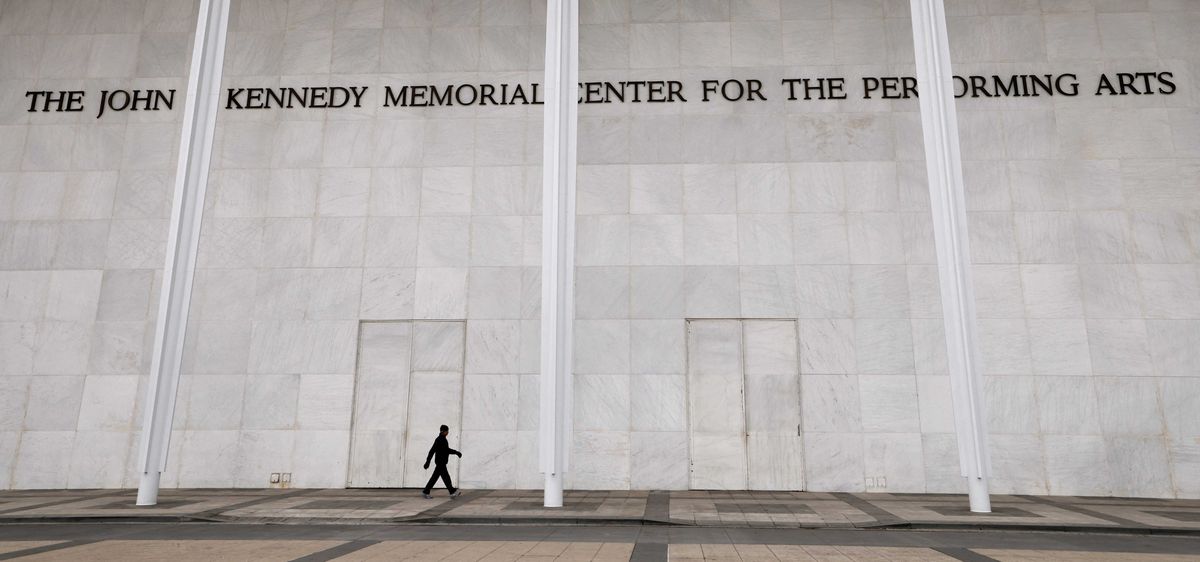
A man walks by the John F. Kennedy Center for the Performing Arts, after White House spokeswoman Karoline Leavitt announced that the Kennedy Center board decided to rename the institution the Trump-Kennedy Center in Washington, D.C., U.S., December 18, 2025. REUTERS/Kevin Lamarque

Layoffs continued Friday at the John F. Kennedy Center for the Performing Arts as the nation’s premier arts institution prepares for a two-year shutdown tied to President Donald Trump’s MAGA-fied overhaul – which included a rebrand as the “Trump-Kennedy Center.

Multiple people familiar with the cuts told the Washington Post that the programming department has been hit especially hard, with staff either terminated or reassigned as the center pivots away from traditional productions.

“Everything is a rental now,” one person with knowledge of the situation told the outlet. “If it’s not making money, we don’t do it.”

Among those laid off were top leaders, including Ryan Hamilton, senior director of broadcast, comedy and special programming, and Sam Miller, senior director of music programming, the Post reported Friday. Both were brought in under former board president Richard Grenell, a Trump ally who previously led efforts to reshape the institution in the MAGA leader’s name before his firing.

The latest cuts follow an earlier round of layoffs that hit the storied arts institution just weeks ago, as leadership prepares for a July 7 closure that will last two years for renovations.

Officials have not disclosed how many employees have been affected, but the Post noted that this round of layoffs is one of several since Trump’s takeover in February 2025. “More than 100 employees have resigned or been laid off since then, including the heads of nearly every department and discipline,” the outlet reported.

In a statement, a Kennedy Center spokesperson said staffing changes are meant to “support the broader move toward a successful closure for renovations.”

And more cuts could still be on the way. In an email last month, Matt Floca, the center’s new president, warned employees of “difficult staffing decisions that support the broader operational changes.”

“Each of you has contributed to the legacy of this institution, and these decisions have not been made lightly,” Floca wrote in the March email. “It is my sincere intention that each personnel action be carried out with consideration and care.”

'Stalin would be proud': Trump's new plans for massive DC arch met with anger

Matthew Chapman
April 10, 2026
RAW STORY 


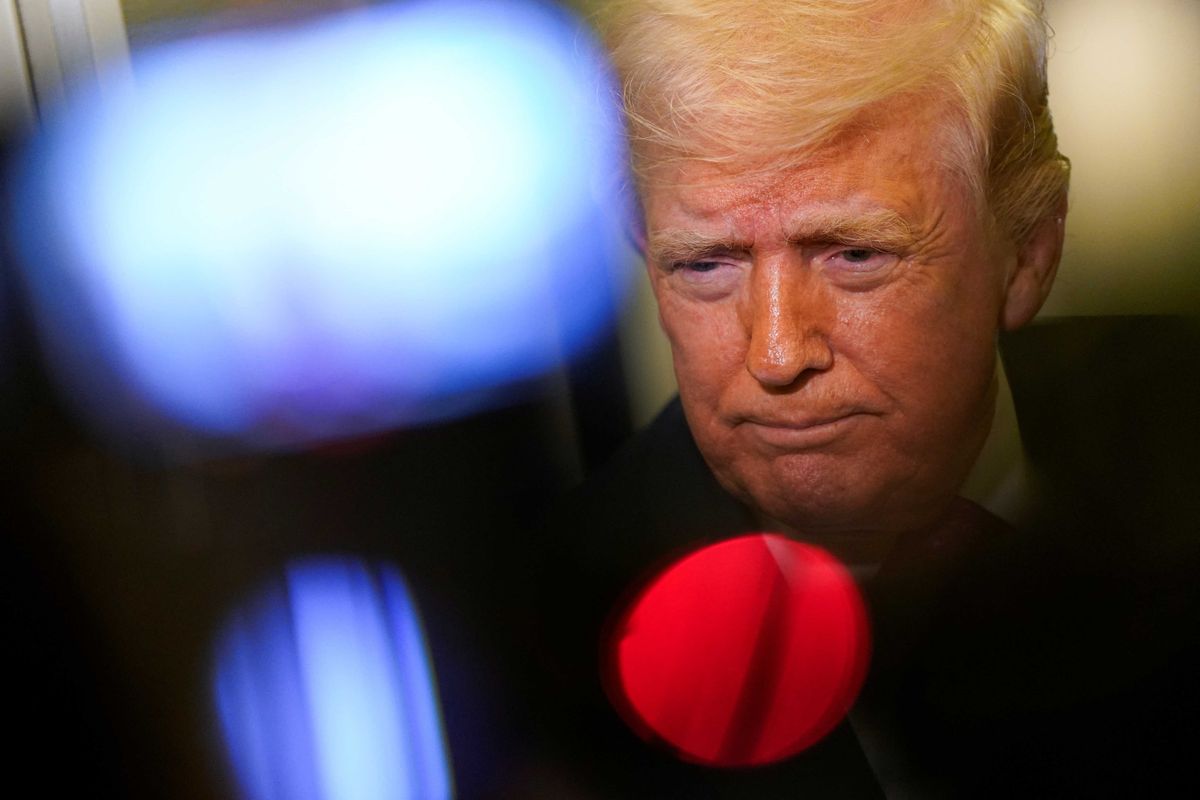
U.S. President Donald Trump looks on as he speaks to members of the media aboard Air Force One en route to Joint Base Andrews, Maryland, U.S., March 29, 2026. REUTERS/Elizabeth Frantz

President Donald Trump unveiled his team's new plan for a 250-foot triumphal arch in Washington, D.C., to be constructed in honor of America's 250th anniversary later this year, on Friday.
Many people on social media, however, reacted to the arch with anger.

Some accused Trump of making the project more a monument to himself than to the country, comparing him to foreign dictators. Anger has swelled over many of Trump's other controversial projects in D.C., including transforming the Kennedy Center and replacing the White House East Wing with a massive, gaudy ballroom.

Others pointed out that building this monument at a moment when America is in geopolitical and economic distress doesn't send a great message, while still others accused the arch of desecrating the hallowed ground of nearby Arlington Cemetery.

"While Americans worry about skyrocketing costs and another endless war, President Trump is focused on a taxpayer-funded vanity project that would choke traffic, block our skyline, and tower over sacred ground where those who served our nation are buried, including my own parents and sister," wrote Rep. Don Beyer (D-VA). "This isn’t about America’s 250th or honoring our veterans. It’s about Donald Trump’s ego — and we're going to stop it."

"Hey but don’t worry about your rising grocery prices," wrote former MS NOW host and Zeteo News chief Mehdi Hasan.

"What a megalomaniac Trump truly is," wrote tennis icon Martina Navratilova.

"Stalin would be proud," wrote political commentator Norm Ornstein.
Trump ordered Pentagon to rewrite report that labeled China a 'security threat': WSJ

Tom Boggioni
April 10, 2026 
RAW STORY


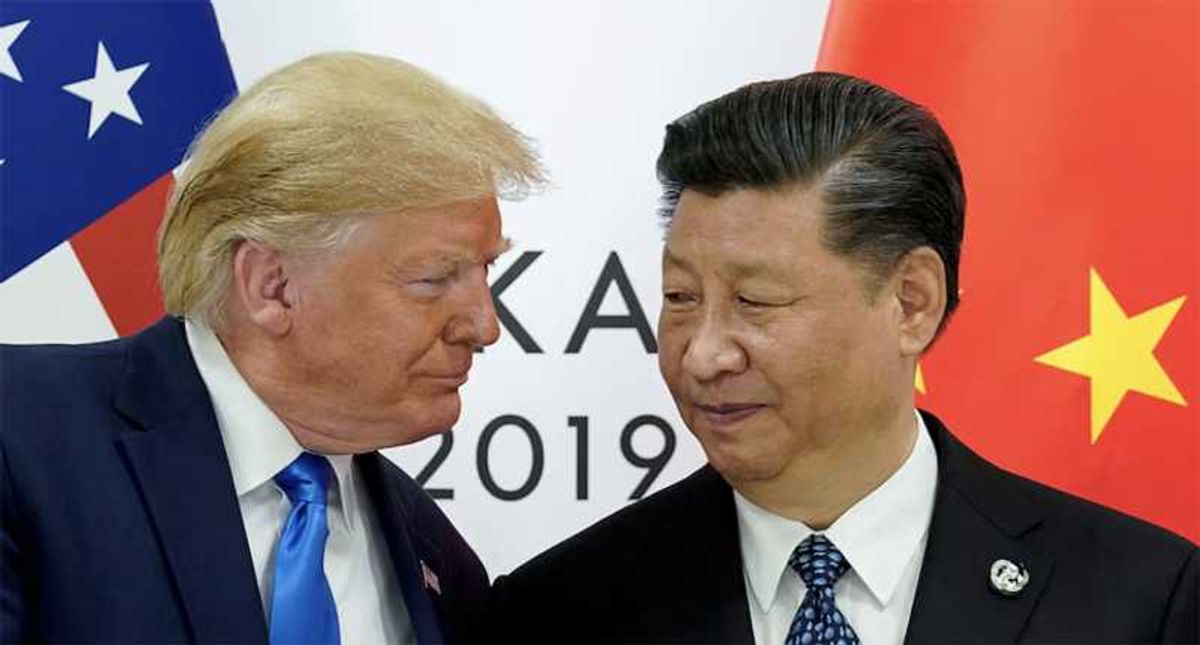
Donald Trump, Chinese President Xi Jinping (Photo by Kevin LaMarque for Reuters)

Donald Trump's public tough-guy posturing on China masks a stunning capitulation to Beijing. When Pentagon officials presented a draft National Defense Strategy last fall that characterized China as the top U.S. security threat — the same assessment his own first administration endorsed — Trump ordered it rewritten in friendlier terms.

According to the Wall Street Journal's Heather Somerville, Alexander Ward, and Gavin Bade, Trump "balked" at the Pentagon assessment and commanded his deputy to soften the language. The revised National Defense Strategy published in January struck an entirely different tone.

"President Trump seeks a stable peace, fair trade, and respectful relations with China," the document now declares — a stunning reversal from the bipartisan consensus that characterized China as the most consequential U.S. adversary.

The shift represents a seismic policy reversal. Trump's own first-term defense strategy took the same hardline approach the Pentagon recommended. Now Trump 2.0 is discarding that bipartisan framework in favor of a new mantra: "Don't rock the boat."

The capitulation goes far deeper than rhetoric. Commerce Secretary Howard Lutnick has imposed a stranglehold on China policy, requiring his personal sign-off for any China-related actions. The result is Kafkaesque: senior Commerce officials sit waiting by Lutnick's office or watch for his car outside the building before pursuing routine China policy actions.

Other agencies have resorted to workarounds, pursuing a ban on a China-linked router maker by strategically avoiding naming either the company or China in the official order — essentially hiding policy from public view.

The reversal has alarmed Trump's own national security aides. China hawks in the administration have adopted gallows humor, calling the shift the "Busan Freeze," referencing the South Korea meeting between Trump and Xi that produced a fragile trade detente.

Treasury Secretary Scott Bessent and other officials appealed to Trump to walk back tariffs and dial down the trade war so minerals could flow from China again — an apparent capitulation to economic pressure over strategic security.

The pivot was deliberate and premeditated. Trump initially asked national security advisers to develop a harder line on China's technological encroachment. But the president later abandoned the restrictions, and in April, Trump fired Douglas Feith and other China hawks from the National Security Council, dismantling the directorate that had coordinated administration actions on tech and China.

Against a president who fancies himself a master dealmaker, China is clearly winning, the Journal is reporting.
Kacey Musgraves says she saw UFOs following her plane — and pilots confirmed it: report

Nicole Charky-Chami
April 10, 2026 
RAW STORY


NEW YORK - JUL 19: Kacey Musgraves performs in concert on NBC's 'TODAY' show on July 19, 2019 at Rockefeller Plaza in New York City.NEW YORK - JUL 19: Kacey Musgraves performs in concert on NBC's 'TODAY' show on July 19, 2019 at Rockefeller Plaza in New York City. (Photo credit: Debby Wong / Shutterstock)

Kacey Musgraves said she saw alleged UFOs following her plane during a flight, TMZ reported on Friday.

The singer and songwriter described on Instagram stories how she saw light orbs that "just didn't look normal" during her trip from Fort Worth, Texas, to Nashville, Tennessee, with her manager Bobby. She also said the pilots on the flight confirmed seeing the suspicious lights — and not just on this flight but "every single night."

She detailed seeing the lights from around 50,000 feet in the sky and how they were "not moving like any craft that we can control," forming triangle patterns that were "extremely bright" and moving around.

Musgraves captured video from the flight, which she admitted was not the best quality, even for an iPhone 17.

"You could have the best, most high-quality footage of something and no one would believe it anyway," she added.


You’re being watched: Japan battles online abuse of athletes


By AFP
April 8, 2026


Japan's authorities have a warning for trolls planning to target competitors at this year's Asian Games: You are being watched. - Copyright AFP/File Yuichi YAMAZAKI


Andrew MCKIRDY

Japan is fighting back against online abuse of athletes and sports authorities have a warning for trolls planning to target competitors at this year’s Asian Games: You are being watched.

Online abuse is felt by athletes all over the world, affecting their performances and mental health, leaving them fearing for their safety and even causing them to quit their sports.

Japan is no exception and efforts are belatedly being made to tackle the problem, from dedicated lawyers to teams monitoring social media for offensive posts.

“Even a single negative comment can cut deeply,” Japanese Olympic Committee (JOC) official Misa Chida told AFP.

“Athletes don’t want to see things like that, so a lot of them choose not to look at social media at all, and that means they miss the 99 percent of messages that are supportive.

“That’s a real shame.”

Chida was part of a dedicated team of JOC officials monitoring social media at the Milan-Cortina Olympics in February.

Six staff members in Milan and 22 in Tokyo checked around the clock for posts abusing Japanese athletes, using both manual and AI searches.

They worked in conjunction with Meta — owner of Instagram, Facebook and WhatsApp — and Japanese company LINE Yahoo.

The team asked social media companies to take down almost 2,000 posts, and succeeded in having nearly 600 removed.

Social media companies have often been accused of not doing enough to crack down on abuse on their platforms.

The JOC said they plan to repeat their monitoring activities at their home Asian Games, which are being held in Nagoya and the wider Aichi area on September 19-October 4.

On top of that, Asian Games organisers told AFP that they will run a wider monitoring programme aimed at protecting athletes from all competing countries.

“We now understand what kinds of comments appear on a daily basis and how they upset athletes,” said JOC official Hirofumi Takeshita.

“We’ve learned how much energy we need to devote to this.”

– ‘Hope your family dies’ –

The JOC is not the first sporting organisation to carry out a social media monitoring programme.

The International Olympic Committee ran one in more than 35 languages at the 2024 Paris Games and there have also been initiatives in football and tennis.

“As awareness of these initiatives grows among athletes, staff and everyone working on the ground, that in itself contributes to a greater sense of psychological safety,” said Chida.

Japan has been relatively late to the party, according to lawyer Shun Takahashi, who leads a seven-strong legal group dedicated to protecting athletes from online abuse.

Takahashi says his group, founded in 2024, is a “safe haven” for athletes, many of whom feel uncomfortable talking about the issue.

“They worry that showing vulnerability might lead a coach to bench them or that others will see them as weak,” he said.

“Many athletes are raised with the idea that they must always be strong and they don’t want to be perceived otherwise.”

Takahashi’s group offered support in the case of Taiki Sekine, a professional baseball player who last year took legal action against online abusers.

Sekine, who received messages such as “I hope your whole family dies in an accident”, has won several settlements and lodged criminal complaints against the worst cases.

The domestic nature of Sekine’s case made it easier to prosecute than social media abuse that crosses international borders.

– Long way to go –

Takahashi says legal action has “a deterrent effect” on online trolls, many of whom he says are in their teens or early 20s.

“It makes them realise the risk involved,” he said.

But while Japan is now taking a proactive approach to online abuse, those involved say there is still a long way to go.

Less than a third of the posts that the JOC’s Olympic monitoring team requested be deleted were actually taken down by social media companies.

Takeshita said the tech firms were “very cooperative” but admitted their view of which posts were offensive did not always match up.

“Yes, there was a gap, but it was a gap that we were able to identify by actually doing this work,” he said.

“That’s better than having an unidentified gap that never gets bridged. Now that we know where the differences lie, we can work to close them.”
EU lawmakers want to tax Big Tech to fund budget

By AFP
April 9, 2026


As they scramble to agree on a 2028-2034 budget, EU lawmakers proposed some funding could come from a 'digital levy' - Copyright AFP Nicolas TUCAT

EU lawmakers on Thursday demanded a European Union-wide tax on the world’s biggest tech companies and online gambling sites to help fund the 27-country bloc’s next seven-year budget.

The EU is facing one of its biggest battles this year over the 2028-2034 budget, which the executive set at two trillion euros ($2.3 trillion).

Fierce negotiations are expected between the European Parliament and member states, especially over where to find extra money that governments are reluctant to chip in.

As they scramble to agree on the budget by the end of year, EU lawmakers proposed that some funding could come from a “digital levy”.

“We believe that technological giants are making a lot of good business in Europe and also significant profits,” said Siegfried Muresan, the EU lawmaker who will lead negotiations on behalf of parliament.

“It is therefore justifiable that they contribute in form of taxation to the budget of the European single market which enables them this business here,” said Muresan, who belongs to the biggest conservative grouping, the EPP.

The parliament’s budget committee is currently negotiating on their position and is expected to vote on the text on April 15 before a vote by all EU lawmakers later this month, Muresan said.

The centre-left socialists and democrats group has called for a tax on online gambling to finance an increase in spending, said socialist lawmaker Carla Tavares, who leads the budget talks with Muresan.

The European Commission wants to increase the budget to two trillion euros from the previous 2021-2027 budget, which was worth around 1.2 trillion euros.

Parliamentarians want more money for critical sectors including agriculture.

But they face a big hurdle since EU countries must approve any such measures unanimously.

The future budget also includes setting aside around 168 billion euros to repay the EU loan taken out during the coronavirus pandemic.
Russia bans Nobel-winning rights group, raids independent newspaper, in one day

By AFP
April 9, 2026


One protester stood outside the supreme court with a placard reading 'Hands off Memorial. Freedom to politial prisoners' - Copyright AFP Dimitar DILKOFF

Russia banned the Nobel Prize-winning human rights group Memorial and raided the offices of the independent newspaper Novaya Gazeta Thursday, in fresh blows to already diminished civil liberties in the country.

Memorial and Novaya Gazeta, both founded around the collapse of the Soviet Union, are Russia’s two most reputable and renowned organisations reporting and documenting human rights abuses.

Since sending troops against neighbouring Ukraine four years ago, the Kremlin has not only suppressed opposition to the war, but also launched a wider crackdown on dissent, something unseen since Soviet times.

Memorial was founded in the late 1980s to document victims of Soviet-era political repression during which millions of people perished in the Gulag penal system.

Under pressure from the government almost since its birth, it was formally liquidated by Russia’s Supreme Court in 2021 and since then has largely operated from abroad.

Thursday’s court ruling to label Memorial as “extremist” effectively outlaws any cooperation with the rights group and makes its supporters subject to prosecution.

Novaya Gazeta, established in 1993, was for years Russia’s leading independent outlet and was targeted heavily for its critical reporting and investigations into rights violations and corruption.

On Thursday, Russian law enforcement agents raided its offices and detained one of its top investigative journalists, the outlet said.

The paper, which used to be published several times a week, cut down production inside the country after the war began, but its online version was still available despite court orders.

Some of its staff were forced into exile and founded the online outlet Novaya Gazeta-Europe.


– Symbol of hope –


Memorial’s first chairman was the Nobel Prize-winning Soviet dissident Andrei Sakharov and the group established the largest publicly available database on Gulag victims.

A symbol of hope during Russia’s chaotic transition to democracy in the 1990s, it has since documented the country’s slide into authoritarianism under President Vladimir Putin.

It has listed hundreds of political prisoners in modern Russia, among them critics of Putin and opponents of the Ukraine war.

Memorial has also documented rights violations linked to Russia’s brutal wars in Chechnya and Syria, the plight of Ukrainian prisoners of war and kept a list of prisoners persecuted for their religion, including more than 200 Jehovah’s Witnesses.

It counts more than 1,000 political prisoners in Russia as of 2026 — up from 46 in 2015, amidst a crackdown on dissent during the Ukraine war.

The head of Memorial’s legal department, Natalia Sekretaryeva, told AFP the Supreme Court’s ruling was “absurd” but expected.


– ‘Lawlessness’ –


Novaya Gazeta was founded by Dmitry Muratov, its long-standing editor-in-chief who jointly won a Nobel Peace Prize in 2021.

He had to formally step down from the post two years later after being declared a “foreign agent,” a label akin to being an enemy of the state.

One of the early investors in the newspaper was Mikhail Gorbachev, the last leader of the USSR and the father of the perestroika liberal reforms.

After Thursday’s raids, which started in the morning were still ongoing well into the night, the police detained one of the paper’s top investigative reporters on alleged illegal personal data use, Novaya Gazeta said.

The journalist, Oleg Roldugin, reported on corruption in Russia’s top brass, including former President Dmitry Medvedev and the influential head of the Chechen Republic, Ramzan Kadyrov.

“We are concerned about the condition of our colleagues and demand an end to this lawlessness!” the paper said on social media.

Several Novaya Gazeta reporters have been murdered in killings widely seen as retribution for their work.

They include Anna Politkovskaya, who spent years investigating allegations of abuses by Russia’s military during its campaigns in Chechnya.

She was found dead in her apartment block on President Vladimir Putin’s birthday in October 2006.

Russian police raid independent Novaya Gazeta media outlet


By AFP
April 9, 2026


Russian police raid independent Novaya Gazeta media outlet - Copyright AFP Igor IVANKO

Russian law enforcement agents on Thursday raided the offices of the Novaya Gazeta independent media outlet, the paper said, adding that a reporter was being questioned by the police.

Novaya Gazeta was for years Russia’s leading investigative independent outlet and was targeted heavily for its critical reporting and investigations into human rights abuses.

“At around 12.00 pm (0900 GMT), security officers in masks started carrying out investigative actions at the editorial office of Novaya Gazeta,” the outlet said on social media.

“We don’t know the reason. The outlet’s lawyers are not being allowed into the office, where some staff members are also present.”

Russian state news agencies reported, citing anonymous law enforcement sources, that the raid was related to one of the paper’s top journalists Oleg Roldugin.

Novaya Gazeta said that “after morning searches in his flat, he (Roldugin) was taken to Moscow’s main investigative directorate of the ministry of internal affairs for questioning” without a lawyer. It said it could not confirm whether the raid on the outlet’s office was linked to Roldugin.

The investigative journalist reported on corruption in Russia’s top brass, including former President Dmitry Medvedev and the influential head of the Chechen Republic, Ramzan Kadyrov.

An AFP reporter in Moscow saw two vans of Russia’s Investigative Committee parked in a yard outside the offices and staff stood inside the entrance foyer.

The paper’s then editor-in-chief, Dmitry Muratov, jointly won the Nobel Peace Prize in 2021 for his “efforts to safeguard freedom of expression” at the helm of the paper.

Several Novaya Gazeta reporters have been murdered in killings widely seen as retribution.

They include Anna Politkovskaya, who spent years investigating allegations of abuses by Russia’s military during its campaigns in Chechnya.

She was found dead in her apartment block on President Vladimir Putin’s birthday in October 2006.

The paper, which used to be published several times a week, cut down production inside the country after Russia introduced military censorship at the start of its offensive on Ukraine in 2022.

Why Trump’s Cuba Plan Won’t Work


by  | Apr 10, 2026 | 

It is clear that the US wants to conduct some kind of regime change operation in Cuba, egged on by Republican and Democratic hawks, though polling indicates it is not popular within the US, Cuba, or the international community. Figures like Marco Rubio have said that Cuba will need to open their economy up, in a nod to when the island was a completely deregulated vassal for US casino companies, ruled by a pro-US brutal dictator, Fulgencio Batista, who was deposed by the Cuban Revolution led by the Castro brothers and Che Guevara.

The US has been applying maximum pressure on Cuba and negotiating like it did in Venezuela to put a new leader compliant to US interests, perhaps even one of the Castros, reportedly.

The Trump administration says it is getting closer to a “deal” as Venezuela has stopped its partnership with Cuba and Mexico has, according to the White House, stopped sending oil shipments. However, Mexico is still sending some oil and aid, Russia is sending more, and China has also sent help. China’s sustained attacks on the Cuban campaign have brought it diplomatic capital. The narrative of a collapsing support network for Havana is wishful thinking.

Conditions on the island are dire thanks to the US blockade, in place since 1958 but increased by Trump. There are rolling blackouts lasting up to 20 hours a day. Hospitals are shutting down wings, and patients have died because respirators lost power. Food is spoiling due to lack of refrigeration, pushing child malnutrition rates to levels not seen since the 1990s. But despite the suffering, Cuba has not budged. Negotiators have said they are “not going anywhere.”

Cubans are reminded daily of what subjugation under the US’s thumb was like, and they see a live demonstration in Venezuela, where the US extracts resources with no regard for the local population. No matter how much the US pushes, Cubans may only be urged to rebel further.

There have been massive youth protests in Cuba, but notably, they rebuke the US and the blockade, throwing out the possibility of an inside coup. Progressives in the US have pushed back, and Cuba’s young population has lost more than 1 million people to emigration (10 percent of the population), which has slowed the economy and decreased the risk of an insurgency. Rich right-wing Cubans are in South Florida. An older, more ideologically-committed population remains.

The history of American interference in Cuba is long and bloody. There was the failed Bay of Pigs invasion in 1961. There have been hundreds of assassination attempts against Fidel Castro. There is the ongoing blockade, codified by the Helms-Burton Act. For six decades, Washington has used OFAC to seize Cuban assets. Every tool in the regime change toolbox has been used. None have worked.

What Cuba hawks like Trump, Rubio, Ted Cruz, Maria Elvira Salazar, and Mario Diaz-Balart want is not new. All come from wealthy conservative families, with Rubio, Cruz, and Salazar being of Cuban descent, and they have a personal and ideological vendetta against socialist Cuba – many of their families held positions within the old Batista regime.

They want a throwback to the old pro-US regime that will do the bidding of American corporations and the military. The island is a strategic base for other operations. Washington wants Guantánamo not just for detention but as a staging ground for airstrikes against fishing boats in the Caribbean – strikes that are war crimes according to international law.

Cuba is an older, more resilient regime than the ones the US has successfully toppled. Cuba was the main socialist revolution that spurred anti-colonial revolts throughout Latin America, Europe, and Asia. The Cuban revolutionary government, while blockaded and sanctioned, helped socialist movements in Angola, Bolivia, Syria, Libya, Venezuela, El Salvador, Granada, Colombia, Ethiopia, Congo, Mozambique, Vietnam, Laos, Cambodia, Nicaragua, and elsewhere.

Unlike some of these projects, Cuba’s Communist Party has a deep bench of leadership and a command economy designed to withstand siege. Their universal programs in healthcare, education, and housing have been massive improvements, though the state is deeply authoritarian. The Cuban state has gone through much worse, including the collapse of the Soviet Union in 1991, which wiped out 80% of its economy overnight and left Cuba vulnerable to a coup. Still, the island survived.

Currently, the Trump administration is distracted and bogged down. Washington is managing simultaneous military campaigns in Ukraine, Ecuador, Gaza, Iran, Somalia, Venezuela, and elsewhere, and has signaled it could invade Greenland and Canada. Historically, overstretched empires lose. The idea that the US could focus its full weight on Cuba alone is fantasy.

Cuba has more allies today than in the 1990s, partly due to its medical and security diplomacy. After the earthquake in Haiti, Cuban doctors took the lead when cholera broke out. During COVID, Cuba sent doctors to Italy, South Africa, and Mexico when wealthy nations restricted vaccines and the US tried to block them. That diplomatic capital buys loyalty. Russia is sending oil. China is sending food aid and investment. Canada continues to send tourists and aid. Even Gulf states, US allies, have maintained trade ties. The Cuban revolutionary state is much stronger than hawks project.

Crucially, there are no natural resources worth invading for. Cuba’s main exports are sugar, tobacco, nickel, and biotech. Its main economic sector is tourism. None of these are strategic enough to justify a war. Unlike Iraq, Iran, or Venezuela, Cuba does not possess a resource that would make American corporations lobby hard for intervention.

Finally, there is no popular right-wing opposition backed by US politicians and capital, unlike in Venezuela. In Cuba, the dissident movement is minuscule, not credible, and mostly foreign. There is no right-wing in Cuba. Even within the regime, there seems no interest in a negotiated takeover. If the Castro family – who engineered the socialist revolution in Cuba and others like it – is the Trump admin’s best shot, then they have no shot.

As things stand, the American strategy is based on a fantasy of a compliant vassal state that the Cuban people do not want. The blockade will continue to cause suffering, but it will not bring about surrender. Only diplomatic partnership and humanitarianism can bring lasting progress for the Cuban people.

Joseph Bouchard is a PhD candidate, journalist, and researcher from Québec covering security and geopolitics in Latin America. His articles have appeared in Reason, The Diplomat, The National Interest, Le Devoir, and RealClearPolitics, among others.


When Flotillas Fight for Life, Not Empire


April 10, 2026

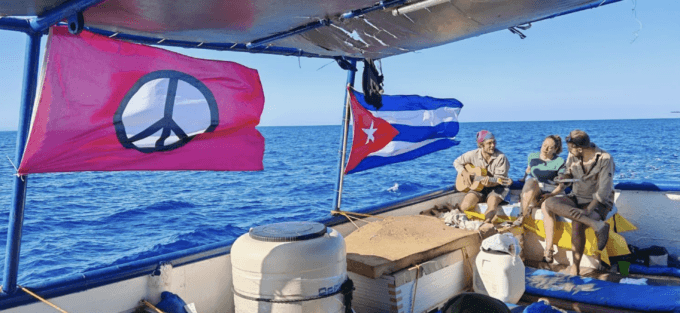
Image courtesy of CodePink.

Flotillas have historically been fleets of military vessels—tools of empire designed for swift offensive or defensive operations at sea. The images they evoke are ones of imperial power and looming violence. Just look at the massive US naval buildup that surrounded Iran as part of the recent US attacks.

But peace activists have also developed a new kind of flotilla.

Instead of instruments of war, flotillas have become symbols of peace—acts of humanitarian direct action, civil resistance, and cross-border solidarity. Take the flotillas that have tried to reach Gaza, like the Global Sumud Flotilla. Even though they have been illegally intercepted by the Israeli military, they have educated millions of people worldwide about Israel’s atrocities, activated entire cities to shut down, and offered a beacon of hope to the beleaguered people of Gaza.

As U.S. policy continues to sanction and blockade Cuba—causing immense hardship for the Cuban people—I, along with many others, felt compelled to escalate our own tactics of solidarity by joining the recent flotilla to Cuba as part of the Nuestra América Convoy. Our boat carried 15 tons of aid, part of the more than 40 tons delivered by the convoy.

The United States is currently imposing some of the harshest sanctions on Cuba in recent history, compounding a 67-year blockade that has restricted access to medicine, fuel, and food. But in recent months, the US added another dimension: a naval blockade to severely limit fuel imports, leading to a humanitarian crisis.

In an ideal world, we wouldn’t need fossil fuels—we would already have made a just transition to renewable energy. And while Cuba is working at lightning speed to expand solar power, the current reality is stark: people still need fuel to cook, to transport food, to operate ambulances, to power hospitals, and to keep ventilators running.

The international community has responded to this escalation in U.S. economic warfare with intensified solidarity. Hundreds of thousands of people around the world have been mobilizing to send aid and condemn the US blockade. In March, Progressive International, CODEPINK, and The People’s Forum launched the Nuestra América Convoy, bringing together over 600 people from 33 countries. We came with millions of dollars’ worth of aid—from urgently needed medical supplies to longer-term solutions like solar panels.

While many of my friends boarded planes to Havana, packing every inch of their luggage with medicine, hygiene products, vitamins, and art supplies, I traveled to Mexico to meet the flotilla crew. We spent four days at sea together—activists, journalists, organizers. Some had helped organize the Gaza Sumud Flotilla; others had taken part in mass protests in solidarity with Palestine.

Our goal was to deliver much-needed aid to the people of Cuba. But just as important was challenging the dominant narrative—that Cuba’s suffering is the result of its own government, rather than decades of U.S. cruel policy.

Even though the boat was full of journalists documenting the trip, their cameras could not fully capture the sense of community among strangers united by a shared mission. I remember being nervous about the cold and the possibility of seasickness, but within minutes, people were offering ginger chews, acupressure bracelets, and rain gear.

Our departure was delayed due to weather, boat repairs, and the logistics of loading the aid. In the meantime, we stayed with supporters in Mexico who couldn’t join the voyage but found other ways to contribute. We shared a send-off dinner at an Egyptian restaurant whose owner had followed the Gaza flotillas. He told us how proud he was to see a flotilla to Cuba leaving from his small town.

On the boat, we shared cooking, dishwashing, and night watch shifts—standard practice in occupations, encampments, and direct actions where resources are limited but creativity and collaboration are abundant. At sea, a simple breakfast of rice, beans, eggs, guacamole, and toast tastes like a feast. We slept under galaxies of stars, woke to sunrises on the horizon, and at sunset made music with whatever we had—a guitar, a bucket drum, water bottles filled with dry beans.

Meanwhile, I stayed connected to those traveling by plane, watching group chats fill with photos of carefully packed bags and urgent questions: Who can fit more supplies? How many solar batteries can we carry on? The coordination was constant, collective, and inspiring.

The blockade severely limits what goods can reach Cuba. While US citizens can still travel there under certain categories, they face restrictions and often risk questioning upon return. But solidarity is not tourism. It is not about swooping in, taking photos, and leaving. It is about building relationships, listening, and committing to ongoing struggle from our home countries.

We had a beautiful reception from the Cuban people when we landed, and then had the opportunity to speak directly with community groups about current conditions.I learned how they overcome so much by placing value in community over the individual.

The US empire is indeed dying, and it is up to us to not just reimagine the better world we need and want, but to actually put that world into practice. Reflecting on my experience, I started thinking — if we can turn flotillas from a force of evil into vessels of hope and solidarity, then what else can we change? What if we built schools around the world instead of sending bombs? What if, like the Cubans, we funded healthcare over warfare and sent doctors to cure people instead of soldiers to kill them?

You don’t have to board a boat with humanitarian supplies to show solidarity. Flotillas are one tactic, but we need a variety and diversity of tactics right now, and always. You can move forward by showing solidarity to your neighbors at home, as well as to our neighbors 90 miles off our shores. Because what we build together, in community—whether through a peace flotilla or local mutual aid—is stronger than anything built through force.

Olivia DiNucci is an anti-militarism and climate justice organizer based in Washington DC.


Russia deputy FM hails ‘special’ relations 

on Cuba visit


By AFP
April 10, 2026


Havana's communist authorities have said exiled Cubans can invest on the island to help its ramshackle economy but the idea is being met with caution in Florida. A coconut water stall is seen on a street in Havana with a sign reading "Ice-cold coconut water," on March 16, 2026. Cubans living abroad and their descendants will be able to invest and have their own businesses on the island, the communist government announced on March 16, 2026, at a time when the country’s economy is almost paralyzed by the energy blockade imposed by Washington. 
— © AFP YAMIL LAGE

Russian Deputy Foreign Minister Sergei Ryabkov hailed the “special nature” of relations with Cuba on a visit Thursday, where he met President Miguel Diaz-Canel as tensions simmer between Washington and energy-starved Havana.

“Russia is not going to leave the western hemisphere, no matter what they say in Washington,” Ryabkov told a press conference after the meeting, according to Russian state news agency TASS.

“Our relations with Cuba are of a special nature… We can’t just betray Cuba, it’s completely out of the question, we can’t leave it to its fate.”

The meeting, confirmed by Diaz-Canel’s office on X, came 10 days after a Russian oil tanker arrived in Cuba despite a de facto US fuel blockade.

“We take this opportunity to send a hug to our dear friend, President Vladimir Putin,” Diaz-Canel said in the meeting, according to his office.

Ryabkov said Cuba’s economic issues, including its energy security, were among the main topics of discussion, TASS reported.

Under President Donald Trump, the United States has threatened tariffs on any country that attempts to sell oil to Cuba, resulting in an energy crisis on the communist island that has worsened since January.

The US labels Cuba a threat to US national security, and Secretary of State Marco Rubio, who is of Cuban descent, has demanded changes to the island’s leadership.

Earlier on Thursday, Diaz-Canel told US-based NBC News that he would not resign under US pressure.

Rubio has denied calling for Diaz-Canel’s resignation.

“At the present moment, Russia is one hundred percent in solidarity with Cuba; despite the complexity the country is going through, we are by your side, said the deputy foreign minister,” the Cuban president’s office wrote on X on Thursday.