It’s possible that I shall make an ass of myself. But in that case one can always get out of it with a little dialectic. I have, of course, so worded my proposition as to be right either way (K.Marx, Letter to F.Engels on the Indian Mutiny)
Recent geopolitical, security and trade tensions between powerful nations accelerated the “de-globalization” momentum marked by a shift from rapid trade integration toward protectionism, economic nationalism, and fragmented supply chains. Global trade and investment are being reorganized around national security and resilience, regionalization and “friend-shoring”, rather than cost-driven integration.
Small and developing countries like Sri Lanka face significant and disproportionate challenges from de-globalization. These challenges include suppressed economic growth, increased vulnerability to external shocks, and reduced influence in global decision-making. Sri Lanka’s trade dependency, stagnant foreign inflows, small domestic markets, limited export product basket make Sri Lanka a highly vulnerable country.
The World Economic Forum, the world’s leading pro-globalization think tank calls de-globalization as “re-globalization” and forecasts the outcome of currently ongoing changes will be “a multi-nodal, regionally and politically clustered world that still operates on a global scale, but with resilience and security prioritized alongside cost and efficiency”.
During last few decades, Sri Lanka’s frequent reliance on IMF support programs resulted Sri Lanka’s economic policies to align with neo-liberalism with underlying globalization agenda. Although, Sri Lanka’s trade dependency ratio of around 44 percent is comparatively moderate, persistent trade deficit, concentration of import and export markets and products, small domestic market make Sri Lanka a highly impacted country due to de-globalization. Moreover Sri Lanka’s lack of natural and financial resources, together with unfavorable demographic shift make Sri Lanka’s economy extremely vulnerable.
Sri Lanka has limited strategic options to weather the impact of de-globalization. Perhaps the most effective option Sri Lanka has is the opportunity to leverage the strategically important geographical location. Sri Lanka is already emerging as a critical global geopolitical hub due to its strategic location in the Indian Ocean, acting as a pivotal maritime, logistical, and economic link between East and West. Apart from Sri Lanka being a critical part of China’s Belt and Road initiative, Sri Lanka’s maritime infrastructure is of strategic interest to India and the U.S, as two-thirds of the world’s oil trade and half of all container cargo passes through the waters surrounding Sri Lanka.
It goes without saying that leveraging country’s strategic location to catalyze economic growth needs well planned geo-political strategy. In order to cultivate geo-political influence requires a multi-dimensional strategy that integrates economic strength, military capability, diplomatic alliances, and technological advancement. These can be secured through securing strategic trade routes, building robust infrastructure, fostering, and utilizing soft power to align with international interests.
At present Sri Lanka has a very weak global influence as reflected in weak ratings in Global Soft power Index. Hence it is essential that Sri Lanka boost its “soft power” through appropriate actions focusing on culture, political values, and foreign policy. Cultural aspects are considered the most important pillar of nation’s soft power, and Sri Lanka can benefit from further enhancing existing cultural foundation rather risking to change it. Even Joseph Nye, the American Political Scientist who developed the “International Theory of Neo-Liberalism” stressed that “culture” of a country is the most important pillar of a country’s soft power.
Many analysts point out that the Sri Lanka’s current political regime is attempting to change existing socio-cultural fabric which is deeply rooted in Buddhist heritage. Moreover Sri Lanka’s fast expanding tourism industry is also deeply rooted in country’s existing cultural foundation and attempts to change it could impact tourism industry negatively. Even recent public discussions on alleged state interventions on LGBT related matters, could work negatively for the country as so far Sri Lanka is neither known as a country that discriminate LGBT persons nor a country that promote it.
Sri Lanka has a wide range of monetizeable opportunities based on its strategic location and also existing domestic business landscape. Currently on going T20 Cricket World Cup is one example. No other country in South Asia, other than Sri Lanka, will find it possible to host a match between India and Pakistan. Hence it is time that Sri Lanka work towards leveraging its geographical location to weather global trade reset, and Sri Lanka can effectively leverage its existing cultural foundation to boost its global soft power.
Indika Hettiarachchi is a Colombo based Independent Private Market Investment professional. He can be contacted on indika.h@jupitercapitalpartners.com
Sunday, July 30, 2023
With one eye on China, Japan backs Sri Lanka as a partner in the Indo-Pacific
Japan’s Foreign Minister Yoshimasa Hayashi says that Sri Lanka's strategic location in the Indian Ocean makes it a key partner in realizing a free and open Indo-Pacific
ByKRISHAN FRANCIS
Associated Press
July 29, 2023,
Japanese foreign minister Yoshimasa Hayashi, left, shakes hands with his Sri Lankan counterpart Ali Sabry after their meeting in Colombo, Sri Lanka on Saturday, July 29, 2023. (AP Photo/Eranga Jayawardena)
The Associated Press
COLOMBO, Sri Lanka -- Japan's Foreign Minister Yoshimasa Hayashi said Saturday that Sri Lanka is a key partner in a Tokyo-led initiative aimed at building security and economic cooperation around the Indo-Pacific but also at countering an increasingly assertive China.
Sri Lanka, strategically located in the Indian Ocean, is integral to realizing a free and open Indo-Pacific, Hayashi said. He was speaking after a meeting with his Sri Lankan counterpart, Ali Sabry, in the capital, Colombo.
The initiative, announced by Japanese Prime Minister Fumio Kishida in March includes Japan’s assistance to emerging economies, support for maritime security, a provision of coast guard patrol boats and equipment and other infrastructure cooperation.
Last year Sri Lanka, which owed $51 billion in foreign debt, became the first Asia-Pacific country since the late 1990s to default, sparking an economic crisis.
While Japan is Sri Lanka's largest creditor, about 10% of its debt is held by China, which lent Colombo billions to build sea ports, airports and power plants as part of its Belt and Road Initiative. In March, China agreed to offer Sri Lanka a two-year moratorium on loan repayments.
Hayashi said that he conveyed expectations for further progress in Sri Lanka's debt restructuring process. He welcomed Sri Lanka’s efforts under an agreement with the International Monetary Fund, which includes anti-corruption measures and transparency in the policy-making process.
Sri Lanka's Foreign Minister Sabry said that he, along with Sri Lankan President Ranil Wickremesinghe, invited Japan to resume investment projects already in the pipeline and to consider fresh investments in sectors such as power generation, ports and highways, and dedicated investment zones, as well as in the green and digital economy.
Over many decades, Japan became one of Sri Lanka's key donors, carrying out key projects under concessionary terms. However, relations between the two countries came under strain after Wickremesinghe's predecessor Gotabaya Rajapaksa unilaterally scrapped a Japan-funded light railway project following his election in 2019.
Sri Lanka's Cabinet has already approved a proposal to restart the railway project.
Rajapaksa was forced to resign in July 2022 amid angry public protects over the country's worst economic crisis.
French leader Emmanuel Macron makes short but 'historic' stop in Sri Lanka
President Emmanuel Macron made a short stopover in Sri Lanka on Friday – the first visit by a sitting French leader to the island nation, which is undergoing a difficult economic recovery.
Issued on: 29/07/2023
President Macron (L) is welcomed by Sri Lanka's Foreign Minister Ali Sabry on arrival at Colombo's airport prior to bilateral talks with Sri Lanka's President, July 28, 2023.
Macron arrived in Sri Lanka Friday night to mark the 75th anniversary of diplomatic relations between the two nations, Sri Lanka's president's office said.
His visit consisted of a two-hour stay at Colombo airport.
After being welcomed by Sri Lanka's Foreign Minister Ali Sabry, Macron held discussions with President Ranil Wickremesinghe.
As the fourth-largest creditor to Sri Lanka, France had pledged cooperation in debt restructuring to help the island nation recover from its worst economic crisis since independence in 1948.
The country has received major support from the IMF, but is expected to remain bankrupt until 2026.
'New era of our partnership'
Wickremesinghe praised France’s significant role in global affairs, particularly in areas such as climate mitigation, global debt restructuring, and matters related to the Indo-Pacific region, the Sri Lankan presidency statement said.
“Sri Lanka and France are two Indian Ocean nations that share the same goal: an open, inclusive and prosperous Indo-Pacific. In Colombo we confirmed it: strengthened by 75 years of diplomatic relations, we can open a new era of our partnership,” Macron said in a Twitter message after the meeting.
Earlier, the Elysée described referred to "a historic visit".
President Macron chats with President Ranil Wickremesinghe in Colombo on his way from an official visit to the Pacific islands in the early hours of July 29, 2023.
Beijing, the country's main creditor, agreed in March to reschedule its loan repayments.
Macron made the stop on his way back from Oceania, after visiting Papua New Guinea, the French territory of New Caledonia and the sea-threatened archipelago of Vanuatu.
China and India are vying for influence in Sri Lanka.
The situation prompted Macron to warn against "new imperialism" at work in the region while he was in Vanuatu, referring in particular to China's growing influence.
Friday, April 01, 2022
UPDATED
Sri Lanka declares state of emergency as protests spread
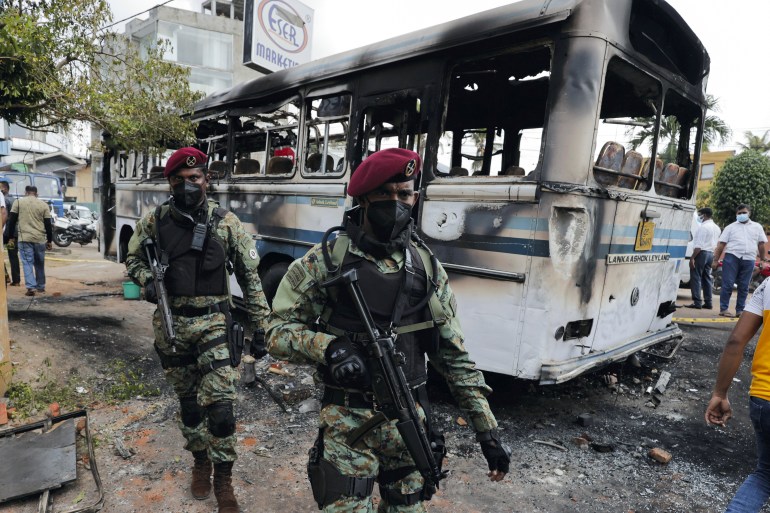
President Gotabaya Rajapaksa invokes tough laws amid protests over Sri Lanka’s deepening economic crisis. Sri Lankan soldiers walk past a bus burned by demonstrators at the top of the road of President Rajapaksa's residence in Colombo, Sri Lanka [Dinuka Liyanawatte/Reuters]
Published On 1 Apr 20221 Apr 2022
Sri Lanka’s president has declared a state of emergency, giving sweeping powers to security forces a day after hundreds tried to storm his house in anger over an unprecedented economic crisis.
President Gotabaya Rajapaksa invoked the tough laws on Friday allowing the military to arrest and imprison suspects for long periods without trial as demonstrations calling for his resignation spread across the South Asian nation.
The emergency was declared for “protection of public order and the maintenance of supplies and services essential to the life of the community”, he said in a proclamation.
The nation of 22 million is facing severe shortages of essentials, sharp price rises and crippling power cuts in its most painful downturn since independence from Britain in 1948.
Police reimposed a nighttime curfew on Friday in the Western Province, which includes the capital Colombo, expanding the no-go zone from the previous night.
Earlier in the evening, dozens of rights activists carried handwritten placards and oil lamps in the capital while demonstrating at a busy intersection.
“Time to quit Rajapaksas,” said one placard. “No more corruption, go home Gota,” said another – referring to the president.
In the highland town of Nuwara Eliya, activists blocked the opening of a flower exhibition by Prime Minister Mahinda Rajapaksa’s wife, Shiranthi, police said.
The southern towns of Galle, Matara and Moratuwa also saw anti-government protests, and similar demonstrations were reported in the northern and central regions. All held up traffic on main roads.
Thursday night’s unrest outside the president’s private home saw hundreds of people demand he step down.
People chanted “lunatic, lunatic, go home”, before police fired tear gas and used water cannons.
The crowd turned violent, setting ablaze two military buses, a police jeep, two patrol motorcycles and a three-wheeler. They also threw bricks at officers.
At least two protesters were wounded. Police said 53 protesters were arrested, but local media organisations said five news photographers were also held and tortured at a local police station, a charge the government said it will investigate.
‘Intelligence failure’
Two government ministers said a major intelligence failure had placed the lives of the president and his wife in danger on Thursday.
“Both the president and his wife were at their home when the protests were going on,” health minister Keheliya Rambukwella told reporters in Colombo, discounting earlier claims that they were away at the time.
“We had information of a demonstration, but nothing suggesting that it could turn violent. This is a major intelligence failure.”
Transport minister Dilum Amunugama said “terrorists” were behind the unrest.
Rajapaksa’s office said Friday that the protesters wanted to create an “Arab Spring” – a reference to anti-government protests in response to corruption and economic stagnation that gripped the Middle East more than 10 years ago.
One of the president’s brothers, Mahinda, serves as prime minister while the youngest, Basil, is finance minister. His eldest brother and nephew also hold cabinet positions.
Sri Lanka’s predicament has been compounded by the COVID-19 pandemic, which torpedoed tourism and remittances.
Many economists also say the crisis has been exacerbated by government mismanagement and years of accumulated borrowing.
Record inflation
The latest official data released on Friday showed inflation in Colombo hit 18.7 percent in March, the sixth consecutive monthly record. Food prices soared a record 30.1 percent.
Colombo imposed a broad ban on imports in March 2020 in a bid to save foreign currency needed to repay nearly $7bn this year to service its $51bn debt.
Diesel shortages have sparked outrage across Sri Lanka in recent days, causing protests at empty pumps.
The state electricity monopoly said it was enforcing a daily 13-hour power cut from Thursday – the longest ever – because it did not have diesel for generators.
Several state-run hospitals, facing shortages of life-saving medicines, have stopped routine surgeries.
The government has said it is seeking a bailout from the International Monetary Fund while asking for more loans from India and China.
Sri Lanka Financial Crisis: Violent Protests In Colombo Amid Power Cuts, Shortage Of Fuel And Food
PHOTO ESSAY
UPDATED: 01 APR 2022
Hundreds of Sri Lankans on Thursday night gathered outside the private residence of Sri Lankan president in a Colombo suburb to protest against their everyday hardships because of the country's ongoing worst financial crisis. Sri Lanka has an acute shortage of foreign exchange, which has led to a shortage of fuel and food. Prices of all commodities have increased. The country is also facing up to 13 hours of power cuts everyday as there is no fuel to burn to produce thermal power. Protesters on Thursday burnt military and police vehicles. Security personnel fired tear gas shells and water cannons to disperse the protesters. Dozens of people were arrested.
A Sri Lankan man shouts anti government slogans during a protest outside Sri Lankan president's private residence on the outskirts of Colombo, Sri Lanka. Sri Lanka police fired tear gas and a water canon to disperse several hundred people protesting near the private residence of the country’s president. The people had gathered Thursday to protest the economic hardships faced by them.
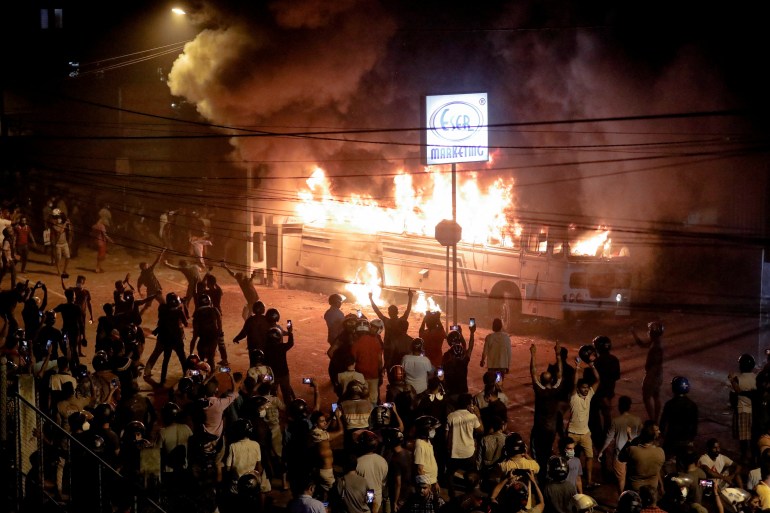
Sri Lankans watch after setting a bus on fire during a protest outside Sri Lankan president's private residence on the outskirts of Colombo, Sri Lanka. Sri Lanka police fired tear gas and a water canon to disperse several hundred people protesting near the private residence of the country’s president. The people had gathered Thursday to protest the economic hardships faced by them. Protestors shouted slogans condemning the long power cuts and shortages of essentials.
Sri Lankan army soldiers secure surroundings around Sri Lankan president's private residence during a protest on the outskirts of Colombo, Sri Lanka. Sri Lanka police fired tear gas and a water canon to disperse several hundred people protesting near the private residence of the country’s president. The people had gathered to protest the economic hardships faced by them. Protestors shouted slogans condemning the long power cuts and shortages of essentials.
Sri Lankans watch clashes between protesters and security officers outside Sri Lankan president's private residence on the outskirts of Colombo, Sri Lanka. Sri Lanka police fired tear gas and a water canon to disperse several hundred people protesting near the private residence of the country’s president. The people had gathered Thursday to protest the economic hardships faced by them. Protestors shouted slogans condemning the long power cuts and shortages of essentials.
Sri Lankan police officers carry an injured officer during a protest out side Sri Lankan president's private residence on the outskirts of Colombo, Sri Lanka. Sri Lanka police fired tear gas and a water canon to disperse several hundred people protesting near the private residence of the country’s president. The people had gathered Thursday to protest the economic hardships faced by them. Protestors shouted slogans condemning the long power cuts and shortages of essentials.
Police uses water canon to disperse protesters during a protest outside Sri Lankan president's private residence on the outskirts of Colombo, Sri Lanka. Sri Lanka police fired tear gas and a water canon to disperse several hundred people protesting near the private residence of the country’s president. The people had gathered Thursday to protest the economic hardships faced by them. Protestors shouted slogans condemning the long power cuts and shortages of essentials.
Sri Lankan protestors riot outside Sri Lankan president's private residence on the outskirts of Colombo, Sri Lanka. Sri Lanka police fired tear gas and a water canon to disperse several hundred people protesting near the private residence of the country’s president. The people had gathered Thursday to protest the economic hardships faced by them.
Protesters run to take cover as police uses tear gas shells to disperse them during a protest outside Sri Lankan president's private residence on the outskirts of Colombo, Sri Lanka. Sri Lanka police fired tear gas and a water canon to disperse several hundred people protesting near the private residence of the country’s president. The people had gathered Thursday to protest the economic hardships faced by them. Protestors shouted slogans condemning the long power cuts and shortages of essentials.
Sri Lankans shout anti government slogans after setting a bus on fire during a protest outside Sri Lankan president's private residence on the outskirts of Colombo, Sri Lanka. Sri Lanka police fired tear gas and a water canon to disperse several hundred people protesting near the private residence of the country’s president. The people had gathered Thursday to protest the economic hardships faced by them. Protestors shouted slogans condemning the long power cuts and shortages of essentials.
Sri Lanka Economic Crisis | AP Photo/Eranga Jayawardena
Sri Lanka Warns Clashes at President’s Home Imperils Tourism
Asantha Sirimanne and Anusha Ondaatjie, Bloomberg News
(Bloomberg) -- Sri Lanka’s government said the protesters’ violent clashes with police outside President Gotabaya Rajapaksa’s home were a threat to the revival of the tourism sector, appealing for calm amid widespread anger over surging costs and power cuts stemming from a foreign exchange crisis.
“Today we have a big problem with foreign exchange. One solution is to get more tourists to come. I believe the opposition wants to create a crisis and stop tourists,” Tourism Minister Prasanna Ranatunga said in a media conference to address the clashes. “In about six to seven months, we think the forex problem will begin to be resolved.”
The government was counting on a restart of tourism to build up its foreign exchange reserves after two years of Covid lockdowns at home and disruptions to global leisure travel. The sector generally accounts for about 5% of the economy.
However, tensions are on the rise after protesters on late Thursday surged past the barricades surrounding Rajapaksa’s residence and pelted stones, prompting police to fire tear gas and water cannons. Local television channels and social media videos showed the crowd screaming “Go home Gota” and demanding the resignation of Rajapaksa and his family from government.
Rajapaksa’s elder brother Mahinda serves as prime minister while Basil, the youngest, holds the finance portfolio. The eldest Rajapaksa brother Chamal controls the agriculture ministry while nephew Namal is the sports minister. These family members enjoy two-thirds majority support in parliament while the opposition remains divided. National elections will be held in 2023 at the earliest.
Stock trading was halted for the day after the bluechip index plunged 10% Friday.
Nearly 50 people were injured and protesters set fire to an army bus near the president’s home, the Daily Mirror reported. A curfew was imposed in several areas of Colombo and its suburbs, which was later lifted on Friday.
The president has not publicly commented on the clashes near his home although his office said in a statement that an organized group of extremists were among the protesters. Many of those who turned violent were arrested by the police.
The cabinet ministers at the Friday media conference echoed these comments, blaming political extremists for the clashes. “The security forces had to act, they had to stop people from walking into the president’s house,” Heath Minister Keheliya Rambukwella said.
Sri Lankans have taken to social media in recent days to criticize the Rajapaksa clan and call for people to gather in Colombo and the surrounding areas on Sunday afternoon to peacefully protest against the political situation in the country.
Rajapaksa’s government is grappling with debt obligations, limited foreign reserves and inflation which is the highest in Asia. People are queuing for hours for fuel and living with daily power cuts that stretch for more than half a day as supplies of diesel are running out and the government lacks the dollars to pay for shipments.
Sri Lanka Leader Ramps Up Spending in High-Risk Bid for Support
The government is seeking a loan from the International Monetary Fund while asking for bilateral aid from countries including China, India and Bangladesh. Sri Lanka has raised interest rates, devalued the rupee and reduced stock-trading hours in a bid to preserve electricity and foreign currency.
Sri Lanka, whose trade deficit doubled to $1.1 billion in December, had about $2.3 billion of foreign-exchange reserves in February and faces a $1 billion dollar bond repayment in July.
The IMF last month said Sri Lanka faces a “clear solvency problem” due to unsustainable debt levels, as well as persistent fiscal and balance-of-payments shorts.
Sri Lanka lifts curfew after violent protests over economic crisis
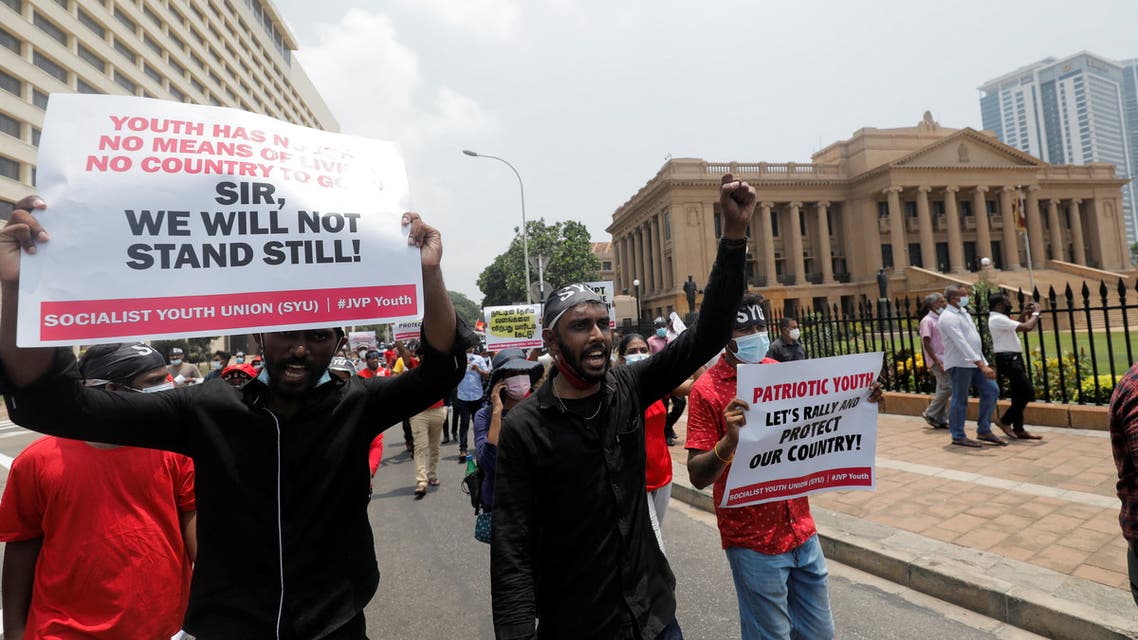
Members of Socialist Youth Union shout slogans against the Sri Lankan President Gotabaya Rajapaksa in front of the President's secretariat during a protest against the worsening economic crisis. (Reuters)
Reuters, Colombo Published: 01 April ,2022
Police in Sri Lanka’s capital lifted a curfew on Friday after protests in which dozens of people were arrested and several policemen were hurt near the home of President Gotabaya Rajapaksa over his handling of an economic crisis.
Hundreds of protesters gathered near Rajapaksa’s residence in a Colombo suburb late on Thursday before police dispersed them with tear gas and water cannons, a Reuters witness said.
“We have arrested 54 people over the unrest last night. Several vehicles belonging to the army and police were burnt by the protesters, including two buses, one police jeep and several motorcycles,” a police spokesman, Senior Superintendent Nihal Thalduwa, told Reuters.
The island nation of 22 million people is in the midst of its worst economic crisis in years with rolling blackouts for up to 13 hours a day because the government does not have enough foreign exchange to pay for fuel imports.
Five policemen were injured and in hospital, Thalduwa said, adding there were no reports of injuries among the protesters.
“The main issue Sri Lanka is facing is a forex shortage and protests of this nature will hurt tourism and have economic consequences,” Sri Lanka’s tourism minister Prasanna Ranatunge told a press conference on Friday.
“Our stance is that people have the right to protest but it should be constructive. What happened yesterday was the opposite.”
Streets in the capital were quiet on Friday morning. Police combed through the wreckage of two burnt-out buses near Rajapaksa’s home, a Reuters witness said.
Trading on the country’s stock market was suspended for the third day in a row after the main blue-chip index fell 10 percent from the previous close.
Curfew in Sri Lanka as protesters try to storm president’s house
Police impose overnight curfew in parts of the capital as protests against a dire economic crisis turn violent.
Demonstrators react after a bus parked at the top the road to Sri Lankan President Gotabaya Rajapaksa's residence is set on fire [Dinuka Liyanawatte/ Reuters]
Colombo, Sri Lanka – Police in Sri Lanka have arrested dozens of people and imposed an overnight curfew in the country’s capital after hundreds of protesters tried to storm President Gotabaya Rajapaksa’s private residence amid widespread anger over a worsening economic crisis.
At least 45 people were detained in Colombo’s Mirihana district on Thursday night, the police said in a statement, branding the protesters as “organised extremists” trying to “create anarchy in the country”.
Some of those arrested “carried iron bars, sticks and sharp weapons” and tried to incite protesters to storm the president’s residence, it added.
Earlier on Thursday evening, Al Jazeera witnessed hundreds of protesters in Mirihana throwing stones and clashing with police as they pushed through the first line of barricades blocking the road to Rajapaksa’s home.
The police responded with tear gas and water cannon as the crowds chanted “Go home Gota, go home!” and “Gota is a dictator”.
Videos from the protest site, posted by the News Wire outlet on Facebook, later showed a police bus on fire and protesters tending to a man with a bloodied face. Police later said two military buses and a four-wheel drive were set ablaze.
It was not clear if the president was at his residence at the time.
A spokesperson for the police declined to comment.
Police disperse demonstrators near Sri Lankan President Gotabaya Rajapaksa’s residence [Dinuka Liyanawatte/ Reuters]A demonstrator throws a stone near Sri Lankan President Gotabaya Rajapaksa’s residence [Dinuka Liyanawatte/ Reuters]
The calls for Rajapaksa’s resignation came as Sri Lanka struggles with an economic downturn sparked by a foreign exchange crisis that has left the government unable to pay for imports of fuel, food, medicine and other essentials. The shortages have resulted in daily rolling blackouts for up to 13 hours in the island nation of 22 million people, and led to some state-run hospitals suspending routine surgeries.
Sri Lanka has turned to the International Monetary Fund for a bailout and is also seeking financial help from China and India. Beijing and New Delhi are reportedly each considering offering $1.5bn in credit facilities, on top of loans worth billions of dollars requested by Rajapaksa’s government.
The protests on Thursday were the latest in a series of nightly demonstrations in Colombo’s suburbs over the past week. The gathering began peacefully, with hundreds of people rallying a few streets away from Rajapaksa’s home.
“We came to protest the unbearable cost of living, fuel shortages and electricity cuts,” said 26-year-old Ajith Perera, who spoke to Al Jazeera before the police cracked down. “The decision to come to the president’s house was spontaneous. We want the president, who has caused so much destruction, to go home.”
Mohamed Asri, a 21-year-old protester, told Al Jazeera he travelled to Mirihana from another Colombo district after seeing coverage of the protest on local television channels.
“The economy is so bad that we can hardly eat two meals a day,” he said. “Things were never this bad in my lifetime. Gota has to go.”
‘Everyone is angry’
After the Mirihana gathering devolved into violence, protests spread throughout the city, with demonstrators using burning logs to block the main highway from Colombo to Sri Lanka’s second-biggest city, Kandy.
“I am angry, everyone is angry,” said protester Saman Wanasinghe. “Who knows what will happen now? There will be protests all over.”
But police – who were deployed to the capital’s streets in force – quickly quelled the unrest and Colombo was calm by the early hours of Friday morning.
Analysts have said the economic crisis in Sri Lanka – which only emerged from a 26-year-long civil war in 2009 – stems from mismanagement by the Rajapaksa government during the COVID-19 pandemic. Despite an ill-timed tax break that depleted government coffers and border closures that resulted in the disappearance of tourism revenues, the government delayed seeking IMF help, they said.
Amid the inaction, Sri Lanka’s foreign exchange reserves dropped by 70 percent in two years, and annual inflation soared by up to 55 percent, according to some estimates.
Alan Keenan, a senior consultant at the International Crisis Group, said Thursday’s protest outside Rajapaksa’s house “was an unprecedented show of anger and defiance” against the president, who is feared by many, partly because he – as the former defence minister – spearheaded a bloody campaign that quashed a separatist rebellion by Sri Lanka’s ethnic Tamil minority.
The United Nations says Sri Lankan forces killed at least 40,000 Tamil civilians in the last days of the war, while rights groups also accuse Rajapaksa and his elder brother Mahinda, who was the president at the time, of overseeing a crackdown against those who opposed the military’s brutal tactics, including journalists and dissidents from the country’s Sinhalese Buddhist majority.
The Rajapaksas, who deny the allegations of rights abuses, lost power following an election in 2015 due to increased public anger about authoritarianism, nepotism and corruption. But they returned to power just four years later, with Gotabaya Rajapaksa winning the presidency after campaigning on a platform of improving security and tackling what he called “Muslim extremism” in the wake of a series of deadly ISIL-claimed attacks on churches and hotels in the country.
His brother Mahinda then became the prime minister. And their eldest brother was appointed agriculture minister while the youngest brother became the finance minister.
Keenan said Thursday’s protests indicated “a sea change in attitudes and willingness to take action” on the Sri Lankan public’s part.
But he cautioned that it was virtually impossible to remove Gotabaya Rajapaksa, as constitutional reforms in 2020 have given the president extraordinary powers while his party’s grip on parliament remained firm.
“With anger growing and inhibitions against violent protest falling away, the current situation is a very dangerous one, even as it contains potential seeds of democratic change,” Keenan said.
“Many fear the government could resort to violence – either directly or through a staged incident, perhaps designed to redirect popular anger against Muslims. Vigilance from influential governments and international bodies like the United Nations is thus essential.
Rathindra Kuruwita reported from Colombo, Sri Lanka, while Zaheena Rasheed reported and wrote from Male, Maldives.
SOURCE: AL JAZEERA
Thursday, March 26, 2026
Iranian Sailors Trapped in Sri Lanka: Tehran Demands Return, US Pressure Mounts — Can Colombo Stay Neutral?
EurAsian Times “You can’t be neutral on a moving train,” is the title of US historian and activist Howard Zinn’s 1994 autobiography.
The world (or the ‘train’), wrote Zinn, “is already moving in certain deadly directions, often toward war, injustice, inequality, or suffering.” Pretending to be neutral often means accepting the status quo, he concluded.
Pretending to be neutral in a ruthless war is difficult enough. However, it is nearly impossible if you’re a small, vulnerable nation trying to maintain good relations with both adversaries, and none illustrates this point better than Sri Lanka’s dilemmas.
The tiny Indian Ocean island-nation sits over 4,200 km away from Iran’s southern border. However, in the three-week-old conflict, Colombo has been tested multiple times.
In fact, the Iran-US War has also been termed as the biggest foreign policy test of the 18-month-old government in Colombo.
For now, President Anura Kumara Dissanayake’s government has been able to somewhat placate both Iran and the US; however, the question is whether, if the war spreads and the pressure to pick sides intensifies, Sri Lanka could continue to maintain neutrality. Sri Lanka’s Dilemmas in the Iran-US War
The US-Iran War started on February 28.
However, in the tiny Indian Ocean island-nation of Sri Lanka, the war dilemmas arrived 48 hours earlier.
On February 26, two papers landed on the desk of the Sri Lankan President Dissanayake. One from the US and one from Iran.
Washington asked permission for two U.S. military aircraft, armed with anti-ship missiles, to land at Mattala airport. Simultaneously, Tehran asked permission for three Iranian naval ships to dock at Sri Lankan ports.
The three Iranian naval ships were in India in February to take part in a naval exercise.
“We received the request on February 26 for the three Iranian vessels to call at port on a goodwill visit between March 9 and 13. On the same evening, the US requested permission for two of its warplanes near Djibouti to land at Mattala airport,” President Dissanayake informed the Sri Lankan Parliament last week.
Committed to maintaining neutrality and ensuring that Colombo does not become a party to the conflict, Sri Lanka denied permission to both.
“So there were two pieces of paper on our desk; one asked for permission for the Iranian vessels to call at port between March 9-13, the other from the US asking to allow 2 naval warplanes to land at Mattala. What should we have done? As a neutral nation, we said no to both. That’s impartiality,” he added.
He said the US wanted to bring in two warplanes armed with eight anti-ship missiles from their base in Djibouti to Mattala International Airport, but “Sri Lanka said no”.\
That should have been the end of Sri Lanka’s role in the conflict; however, as Howard Zinn warned, it is difficult to be ‘neutral on a moving train.’
On March 4, a US submarine torpedoed the Iranian warship, IRIS Dena, which had earlier requested Sri Lanka’s permission to dock. The Iranian warship was torpedoed by the US submarine in international waters, but within Sri Lanka’s Exclusive Economic Zone (EEZ) and search-and-rescue region.
As many as 87 sailors died in the incident, which also brought the deadly conflict right to Sri Lanka’s doorstep.
One week earlier, Colombo had categorically denied permission to IRIS Dena to dock at its port; now, with the lives of 136 sailors hanging by a thread on its doorstep, Colombo had no choice but to respond to IRIS Dena’s distress call.
At least 87 sailors were killed. Sri Lanka recovered 87 bodies and 32 survivors. Colombo also faced criticism, both domestic and international, for denying permission to IRIS Dena to dock at its port, leading to its drowning.
President Dissanayake responded to these criticisms in his statement in the Parliament.
“Certain parties are saying that we have signed agreements with the US, and that’s why we delayed entertaining the Iranian vessel. It was said in Parliament that an 11-hour delay on our part sacrificed the Iranian vessel. That’s outrageous, inhumane,” he said.
Under pressure, Sri Lanka also allowed IRIS Bushehr, an Iranian Navy supply ship, to dock at its port on March 5, less than 24 hours after the drowning of IRIS Dena and the death of 87 sailors.
Sri Lanka also rescued the 221 sailors on board the IRIS Bushehr. Together with the 32 sailors rescued from IRIS Dena, these 252 Iranian sailors have been in Sri Lanka since then. Iranian Sailors in Sri Lanka Remain in Limbo
While rescuing the drowning sailors, Sri Lanka would not have thought that its humanitarian gesture would become its geopolitical dilemma in the coming days.
Sri Lanka has repatriated the bodies of 87 sailors it recovered from the IRIS Dena, after the Iranian government chartered a special plane.
Colombo would like to do the same with 252 Iranian sailors in its custody, especially given that Tehran has repeatedly requested Colombo to repatriate these sailors.
Iran considers the release of its sailors to be a “bilateral” issue that can be resolved directly, since the two countries are on friendly terms, Alireza Delkhosh, Iran’s ambassador to Sri Lanka, said in an interview last week.
However, there is one problem. The US would not allow Sri Lanka to do so, and Colombo is wary of antagonizing the US.
A US State Department cable dated March 6, cited by Reuters, indicated that Jayne Howell, the charge d’affaires at the US embassy in Colombo, urged Sri Lankan authorities not to send back the 32 survivors or the crew of another Iranian vessel, the IRIS Booshehr.
There is also some confusion about the legal status of these sailors.
Delkhosh said they should be free to go because Sri Lanka is not a participant in the hostilities, meaning the sailors are not prisoners of war. He also said many of the sailors were cadets still in training.
“They are not belligerents, they are not fighters, they are just students,” he said. “And here is not the battleground.”
Several other people on board were not from the army. “They were… a music band,” he said.
However, the US differs. Some of the sailors on the ship could be intelligence operatives, and their return to Iran could harm US interests in a war situation, Washington contends.
Furthermore, once in Iran, they could join the war against the US.
According to the New York Times, there is tremendous pressure on Colombo not to let these sailors return to Iran, at least till the war is not over.
In an interview, Sri Lanka’s foreign affairs minister, Vijitha Herath, expressed his dilemma.
“They are not prisoners,” he said. “But that doesn’t mean, give them all freedom.”
Herath also disagreed with the characterization of the Iranians as students. “They were in the warship,” he said.
Walking a tightrope, for now, Colombo has given all the Iranian sailors a one-month visa for Sri Lanka.
Herath stated that, at present, the captain of the Bushehr and 14 of its sailors remain on board the vessel, which is still in Sri Lanka. The rest of the ship’s crew are at a Sri Lankan Navy camp in Welisara, about 12 miles north of Colombo, he said, adding that the 32 survivors of the Dena are at a separate camp operated by the Sri Lankan Air Force.
Colombo is also bearing the cost of their medical expenses and their stay in the country, while also facing pressure from Washington and Tehran to quickly resolve the issue.
“This is a very unique situation. Keeping them is an expense, an obligation, and a security issue for us,” George I. H. Cooke, a visiting lecturer at the University of Colombo in Sri Lanka, told NYT.
Sri Lanka is in a difficult position as both regions are critical for the island-nation.
Sri Lanka’s garment sector is especially exposed to Western markets, and Herath said that more than 40 percent of garment exports go to the United States.
Any blowback on trade with the US could have devastating consequences for a country that has just emerged from near economic collapse.
At the same time, Colombo relies on West Asia to meet its energy needs. Additionally, more than one million Sri Lankans work in West Asia and send significant remittances home.
Sri Lanka would not like to be a party to this conflict. The country has historically followed a non-aligned policy of ‘friends to all, enemies to none’.
Colombo has worked hard to maintain its neutrality in this war, refusing permission to both US fighter jets and Iranian warships. However, the question is for how long a tiny, vulnerable nation can continue to do so?
Sumit Ahlawat has over a decade of experience in news media. He has worked with Press Trust of India, Times Now, Zee News, Economic Times, and Microsoft News. He holds a Master’s Degree in International Media and Modern History from the University of Sheffield, UK. VIEWS PERSONAL OF THE AUTHOR. He can be reached at ahlawat.sumit85 (at) gmail.com