Rubio slams Zelenskyy's Donbas comments and says US may divert Ukraine arms to Iran
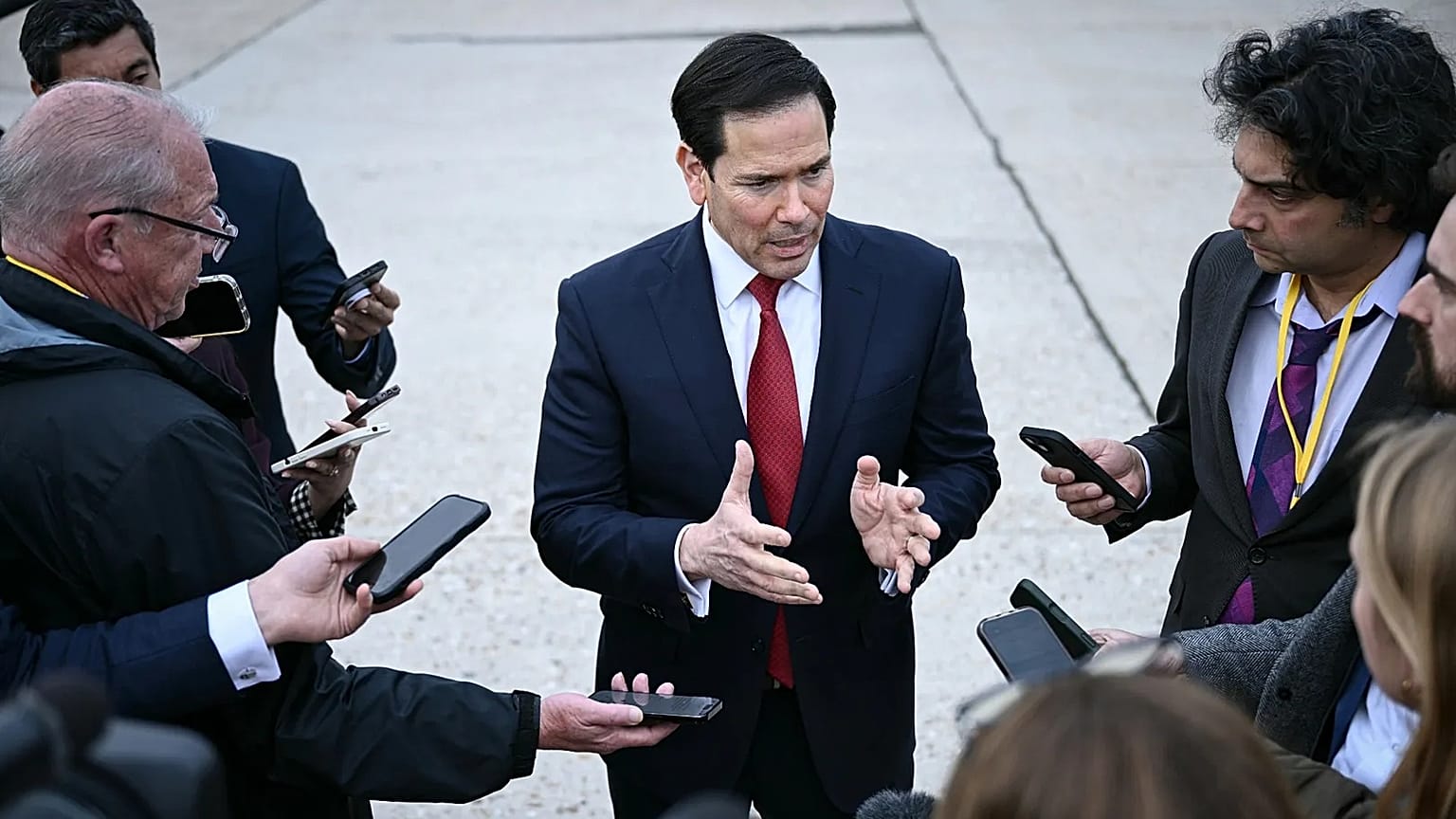 Copyright AP Photo
Zelenskyy had said in an interview that the United States was pressing Ukraine to cede the eastern Donbas region to Russia before finalising any post-war security guarantees.
Secretary of State Marco Rubio accused Ukrainian President Volodymyr Zelenskyy of lying over US demands on Friday and voiced an openness to divert weapons earmarked for Kyiv to support the war on Iran.
Zelenskyy had said in an interview that the United States was pressing Ukraine to cede the eastern Donbas region to Russia before finalising any post-war security guarantees.
"That's a lie," Rubio told reporters when asked about Zelenskyy's remarks.
"I saw him say that and it's unfortunate he would say that, because he knows that's not true," Rubio said in Paris after talks with the Group of Seven industrialised nations.
"What he was told is the obvious: security guarantees are not going to kick in until there's an end to a war, because otherwise you're getting yourself involved in the war," Rubio said.
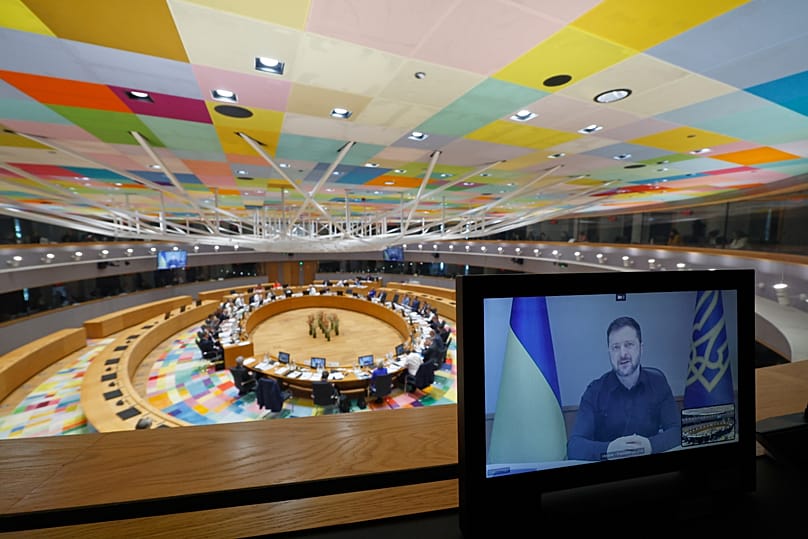 Ukraine's President Volodymyr Zelenskyy speaks to EU leaders via video link during a round table meeting at the EU summit in Brussels, 19 March, 2026 AP Photo
"That was not attached to, unless he gives up territory," Rubio said. "I don't know why he says these things. It's not true."
The attack on Zelenskyy was especially striking coming from Rubio, a former hawkish senator who has largely been seen as more supportive of the Ukrainian cause than some others in President Donald Trump's circle.
In a scene that went viral in February last year, Rubio sat sullenly in the Oval Office as Trump and Vice President JD Vance berated Zelenskyy, saying he was ungrateful for US assistance.
Recently, Trump has again criticised Zelenskyy, saying that he needs to accept compromises and comparing him unfavourably with Russian President Vladimir Putin.
Rubio said that the United States was open to shifting assistance to Ukraine after the United States and Israel attacked Iran
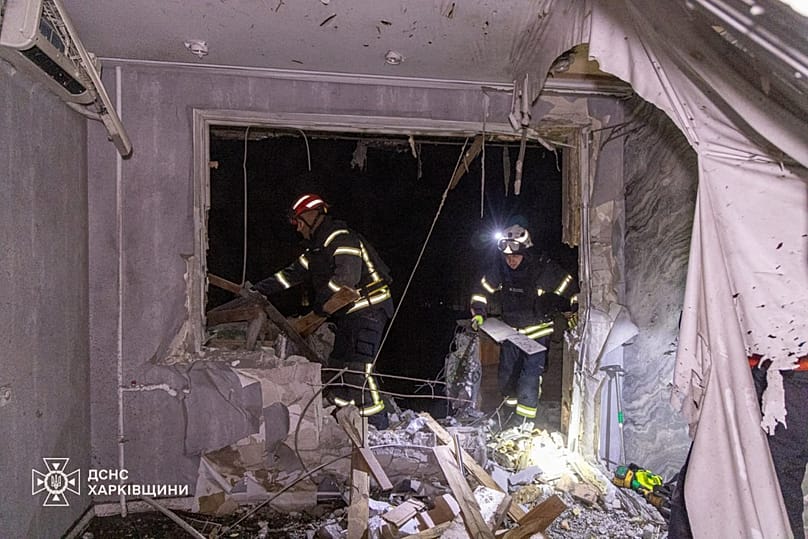 Firefighters put out a fire in a residential building following a Russian drone attack in Kharkiv, 27 March, 2026 AP/Ukrainian Emergency Service
"Nothing yet has been diverted, but it could," Rubio said.
"If we need something for America and it's American, we're going to keep it for America first."
But he said there had not yet been any change to the so-called Prioritised Ukraine Requirements List (PURL), a NATO initiative established after Trump's return in which European allies fund weapons requested by Ukraine that are purchased from the United States.
Secretary of State Marco Rubio accused Ukrainian President Volodymyr Zelenskyy of lying over US demands on Friday and voiced an openness to divert weapons earmarked for Kyiv to support the war on Iran.
Zelenskyy had said in an interview that the United States was pressing Ukraine to cede the eastern Donbas region to Russia before finalising any post-war security guarantees.
"That's a lie," Rubio told reporters when asked about Zelenskyy's remarks.
"I saw him say that and it's unfortunate he would say that, because he knows that's not true," Rubio said in Paris after talks with the Group of Seven industrialised nations.
"What he was told is the obvious: security guarantees are not going to kick in until there's an end to a war, because otherwise you're getting yourself involved in the war," Rubio said.
"That was not attached to, unless he gives up territory," Rubio said. "I don't know why he says these things. It's not true."
The attack on Zelenskyy was especially striking coming from Rubio, a former hawkish senator who has largely been seen as more supportive of the Ukrainian cause than some others in President Donald Trump's circle.
In a scene that went viral in February last year, Rubio sat sullenly in the Oval Office as Trump and Vice President JD Vance berated Zelenskyy, saying he was ungrateful for US assistance.
Recently, Trump has again criticised Zelenskyy, saying that he needs to accept compromises and comparing him unfavourably with Russian President Vladimir Putin.
Rubio said that the United States was open to shifting assistance to Ukraine after the United States and Israel attacked Iran
"Nothing yet has been diverted, but it could," Rubio said.
"If we need something for America and it's American, we're going to keep it for America first."
But he said there had not yet been any change to the so-called Prioritised Ukraine Requirements List (PURL), a NATO initiative established after Trump's return in which European allies fund weapons requested by Ukraine that are purchased from the United States.
'The US must not divert weapons for Ukraine to Iran,' Finnish defence minister tells Euronews
The Finnish defence minister said his country will check that weapons paid for by Europe for the Ukrainian army will reach their intended destination. European allies are concerned about depleting US military resources due to the Iran war and after media reports that the US might divert assets.
Finland’s Defence Minister Antti Häkkänen told Euronews he expects all weapons destined for Ukraine, purchased from the US by European countries, to be delivered.
Häkkänen said Helsinki would check to ensure Washington honours contracts signed with European NATO countries that have bought weapons for Ukraine from US military contractors.
The issue arises from a Washington Post report that the Pentagon is considering diverting crucial military equipment intended for the Ukrainian defence forces to the Iran war.
“Every time we are assessing how the money is being spent, and we are trusting that the mechanism is working. If there are problems of course, then we have to reassess that,” Häkkänen told Euronews' 12 Minutes With programme in an interview at the defence ministry in Helsinki.
The weapons reportedly include vital air defence systems needed to intercept Russian missiles and drones, purchased through NATO’s Prioritised Ukraine Requirements List or PURL system, which allows NATO countries to buy arms for Ukraine from the US.
NATO Secretary General Mark Rutte told journalists that essential equipment for Kyiv, including interceptors, “is continuing to flow into Ukraine.”
However, there are concerns that as the war grinds on and US military supplies deplete, a decision to divert assets to Iran will be made.
“PURL has now supplied around 75% of all missiles for Ukraine's Patriot batteries and 90% of the ammunition used in other air defence systems,” to Ukraine, Rutte told journalists at NATO HQ in Brussels on Thursday.
Helsinki is also adamant it would not be drawn into the US-Israeli intervention in Iran, despite comments from US Secretary of State Marco Rubio implying that Washington's support in Ukraine is at risk if European allies do not help the US secure the Strait of Hormuz.
In a thinly veiled threat to allies while en route to the G7 meeting of foreign ministers in Paris, Rubio said: “Ukraine is not America’s war, and yet we’ve contributed more to that fight than any other country in the world."
“So, it’ll be something to examine that the president will have to take into account down the road”, Rubio added.
But Häkkänen said redirecting security apparatus from Finland to the Gulf was something Helsinki could not do, given the 1350-kilometre border Finland shares with Russia.
“We're a small country neighbouring Russia,” he said. “All our resources are involved into our readiness in this area, so there's no options or potential” to participate, he said.
Meanwhile, Finnish President Alexander Stubb also doubled down on his country’s resistance to US calls for help.
The Iran war "not a NATO matter," he said on Thursday evening, as NATO is a defensive alliance.
Stubb was speaking at a press conference following a meeting of the leaders of the Joint Expeditionary Force (JEC), a multilateral defence cooperation among Nordic-Baltic NATO countries.
Zelenskiy seeks Gulf security ties as Middle East war reshapes Ukraine conflict
.jpg)
Ukrainian President Volodymyr Zelenskiy arrived in Saudi Arabia on March 26 for talks on regional security cooperation, offering Kyiv’s battlefield-honed drone defence expertise in exchange for military support, as the war in Iran reshapes the strategic landscape of Russia’s invasion of Ukraine, reported Ukraine Business News.
Zelenskiy said he expected “important meetings” and expressed gratitude to partners willing to deepen cooperation. Ukrainian officials, cited by AFP, said Kyiv is preparing to sign an air security agreement with Riyadh, reflecting growing demand in the Gulf for counter-drone capabilities after attacks on energy infrastructure linked to the Iran conflict.
Kyiv has already dispatched more than 200 military specialists to countries including the United Arab Emirates, Qatar and Saudi Arabia to help defend against drone strikes. Zelenskiy has proposed a barter arrangement, offering Ukraine’s combat experience in exchange for access to scarce Western systems, particularly US-made Patriot interceptor missiles critical for countering high-speed ballistic threats.
The diplomatic push comes as the Middle East war alters calculations in both Kyiv and Moscow. According to analysts, rising global energy prices triggered by the conflict have boosted Russian revenues, easing economic pressure that had begun to weigh on the Kremlin earlier this year.
Journalist Mikhail Zygar said President Vladimir Putin had been considering renewed peace talks in early 2026 amid weakening economic indicators, including discounted oil sales and tightening credit conditions. Plans for a government reshuffle and shifts in economic management were reportedly under discussion. However, the outbreak of war in Iran reversed that trajectory.
“In one fell swoop, the conditions for reconciliation were violated,” Zygar said, pointing to higher oil prices and growing divisions among Western allies. Analysts caution that the boost to Russia’s finances may prove temporary, but in the short term it reduces incentives for compromise.
At the same time, Ukraine faces renewed uncertainty over military supplies. US officials are weighing whether to redirect some weapons originally intended for Kyiv to the Middle East, including air defence interceptors procured under Nato’s PURL mechanism. While no final decision has been taken, European diplomats say concerns are growing that US stockpiles are being stretched.
President Donald Trump said Washington frequently reallocates weapons globally and emphasised that the United States continues to sell arms to allies, who can then transfer them to Ukraine. Nato Secretary General Mark Rutte sought to reassure Kyiv, stating that deliveries of air defence systems and ammunition would continue without interruption.
Peace diplomacy remains fragile. Talks between Ukrainian and US delegations in Miami were described as constructive, but no breakthrough has been achieved. Washington has reportedly floated security guarantees for Ukraine contingent on Kyiv relinquishing control of the Donbas region, a proposal Zelenskiy has warned could undermine long-term regional stability.
European leaders have also voiced concern. EU foreign policy chief Kaja Kallas said any peace settlement should not force Ukraine into territorial concessions, while Nato officials stressed that decisions on sovereignty must rest with Kyiv.

No comments:
Post a Comment