It’s possible that I shall make an ass of myself. But in that case one can always get out of it with a little dialectic. I have, of course, so worded my proposition as to be right either way (K.Marx, Letter to F.Engels on the Indian Mutiny)
A stream of gas falling into a triple-star system in the Orion constellation reveals how planets can end up tilted relative to their stars, according to a new astronomical study.
“If these streamers are common, then we can naturally explain why planets may not necessarily end up in very orderly systems. They can have much more random orientations,” said Jaehan Bae, Ph.D., a professor of astronomy at the University of Florida who helped lead the new study.
At issue is how planetary orbits are aligned with the stars they circle. While our own solar system has all eight planets orbiting the sun’s natural orientation, many other planetary systems in the galaxy have much more tilted angles. That includes GW Orionis, the triple-star system at the heart of this new study.
Imagine three hula hoops hanging in space, one inside another. The typical expectation is all three hoops would be at the same angle, as if they are simply lying on the ground nested one inside another. Around GW Orionis, however, each hoop is tipped at a different angle.
The new study suggests an incoming river of gas gradually tilted the outer hoop, while leaving the inner one mostly unchanged, causing the rings to be misaligned with each other. If those rings form planets, the planetary orbits would end up tilted to one another as well.
The study was led by Maria Galloway-Sprietsma, a doctoral student in Bae’s group. The team, which included co-authors from the Max-Planck Institute for Astronomy in Germany, Ireland’s University of Galway and Queen Mary University of London, published their findings Aug. 6 in The Astronomical Journal.
Astronomers had previously noticed the misaligned rings of GW Orionis, but most theories chalked up the out-of-kilter rings to the influence of the three stars in this triple system. However, when reviewing data collected by the Atacama Large Millimeter/submillimeter Array telescope in Chile, Bae’s group realized that this large stream of gas better explained how the planetary disks had come out of alignment.
“What we need next is a systematic survey of young stars to see how many have streamers and how many don't,” Galloway-Sprietsma said. “That will tell us how important they are in shaping planetary systems.”
The LVM RGB color visualization zoom-in of the Orion Nebula. This is a small portion of the HiPS map that is being released as a Value Added Product in DR20.
Credit: Contacts Kathryn Kreckel Heidelberg University kathryn.kreckel@uni-heidelberg.de Sebastián Sánchez Universidad Nacional Autónoma de México sfsanchez@astro.unam.mx Ivan Katkov New York University Abu Dhabi ik52@nyu.edu
LAS CAMPANAS OBSERVATORY, CHILE — While the Milky Way appears from Earth as a serene, glowing band stretching across the night sky, zoom in closely and a picture of dynamic cosmic mayhem emerges. Galaxies are living, evolving ecosystems driven by the lifecycles of their stars. Massive stars are born in cold molecular clouds, live short, energetic lives, and flood their environments with intense ultraviolet radiation and powerful stellar winds before dying in violent supernova explosions.
This process, known as stellar feedback, carves giant, glowing bubbles into the interstellar gas and dust, dictating how future generations of stars can form. Yet, understanding the physics governing these complex feedback loops has remained one of astrophysics’ biggest challenges because astronomical instruments usually have to choose between a wide view of a nebula or a detailed chemical breakdown of its gas.
Today, as part of Data Release 20 (DR20) of the fifth phase of the Sloan Digital Sky Survey (SDSS-V), astronomers are releasing a public preview of the Local Volume Mapper (LVM). Operating from the Chilean desert, LVM bridges this gap by capturing light to reveal the physics and chemistry of stellar birthplaces across vast expanses of the sky in unprecedented detail.
Small Telescope, Massive Vision
Operating since 2023, the LVM relies on an unconventional design: a compact set of 16-centimeter primary telescopes working in tandem with extraordinary wide-fields of view capable of capturing the entire full Moon in a single snapshot.
Despite its modest physical size, the instrument combines ultra-dense arrays of optical fibers into Integral Field Units (IFUs). Instead of taking standard two-dimensional photographs, LVM breaks the light at every point in the field into more than 10,000 individual color channels (spectra) simultaneously – a hyperspectral cube with 2 spatial and 1 spectral dimension.
By analyzing specific spectral lines—such as ionized sulfur ([S II]), hydrogen-alpha (Hα), and doubly-ionized oxygen ([O III])—astronomers can map the precise temperature, density, chemical abundance, and motion of interstellar gas across the gas in the Milky Way.
A Global Endeavor
SDSS-V is made up of hundreds of scientists across more than 70 institutions worldwide. While each phase is distinct, SDSS is committed to releasing public data as part of its core mission and is celebrating its 20th major public data release since its debut release in 2003. In addition to the LVM preview, DR20 delivers expanded spectroscopic datasets from the Milky Way Mapper (MWM)—tracing the structure and chemical history of millions of stars—and the Black Hole Mapper (BHM), which monitors supermassive black holes at the centers of distant active galaxies.
“These observations showcase the remarkable breadth and depth of LVM,” added Dr. Kathryn Kreckel, group leader at Heidelberg University and LVM Survey Scientist, “revealing the complex ecosystems of gas and stars in exquisite detail. With millions more spectra still to be collected, we are only beginning to explore the scientific opportunities this survey will provide.”
“Now it is time to scientifically exploit this enormous distributed dataset, exploring the interstellar medium at a range of physical scales never covered before, from resolved nebulae to entire galaxies, creating synergies with other surveys, incorporating multiwavelength explorations, and providing a deeper physical understanding of the new observations,” noted Dr. Sebastián Sánchez, professor at UNAM, LVM program head, and lead author on the recent Helix Nebula study.
A Tale of Two Nebulae: Key Discoveries by Early-Career Researchers
The SDSS-V data are vital for education and cutting-edge PhD research, which is one reason that Universities join the project. The power of this detailed spatial-spectral mapping is highlighted in recent studies focusing on well-known galactic nebulae, led by early-career researchers in the SDSS/LVM collaboration.
Driven by the radiation and energetic photons of a single massive star, the Triffid (latin for three-part) Nebula displays a surprisingly clean thermal structure reasonably well-described by theoretical models.
“In the Triffid Nebula, the density varies significantly as a result of the interaction between stellar radiation and the surrounding molecular gas,” observed Natascha Sattler, PhD student at Heidelberg University and lead author on the Triffid study. “Despite these pronounced density fluctuations, the temperature remains remarkably uniform across our two-dimensional view of the nebula. This simple thermal structure makes the Triffid Nebula an ideal laboratory for studying the chemical composition of star-forming regions.”
By contrast, the Rosette Nebula is driven by a massive, energetic cluster of young stars actively carving out surrounding molecular clouds into a complex, chaotic environment.
“Every region of the Rosette Nebula tells a different part of the story,” said Mónica Villa-Durango, PhD student at the Universidad Nacional Autónoma de México (UNAM) and lead author on the Rosette study. “By mapping its gas in detail, we can trace how the energy from massive stars reshapes the cloud and influences the evolution of the stellar clusters that are formed in the complex.”
Together, these studies highlight a key lesson: complex star-forming regions in distant galaxies are easily misunderstood when their internal physics cannot be directly resolved.
Open Science: Explore the Cosmos in Your Browser
To solve these cosmic puzzles, SDSS is making this initial set of LVM observations publicly available worldwide. The Data Release 20 (DR20) preview features 300,000 individual spectra covering 6 targeted regions—including the Triffid, Rosette, Orion, and Helix nebulae, alongside two nearby dwarf galaxies. While this represents just 1% of LVM’s planned 55+ million spectra, it marks a major step forward in open science. SDSS has released full code repositories alongside the data so researchers everywhere can make use of the observations freely.
To make this massive spatial-spectral dataset accessible to both professional astronomers and the public, the team developed LVMvis, a custom interactive web browser.
“I first developed LVMvis as a way to understand the LVM survey myself: what had been observed, what the data looked like, and how it was organized,” explained Dr. Ivan Katkov, researcher at NYU Abu Dhabi and project lead for LVMvis. “Now, LVMvis lets anyone explore the LVM data without needing to be an expert. You can see which parts of the sky have been observed, click on them, and immediately start looking at what the telescope has measured.”
“The cycle of stellar birth from and return to interstellar and intergalactic material is one of the most important research questions in modern astrophysics. As a theorist, I wanted a dataset that can help put our theoretical ideas to the test. The SDSS-V team has succeeded,” noted Dr. Juna Kollmeier, SDSS-V Director. “Many wrong theories will fall by the sword of LVM data. As it should be in science.”
Key Research Publications
Triffid Nebula Study: Sattler et al. (2026), SDSS-V LVM: Resolving physical conditions in the Triffid Nebula, A&A, 706, A81. NASA ADS Abstract
Rosette Nebula Study: Villa-Durango et al. (2025), SDSS-V Local Volume Mapper (LVM): revealing the structure of the Rosette Nebula, MNRAS, 543, 1196. NASA ADS Abstract
Helix Nebula Data Release: Sánchez et al. (2026), SDSS-V Local Volume Mapper (LVM): Helix Nebula Public data, Data Analysis Pipeline data products, RMxAA, 62, 87. NASA ADS Abstract
About the SDSS
Funding for the Sloan Digital Sky Survey V has been provided by the Alfred P. Sloan Foundation, the Heising-Simons Foundation, the National Science Foundation, and the Participating Institutions. SDSS acknowledges support and resources from the Center for High-Performance Computing at the University of Utah. SDSS telescopes are located at Apache Point Observatory, funded by the Astrophysical Research Consortium and operated by New Mexico State University, and at Las Campanas Observatory, operated by the Carnegie Institution for Science. The SDSS web site is www.sdss.org.
SDSS is managed by the Astrophysical Research Consortium for the Participating Institutions of the SDSS Collaboration, including Caltech, the Carnegie Institution for Science, Chilean National Time Allocation Committee (CNTAC) ratified researchers, The Flatiron Institute, the Gotham Participation Group, Harvard University, Heidelberg University, The Johns Hopkins University, L’Ecole polytechnique fédérale de Lausanne (EPFL), Leibniz-Institut für Astrophysik Potsdam (AIP), Max-Planck-Institut für Astronomie (MPIA Heidelberg), Max-Planck-Institut für Extraterrestrische Physik (MPE), Nanjing University, National Astronomical Observatories of China (NAOC), New Mexico State University, The Ohio State University, Pennsylvania State University, Smithsonian Astrophysical Observatory, Space Telescope Science Institute (STScI), the Stellar Astrophysics Participation Group, Universidad Nacional Autónoma de México, University of Arizona, University of Colorado Boulder, University of Illinois at Urbana-Champaign, University of Toronto, University of Utah, University of Virginia, Yale University, and Yunnan University.
NSF Inouye solar telescope enables major discovery of a hidden solar process
Scientists using the US National Science Foundation Daniel K. Inouye solar telescope discovered Kelvin-Helmholtz instability on the surface of the sun — a finding that could help explain explosive solar activity and other solar phenomena
Association of Universities for Research in Astronomy (AURA)
The highest-resolution image of the Sun's surface (photosphere) ever captured, taken at 416 nm by the Inouye Solar Telescope. It reveals deformed boundaries of magnetic elements and ultra-fine scale stripes, both associated with Kelvin-Helmholtz instability.
Boulder, Colorado — August 5, 2026 — The U.S. National Science Foundation National Solar Observatory (NSF NSO) today announced a groundbreaking discovery in the field of solar physics that could fundamentally change how we understand the physical mechanisms driving solar activity and its impacts on life on Earth.
NSF Inouye Solar Telescope Captures First High-Resolution View of Kelvin-Helmholtz Instability in the Solar Photosphere
A team of international researchers from the NSO, the NSF NCAR High Altitude Observatory (HAO), and the German Max Planck Institut für Sonnensystemforschung (MPS) has discovered Kelvin-Helmholtz instability (KHI) in the form of small, swirling, whirlpool-like patterns on the surface of the sun (the photosphere). The research, published in the journal Nature, is based on data collected with the world's largest solar telescope, the NSF Daniel K. Inouye Solar Telescope, built and operated by NSO on the island of Maui, HI. The time-lapse video and images released today reveal a solar landscape unlike any that had been seen before, uncovering small-scale and dynamic swirls everywhere at the edges of magnetic areas. This allowed for the unambiguous identification of KHI in the photosphere, providing the first experimental confirmation of a phenomenon that has long been predicted by theory but could only be revealed by the Inouye Solar Telescope’s high spatial resolution.
“We believe that the discovery of Kelvin-Helmholtz instability in the solar photosphere, backed up by analysis of numerical simulations, is a major step forward in our understanding of the dynamics and evolution of solar and stellar plasma, and will serve as a basis for future discoveries.“ — Dr. David Boboltz, Deputy Director at the National Solar Observatory.
Kelvin-Helmholtz Instability Explained
An effect caused by fluid motion, KHI occurs when two fluids slide past each other at different velocities creating a "shear" at the interface—causing small disturbances to grow into striking, wave-like or spiraling, vortices that look like breaking ocean waves. Since its original formulation by Lord Kelvin and Hermann von Helmholtz around 1870, KHI has been observed and investigated across many areas of physics, including fluid dynamics, meteorology, oceanography, heliosphysics, and astrophysics. The instability is observed at a variety of scales from small lake and ocean waves (in windy conditions) and cloud formations on Earth, to the atmospheres of gas giants like Jupiter and Saturn, and the interaction of the solar wind with planetary magnetospheres within our solar system.
Vortices as a Driver of the Sun’s Explosive Events
The swirling vortices of magnetic solar plasma have become an area of increased interest for solar physicists. They could be an effective source of free magnetic energy, which powers major solar activity—including explosive events from tiny nano-flares to massive flares, jets, and coronal mass ejections. These are the main contributors to space weather, and can severely disrupt our modern technological infrastructure, including power grids, satellites, GPS navigation, and global communications.
The leading theory on how the Sun builds up magnetic energy is called "flux braiding." As magnetic field lines twist around each other—like braiding hair—they create a tense, unstable setup. When that tension gets rapidly released, the tangled magnetic lines “snap”, cross over each other, and reconnect in new shapes (a process called "magnetic reconnection"). This sudden rearrangement releases a burst of energy as the system settles into a calmer, lower-energy state.
What scientists don't fully understand yet is what causes the twisting and braiding to happen in the first place. This new discovery—those small swirling patterns (from the Kelvin-Helmholtz instability)—might be part of the answer. Since the swirls seem to be happening constantly and everywhere on the Sun's surface where there is a strong enough magnetic field, they could be the everyday "engine" that keeps twisting the magnetic field lines and setting the whole process in motion.
“We are only at the beginning of recognizing the wide-reaching impact the discovery of Kelvin-Helmholtz instability has on our understanding of the connection between the magnetized plasma motion and the energy transport and release into the upper solar atmosphere.” — Dr. Friedrich Wöger, Senior Scientist at the National Solar Observatory.
Inouye Observations, Simulations, and Theory Align
In their Nature paper, the team analyzed and compared the high-resolution Inouye observations with computer simulations of the solar photosphere created with a highly specialized code built and maintained by international teams including HAO and MPS (MPS/University of Chicago Radiative MHD, or “MURaM”). These computer simulations provided by HAO are built using basic physics equations that describe what's happening in the Sun's atmosphere, and are an important tool in the interpretation of scientific data. The simulations allow the scientists to "see" things that are hard or impossible to measure directly by observation, giving insight into processes that would otherwise stay hidden.
In the case of this work, the scientists found dozens of vortex-like structures along the edges of magnetic areas both in the observations and simulations, with strikingly similar characteristics and dynamics. For example, the average distance between vortices, known as the “instability wavelength,” ranged between 50–65 km in both cases. The study shows that the Sun’s constantly bubbling surface, or granulation, interacts with magnetic structures to create areas where neighboring layers move at different speeds, providing the conditions necessary to trigger KHI.
"It is very exciting to see that the highest-resolution observations of the solar photosphere revealed a new dynamical regime in the form of KH vortices at the edges of magnetic field concentrations. These observations also provide the highest resolution validation of solar magnetohydrodynamic simulations to date, and the agreement in physical details is impressive." — Dr. Matthias Rempel, Senior Scientist at the High Altitude Observatory.
The team’s advanced analyses of the Inouye observations and the computer simulations, combined with their agreement with analytical theory, led to the conclusion that the swirling vortices, and the fast-moving, finest-scale dark stripes (“striations”), found in both the observations and simulations are without a doubt produced by KHI.
Implications for the Solar Atmosphere and Coronal Heating Mystery
”Kelvin-Helmholtz instability is likely a mechanism that contributes to the heating of the outer atmosphere and is part of the solution of the longstanding enigma of why stars have a million degrees Kelvin hot corona.” — Dr. Thomas Rimmele, Chief Technologist at the National Solar Observatory.
The data also shows that this swirling effect (KHI) efficiently mixes magnetized and non-magnetized plasma on the Sun’s surface, enhancing the spreading out or diffusion of magnetic fields throughout the solar atmosphere. The diffusion resulting from the KHI is a key factor scientists use when building models to predict how magnetic activity changes over time—not just for our Sun, but for other stars too.
”The Sun’s magnetic field is generated by dynamo processes that act like giant cosmic engines that turn the star's rotational energy into magnetic fields. However, because the solar magnetic cycle is only 11 years, a remarkably rapid timescale in cosmic terms, the generated magnetic flux must dissipate efficiently. Current models struggle to explain this rapid diffusion. The Kelvin-Helmholtz instability we discovered in the solar photosphere can act as a key source of this missing magnetic diffusion.” — Dr. David Kuridze, Astronomer at the National Solar Observatory.
Looking Ahead
Scientists are now moving towards the next phase of analysis, which includes using computer programs that can automatically spot and study these swirling patterns — aided by the high resolution data from the Inouye Solar Telescope. This next phase of research will help in two main ways: it'll show scientists more about how much energy these KHIs can carry up into the Sun's higher atmosphere, where it helps heat things up, and it'll also help scientists figure out just how much they affect the way magnetic fields spread out in the lower parts of the Sun's atmosphere.
“To understand the dynamic space weather that affects Earth, we have to see the small-scale processes driving it. For decades, seeing these vortices at such tiny scales remained elusive. By pairing a massive four-meter mirror with state-of-the-art optics and instruments, the NSF Inouye Solar Telescope delivers the resolving power needed to reveal these ultrafine details for the first time, enabling discoveries that were once beyond our reach.” — Dr. Jacqueline Keane, NSF Program Director for the National Solar Observatory
High-resolution images, figures, videos, captions, and credits are available for download in the Google Drive media kit: Click Here
These assets are provided for editorial use in connection with this announcement.
About the NSF National Solar Observatory
The mission of the U.S. National Science Foundation National Solar Observatory (NSF NSO) is to advance knowledge of the Sun, both as an astronomical object and as the dominant external influence on Earth, by providing forefront observational opportunities to the research community.
NSO built and operates the world’s most extensive collection of ground-based optical and infrared solar telescopes and auxiliary instrumentation— including the NSF-NOAA GONG network of six stations around the world, and the world’s largest solar telescope, the NSF Daniel K. Inouye Solar Telescope—allowing solar physicists to probe all aspects of the Sun, from the deep solar interior to the photosphere, chromosphere, the outer corona, and out into the interplanetary medium. These assets also provide data for heliospheric modeling, space weather forecasting, and stellar astrophysics research, putting our Sun in the context of other stars and their environments.
Besides the operation of cutting-edge facilities, the mission includes the continued development of advanced instrumentation both in-house and through partnerships, conducting solar research, and educational and public outreach. NSO is managed by the Association of Universities for Research in Astronomy, Inc. (AURA) under a cooperative agreement with NSF. For more information, visit nso.edu.
Combination of data from the NASA/SDO satellite, the NSF Inouye Solar Telescope VBI instrument, the MPS camera, and the HAO MuRAM simulation. This demonstrates the high detail obtained by the Inouye Solar Telescope. In the last part of the movie, the HAO MURaM simulation data is overlaid for both the synthesized intensity and the vertical magnetic field component that is finally displayed in three dimensions.
Inouye Solar Telescope data obtained at the wavelength 416 nm, with 3 zoomed regions. Three selected close-up areas show the Kelvin-Helmholtz instability on the Sun.
This close-up video, derived from the Inouye's high-resolution observations of the solar surface, reveals signatures of the Kelvin–Helmholtz instability with unprecedented clarity.
The highest-resolution image of the Sun's surface (photosphere) ever captured, taken at 416 nm by the Inouye Solar Telescope. It reveals deformed boundaries of magnetic elements and ultra-fine scale stripes, both associated with Kelvin-Helmholtz instability.
A close-up view from the Inouye Solar Telescope image highlighting a region of the solar photosphere. The enlarged inset reveals the fine-scale magnetic structures and dark striations associated with the Kelvin-Helmholtz instability at a scale of tens of kilometers.
(Hawai‘i-scale): The highest-resolution image of the Sun's surface (photosphere) ever captured, taken at 416 nm by the Inouye Solar Telescope. It reveals deformed boundaries of magnetic elements and ultra-fine scale stripes, both associated with Kelvin-Helmholtz instability.
Credit
NSF/NSO/AURA/MPS
Astronomers catch massive star’s death from the first explosive moment
With an extremely faint burst of X-rays and no high-velocity jets, this supernova suggests a new way for massive stars to end their lives
Association of Universities for Research in Astronomy (AURA)
This image shows the field around the progenitor to supernova SN 2026gzf, detected by the Einstein Probe on 21 March 2026. The supernova progenitor appears as a bright blue dot within the galaxy located at the center of this image.
View a series of close-up images that show the evolving supernova here.
This image was captured with the 570-megapixel DOE-fabricated Dark Energy Camera (DECam), mounted on the NSF Víctor M. Blanco 4-meter Telescope at Cerro Tololo Inter-American Observatory (CTIO) in Chile, a Program of NSF NOIRLab.
Credit: CTIO/NOIRLab/DOE/NSF/AURA Image Processing: D. de Martin & M. Zamani (NSF NOIRLab)
In March 2026, the Einstein Probe detected a brief flash of soft X-rays emitted from a galaxy about 500 million light-years away. The flash, dubbed EP260321a, immediately triggered a worldwide observing campaign. Within an hour, ground-based telescopes began monitoring the source, revealing a rapidly brightening supernova later designated SN 2026gzf. Two teams of scientists utilized several NSF NOIRLab facilities to observe the event and monitor its evolving light profile.
The teams were led by Brendan O’Connor, astronomer and McWilliams Fellow at Carnegie Mellon University, and Jillian Rastinejad, a NASA Einstein Fellow at the University of Maryland, College Park. The teams present the results of their studies in papers published in The Astrophysical Journal Letters (O’Connor et al., Rastinejad et al.).
Both teams were able to independently identify the initial burst of X-rays as a “shock breakout” — the moment when the powerful shock wave from a stellar explosion bursts through the star’s surface and releases the first light of a supernova.
Although shock breakouts are expected to occur in all supernova explosions, they are notoriously difficult to observe because they last only seconds to hours. In the past two decades, astronomers have confidently identified only one other clear X-ray shock breakout event [1], making EP260321a an exceptionally rare discovery.
Each team was also able to independently confirm that the explosion was a broad-lined Type Ic (Ic-BL) supernova. These supernovae typically possess jets of relativistic material — material that is moving close to the speed of light — and they are commonly linked to gamma-ray bursts, which are the brightest and most powerful class of explosions in the Universe.
However, SN 2026gzf stands out as a unique case for multiple reasons. First, the initial shock breakout is the faintest to ever be associated with a Ic-BL supernova, even though the explosion itself was not similarly weak. Additionally, researchers were surprised to find no evidence of a gamma-ray burst following the supernova, despite the event appearing to match other Ic-BL supernovae that were followed by gamma-ray bursts.
“SN 2026gzf looks remarkably similar to other energetic supernovae that have been previously linked to gamma-ray bursts. Yet multi-wavelength follow-up observations using the most sensitive facilities found no evidence for a relativistic jet or an afterglow, which are typically seen in those events,” says O’Connor. “One possibility is that the jet was ‘choked,’ either by the surface of the star or by circumstellar material surrounding the star.”
For their investigation into this puzzling event, O’Connor and his team acquired deep imaging of the supernova as it brightened and reached peak luminosity using the 570-megapixel DOE-fabricated Dark Energy Camera (DECam), mounted on the NSF Víctor M. Blanco 4-meter Telescope at Cerro Tololo Inter-American Observatory (CTIO) in Chile, a Program of NSF NOIRLab. Archival DECam images taken ten years before the explosion revealed a blue source at the same location [2], offering rare clues about the progenitor system and its environment before the star died.
The event also occurred within the NSF–DOE Vera C. Rubin Observatory’sCOSMOS Deep Drilling Field. Public commissioning data from the Rubin alert broker, Babamul, supplied additional multi-band observations that helped track the supernova’s evolution and revealed evidence of activity from the progenitor system shortly before the explosion. Thanks to Rubin’s rapid cadence and unprecedented sensitivity, continued observations are expected to provide detailed, long-term records of the supernova as it evolves for years to come.
Additionally, the Dark Energy Spectroscopic Instrument (DESI), mounted on the NSF Nicholas U. Mayall 4-meter Telescope at Kitt Peak National Observatory (KPNO), a Program of NSF NOIRLab, obtained multiple spectra through its spare-fiber transient program. This program is aimed at using spare fibers on DESI that are not already matched to a target to follow up on transients identified by Rubin. These observations allowed the team to watch SN 2026gzf evolve over time and confirm its nature as a Ic-BL supernova.
“DESI’s spare-fiber program gave us the opportunity to return to SN 2026gzf repeatedly and follow how its spectrum changed as the explosion evolved,” says Xander Hall, graduate student at Carnegie Mellon University, member of O’Connor’s team, and second author of the paper. “This sequence of observations demonstrates the power of using DESI’s spare fibers for rapid transient follow-up and classification as Rubin continues to ramp up its transient alert stream over the next decade.”
Rastinejad and her team simultaneously conducted a multi-wavelength follow-up investigation of the event using both of the Gemini Multi-Object Spectrographs (GMOS) mounted on Gemini North in Hawai‘i and Gemini South in Chile, which compose the International Gemini Observatory, and the Goodman spectrograph mounted on the SOAR 4.1-meter Telescope through its AEON queue; both Gemini and SOAR are supported in part by the NSF and operated by NSF NOIRLab. They also used data from NSF–DOE Rubin Observatory, Palomar Observatory, and the VLA.
These observations helped Rastinejad and her team confirm that SN 2026gzf was a Ic-BL supernova, determine the absence of relativistic jets, and understand the star’s structure and surroundings just prior to collapse.
“Our observations allowed us to study the physics of three pieces of this explosion: the X-ray shock breakout, the accompanying supernova, and the interaction of the supernova with material previously cast out by the dying star,” says Rastinejad. “With this information we were able to map out the structure of the material surrounding the star and understand the star’s violent lifestyle before it collapsed.”
They determined that the progenitor is a Wolf-Rayet star — a star born with about 20 times the mass of the Sun that burns through its hydrogen early on in its life. They found that in the lead-up to its explosive death, the star underwent irregular episodes of mass loss, ejecting all of its hydrogen and helium and leaving behind a stripped star made mostly of carbon and oxygen. The turbulent mass loss created multiple shells of material around the star: a nearby, compact shell of low-mass material that emitted the initial X-ray signal, plus an extended, non-symmetric shell of material that emitted the optical supernova signal.
“This is the first time we’ve mapped out the pre-explosion environment of a star that has been stripped of hydrogen and helium,” says Gokul Srinivasaragavan, a recent PhD graduate from the University of Maryland, a member of Rastinejad’s team, and second author on the paper. “Going forward, I’m excited to observe more shock breakout events in similar detail to test if all stripped stars have a similar ‘lifestyle’ prior to collapse and what, if any, differences we see.”
With an exceptionally faint X-ray shock breakout and no relativistic outflows, EP260321a/SN 2026gzf acts as a unique bridge between ordinary supernova shock breakouts and the more extreme explosions that generate low-luminosity gamma-ray bursts.
By establishing that energetic Ic-BL supernovae do not always produce a gamma-ray burst, relativistic outflows, or a long-lived afterglow, this discovery suggests that massive stars can die through a wider range of pathways than previously recognized.
The result also demonstrates the growing power of coordinated time-domain astronomy, where space missions and ground-based observatories work together to capture transient cosmic events in real time. By combining observations from Einstein Probe, NSF NOIRLab facilities, and partner observatories around the world, researchers were able to reconstruct a rare explosion in unprecedented detail.
Notes
[1] Supernova SN 2008D was detected by NASA’s Neil Gehrels Swift Observatory in 2008. It was the first time astronomers directly detected the initial shock breakout of a core-collapse supernova.
[2] Scientists say that the bright emission at the location of the supernova in pre-explosion images likely represents a compact, extreme star-forming region in the host galaxy, combined with pre-explosion activity of the progenitor star before its death.
More information
This research is presented in a paper titled “EP260321a/SN 2026gzf: The Faintest Shock Breakout Associated with a Broad-Lined Supernova” published in The Astrophysical Journal Letters. DOI: 10.3847/2041-8213/ae84ba. The team is composed of B. O’Connor (Carnegie Mellon University, USA), X. Hall (Carnegie Mellon University, USA), M. Busmann (Ludwig-Maximilians-Universität/Excellence Cluster ORIGINS, Germany), et al.
This research is presented in a paper titled “A Multi-Wavelength View of the First Type Ic-BL Supernova with an Einstein Probe X-ray Shock Breakout” appearing in The Astrophysical Journal Letters. DOI: 10.3847/2041-8213/ae8a4b. The team is composed of J. C. Rastinejad (University of Maryland, USA), G. Srinivasaragavan (University of Maryland/NASA Goddard Space Flight Center/California Institute of Technology, USA), N. Sarin (University of Cambridge, UK), et al.
The Dark Energy Camera (DECam) was designed specifically for the Dark Energy Survey (DES). It was funded by the U.S. Department of Energy (DOE) and was built and tested at DOE's Fermilab.
The Southern Astrophysical Research (SOAR) Telescope is a joint project of the Ministério da Ciência, Tecnologia e Inovações do Brasil (MCTIC/LNA), NSF NOIRLab, the University of North Carolina at Chapel Hill (UNC), and Michigan State University (MSU).
NSF–DOE Vera C. Rubin Observatory, funded by the U.S. National Science Foundation and the U.S. Department of Energy’s Office of Science, is a groundbreaking new astronomy and astrophysics observatory on Cerro Pachón in Chile. It is named after astronomer Vera Rubin, who provided the first convincing evidence for the existence of dark matter. Using the largest camera ever built, Rubin will repeatedly scan the sky for 10 years to create an ultra-wide, ultra-high-definition, time-lapse record of our Universe.
NSF–DOE Vera C. Rubin Observatory is a joint initiative of the U.S. National Science Foundation (NSF) and the U.S. Department of Energy’s Office of Science (DOE/SC). Its primary mission is to carry out the Legacy Survey of Space and Time, providing an unprecedented dataset for scientific research supported by both agencies. Rubin is operated jointly by NSF NOIRLab and SLAC National Accelerator Laboratory. NSF NOIRLab is managed by the Association of Universities for Research in Astronomy (AURA) and SLAC is operated by Stanford University for the DOE. France provides key support to the construction and operations of Rubin Observatory through contributions from CNRS Nucléaire & Particules. Rubin Observatory is privileged to conduct research in Chile and gratefully acknowledges additional contributions from more than 40 international organizations and teams.
The scientific community is honored to have the opportunity to conduct astronomical research on I’oligam Du’ag (Kitt Peak) in Arizona, on Maunakea in Hawai‘i, and on Cerro Tololo and Cerro Pachón in Chile. We recognize and acknowledge the very significant cultural role and reverence of I’oligam Du’ag to the Tohono O’odham Nation, and Maunakea to the Kanaka Maoli (Native Hawaiians) community.
EP260321a/SN 2026gzf: The Faintest Shock Breakout Associated with a Broad-Lined Supernova
These images show the evolution of supernova SN 2026gzf, which was first detected by the Einstein Probe on 21 March 2026. Images taken on 25 March and 3 April 2026 show the supernova brightening. An archival image of the host galaxy from 9 March 2016 reveals a bright blue source at the location of the supernova, which scientists say likely represents a compact, extreme star-forming region in the host galaxy, combined with pre-explosion activity of the progenitor star before its death.
These images were captured with the 570-megapixel DOE-fabricated Dark Energy Camera (DECam), mounted on the NSF Víctor M. Blanco 4-meter Telescope at Cerro Tololo Inter-American Observatory (CTIO) in Chile, a Program of NSF NOIRLab.
This image shows the field around the progenitor to supernova SN 2026gzf, detected by the Einstein Probe on 21 March 2026. The supernova progenitor appears as a bright blue dot within the galaxy located in the middle of the upper third at the center of this image.
View a series of close-up images that show the evolving supernova here.
This image was captured in May 2025 with the LSST Camera, mounted on NSF–DOE Vera C. Rubin Observatory, jointly funded by the U.S. National Science Foundation (NSF) and the U.S. Department of Energy's Office of Science (DOE/SC).
SN 2026gzf occurred within Rubin’s COSMOS Deep Drilling Field. Observations of this field, including this image, were recently made public as part of Rubin’s Early Data Preview 2 (EDP2) — the first data preview based on observations from the LSST Camera. EDP2 combines Rubin’s science validation observations collected between April 2025 and January 2026.
These images show the evolution of supernova SN 2026gzf, which was first detected by the Einstein Probe on 21 March 2026. Images taken on 25 March and 3 April 2026 show the supernova brightening. Archival images of the host galaxy from 9 March 2016 and 20 May 2025 reveal a bright blue source at the location of the supernova, which scientists say likely represents a compact, extreme star-forming region in the host galaxy, combined with pre-explosion activity of the progenitor star before its death.
These images were captured with the LSST Camera, mounted on NSF–DOE Vera C. Rubin Observatory, jointly funded by the U.S. National Science Foundation (NSF) and the U.S. Department of Energy's Office of Science (DOE/SC), and the 570-megapixel DOE-fabricated Dark Energy Camera (DECam), mounted on the NSF Víctor M. Blanco 4-meter Telescope at Cerro Tololo Inter-American Observatory (CTIO) in Chile, a Program of NSF NOIRLab.
SN 2026gzf occurred within Rubin’s COSMOS Deep Drilling Field. Observations of this field, including this image, were recently made public as part of Rubin’s Early Data Preview 2 (EDP2) — the first data preview based on observations from the LSST Camera. EDP2 combines Rubin’s science validation observations collected between April 2025 and January 2026.
This image shows the host galaxy of the recently detected supernova SN 2026gzf. This supernova was first detected by the Einstein Probe on 21 March 2026. This archival image of the host galaxy from 9 March 2016 reveals a bright blue source at the location of the supernova. Scientists say this blue source likely represents pre-explosion activity of the progenitor star before its death.
This image was captured with the 570-megapixel DOE-fabricated Dark Energy Camera (DECam), mounted on the NSF Víctor M. Blanco 4-meter Telescope at Cerro Tololo Inter-American Observatory (CTIO) in Chile, a Program of NSF NOIRLab.
This image shows supernova SN 2026gzf, which appears as a bright blue point source in the upper right corner of the host galaxy. SN 2026gzf was first detected by the Einstein Probe on 21 March 2026, and this image was taken just a few days later on 25 March 2026.
This image was captured with the 570-megapixel DOE-fabricated Dark Energy Camera (DECam), mounted on the NSF Víctor M. Blanco 4-meter Telescope at Cerro Tololo Inter-American Observatory (CTIO) in Chile, a Program of NSF NOIRLab.
This image shows supernova SN 2026gzf, which appears as a bright blue point source in the upper right corner of the host galaxy. SN 2026gzf was first detected by the Einstein Probe on 21 March 2026, and this image was taken a couple of weeks later on 3 April 2026.
This image was captured with the 570-megapixel DOE-fabricated Dark Energy Camera (DECam), mounted on the NSF Víctor M. Blanco 4-meter Telescope at Cerro Tololo Inter-American Observatory (CTIO) in Chile, a Program of NSF NOIRLab.
View a series of close-up images that show the evolving supernova here.
Credit
CTIO/NOIRLab/DOE/NSF/AURA Image Processing: D. de Martin & M. Zamani (NSF NOIRLab)
SwRI study finds evidence of liquid recently flowing on Pluto’s surface
Researchers use New Horizons imagery to identify evidence for liquid nitrogen flowing from underneath Pluto’s famous heart-shaped glacier
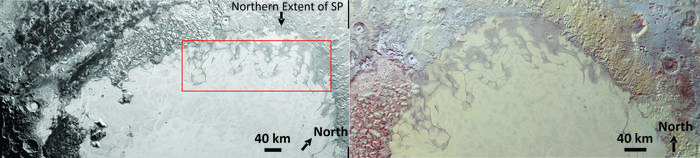
Pluto’s northern Sputnik Planitia glacier (in the western or left side of Pluto’s brightheart) is shown here in a color mosaic made from New Horizons imagery. The direction of north is shown on the image. The image is ~ 700 x 350 kilometers across. The red box has been added to show most of the region containing dark features attributed to the wetting of the glacier by liquid nitrogen sourced from a “basil melting” process beneath the glacier, as described in the published paper by Stern et al. (2026).
Credit: NASA/John Hopkins APL/Southwest Research Institute
SAN ANTONIO — August 5, 2026 —A new study led by Southwest Research Institute (SwRI) provides evidence that liquid nitrogen is rising to Pluto’s surface through cracks in the northern edge of the Sputnik Planitia, part of the massive heart-shaped glacier on the dwarf planet’s surface. This is the first evidence of liquid recently flowing on Pluto. The study is based on data from NASA’s New Horizons spacecraft and is led by SwRI Associate Vice President Dr. Alan Stern, the principal investigator of the New Horizons mission.
“Pluto never stops surprising us,” Lead Author Stern said, “and this new result certainly does that. In addition to suggesting that liquids have recently expressed themselves on Pluto’s surface, it also suggests a new kind of time-variable feature on Pluto.”
The Sputnik Planitia is a vast, frozen nitrogen glacier on Pluto, larger than Texas and Oklahoma combined. In 2015 and 2016, New Horizons images of the northernmost portions of this region revealed city-sized geologic convection cells on Sputnik Planitia separated by thin, dark linear and more diffuse, dark features. New analyses now indicate that these dark, linear and diffuse features appear to be occasionally and temporarily wetted, perhaps from time to time, by a liquid—most likely liquid nitrogen. This result has been published in the peer-reviewed Planetary Science Journal.
Pluto’s atmospheric and thermal conditions make liquid nitrogen rain physically impossible. Nonetheless, the surface patterns on northern Sputnik Planitia have been darkened in ways that resemble glacial features on Earth that have been wetted by water rain or the subsurface emergence of liquids to the surface.
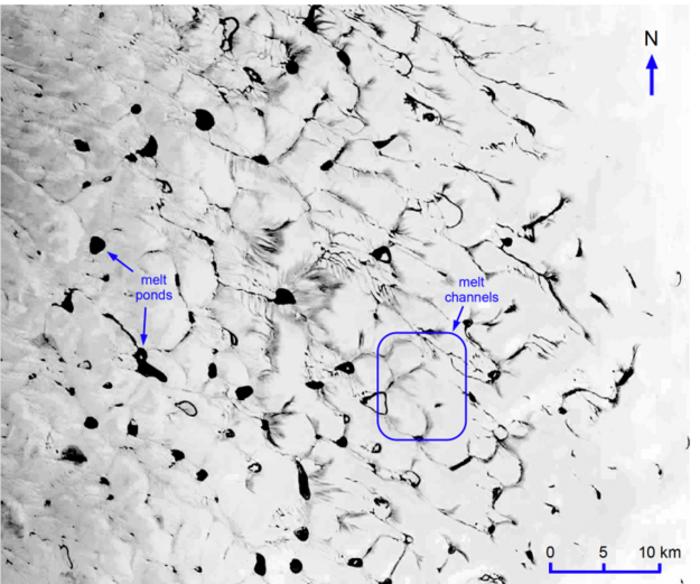
The SwRI-led team of Pluto researchers compared the New Horizons images to NASA Landsat 9 imagery of locations on Earth, including the Greenland ice sheet. There, dark narrow surface features have been identified in areas where liquid water occurs on the ice and snow. The Sputnik Planitia images from New Horizons appear very similar, suggesting that subsurface liquids, specifically nitrogen, is rising and wetting Pluto’s nitrogen ice.
“The surface of Sputnik Planitia is quite young, probably less than one million years based on modeling of the surface overturn, and thus these features that we are looking at must have formed since then,” said SwRI Principal Scientist Dr. Kelsi Singer, one of the study’s co-authors. “Pluto has many unique terrains seen nowhere else in the solar system, and this area of Sputnik Planitia is one of them. Its surface provides a different set of conditions compared to what we are used to on Earth, and exploring that allows us to better understand how materials behave in environments that are difficult to produce on Earth.”
The new work provides the first evidence of recent liquid flows to the surface of Pluto. Earlier research, including some led by first author Stern, suggested ancient liquid flows, but the new work suggests there is currently or recently liquid nitrogen beneath the surface of the glacier.
Computer models led by Dr. Orkan Umurhan, senior research scientist at the SETI Institute, show that nitrogen ice at the base of Pluto’s kilometers-deep Sputnik glacier can melt, forming liquid nitrogen. Furthermore, these computer models revealed that this liquid can be transported upward to the surface through small conduits, similar to lava or geyser tubes, driven by buoyancy or pressure from below. The researchers found that once reaching the surface, the melted nitrogen can remain liquid long enough to flow downward on slopes on the Sputnik’s nitrogen glacier, wetting the icy surface and producing the observed dark features.
“I think the great significance of these findings, and the tantalizing picture that it promotes, is a great motivation and reason to further examine solid state nitrogen physics at very low temperatures,” Umurhan said. “Specifically, it’s important to examine the physics taking place in solid nitrogen materials under stress and strain, which can cause them to melt. These processes have never been studied in real detail in the laboratory.”
While no other regions of Pluto show evidence of basal flow over half of Pluto remains unmapped in high-resolution. The melting process and the liquid’s upward movement on Pluto could also potentially explain other events seen across the solar system, such as the geysers observed by NASA’s Voyager 2 on Neptune’s moon Triton. Further high-resolution mapping of Pluto and other Kuiper Belt planets is needed to determine if similar processes are occurring elsewhere in that region of the solar system.
The Johns Hopkins Applied Physics Laboratory in Laurel, Maryland, designed, built, and operates the New Horizons spacecraft and mission for NASA’s Science Mission Directorate. The Planetary Missions Program Office at Marshall Space Flight Center (MSFC) in Huntsville, Alabama, provides NASA oversight for New Horizons. Southwest Research Institute, based in San Antonio, directs the mission via Principal Investigator Dr. Alan Stern, who leads the science team, payload operations and science planning. New Horizons is part of the New Frontiers Program managed by NASA's MSFC.
The study “Evidence for possible N2 basal flow beneath Pluto’s northern Sputnik Planitia,” was published this month in The Planetary Science Journal. DOI: https://doi.org/10.3847/PSJ/ae7e85.
Researchers for an SwRI-led study compared New Horizons images to NASA Landsat 9 images of the Greenland ice sheet. Dark, narrow surface features have been identified here in areas in Greenland where liquid water darkens the ice and snow in a manner analogous to what is now believed to perhaps be occurring on northern Sputnik Planitia on Pluto due to present or recent liquid nitrogen there. The newly-published Pluto study identifies very similar features in the northern edge of Pluto’s Sputnik Planitia glacier, suggesting the recent presence of liquid nitrogen there.
A new study led by Southwest Research Institute (SwRI) posits that liquid nitrogen is rising to Pluto’s surface through cracks in the northern edge of the Sputnik Planitia, part of the massive heart-shaped glacier on the dwarf planet’s surface. This is the first evidence of liquid flowing currently on Pluto. For scale, Pluto is about 3/4ths as wide as the continental United States.
Credit
NASA/Johns Hopkins APL/Southwest Research Institute
High-energy particles in the Earth’s radiation belt can appear to spread out randomly, even when they are moving in a ‘predictable’ way. This is because spacecraft observations naturally blur the fine-scale structure of the particle population, a new study reveals.
Publishing their findings in Physical Review Research, the International Space Science Institute (ISSI) research team, led by the University of Birmingham and the Czech Academy of Science, shows that particles moving in a ‘predictable’ way can create patterns very similar to random movement or ‘diffusion’ when observed by a spacecraft.
The researchers show that highly structured particle motion can create spacecraft observations that look almost identical to those traditionally interpreted as diffusion. The findings highlight a fundamental challenge for space scientists: different physical processes can produce the same observational evidence.
Radiation belts are doughnut-shaped regions of high-energy particles trapped by a planet’s magnetic field. They also exist around Saturn, Jupiter and its moon Ganymede, as well as recently discovered ultracool brown dwarfs. Understanding how particles move through these environments is important because they can damage satellites, disrupt communications and affect space missions.
Localised populations of ‘predictable’ or energetic particles evolve into increasingly intricate structures as they drift through magnetic fields in the radiation belts. However, when these complex structures are sampled by a spacecraft with limited resolution, they can appear smooth and diffusive, even when no diffusion has occurred.
Lead author Dr Adnane Osmane, from the University of Helsinki, said: “For more than 60 years, spacecraft observations have often been interpreted using diffusion-based models. Our results show that some observations may also be explained by a fundamentally different process. The key message is not that diffusion does not occur, but that observations alone may not always distinguish between diffusive and non-diffusive transport.
"This has important implications for how we interpret spacecraft data and develop models of hazardous space environments around Earth and other planets. If different physical processes can appear similar in the observations, we need to be careful about how we infer the underlying physics."
As a spacecraft travels through the radiation belts, it samples particles moving around the planet at slightly different speeds. Because of these speed differences, well-organised particle structures look very similar to what would be expected if particles were being randomly scattered by waves, even when no such scattering is taking place.
Co-author Dr Oliver Allanson, from the University of Birmingham, said: “For over 60 years, scientists have interpreted radiation belt observations as evidence that particles spread through space in a random, diffusive way. Our findings challenge these assumptions about how radiation belts work - suggesting we may need to rethink how we model and predict hazardous space environments around Earth, other planets, and even distant brown dwarfs.
“Radiation belts contain highly energetic particles that can damage satellites, disrupt communications and affect space missions. Our study suggests major implications for how scientists interpret spacecraft data and build models of particle acceleration and transport - challenging researchers to re-evaluate decades of interpretations.”
The researchers use a striking artistic analogy to explain the idea. A Jackson Pollock painting contains a rich web of intricate lines, splatters and filaments, while a Mark Rothko painting appears as large, smooth regions of colour.
What matters is not the paintings themselves, but what happens when fine detail can no longer be resolved. A Pollock does not transform into a Rothko; rather, some of its intricate structure becomes hidden from view. Similarly, the complex filamentary structure created by particle motion does not disappear, but becomes inaccessible through the measurement process, causing highly structured dynamics to appear smooth and diffusion-like.
Corresponding author Dr Mirek Hanzelka, from the Czech Academy of Science, said: “Our research points to an important limitation of many past radiation-belt missions: with a single spacecraft, spatial structure and temporal evolution can be difficult to tell apart, so very different physical processes may leave remarkably similar observational signatures. This makes a strong case for future missions using constellations of scientific satellites that can observe the same particle populations simultaneously at multiple locations.”
The research is one of the first scientific publications to emerge from the ISSI International Team collaboration - demonstrating the value of bringing together experts in spacecraft observations, theoretical physics and computational modelling to tackle long-standing questions in space science.
ENDS
For more information, please contact Tony Moran, International Communications Manager t.moran@bham.ac.uk or +44 (0)7827 832312
How spacecraft measurements can create the illusion of particle diffusion. Left: a localised injection of energetic particles into Earth’s radiation belt. Centre: as particles drift at different speeds, the injection is stretched into increasingly fine, filament-like structures, while remaining highly organised. Right: when observed by a spacecraft, these fine details become unresolved, making the particle population appear smooth and diffuse, even though the underlying motion remains structured rather than random.
Notes for editors
The University of Birmingham is ranked amongst the world’s top 100 institutions. Its work brings people from across the world to Birmingham, including researchers, teachers and more than 40,000 students from over 150 countries.
England’s first civic university, the University of Birmingham is proud to be rooted in one of the most dynamic and diverse cities in the country. A member of the Russell Group and a founding member of the Universitas 21 global network of research universities, the University of Birmingham has been changing the way the world works for more than a century.
Participating institutions: University of Birmingham, UK; University of Exeter, UK; University of Helsinki, Finland; University of California, USA; University of Texas, USA; Air Force Research Laboratory Space Vehicles Directorate, New Mexico, USA; and Institute of Atmospheric Physics of the Czech Academy of Sciences, Czech Republic.
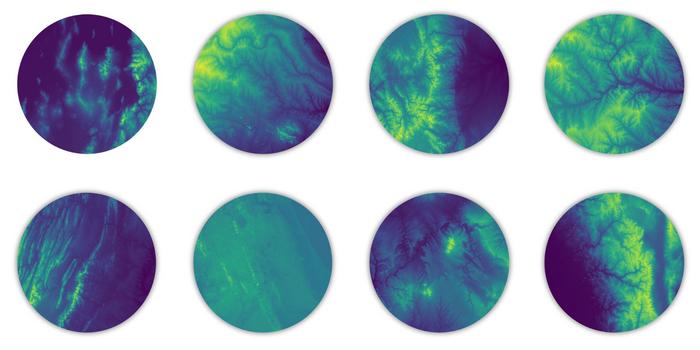
In a new study, researchers provide measures of elevation and climate around 47 sites in the U.S. National Ecological Observatory Network, from Florida’s Everglades to the Alaskan tundra hundreds of miles above the Arctic Circle.
Credit: Courtesy of Kelly Kapsar, Michigan State University
Zooming from her office, Michigan State University researcher Kelly Kapsar showed off stunning satellite images from across the United States.
In some, different colors revealed the precise heights of the forested ridges in the Sierra Nevada or the craggy peaks of the Rockies and the valleys between them. Others showed the pine flatwoods of southern Florida, or the smooth rolling grasslands of the Kansas prairie.
The images were taken by the space shuttle Endeavor during a 2000 mission to make detailed radar maps of planet's surface.
Endeavour orbited Earth 16 times a day during the 11-day mission. In that time it took more than a trillion elevation measurements, generating a whopping 12.3 terabytes of data.
Since then, other Earth-observing satellites have measured things like temperature, rainfall, sea levels, carbon dioxide, snow cover, wind speeds, even dust — and at scales ranging from the span of a continent to patches barely larger than a tennis court.
It’s a treasure trove of data. And by combining this data captured from space with measurements of plants and animals taken on the ground, researchers hope to better predict where species are most likely to thrive in the years to come, said Phoebe Zarnetske, who directs MSU’s Spatial and Community Ecology Lab (SpaCE Lab)
But there’s a hitch, said Kapsar, a postdoctoral associate in the SpaCE Lab.
While a lot of satellite remote sensing data is publicly available, for many researchers, taking advantage of it isn’t straightforward.
“We have so much satellite-based data now, but ecologists receive very little training on how to work with it,” Kapsar said.
“Once you start downloading satellite data, it gets into hundreds of gigabytes and thousands of layers,” Kapsar said.
That often requires technical expertise in supercomputing and big data analysis to process.
There’s another problem, Kapsar added. The statistical models that scientists use to map where plants and animals are likely to live often require a single, numerical value to characterize the environment. But from the perspective of, say, a vole or a beetle, summarizing a landscape in just one number doesn’t tell the whole story.
To illustrate, Kapsar pulled up a series of satellite images showing the contours of the land around sites within the National Ecological Observatory Network (NEON), a 30-year research effort to monitor changes at 81 field sites across the U.S..
One NEON field site within the Sierra Nevada mountain range in California has an average elevation of 7,050 feet. However, this number masks a lot of ups and downs, from towering 10,000-foot mountain peaks to valleys and meadows.
The same holds true when it comes to rainfall, Kapsar said. While annual precipitation in a NEON site near Las Cruces, New Mexico, in the northern Chihuahuan Desert stays pretty consistent around 11 inches a year, rainfall at another site in Hawai'i can vary drastically from 80 to 160 inches.
“If you think about the world like many animals do, they're not going to just take the average of a mountain landscape,” Kapsar said. “They have to contend with things like: how steep is this cliff? Can I climb it? How many ups and downs are there? How bumpy is the terrain? Are there places for me to hide?”
“The temperature and precipitation within an area can vary with the topography and vegetation to produce microclimates, where only certain species can thrive,” said co-author Lala Kounta, a climate scientist in the SpaCE Lab.
Kapsar, Kounta, Zarnetske, and collaborators are working on ways to provide geodiversity data to researchers and help close the gap.
Crunching massive amounts of satellite data on the MSU High Performance Computing Cluster in a new study, they hand over a set of climate and elevation geodiversity metrics that capture more than just the mean so researchers working at NEON sites across the U.S. can use them.
Originally developed for the field of surface metrology, the metrics include statistical measures of how “rough,” or “smooth” precipitation, temperature, and elevation are across the landscape, calculated using an open-source computer program developed by Zarnetske and MSU professor Kyla Dahlin and colleagues called ‘geodiv.’
Their paper also offers a “how-to” for researchers who want to use satellite data to capture this complexity at other sites around the world, and at different scales.
“The idea is to take the satellite’s perspective from way up high in the sky, and NEON’s intensive data collection on the ground — catching bugs, listening for birds, sampling plants — and bring them together to get the best of both worlds,” Kapsar said.
Collaborators include Patrick Bills (MSU Institute for Cyber-Enabled Research (ICER)), Sydne Record (University of Maine), Benjamin Baiser (University of Florida), Angela Strecker (Western Washington University), and Annie Smith (Washington Department of Natural Resources). This research was supported by grants from the National Science Foundation (1926567, 1926568, 1926569, and 1926610). The geodiv R package was supported by NASA Grant NNX16AQ44G.
CITATION: "Multi-scale environmental geodiversity: data for the National Ecological Observatory Network (NEON) with an adaptable workflow," Kelly Kapsar, Lala Kounta, Patrick Bills, Annie Smith, Sydne Record, Angela Strecker, Benjamin Baiser and Phoebe L. Zarnetske. Scientific Data, July 15, 2026. DOI: 10.1038/s41597-026-07613-5