First published at Radio Zamaneh.
The war in Gaza, and then the spread of fighting to Lebanon and Iran, has once again turned an old disagreement on the left into an urgent question. Is a political force’s relationship with the United States and Israel enough to define what it is? If an organisation fights Israel, should we call it progressive or anti-imperialist? How can we defend the right of Palestinians and Lebanese people to resist, while at the same time criticising Hamas and Hezbollah for their social programmes, economic policies and relations with independent movements? And in Iran, how can we oppose war by the United States and Israel without turning defence of Iran against foreign attack into defence of the Islamic Republic?
Joseph Daher, a Syrian-Swiss socialist researcher and activist, has been studying these questions through political economy for years. He holds a PhD in Development Studies from SOAS University of London and another doctorate on revolution and counter-revolution in Syria from the University of Lausanne. His research mainly focuses on the political economy of the Middle East, political Islam, sectarianism, neoliberalism and social movements. Among his most important works is Hezbollah: The Political Economy of Lebanon’s Party of God, which examines Hezbollah not simply through religious ideology or military activity, but through its position within Lebanon’s class structure, political economy and sectarian system.
Daher taught at the University of Lausanne for more than a decade. At the beginning of 2025, the university didn’t renew his teaching contract. The decision came after his support for student mobilisation in solidarity with Palestine and an administrative case connected to a protest occupation of the university. Several Middle East studies associations, the faculty council and academic freedom groups protested the decision, calling it disproportionate and a threat to academic freedom. Daher has also placed his removal in the wider context of pressure on pro-Palestinian voices in European universities.
Our conversation began with a question of method, but Daher’s answers gradually led to a bigger question. In a region where people face colonialism, imperialism, war, authoritarian states and reactionary domestic political forces at the same time, how can the left maintain an independent politics?
Foreign policy alone doesn’t define a political force
Parts of the left classify political forces in the Middle East mainly through their relationship with the United States and Israel. In this view, any force fighting these two powers belongs to the “resistance,” or at least becomes an objective ally.
Daher argues almost the opposite. He says we have to separate two questions. First, what is the political nature of an actor? And second, what position should we take toward that actor and its enemies in a particular situation?
He says: “The political nature of any actor, not only Hezbollah or Hamas, cannot be reduced to its foreign policy or its relationship with the United States and Israel at a particular moment.”
If opposition to the United States alone makes a force progressive, Daher argues, then every Western bourgeois state should become an ally of the working class whenever it disagrees with Washington. France opposed the US invasion of Iraq in 2003, but that didn’t change the class nature of the French state. Al-Qaeda also fought the United States, but that didn’t make it a progressive force.
So he suggests starting the analysis somewhere else: “As the left, we shouldn’t analyse a political actor or a state only through its foreign policy and decide our political position toward it on that basis. We have to examine its policies toward working and popular classes, its political programme, economic policies, relationship with social movements, and so on. In other words, we need a material and comprehensive analysis.”
Using these criteria, Daher doesn’t consider Hamas or Hezbollah left-wing or progressive forces. He points to neoliberal economic policies, social conservatism, the Islamisation of society, opposition to some independent movements from below, problems with women’s rights and secularism, and their contradictory relations with workers’ struggles.
But another important distinction enters here. Hamas, Hezbollah, the Muslim Brotherhood and the Islamic Republic cannot all be placed inside one identical category.
For example, when Daher discusses the “bourgeoisification” of Islamic fundamentalist movements, he stresses that this process has been more limited in Hamas than in many other movements. The reason lies in Gaza’s material conditions. Israel’s blockade and what he calls its policy of “de-development” have severely limited capital accumulation and the formation of a powerful local capitalist class. So even among movements that he places inside the wider family of political Islam, the class structures are not identical.
He uses the same method when examining Hamas’s regional relations. Daher rejects the picture of Hamas as simply an Iranian “proxy.” The relationship is close, but Hamas has also shown political independence. Its disagreement with Tehran over the Syrian uprising was one major example. Hamas refused to support the Assad regime’s repression of Syrian protesters, and Tehran responded by reducing some of its financial support.
There are other examples. In 2015, Iran temporarily reduced its support for Palestinian Islamic Jihad because the organisation refused to condemn Saudi Arabia’s war in Yemen against the Houthis. At another point, Tehran redirected some funding toward another group in Gaza.
Even after the US-Israeli war against Iran, Hamas leaders, while defending Iran’s right to respond to the attack, asked Tehran not to target neighbouring countries.
Daher also points out that the alliance with the Islamic Republic hasn’t always gone unchallenged inside Gaza. In 2020, groups of Palestinians pulled down images of Qassem Soleimani in Gaza, and some condemned him for Iran’s role in Syria and Iraq. These cases matter to Daher because they show that what is called the “Axis of Resistance” cannot be understood as one political bloc under a single command. There are states and organisations whose interests sometimes meet, but which also have disagreements.
The same applies to Hamas’s relations with other states. Alongside Iran, the organisation has built close ties with Qatar and Turkey. Daher points to Khaled Mashal’s position in 2018 on Turkey’s attack on Afrin. Mashal welcomed the Turkish victory, although the occupation of Afrin led to widespread displacement, especially among Kurds.
For Daher, then, a relationship with a regional state or foreign power proves nothing about an organisation’s supposedly inherent anti-imperialism.
And here we reach one of the most important distinctions in the interview. The difference between tactical necessity and political strategy.
Daher says the left should support the right of Palestinians and Lebanese people to obtain weapons and defend themselves. If a force under occupation or attack has to work with authoritarian states to get weapons, people sitting safely outside cannot demand that it only accept weapons from governments that meet our political standards. “I support these organisations’ efforts to obtain weapons wherever they can in order to defend themselves, and I also accept tactical cooperation with regional or international states for this purpose. The problem begins when these tactical choices become strategic ones. That often leads to wrong political strategies.”
In other words, receiving weapons from Iran is one thing. Tying Palestine’s political future to the regional strategy of the Islamic Republic is another. Daher says regional states support Palestine as long as this support fits their interests. When their interests change, the limits of their support change as well.
He sees the behaviour of the Islamic Republic and Hezbollah after October 2023 as an example. During the first months of the Gaza war, Iranian leaders repeatedly said they didn’t want the war to spread across the whole region. Hezbollah too, in Hassan Nasrallah’s words, was mainly supposed to act as a “pressure front” rather than enter a full-scale war.
In Daher’s view, Tehran didn’t want its most important regional ally in Lebanon weakened in a direct war with Israel. “Iran’s geopolitical goal isn’t the liberation of the Palestinians. It’s to use these groups as leverage, especially in its relationship with the United States.”
Still, none of this criticism means denying the right to resistance. “The conservative nature of Hamas or Hezbollah shouldn’t prevent the left, locally or internationally, from defending the resistance and struggle of Palestinians, Lebanese people and others in the region against a colonial, racist and apartheid regime supported by Western imperialism.”
For Daher, saying the left should only support resistance when communists or socialists lead it is an old ultra-left mistake on the national question. People under occupation have the right to resist even when the political leadership of that resistance is far from the programme the left would want. But support for the right to resist should never be confused with support for the political project of the resistance leadership.
“Two fascisms,” or different forces in an uneven world system?
Part of the Iranian left has a theory for explaining the relationship between political Islam and the Western far right. Sometimes it’s called the “mutual services of two fascisms.” Islamism produces the enemy and fear that the Western far right needs. Meanwhile the far right, Western wars, occupation, racism and Islamophobia allow Islamists to present themselves as the only defenders of Muslims and the peoples of the region.
Daher accepts that part of this relationship exists, but he has problems with the broad use of the word “fascism.” He says he is cautious with concepts such as fascism, neo-fascism and post-fascism. Not only because their definitions are disputed, but because how we define a political force affects the strategy we use against it.
This caution, he says, shouldn’t be confused with underestimating the danger of the far right and authoritarianism in the West. He sees developments in Europe and the United States over the past two decades as a very serious threat. But ideological or social similarities don’t mean that the Islamic Republic, Hamas, Hezbollah, Trumpism and the Israeli state are all the same kind of political force.
The first problem is their very different positions in the world system. “Politically, we cannot place Western imperialist powers on the same level as peripheral or Global South regional powers such as Iran.”
Daher still sees the United States as the dominant power in the global imperialist system. China is its main competitor, while Russia, France and Britain are also imperialist powers. But their economic, financial and military capacities are not equal.
To explain this inequality, he returns to the concept of uneven and combined capitalist development.
Capitalism expands the productive forces globally, but this expansion is never uniform. Countries, industries and centres of capital develop at different speeds, and this constantly changes relations of power. A power at the top during one period may later face a new rival. Alliances don’t stay permanent either.
Daher connects this discussion to Lenin’s theory of imperialism. If capitalist development is uneven, the balance between states keeps changing. And those changes create the possibility of conflict and war.
Here he distances himself from Kautsky’s idea of “ultra-imperialism,” the idea that the concentration of capital might eventually bring the major powers into some kind of relatively coordinated global order. For Daher, the constant redistribution of power between states makes such stable coordination impossible.
The relevance to the Middle East is clear. The difference between the United States and Iran isn’t simply a matter of “good” and “bad” governments. They occupy different positions within the global hierarchy of capital and power. But Daher also warns that this difference must not become a way of cleaning up the image of peripheral states. A regional power can pursue expansionist and repressive policies even if it isn’t in the same position as the United States.
Still, he does see similarities between Islamic fundamentalism and the Western far right.
Both have often had a historical petty-bourgeois base, while parts of their leadership and structures later entered bourgeois blocs. Both tend to present themselves as “neither left nor right” and put the unity of the nation, community or ummah ahead of class struggle.
There are important overlaps in economics too. Many Islamic fundamentalist movements have no basic problem with neoliberal policies. Instead, they expand religious charity networks. Daher calls this a form of “religious neoliberalism.” Public services provided by the state shrink, while things that should be social rights become charity.
He gives an example from the United States. Religious conservatives argue that welfare states are ineffective and that local religious organisations can provide social services better. This allows economic neoliberalism to combine with moral conservatism.
A similar mechanism exists in political Islam. Markets and privatisation stand next to religious charity, while the same movements stress family, sexual morality and conservative social order. The far right and Islamic fundamentalists also overlap on gender. Both often treat the family as almost sacred, oppose parts of women’s rights and the rights of gay and trans people, and present social change as moral decline.
But the Western far right has another feature. It can take part of the language of liberalism, including the language of “women’s rights,” and use it for racism. Daher refers to Sara Farris’s concept of “femonationalism.” Muslim women supposedly need to be “saved” from Muslim men, while anti-immigration policies or hijab bans are justified through the language of women’s freedom.
Another similarity is the idea of civilisational decline. Islamic fundamentalists want to return to a mythical “golden age” of Islam. The far right promises to restore the lost greatness of the nation. In both cases, migrants, feminists, the left, sexual minorities or “Western culture” can be blamed for society’s crisis. Material problems such as inequality, exploitation and capitalist crisis get replaced by cultural explanations.
But for Daher, these similarities are still not enough to call all these forces “fascist.”
On the Islamic Republic, he describes the regime as theocratic, militarised, authoritarian and violent. But he remains cautious about using the concept of fascism.
The Zionist far right is a different case. Some of its currents have clear historical roots in fascism, and some Israeli far-right figures have even accepted the label themselves. Jabotinsky was also influenced by Mussolini.
But even here, Daher says fascism isn’t the main concept for understanding Zionism. “What defines Zionism as a movement, first and above all, is its settler-colonial nature and its attempt to remove Palestinians from their land.”
From this perspective, if the Israeli state, Trumpism, the Islamic Republic, Hamas and Hezbollah are all simply called “fascism,” a basic difference disappears. The difference between a colonial state and a people under occupation, between a central imperialist power and a regional power, and between different class histories.
October 7: The right to resist, Hamas’s decision and the killing of civilians
October 7 is where these distinctions become harder.
Three different levels are often mixed together. The historical right of Palestinians to resist, Hamas’s political and military decision to launch the October 7 operation, and specific acts carried out against civilians that day. Daher says support for the first shouldn’t mean unconditional support for the other two.
“Palestinians, like any other population facing a colonial and apartheid regime, have the right to resist, including through military means, and this includes Hamas. But this right shouldn’t be confused with support for the political views of different Palestinian parties or all their military operations, including the killing of civilians on October 7.”
At the same time, he also rejects a narrative that puts every form of violence on the same level. “The violence used by an oppressor to maintain structures of domination and subjugation should never be treated as equal to the violence of the oppressed who are trying to regain their dignity and affirm their right to exist.”
Daher doesn’t mean that every act by the oppressed becomes legitimate. His point is the difference between judging a specific act and analysing the structural relationship between coloniser and colonised. In this context, Daher explains that Israel is the actor most responsible historically by its policies (dispossession, displacement, occupation, colonization,etc…) for the events of October 7.
He also argues that the Israeli state’s problem isn’t simply the type of Palestinian resistance. Before Hamas, the Palestine Liberation Organisation, left groups, Fatah, democratic and secular activists, and even non-violent Palestinian protests were repressed. The Great March of Return in 2018 and 2019 is an important example. These were largely peaceful protests that the Israeli army suppressed with live ammunition and heavy violence. Other historical examples reflect this dynamic, such as the first Intifada between end of 1987 until the beginning of the 1990s.
So for Daher: “For the Israeli ruling class, the issue isn’t the nature of the Palestinian resistance, whether peaceful or armed, or even what ideology it has. Any challenge to the structure of occupation and colonisation has to be criminalised and repressed.”
But if resistance is legitimate, how should Hamas’s political calculations on October 7 be judged?
Daher believes Hamas had several goals. First, to break the existing situation in Palestine. The blockade of Gaza, settlement expansion, violence in the West Bank and attacks on Al-Aqsa Mosque. Second, to stop the regional process of normalising relations between Israel and Arab states.
On the second point, the operation was at least temporarily successful. Saudi-Israeli normalisation stopped, and Palestine returned to the centre of regional politics. But Daher believes Hamas’s calculations about the “day after” were largely wrong.
Hamas’s leadership probably expected a wider uprising in the West Bank, and to a lesser extent Palestinians living in 48 territories (within Israel) and a much stronger intervention from forces in the so-called Axis of Resistance. Neither happened on that scale. Iran, Hamas’s most important regional ally, mainly wanted to preserve its position for future talks with the United States. Hezbollah also spent a long time trying to avoid a full-scale war.
For Daher, this exposes a deeper strategic weakness.
Hamas, on this question, isn’t fundamentally different from many other Palestinian political forces. From Fatah to even parts of the Palestinian left, the dominant strategy has repeatedly depended on finding patrons among regional states and ruling classes. “Hamas, like other Palestinian parties, from Fatah to the Palestinian left, doesn’t see the Palestinian masses and the working and oppressed classes of the region as the forces that will achieve liberation. Instead, it looks for political alliances with ruling classes and regional regimes.”
Here Daher’s criticism of the “Axis of Resistance” goes beyond criticism of the Islamic Republic and becomes a criticism of a historic strategy within Palestinian politics.
Islamophobia and the danger of “reverse Orientalism”
But criticism of Hamas in Europe and the United States doesn’t happen in a vacuum. The Israeli state and the Western far right quickly use criticism of Hamas to justify collective punishment of Palestinians and, sometimes, Islamophobia itself. In response, parts of the left delay almost any criticism of Hamas because they fear that criticism will be absorbed into Israeli propaganda.
Daher says silence isn’t the answer. What matters is making clear the political position from which the criticism comes. “No serious and honest criticism of Hamas or Hezbollah can be made without a clear opposition to Israeli apartheid and the racist and colonial nature of this state, and clear support for Palestinian self-determination and their right to resistance.”
For the same reason, he firmly rejects comparisons between Hamas and ISIS. Hamas comes from the political history of Palestine and the struggle against colonialism and occupation. It has taken part in elections, participated in political institutions created after Oslo, and cooperated politically and militarily with Palestinian left groups such as the Popular Front.
ISIS came out of a different historical context. The US occupation of Iraq, Al-Qaeda in Iraq, sectarian war, and then counter-revolution in Syria and Iraq. Daher considers Hamas’s rule in Gaza far from democratic, but believes comparing it with ISIS rule is wrong in its structure, strategy and relationship with society.
The deeper problem is treating “Islam” and “Islamic fundamentalism” as the same thing.
Islamophobia, Daher says, turns Muslims into an inherently suspicious and dangerous population. After September 11, the “war on terror” allowed governments in Europe and the United States to expand controls, surveillance and restrictions against Muslims.
He points to France and Britain’s security programmes, but his argument goes beyond particular laws. The point is that “Muslim” becomes a political identity that constantly has to prove its loyalty to “Western values.”
Marxists, in Daher’s view, should stand against this Islamophobia and defend both religious freedom and the right to self-determination.
But the left’s answer to Islamophobia cannot be to accept the same essentialist view of Middle Eastern people and simply give it a positive meaning.
This is where Daher introduces the idea of “reverse Orientalism.”
Traditional Orientalism says Muslim societies are inherently religious and that this religion separates them from the modern West. Reverse Orientalism keeps the first part but reverses the conclusion. Because these societies are supposedly naturally religious, political Islam becomes their natural language of resistance and even progress.
Referring to Sadiq Jalal al-Azm and Gilbert Achcar, Daher says both views share one assumption. They treat religion as a permanent and essential quality of Muslim people. “The answer to Islamophobia in the West shouldn’t be to give the peoples of the Middle East and North Africa an essentialist and uniform identity called ‘Muslim’ and reproduce a form of reverse Orientalism.”
For the same reason, he also has problems comparing Islamic fundamentalism with Latin American liberation theology. In his view, liberation theology was mainly concerned with the poor and oppressed, development and social liberation. Its goal wasn’t to Christianise the state and economy.
Political Islam, by contrast, makes the Islamisation of society, politics and economics part of its programme.
So opposition to the West alone doesn’t make an Islamist force anti-imperialist.
Daher says Islamic fundamentalism often explains imperialism not through global capitalism, economic domination and class relations, but as a cultural struggle between Islam and the West. In this sense, its worldview strangely overlaps with Samuel Huntington’s theory of the “clash of civilisations.”
“The main enemy is at home,” but that isn’t the end of internationalism
At this point Iran enters our conversation.
An important argument among parts of the left and among opponents of the Islamic Republic says that the first responsibility of every revolutionary force is to fight its own government. Iranians should fight the Islamic Republic. The left and anti-war movement in the United States should fight their own state. Europeans should confront the governments of their own countries.
At first sight, this seems close to one of the classic slogans of the socialist anti-war movement. “The main enemy is at home.”
Daher accepts the principle of the slogan but believes parts of the left have removed it from Karl Liebknecht’s historical context.
In 1915, during the First World War, Liebknecht stressed the responsibility of German workers to confront their own ruling class and the militarism of their own state. In that sense, Daher says the slogan remains correct. “Within this framework, the slogan ‘the main enemy is at home’ is correct, with the goal of defeating the imperialists and bourgeoisie in our own societies.”
But this wasn’t everything Liebknecht said. “Many of those who refer to Liebknecht take his position out of context. For him, fighting the enemy at home didn’t mean ignoring foreign regimes that repress their own people, or refusing solidarity with the oppressed.”
Daher points out that Liebknecht connected the struggle against one’s own ruling class with cooperation with the proletariat of other countries, people who were themselves fighting their rulers and imperialists.
So this division of responsibility doesn’t mean that an American should speak only about the United States and remain indifferent to Iran, or that an Iranian should only look at the Islamic Republic and ignore US responsibility for war.
Internationalism gains its meaning precisely when these struggles connect.
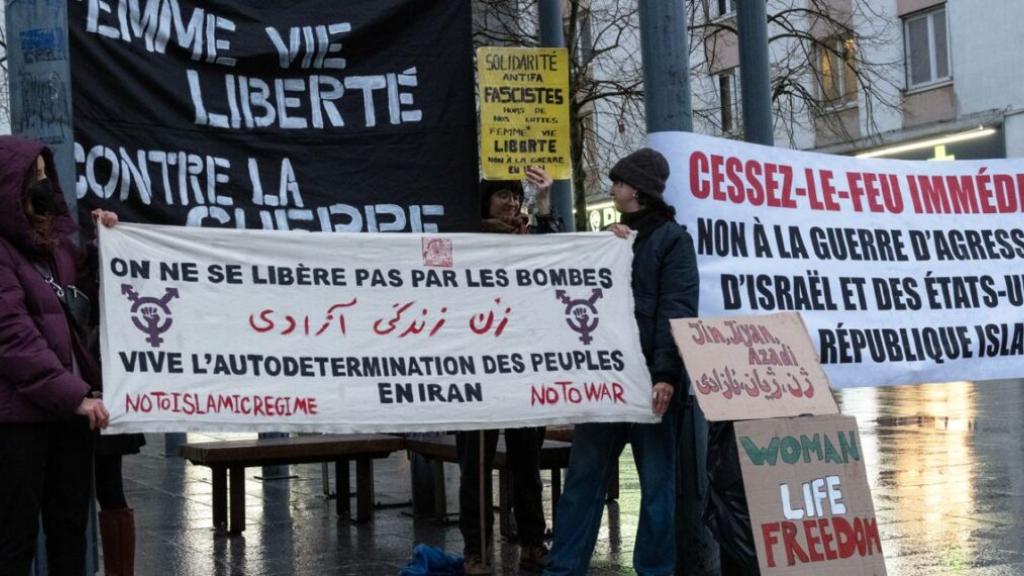
Daher extends this criticism to parts of the Western left that, while protesting war on Iran, ignore Iranian leftists who oppose the Islamic Republic, or sometimes even accept symbols of the Islamic Republic at anti-war demonstrations.
“Some on the left tend to ignore Iranian leftists opposed to their own regime, just as they did in the past with Syrians under Assad. Worse, they make no effort to cooperate with these groups, while at some anti-war protests they accept the use of symbols of these authoritarian regimes, including the flag of the Islamic Republic or images of Khamenei. In such conditions, this is a denial of internationalism. A denial of our comrades in Iran and their struggles for a more democratic, progressive and anti-imperialist Iran.”
So “the main enemy is at home,” for Daher, isn’t an invitation to indifference toward the world. It means an internationalist division of labour.
Elsewhere he quotes Liebknecht: “Unite yourselves in the international class struggle against the conspiracies of secret diplomacy, against imperialism, against war and for peace in the spirit of socialism.”
For Daher, none of these parts can be removed. If resistance to foreign imperialism turns into support for an authoritarian domestic regime, part of socialist politics has disappeared. If the struggle against a domestic regime turns into support for foreign imperialist war and pressure, the same thing happens from the other direction.
Iran: Opposing war without defending the Islamic Republic
This is where Daher’s answer on Iran begins.
Some opponents of the Islamic Republic argue that if Iran hadn’t supported regional forces, developed its missile programme or pursued its nuclear policies, the risk of war would have disappeared. So genuine opposition to war in Iran should begin with opposition to the Islamic Republic.
Daher says this argument mixes together two different questions. “We have to separate two things. Iran’s domestic policies and regional ambitions and influence on one side, and the goals of the US-Israeli war against Iran on the other.”
He condemns the US-Israeli war without ambiguity and says Iran has the right to defend itself.
In his view, Washington’s goal in the region is to maintain and expand its hegemony. The region has strategic importance because of its concentration of energy reserves and its connection with the global economic and financial system through its revenues. “Washington’s problem with the Tehran regime isn’t its authoritarian nature. The problem is that the Iranian regime hasn’t placed itself under US hegemony.”
For Daher, saying this doesn’t mean defending the Islamic Republic’s policies. Quite the opposite. He immediately returns to criticism of them.
On the nuclear issue too, his position isn’t ambiguous. Personally, he opposes nuclear weapons and even the development of nuclear technology because of the dangers involved, including environmental consequences. But he believes abandoning it should be a democratic decision made by the Iranian people, not the result of bombing or ultimatums from the United States and Israel.
He also points to the double standard. The United States demands limits on Iran’s programme while supporting Israel’s nuclear arsenal, and at the same time has considered nuclear cooperation with Saudi Arabia as part of normalisation with Israel.
Daher’s alternative is a nuclear-weapons-free Middle East that includes Israel.
But Iran’s right to defend itself against foreign attack doesn’t legitimise the Islamic Republic’s regional policies.
Since the 2000s, the Islamic Republic has used the failure of US projects in Iraq and Afghanistan to expand its regional influence. Shia parties and militias in Iraq, Hezbollah in Lebanon, pro-Tehran forces in Syria, its relationship with the Houthis in Yemen and its alliance with Hamas became parts of this network.
The Revolutionary Guards played a central role. Daher describes the Guards, to some extent, as a “state within the state,” an institution combining military power, political influence and a large economic presence.
In his view, Iran has tried both to create a balance of power against the United States and Israel and to pursue its own military, political and economic goals.
This policy, he says, is entirely “guided by the state and capitalist interests of the regime, not by an emancipatory project.”
One important reason for this conclusion is the Islamic Republic’s behaviour toward popular movements.
Inside Iran, workers face restrictions on independent organisation, strikes and collective bargaining. The state represses protest movements, women, Kurds, Baluch people and political opponents. For Daher, the Woman, Life, Freedom movement was an important example of society resisting this structure.
Outside Iran too, Tehran hasn’t necessarily sided with popular movements when they challenge the interests of its allies.
In Lebanon and Iraq in 2019, the Islamic Republic described mass protests through the language of “foreign intervention.” Hezbollah in Lebanon and groups close to Iran in Iraq also confronted parts of these protest movements.
Syria is an even clearer example. The Revolutionary Guards, Hezbollah and forces linked to Tehran entered the war alongside Russia to preserve the Assad government.
Daher also points out that Iran hasn’t always been an absolute and principled opponent of the United States. Tehran has cooperated with Washington at different moments in Afghanistan and Iraq.
So in his view, today’s hostility toward the United States cannot be turned into a permanent “anti-imperialism.”
At the same time, this criticism shouldn’t lead to legitimising sanctions and war.
Daher gives the left in Europe and the United States a clear task. Oppose imperialist wars. Fight their own governments’ support for authoritarian regimes. Oppose sanctions whose costs fall on working and popular classes in the Global South. And oppose the criminalisation of movements such as Hamas and Hezbollah.
Another important point in his answer is that war doesn’t only destroy people and infrastructure. It also weakens society’s own capacity to struggle.
War increases security repression, closes political space and makes organising by progressive and working-class forces harder.
So opposing foreign attack on Iran isn’t simply an abstract defence of “national sovereignty.” War also weakens the very forces trying to change the Islamic Republic from below.
Lebanon and Hezbollah: Resistance without handing society over to one party
The same question becomes even more concrete in Lebanon.
Hezbollah played a real role in ending Israel’s occupation of southern Lebanon, and part of its social base still sees the organisation as a defensive force against Israel.
At the same time, Daher considers Hezbollah part of Lebanon’s sectarian system and neoliberal political economy. It has extensive ties to sections of capital, has participated in government and has at times stood against independent social movements.
During an Israeli attack, do we have to ignore one of these two realities?
Daher says the conditions of war affect political priorities. “When Hezbollah and Lebanon face an Israeli war, the priority is clearly to support resistance and put pressure on Western ruling classes to end their support for Israel’s war against Lebanon.”
He stresses that the United States and Israel aren’t fighting in Lebanon or Iran for democracy or people’s welfare. They are seeking a regional order that strengthens the dominance of Washington and Tel Aviv.
Under these conditions, the left should also show Hezbollah’s social base that it opposes bombing, displacement, the destruction of homes and the killing of people.
Daher recalls the experience of Lebanese left forces during the 2006 war. While defending the right to resist, they also created independent humanitarian networks for displaced people.
But resisting Israel shouldn’t mean handing the political leadership of society over to Hezbollah.
One major concern is the sectarianisation of resistance.
Israel has heavily targeted Shia areas. Such a policy can both isolate Hezbollah’s social base from the rest of society and deepen sectarian divisions.
There is a debate about this inside Lebanon as well. Osama Saad, the Nasserist leader, has criticised the transformation of national resistance into sectarian resistance. The Lebanese Communist Party has also condemned Israel and defended the right to resist while criticising some Hezbollah operations and arguing that resistance shouldn’t become the monopoly of one religious group.
For Daher, sustainable resistance needs a national and social project. One that brings Shia, Sunni, Christian and other communities together around shared interests and connects liberation from occupation with democracy and social justice.
This is also where the debate over disarming Hezbollah becomes complicated.
On one side, Daher is clear. “Hezbollah’s independent military capacity and its political relationship with Iran are clearly incompatible with an independent and sovereign national defence policy.”
But on the other side, he rejects the idea that simply giving the Lebanese state a monopoly on weapons would solve the sovereignty problem.
The Lebanese state itself exists inside a sectarian, neoliberal and patronage-based system. The army also lacks the financial and material resources needed to defend the country independently.
Here Daher gives particular importance to the Lebanon-Israel framework agreement of June 2026.
He says the agreement made Hezbollah’s disarmament one of the central parts of the security arrangements, while Israel’s withdrawal from Lebanese territory was linked to the implementation of that process.
There is no clear deadline for Israel’s full withdrawal within this framework, leaving Israel able to decide, based on its own assessment, when the Hezbollah “threat” has been removed.
Daher considers this dangerous because the Lebanese state, instead of first rebuilding its own defensive capacity and social legitimacy, could become an agent for carrying out a security arrangement designed under external pressure.
His concern isn’t only about weapons. Reconstruction arrangements could also exclude civilian institutions linked to Hezbollah and even limit the Lebanese state’s legal space for pursuing Israeli war crimes.
For Daher, if taken too far, this process could resemble the role that the Palestinian Authority developed after Oslo. A local government whose function partly became the management of security within an order that had never ended the occupation itself.
So, he argues, disarming Hezbollah without a political and economic transformation of Lebanon could even deepen sectarian tensions.
The Lebanese state gains legitimacy not only through weapons but by being able to respond to society. Providing security, social services, reconstruction, a fairer tax system and democratic space.
Hezbollah’s base wasn’t created in a vacuum either. Repeated Israeli attacks and occupations, the historical weakness of the state, insecurity and economic marginalisation have all helped strengthen the organisation.
If these conditions don’t change, pressure from above to disarm Hezbollah may have the opposite effect. It could even push people who are unhappy with the party back behind it. “A resistance limited to one sect or religious group, without a political project for democracy, social justice and equality in Lebanon and the region, cannot be sustainable and cannot find a path toward victory.”
But for Daher, this democratic resistance also cannot tie its future to the Islamic Republic, a regime that represses its own working class and has pursued power-centred regional policies in Syria, Iraq and elsewhere. A national defense strategy is needed, which could include former Hezbollah soldiers, their armament and benefit of the experience accumulated by these fighters, but under a democratic leadership rooted in the popular and working classes’ interest in Lebanon.
For him, these two criticisms exist fully at the same time. Opposition to US-Israeli war against Iran and Lebanon, and opposition to the policies of the Islamic Republic and Hezbollah.
If Iran and Hezbollah are weakened, who benefits?
A real problem remains.
If Iran and Hezbollah are weakened militarily and politically, the regional balance of power will probably shift in favour of Israel and the United States. In the short term, this could open the way for more pressure on Palestinians, greater occupation and new wars.
Daher doesn’t deny this reality. “As left and progressive forces, we have to be clear that we are in a very bad and difficult situation. Under present conditions, US imperialism may benefit in the short term from the weakening of Iran and its regional network.”
But he doesn’t conclude from this that the left should politically support the Islamic Republic and its allies in order to preserve a “balance of power.”
The basic crises of the region haven’t been solved by maintaining this axis. Capitalism, inequality, poverty, repression, sectarianism and the colonisation of Palestine all continue.
Iran and its allies have also, in many cases, been part of this regional order rather than an alternative to it.
Daher’s alternative is “resistance from below.”
On Palestine, he begins with a material limitation. Palestinians cannot defeat Israel on their own.
Israel is far stronger economically and militarily. The situation is also different from apartheid South Africa. White South African capitalism depended on Black labour, which gave Black workers enormous power to disrupt the economy.
The Israeli settler project, by contrast, has a long history of trying to replace Palestinian labour with Jewish labour. So the Palestinian working class alone doesn’t have the same economic leverage.
Who, then, are the Palestinians’ natural allies?
Daher’s answer is the popular classes of the region.
Workers, women, students, refugees and other oppressed groups across the region have the potential to build solidarity with Palestine, both because of the shared historical experience of colonialism and because of common economic and political structures.
But this isn’t only about sympathy. The region’s working class has enormous material power.
Oil economies, ports, transport networks and industries in the region are part of the global economy. Organisation and strikes in these sectors can put pressure not only on a local government but on much larger economic networks.
Daher also sees historical support for this strategy.
During the 1960s and 1970s, the Palestinian movement helped strengthen class and political struggles across the region. The Second Intifada in 2000 created a new wave of mobilisation, and Daher sees it as one of the longer-term backgrounds to the revolutions of 2011.
In 2011, Palestinians in Lebanon, Syria, Jordan, the West Bank and Gaza mobilised on the anniversary of the Nakba for the right of return. Years later, in the summer of 2019, Palestinian protests in Lebanon’s refugee camps against Labour Ministry discrimination became part of the wider atmosphere that led to the nationwide Lebanese uprising in October.
From this perspective, Palestinian liberation cannot be separated from social transformation across the region. “The region needs a real axis of resistance from below. The popular classes of Palestine and the region, supported by anti-imperialist solidarity in the major powers, itself based on workers’ struggles against their own ruling classes.”
Is a multipolar world an alternative to US domination?
Daher’s argument also leads to another criticism. The idea that a multipolar world is automatically good for the Global South.
Parts of the left see the decline of US hegemony and the rise of China, Russia and BRICS as opening more space for resistance to imperialism. Daher disagrees. “The rise of more major and regional powers and a multipolar world of capitalist states isn’t an alternative to unipolarity. It’s a new and potentially even more dangerous stage of global imperialism.”
For him, unchallenged US dominance has been destructive. But stronger competition between the United States, China, Russia and regional powers doesn’t necessarily produce a more peaceful world.
History suggests the opposite. Multipolarity can intensify military competition.
Again, the question of “uneven and combined development” matters. Different rates of growth redistribute power and increase tensions. China and Russia, in Daher’s view, are capitalist states too. They don’t offer a socialist alternative for the Global South.
China’s economic relations with developing countries can reproduce patterns of raw-material extraction and dependency on imported finished goods. Local ruling classes may benefit from these relations, while workers face unemployment, insecure jobs and environmental destruction.
BRICS, for Daher, isn’t a project for overthrowing global capitalism either. Its members mainly want more position and a larger share inside the same system.
So the left shouldn’t trap itself in a choice between Washington and Beijing, or between “unipolarity” and “multipolarity.” “In every situation, we should stand with the exploited and oppressed and with their struggle for liberation, not with their exploiters and oppressors.”
This doesn’t mean treating all powers as equal. Daher still considers the United States the most powerful imperialist force and the biggest global obstacle to progressive change.
But US dominance doesn’t make China or Russia progressive. Just as US domination doesn’t turn the Islamic Republic into a force for liberation.
Resistance from below cannot be built without democratic freedoms
But perhaps the hardest question remains at the end.
If the alternative to the “Axis of Resistance” is workers’ movements, women, students, refugees and progressive forces across the region, where are these forces today?
In Iran, Syria, Egypt, Lebanon and Palestine, many have faced severe repression. Independent unions are weak or banned. Left parties are in crisis. War has destroyed social infrastructure, and organising carries an enormous cost.
How can “resistance from below” become more than a moral hope and turn into a material political strategy?
Daher has no simple answer for what organisational form should come next. In his view, this is precisely the main challenge. Building relationships between progressive forces across the region and working together around specific projects and demands.
But one point in his answer is decisive. Democratic freedoms are not a secondary or merely “liberal” issue.
He says authoritarianism takes different forms in different countries, so the struggle against it cannot follow one single model.
States also learn from each other. Surveillance technology, security laws, methods for controlling universities and media, and techniques for repressing protests move from one country to another.
A modern internationalism must recognise this network of authoritarianism too and connect anti-authoritarian movements across borders.
Here Daher makes a statement that becomes central to his whole argument about resistance from below. “For movements operating under illiberal and authoritarian states, organising is almost impossible without the basic freedoms provided by traditional forms of bourgeois democracy.”
In one sense, this completes the whole argument.
If the working class is going to become the force of its own liberation, it needs the ability to organise. If women, students or ethnic minorities are going to become independent political forces, they need the ability to speak, assemble and organise.
Freedom of expression, freedom of association, the right to form political parties and democratic space cannot be postponed until after the “imperialist question” has been solved. And the struggle for these freedoms cannot be separated from imperialism and war either.
Daher makes a similar argument about the West.
The Palestine solidarity movement hasn’t only helped Palestine. In universities, unions and workplaces across Europe and the United States, it has itself become a struggle over freedom of speech, academic freedom and the right to protest.
Student occupations, strikes, boycott campaigns, transport workers refusing to move weapons and union actions are all signs that, for Daher, point toward the possibility of rebuilding a social pole of the left.
He says repression of Palestine solidarity is part of a wider authoritarian turn that is changing Western societies themselves. So the struggle for Palestine can also become a struggle to defend democratic rights inside these countries.
In the end, “resistance from below” for Daher isn’t simply a regional alliance against Israel. It’s a project that connects the struggle against occupation, capitalism, authoritarianism, racism and imperialism.
This project hasn’t yet been built. And the forces that could carry it remain weak in many countries. But he believes no axis of states can replace it.
States make deals according to their own interests. They support today and step back tomorrow. The major powers too, whether Washington, Beijing or Moscow, don’t shape their policies around the freedom of people in the region.
So in the end, Daher suggests moving the left’s political compass away from the capitals. “Our political compass shouldn’t constantly point toward the capitals of major international powers such as Washington, Beijing or Moscow. It should point toward the courage, anger and resistance of people who are struggling.”
He then recalls a line from Che Guevara: “If you tremble with indignation at every injustice, then you are a comrade of mine.”
And he concludes: “That’s a good principle for beginning the work toward unity and solidarity across the world, with the understanding that our destinies are connected.”