Wednesday, November 11, 2020

UK Government launches consultation on ban of online advertising for 'unhealthy' foods
10 November 2020 by Katherine Price


A consultation has been launched on proposals to ban online adverts for foods high in fat, sugar and salt in the UK.

The consultation, which will run for six weeks, will gather views from the public and industry stakeholders to understand the impact and challenges of introducing a total ban on the advertising of these products online.

The consultation closes on 22 December.

Health and social care secretary Matt Hancock said: "I am determined to help parents, children and families in the UK make healthier choices about what they eat. We know as children spend more time online, parents want to be reassured they are not being exposed to adverts promoting unhealthy foods, which can affect eating habits for life.

"This will be a world-leading measure to tackle the obesity challenges we face now but it will also address a problem that will only become more prominent in the future."

Public health minister Jo Churchill said: "It's vital we build on the world-leading obesity measures announced in July to ensure our efforts to tackle childhood obesity have the greatest impact… This is part of a package of measures to help families. We want to support people of all ages to make healthier choices."

In 2019 the government consulted on restricting advertising for TV and online, and in July 2020 confirmed its intention to introduce a 9pm watershed on TV.
NASA may want to send bacteria to the Moon and Mars after all

A shot of the lunar surface. Image source: NASA

By
Mike Wehner November 10th, 2020 

Research from the International Space Station reveals the benefits of using bacteria to extract minerals from material found on the Moon and Mars.

One specific bacteria is capable of extracting rare earth elements from volcanic rock under multiple gravity conditions.

NASA has historically avoided contaminating its mission with bacteria, but it turns out they may be helpful.


NASA has always done its best to ensure that its missions are as sterile as possible. Sending bacteria from Earth into space is a bad idea for a number of reasons, but new research suggests that certain bacteria may be useful. The research, which was published in Nature Communications, reveals that Earthly bacteria could help extract minerals from the material that covers the surfaces of the Moon and Mars.

The research, which is based on experiments performed on the International Space Station, revealed that one specific bacteria called Sphingomonas desiccabilis is particularly good at extracting rare earth elements from basalt, a type of volcanic rock that was used as an analog for what might be found on the Moon and Mars.

The bacteria were able to perform their little trick in standard Earth gravity, microgravity, and gravity that mimics that of Mars. That’s important news for researchers, and it could signal a partnership between humans and bacteria during future explorations of space.


Typically, NASA and other space agencies do whatever they can to prevent bacteria from making it to space. The idea is that we don’t want to accidentally seed another world with life, as it could cause problems later on. If we eventually send crewed missions or more advanced rovers to a place like Mars and then discover bacteria there, we might mistake Earthly bacteria that we brought our selves for genuine Martian life. That would be a pretty embarrassing mix-up, and it’s something that scientists would like to avoid.

However, bacteria are capable of some pretty incredible things, and we’ve already seen discussion of using bacteria either as a food source or in the production of food for future long-haul missions to places like Mars. Now, it seems, bacteria may help us make the most of the material we find on those planets as well.

“Our experiments lend support to the scientific and technical feasibility of biologically enhanced elemental mining across the Solar System,” Charles Cockell, lead author of the work, said in a statement. “For example, our results suggest that the construction of robotic and human-tended mines in the Oceanus Procellarum region of the Moon, which has rocks with enriched concentrations of rare earth elements, could be one fruitful direction of human scientific and economic development beyond Earth.”

NASA’s Artemis missions to the Moon are coming up shortly, and with crewed missions included in that program, humans will have plenty of time to toy around with the material covering the Moon’s surface. At that point, we may learn a great deal more about how bacteria could pave the way to a sustainable existence in space.
90% efficacy for Pfizer's COVID-19 mRNA vaccine is striking, but we need to wait for the full data

by Harry Al-Wassiti, Colin Pouton, Kylie Quinn, The Conversation
Credit: Unsplash/CC0 Public Domain

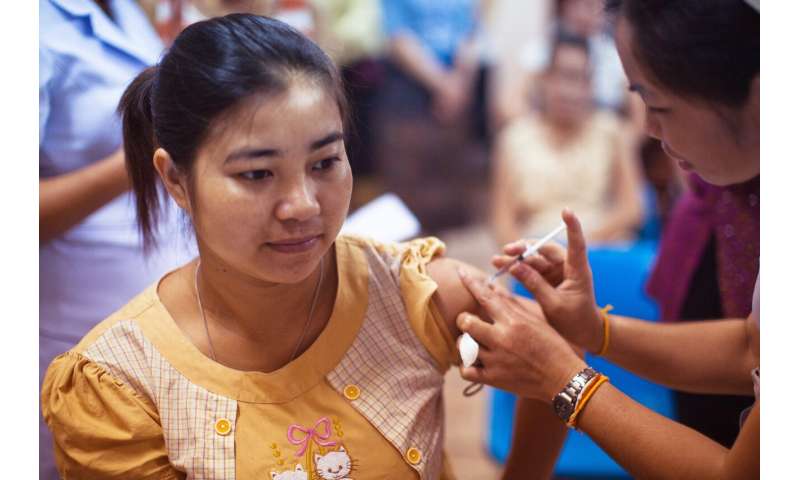
German biotech company BioNTech and US pharmaceutical Pfizer announced on Monday promising early results from their phase 3 clinical trial for a vaccine against SARS-CoV-2, the virus that causes COVID-19.

These early results are what is known as an "interim analysis." It's an early look at the data before a study is complete, to understand if there is any indication of whether the vaccine might work.

Currently, this trial has enrolled 43,538 volunteers, giving half the volunteers two doses of the vaccine and the other half two doses of a placebo. These volunteers then continued their normal lives, but they were monitored for any symptoms that could be COVID-19, with testing to confirm.

Analysis of 94 volunteers with confirmed COVID-19 suggests the vaccine has an efficacy of over 90%.

This means that if you took ten people who were going to get sick from COVID-19 and vaccinated them, only one out of ten would now get sick.

Can we get excited yet?

There is more data to come. This is a press release and the data have not undergone "peer-review" through scientific publication, although it has been assessed by an independent monitoring board. The study also won't be complete until 164 volunteers have confirmed COVID-19, and the estimate of efficacy may therefore change. Finally, the volunteers must be monitored for a defined period of time after vaccination for any side effects and this must be completed.

Important questions also remain. It's unclear how long protection will last, as this study has only been underway for three months. It's unclear if this vaccine protects against severe disease or if this vaccine will work equally well in everyone. For example, a phase 1 clinical trial with this vaccine showed that immune responses were lower in older people.

But 90% efficacy is striking. To give some context, the US Food and Drug Administration indicated they would license a SARS-CoV-2 vaccine with 50% efficacy. The flu vaccine often provides around 60% efficacy and the mumps vaccine, which is currently the fastest vaccine ever made at four years, provides around 88% efficacy.

The BioNTech/Pfizer vaccine could outstrip that, after just nine months of development. This level of efficacy means virus transmission could be very effectively controlled.

That has the research community excited. It bodes well for other vaccines currently being tested for SARS-CoV-2 and we could end up with multiple successful vaccines. This would be great because some might work better in certain populations, like older people.

Multiple vaccines could also be manufactured using a broad range of established infrastructure, which would accelerate vaccine distribution.

Producing mRNA on a commercial scale

The BioNTech/Pfizer vaccine is what's called an mRNA vaccine.

As this article by Associate Professor Archa Fox, an expert on molecular cell biology from the University of Western Australia, explains: "mRNA vaccines are coated molecules of mRNA, similar to DNA, that carry the instructions for making a viral protein."

After injection into muscle, the mRNA is taken up by cells. Ribosomes, the cell's protein factories, read the mRNA instructions and make the viral protein. These new proteins are exported from cells and the rest of the immunization process is identical to other vaccines: our immune system mounts a response by recognizing the proteins as foreign and developing antibodies against them.

A problem for Australia is that it can't make mRNA vaccines onshore yet.

The Australian government has an agreement for ten million doses of the BioNTech/Pfizer vaccine. Since this vaccine requires two doses, this agreement is sufficient for five million Australians. It's unclear how long it will take until any vaccine is widely available, but we may hear more about this in the coming weeks and months.

The vaccine requires storage at a temperature below -60℃. This will certainly be a challenge for shipping to Australia and local distribution, although not impossible. One solution to this problem is to form vaccination centers to roll out the vaccine once it becomes available. In a briefing by Pfizer, the company said it will use ultra-low temperature shipment strategies and the vaccine can then be distributed on "dry-ice."

Currently, Australia has no capacity to produce mRNA on a commercial scale given the technology's novelty. But we (the authors) and others have been working to coordinate and build the manufacturing capacity in Australia for future mRNA vaccine and therapeutics. With financial support aimed at private-public mRNA manufacturing collaboration, Australia can equip itself with this vital technological asset.

England's Mings says BAME candidate heading the FA would be 'huge step'

(Reuters) - England defender Tyrone Mings has said it would be a big step forward in the fight for equality if the Football Association appoints a candidate from Black, Asian and Minority Ethnic (BAME) communities as its chair to replace Greg Clarke.

Clarke resigned as chairman of English soccer’s governing body on Tuesday, hours after referring to “coloured footballers” during questions from members of parliament.

“Of course, it would be a huge step,” Aston Villa defender Mings told reporters when asked if he would like to see a black man or woman at the helm. “It would be everything that a lot of people have worked for... people more senior than myself.”

“But ultimately that isn’t what we’re asking for. We’re not necessarily asking for the next chief to be black. What we’re asking for is equal opportunities for both black and white people, or ethnic minorities.”
PLO’s Saeb Erekat honoured in memorial ceremony ahead of funeral
Wednesday, 11 Nov 2020 
Palestinian honour guard carrying the coffin of late Palestinian chief negotiator Saeb Erekat during his funeral procession in in the West Bank city of Ramallah, November 11, 2020. — Thaer Ghanaim/Palestinian Authority’s press office handout pic via AFPRAMALLAH,

 Nov 11 — In a sombre memorial ceremony in the occupied West Bank, a Palestinian military honour guard laid a wreath today over the coffin of veteran Palestinian official Saeb Erekat, who died after contracting Covid-19.

Erekat, 65, served President Mahmoud Abbas Abbas and his predecessor Yasser Arafat as chief negotiator over decades of talks with Israel. His funeral, due to take place later on Wednesday, coincides with the 16th anniversary of Arafat’s death.

A procession of Palestinian soldiers wearing face masks carried a coffin containing Erekat’s body through a plaza at Abbas’ presidential compound in Ramallah.

Abbas and other senior officials watched as two soldiers laid a wreath over the coffin, which was draped in a Palestinian flag and a keffiyeh — the black-and-white chequered scarf that was often worn by Arafat.

A long-time resident of Jericho, the largest Palestinian city in the Jordan Valley, Erekat died yesterday after announcing on October 8 that he had contracted the coronavirus.

A lung transplant three years ago left his immune system compromised, and his condition deteriorated. He was taken to an Israeli hospital in Jerusalem three weeks ago and was pronounced dead yesterday after multiple organ failure.

Waving goodbye

Erekat, who held the post of secretary general of the Palestine Liberation Organisation, was one of the most experienced and high-profile advocates for the Palestinian cause over decades of conflict with Israel.

He led the Palestinians in peace talks with Israel for many years until they collapsed in 2014 but remained a firm backer of the negotiated creation of a future Palestinian state.

In recent years he was the main face of Palestinian opposition to US President Donald Trump’s plan that envisaged leaving Israel in control of Jewish settlements and large parts of the occupied West Bank.

Abbas and other officials waved goodbye to Erekat’s funeral convoy as it departed the presidential compound and drove to Jericho, where his body will be carried in procession to a town mosque for prayers.

A military ceremony is then expected to lead the procession to a nearby cemetery.

The sombre events take place as Palestinians mark the death of Arafat, who died in Paris on November 11, 2004, and was flown back to Ramallah for burial, with a huge crowd in attendance.

Earlier today, Palestinian Prime Minister Mohammad Shtayyeh laid a wreath at Arafat’s burial place in Ramallah. — Reuters


Mass resignation of Hong Kong opposition lawmakers after Beijing rules on disqualification

China’s top legislative body empowers city authorities to unseat legislators without need to go through courts

After four opposition members removed, their 15 remaining colleagues say they will quit in protest on Thursday

Tony Cheung and Jeffie Lam
Published: 11:16pm, 11 Nov, 2020

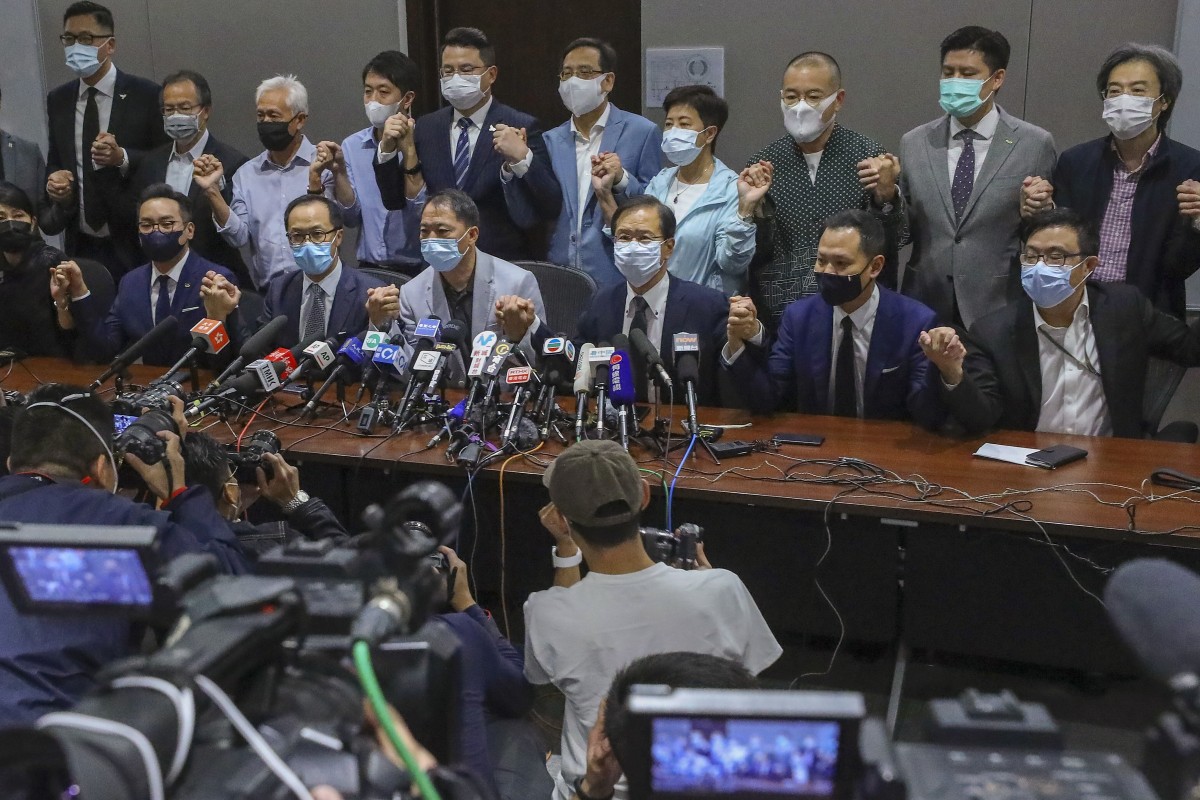
Pan-democratic lawmakers put on a show of unity on Wednesday following the ejection of four lawmakers. Photo: Dickson Lee

Hong Kong’s opposition lawmakers will all resign together to protest against the disqualification of four colleagues after China’s top legislative body empowered the local government to unseat politicians without having to go through the city’s courts.

Under a resolution unanimously endorsed on Wednesday by 161 members of the National People’s Congress Standing Committee (NPCSC), Hong Kong lawmakers will lose their Legislative Council seats immediately if they are deemed to have engaged in a range of acts, from endangering national security to dishonouring their pledge of allegiance and refusing to support China’s sovereignty over the city.

The local government quickly followed up the ruling by disqualifying the Civic Party’s Alvin Yeung Ngok-kiu, Kwok Ka-ki and Dennis Kwok, along with Kenneth Leung of the Professionals Guild, all four of whom were previously barred from running in September’s Legco elections which were postponed for a year.

Hong Kong’s leader, Chief Executive Carrie Lam Cheng Yuet-ngor, said she had asked Beijing to step in because the four posed a constitutional anomaly in being allowed to carry on serving as lawmakers when they had already been disqualified from running for re-election over their calls for foreign governments to sanction the Hong Kong and central governments.

“[Beijing’s ruling] has made it very clear that the criteria for anyone who has taken an oath and served as a legislative councillor but thereafter they have engaged in activities which are breaching those requirements, is that they should immediately lose their qualification,” she said.

Hong Kong is a society under the rule of law ... It’s not only the executive branch which has a sayCarrie Lam, Hong Kong chief executive

Lam said the NPCSC’s decision did not mean she now had additional powers to unseat legislators.

Officials such as electoral officers, the justice minister, the Legco president and the courts would still need to follow existing constitutional and election laws, she said.

“Hong Kong is a society under the rule of law ... It’s not only the executive branch which has a say,” Lam said.

She insisted the NPCSC’s decision had little to do with the pan-democrats’ delaying tactics in the legislature, even though their filibustering had been cited by pro-establishment rivals earlier as justification to have them disqualified.


With no more opposition lawmakers left in the city’s legislature, Lam’s planned legislative amendments could have far-reaching implications for the city’s political and electoral systems, commentators said.

Making good on a threat they had issued on Monday, Democratic Party chairman Wu Chi-wai said all 15 remaining pan-democratic lawmakers would tender their resignations on Thursday.

“All the power will be centralised with the chief executive – a puppet of the central government. So today is the end of ‘one country, two systems’,” he said, referring to the governing policy under which Hong Kong is allowed a high degree of autonomy.


But pro-establishment lawmakers said the pan-democrats had only themselves to blame, and Beijing’s decision would ensure Hong Kong’s prosperity and stability.

They said the remaining 41 members from their camp would “act more diligently” to monitor the government, dismissing critics’ warnings that Legco would be reduced to a compliant “rubber stamp”.

“If the council turns quiet [without the opposition], the remaining lawmakers will be able to scrutinise government proposals in a more critical and careful manner,” said the camp’s leader, Martin Liao Cheung-kong.

What might lie ahead if Beijing moves to disqualify Hong Kong lawmakers
11 Nov 2020


Independent lawmakers Cheng Chung-tai and Pierre Chan will also remain in Legco.

The NPCSC resolution stipulated that lawmakers would lose their seats if they were deemed to have promoted or supported the notion of Hong Kong independence and sought foreign intervention in the city’s affairs.

Lawmakers could also be disqualified if they “were recognised in accordance with the law” to have failed to meet the legal requirement of “upholding the Basic Law and pledging allegiance to Hong Kong as a special administrative region of China” – as stated in their oath of office.


“This decision applies to lawmakers whose candidacies were invalidated during the nomination period of the Legco election originally slated for September 6,” the resolution stated, in a reference to the four disqualified pan-democrats.

NPCSC chairman Li Zhanshu, China’s third-ranking state leader, issued a statement saying the decision was “necessary and appropriate”.

“This is another important piece of legislation, as the standing committee insists on the ‘one country, two systems’ principle and improves its systems to protect national security,” he said.

In separate statements, the State Council’s Hong Kong and Macau Affairs Office (HKMAO) and Beijing’s liaison office in Hong Kong expressed firm support.

Beijing vows to ‘prevent and curb’ external meddling in Hong Kong affairs
4 Nov 2020


Quoting late paramount leader Deng Xiaoping, the HKMAO said: “Deng had pointed out that [the principle of] ‘Hong Kong people governing Hong Kong’ has its bottom line and standard, which is that patriots must form the main body of the city’s administrators.”

The liaison office also condemned the pan-democrats’ plan to quit as “irresponsible”.
The NPCSC interpreted Article 104 of the Basic Law back in 2016 to rule that lawmakers and other public officers must take their oath “solemnly and sincerely”. That ruling resulted in the disqualification of six opposition lawmakers.

Lam said on Wednesday that her government would amend local laws next to ensure they aligned with both the 2016 interpretation and the latest ruling from Beijing.

“It could involve specifying the formalities of oath-taking, who oversees it, as well as the mechanism and consequences of a breach of the oath,” she said.

In July, Lam suggested that there was no “legal basis” to stop the four lawmakers from serving out their extended term, even after they were banned from running for re-election, as she sought Beijing’s approval for the Legco polls to be postponed by a year, citing public health concerns because of the coronavirus pandemic.

While the NPCSC endorsed the postponement of the election in August, it did not make a specific ruling on the fate of the four back then.


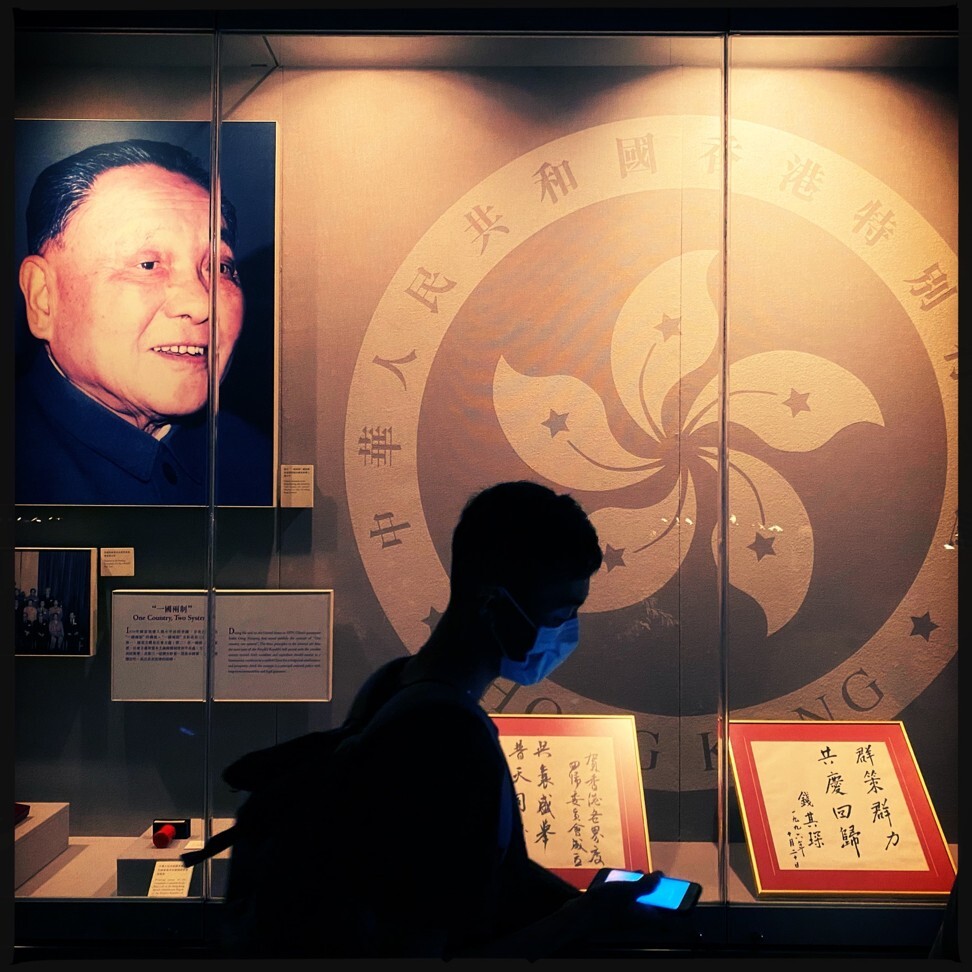
A portrait of Deng Xiaoping hangs beside the emblem of Hong Kong at an exhibit at the Hong Kong Museum of History. Photo: Robert Ng

However, since the extended Legco term started a month ago, pro-Beijing lawmakers have repeatedly called for action to be taken against the pan-democrats for filibustering with repeated quorum calls at council meetings.

Before Tam Yiu-chung, Hong Kong’s sole delegate to the NPCSC, travelled to Beijing on Monday, he also described filibustering as grounds for disqualification.

But as the resolution stopped short of mentioning delaying tactics, Lam argued that it was not aimed at stopping filibustering.

“We would not take away members’ qualifications because they deploy certain parliamentary tactics,” she said. “We would not like to see this ... but that is not the purpose of this decision at all.”

Maria Tam Wai-chu, vice-chairwoman of the Basic Law Committee, which advises Beijing on Hong Kong’s mini-constitution, said the NPCSC’s decision could not be challenged in the city’s courts.

Tam Yiu-chung said the decision should serve as a reminder to lawmakers about being mindful of their conduct in the legislature.

Professor Johannes Chan Man-mun, a legal expert at the University of Hong Kong, criticised the resolution for bypassing the courts, saying it was unfair for the NPCSC to leave no room for lawmakers to explain or review their disqualifications.


Britain was quick to condemn Beijing’s move as “a further assault on Hong Kong’s high degree of autonomy”.

Foreign Secretary Dominic Raab said: “This campaign to harass, stifle and disqualify democratic opposition tarnishes China’s international reputation and undermines Hong Kong’s long-term stability.”

This article appeared in the South China Morning Post print edition as: New rule ousts lawmakers New rule sees four opposition members ousted

CONVERSATIONS (5)

Tony Cheung
Ton Cheung became a political journalist in 2007. He joined the Post in 2012 and now leads the Hong Kong-mainland relations team on the Hong Kong desk. Tony also writes about the economy, and reports from mainland China, the United States, Germany and Britain.


Jeffie Lam
Jeffie writes predominantly about Hong Kong politics, but is also interested in social welfare issues, such as the city's ageing population and elderly care. She joined the Post in 2013 after beginning her career as a political reporter in 2009. In 2016, she won the English features merit prize in the 20th Human Rights Press Awards.
Four Hong Kong pro-democracy lawmakers unseated as Beijing moves to silence opposition

By Helen Regan, Ben Westcott and Jadyn Sham, CNN
Wed November 11, 2020

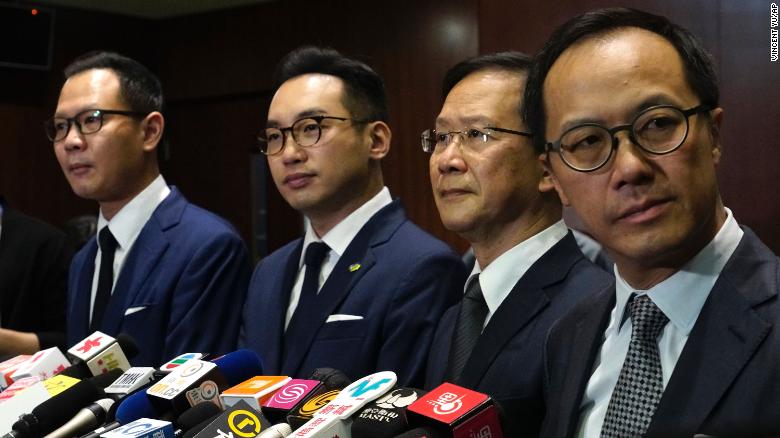
Four lawmakers, from left, Dennis Kwok, Alvin Yeung, Kwok Ka-ki and Kenneth Leung during a press conference at Legislative Council in Hong Kong, November 11, 2020.

Hong Kong (CNN)Four pro-democracy Hong Kong lawmakers were stripped of their seats on Wednesday after Beijing passed a resolution giving local authorities broad new powers to quash dissent, in a move that could signal the end of political opposition in the city.
The resolution, passed by China's highest legislative body, allows Hong Kong's executive to expel elected lawmakers directly without having to go through the courts, allowing Beijing to further its control over the semi-autonomous territory.
Under the new ruling, lawmakers who are deemed to promote or support Hong Kong independence, or who refuse to acknowledge Beijing's sovereignty over the city will "immediately lose their qualifications," the resolution said.
It also applies to elected lawmakers who "seek foreign forces to intervene in the affairs of Hong Kong, or who have endangered national security" and who "fail to uphold the Basic Law" -- the city's mini constitution -- as well as those who are deemed "not loyal to the legal requirements and conditions" of the territory.


The four legislators, Alvin Yeung, Dennis Kwok, Kwok Ka-ki and Kenneth Leung, were immediately disqualified from the city's Legislative Council following the ruling, the Hong Kong government said. The four were previously barred from running in now postponed legislative elections earlier this year.
Kwok Ka-ki, one of those disqualified, told Hong Kong public broadcaster RTHK that it was a day to "remember and reflect on the fight for democracy."
"Today, One Country, Two Systems no longer exists. Anyone who made this decision has to answer to history and every one of the Hong Kong people," he said, referring to the legal framework that allows Hong Kong greater autonomy from the mainland.
In a show of solidarity in advance of the ruling on Monday, 19 pro-democracy lawmakers threatened to resign en masse if any of their members were disqualified.
Pro-democracy lawmaker Claudia Mo, said she and the 15 remaining pro-democracy lawmakers will step down later today.

Hong Kong journalist appears in court as crackdown fears grow

"They have practically put the nail into Hong Kong's democracy fight. From now on, anyone deemed to be politically incorrect will not be allowed to run in the election," she said. "They are making sure only patriots can join Hong Kong's political election."
China's National People's Congress Standing Committee (NPCSC) passed the resolution following a meeting in Beijing on Monday. The move is a latest in a months long clampdown on opposition and pro-democracy voices in the city, following last year's anti-government protest movement.
Hong Kong's leader, Chief Executive Carrie Lam, said in a press conference Wednesday that those who do not respect China's sovereignty "cannot genuinely perform their duties as legislators."
"I welcome diverse opinion in the Legislative Council and respect the checks and balances," Lam said, adding that, "all of those responsibilities must be exercised responsibly."
Hong Kong is part of China, but the semi-autonomous city has its own legal and political system, with limited democracy and greater personal freedoms than on the mainland.
Opposition lawmakers -- the democratic camp -- hold a minority in the 70-member Legislative Council and often resort to filibustering and other procedural tactics to slow down legislation they see as diminishing those social freedoms.
RTHK previously reported that Beijing was seeking to unseat the now disqualified lawmakers for violating Hong Kong's Basic Law by filibustering meetings. Emily Lau, former chair for the Democratic Party, said that she believed the Hong Kong government and the ruling Communist Party in Beijing had become fed up with the filibustering by pro-democracy lawmakers in the city's Legislative Council chamber.
"It is absolutely devastating," said Lau, a former Legislative Council member, of the new resolution. "We have procedures in the Basic Law if you want to kick out a legislator but they have just ignored all that ... there's no rule of law. It's sending a very bad signal to Hong Kong and the world."
Lau said that the broad definition of new ruling means it could be applied to "almost half of the population" and that the only people who could now run for government would be those who would "kowtow to Beijing."
In July, 12 pro-democracy candidates -- including the now-excluded four -- were disqualified from standing in now-postponed legislative elections on the grounds that they would not uphold the city's mini-constitution. They included prominent Hong Kong activist and former leader of the 2014 Umbrella Movement Joshua Wong, and a number of candidates from more traditional pro-democracy parties, as well as several young activists who cut their political teeth in last year's pro-democracy protest movement.
The legislative election, which had been scheduled for September 6, was postponed in July for 12 months due to coronavirus concerns. But some pro-democracy activists claimed the government was using the pandemic as an excuse to indefinitely postpone a crucial election for Hong Kong.
Just under half the seats in the Legislative Council are controlled by so-called functional constituencies, which represent business and society groups and are typically pro-government. The rest go to candidates in geographical constituencies, and before the election postponement, opposition parties had aimed to ride a wave of discontent with the government to fill those seats.
Critics now fear that with Beijing's ruling and the expulsion of democracy lawmakers, Hong Kong's parliament may just become a rubber stamp body for pro-Beijing policies.

With reporting from Eric Cheung, Kristie Lu Stout, and James Griffiths in Hong Kong.

New primate species discovered in Myanmar

DEUTSCHES PRIMATENZENTRUM (DPZ)/GERMAN PRIMATE CENTER

ANOTHER AMAZING FIND IN THE MUSEUM STORAGE ROOM

Research News

A new primate species dubbed the Popa langur has been discovered in Myanmar after years of extensive study, including analysis of a 100-year old specimen kept in the London Natural History Museum. The Popa langur (Trachypithecus popa) is described in a new scientific paper released today that documents the extensive genetic and morphological studies and field surveys undertaken by the German Primate Center (DPZ) - Leibniz Institute for Primate Research in Göttingen and conservation NGO Fauna & Flora International.

The Popa langur only occurs in central Myanmar and is named after the sacred Mount Popa, which holds the largest population of the species with about 100 animals. Mount Popa is an extinct volcano, which features an important wildlife sanctuary, as well as a sacred pilgrimage site, home to Myanmar's most venerated spirits, known as 'Nats'. Altogether there are only 200 to 250 animals of the new species, which live in four isolated populations. Throughout its range the langur is threatened by habitat loss and hunting, and the new species can be considered critically endangered. "Just described, the Popa langur is already facing extinction," says Frank Momberg at FFI.

Researchers of the DPZ and FFI in collaboration with partners from other non-government organizations, universities and natural history museums, investigated the evolutionary history and species diversity of langurs in Myanmar. Their study resulted in the description of the new langur species, the Popa langur.

The Popa langur differs from known species in fur coloration, tail length and skull measurements. Genetic studies revealed that the new langur species separated from known species around one million years ago. The DNA for genetic analyses was obtained from fecal samples collected by FFI staff in the wild, as well as from tissue samples of historical specimens from the natural history museums in London, Leiden, New York and Singapore.

Christian Roos, scientist in the Primate Genetics Laboratory at DPZ says, "The DNA analysis of a museum specimen collected for the London Natural History Museum more than 100 years ago has finally led to the description of this new species, confirmed also by samples collected from the field by FFI's research team."

"Additional field surveys and protection measures are urgently required and will be conducted by FFI and others to save the langurs from extinction," says Ngwe Lwin, a primatologist with FFI's Myanmar program.


Remote Canadian town programs radar to spot approaching polar bears

By Gloria Dickie

Churchill, Canada (Reuters) - Along the frosty coast of Hudson Bay, hundreds of polar bears have been wandering for weeks, waiting for the wintertime sea ice to form so they can return to hunting ringed seals.

AI radar protects remote village from polar bears 02:39

Until then, they represent a danger to the 900 people living in nearby Churchill - a remote, sub-Arctic town in Canada famous for the visiting carnivores.

The town is working on a plan to prevent conflicts between hungry bears and humans, using a new radar system that can watch and warn when a bear approaches and do so in a snowstorm and during the dead of night.

“The radar can see through all of that,” said Geoff York, senior conservation director at Polar Bears International who has been “training” the system’s artificial intelligence this year to recognize bears on the tundra near Churchill.

“It’s one more way to keep communities or camps safe.”

Next year, the system will be deployed for the first time at a tourist campsite near Longyearbyen, a former coal-mining town on Norway’s Svalbard archipelago, where a Dutch man was killed by a polar bear in August.

That bear was shot by authorities to prevent another attack.

As climate change warms the Arctic faster than the rest of the world, the region has been drawing more tourists, at least until the coronavirus pandemic severely restricted travel.

With sea ice breaking up earlier and forming later, “we’re seeing more bears on shore in more places and for longer time periods,” York said.

“We’re setting up this perfect scenario for increased human-bear interaction and increased human-bear conflict. We’re trying to get ahead of that.”

Churchill’s last bear attack was in 2013, when a wayward animal mauled a young woman walking home from a Halloween party. The woman survived after receiving 28 staples to her scalp. Two bears were killed in response.

Slideshow ( 5 images )

LONGER ON LAND


Mounted on the tundra where bears congregate during the migration to the sea ice each year, the bear radar, or “Beardar”, was adapted from a system designed by a private surveillance firm for military use.

The system’s computer algorithm has been learning to distinguish bears from other large objects, including caribou, vehicles and humans.

When the radar detects a bear ambling toward a human settlement, it will alert conservation authorities who then deploy a range of tactics from rubber bullets to helicopters to shoo the bear away.

Otherwise, authorities only know of a bear approaching when a person spots it

When a two-year-old male bear was seen scrambling over a rocky stretch by the nearby historic Cape Merry battery site in late October, conservation officers deployed a helicopter and for three hours it buzzed in the sky above the bear.

Eventually the animal turned back toward wilder areas.

Churchill’s residents are used to living alongside hundreds of bears for part of the year: as a rule, townfolk leave car doors and homes unlocked in case someone needs to take shelter from the animals.

“You’re just always aware,” said longtime resident Joan Brauner. “I always have a cocker pistol on me whenever I go out.”

A 24-hour hotline receives up to 300 tips on polar bear sightings each year. Rangers patrol the town by truck.

When a bear repeatedly gets too close, it is trapped and transferred to what locals call the “polar bear jail” in an old military aircraft hangar until it can be moved to the coast.

“Generally, we handle 30 to 50 bears every season,” said conservation officer Andrew Szklaruk. As the region continues warming, that number could grow.

POPULATIONS IN DECLINE


Bears rely on sea ice as a hunting platform, waiting by holes in the ice for seals to come up for air.

But as the Arctic has warmed more than twice as fast as the rest of the world over the last three decades, that ice breaks up earlier after each winter and takes longer to form in autumn.

This year’s sea ice formation has been particularly slow across the High Arctic due to warmer water temperatures and a record summer heatwave.

In the Hudson Bay area, bears are often staying up to four weeks longer on land than the four months or so they spent there in the 1980s. During that time, they fast and lose about 2 pounds of body fat daily.

“Bears here are not as big as they used to be in their overall frame,” said Cassandra Debets, an Arctic ecologist at the University of Manitoba.

Because malnourished bears can experience reproductive failure, scientists have projected that polar bears could disappear from the Arctic almost entirely by 2100 as the sea ice continues to diminish with climate change, according to a study published in July in the journal Nature Climate Change.

Four of the 19 polar bear populations across the Arctic and sub-Arctic are already in decline, including the Western Hudson Bay bears, while the status of others remains unknown.

As the Churchill bears wait for the ice this year, one impatient juvenile male checked out the saltwater slush and then returned to the tundra.

Another young male munched on a pile of kelp - a sign of boredom, scientists say. It will be a few more days before the ice is thick enough for him to head out and hunt again.
Canada PM scolds provinces: Do more to fight coronavirus

NO MENTION OF ALBERTA THE WORST OFFENDER, UNDER TRUMP WANNABE KENNEY

By David Ljunggren, Steve Scherer

OTTAWA (Reuters) - Canadian Prime Minister Justin Trudeau on Tuesday urged premiers of the country’s 10 provinces to “do the right thing” and take stricter measures to fight a rapidly spreading second wave of the coronavirus.

“We are seeing record spikes this morning across the country, so I urge the premiers and the mayors to please do the right thing: act now to protect public health,” he told a news conference. Over the past week Canada has posted a daily average of more than 3,800 cases.

As Trudeau spoke, the central province of Manitoba announced a major shutdown beginning on Thursday. All social gatherings will be forbidden, restaurants closed except for takeout meals, and recreational facilities shut. Even supermarkets and pharmacies will operate only at 25% capacity.

Quebec, which has recorded the most cases, will maintain restrictions on the hardest-hit areas for at least another two weeks, Premier Francois Legault said.

Health authorities in Toronto, Canada’s most populous city, announced an existing ban on indoor dining, casinos and gyms would be extended for another 28 days to control what they called the most serious spread of the virus so far.

“Our situation is incredibly urgent,” Toronto’s chief medical officer Eileen de Villa told reporters.

New cases are rising everywhere except for the Atlantic Coast provinces, which have closed their borders even to most other Canadian visitors. But many provinces have resisted imposing another round of lockdowns, fearing potential economic damage.


Theresa Tam, Canada’s chief public health officer, said “it is clear we have yet to bend the curve on accelerated growth.” The virus will have more chance to spread as winter sets in, forcing people indoors, she said.

In Canada, health restrictions are the jurisdiction of provincial governments. Ottawa can step in during an emergency, but Trudeau said he saw no need for such action.

“I would hope that no leader in our country is easing public health vigilance because they feel pressure not to shut down businesses or slow down our economy,” said Trudeau, noting that Ottawa has provided billions of dollars to help businesses and people through the health crisis.