Monday, July 19, 2021


Growing vaccine hostility in U.S. will be extremely difficult to fix, experts warn

Last weekend, a speaker at the Conservative Political Action Conference in Dallas crowed that U.S. President Joe Biden’s administration had failed to “sucker” most of the American people into getting vaccinated against COVID-19.

“Clearly that isn’t happening,” writer Alex Berenson said, drawing applause and cheers from the crowd.

Despite the best efforts of some health and government officials, outright hostility against getting vaccinated has taken root among some conservative segments of America. It’s a trend that experts say will be extremely difficult to overcome, thanks to deep political polarization and the spread of misinformation.

“It comes down to trust,” said Colin Furness, an epidemiologist at the University of Toronto. “And remember, there’s a large proportion that believes the (2020 presidential) election was fraudulent. You think they’re going to believe what this government is telling them? I don’t think so.”

READ MORE: COVID-19 cases are rising in the United States. Will this impact Canada’s border reopening?

Canadian experts say they’re growing concerned that a recent spike in COVID-19 cases in the U.S. could impact the reopening of the border. Those travel restrictions could be lifted by mid-August, according to Prime Minister Justin Trudeau — provided vaccination rates stay steady.

The rising infections are being fuelled largely by vaccine resistance, which recent polling suggests is split among party lines.

A recent Washington Post-ABC News poll found that 86 per cent of Democrats have received at least one vaccine dose, compared to 45 per cent of Republicans. When it came to those who said they will definitely not get the shot, 38 per cent of Republicans said so, while just four per cent of Democrats had the same opinion.

Vaccination statistics from the U.S. Centers for Disease Control and Prevention appear to be backing up that polling data.

Only five states have yet to crack the 50 per cent threshold for at least one vaccine dose among their eligible population — Mississippi, Alabama, Louisiana, Wyoming and Idaho. All five voted for Donald Trump in 2016 and 2020, and are led by Republican state governments. Other states with rates lower than the national average also lean Republican, including Tennessee and Missouri.
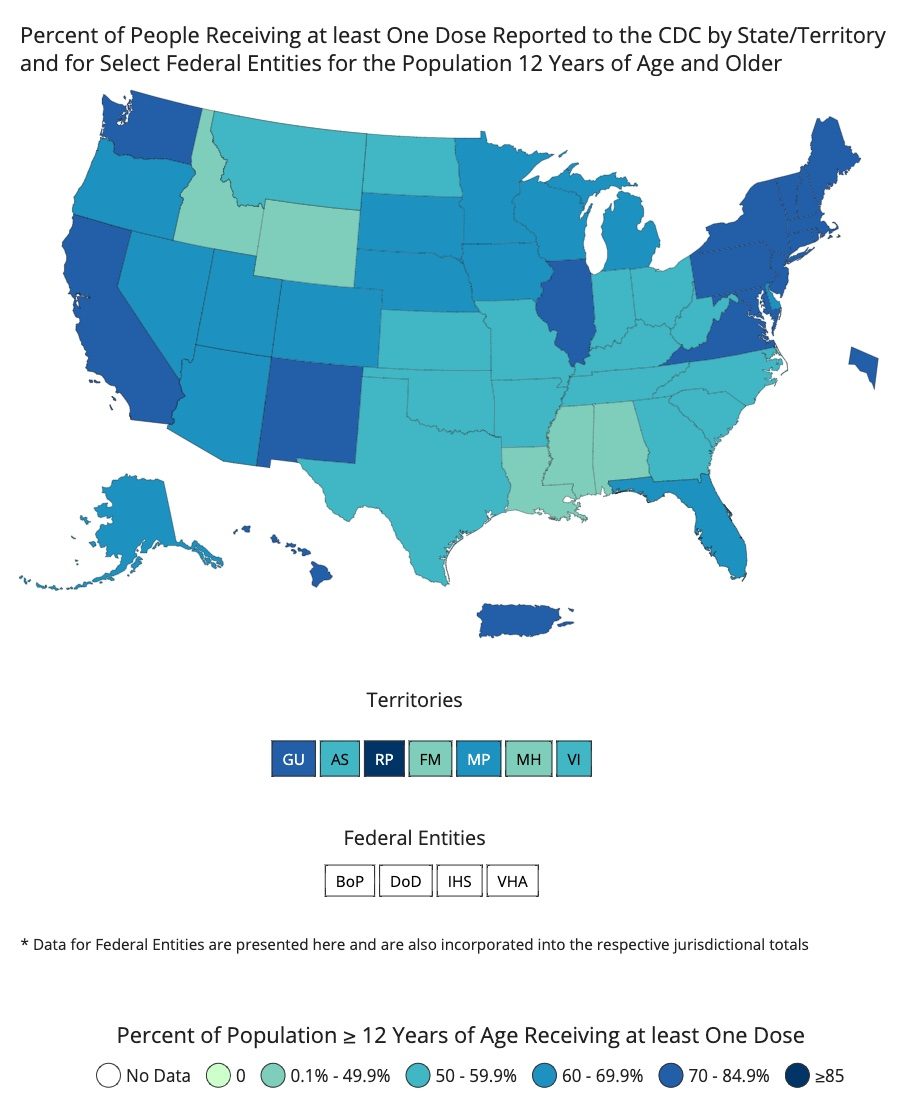
A state-by-state breakdown of vaccination rates among the eligible population (aged 12 and up) in the United States as of July 16, 2021. Alaska, Hawaii, the District of Columbia and Puerto Rico are shown detached from the mainland U.S. U.S. Centers for Disease Control and Prevention

Nationally, 56.5 per cent of Americans aged 12 and over have received two doses, and 65.2 per cent have received at least one — still short of Biden’s goal to have at least 70 per cent of Americans vaccinated by July 4. The pace of vaccinations being administered has also fallen more than 80 per cent from its peak in April.

COVID-19 cases, meanwhile, are rising again. As of Friday, new infections per capita nationwide have jumped at least 120 per cent within the past 10 days, according to Johns Hopkins University data.


At the U.S. Centers for Disease Control and Prevention (CDC), Director Dr. Rochelle Walensky on Friday warned of a “pandemic among the unvaccinated.” More than 99 per cent of COVID-19 deaths and 97 per cent of hospitalizations are among people who have not been vaccinated, according to the CDC.

The biggest jump in cases last week came in Florida, accounting for nearly half the national cast count. Yet at the same time, Gov. Ron DeSantis is selling merchandise that says “Don’t Fauci My Florida,” referring to Biden’s chief medical advisor Dr. Anthony Fauci.

After Biden announced a door-to-door campaign aimed at reaching unvaccinated Americans, Texas Rep. Chip Roy posted a reworked version of the famous “come and take it” flag. Georgia Rep. Marjorie Taylor Greene referred to those campaigners as Nazi brownshirts.


Misinformation has also been spreading within right-wing media. Fox News host Tucker Carlson has sometimes suggested that the vaccine doesn’t work at all “and they’re just not telling us,” though he has also insisted that he’s in favour of inoculations. Meanwhile, a host on Newsmax, which leans further to the right than Fox, said on-air that vaccines “go against nature,” which the network later distanced itself from.

While the reactions have been framed as a question of personal freedoms and government overreach, political analysts see them much more cynically.

“The Republican Party is determined to deny Joe Biden any successes, and their best electoral strategy is to make sure that Joe Biden looks bad,” said Matthew Lebo, a political science professor at Western University. “That means not helping the economy, not helping voters, not helping the pandemic go away.

“They put it in terms of ‘the socialists are coming to force you to take your shots,’ and the end goal is to make the Democrats the enemy. But that just makes the vaccine the enemy.”

READ MORE: 99% of COVID-19 deaths in U.S. involve unvaccinated people, Fauci says

Some Republicans have tried to stress the importance of getting vaccinated, including the party’s top senator Mitch McConnell, who has expressed confusion about the resistance. But Lebo doesn’t see that working.

“People watching Fox and Newsmax aren’t listening to Mitch McConnell,” he said. “Trump disavowed him, so his supporters have too. And right now, the people Trump has endorsed aren’t saying the right things.”

Trump, who was privately vaccinated in January shortly before leaving the White House, has occasionally told his supporters in speeches and media interviews to get the vaccine. But he has also said it should be a personal choice, and has not participated in public service announcements made by other former presidents or sitting Republicans.

Shannon Macdonald, a University of Alberta professor whose research specializes in vaccine hesitancy, says it’s much harder to convince people to get something they’re outright resisting, as opposed to convincing people who have concerns.

Door-to-door outreach may help sway some of those hardliners, she added, but only if those campaigners are providing practical, useful information.

“‘Did you know you’re eligible?’ ‘Do you know where you can get the shot?’ ‘Do you need a ride to the location?’ These are all good questions to ask,” she said. “But a stranger coming to the door and saying, ‘Vaccines are safe and effective, you should get vaccinated,’ that will only make people dig in more.”

Click to play video: 'Biden says social media sites like Facebook ‘are killing people’ by spreading COVID-19 disinformation'Biden says social media sites like Facebook ‘are killing people’ by spreading COVID-19 disinformation
Biden says social media sites like Facebook ‘are killing people’ by spreading COVID-19 disinformation

That still won’t be enough to fully turn the tide, she warns.

“If it’s a part of their identity — ‘I’m a Republican, and the Republicans I support say we shouldn’t get vaccinated’ — then that’s extremely difficult,” she said.

“The only way you can really change that is if the people who share that identity, and particularly people in leadership with that identity, change their stance on the issue.”

Lebo says there’s a slim chance of that happening, but only after “a lot of unnecessary pain and suffering.”

“We may get to a point where Republican leaders realize, ‘Wait, the Democrats aren’t getting sick, it’s all Republicans who aren’t vaccinated,'” he said. “And then maybe they’ll start telling people to get (vaccinated).

“But the story of the last two years has been people in hospital dying from the disease, saying with their last breaths, ‘How can this be happening? It’s all a hoax.’ So I don’t have a lot of optimism of this craziness breaking anytime soon.”

READ MORE: Nearly 20% of Canadians still hesitant or refusing to get COVID-19 vaccine: poll

While some vaccine resistance exists in Canada, it’s not nearly as widespread. Just nine per cent of respondents in the most recent Ipsos poll for Global News said they will definitely not get the shot. The poll did not ask for party affiliation.

Conservative strongholds like Alberta, Manitoba and Saskatchewan boast higher vaccination rates than other provinces. More than 60 per cent of eligible Manitobans are now fully vaccinated, outpacing every jurisdiction except the northern territories.

Macdonald also noted that while some U.S. Republicans are opposing vaccinations in children — even those who are eligible — youth vaccinations in Alberta are being performed at the same rate as adults.

Furness says that until more Americans get vaccinated, it may be necessary to introduce mandatory rapid tests to ensure those coming into Canada won’t spread the virus.

He also wants there to be restrictions for unvaccinated people, including mandatory quarantines, which he says could help incentivize U.S. travellers to finally get the shot — along with the heightened possibility of getting sick.

“It’s going to become increasingly difficult for those people to justify not getting vaccinated, or to pretend that COVID doesn’t exist,” he said.

“And unfortunately, the U.S. is going to see a much larger wave of infections among the unvaccinated (compared to Canada), and it’s going to be frightening.”

SHE WAS JUST JOKING
Head of B.C. civil liberties group resigns following 'burn it all down' tweet'
SILENCED BY RIGHT WING CANCEL CULTURE
Harsha Walia made the tweet two weeks in response to the torching of Catholic churches after the discovery of unmarked graves at former residential schools
IT'S BETTER TO TAX THE CHURCHES THEN TO TORCH THEM


Author of the article: Cheryl Chan
Publishing date: Jul 17, 2021 •
Harsha Walia, B.C. activist and author of Border & Rule: Global Migration, Capitalism, and the Rise of Racist Nationalism. PHOTO BY CAELIE FRAMPTON /PNG


The head of the B.C. Civil Liberties Association has resigned following a controversial social media post.

The BCCLA announced the resignation of Harsha Walia on Friday, two weeks after she tweeted “burn it all down” in response to the torching of Catholic churches following the discovery of unmarked graves at former residential schools.

In a message posted to its website, the BCCLA’s board of directors said Walia’s tweet, posted from her personal account, failed to convey the organization’s message.

“Using a particular turn of phrase in that context left some people with the wrong impression about the values and principles to which we adhere,” it said. “We regret the misunderstanding that was caused by the tweet and apologize for the harm the words caused.”

The organization said it received numerous hateful responses after Walia’s tweet, fuelled by the fact Walia is a woman and a person of colour. Walia and staff were exposed to racism, misogyny and threats, it said.

The board said Walia demonstrated “bold, skilful and compassionate leadership” during the pandemic, and that she worked to strengthen the BCCLA’s policy positions on policing, Indigenous self-determination and immigration.

Walia was named executive director of the BCCLA in January 2020. She was a well-known activist involved with No One Is Illegal, a group that worked to protect the rights of undocumented immigrants, and the Downtown Eastside Women’s Centre.


U of T's music program fosters culture of sexual harassment and fear, students, faculty claim

Open letters outline systemic issues; school says it’s working to address concerns


Angelina King · CBC News · Posted: Jul 12, 2021 
A woman jogs past an art installation documenting allegations of sexual misconduct at the University of Toronto's faculty of music on June 28. Faculty members, students and unions have sent several letters to the school's administration expressing concern over the way it's been handling complaints. (Evan Mitsui/CBC)

Students, faculty, staff and alumni are demanding that the University of Toronto address what they say is a toxic culture within the faculty of music that allows sexual harassment and other misconduct to continue unchecked.

In open letters published online, those connected to the school also say the issues include harassment, racism, discrimination and censorship and that many were fearful to speak up until now.

At the end of last month, a group of students put up a "clothesline" installation on campus meant to air the school's "dirty laundry." Messages were hung up on coloured paper, including experiences of sexual harassment within the faculty of music.

Faculty members, students and unions have sent several letters to the school's administration expressing concern over the way it's been handling complaints.

"We absolutely need change ... because this has been going on for decades. Enough is enough," said Ness Wong, president of the Faculty of Music Undergraduate Association (FMUA).

"For change to happen at such a high level at an institutional level, we need to work together."

One of the messages to the university hangs on a 'clothesline' installed on the campus. It's part of an effort to get the school to address what critics say is a toxic culture at the faculty of music. (Evan Mitsui/CBC)

Students, faculty, instructors and alumni who spoke to CBC News describe an environment where predators are protected, the complaint process harms victims and systemic misconduct goes unaddressed. They say power dynamics lead to fear of speaking out or censorship. The open letters were sent after allegations of sexual harassment were brought to light on social media in the spring.

The allegations have not been substantiated.

In a statement, a spokesperson for U of T said the university is working with the faculty of music to address the issues. While the university didn't directly respond to claims about protecting perpetrators, it said that due to privacy obligations and the nature of some allegations, it isn't able to discuss specifics.
Letter details dozens of sexual harassment claims

FMUA first circulated an open letter in May calling on the faculty of music to address "historic and ongoing misogyny and systemic inequalities which have once again been brought to light."

The letter now has nearly 1,000 signatures and includes more than 50 stories of sexual assault or harassment at the music school — some current and some dating back to the 1970s, Wong said.

63% report experiencing sexual harassment on campus, Ontario survey shows

"It hurts to read those stories. It's horrendous," she told CBC News. "You wish it never happened. But you're also not surprised because this has been a problem for ages."

Other signatories outline instances of racism, bullying and other misconduct and how the experiences had an impact on their personal and professional lives and studies.

Ness Wong, president of the Faculty of Music Undergraduate Association, says while it's painful to read the allegations, 'you're also not surprised because this has been a problem for ages.' (Submitted by Ness Wong)

The letter says it's initially asking the university to:
Take concrete actions to ensure students are safe.
Launch an external review into the environment of misogyny, fear of speaking out against sexual misconduct and abuse of power.
Implement mandatory consent training for students, faculty and staff.
Add an in-house equity, diversity and inclusion officer within the faculty of music.

The faculty's dean at the time responded in his own letter, saying the administration agrees that action is needed to ensure the safety of students and faculty.

Students who report sexual violence can't be asked about sexual history, Ontario government says

"The institutional culture detailed in the letter is distressingly toxic and needs to change both immediately and permanently," Don McLean wrote on May 27. "It is clear that we have failed to ensure the safety of our community. The painful truths of individuals, and those of others whose voices are not yet registered, are deeply shocking and upsetting."

McLean also responded to the four requests from the FMUA and made some promises, including creating a group that will conduct broad consultations over the summer.

FMUA's vice-president of communications, Vanessa Ng, who just completed her second year of music education, said she doesn't feel safe heading back to campus in September if more action isn't taken.

"It's all buried deep into the culture and the institution," she said.

A passerby photographs the art installation set up on campus on June 28. (Evan Mitsui/CBC)

Master's student Danielle Sum, who signed the letter, said if the culture doesn't change, she wouldn't feel comfortable recommending the program to future students.

"It's kind of sad for me to see the school reputation be tarnished. But at the same time, I'm glad to see there are issues that are being brought to light," she said in an interview.
'Culture of music has always kind of dealt with this'

At the end of June, three unions penned a letter to the U of T administration with a series of demands to address the culture within the faculty, saying many members reported feeling unsafe.

Amy Conwell, chair of CUPE Local 3902, which represents more than 360 members in the faculty of music, said members have faced legal threats from an alleged perpetrator when they commented on a post in support of a woman who shared allegations of sexual harassment on social media.

CBC News spoke with three people who each received a similar letter from his lawyer, which was first sent to U of T's office of the vice-provost, faculty and academic life. It asks that the university require the instructors to remove the comments and claims that they breach university policy.

Sexual violence still a major problem at the University of Toronto, report warns
University of Toronto revamps counselling service for sexual assault cases

"She has no business participating in students' public Facebook (unproven and false) allegations against another faculty member," the letter states. "These comments are harassing, uncivil, defamatory, and conduct not becoming of their positions at U of T and the university as a whole."

Conwell said U of T's labour relations department sent the letters to the union to pass on to its members. CUPE 3902 has since filed a grievance. She said the university didn't require the instructors who received the letter to remove their comments from the post.

"The idea that not only survivors can be silenced, but just folks who are standing in solidarity with survivors would be silenced actively by the university and by folks in power in the music world is really unacceptable," Conwell said.

A spokesperson for the University of Toronto says the school 'cares deeply' about the safety of its students, faculty and staff and is working to address the issues within the faculty of music. (Chris Mulligan/CBC)

U of T said that due to privacy reasons, it can't comment on specific allegations or grievance processes.

"As noted previously, the university has robust policies and procedures in place around sexual violence and harassment. This is a highly sensitive subject for many within our community, and we are bound by legal limitations in terms of what we can disclose," the university said in a statement.

While some people have come forward with complaints and allegations, FMUA says others are too afraid.

U of M drama professor fired after allegations of sexual harassment

"The whole culture of music has always kind of dealt with this," Ng said. "Your reputation is a really big deal. And if you say something ill of someone, then no one's going to call you for gigs, or no one's going to want to book you."

The university said the school "cares deeply" about the safety of students, faculty and staff and that a safe and welcoming environment is a top priority.

It said the Sexual Violence Prevention and Support Centre and the university's Anti-Racism and Cultural Diversity Office are closely engaged in its work to address issues within the faculty of music.
Call for changes to 'convoluted' complaint process

Sessional instructor Tara Kannangara, one of two women of colour faculty members at U of T Jazz, co-authored an open letter outlining experiences of racism and the handling of a complaint she filed.

Kannangara says when she reported being verbally attacked in a faculty meeting in May after addressing issues of race and discrimination, she didn't feel the process was adequate or helpful.

"It was incredibly convoluted," she said.

"To ask for any kind of accountability over and over again and to have to retell the story is just so hard for your body and mind to take."

Tara Kannangara, a sessional instructor at U of T Jazz, says she can't ethically recommend that students go through the reporting process as it exists now when she doesn't trust the system. (Submitted by Adnan Khan)

She said students often come to instructors for guidance, and she can't ethically recommend they go through the reporting process as it exists now when she doesn't trust the system.

CUPE 3902 is asking the university to change the way complaints are handled, including by ensuring there are clear, mutually agreeable timelines for investigations and protection for survivors and whistleblowers.

"There are robust policies and processes in place at the university to address concerns of sexual harassment and violence, and to provide support for those who are affected. There are also a set of policies and guidelines to address complaints of harassment and discrimination," U of T's statement said.

University of Windsor erred in handling student's sexual assault complaint, court rules
McGill students anxious for update in sexual misconduct investigation

The university says a planned change in leadership recently took place and that the new dean of the faculty of music, Ellie Hisama, has already started consultations and will be speaking publicly about what happens next in the coming weeks.

FMUA says a new dean brings optimism, noting that everyone — from the administration to students — must be willing to work together in order to create institutional change.

"Please just help us and listen," Ng said.

ABOUT THE AUTHOR

Angelina King
Reporter
Angelina King is a reporter with CBC Toronto where she covers a wide range of topics. She has a particular interest in crime, justice issues and human interest stories. Angelina started her career in her home city of Saskatoon where she spent much of her time covering the courts. You can contact her at angelina.king@cbc.ca or @angelinaaking
Penn Museum Workers Accuse Leadership of Union-Busting Tactics

Workers are charging the museum's leadership with "obstructing the free and fair election process through anti-union activity."

by Hakim Bishara
July 16, 2021
Hyperallergic

The Penn Museum at the University of Pennsylvania in Philadelphia (courtesy the Penn Museum)

Amid a union election at the Penn Museum of Archaeology and Anthropology in Philadelphia, workers are charging the museum’s leadership with “obstructing the free and fair election process through anti-union activity.” The tally of the mail ballots, sent to workers by the National Labor Relations Board (NLRB) earlier this week, is expected on August 10.

The workers are voting for a wall-to-wall union representing staff from all of the museum’s departments. It would include 75 workers ranging from font-of-line staff to curators and museum educators. If they win, the workers will join AFSCME District Council 47 and Cultural Workers Local 397, a union recently formed by workers from the Philadelphia Museum of Art (PMA). The workers are demanding more involvement in the museum’s decisions, improved work conditions like fair wages and job protections, and a better dialogue with the community.

This latest conflict follows a string of controversies involving the museum’s possession of human remains, including the skulls of enslaved people, in its infamous Morton Collection. Most recently, the museum also faced backlash for holding the remains of a victim of the 1985 MOVE Bombing for decades. The remains of the victim, who is believed to be 14-year-old Tree Africa, were returned to her family on July 2, the museum told Hyperallergic.

Earlier this month, workers at the museum released a letter of support, signed by hundreds of museum professionals, calling on the museum to “maintain neutrality throughout the election process and to refrain from all anti-union activity.”

In a comment to Hyperallergic, a spokesperson for Penn Museum wrote: “We fully support our employees’ right to make a free and informed decision, and we believe they are entitled to receive honest, factual information about the voting process and collective bargaining.”

But the workers say that the museum is actively discouraging their colleagues from unionizing by “spreading misleading information about the outcomes of unionizing” via all-staff emails, meetings, and printed fact sheets. A packet that was mailed to workers and reviewed by Hyperallergic includes the warning: “By unionizing, individual employees will have less voice in decisions that will affect them individually, not more as unions sometimes promise.”

Such fact sheets are common practice among museums and other organizations that show reluctance to union drives. Adding to the pressure, Penn Museum also sent workers a plethora of different materials with anti-union talking points, including a video message from its new director, Chris Woods, pleading with his workers to vote NO in the election.

“I’m deeply concerned that giving your voice to a union will not contribute to healthy, productive relationships among our team,” Woods says in the video. “To the contrary, a third party would make it more difficult for us to work directly together to achieve the goals you’ve shared with me over the past few months.”

Woods, who became the museum’s first Black director in April, was immediately plunged into the controversies around the museum’s possession of human remains while also overseeing a $100 million renovation project. Now, he’s facing backlash from his own staff.

Rebeccah Ulm, a museum educator and member of the union’s organizing committee, told Hyperallergic that workers had initially hoped that Woods, who started his tenure with a good rapport with staff, would voluntarily recognize their union.

“It’s been disappointing and disheartening,” Ulm said in a phone conversation with Hyperallergic. “We hoped for [Woods’] support, but instead we got negative messaging and boilerplate anti-union propaganda calling a union a ‘third-party’ while, in fact, a union would be made of us.”

“The museum is using a lot of resources to produce documents and videos that are meant to scare people and sow seeds of mistrust and confusion,” Ulm continued. “It makes me question: Where is this money coming from?”

The workers have been sharing snippets of the museum’s anti-union messaging on their Instagram account with the label “BUSTED,” indicating union-busting tactics. One of the documents they received urged them to “give Chris Woods a chance.”

Despite these obstacles, Ulm said she’s hopeful for a victory based on the overwhelming majority of workers who had signed union authorization cards. “I believe in my colleagues,” she said. “I believe in the strength of our community and the care we have for each other.”
Enough with the Ableist Worship of Frida Kahlo

Emily Rapp Black’s new book cuts though self-serving interpretations of disabled bodies like Kahlo’s, which have long emphasized the comfort or pleasure of others

by Sophia StewartJuly 15, 2021
A display of Frida Kahlo's shoes at La Casa Azul, Mexico City (photo by learnatw)


The question that propels Emily Rapp Black’s Frida Kahlo and My Left Leg is simple and self-implicating: “Why do we (I) love Frida?” Throughout the book’s fourteen loosely-linked essays, Black lays claim to Kahlo for unique reason: like the painter became later in life, Black is an amputee, and both women’s lives were shaped by physical disability. In her youth, the author formed what she calls “the perfect imaginary friendship” with Kahlo. “I chose to try and understand the story of her body as a way of knowing or accessing mine,” Black writes, “as if the story of her life set out a path or trail that, no matter how difficult, I might follow.” Latching onto public figures like this is common among young disabled people, who are desperate to find other people in the world like us, to trace a possible road map for our own lives. Still Black admits the limits of an attachment to a woman who “lives only in the terrain of my imagination where I set all the terms of the story.”

But what about the rest of Kahlo’s legion of fans? Few, if any, other artists have become objects of such intense parasocial affection. Kahlo’s disembodied likeness adorns lipsticks, coasters, aprons, magnets, leggings, notebooks, keychains, backpacks, even Christmas ornaments. (Full disclosure: I have previously owned a Kahlo-emblazoned pencil case, t-shirt, pair of socks, and sticky-note pad; I still display her “Self-Portrait with Cropped Hair” in my bedroom.) Surely the outspoken communist would have abhorred the commercialization of her image and art. But what would she make of how her life has been interpreted, packaged, and flattened by her own admirers?
 
The cover of Frida Kahlo and My Left Leg (Notting Hill Editions, 2021) by Emily Rapp Black

Black observes these admirers during visits to La Casa Azul in Mexico City and the Victoria and Albert Museum in London, both of which contain many of the artist’s personal artefacts. In the essay “The Viewing, London,” she eavesdrops on her fellow exhibit-goers: “Isn’t it just terrible, the pain she was in?” one remarks to a friend as she inspects some of Kahlo’s prosthetics and orthopedic devices. “But it inspired her to paint,” the friend replies. “Yes,” the other says, “it made her an artist. All that pain.” Rapp, who walks through the exhibition on the prosthetic leg she’d worn since early childhood, who like Kahlo has navigated surgeries and doctors and medical apparati all her life, seethes at the insinuation that pain is a noble muse. Pain did not make Frida Kahlo an artist; Frida Kahlo made Frida Kahlo an artist. What she went through, the author reminds us, had no bearing on the vision and talent she already possessed. Black’s most harrowing experiences inform her own work — including this very book — but they do not produce it. “Suffering does not create art,” she thinks, observing Kahlo’s hand-painted plaster corset, “people do.”

But Kahlo has been canonized to the extent that she is no longer understood as just a person. London exhibit-goers ogle her braces and casts “as if passing by a saint’s shrine”; at La Casa Azul, visitors “treat the bed where the artist died as Christian supplicants treat the slab in Jerusalem.” Black worries over how Kahlo’s suffering has been romanticized, her body fetishized: fans obsess over the details of her accident (how “lovely” her mangled body must have looked coated in gold dust) and resultant injuries (how “intimately” the handrail exited her torso). Her life was so dense with senseless tragedies that we have to make it all mean something. As a result, Kahlo has been poured into familiar, palatable molds, with the aim of turning her into the sort of disabled person we can admire, not just tolerate; the sort of disabled person who doesn’t remind us of “the chaos of the world.” Black herself has been constricted by these sorts of molds. Time and time again, as she recounts, her body has been interpreted to ensure other people’s comfort or pleasure. Passengers willfully mistake her for a military veteran during a flight and applaud her accordingly; acrotomophiles lurk outside amputee conventions and swear their devotion to her. Through a self-serving able-bodied gaze, disability — Black’s, Kahlo’s — is made estimable or fuckable or brave.
Frida Kahlo’s medications and crutches on display at La Casa Azul, Mexico City (photo by learnatw)

Candid and eloquent, Frida Kahlo and My Left Leg is an invaluable addition to the canon of disability literature and the field of disability studies. Black eloquently articulates the longing and frustrations that are central to experiences of living with a disability. She isn’t interested in uncritically celebrating or passively meditating on Kahlo’s story; she wants to know exactly what she can glean from a woman who was all the things disabled folks are told we can’t be: sexy and productive and complicated, roiling with ego and desire. “What can all of us learn from Frida, no matter our embodiment?” she writes. The answers she lands on are, like the rest of the book, lucid and profound. I won’t spoil them, as they’re most resonant when earned. But Black makes clear that to honor Kahlo properly means embracing both her art and her disability, and more important, that we can learn the most from the artist when we peel away the fanfare and iconography, and see her for the person she was.

Frida Kahlo and My Left Leg (Notting Hill Editions, 2021), by Emily Rapp Black, is now available on Bookshop.
Is a Publication Boycott of Chinese Science a Justifiable Response to Human Rights Violations Perpetrated by Chinese Doctors and Scientists?

Published July 7, 2021 | By Doug McConnel

Practical Ethics (ox.ac.uk)

Recently the editor-in-chief of the Annals of Human Genetics, Prof David Curtis, resigned from his position, in part, because the journal’s publisher, Wiley, refused to publish a letter he co-authored with Thomas Schulze, Yves Moreau, and Thomas Wenzel. In that letter, they argue in favour of a boycott on Chinese medical and scientific publications as a response to the serious human rights violations happening in China. Several other leading journals, the Lancet, the BMJ and JAMA have also refused to publish the letter claiming that a boycott against China would be unfair and counterproductive.

This raises two separate ethical issues: 1. Should journals refuse to publish a letter arguing in favour of a boycott on Chinese medical and scientific publications? 2. Should journals actually establish a boycott on Chinese medical and scientific publications?


The letter

The letter is concerned with three kinds of practice happening in China: unjustified mass DNA collection without consent, forced birth control, sterilisations, and abortion, and organ harvesting from prisoners.

“The practices described require the active cooperation of many doctors and scientists and the passive compliance of many more. We note that this complicity may not be voluntary and that protest or dissent would not be tolerated. We understand that because of censorship some practitioners may be genuinely unaware of these abuses. Nevertheless, it seems inescapable that a substantial proportion of doctors and scientists in China are complicit in practices which we regard as profoundly unethical.”

The authors don’t directly take issue with other human rights abuses, such as the unjustified detention and forced labour of Uighurs (see here, here and here), presumably because doctors and scientists aren’t complicit in those practices.

The authors of the letter recognise that unethical research occurs in other countries but claim that the “nature and scale” of the problem is different. In other countries, professional standards are enforced and there is some protection for whistle blowers, both of which limit unethical practice. So you might, for example, have “two rogue psychologists advise the CIA on torture techniques” but there isn’t widespread complicity with unethical practices.

The letter considers vetting individual publications for whether they meet ethical standards but suggests that the problem with vetting contributions is that it is difficult to trust or verify claims that the research was conducted ethically. This leads them to ask:

“Should we go further and say that we regard the Chinese medical and scientific establishments to be so intrinsically involved in these abuses that we are not willing to consider hosting any of their outputs in our journals? … Our own view is that it is very difficult to see how we can claim to uphold our own values, such as are embodied in the Nuremberg Code, the Declaration of Helsinki and the Convention on the Prevention and Punishment of the Crime of Genocide, if we continue to maintain normal professional relations.”

So their main argument in favour of a boycott is deontological in flavour – to continuing to publish scientific research coming out of China is to be complicit in the abuse of human rights going on there.

They also briefly refer to a consequentialist argument – pressure from international medical bodies could be effective in curtailing those abuses, as they claim it was when it was when the Soviet Union was pressured into reducing the use of psychiatry against political prisoners.

The authors recognise that many researchers in China are “bright, committed, and ethical” but characterise them as also being “victims of the very regime we criticise.” This glosses over the fact that a boycott would potentially harm the careers of these blameless scientists and that a more complete consequentialist analysis might weigh against a boycott, but I return to that below. First, let’s consider the ethics of publishing the letter.

Should these journals block the publication of a letter arguing in favour of a boycott on Chinese medical and scientific publications?

One of the letter’s co-authors, Prof Schulze, claimed that the refusal to publish the letter indicated that “freedom of speech in western science is under threat because of Chinese influence.” “We were turned down because all these journals are heavily invested in China with business and editors there.” It isn’t clear, however, that these authors’ freedom of speech is being limited. There are, presumably, other means of publishing the letter (indeed, it is now getting significant attention online). Interestingly, Curtis has himself used this argument in an editorial to justify rejecting submissions to the journal on ethical grounds – “we do not consider that declining a submission on such a basis would amount to censorship. If we declined to consider a submission, it might still be published elsewhere”. Of course, other vehicles for disseminating the letter won’t come with the authority of those journals, but the right to freedom of speech doesn’t entail a right to publication in authoritative journals.

The situation is somewhat different regarding Curtis’s freedom of speech, however, because he was the editor in chief of the journal he was attempting to publish in. He claims that “the publisher has no business telling the editor what they can and can’t publish because of strong interests in China.” Wiley’s publisher of the Annals, Mark Paalman, says that publication of the letter was not refused outright but that he asked for it to be made less provocative. But perhaps even this represents unethical meddling in the editor in chief’s discretionary space.

In general, we should favour a high degree of editorial independence because scientific journals should publish high quality science, not just the science that happens to align with the commercial (or political) interests of the publisher. The editor is selected, in part, for their expertise in recognising high quality science. Similarly, editors shouldn’t use scientific journals as their personal mouthpieces, e.g. to push a biased conception of the science in their field. The role of the editor is presumably to pursue the purpose of the journal, in this case – “The principal aim of the Annals is to increase understanding of the causes and consequences of human genetic variation, particularly in relation to health, disease and evolution.”

The contested letter was not a scientific publication but an ethical argument about how journals should behave. Does editorial freedom extend to publishing such ethical arguments? Well, it would be naïve to think that human genetic research can proceed in a value-neutral way. Editors have an obligation to ensure that the journal pursues its aims ethically. In the interests of transparency it seems right that the editors should communicate the ethical stance the journal will take . In fact, Curtis and Balloux do just this in their February 2020 editorial. The most relevant section for us is the following on mass genetic sampling: “We would not consider submissions whose major aim seems to be to facilitate the identification of individuals or minority groups to facilitate repressive measures. Additionally, we will have a high threshold for assurance that DNA samples used for population studies have been freely donated with full informed consent.”

However, the letter arguing for a boycott of Chinese research doesn’t explain or justify the journal’s ethical position; rather, it argues for a potential ethical position that this journal and others might take. Given that most of the Chinese research the letter refers to would never be suitable for the Annals of Genetic Research anyway, the scope of the letter might seem overly broad for the journal. Nevertheless, affecting a blanket ban on Chinese research would require cooperation – the Annals could only police its own submissions so, for a blanket ban to take effect, the Annals would have to convince other journals to police their own submissions. Presumably, it is morally permissible to communicate an argument for a collective course of action; it would be up to the other journals whether to accept or reject the argument. So, in short, it isn’t obvious that the content of the letter is contrary to the goals of the journal.

A further consideration, however, is that there are ethical limits on the normative positions that editors can give their journals. It would be right, for example, for a publisher to block an editor from publishing an outright racist or sexist editorial or to prevent the editor from preferencing the publication of research that directly enables the oppression of minorities. Presumably the publisher would also be justified in blocking the editor’s actions if they were likely to seriously damage the journal’s standing. The journal itself has some value and should only be put at risk for something of greater value. So, does a letter arguing for a boycott on Chinese publications amount to a serious ethical infringement or risk such damage to the journal that the publisher would be justified in intervening?

To answer this we need to address the second ethical issue: Should journals actually establish a boycott on Chinese publications? Before discussing this, however, it is worth reflecting on a closely related precedent. Efforts over the past ten years have resulted in a boycott of a narrower range of Chinese research on organ transplant research.


Precedent

In 2011, the Lancet was prepared to publish a letter calling for a boycott on organ transplant research coming out of China. The letter stated:

The time has come to bring normal scientific and medical interchange with China concerning transplantation to a halt. We call for a boycott on accepting papers at meetings, publishing papers in journals, and cooperating on research related to transplantation unless it can be verified that the organ source is not an executed prisoner.”

In 2016 and 2017, the journal Liver International published two letters (here and here) to the editor urging the journal to retract research published by Chinese scientists on the grounds that it almost certainly used the livers of executed prisoners in the research. In 2018, Rogers et al. published a paper in BMJ calling for the retraction of 445 organ transplant papers for the same reason. These researchers arguing for the boycott and retraction of Chinese organ transplant research provide a similar argument to Curtis’s: “Banning publication of new research and retracting published research are actions that express condemnation of the underlying human rights abuses while avoiding complicity. It is our hope that such actions will contribute to change in China.” Since then the journals PLOS ONE and Transplantation have retracted 27 papers.

It seems, then, that there is a relatively strong consensus that organ transplant research should not be published (and even retracted) unless researchers can convincingly show that they have not relied on the organs of executed prisoners. This narrower boycott is less controversial because the scientists whose work is being boycotted are those acting unethically, i.e. providing and enabling the transplant of organs from prisoners. The more controversial move in Curtis et al.’s letter is clearly the extension of a boycott to a much wider range of science which is only very loosely connected to unethical practices.

Should journals actually establish a boycott on Chinese medical and scientific publications?

One deontological reason in favour of extending a blanket ban on Chinese scientific research might be that it would communicate disapproval of the human rights abuses more strongly. There is a sense in which the boycott and retraction of just transplant science seems a disproportionately small reaction to serious, systematic human rights abuses.

People with deontological leanings would feel uncomfortable, however, about the fact that a blanket ban would unfairly impinge on the careers of thousands of Chinese scientists who could barely be considered complicit in human rights transgressions.

There is also a concern about the threshold being used here. What exactly do we have in mind when we say the “nature and scale” of human rights violations are at the point where a blanket boycott is justified? In the US, Homeland Security has authorised mandatory DNA sampling of immigrants and some physicians participate in carrying out the death penalty (sometimes on the wrongly convicted). Perhaps this is not sufficient to justify a boycott on US research because the number of immigrants or complicit physicians is too low or perhaps capital punishment is not sufficiently wrong, but we should be clear about the threshold being used before a boycott is implemented. Without a principled justification for a specific threshold, a boycott on Chinese science remains open to the charge that it is racist or merely an attempt to exert political power. Assuming an ethically justifiably threshold for a blanket ban on research can be found, journals would have to be prepared to boycott other countries now or in the future if they met that threshold.

When assessing the moral problem through a consequentialist lens, much comes down to how much a blanket ban might encourage the Chinese government to stop their human rights violations. A blanket ban would certainly exert more pressure than the relatively limited boycott on transplantation scientists. However, it is unclear whether the added pressure would change Chinese policy, it might only serve to diplomatically isolate China, essentially making the problem worse. Finally, a blanket ban would reduce the significant Chinese contribution to global scientific progress. This would entail significant harm to many innocent bystanders as medical and scientific breakthroughs would take longer to eventuate than without the ban.

Perhaps a blanket ban on Chinese science (and other countries who meet the threshold) could be justified in the eyes of a certain kind of deontologist but for consequentialists or pluralists it seems to me that the weight of reason counts against such a ban.

Regarding whether Curtis should have been allowed to publish his co-authored letter arguing for a blanket ban in the Annals, is less clear. I don’t think it is clearly unethical to present an argument for such a ban in the Annals, so it shouldn’t have been blocked by the publisher on those grounds. However, the publisher may have been justified in thinking that the journal’s reputation shouldn’t be risked to promote a controversial ethical position.


David Curtis says:
July 8, 2021 at 8:06 am


Thank you for publishing this excellent, thoughtful piece.

I know the links are included in your text, but just for the convenience of your readers, here they are:

Guardian article reporting my resignation:

https://www.theguardian.com/education/2021/jun/30/science-journal-editor-says-he-quit-over-china-boycott-article

Text of the opinion piece we sought to publish:

https://s3.documentcloud.org/documents/20972615/the-article-academic-journals-refused-to-print-china-is-it-time-to-consider-a-boycott.pdf

Also, to clarify that the final quote you provide is not from me. I’m not sure where it has come from. (Not that I disagree with it.)

We were hoping to stimulate a debate on this topic, so all views are welcome.


First human death due to monkey B virus reported in China

Posted July. 19, 2021 07:28,   


Patients of rare viral infections transmitted from the monkey have been reported in China and the U.S. in succession.

According to China’s state-run Global Times on Saturday, a 53-year-old veterinarian who was working at a primate laboratory in Beijing died on May 27 while taking treatment for “monkey B virus.” The veterinarian was infected with the virus while dissecting two dead monkeys in March this year. He then came down with symptoms including nausea and vomiting beginning one month later. The Global Times said it is the first case of human infection with the animal virus in China. There are reportedly no additional infections among people who came into contact with the veterinarian.

The monkey B virus is a type of the herpes virus. A person can be infected with the virus if he or she is bitten or mauled by the infected monkey, or when secretion from the monkey is splattered onto human mucous membrane such as an eye. The virus can transmit between humans, with a case fatality rate reaching as high as 70 to 80 percent.

Meanwhile The Washington Post reported Friday a person was infected with the monkeypox, a rare infectious disease in Dallas, Texas in the U.S. The health authority of the Dallas County said the Dallas resident who had visited Nigeria was confirmed as a patient infected with the virus.

The patient took a Delta Airline flight in Lagos, Nigeria on July 8 and arrived in Dallas on July 9 via Atlanta. The U.S. Centers for Disease Control and Prevention is tracking and contacting people who came into contact with the patient inflight. “Due to mandatory mask requirement for the prevention of Covid-19, there is little chance that the virus has spread to other people through droplets,” the Dallas County health authority said.


Jong-Yeob JO jjj@donga.com


Korea secures 94% of global LNG tanker orders in 1st half

Posted July. 19, 2021 07:27,   


The Korean shipbuilding industry has secured 94 percent of the global orders for LNG tankers, a high value-added ship, in the first half of this year.

According to Clarkson Research, a shipbuilding and shipping market analysis company in the U.K. on Sunday, orders for a total of 1,529,421 CGT of LNG tankers were placed worldwide in the first half of this year. The figure represents a 320-percent increase from the same period of last year (363,629 CGT). Korea secured a total of 1,433,562 CGT, or 94 percent of the total order. The construction of an LNG tanker requires advanced technology that enables the tanker to maintain an ultralow temperature of minus 163 degrees Celsius, while minimizing losses due to gasification. Korean shipbuilders are said to have unrivaled technological edge in this field.

Orders for LNG tankers will likely increase further in the second half. While shipbuilding orders were lackluster last year due to the Covid-19 pandemic, the market is enjoying a boom this year due to the distribution of vaccines and rising demand for eco-friendly ships stemming from the global trend towards carbon neutrality. Korea’s share of the global LNG ship market amounted to 98 percent in 2018, 94 percent in 2019, and 72 percent in 2020.


Dong-Jin Shin shine@donga.com
KOREA
Heat wave issues a ‘red alert’ in electricity supply  


Posted July. 19, 2021 07:28,

A heat dome that sends the temperature above 35 degrees Celsius during the daytime is projected to stay until the end of this month, which is posing a crisis in electricity supply and demand. The electric power reserve rate is expected to fall to the four percent range on the last week of July. Some are concerned that the electricity crisis in 2011 could occur again if the heat wave persists.  

According to the Ministry of Trade, Industry and Energy and the Korea Power Exchange on Sunday, the electric power reserve rate fell below 10GW, which is the stable level from Monday to Friday. The rate subtracts the amount of electricity currently being used from the total supply capacity. It fell below 10GW at the end of August last year, but it is analyzed that electricity usage sharply increased this year due to higher factory operation rates and increased use of air conditioning because of the heat wave that arrived early.

It is projected that electricity demand for air conditioning would increase as the heat wave is predicted to become more intense from this week and tropical nights would last. The Korea Meteorological Administration projected that a heat dome would cover the lower and upper part of the atmosphere of the Korean Peninsula after Monday. There is a chance that the daytime temperature high would be around 40 degrees Celsius.  

Increased electricity demand caused by the prolonged heat wave is likely to further decrease the power reserve rate. The Ministry of Trade, Industry and Energy announced its electricity supply and demand projection at the end of last month and predicted the power reserve rate to hover around 4.2 to 8.8 percent and hit a low of 4.0GW on the fourth week of July.  

An electricity supply and demand emergency alert is used when the reserve rate falls below 5.5GW. It would be the first alert in eight years since 2013 if it is issued this year. A state of alert was declared when the power reserve rate fell to 3.2 percent in mid-August 2013.

Looming climate risks on Korean peninsula

Posted July. 17, 2021

The planet is sickening due to climate change. Record-breaking heat waves are roaring across the west coast of North America. More than 800,000 residents have been left displaced in China’s Sichuan since heavy rain started pouring last Friday. Is there any likelihood of such extreme weather events occurring on the Korean peninsula this summer?

Woo Jin-kyu, a weather forecaster of the Korea Meteorological Administration in charge of sharing weather analysis and forecasts in a regular briefing of the agency, warned that torrential downpours and heat waves have only intensified over recent years on the Korean peninsula, showing signs of the advent of unprecedented weather events. “South Korea is not a safe zone for climate abnormalities,” he said.

The monsoon season in South Korea shows a great example of red signals of climate change. Last year had the longest monsoon season ever. By contrast, this year’s started in July - the latest start in 39 years. It is a rare phenomenon that most parts of the country entered into the influence of the monsoon concurrently as a stationary front (monsoonal front) is naturally built in the south to move northward.

This year’s weather trends around the Korean peninsula are related to the ongoing worldwide event of climate change. With the peninsula blanketed with cold air for a while, it rained frequently last month, hindering a monsoonal front from moving northward. The heat wave across the west coast of North America is the main cause, explained Mr. Woo from the KMA. “Westerlies prevail in the mid-latitude zone where the peninsula is located. Air currents are supposed to flow from west to east. As a hot high pressure system stays at bay over the Pacific Ocean, cold air above the peninsula lingers,” he said. This year’s monsoonal front poured rain over China and Japan starting from May and went up to the Korean peninsula in July.

With the heat wave coming into effect, all eyes are on whether this summer will turn out to be a hotter season that the 2018 heat wave recorded as the worst year ever. Heavy rains are another threat to the peninsula this summer. Starting from July 3, it rained up to 70mm an hour, adding up to more than 300mm a day. On Thursday, localized torrential rains affected many parts of the nation in the heat wave.


kej09@donga.com


GERMAN FLOODING

Frontrunner for next German chancellor got caught laughing

Posted July. 19, 2021 


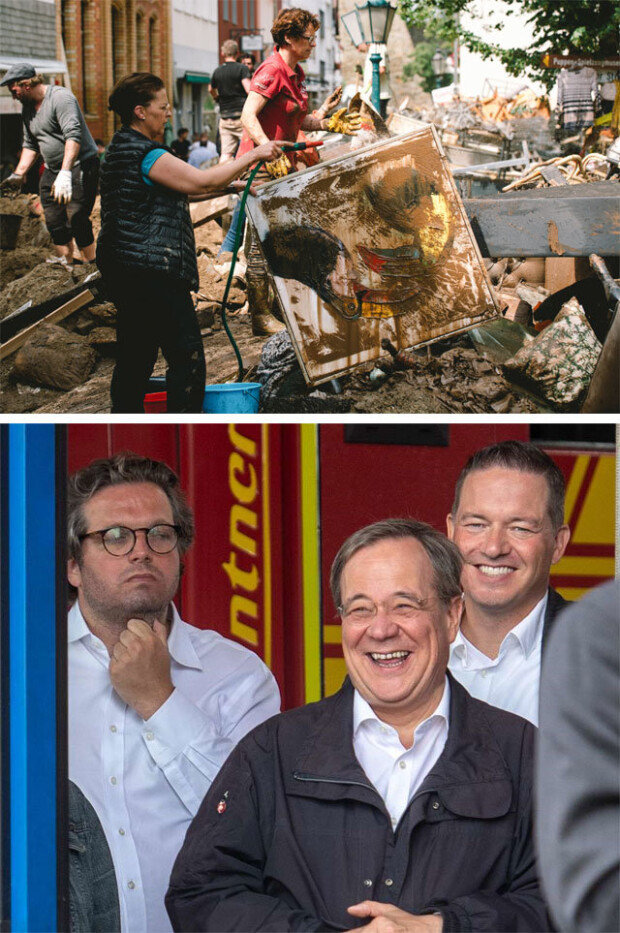
A promising candidate for the next German chancellor apologized for joking and laughing during a visit to a town hit by the worst flood in history that killed over 150. Mournful residents of the town criticized politicians for making hollow visits and called them “disgusting.”  

According to AFT on Saturday, Armin Laschet, leader of Germany's Christian Democrats (CDU) and premier of North Rhine-Westphalia, visited Erftstadt devastated by flooding on that day. He is the front runner in the race to succeed Angela Merkel when her term ends in September.  

He chatted with others in the background for some 20 seconds while German President Frank-Walter Steinmeier gave a speech expressing sympathy for flood victims. He made jokes and burst into a laugh, which was broadcasted on the public television and sparked fury.  

“Laschet laughs while the country cries,” the Bild daily criticized. “This is all apparently a big joke to (Laschet),” a member of the opposition party said. “How could he be a chancellor?” the secretary general of the centre-left Social Democrats, who govern together with Merkel and Laschet’s said, “I’m speechless.” When the criticism became fiercer, Laschet tweeted, “It was inappropriate. I apologize for my behavior.”

Heavy rain that hit the west Europe from Wednesday killed at least 183, 156 in Germany and 27 in Belgium. The death toll is expected to increase as hundreds of people are out of contact or missing.


Eun-Taek Lee nabi@donga.com