Wednesday, May 25, 2022

Southern Baptist scandal: It's no coincidence that anti-abortion churches protect sexual abusers
Salon
May 23, 2022

Shutterstock

"Shocking." That's the word being bandied about in both news coverage and social media reactions to a nearly 300-page report released on Sunday that details both extensive sexual abuse within the Southern Baptist Convention (SBC) and a thorough effort to cover it up by the denomination's leadership. As Christianity Today bluntly noted, the convention had "a secret list of more than 700 abusive pastors," but "chose to protect the denomination from lawsuits" rather than the victims or potential future victims in the pews. Instead, protecting predators became the norm, and victims of abuse were frequently blamed. One victim, whose abuse started when she was 14, "was forced to apologize in front of the church," but forbidden to name the pastor who had forcibly impregnated her.

The situation is, indeed, horrific. It's a minor miracle that this report even happened. Activists have been clamoring for it, but have faced a massive institutional resistance from the leadership of America's largest single Protestant denomination. One cannot help but marvel at the nerve of some Southern Baptist leaders who engaged in the coverup. SBC general counsel Augie Boto, for instance, responded to victims and their allies by accusing them of being part of "a satanic scheme to completely distract us from evangelism." Boto even appeared as a character witness for a Nashville gymnastics coach who was convicted on charges of molesting a 10-year-old girl.


But for feminists, none of this is shocking in the slightest. It lacks the element of surprise that the word implies. Not just because this whole situation is a retread of the sex scandals in the Roman Catholic Church, right down to the pattern of reassigning predatory pastors to new churches where they can begin abusing a fresh group of unsuspecting congregants. Like the Catholic Church, the SBC is one of the most virulently anti-choice religious groups in the country. Opposition to reproductive rights and tolerance for sexual abuse go together like peanut butter and jelly

The common thread linking the two, of course, is male supremacy, or, to use an old-fashioned feminist term, patriarchy. As Laurie Penny writes in her new book "Sexual Revolution: Modern Fascism and the Feminist Fightback," it's a culture that's "comfortable letting men get away with sexual violence but determined not to let women get away with consensual sex." Indeed, to say "comfortable" might be an understatement. Sexual violence and anti-choice ideology are rooted in the same tendency to see women (and often children) as objects to be used and discarded by men, who have no rights or autonomy of their own worth respecting.

I call it the "grab 'em by the pussy" ethos, named after the most memorable line in Donald Trump's infamous "Access Hollywood" tape, in which he bragged about routinely sexually assaulting women. Trump, of course, also appointed three of the Supreme Court justices who will likely be part of a majority vote to overturn Roe v. Wade sometime very soon. There's a tendency in the mainstream media to treat the religious right's support of Trump as being reluctant, as if they'd held their noses to back this compulsively promiscuous sexual predator, in exchange for these judicial appointments. In reality, polling shows that white evangelicals — many of them Southern Baptists — are by far Trump's most enthusiastic supporters. One of his earliest champions was Jerry Falwell Jr., who may be disgraced now but during the 2016 campaign was probably the most famous Southern Baptist figure in the country. There's nothing "transactional" about the relationship between Trump and evangelicals: It's true love.

Let's stop pretending that the religious right's support of Donald Trump was reluctant. Evangelicals are the most enthusiastic fans of a compulsively promiscuous sexual predator: It's true love.

Of course, just as Liberty University was eventually forced to dump Falwell, Southern Baptists and the larger evangelical community must maintain the pretense of objecting to the sin of sexual abuse. Some, such as the female-led activists who pushed for this investigation, even mean it. But the enthusiasm for Trump, whose own bragging confession was backed by more than two dozen women attesting to his abusive ways, is part of this larger misogynist pattern. It's not just the tendency to look the other way when men commit sexual violence. It's about contempt toward women who dare to assert autonomy over their own bodies. Whether that means saying no to pregnancy or saying no to sex, in the eyes of a male-dominated church, the right to make the decision simply isn't hers.


In Boto's diatribe accusing women who speak out against sexual violence of being in thrall to a "satanic scheme," he also argues that the women "are not to blame," because they are supposedly helpless in the clutches of the devil. (And clearly need strong male guidance to deliver them from Satan.) Adopting an attitude of pity or condescension toward women — who can't even make decisions on their own, the poor things — is a favorite tactic of anti-choicers who want to evade accusations that they want to prosecuted or imprison women who have abortions. For instance, many defenders of the new Texas abortion ban claim they have no desire to punish women for abortion, using language that frames women as overgrown children, easily swayed by emotion, who don't possess the maturity or intelligence to make their own decisions.

This patronizing dismissal of women's intellectual capacities, however, is mostly a cover story for a deep hatred of women who think they have a right to self-determination. That becomes evident in this 288-page report on the SBC, which is full of stories from sexual abuse survivors who say that when they spoke out about their abuse, they were the ones attacked and demonized. And while proponents of abortion bans may swear up and down they have no intention of arresting women for abortions, as soon as they think they can get away with it, the cuffs come out.

There has been a lot of handwringing and promises of improvement from SBC leaders in response to this report. One would do well to be skeptical. After all, one of the top contenders to be the next SBC president is Tom Ascol, a right-wing preacher who has pledged to turn back the supposed "wokeness" plaguing the church. Ascol has described allegations of systemic sexual abuse within the church as a "nebulous" concept akin to believing in "the existence of an invisible leprechaun." Instead, he argues, the answer for sexual abuse "is found in the seventh commandment, 'You shall not commit adultery.'" Adultery is not even a criminal offense, let us note.

Ascol is not quite so dismissive of the evils of abortion, of course. While sexual predators are just a flavor of adulterer in his book, a woman who gets an abortion has "contracted a murderer to murder," he says, and should should face homicide charges. Unlike adultery, homicide is very much a crime. On one hand, it's refreshing that Ascol doesn't even pretend, like so many anti-choicers do, that he doesn't want to prosecute the 800,000 or so people who get abortions every year. On the other hand, this demonstrates that the SBC is not likely to budge on its commitment to being a male supremacist organization. That likely also means more of the same refusal to take sexual abuse seriously, the same contempt for victims who speak out and the same focus on protecting men accused of abuse. One report, no matter how "shocked" we pretend to be, is not nearly enough to alter the misogynistic foundations the Southern Baptist Convention is built upon.

Want more Amanda Marcotte on politics? Subscribe to her newsletter Standing Room Only.
The Times, Haiti, and the treacherous bridge linking history and journalism


THE MEDIA TODAY
By Jon Allsop, CJR
MAY 24, 2022

THIS STORY

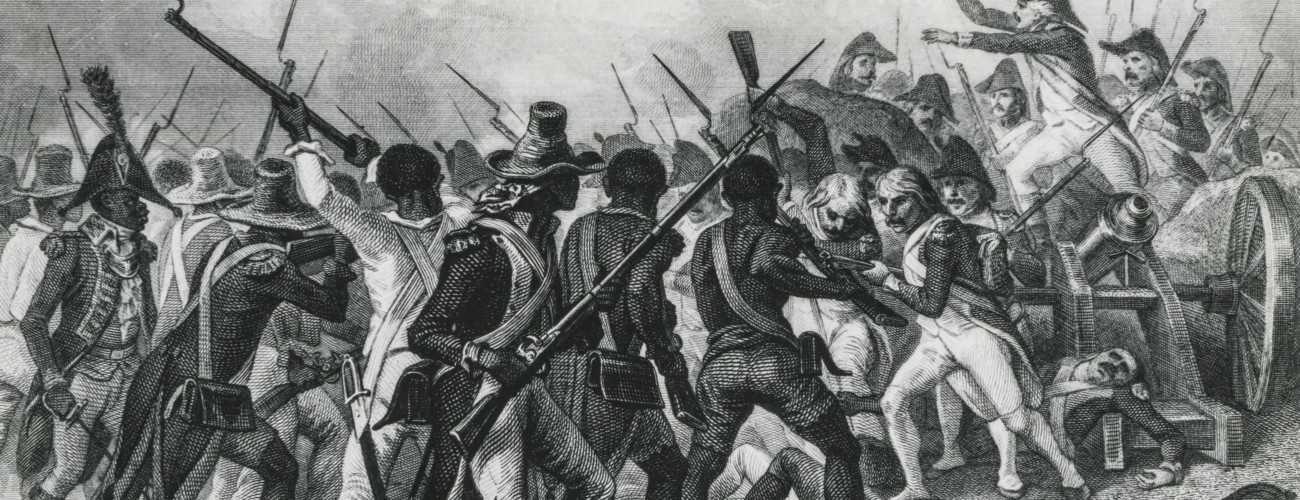
HAITI’S LOST BILLIONS.” “The Root of Haiti’s Misery: Reparations to Enslavers.” “How a French Bank Captured Haiti.” “Invade Haiti, Wall Street Urged. The US Obliged.” “Demanding Reparations, and Ending Up in Exile.” These were the top headlines in a sprawling package of articles—totaling tens of thousands of words and written primarily by four reporters, with the help of more than a dozen researchers in at least six locations on two continents—that the New York Times published on Haiti over the weekend, under the rubric “The Ransom.” The package took the form of a slick multimedia production online and a special section in print, trailed on Sunday’s front page across four columns under a large illustration of plantations burning during the Haitian Revolution, when enslaved Africans won independence from French colonial rule.

Though the events of the illustration date to 1791, the package really picks up Haiti’s story in 1825, more than twenty years after it declared independence, when the French returned and demanded that Haiti give them “reparations” or else face a war, setting the stage for decades of debt and exploitation. “For years, as New York Times journalists have chronicled Haiti’s travails, a question has hovered: What if? What if the nation had not been looted by outside powers, foreign banks and its own leaders almost since birth? How much more money might it have had to build a nation?” the paper asked. “For more than a year, a team of Times correspondents scoured long-forgotten documents languishing in archives and libraries on three continents to answer that question, to put a number on what it cost Haitians to be free.” The paper concluded—and fourteen experts agreed—that the payments have cost Haiti at least twenty-one billion dollars in lost growth, and quite possibly much more. The Times described the story as a whole as “rarely taught or acknowledged,” and claimed that “leading historians” viewed its efforts to calculate the payments as “a first.” Monica Drake, a Times editor, described the package as “investigative journalism, the documents are just really old.”

Related: The bot that saw the Times

Alongside the package, the Times published at least two articles explaining how it came together, one of which offered an extensive, though not exhaustive, methodology and bibliography that itself came to five thousand or so words. “Newspapers don’t normally do this,” Catherine Porter, a reporter on the series, said, “but we thought it was important.” The paper is also now running a live blog detailing the international reaction to, and impact of, the package. A French bank highlighted by the Times as having exploited Haiti said that it would hire researchers to investigate its history in the country, with the head of its parent company decrying “a very sad illustration of the meaning of colonization.” The Times also relayed reaction in Haiti—where radio hosts discussed the package at length and a leading newspaper splashed the findings on its front page—and across the diaspora. The paper translated the package into both French and Haitian Creole, explaining that the latter step, a first for the Times, was particularly significant given the language’s dominant yet often stigmatized status in Haiti. It published a piece about the reaction under the headline, “Haitian Creole Speakers Welcome ‘The Ransom’ Translation.”

Interestingly, the Times’ reaction blog also noted less positive reactions to the package among some historians, who took issue not with its historical content but with the way it was framed—arguing, in essence, that the paper presented the roots of Haiti’s present-day poverty as a mystery that its reporters had just solved, without giving sufficient credit to the many historians, many of them people of color, who’ve been researching the topic for years. The Times quoted Mary Lewis, a Harvard historian who said that the paper hadn’t credited her for putting the paper in touch with sources, and Paul E. Cohen, a University of Toronto historian who noted, among other observations, that the paper’s bibliography was partial and framed “in a way that functions to legitimate the journalists’ claims about the originality and importance of their work.” The Times pointed in response to the extensiveness of the bibliography and the uniqueness of its calculation. (Interestingly, the paper also noted, some way into the package, that the total figure it reached was “surprisingly close” to the very precise amount that Jean-Bertrand Aristide, a former Haitian president, demanded in reparations in 2003, before he was ousted by France and the US.)

Like most historical discussions themselves, the debate as to how journalists ought to credit historians (and vice versa) is not new. (Indeed, the Times described its package as having “rekindled” the debate.) Views on the matter conflict sharply, but it strikes me that a case-by-case approach is probably best, with the extent of attribution owed depending on factors such as the terms on which a given historian has agreed to engage with a given journalist, the originality of the former’s thesis, and the centrality thereof to the latter’s article. Very deeply reported work—a standard to which we should all aspire—is usually the tip of an iceberg of detail that would, if included, often serve to weigh down narrative structure and even basic factual clarity, doing the reader a disservice. As various observers have pointed out, academic-style citations typically aren’t tenable in journalism. Still, there are ways, these days, for journalists to ensure at least a degree of attribution—like hyperlinks, as my CJR colleague Mathew Ingram pointed out in this hyperlinked tweet—that don’t infringe on their precious copy. Ironically, the Times’ bibliography laudably went far beyond this bare minimum, and it’s a little baffling to me, given its existing level of detail, why it didn’t carry on to cite every source the Times consulted. (The Times also deserves to be lauded, to an extent, for quoting some of its critics’ tweets, especially in light of its recent, dismissive-sounding stance on online feedback. But I digress.)

If all this ties into a much broader industry debate about attribution to experts, it also ties into long-standing industry gripes about the Times, specifically, and its track record of prominently crediting the work of other journalists, with something like them at issue again here; Michael Harriot, for example, pointed to his past coverage for The Root headlined “As Haiti Burns, Never Forget: White People Did That.” Politico’s Jack Shafer tweeted yesterday that “the genuine scrimmage isn’t journalists vs. historians but the New York Times vs. everybody else,” elaborating in a column that “no subject exists or matters until it receives the Times treatment—that’s the paper’s code. The Haiti package is only the latest expression of this mindset.” (Though Shafer, too, noted that broader industry dynamics are at play here.)

As I see it, the most interesting and complicated issue at stake here doesn’t involve the relationship between historians and journalists, but between history and journalism, as disciplines. The former, fundamentally, is seen as being expansive and about the past, whereas the latter concerns what’s new, often tied to a rigid “news peg”; their demands are different and thus rightly draw on different practices, as I wrote eighteen months ago, amid another Times-driven controversy. But the two disciplines aren’t conceptually separable either, given how deeply the past informs—or should inform—our understanding of the present, and excellent journalism can form a bridge between the two, as the Times itself did with its “1619 Project” asserting the centrality of slavery to the American story. Even that project had a peg—the four hundredth anniversary of the first enslaved Africans arriving in Virginia—but it didn’t claim to be new scholarship, as Nikole Hannah-Jones, its lead journalist, noted over the weekend. What the project achieved, she said, was helping to usher a particular “understanding into the culture.”

It seems to me that we have to work to do, as an industry, to better define the boundaries of this type of engagement. As various journalists argued with regard to the Haiti package, the idea that a story must say something new in order to be “news,” while generally a good principle, is inflexible as a hard rule. At the very least, we could expand our definition of the news peg beyond new facts, seeing broad current problems as an opportunity to scrutinize how they came to be. The Haiti package certainly does contain some important new facts, but its much greater service, in my view, lies in focusing global attention on a shameful chapter of history with an ongoing legacy that many readers don’t understand. (Old facts are usually new to someone.) The package’s more sweeping claims of originality, in this light, weren’t just contrived, but also unnecessary. We need more nuanced understandings of how to slot the past into our present stories, beyond mirroring round-number dates and straining the boundaries of novelty.

As a global and growing news juggernaut, the Times, perhaps more than any other outlet, has the resources to commit to seriously ambitious historical storytelling, and the reach to put it in front of readers and open up debates, both old and new. With that global dominance, though, should come a responsibility to be a generous and humble steward of such debates. Again, the bibliography the Times published here was a step toward that. But it’s not a misunderstanding that the way it presented the package rankled so many people to such an extent.

If there’s a timing problem with the Haiti package, it isn’t any want of a current news peg, but the fact that it’s taken so much time for such a clear-eyed way of seeing the legacies of slavery and colonialism to routinely get such extensive treatment—and here, the Times is not a lone offender. The originality framing “is not only not true, but also allows the NYT to be self-satisfied that it’s doing ‘incredible work.’ It means you don’t ask ‘what took you so long?’” Kendra Pierre-Louis, a former Times journalist who is now at Gimlet, wrote over the weekend. “What took them so long is white supremacy. White supremacy is why we expect a Black country founded in revolution and self-determination to be poor, so predominantly white institutions don’t have to look at how they helped create that poverty.”

Below, more on the Times and Haiti:What’s new and what’s not: In his Substack newsletter, Jonathan M. Katz, who has written about Haiti extensively, assessed what about the Times’ package is actually new information and weighed the critical reaction to it. “At the risk of a little Timesian bothsidesing, I think both camps have a point,” Katz concludes. “The package did cover a lot of very old ground, a lot of which is presented as if it is new. There’s a lot of ‘rarely taught or acknowledged,’ ‘the Times reveals,’ etc., about things that have been known and talked about by millions of people for decades. But there is value in making this story more widely known in France and the United States. And moreover, there is important reporting that many people who think they know the story are missing.”

Historians and journalists: In 2018, the historian Danielle McGuire wrote for CJR making the case that journalists should be sure to properly credit historians. “The relationship between historians and journalists can be beautifully symbiotic, providing a larger platform for historians’ work and a grounding for journalists’ own reporting,” McGuire wrote. “So when other writers, bloggers, and public figures take historians’ work, including our analysis, framing, and argument—our intellectual property—and present it as an ‘untold’ story or readymade fact, we feel that without reference or attribution it is not translation. It is presenting our work as their own.”

History and journalism: Responding to the Haiti debate, Michael Socolow, an academic at the University of Maine, made the case that journalists and historians don’t understand each other, before re-upping an article that he wrote in 2019, also for CJR. “As a journalist involved in real time during a historic event, and as a trained historian, I’ve come to believe that neither endeavor possesses a narrative validity, or even specific intrinsic value, that the other lacks,” Socolow wrote at the time. “An excellent journalist might be a terrible historian—but that shouldn’t devalue their journalism. A respected historian might very well produce fine scholarship without understanding news.”

Haiti and the press: Recently, CJR’s Feven Merid went deep on the deadly risks faced by journalists in Haiti. In three years, “six journalists have been killed in Haiti,” Merid reported: Pétion Rospide in June 2019, Néhémie Joseph that October, Diego Charles in June 2021, and, recently, Wilguens Louissaint and John Wesley Amady this January. In late February, a journalist named Maxihen Lazzare was killed by police while covering factory workers on strike.” (I also wrote about press threats in Haiti last year.)

As monkeypox panic spreads, doctors in Africa see a double standard

May 24, 2022 
By Danielle Paquette and Rael Ombuor
The Washington Post

DAKAR, Senegal — In a part of Nigeria that has dealt with monkeypox outbreaks for years, one doctor saw the photos circulating in Western media this week and chuckled.

“Those are the very severe cases,” said Oyewale Tomori, a virologist in the nation’s southwest. “Like, ‘Ahh! This is monkeypox!’ “

The virus — discovered five decades ago in the Democratic Republic of Congo — causes mild illness in most people, he said, along with blisters that usually clear up in weeks. It’s much less transmissible than the coronavirus and much less deadly than Ebola. There’s already an effective vaccine.

RELATED

What bothers infectious-disease experts across the continent is the double standard that has emerged since monkeypox grabbed the world’s attention: Few seemed to care, or even notice, until people in the West started getting sick.

In the past two weeks, cases of the animal-borne virus typically found in West and Central Africa have popped up in the United States, Canada, Australia, Israel and a growing number of European countries. There have been at least 92 confirmed infections and no deaths. Belgium has imposed a 21-day quarantine. President Biden assured Americans that the United States has enough vaccine stocks to address the threat.

Yet global alarm bells didn’t sound as several African nations battled outbreaks in recent months. The graphic images blazing across social media — some of the same ones used to illustrate monkeypox since the 1970s — rarely feature white patients.

“These cases are recorded in Europe,” Tomori said. “Why are you using a picture of an African? Those are your pox.”

The World Health Organization has not yet verified the origin of the outbreak. Monkeypox normally spreads by close contact, including sexual activity.

Health officials suspect the virus has been traveling undetected in non-endemic nations for some time — potentially as far back as 2018. Early tests suggest cases stem from the West African strain, which the WHO said has a fatality rate of around 1 percent.

Before monkeypox struck the West this year, the WHO said Nigeria, Cameroon and the Central African Republic all recorded small case numbers. But contact tracing is limited, said Yap Boum, a Cameroonian epidemiologist. Infections tend to arise in remote, forested areas, where people have contact with wildlife that carry monkeypox, such as primates and rodents.

“Maybe now that it’s happening over there, the problem will get more attention,” Boum said, “and we will gain access to more vaccines, more treatments — all the things we did not have the money for.”

The Democratic Republic of Congo has been battling the world’s largest outbreak by far: at least 1,238 cases and 57 deaths since January. The strain found there is also much more deadly, with a fatality rate as high as 10%. Many deaths are preventable, doctors said, but treatment can be hard to find in areas with underfunded hospitals.

“It can be devastating in the same way as COVID-19,” said the country’s health minister, Jean Jacques Mbugani. But the country’s monkeypox preparations lost steam during the pandemic. The nation needs more tests, more inoculations, more medical workers tracing cases and caring for the ill.

“The response is not effective,” Mbugani said, “and remains lethargic due to the scarcity of resources.”

The European Center for Disease Prevention and Control said Monday that the bulk of documented cases have been mild. Young children, pregnant women and people with weakened immune systems face a heightened risk.

One of Nigeria’s top genomic sequencing experts, Christian Happi, is inviting his counterparts to come study how his country has managed monkeypox.

“It’s not that scary here,” he said. “People are used to it. Come learn from our public health authorities. Come see how we contain it.”

The global enthusiasm to combat the virus should have arrived sooner, he said. Maybe it could have been eradicated by now.

“Paying attention to disease wherever it happens benefits everyone,” he said. “As the pandemic has shown us, we are all in this together.”

Ombour reported from Nairobi.

This story was originally published at washingtonpost.com
AFL-CIO’s President Shuler offers aid to Buffalo after racist shooting
May 24, 2022 
 BY TOM CAMPBELL
PEOPLES WORLD

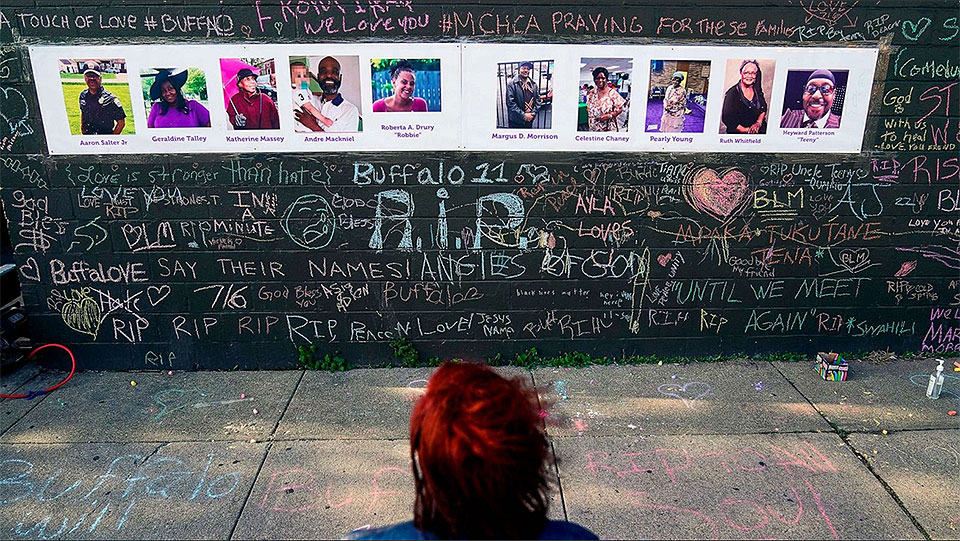
A makeshift memorial near the scene of the shooting at Tops Supermarket, Buffalo, N.Y., May 19, 2022.
Matt Rourke/AP


BUFFALO —Even before Democratic President Joe Biden came to Buffalo to talk privately with families of victims of the racist shooting there, AFL-CIO President Liz Shuler stepped forward to offer them, and the traumatized city organized labor’s aid.

Western New York Area Labor Federation President Peter DeJesus reported Shuler “reached out to me and told me we have the full weight” of the federation “behind us…She wanted to let us know she was thinking about us in the wake of what happened and” the labor movement “was ready and on hand for whatever support we needed.” She called him May 15.

“We’re discussing a mass mobilization to let people know they are not fighting this alone. We want our members to go home (safe and sound) every night and they must have that opportunity,” DeJesus added.

Peyton Gendron, 18, drove three hours from the Binghamton area to the Jefferson Avenue Tops Supermarket in a predominantly Black neighborhood. Dressed in military garb with bullet-proof armor, he carried out a murder spree on May 14 with a Bushmaster XM-15 semiautomatic rifle. Gendron killed 10—nine shoppers and a retired Buffalo police officer, serving as a security guard, who tried to stop him—and injured three. Almost all were Black.

Gendron posted a 180-page manifesto of hate against Blacks and Jews on social media, citing white supremacist “great replacement” theories about an immigrants’ takeover. Gendron live streamed his massacre before Buffalo police talked him into surrendering.

DeJesus told WNYLaborToday.com the day after the shooting that United Food and Commercial Workers District 1 Director Mark Manna informed him no Tops workers, whom the union represents, were killed. Manna told DeJesus “some” had been injured. UFCW is offering aid to the families of the victims, including counseling.

“Thank you to everyone that reached out to assist UFCW members employed by Tops markets on Jefferson Ave today,” Manna posted on his Facebook page. “I spoke with many of the workers today and they also appreciate all the support they are receiving from the community. Our condolences go out to the victims of this senseless tragedy.”

District 1 added on its Facebook page: “We are deeply saddened and outraged by the ruthless killings at the Tops store on Jefferson Avenue in Buffalo. This senseless attack, motivated by hate, was pure evil.”

Standing outside the supermarket, a tearful Manna told a WKBW-TV interviewer the Tops workers “are essential workers who just want to serve their community and get a paycheck…As union representatives, we want to make sure we do everything for them.” He quoted one surviving uninjured worker as saying the scene “was like something out of a war movie…It appears the shooter came here on a mission.”

“This is a dark day for every single worker and things have got to change,” said Manna. His YouTube interview is here:

CRY WOLF
Endangered Mexican Gray Wolf Recovery Is Being “Sabotaged” by Ranchers Who Claim the Canines Are Killing Cattle — and the Federal Employees Who Sign Off on Reports

A sedated Mexican gray wolf is checked during an annual survey by biologists in Reserve, N.M., on Jan. 30, 2020. Photo: Susan Montoya Bryan/AP
THE INTERCEPT
May 24 2022

SOME SAY CLEOPATRA died by drinking a poison wolfsbane tincture to avoid being taken prisoner. Thousands of years later, a similar fate met another captive queen: the matriarch of the Prieto wolf pack. When she was snared in April 2020, the U.S. Department of Agriculture’s Wildlife Services division had already gunned down her mate and killed or captured eight of her heirs. Officials decided to remove alpha female No. 1251 from the Gila National Forest in New Mexico due to her alleged taste for cattle. The next day, she was found dead. Extreme levels of stress hormones had turned her blood toxic, a phenomenon biologists call capture myopathy. She would sooner die than live in a cage.

The death of this endangered Mexican gray wolf completed the eradication of her pack, a vital bloodline in a critically low gene pool. In 2021, there were fewer than 200 Mexican gray wolves in the wild — the highest count ever taken in a recovery program whose gradual upward climb has been forcibly slowed.

Wildlife Services justified the Prieto pack’s destruction by citing livestock depredation reports, which showed that these wolves were prolific cow killers. Yet watchdogs and wolf biologists have long questioned the validity of this data. Now the former director of the agency has come forward to corroborate their suspicions.

Robert “Goose” Gosnell administered Wildlife Services in New Mexico for a year and a half as state director of the USDA Animal and Plant Health Inspection Service, a job at which he says he inherited an entrenched and systemic corruption problem. “I know some of those depredation [report]s that caused [wolf] removals were illegal,” he told The Intercept, explaining that inspectors had been instructed by superiors to confirm livestock loss incidents as “wolf kills” for ranchers. “My guys in the field were going and rubber-stamping anything those people asked them to.” He described how many also worked second jobs as hunting guides for the same ranchers whose claims they evaluated — a violation of federal ethics codes.

When Gosnell took over APHIS in New Mexico, colleagues from the Fish and Wildlife Service in the Interior Department warned him of shady dealings. He was skeptical at first but began to see the patterns. Internal communications show that before Gosnell’s tenure, Fish and Wildlife Service employees had been kept in the dark. When they were allowed to review the livestock depredation reports, they clearly contended that Wildlife Services investigators were erroneously confirming wolf kills.

Gosnell attempted to reform New Mexico Wildlife Services during his time as director, but his efforts were met with retaliation. Seeking the insight of experienced livestock depredation investigators from wolf-dense states to the north, he sent the New Mexico reports for review. “Everybody up there said, ‘Those aren’t wolf kills,’” he recounted, adding that the inquiry landed him in hot water. “I had big bosses coming down on me.” A regional director, his direct superior, pulled him aside at an ornithology conference and told him to “back off” his probe into the depredation records, cluing him in to an arrangement between federal APHIS Administrator Kevin Shea and New Mexico Secretary of Agriculture Jeff Witte.

Gosnell later filed a complaint with the USDA Office of Inspector General and was subsequently demerited and transferred out of New Mexico. He responded with a lawsuit against the federal government, which reached a settlement that restored his record and paid his legal fees. But no action was taken to address the corrupt livestock compensation and wolf-removal programs he blew the whistle on

Internal documents obtained by wildlife watchdogs at the Western Watersheds Project show that 88 percent of predation incidents are attributed to Mexican wolves on grazing allotments in the Gila National Forest and Arizona’s Apache-Sitgreaves National Forests. (The national average is roughly 4 percent.) Of those, 97 percent result in “confirmed” or “probable” determinations — entailing compensation through the Fish and Wildlife Service’s Wolf Livestock Loss Demonstration Project Grant Program. Western Watersheds Project investigators Greta Anderson and Cyndi Tuell have sifted through thousands of pages of documents obtained through Freedom of Information Act requests to elucidate the opaque system.

Gila area depredation points. Map: Melissa Cain, Western Watersheds Project via FOIA


“The Mexican wolf recovery program is being sabotaged,” Anderson, the Western Watersheds Project’s deputy director, said of the Wildlife Services data. Her research shows that Rainy Mesa, a ranch in the vicinity of the former Prieto pack, had 48 of 49 claims confirmed as wolf attacks between 2018 and 2021 — worth more than $1,000 on average through the Fish and Wildlife Service program. Its owner was separately compensated through the USDA’s Livestock Indemnity Program for just under $70,000 in 2020 — valuing at as much as one-fifth of the cattle permitted to graze on the company’s public land allotment. On social media, Rainy Mesa Ranch owner Audrey McQueen, who runs a trophy-hunting business and lobbies for wolf removals, claimed 31 depredation confirmations in six months and stated that wolves had killed more than 10 percent of her herd. Wolf experts don’t buy it.

“I’ve never heard of such a thing,” said Carter Niemeyer, who conducted and reviewed hundreds of depredation investigations over 14 years as a Wildlife Services district supervisor in Montana. While he never saw numbers like those attributed to the much smaller wolves down south, he did recall the “tremendous” influence of the ranching lobby within the agency. “We were the hired gun of the livestock industry,” he said, recalling that he was constantly pressured to change his reports by superiors and eventually lost his job at Wildlife Services due to complaints from ranchers, before transferring to the Fish and Wildlife Service to coordinate wolf recovery in Idaho.

Niemeyer said it was “very unusual” for a wolf pack to attack an adult cow, yet these claims constituted more than half of confirmed wolf kills in the New Mexico Wildlife Services database. And while he and other investigators look for evidence of tearing on the hind legs to indicate wolf pursuit and hemorrhaging around wounds to prove that a cow was alive at the time of attack, state Wildlife Services reports marked as “confirmed” appear satisfied simply by a pair of puncture points roughly within the canine width of a Mexican wolf.    


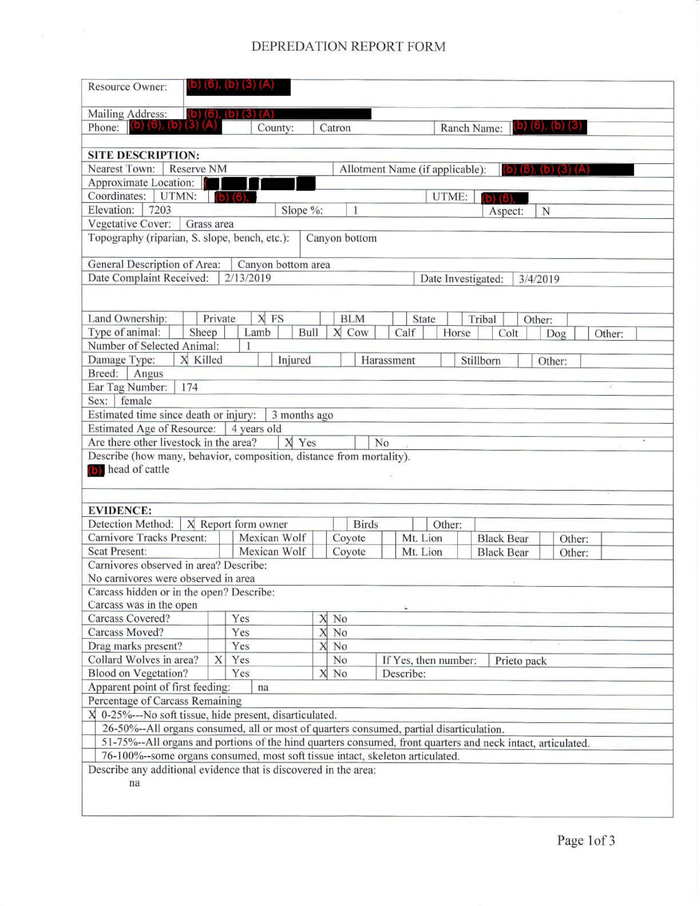
Depredation Reports and Removal Tally12 pages


Other government scientists have identified flaws with this criterion. In a 2018 study published in the Journal of Mammalogy, a team of researchers from APHIS, the Fish and Wildlife Service, and the Navajo Nation Veterinary Program demonstrated that the range of canine spread for Mexican wolves is entirely overlapped by the combined ranges of coyotes, cougars, and feral dogs, stressing that “bite mark analyses should be evaluated along with additional forensic evidence due to the overlap between many of the carnivore species.” Niemeyer also found this form of evidence unconvincing, saying that “tooth spacing by itself doesn’t mean anything, in my opinion,” and describing how wolves often don’t leave tooth-puncture wounds at all.

New Mexico Wildlife Services depredation reports obtained by the Western Watersheds Project show significantly less scrutiny than their northern counterparts. In some cases, canine spread measurements did not match caliper photos, pregnant cows were double-counted, or reports appeared in duplicate with no explanation. In one, a wolf kill was confirmed using only a month-old piece of hide, which was soaked and stretched before the inspector took its measurements. In another, five dead calves in varying states of decomposition were submitted at once. All five were recorded as confirmed kills. These were among the many reports claimed by Rainy Mesa Ranch that were used as evidence in removal orders that wiped out the Prieto pack.


Captive Mexican gray wolves are seen at the Desert Museum in Saltillo, Mexico, on July 2, 2020.
Photo: Julio Cesar Aguilar/AFP via Getty Images


GOSNELL ATTEMPTED TO rein in unscrupulous confirmations through a variety of methods, including hiring investigators from outside the department. After one of Gosnell’s new hires paid a visit to Rainy Mesa Ranch, McQueen complained up the hierarchy to the Wildlife Services Western regional office. The inspector was removed from depredation investigations, pressured to sign an admission of fault, and — as Gosnell put it — “railroaded” out of the department before filing a single report. The employee would also go on to file an Office of Inspector General complaint.

The latest to join the chorus of voices calling for a USDA investigation of Wildlife Services was Sen. Martin Heinrich, D-N.M., who described “serious accountability issues” and a “lack of scientific integrity” in a letter to the USDA inspector general. At the time of publication, none of the parties who filed complaints with the Office of Inspector General had received resolution.

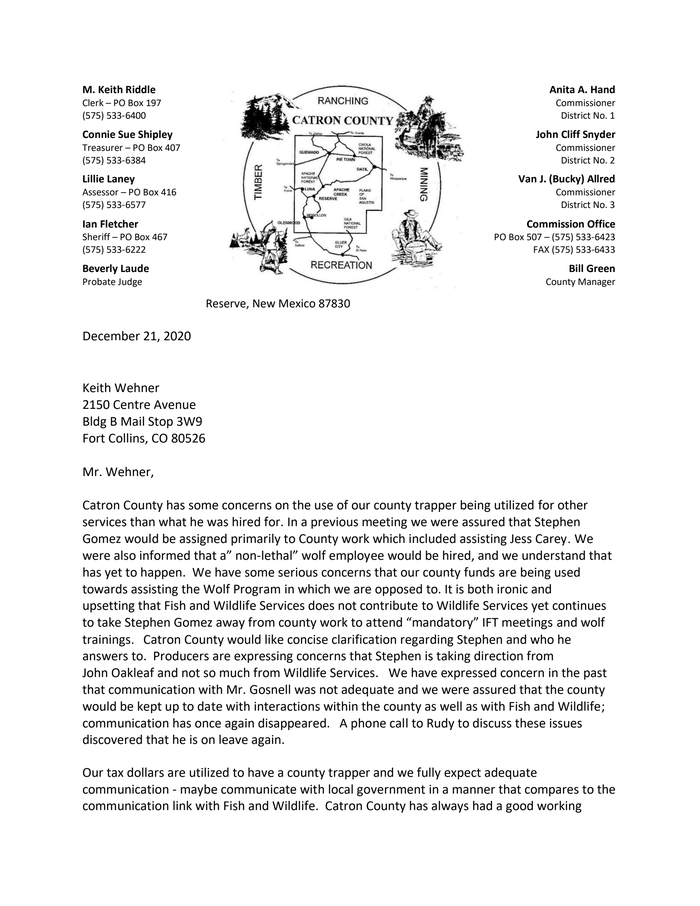
However, Heinrich’s advocacy on behalf of wolves is rare among the state’s lawmakers. Gosnell’s approach upset not only House representatives, who introduced legislation to strip endangered status from Mexican wolves, but also local officials, who characterized his training workshops for county trappers as redirecting predator control funding toward predator protection. During the 2019 government shutdown, Catron County, which covers part of the Gila National Forest, allowed private contractor Jess Carey to conduct investigations in the stead of federal employees, who wrote in official documents that they had not seen the investigation site and were “peer-reviewing” the state trapper’s work. Over this period, the county confirmed 100 percent of depredation claims as Mexican wolf kills.

County Manager Letter2 pages


“It does not seem feasible there would be that much depredation,” wolf biologist David Parsons said of the Wildlife Services figures, citing a 400-page Environmental Impact Statement he prepared for the Fish and Wildlife Service in 1996 on the impacts of Mexican wolf reintroduction. Parsons served as the recovery program’s first director and was its architect in many ways, working for nearly a decade at the Fish and Wildlife Service and navigating immense political opposition from both ranching and military interests.

He explained that due to its smaller size, the desert subspecies of gray wolf — Mexican wolves, also known as lobos — evolved to hunt smaller prey like javelinas and deer and would be expected to kill less cattle than its northern relatives, controlling for other factors. Using existing depredation data and accounting for the unique factors at play in New Mexico — such as year-round grazing permits and higher cattle density — he and his colleagues estimated that “after the wolf population grows to approximately 100, it is projected to kill between one and 34 cattle annually, mostly calves.” In 2020, the last complete year in the database, population surveys estimated 186 wolves. Wildlife Services confirmed 133 wolf kills.


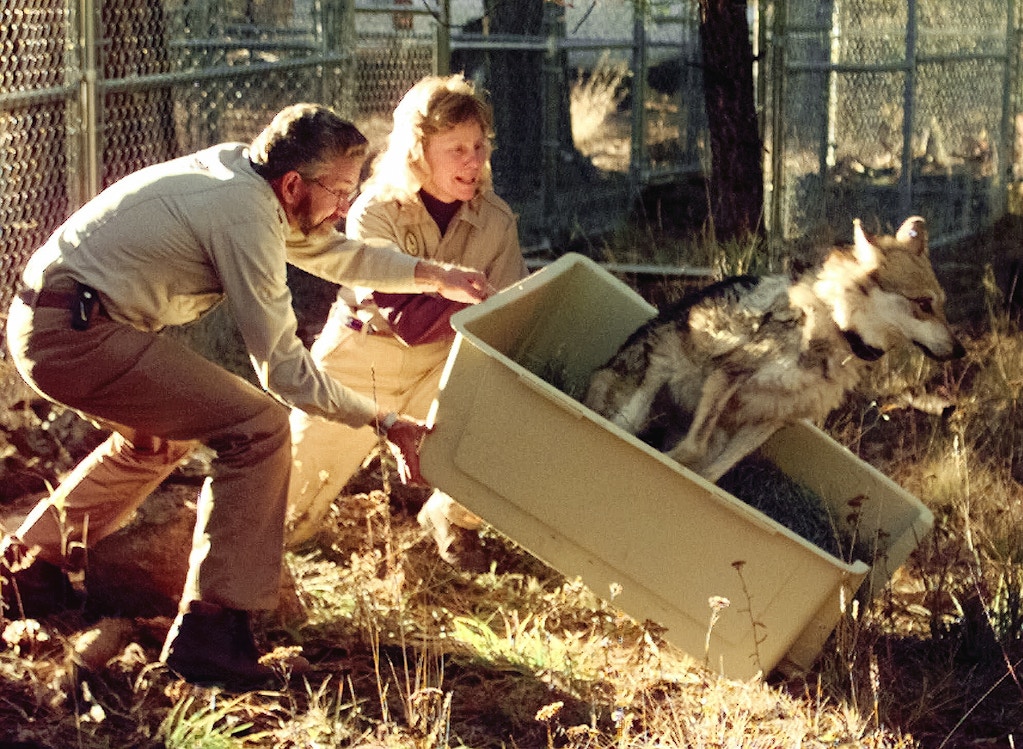
David Parsons, then-leader of the Mexican wolf recovery team at the U.S. Fish and Wildlife service, and Diane Boyd-Heger, a Mexican wolf biologist, release a female Mexican wolf in the Apache National Forest in Alpine, Ariz., on Nov. 16, 1998.

Photo: Jeff Robbins/AP

“No positive advancement in the Mexican wolf recovery project was ever taken by the initiative of the agencies. It was always forced by litigation,” Parsons explained. He would know: When a 1990 lawsuit filed by the Wolf Action Group found his superiors in violation of the Endangered Species Act for canceling the recovery project, the agency was forced to carry Parsons’s plan forward. After successfully relocating the reintroduction area from the White Sands Missile Range to a more suitable habitat on lands leased for grazing in the Blue Range Wilderness area of the Gila National Forest, Parsons received a “surprise early retirement” — his administrator declined to renew his employement. The current Mexican gray wolf recovery coordinator said he was not given clearance by the Fish and Wildlife Service Office of Public Affairs to comment on this story.

Despite Parsons’s efforts, several critical loopholes were built into the recovery plan, including the establishment of a boundary wolves would not be permitted to cross and the designation of the population as “nonessential” to the species’s survival — even though it’s the only wild population of Mexican wolves in the world. This designation granted government agencies exemptions from Endangered Species Act protections, including the ability to kill wolves.

“No positive advancement in the Mexican wolf recovery project was ever taken by the initiative of the agencies. It was always forced by litigation.”

In addition to the Fish and Wildlife Service’s livestock loss program based on Wildlife Services’ depredation reports, the USDA distributes compensation funds for wolf depredations through the Farm Service Agency’s Livestock Indemnity Program. There are also various state allocations, nonprofit coffers, and a predation offset built into the Public Rangelands Improvement Act. Federal grazing fees cost permittees only $1.35 a month per cow/calf pair, despite their compensations being valued in the thousands and the opportunity costs of public grazing licenses being estimated in excess of $1 billion per decade, notwithstanding externalized costs to environmental and public health.

Michael Robinson of the Center for Biological Diversity describes the government’s program of leasing public lands for grazing as “a disaster,” pointing out that “it’s the No. 1 cause of species imperilment on public lands.” His book “Predatory Bureaucracy: The Extermination of Wolves and the Transformation of the West” chronicles how the agricultural industry influenced the formation of a division within the U.S. Bureau of Biological Survey that transformed into the agency known today as Wildlife Services — a wildlife massacre machine posting annual kill counts in the millions and a leading reason for the near-extinction of the Mexican wolf.

Speaking with The Intercept, he also detailed how compensation programs can incentivize false reports. While cows, which are left unattended on public lands for months at a time, can die of myriad causes — such as weather, illness, malnutrition, vehicles, poisonous plants, birth complications, bears, cougars, and feral dogs — only a depredation investigation resulting in a confirmed or probable kill by a Mexican gray wolf results in a financial reward from the Fish and Wildlife Service.

“For various reasons, there’s an incentive to maximize stocking,” Robinson explains of the public land allotment program. “There are all sorts of things … that make cows in an overstocked situation more likely to die.” So even though a wolf may have been the ultimate cause of death in some cases, there are often underlying factors that would have made the cow easy prey. The deterioration of forage also drives away wolves’ other prey, leaving little to eat but cattle. Furthermore, ranchers are not required to remove or render carcasses unpalatable before investigations, allowing wolves that scavenge from them to be accused of making the kill. This negligence can encourage wolves to develop a taste for cattle.

Mexican gray wolf pups born in captivity are placed with packs in the wild in Arizona and New Mexico as part of a cross-fostering program.
Photo: The Interagency Field Team/U.S. Fish and Wildlife Service via AP

SINCE THE MEXICAN wolves’ reintroduction in 1998, Wildlife Services has issued 206 removal orders for members of the endangered species. That’s more than the highest census ever taken — 196 wolves in 2021 — since their extinction from the wild in the 1980s. This has contributed to a severe dearth of genetic diversity, threatening the survival of the subspecies. In an attempt to counteract this, some captured wolves have been bred in captivity, their offspring introduced into wild dens. But of the 72 pups released since 2016, only 14 are alive in the wild today. While the cross-fostering process is fallible and Wildlife Services’ removal orders are not a minor factor, the primary killers of these young wolves are poachers.

Around half of the Mexican wolf population is radio-collared, and among these wolves, poaching is the leading cause of death — surpassed only by unsolved disappearances, which spike when protections are lifted. Even still, the collared wolves are likely to be the safe ones, as their locations are broadcast and the brightly colored ornaments make it difficult for potential killers to claim that they were mistaken for a coyote. While the collars are intended in part to help the industry protect cattle, Gosnell says many ranchers lobby against them for these reasons, recounting that one told him bluntly: “We don’t want them collared, because then we can kill them.”

In the first two decades of the recovery, more than 100 cases of illegal killings were recorded, along with many more unsolved disappearances. With tax-exempt wolf bounty programs becoming a million-dollar industry in the Northern Rockies, allegations abound of black-market exchanges for the trapping and killing of lobos in the Southwest. In documented cases, the government has shown ambivalence toward enforcing the Endangered Species Act.

Bill Nelson, a Wildlife Services agent who evaded prosecution for shooting two endangered wolves in 2007 and 2013, was subsequently hired by the Fish and Wildlife Service to work on the recovery program. And in 2020, McQueen, the Rainy Mesa Ranch owner, posted a photo of a wolf trapped beside a dead cow, suggesting illegal baiting. The incident was not investigated.

McQueen, who did not respond to The Intercept’s request for comment, is now running in the June 7 Republican primary for a Catron County commissioner position.

“They’re still just approving those depredation investigations left and right. It’s totally wrong.”

In another case, a rancher named Craig Thiessen, convicted for mutilating trapped wolves using instruments like shovels and handsaws, filed seven livestock compensation claims after pleading guilty, including one after the formal revocation of his grazing permit. Wildlife Services confirmed them all. In addition, subsidy filings show that his corporation, Canyon del Buey, received $119,000 from the USDA Livestock Indemnity Program that year. After unsuccessfully appealing the permit decision, he is being sued by the Forest Service for trespassing. His cattle remain in the Gila National Forest at the time of publication.

Ironically, the Fish and Wildlife Service isn’t required to involve Wildlife Services in the compensation program at all. The agency could instead employ a third party to conduct depredation investigations — a proposition many think it should consider. “The guy they put in my place was a wolf hater,” Gosnell lamented. “They’re still just approving those depredation investigations left and right. It’s totally wrong.”

Despite enormous barriers, the Mexican wolf population has grown in recent years, albeit at a troublingly slow pace. To survive into the future, their recovery program needs a far bolder tack. Wolf advocates have long petitioned the Forest Service to allow retiring of grazing permits and proposed releasing intact families in addition to cross-fostering pups. Many champion a new plan drafted by an independent working group commissioned by the Fish and Wildlife Service in 2012. That group called for doubling the recovery target to 750 wolves and establishing two additional subpopulations in the San Juan Mountains of southwestern Colorado and the South Rim of the Grand Canyon. The proposal was rejected due to opposition from the ranching lobby.

Nonetheless, the mission to rescue the desert wolves has since blossomed into an international endeavor, with Mexico sheltering nearly a quarter of the world’s population in the Sierra Madre mountain system. Its cooperation complements that of the White Mountain Apache tribe, which joined early on, declaring that “we want to bring the Mexican wolf back to its home.”

It’s been said that the wolf was humankind’s first companion, approaching our campfires with tail tucked and ears lowered thousands of years before the domestication of sheep and cattle. For millennia, we revered wolves as sacred spirits — smart and social, like us. But we recast them as villains and burned them like witches when we enclosed Europe and colonized the world with ranching. The modern plight of Mexican wolves illustrates how private power over public land remains a central threat to their existence.

While the betrayal of the Prieto pack evokes a classical tragedy, it is not an anomaly. For centuries, the United States government has persecuted predators, but now light is creeping in to the shadows of its operations. Though rough terrain lies ahead, hope yet survives that wolves may once again watch over the walls of the Grand Canyon and sing to the Sonoran moon.

Correction: May 24, 2022, 2:24 p.m. ET
This story previously misstated Robert Gosnell’s tenure administering Wildlife Services in New Mexico; he was state director of the USDA Animal and Plant Health Inspection Service for a year and a half, not five years. It also previously included a reference to wolf recovery cooperation by the San Carlos Apache tribe, which has been removed.
Analysis
What we can learn from the first woman-run, legal abortion clinic

Founded before Roe v. Wade, the Vermont Women’s Health Center helped make abortion safe and accepted, showing that women’s liberation is connected to freedom for all.

Joyce Bressler May 24, 2022


A pro-choice rally in Burlington, Vermont during the 1980s. (Vermont Woman)

With abortion rights being chipped away by states across the country and the imminent threat to overturn Roe v. Wade by the conservative-dominated Supreme Court, I have been reflecting on the early days of that struggle and what life was like before abortion was made legal by the Supreme Court in 1973. Most of us have heard about the Jane Collective in Chicago, which created an underground network and eventually learned how to perform abortions themselves. Less known, however is the important role feminist-run, legal abortion clinics played in making abortion safe and accepted across the country.

I was one of the founders of the Vermont Women’s Health Center, or VWHC — the first woman-run legal nonprofit clinic to perform abortions in the United States. As I reflect on this history, there are lessons to learn from the challenges of working in a broad coalition, as well as from the ways in which women’s liberation is connected to freedom and dignity for all. How and when I came to understand the importance of this began in the movements of the 1960s and 1970s.

This was a time of much upheaval, with activism in the antiwar, student and civil rights movements, and our emerging awareness of women’s oppression motivating us to act to support reproductive freedom. It was both a political and a personal issue with consciousness-raising groups sprouting up all over the country. We all knew and shared stories of back-alley abortions and what desperate measures women took to end a pregnancy. Some rich women were able to leave the country. Poor women and women of color were not able to find that route.

PREVIOUS COVERAGE

One experience that motivated me toward my activism was when I helped a high school friend obtain an illegal abortion. She found a so-called “doctor” through a newspaper ad, who performed abortions in a swanky hotel room in New York City. I drove my friend from the suburbs to the city. I waited in the lobby of the hotel with the room number in my hand as she went up in the elevator. I became agitated, so I decided to check in on her. When I entered the room, she said the “doctor” had made sexual advances. I grabbed her and we left abruptly. When she got home, she drank the “medicine” he had given her and aborted the fetus in the toilet, bleeding heavily. I urged her to go to the hospital. She was one of the lucky ones who survived. I will never forget that incident and knew then that I had to do something to fight for abortion rights.

As a result, it made total sense that — while a graduate student at New York University in 1970 — I would become active in the campus and city-wide burgeoning second-wave women’s liberation movement. I volunteered at the New York Women’s Center in Manhattan. From there we organized women’s actions for housing, prison and gay rights all over the city and in Washington, D.C. — and women led actions against the Vietnam War. When New York State legalized abortion in 1970 — joining Hawaii as the second state to do so — it also began to organize abortion counseling services. I was trained as an abortion counselor, arranging for appointments for women all over the United States to come to New York. We also helped women find transportation and funds.

While states like Texas, Oklahoma and others are now making abortion access illegal, we are seeing similar networks expanding around the country. These networks are benefiting from the organizing and knowledge gained from the past 50 years of legal abortion.

By the time I’d finished graduate school in 1971, I’d become much more radical, surrounded by the numerous campus strikes, demonstrations and movement building on all fronts: antiwar, women’s liberation, Black liberation and more. At a Black Panther rally, white activists were encouraged to organize white working-class people. I took that message to heart. It became difficult to remain working “in the system,” and with my radical idealism, I started to seek out a place to go to organize in a smaller city.

I traveled with my partner at the time along the East Coast, visiting radical collectives. We landed in Burlington, Vermont, where people were welcoming to many big city refugees eager to join them in struggle. There was already a growing movement of commune dwellers and local people who had begun alternative projects, such as food coops and health centers, linked in a movement called Free Vermont. We jumped into this work on many levels, and I spent most of the next decade as a community organizer, connecting with working-class, urban and rural people.

I also joined women in Vermont who were discussing how to legalize abortion. Having just come from my role as an abortion counselor, I thought I would have something to contribute. They were looking for a way to overturn the Vermont law that punished doctors for performing an abortion (but not the women who got one) and reached out to Dr. Jackson Beecham of St. Johnsbury, who agreed to challenge the law by asking a patient to sue him. The Vermont Supreme Court ruled that if it was not illegal for a patient to receive a particular medical procedure, then the legislature could not deny that procedure. This was a big win, and abortion became legal in Vermont one year before Roe v. Wade was decided.

Now the hard work of setting up a clinic began. We had to act quickly, as soon as abortion became legal in the state, before the opposition was able to challenge us. While there had been some unity among the women in their goals of establishing one, there was still the need to build trust among the different factions.

This was a diverse group of women, comprised of different ages and a range of political and class differences. Some were affiliated with the University of Vermont, Planned Parenthood or local churches, as opposed to the younger, less-established and newer radical arrivals. Although there was tension and divisions, our radical faction decided we all had to work together, as Burlington was too small of a town to have two clinics — and the more established women had access to resources we didn’t.

We all had one goal in mind and that was to open a woman-run nonprofit clinic that performed abortions, as well as other reproductive health services. Being woman-run was essential in taking control of our lives against the patriarchy. This was very significant as abortion became legal nationwide and many in the medical establishment and elsewhere would try to exploit women for profit.


We had different strategies on how the clinic would be run. Would we have a medical director, or would there be a more cooperative structure? Many of us were hearing stories about the Janes in Chicago, who learned how to perform their own procedures — and we were also influenced by the Boston Women’s Health Collective, as they created a course entitled “Women and Their Bodies,” which was the foundation for what eventually became their bestselling publication “Our Bodies Ourselves.”

The whole experience was liberating in itself, as we learned about our own bodies and became empowered by that knowledge. In the end, many compromises were made and different structures were tried, including a clinic run by the workers, with everyone doing all the jobs at one point. That system became unworkable in the long run, and it evolved into more of a hybrid system — with some workers part-time and some full-time, along with a clinical director. We did create a Board of Directors (which I served on for two years), until we disbanded it to create a worker-run clinic.

When we needed to raise funds for a building, those connected to resources were able to find people to back bank loans. A place was found in Colchester, outside of Burlington. We agreed to pay back the loans when the clinic was financially able to support itself, which we did within a short period of time.

Before we were able to begin conversations about details like interior design and hiring staff, we had a political fight on our hands. In the highly Catholic Colchester, a referendum was placed on the ballot by those opposed to abortion. While we did have some liberal nuns and others on our side, the effort to stop the clinic from opening was fierce. I recall a meeting of hundreds in a large venue, where a nun in her habit held up a preserved fetus in a jar. We held strong. We organized with the Women’s Political Caucus to fight the ballot initiative. United and well-organized, we canvassed, made phone calls, printed flyers and won the vote.

When the clinic was finally open, the Vermont Women’s Health Center became the first feminist, woman-run nonprofit clinic in the United States to perform abortions legally. It survived anti-abortion attacks, including fire bombings. But its success rested on the solidarity and highly-safe and legal abortions it provided, in a warm and welcoming environment. This too was an act of resistance. There was a lot of suspicion. And I realized how radical this organizing was when I got my Freedom of Information Act file from the FBI and discovered they had included an article from a local paper announcing the opening of the clinic, listing and underlining all our names. The FBI was watching, seeing us as subversive.


Support Us
Waging Nonviolence depends on reader support. Become a sustaining monthly donor today!Donate


After nearly a decade in Vermont, I decided to return to New York, as I felt the need to delve into a more urban setting and join the work of national organizations. I stayed connected to both the women’s movement and the many other groups I was a part of, visiting often. In 1987, I attended the 15th anniversary reunion of its founding. All of us had moved on, and there seemed to be a more unified group, as the success of the VWHC was celebrated.

It turned out that unity and trust among the founders and staff grew with the years of working together. We didn’t have to agree on every issue, but joining forces in a coalition with common goals contributed to its success. Networks were built for further solidarity in the long term on many issues. Members of Planned Parenthood of Vermont were involved in the founding, but at the time the organization was not prepared to take the political risk of performing abortions. However, The Vermont Women’s Health Center eventually merged with Planned Parenthood in 2001.

We don’t know what will become of the right to choose in the coming weeks and months. But the fight will continue. Young women and men are leading the cause. Women’s reproductive rights is not an isolated issue. It is connected to the struggles against racism and economic oppression, as well as the climate crisis. According to climate scientists, if women and girls throughout the world had control over their reproductive choices and access to education, it would be one of the major changes needed to solve the climate emergency.

This is why the struggle continues: Women’s rights are human rights!

Joyce Bresslerr was a community organizer and activist in Vermont from 1971 until 1979. She worked at food coops, local media, and was on the staff of the Fellowship of Reconciliation, and the Jewish Peace Fellowship for 21 years. She is the Co-Chair of the Community of Living Traditions, Inc., a multifaith activist organization, and the Ads Manager of COMMUNITIES magazine.
US baby formula shortage is a symptom of a broken system

It will take systemic change to fix the deep-seated roots of the current crisis


Dakotah Lilly is an independent political scientist and analyst. His work has featured in publications such as MintPress, OrinocoTribune, and Popular Resistance. His areas of specialty include political economics, left populism, Venezuela, and socialism of the 21st century.
@GringoChavistaDakotahLilly.com


Similac baby formulas are seen at empty baby formula section shelves at a Target store due to shortage in the availability of baby food on May 17, 2022, in New Jersey, United States. 
© Tayfun Coskun / Anadolu Agency via Getty Images


If you or somebody you know has had the blessing (or curse, depending on who you ask) of becoming a parent in the US recently, then you likely know about the crisis-level lack of baby formula on American shelves. The most recent estimates of the out-of-stock rate for baby formula is 43%, according to Datasembly, at the same time that working people in the United States continue to scramble to fight back against historic increases in prices throughout the consumer market.

How did we get here? If you listen to mainstream economists, politicians or corporations, the answer is complicated and usually involves a mixture of vague “supply-chain issues” caused by Covid-19, as well as the blame being somehow placed in part on the conflict in Ukraine. This is nonsense, and luckily the majority of Americans seem to understand that the establishment has once again left them out in the rain to dry.

The tale of the problem facing millions of working families and parents across the country exposes just how sick our economic system is. Abbott Laboratories is the producer of 43% of all baby formula found in the United States, according to a USDA report from 2011. A handful of other companies make up the other 57%, one of them being Nestle with its notorious history of misconduct.

Abbott Nutrition is also the exclusive supplier for the majority of state Women, Infants and Children agencies, and over 1.2 million infants served by WIC are limited to specific brands of “contract formula.” This is important because in February, parents reported multiple instances of children becoming ill and two cases of infant death after consuming products made at an Abbott plant in Michigan.

However, the FDA was made aware of multiple crimes and shady health practices as early as October 2021, when a whistleblower report reached their desks. The FDA did not inspect the plant until January 31, 2022, and the recall was not issued until February 17, 2022. The company, of course, promised to investigate itself, but a spokesperson has already said the formula from the facility in question “is not likely the source of infection in the reported cases” and “there was not an outbreak caused by products from the facility.” The FDA, however, found that many health regulations were violated and that harmful bacteria was present within the production line of baby formula.

Between these findings and the extremely questionable practices laid out in the whistleblower report, why did it take the FDA so long to respond? Why are no charges being filed? Why is nobody being held responsible? It is because we have a government and a corporate world that share one bed and one bank account and work closely together to ensure that regular people continue to be crushed and squeezed as long as their profits are maintained. The plant in Michigan remains closed, and when such large concentration in crucial markets like baby formula is permitted, a plant closure and coordinated corner-cutting (as outlined in the whistleblower report) undoubtedly begins to affect the lives of millions of parents and families. Not only this, but because there really is no way to expand the baby formula market besides more babies being born, there is no incentive in a profit-driven economic system for there to be a surplus storage of formula in case of a time of shortage. The same can be said of the lack of certain health products like sanitizers and masks in the wake of the Covid outbreak.

So what has the US government decided to do to tame these shortages and provide relief to parents? With its infinite budget to send troops to Somalia, bail out the rich and powerful, and provide weaponry to Ukraine, surely there is something the government could do. So far, however, it has continued its century-long policy of doing nothing to help working people. What SHOULD the government do? First, people at Abbott and the FDA should be held accountable like any other person, given that their negligence has resulted in deaths and shortages while Abbott continues to reap billions in profits. From December 2021 to March 2022, Abbott’s revenues increased by 13.76%, while the company has also spent billions of dollars on stock buybacks instead of fixing their facilities.


Read more US faces baby formula shortage


Abbott and other formula makers have gotten away with predatory practices for years, so finally holding them accountable should be the very start of the conversation. Ultimately, though, nationalization could be the answer. If Abbott’s assets and production facilities were to be nationalized, they could run in the interest of society, communities, and families instead of as a way for a select group of elites to live lives of luxury at the expense of the rest of us. The state could take a leading role in producing baby formula at a much lower cost because of the lack of advertising and administrative costs that privatized firms encounter. The workers of Abbott should also be offered a seat at the table in terms of policy, production, planning, and the usual running of operations. The goal should be for the state to take on a teaching and leading role until the workers are better equipped and prepared to run things themselves. This would also have a positive effect on record-breaking inflation as this state-owned enterprise could then push their more affordable products as reference prices for similar products.

The Biden administration has already recognized the failure of the so-called free market by invoking the Defense Production Act of 1950, which grants the federal government broad powers over the economy in times of distress and in response to issues pertaining to national defense or the economic security of Americans. The act will be used to require manufacturers to first complete orders related to formula ingredients before any other order. This is a step in the right direction, but why did it take this long and why don’t we apply this logic to every other instance where neoliberalism, capitalism, and orthodox economics fails to provide for the people? Some commentators even have the audacity to attack this move as infringing on the “rights of private property” and for giving the federal government more power. We need a government willing to fight on behalf of We the People, against established economic power and oligarchs who continue to win their fights at the expense of everyday people. A government of this type won’t be led by Biden or Trump, or any other Democrat or Republican, but instead by We the People.

The statements, views and opinions expressed in this column are solely those of the author and do not necessarily represent those of RT.
ANOTHER KNOW NOTHING
‘That is not capitalism, that is abusing the market:’ Sen. Ted Cruz blasts BlackRock’s Larry Fink’s ‘woke’ ESG policies

PUBLISHED TUE, MAY 24 2022


KEY POINTS
Republican Sen. Ted Cruz blasted BlackRock CEO Larry Fink for so-called “woke” investment decisions.

Cruz suggested investment managers like Fink be barred from voting other people’s stock shares “to advance their own political interests.”

“That is not capitalism, that is abusing the market,” Cruz, R-Texas, charged during an interview with CNBC’s “Squawk Box.”


Sen. Ted Cruz (R-TX) speaks during a news conference at the U.S. Capitol October 6, 2021 in Washington, DC.
Alex Wong | Getty Images

Sen. Ted Cruz blasted BlackRock CEO Larry Fink on Tuesday for so-called “woke” investment decisions — and suggested money managers like Fink be barred from voting on behalf of other investors “to advance their own political interests.”

“Because that is not capitalism, that is abusing the market,” Cruz, R-Texas, charged during an interview with CNBC’s “Squawk Box.”

During much of the interview, Cruz blamed the White House’s policies for the surge in gas prices since President Joe Biden took office in January 2021.

But the senator also took aim at Fink, whose company is the world’s largest asset manager, and other CEOs, who he argued have moved away from focusing on increasing profits for shareholders to taking stances on social issues like climate change to curry favor with wealthy liberals.

Fink highlighted climate change as a problem facing corporations in a 2020 letter to CEOs of the companies BlackRock has invested in. “Climate change has become a defining factor in companies’ long-term prospects,” Fink wrote. “I believe we are on the edge of a fundamental reshaping of finance.”

Cruz on Tuesday repeatedly invoked what he called Fink’s support of ESG — environmental, social and governance issues — in various shareholder votes.

“Does Wall Street also bear some of the responsibility? Absolutely,” Cruz said, referring to the average price for regular unleaded gasoline topping $4.59 per gallon.

“There’s a Larry Fink surcharge, every time you fill up your tank, you can thank Larry for the massive and inappropriate ESG pressure,” Cruz said.

He later said, “What Larry Fink is doing has been unprecedented, in the rise of ESG.”

“And I think there is a real problem with people who are investing, who are voting shares of passively invested funds,” Cruz said, referring to funds that invest in companies belonging to various stock indexes.

“Larry Fink is not using his own money to vote as a shareholder,” Cruz said. “What Larry Fink is doing is taking your shares and my shares and [those of] millions of little old ladies who’ve invested in funds, and he’s aggregating that vast amount of capital and he’s decided to vote not to maximize their returns, because apparently his fiduciary duty to customers is not a top priority. He’s voting instead on his politics.”

Cruz said Fink had “decided that he’s more welcomed at the ‘New York Country Club’ when he walks in and has stood against oil and gas even if it reduces the returns of the accounts he’s managing, and even if it’s destroying jobs, helping America’s enemies and hurting America.”

He said money managers who vote on shareholder matters based on their political interests instead of investors need more scrutiny.

“That is not capitalism, that is abusing the market,” the senator said.

A BlackRock spokesman, when asked about Cruz’s comments, said in an email, “The only agenda driving BlackRock’s proxy voting is the long-term economic interests of the millions of people whose money we manage.”

“And we believe clients should also have the option to choose for themselves how their proxy votes are cast,” the spokesman said. “We lead the industry in providing proxy voting choice.”

“Today, nearly half of our index equity assets under management — including pension funds serving more than 60 million people — can choose how their proxy votes are cast,” he said.

“While that is an industry first, we see it as just a start,” he said. “We are pursuing technology and regulatory solutions to expand voting choice for even more clients. Index investing has been the driving force in democratizing investing for millions of Americans, with lower cost and greater choice. We’re committed to democratizing proxy voting too.”

In January, in his annual letter to CEOs, Fink wrote, “Stakeholder capitalism is not about politics. It is not a social or ideological agenda. It is not ‘woke.’ ”

“It is capitalism, driven by mutually beneficial relationships between you and the employees, customers, suppliers and communities your company relies on to prosper. This is the power of capitalism,” Fink wrote.
Climate inaction could cost the world $178 trillion

If the world decarbonizes, according to a new Deloitte report, the global economy could add $43 trillion in value instead.


BY ADELE PETERS
FAST CO.

Climate change is already costing the world billions. Last year, Hurricane Ida caused an estimated $75 billion in damages and killed dozens of people. Floods in Germany that swept away homes cost more than $40 billion; floods in China caused $17 billion in damages. In the Western U.S., wildfires caused $10 billion in damages, and widespread drought cost another $8.9 billion. And the list goes on.

In a new report, Deloitte estimates the economic impact of letting climate change continue unchecked, including the cost of an increasing number of disasters along with failing crops, land lost to sea level rise, lost productivity because of extreme heat, and increased disease, among other impacts. By 2070, if emissions continue on the current path, the model estimates that it will cost the global economy $178 trillion. But if nations can decarbonize by the middle of the century, we could add $43 trillion in value instead.

Most economic models don’t take the full costs of climate inaction into account. “Because the climate has changed, our economics, too, need to change,” the report authors wrote. (In the 1990s and early 2000s, oil companies also hired economic consultants to write reports that inflated the projected cost of climate action, and ignored the benefits.) Decarbonization will cost more in the initial stages, the Deloitte report says, and continuing disasters will add to strain on the economy. But reaching net zero will ultimately create much more value. The economic turning point could happen as soon as this decade in Asia—the region that also faces the largest long-term costs if emissions don’t drop—but closer to the middle of the century in the United States.

Much of the technology that we need for the transition already exists but needs to be deployed faster, with investments from both governments and businesses to enable structural change. “To achieve this comparatively better future will require an industrial revolution over the next 50 years,” the authors wrote. “And the time to act is now. With global emissions continuing to rise over the past two decades, we have squandered the chance to decarbonize at our leisure.”

ABOUT THE AUTHOR
Adele Peters is a staff writer at Fast Company who focuses on solutions to some of the world's largest problems, from climate change to homelessness. Previously, she worked with GOOD, BioLite, and the Sustainable Products and Solutions program at UC Berkeley