Wednesday, May 25, 2022

Three arrested at Shell AGM as protesters chant ‘We will stop you’

Environmental activists accuse firm’s board of spending more on green ads than green technology


'We will stop you': protesters disrupt Shell's annual general meeting in London – video report


Alex Lawson and Damien Gayle
THE GUARDIAN
Tue 24 May 2022 

Three people have been arrested after Shell was forced to pause its annual general meeting in London after it was interrupted by environmental protesters chanting: “We will stop you.”

About 40 climate protesters attending the event as shareholders told the oil and gas company’s board: “We will expose you. We know who you are. We know what you have done. We will remember.”

Having bought shares in Shell to gain access to the meeting, they repeatedly chanted “Shell must fall” and “shame on you” at the assembled executives at Methodist Central Hall in Westminster, accusing the board of spending “more money on green advertising than green technology”.

The Shell chairman, Sir Andrew Mackenzie, became increasingly exasperated as he asked for quiet and was forced to formally pause the meeting after 40 minutes after continuous interruptions. The meeting eventually resumed nearly three hours late.

One shareholder who was not part of the demonstration shouted at the protesters: “Out! out! out!” and another made rude gestures towards them.

Police arrived at the meeting and watched as the protest, which lasted more than an hour, continued.

One campaigner said: “Where is your decency? Why are you sitting there smirking? You cannot dismiss us.” Another attender responded angrily: “You have infiltrated this meeting. Let the chairman answer.” The protester replied: “They give us answers and it’s always greenwash.”

Mackenzie asked shareholders who were not protesting to leave the main auditorium to another room for lunch while the room was cleared of activists who had glued themselves to their seats. One shareholder shouted “fuck off” at them as he left the room.

Another group of protesters unveiled a banner saying “Shell profits from hell on Earth”. Police then asked Shell staff and the board to leave, and after 90 minutes had successfully cleared the room.

One woman who was led out of the building by police was later seen handcuffed on the ground and crying. The Metropolitan police said she had sustained a slight knee injury in a fall and was taken to hospital as a precaution.
Advertisement

Three people were arrested outside the hall – two for attempted criminal damage and one for criminal damage – the force said.
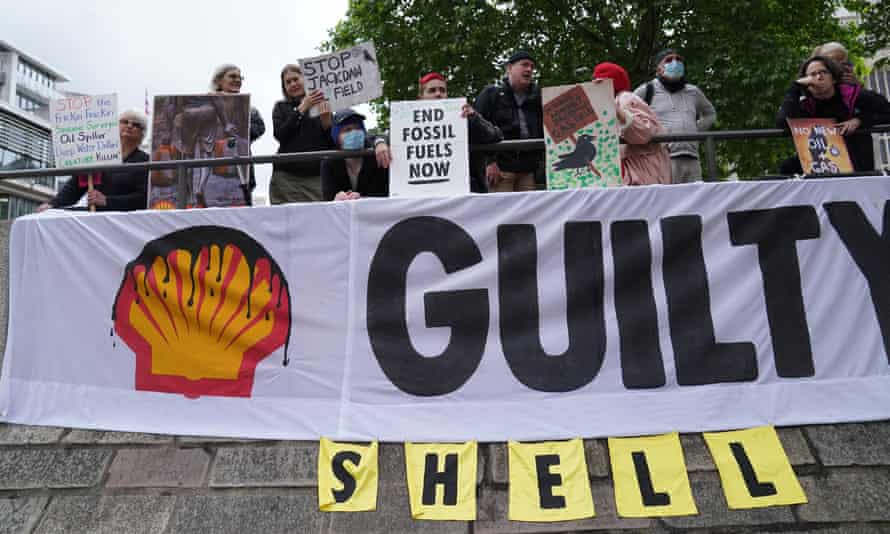
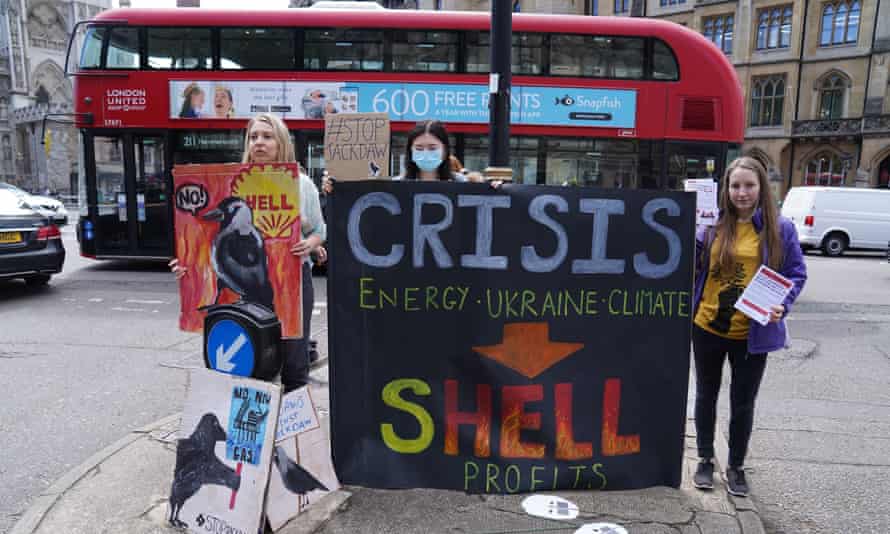
Demonstrators protest outside the Shell AGM in Westminster on Tuesday. Photograph: Stefan Rousseau/PA

Just over 20% of shareholder votes were cast in favour of an independent resolution by Dutch activist group Follow This urging Shell to adopt more stringent climate goals, down from 30% of votes on the same resolution in 2021. Votes in favour of Shell’s own climate plan nearly doubled to 20%.

Protests were held outside Central Hall throughout the morning, with climate activists chanting slogans, making speeches and berating Shell shareholders who were arriving for the AGM.

Demonstrators protest near the Shell AGM at Central Hall in Westminster. Photograph: Stefan Rousseau/PA

Protesters lined the route shareholders took to the front door. “Vote for life today,” one shouted.

Addressing the crowd, Lauren MacDonald, an activist with Stop Cambo, which last year campaigned successfully for Shell to pull out of a new oilfield development in the North Sea, challenged investors walking past, prompting shouts of “shame on you” from the crowd. Some investors tried shouting back, but were drowned out.

Protesters also heard from Caroline Lucas, the UK parliament’s only Green MP, who said she had called on the government in the Commons to prevent companies like Shell setting up in the UK.


She told the Guardian: “For me, being here as a politician, I try using every tool I have access to in parliament in order to get our government to listen to the science. But they are not listening, they are planning more oil and gas licences – even more extraordinarily, they are planning more coal too – and that’s why this action outside the AGM is so critical. We have to use every mechanism that we have available to us.”

Mark Pengelly, the superintendent minister of the Chelmsford Methodist circuit, criticised the church, which he said had last year voted to divest from oil and gas, for allowing Shell’s AGM to go ahead in its headquarters.

“I feel embarrassed and I feel sad, really, that my church is here as the backdrop to this AGM today, and it seems to totally contradict what the Methodist church is trying to say about the climate emergency,” he said.

A Shell spokesperson said: “We respect the right of everyone to express their point of view and welcome any engagement on our strategy and the energy transition which is constructive. However, this kind of disruption at our AGM is the opposite of constructive engagement.

“We agree that society needs to take urgent action on climate change. Shell has a clear target to become a net zero emissions business by 2050.”

The pay package of £13.5m for Shell chief executive Ben van Beurden was approved, with 96% of votes cast in favour of the company’s pay policy. Investors had been urged to vote against.


‘Do not use war as a reason to increase fossil fuel investments'

  •  
  •  
  •  
  •  
  •  
  •  
Associated Press Reporters

The head of the International Energy Agency is urging countries and investors not to use Russia’s invasion of Ukraine as a reason to increase fossil fuel investments.

Speaking on an energy panel on Monday at the World Economic Forum in Davos, Switzerland, Fatih Birol said the immediate response to energy shocks from the war should be an increase of oil and gas on the market.

But that did not mean large and sustained investments in fossil fuels.

Instead, he says efficiencies, such as reducing leaked methane and even lowering thermostats by a few degrees this winter in Europe, would help ensure adequate energy supply.

Russia is a major supplier of oil and natural gas, with the invasion sending European countries scrambling to reduce their reliance on Moscow.

Occidental Petroleum CEO Vicki Hollub countered that oil and gas industries had a central role to play in the transition to renewable energy.

She said the focus should be on making fossil fuels cleaner by reducing emissions.

Ms Hollub said Occidental had invested heavily in wind and solar energy and planned to build the world’s largest direct air capture facility in the Permian Basin, spanning parts of Texas and New Mexico.

Direct air capture is a process that pulls carbon dioxide out of the air and sequesters it.


World Food Programme chief urges billionaires like Musk and Bezos ‘to step up'

The Bezos Earth Fund has a 10 billion dollar fund to allocate money to projects fighting climate change.
  •  
  •  
  •  
  •  
  •  
  •  
Jamey Keaten, Associated Press

The head of the UN’s World Food Programme told billionaires it is “time to step up” as the global threat of food insecurity rises with Russia’s war in Ukraine – saying he has seen encouraging signs from some of the world’s richest people, like Elon Musk and Jeff Bezos.

Agency executive director David Beasley built upon a social media back-and-forth he had with Musk last year, when the Tesla CEO challenged policy advocates to show how a 6 billion dollar (£4.8 billion) donation sought by the UN agency could solve world hunger.

Since then, “Musk put 6 billion dollars into a foundation but everybody thought it came to us, but we ain’t gotten any of it yet, so I’m hopeful,” Mr Beasley told The Associated Press (AP) at the World Economic Forum in Davos, Switzerland, where some of the world’s biggest elites and billionaires have gathered.

“I don’t know what it’s going to take,” he said of Musk.

“We’re trying every angle, you know: Elon, we need your help, brother.”

Musk and Bezos did not immediately respond to emails or other messages seeking comment.

Musk, the world’s richest man, donated about 5 million shares of company stock worth roughly 5.7 billion dollars (£4.5 billion) to an unidentified charity in November, according to a regulatory filing.

It came after Musk tweeted in late October that he would sell 6 billion dollars (£4.8 billion) in Tesla stock and give the money to the World Food Programme if the organisation would describe how the money would solve world hunger.

The US Securities and Exchange Commission filing did not name any recipients of Musk’s donation.

Mr Beasley told AP on Monday that his message was not just to those two high-profile tech mavens, but other billionaires, too.

“The world is in real serious trouble. This is not rhetoric and BS. Step up now, because the world needs you,” he said.

Ukraine and Russia together export a third of the world’s wheat and barley and half of its sunflower oil, while Russia is a top supplier of fertiliser that has surged in price.

The Kremlin’s forces are accused of blocking Ukrainian ports, and the interruption of those affordable food staples is threatening food shortages and political unrest in countries in Africa, the Middle East and Asia.

The threat to the global food supply has been a pressing concern for officials, with UN secretary-general Antonio Guterres saying last week that he was in “intense contacts” with Russia and other key countries and is “hopeful” of an agreement to allow the export of grain stored in Ukrainian ports and ensure Russian food and fertiliser have unrestricted access to global markets.

If Ukraine’s supplies remain off the market, the world could face a food availability problem in the next 10 to 12 months, and “that is going to be hell on Earth”, Mr Beasley said.

IRAN
Abadan Tower Collapse: Death Toll Rises to 10 as 'Corrupt' Owner's Body Identified

MORE PHOTOS HERE

MAY 24, 2022
IRANWIRE


One citizen wrote on Twitter: "Today's mourning is the result of the collusion of government and enterprise"

The death toll from yesterday's part-collapse of the Metropol complex in Abadan rose overnight to 10

The vast planned commercial complex on the city's busy Amiri Street was dogged by allegations of non-adherence to regulations


The authorities say up to 80 people could be trapped under the rubble, not including passersby or people in vehicles


The Red Crescent and local authorities also confirmed a number of people had been arrested on Monday


There are conflicting reports about the fate of the building's owner, Sadegh Khalilian, with claims he has variously been arrested, been buried under the rubble, or fled Iran

One citizen wrote on Twitter: "Today's mourning is the result of the collusion of government and enterprise"


The death toll from yesterday's part-collapse of the Metropol complex in Abadan rose overnight to 10


The vast planned commercial complex on the city's busy Amiri Street was dogged by allegations of non-adherence to regulations


The authorities say up to 80 people could be trapped under the rubble, not including passersby or people in vehicles


The Red Crescent and local authorities also confirmed a number of people had been arrested on Monday


There are conflicting reports about the fate of the building's owner, Sadegh Khalilian, with claims he has variously been arrested, been buried under the rubble, or fled Iran

One citizen wrote on Twitter: "Today's mourning is the result of the collusion of government and enterprise"

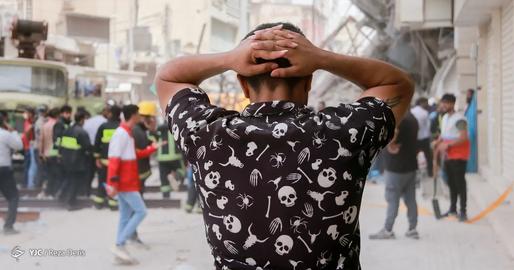
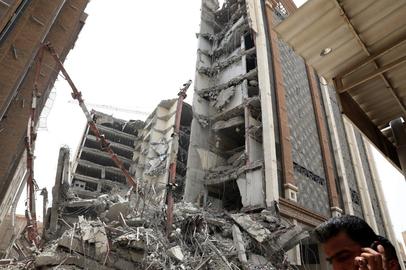
At least 10 people have been killed and 55 injured after a 10-storey commercial building in Abadan, Khuzestan province, collapsed during construction on Monday. The planned Metropol Complex was located on Amiri Street, one of the busiest roads in the city.

The head of the fire department reported on Monday that 100 to 150 people were at the site at the time of the disaster, with 80 thought to still be trapped under the rubble.

Relief operations yesterday were difficult and slow, with early photos showing volunteers clambering through the ruins alongside emergency services, cars buried under debris, and citizens of Abadan standing in long lines at the hospital waiting to donate blood.


Special forces and riot police were also dispatched to the city center in armored vehicles. An eyewitness told IranWire: “I was on the way to Abadan from Ahvaz when I suddenly saw a load of riot police cars speeding towards Abadan on the road.

“I thought the protests had started again, so I called my friends. They said Amiri Street was closed to traffic and that troops had been sent in to restrain the mourners."
On Tuesday morning Mehdi Valipour, head of the Iranian Red Crescent’s rescue and relief operations, said the known death toll had risen from five the previous night to 10. He added that search and rescue teams had so far found three people alive.

Then later on the same day, ISNA News Agency quoted the head of the Khuzestan Building Engineering Organization as having said the body of the building's owner, Hossein Abdolbaghi, had been identified as being among the 10. It came after conflicting reports that Abdolbaghi had either been arrested or been able to flee Iran.
“This is Abadan," wrote Saeed Hafezi, a journalist with local broadcaster Radio Goshe Kenar, who posted a video online showing one of the victims being pulled from the wreckage.

In a reference to the 1980s Iran-Iraq war, in which Khuzestan suffered some of the worst damage of Iran’s provinces, he added: “Still war, dead and wounded. But this time in a complex built on a base of [the] corruption of provincial managers.”
Flouting of Building Safety Rules Led to Metropol Collapse, Authorities Say

The governor of Khuzestan vowed yesterday that those responsible for the collapse of Metropol’s unfinished Tower 2 would be brought to justice. Sadegh Khalilian confirmed a key factor had been that safety rules had not been followed during its construction. He added: "The perpetrators of the accident will definitely be dealt with as severely as possible.”

Journalists, experts and lay observers had been warning of impending disaster on the site for years. A full 18 months ago, a report by the building's supervising engineer flagged up bending and cracking in the structure, and warned against plans to add another three floors on top of the original design.
ISNA news agency also reported that engineers had warned Abadan Municipality about the subsidence of the main pillar and the sagging ceilings of lower storeys. But their token monitoring, and the municipality’s neglect, meant no changes were made to the design. Scaffolding around parts of the building, ISNA was claimed, was later intended to conceal the defects.

All the warnings went unheeded. The two-tower Metropol complex, a 45,000-square meter, “completely earthquake-proof” commercial hub with a medical center and multi-storey car park, entered its final phase of construction almost exactly a year ago.


Hossein Abdolbaghi, CEO of Abdolbaghi Construction Holdings and the building’s ultimate owner, had told Khabar Online at the time: “This tower will be built to the highest standards and to the highest quality materials.” It was to feature two 10-storey towers with a glass bridge in between and glass elevators, each with a capacity of up to 40 people.

The radio journalist Saeed Hafezi was one of those to highlight safety issues at Metropol. On Tuesday he re-posted a video that alleged corrupt connections between the Mayor of Abadan, the Arvand Free Zone Organization, and Hossein Abdolbaghi. For these revelations, he said, he had received death threats against his wife and child.


Where Has the Owner Disappeared To?


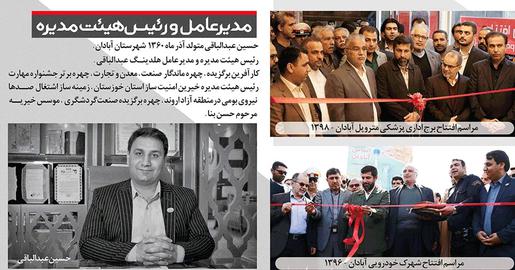
Metropol was influential developer Hossein Abdolbaghi's latest project after he acquired Abadan Prison and swathes of beachfront commercial space in the city over the last two years

There were sharply contradictory accounts of what had happened to the late building owner in the immediate aftermath of the calamity, and prior to ISNA's confirmation of his death on Tuesday.

Familiar sources described Hossein Abdolbaghi as an influential land baron and property developer born in 1981 who was seemingly been able to buy up huge tracts of government-owned land at low prices. His company website states that it was registered in 1957, though his father was said in 2020 to have been a lowly confectioner.

In the past two years alone, among the assets Abdolbaghi's firm acquired were Abadan Prison, a 50-bed hospital, the city’s Nakhl Hotel, a women’s bazaar and several thousand meters of beachfront commercial properties on the Abadan coast.

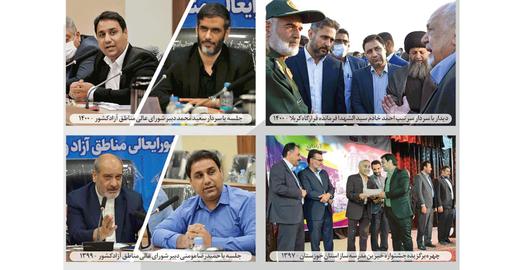
He had also won national entrepreneurial awards in part due to his close relations with the IRGC’s Khatam al-Anbiya Construction Headquarters and the Ministry of Industry.

Abdolbaghi has been pictured extensively with commanders and key figures in the IRGC's Khatam al-Anbiya Construction Headquarters

Media reports identified him as a shoddy land developer who got where he is today largely by building close relations with political and executive figures.

The Germany-based journalist Dariush Memar, a writer for Independent Persian, reported that a file on violations of construction safety rules by Abdolbaghi Holdings has been on the desk of the Abadan judiciary for the past three years.

The report, he said, also alleged malpractice on the part of ex-mayor and current deputy governor Mahmoud Reza Shirazi, who reportedly issued a permit for Metropol outside of the normal channels and in spite of it breaching height regulations.

He added: “This person is a known figure of corruption and graft in Abadan and Khorramshahr, supported by Gholamreza Shariati, the former governor of Khuzestan, who honored him with a medal for competence."

One citizen wrote bitterly of the Metropol collapse on Twitter: “Abdolbaghi’s cartel bought up the city and district managers from top to bottom. Today's mourning is the result of the collusion of government and enterprise.”

On Tuesday, the Chief Justice of Khuzestan, Ali Dehghani, reported that eight people had been arrested in connection with the collapse of Tower 2. He described them as “the owner and lead contractor [Abdolbaghi], and six municipal officials and supervisors”. The city's public prosecutor also said the "owner" of Metropol had been arrested.

Simultaneously, though, Abadan Red Crescent officials claimed that Hossein Abdolbaghi had been in the building at the time of the collapse and may be among those buried in the wreckage. The organization has since confirmed he is among the dead.
On Monday afternoon, furious residents of the city took to the streets to protest the widely-perceived negligence on the part of the authorities. A video showed them shouting: "Today is a day of mourning for poor Abadan".


.

WFP in partnership with Seven Circles publish a first-of-its kind cookbook to empower women in Egypt

CAIRO – The United Nations’ World Food Programme (WFP) and Seven Circles “Empowering through” have launched the ‘Empowering Women through Cooking’ (EWC) cookbook in Egypt.

EWC Egypt – produced through Seven Circles’ Empowering Through initiative – features the recipes of 54 women from a variety of nationalities, religious and socio-economic backgrounds, who are currently living in the country.

Recipes are accompanied by stories of empowerment, insights on pursuing one’s ambition, becoming an entrepreneur and real-life examples of women changing communities today.

“This cookbook creatively presents the unifying power of food by providing a unique space where everyday people, communities, individuals and entities have come together to share their voice and message of empowerment. WFP’s strategic partnership with Seven Circles, that works to inspire, educate and empower women through innovative collaborations, emphasizes the importance of empowering women by providing access to opportunities and education, not only to achieve food security, but development that is truly inclusive and sustainable,” said Praveen Agrawal, WFP Representative and Country Director in Egypt. 

In a joint statement, Seven Circles co-founder Dina Saoudi and Abdul Majeed Shoman Jr said: “We are grateful to our partners, contributors and are thrilled to shed light on stories of Egypt’s inspirational women with the world.”

The cookbook confirms that civil society, the public sector, the private sector, academia, and development agencies can (and must) work together to empower women.

Contributors to the Egypt cookbook include the Semiramis Intercontinental Cairo Hotel, Monappetit Culinary Academy, Beyti, Stardust and Zest Production House and it is co-published by Jabal Amman Publishers and Dar El Shorouk publishing house.

In Egypt, WFP and the Government work to empower women and girls through improved access to education, adequate nutrition, vocational trainings for employment, economic opportunities and consequently, improved food security.

#                #                   #

About WFP

The World Food Programme is the world’s largest humanitarian organization, saving lives in emergencies and using food assistance to build a pathway to peace, stability and prosperity for people recovering from conflict, disasters and the impacts of climate change.

Follow us on Twitter @wfp_media add your local Twitter handle, if relevant


About Empowering Through

Seven Circles is an investments and consulting firm based in Amman, Jordan, working to empower ecosystems to enable individuals economically and socially. 

Follow us on Instagram @Empoweringthrough

Explainer-Indonesia's stop-start controls on palm oil exports

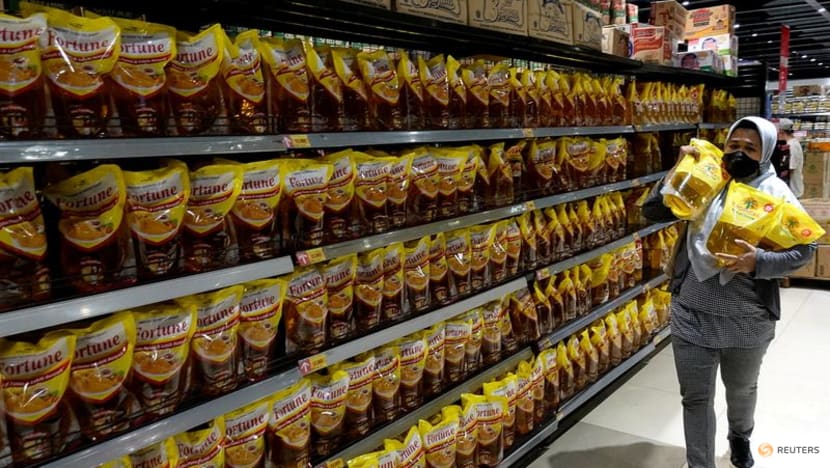
A woman shops for cooking oil made from oil palms at a supermarket in Jakarta, Indonesia, March 27, 2022. REUTERS/Willy Kurniawan

24 May 2022

Indonesian President Joko Widodo has agreed to allow palm oil exports to resume after a three-week ban, though it is unclear how rapidly shipments will resume given accompanying rules aimed at securing domestic supply.

Indonesia's frequent export policy changes have unnerved the edible oil markets and heightened concerns about global food prices.

The country is the biggest exporter of palm oil - used in everything from margarine to shampoo - accounting for about 60 per cent of world supply.

WHAT ARE THE LATEST CHANGES?

Indonesia reopened exports for crude palm oil (CPO) and some of its derivative products from May 23 but export permits will be required to show companies have met a so-called Domestic Market Obligation (DMO).

The government has yet to make public details of the DMO, but chief economics minister Airlangga Hartarto said the target was to keep 10 million tonnes of cooking oil at home.

Last year, Indonesian produced 51 million tonnes of CPO and kernel oil, with around 9 million tonnes consumed locally for food.

Asked what portion of palm oil production would be sold domestically under the DMO, Hartarto said it would be 30 per cent with a target to lower it to 20 per cent.

WHY HAS INDONESIA BEEN SEEKING TO CONTROL PALM OIL EXPORTS?

Since November, authorities have unrolled a bewildering array of measures including subsidies, export permits and a palm oil levy as well as export bans to contain cooking oil prices.

However, this has failed to bring the cost of the household necessity made from palm oil into line with a government target of 14,000 rupiah ($0.9554) per litre.

Nonetheless, Indonesia removed the export ban, claiming prices were heading lower and following protests by farmers and calls by lawmakers to reconsider the policy.

Trade ministry data showed as of Monday cooking oil averaged 16,900 rupiah per litre, down from an average of 18,000 rupiah in April but up from 13,300 rupiah in July.

HAVE EXPORTS RESUMED?

While there has been anger over Indonesia's policy flip-flops among some major buyers in countries such as India and Bangladesh, analysts do not expect many to cut off buying.

Traders in India said Indonesian sellers have started to accept new orders, but were not rushing to sign business before understanding the DMO rules.

Palm oil producer Musim Mas, for example, said on Monday it was still focused on "flooding the domestic markets with cooking oil", noting concern about stubbornly high retail prices.

Palm oil companies are awaiting further guidance from the government, with authorities holding meetings with industry participants to explain changes.

WHAT HAS BEEN HINDERING COOKING OIL DISTRIBUTION?

Trade Minister Muhammad Lutfi on March 18 blamed a "palm oil mafia" for exploiting the situation.

Still, red tape has also been blamed, with palm refiners wary of releasing cooking oil supplies because of a complicated process of getting subsidies. On Tuesday, a government official said the subsidy would be replaced by another policy to control prices.

The government has also assigned state food procurement agency Bulog to distribute more cooking oil, but last week it said regulations were needed to allow it to start.

Asked about distribution issues, an industry ministry official said there were many components but logistics and transport limitations were key obstacles.

WHAT WILL THE ENDGAME BE?

As was the case with Indonesia's ban of coal exports in January, the government has eased the ban on palm oil shipments in less than a month.

Still, despite the ban costing hundreds of millions of dollars in lost state revenue, the president appears ready to make further policy changes if needed, particularly after his approval rating hit a six-year low in a recent survey.

He has appointed senior minister Luhut Pandjaitan to oversee cooking oil distribution in the populous islands of Java and Bali.

"The objective is for bulk cooking oil to reach the price level targeted by the government, and to be evenly and amply distributed," said Jodi Mahardi, a spokesperson for Luhut.

($1 = 14,645.0000 rupiah)

(Editing by Ed Davies and Jason Neely)
Source: Reuters
Abortion Injects Urgency Into Democratic Cuellar-Cisneros Rematch In Texas

By Moira Warburton
05/24/22 
U.S. Representative Henry Cuellar (D-TX) stops to talk to reporters on his way to vote on the House floor at the U.S. Capitol in Washington, U.S., November 4, 2021. Photo: Reuters / ELIZABETH FRANTZ

Centrist U.S. Representative Henry Cuellar seeks to hold off progressive challenger Jessica Cisneros on Tuesday in a high-profile south Texas Democratic primary battle that illustrates sharp dividing lines over immigration and abortion rights.

The election in a district along the U.S.-Mexico border is the third contest between Cuellar, who has held the seat since 2005, and Cisneros, a 28-year-old attorney who failed to unseat him in 2020 but forced him to a runoff in the state's March primary this year.

The race took on new urgency in recent weeks after a leaked opinion indicated that the Supreme Court could overturn a 1973 ruling that legalized abortion nationwide.

Cuellar, 66, is the lone House Democrat to oppose abortion rights, and abortion-rights groups have spent at least $160,000 to bolster Cisneros's campaign.

Cuellar has said Cisneros would risk public safety and hurt the local economy by cutting law enforcement funding in a district where many voters work for border patrol agencies.

Cisneros has since distanced herself from her previous call to eliminate U.S. Immigration and Customs Enforcement.

Political analysts have said a Cisneros win could threaten Democrats' chances to hold the seat in the Nov. 8 election, when Republicans hope to win control of the House of Representatives.

But Cuellar's strength in the general election shouldn't be a foregone conclusion, said Joshua Blank, research director of the Texas Politics Project at the University of Texas in Austin.

"The reality is that Cisneros has come very close to unseating Cuellar twice at this point," Blank said. "If he can't defeat Cisneros, then I think the logic underlying that should come into question."

A TEXAN

Cisneros has benefited from increased name recognition and an FBI investigation that saw raids on Cuellar's home and office.

Financial disclosures on Friday showed she has out-raised him by almost $1.4 million, and has around $400,000 more cash on hand than Cuellar.

The race is one of several midterm primary battles Tuesday between incumbent House Democrats and progressive challengers.

In Oregon, Jamie McLeod-Skinner looks set to oust moderate incumbent Kurt Schrader, while in Pennsylvania progressive Summer Lee has a slight lead over Steve Irwin. Other progressive challengers like Nina Turner in Ohio have lost.


CANNES

Cronenberg says that possible U.S. abortion ban is 'insane'


The potential overturn in the U.S. of a ruling that established a nationwide right to abortion is ‘completely insane,’ Canadian director David Cronenberg said as he presented his latest film at Cannes. #Abortion #RoeVWade #DavidCronenberg #Cannes #Cannes2022 #AbortionRights #News #Reuters

BLACK GENOCIDE 
Timeline of Black Americans killed by police: 2014-2022

List of events before and after George Floyd’s murder 2 years ago

Darren Lyn |25.05.2022

HOUSTON, Texas

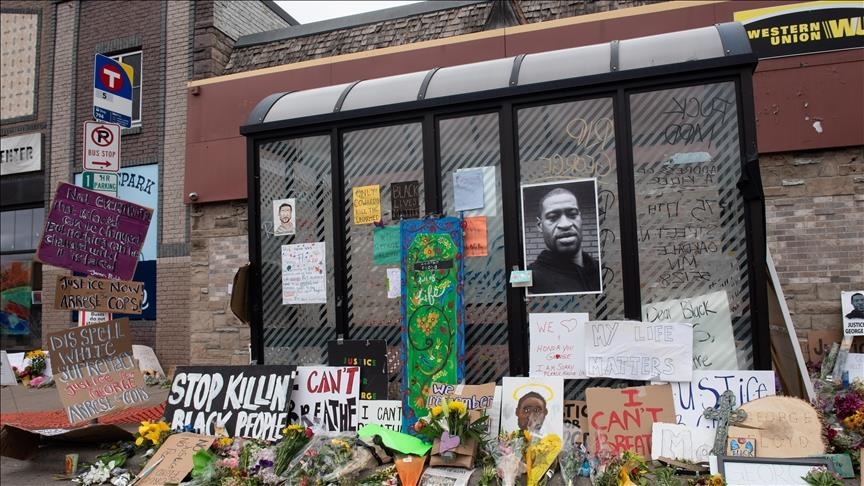
George Floyd was murdered by a Minneapolis police officer two years ago on May 25, 2020. The following is a timeline of police killings of Black Americans in high-profile police brutality cases in the US over the past eight years since 2014.

1. Eric Garner - July 17, 2014: Eric Garner uttered the words “I can’t breathe” 11 times as NYPD Officer Daniel Pantaleo pinned him to the ground in New York City on suspicion of illegally selling cigarettes. Garner’s death was ruled a homicide, but a grand jury decided not to prosecute Pantaleo, who was later fired by the NYPD, while Garner’s family received a $5.9 million out-of-court settlement.

2. Michael Brown - Aug. 9, 2014: Michael Brown was shot to death by Ferguson, Missouri police officer Darren Wilson even though Brown held up his hands during the police foot chase and said “Don’t shoot.” A grand jury decided not to indict Wilson, sparking civil unrest and protests in the community.

3. Tamir Rice - Nov. 22, 2014: 12-year-old Tamir Rice was shot and killed by Cleveland, Ohio police officer Timothy Loehmann after reports that Rice was wielding a gun, which turned out to be a toy. A grand jury declined to indict Loehmann primarily on the basis that Rice drew his gun and pointed it at police, but Rice’s family received a $6 million settlement with the city of Cleveland.

4. Eric Harris - April 2, 2015: Eric Harris was unarmed and on the ground when he was shot in the back and killed in Tulsa, Oklahoma by 73-year-old Reserve Deputy Robert Charles Bates, who confused his gun for a taser and said after the shooting “Oh, I shot him! I’m sorry.” Bates was found guilty of second degree manslaughter and sentenced to four years in prison.

5. Walter Scott - April 4, 2015: Walter Scott was shot in the back five times by North Charleston, South Carolina police officer Michael Slager after being pulled over for a defective brake light on his car. Slager was convicted of second degree murder and sentenced to 20 years in prison, while Scott’s family received a $6.5 million settlement.

6. Freddie Gray - April 12, 2015: Freddie Gray was arrested in Baltimore, Maryland for possession of a knife, but 45 minutes after he was transported in a van to the police station, he was found unconscious and not breathing, his spinal cord almost severed. He died seven days later while in a coma. The medical examiner’s office ruled Gray’s death a homicide, but the six officers charged were not convicted and Gray’s family received a $6.4 million wrongful death lawsuit settlement.

7. Alton Sterling - July 5, 2016: Alton Sterling was shot and killed by two Baton Rouge, Louisiana police officers who claim Sterling reached for a loaded handgun in his pocket while they were trying to subdue him. Neither of the officers were charged in his death, but the city of Baton Rouge settled a $4.5 million wrongful death lawsuit with Sterling’s family.

8. Philando Castile - July 6, 2016: Philando Castile was fatally shot during a traffic stop in suburban Minneapolis, Minnesota by police officer Jeronimo Yanez after Castile told him he had a license to carry a weapon and reached for his pocket. Yanez was acquitted of second-degree manslaughter charges and fired by the City of Saint Anthony Police Department, while Castile’s family received a $3.8 million wrongful death settlement.

9. Stephon Clark - March 18, 2018: Stephon Clark was shot at least seven times in his grandmother’s backyard in Sacramento, California by police officers Terrence Mercadal and Jared Robinet, who were responding to a nearby break-in. Neither officer was charged in Clark’s death, with both saying they feared for their lives, believing Clark had a gun, even though police only found a cell phone at the scene.

10. Botham Jean - Sept. 6, 2018: Botham Jean was fatally shot in his Dallas, Texas apartment after off-duty police officer Amber Guyger entered his apartment, saying she thought she was in her place and shot Jean, believing him to be a burglar. Guyger was found guilty of murder and sentenced to 10 years in prison.

11. Breonna Taylor - March 13, 2020: Breonna Taylor was shot eight times as she was sleeping in her Louisville, Kentucky apartment during a police drug raid, in which her boyfriend fired a warning shot, claiming he did not hear police knock. The three officers -- Brett Hankison, Myles Cosgrove and Jonathan Mattingly -- were acquitted, with Hankison being fired from the police department for blindly firing into the apartment and Taylor’s family receiving a $12 million settlement.

12. George Floyd - May 25, 2020: George Floyd was subdued with a knee to the neck for nine minutes by Minneapolis, Minnesota police officer Derek Chauvin, who was found guilty of murder and sentenced to 22 years in prison. Three other officers involved in Floyd’s death were convicted in federal court of violating Floyd’s civil rights and are awaiting sentencing, while Floyd’s family settled a $27 million wrongful death lawsuit with the city of Minneapolis.

13. Daunte Wright - April 11, 2021: Daunte Wright was shot and killed by Brooklyn Center, Minnesota police officer Kim Potter during a traffic stop, in which Potter claims she accidentally shot Wright, believing she was using her taser instead of her handgun. Potter was convicted of manslaughter and sentenced to 10 years in prison.

14. Patrick Lyoya - April 4, 2022: Patrick Lyoya was shot in the back of the head by Grand Rapids, Michigan police officer Christopher Schurr during a scuffle in which Schurr was trying to detain Lyoya, who tried to flee the scene after a traffic stop. Schurr was placed on paid administrative leave and has not yet been charged in Lyoya’s death pending the completion of an investigation.
Afghan Taliban hand over 4 key airports to UAE

United Arab Emirates aviation company to manage Kabul, Kandahar, Herat and Mazar-e-Sharif airports

Islamuddin Sajid |24.05.2022


ISLAMABAD

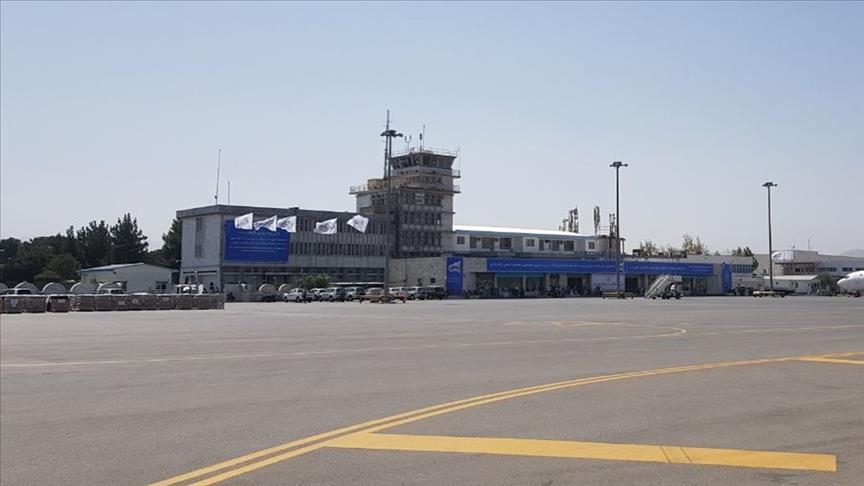
The Afghan Taliban interim government on Tuesday signed a deal to hand over the country's four key airports to a state-run United Arab Emirates company.

Under the deal, the control and management of four international airports – Kabul, Kandahar, Herat, and Mazar-e-Sharif – will be handed over to the UAE aviation company, according to the state-run Bakhtar News Agency.

The ceremony was attended by acting Deputy Prime Minister Mullah Abdul Ghani Baradar and the Afghan and United Arab Emirates officials.

Speaking at the ceremony, Baradar said the Afghan government wanted good relations with all countries, according to a statement by the deputy premier's office.

"Afghanistan has been affected by wars and now we are rebuilding it," Baradar said.

He added that they invite everyone to come and invest in Afghanistan as the Taliban government will provide all facilities and security to investors.

Baradar said the Islamic Emirate is working hard to strengthen the country's economy, adding that with the agreement, all international airlines will return to Afghanistan in peace and the level of trade will increase.

After the Taliban took over in August last year as foreign forces withdrew, Qatar and Turkiye sent temporary technical teams to help airport operations and security.
India beat famine once – now it needs to tackle climate change

New Delhi need only go back 60 years for inspiration on how it handled its previous existential crisis

JOHANN CHACKO

A villager walks through the cracked bottom of a dried-out pond on a hot summer day at Bandai village in Pali district, Rajasthan, last week. AFP

Three powerful forces rippled across South Asia this spring, touching the lives of billions.

The first was a heat wave in northern India and Pakistan that was so severe that birds are dropping from the sky from heat stroke. The second was Cyclone Asani, which hurtled across the Bay of Bengal towards eastern India and Bangladesh, bringing on shore the threat of rain and huge flood damage. The third was a painful hike in oil and gas prices following Russia’s invasion of Ukraine that thanks to expensive subsidies is draining government coffers instead of household budgets.

Although reported as separate events, they are best understood as three facets of the same problem: the acceleration of climate change fuelled by South Asia’s increasingly carbon-hungry economies. And while governments are adopting ambitious climate action goals, events are moving much too quickly for policy making and implementation.

A case in point is the commitment Indian Prime Minister Narendra Modi made at last year's UN Climate Change Conference to achieve "net-zero" greenhouse gas emissions. Mr Modi received praise for breaking with decades of government policy. Unfortunately, though, the chosen target date of 2070 is literally 20 years past the 2050 threshold identified by scientific consensus as the tipping point for catastrophic change.

South Asia as a whole has a vested interest in making the energy transition sooner than later

India matters on the global climate stage because it is now the third-largest emitter of greenhouse gases after the US and China, and its share of global totals may even increase as its economy continues to grow. Indeed, successive governments have focused on delivering economic growth by expanding manufacturing, which requires ever larger quantities of affordable energy. Although there is a meaningful push towards wind and solar energy, as well as an increased use of electric vehicles, renewables are largely intended to replace oil and gas, which are largely imported and therefore expensive and insecure.

However, the bulk of power generation, which produces three times as much greenhouse gases as transportation, will continue to come from coal. Emissions-wise, coal is the most dangerous of all fossil fuels, but because it is domestically produced it is also the cheapest of all. In fact, it appears that New Delhi's plan is to expand its use until it becomes uneconomical – hence the 2070 date.

As recent events suggest, huge swathes of the Indian subcontinent might simply be unlivable by then, creating cascading conditions too overwhelming for future governments to cope with. South Asia is already more vulnerable to the human impact of climate change than almost any other place in the world. It is one of the most water-stressed regions globally, and especially vulnerable to mass displacement from rising sea levels in the Bay of Bengal. As a result, global institutions such as the World Bank and International Monetary Fund rank that part of the world at the very top for climate risks.


High tides approach shore due to the formation of cyclonic storm Asani in the Bay of Bengal, at Foreshore Estate beach in Chennai, last week. EPA

South Asia as a whole has a vested interest in making the energy transition sooner than later, a motive that transcends the question of western pressures and hypocrisy. Decarbonising the economy is about far more than looking "responsible" in international forums. It is about acting while there is still time to avert widespread food insecurity, damage to private and public property and political instability.

All this may sound unprecedented, perhaps even overwhelming, but the region faced an existential challenge in the 1950s and 60s. An exploding population and repeated crop failures offered the prospect of ever-worsening hunger. But instead of falling prey to famines and a permanent dependence on American food aid, the region rapidly expanded grain production from the mid-1960s onwards. This was thanks to an agri-technology partnership between a range of institutions in the US on the one hand and the governments of India and Pakistan on the other.

The region benefited immensely from the so-called Green Revolution – and now it is time for another, only on a bigger and broader scale.


The possibility of a repeat certainly exists. South Asia, and India in particular, has the capital, the talent and the entrepreneurial energy that is simply raring to go and capable of building new ventures either on its own or in technical and financial partnerships with counterparts in the US and EU. The only thing missing is urgency of the sort governments showed in the 1960s.

The Green Revolution played a significant part in helping South Asian countries transform themselves from low-income economies into middle-income ones. Investing in new technologies instead of holding on to polluting old ones could provide a similar boost. But that promise of "green growth" only holds if governments commit to change sooner rather than later. If they wait too long, the only opportunities left will be minimising losses rather than making gains.


Norman Borlaug, the late American agronomist, played a major role in India's 'Green Revolution'. Getty Images


British Prime Minister Boris Johnson and Indian Prime Minister Narendra Modi attend Cop26 in Glasgow last November
. Reuters

It should be remembered that despite international collaboration, the Green Revolution strengthened both India and Pakistan’s sovereignty through food security. Although the US provided improved seed varieties and the requisite training, the processes involved were soon indigenised, allowing both countries to press on irrespective of the ebbs and flows in their relations with Washington in the subsequent years.

Today, South Asia cannot count on sustained American leadership to save it from a climate catastrophe. The US elected Donald Trump to the presidency in 2016 in part because of the grassroots appeal of his climate denialism. Mr Trump, or someone with his worldview, could win the presidency in 2024. Concerns about such a possibility should provide governments in the subcontinent the motivation to lock in collaborations with the US while the political atmosphere in Washington is still favourable.

The interplay between ocean, atmosphere, ecology, technology, economy and politics may seem too much for the general public to grasp, but this is where South Asia’s everyday institutions need to step up. From newspapers to television, schools and universities, the climate question needs to move from the periphery to the centre of the national conversations, alongside more household topics such as economic growth and national unity.

After all, without timely climate action, it is unclear if the survival or let alone growth of nation states will remain possible.

Published: May 23, 2022


Johann Chacko
 is a writer and South Asia analyst