Tuesday, March 28, 2023

Here are the key takeaways in Canada’s budget

Finance Minister Chrystia Freeland released a budget in Ottawa on Tuesday that deepens Canada’s fiscal deficit as the Trudeau government books $43 billion (US$31.6 billion) in new costs over six years. New spending focuses on bolstering the health-care system, keeping up with the U.S. on clean-technology incentives, and helping low-income Canadians cope with inflation. Debt as a proportion of total output will climb as a result, before resuming its downward trajectory. No return to budgetary balance is forecast.
 

Key Takeaways

  • The deficit for the fiscal year ending this week grows to $43 billion, or 1.5 per cent of gross domestic product, from the $36.4 billion Freeland forecast in her November budget update. By 2027-28, the government expects a shortfall of $14 billion, instead of the $4.5 billion surplus it previously projected
  • Federal debt as a proportion of GDP will climb to 43.5 per cent in the fiscal year that begins April 1, from 42.5 per cent this year. It’s expected to decline to 42.2 per cent in 2025-26 and 39.9 per cent by the end of the forecast horizon
  • Revenue projections are down $5.7 billion on average per year from November’s budget update, reflecting a weaker economic outlook. Given still-elevated inflation and the impact of lower commodity prices, risks to the projection are tilted to the downside
  • New spending on health transfers to provinces and expanded dental care totals $31.3 billion over six years, while clean-energy incentives will cost $20.9 billion over the forecast horizon. Targeted inflation relief measures total $5.2 billion
  • Prime Minister Justin Trudeau’s government is aiming to support Canada’s energy transition through a mix of investment tax credits and cash handouts. The budget includes a clean electricity tax credit worth $6.3 billion over six years and one for hydrogen projects worth $5.6 billion. Another investment credit for clean manufacturing, intended to be used for producing electric vehicle batteries or processing critical minerals, is worth $4.5 billion

Debt and Taxes

  • The government plans to issue $172 billion in bonds in 2023-24, down 7 per cent from the current fiscal year. It’s tilting its borrowing further to the short end, with two-year bonds accounting for 44 per cent of total issuance
  • Freeland’s budget changes tax rules for financial institutions that receive dividends from Canadian companies. Payouts will be taxed as business income, raising an expected $3.2 billion over five years
  • The Trudeau government is also changing the alternative minimum tax on high earners. It’s boosting the rate to 20.5 per cent from 15 per cent, while quadrupling the income threshold at which the tax might apply. The measure applies primarily to individuals who earn at least $300,000


Budget 2023: What you missed, from phone

chargers and concert fees to air travel

For Canadians fed up with chargers that don't fit their cellphones, hidden fees, air-travel disruptions and cosmetic testing on animals, the Liberal government says help is on the way. 

Those and others are among the countless measures contained in the federal budget plan unveiled by Finance Minister Chrystia Freeland. 

Here are some of the less-prominent promises being made: 

Common chargers: Tired of trying to find the right charger for your phone? Noting the European Union recently mandated USB-C charging ports for all small handheld devices and laptops by 2024, the government says it will work with international partners and industry to develop a common standard for Canada. It claims the move will save Canadians money and reduce electronic waste. It is also promising to introduce a "targeted framework" for home appliances and electronics in 2024 to make it easier for Canadians to get such items repaired rather than having to replace them.

Right to repair: The budget says the government will work to create a framework outlining a right to repair home appliances and electronics sometime next year.


Fees and loans: The government says it will amend the Competition Act to better protect Canadians from hidden fees such as excessive baggage charges, roaming fees and added costs when buying things like concert tickets. It also promises to reduce the amount of interest lenders are allowed to charge to crack down on predatory loans, limiting the rate to 35 per cent annually. It also says it has secured commitments from Visa and Mastercard to lower their fees for small businesses, with details to come.

Air travel: Following months of complaints and horror stories from frustrated air travellers, the government says it is taking action. The budget promises $1.8 billion over five years to improve airport operations and passenger screening, and to address a backlog of complaints to the Canadian Transportation Agency. It is also proposing to strengthen the rules around compensation for Canadians whose travel plans are disrupted, and to give the CTA more authority to resolve passenger complaints.

Montreal infrastructure: The government says it plans to spend $587 million on redeveloping the Bonaventure Expressway and maintaining infrastructure held by Jacques Cartier and Champlain Bridges Incorporated in Montreal.

Floods: Canadians are seeing more and stronger natural disasters, including devastating floods. In response, the government is setting aside $31.7 million over three years to start work on what it calls a "low-cost flood insurance program" for high-risk households without adequate insurance. It is also promising $15.3 million over three years for an online portal so Canadians can determine their flood risk, and $48.1 million over five years to identify high-risk flood areas and improve the program used by provinces and territories to recoup the cost of natural-disaster response.

Help for asylum seekers: Buried in the budget document is $999 million in spending for the coming fiscal year on temporary lodgings and health-care support for asylum claimants. 

Leave for pregnancy loss: The budget says the government intends to make Canada Labour Code amendments that would create a stand-alone leave for workers in federally regulated sectors who suffer a pregnancy loss. 

Farmers: The budget sets aside $34.1 million over three years to support the adoption of nitrogen management practices for Eastern Canadian farmers. The government notes that Russia’s invasion of Ukraine has led to higher fertilizer prices, and that the money will help farmers optimize its use. 

Space: Canada's space program is getting a boost, with $1.1 billion over 14 years for the country's participation in the International Space Station for the rest of the decade. Ottawa is also earmarking $1.2 billion over 13 years to develop and build a vehicle for astronauts to use when humanity returns to the moon with the Artemis 2 mission – a mission that will include a Canadian.

Protecting animals: They may not vote, but the federal government is nonetheless setting aside $151.9 million over three years to protect endangered whales and their habitats, and $184 million over three years for other species at risk. It is also promising to ban cosmetic testing on animals, and implement a ban on the sale of cosmetics that rely on animals to prove they are safe.

Fitness: The budgets earmarks $10 million over the next two years to fund ParticipACTION’s Let’s Get Moving initiative, which promotes daily exercise. 

This report by The Canadian Press was first published March 28, 2023.


Canada plots tax on banks, raising billions 

with dividend levy

Finance Minister Chrystia Freeland is planning to raise billions of dollars from banks and insurance companies by changing the tax rules for dividends they get from Canadian firms. 

In a measure that officials billed as closing a loophole, Canada will begin treating dividends received by financial institutions from holding domestic shares as business income. It’s expected to bring in $3.2 billion over five years, starting in 2024.

Banks and other financial firms for years have used complex tax planning to effectively exclude these dividends from their income, lowering their overall tax burden. The new tax will apply to shares that are held as mark-to-market property — not to dividends paid from one subsidiary to another.

The change comes as Prime Minister Justin Trudeau’s government faces a deteriorating fiscal outlook and slowing economy, while it ramps up spending to help residents cope with inflation, prop up the health-care system and compete with the U.S. on low-carbon initiatives.

Trudeau and Freeland have targeted the financial sector for new revenue after the federal debt ballooned to pay for income support and other programs in the COVID-19 pandemic. The government previously introduced a corporate tax hike on large banks and life insurers and a one-time windfall tax on financial firms called the Canada Recovery Dividend. Those two measures were projected to raise more than $5 billion over five years, according to a government analysis last year.


Freeland’s new budget, released Tuesday in Ottawa, also proposed changes to an “alternative minimum tax” that will apply to some Canadians earning more than $300,000 annually. The hike in the special tax rate to 20.5 per cent, from 15 per cent — which comes with a fourfold increase in the income level at which it begins to apply - is expected to generate C$3 billion over five years.

“We’re making sure the very wealthy and our biggest corporations pay their fair share of taxes, so we can afford to keep taxes low for middle class families - and invest in our health care system and social safety net,” Freeland, who’s also Canada’s deputy prime minister, said in prepared remarks.

Some of the highest-income Canadians pay little to no personal income tax annually through “excessive use” of deductions and credits, the government said.

The alternative minimum tax, implemented in 1986, was intended to ensure that the wealthiest earners can’t escape taxes. Under the amendments, more than 99 per cent of the AMT paid by individual Canadians would be paid by those who earn more than $300,000 per year, and about 80 per cent of the AMT paid would be by those who earn more than $1 million annually, the government said.

These tax measures followed a 2 per cent tax on share buybacks for public firms announced late last year. The buyback tax will come into effect on Jan. 1, 2024.


Budget 2023: Liberals add foreign 

interference office, new money-laundering 

rules

Prime Minister Justin Trudeau's Liberal government plans to launch a National Counter-Foreign Interference Office, amid ongoing scrutiny of allegations that Beijing interfered in recent federal elections.

Tuesday’s federal budget earmarked $56 million over five years for measures to combat foreign interference, threats and covert activities.

The Mounties are slated to receive most of that money before April 2026 in support of efforts to investigate threats and proactively work with diaspora communities at risk of being targeted by foreign interference.

The budget document says the new office will be created within the Department of Public Safety, but it does not include a timeline for its launch.

The measures come as former governor general David Johnston takes up his role as a special rapporteur, with a mandate to sort out whether Trudeau should call the public inquiry demanded by the three main opposition parties.


The Liberals are also proposing legislative amendments that would task a federal banking watchdog with determining whether large financial institutions "have adequate policies and procedures to protect themselves against threats to their integrity and security, including protection against foreign interference."

The Office of the Superintendent of Financial Institutions would also be given the powers to take control of a bank "where there are national security risks."

Ottawa also plans to beef up its money-laundering regime and policies tackling terrorism funding through a series of proposed amendments.

The changes would follow an internal assessment that found weaknesses in how departments share information, few prosecutions being pursued and gaps how the rules apply to lawyers.

The proposed legislative changes would enact whistleblower protections and crack down on people who avoid reporting requirements by using a series of small transactions.

Ottawa would also compel banks to report on assets held by people who are subject to sanctions, beefing up existing rules that generally only compel such reporting on clients suspected of terrorist financing and money laundering.

The budget says the Liberals plan to implement a Federal Beneficial Ownership Registry by the end of this year, after recently introducing legislation to that effect, with a mandate to be publicly shared by this fall.

The Liberal government also says it aims to update the public this fall on whether Fintrac should be tasked with countering sanctions evasion.

In another measure related to terrorist financing, the budget allocates $16 million over the coming two years to implement proposed legislation aimed at allowing humanitarian groups to work in Afghanistan.

Currently, aid workers cannot operate in that country without paying taxes to the government and therefore running the risk of being prosecuted for financially supporting the Taliban.

The bill proposes a regulatory program to issue exemption permits. Officials said the funding would be needed to assess applications for permits and probe the risk of the exemptions benefiting terror groups.


This report by The Canadian Press was first published March 28, 2023.

Trudeau ramps up spending in race to keep up

with U.S. subsidies

Prime Minister Justin Trudeau’s government is pumping billions of dollars into clean energy subsidies and health care, despite a gloomy forecast of slow economic growth and weaker tax revenue.

The federal budget released Tuesday aims to jump-start an energy transition that will, over time, generate new growth and help offset the steep cost of the subsidies. But Finance Minister Chrystia Freeland is also proposing to run larger deficits at a time many economists are still concerned about high inflation and the prospect of a recession.

The budget adds $43 billion in net new costs over six years, even as the government projects about $34 billion less in revenue compared with forecasts in November. The end result is a significantly higher deficit each year through 2028, and no prospect of a balanced budget in sight.

Weaker growth means income taxes will come in lower than expected, while debt charges are rising amid higher interest rates and elevated borrowing.

The budget outlines large increases to health-care spending, including more cash for provincial governments announced earlier this year, and a $13-billion dental-care plan that Trudeau’s Liberals promised in exchange for support in parliament from the left-leaning New Democratic Party.


Freeland is also rolling out substantial new green incentive programs to compete with the Inflation Reduction Act signed into U.S. law last year by President Joe Biden. The largest new subsidy in the budget is an investment tax credit for clean electricity producers, but it also includes credits for carbon capture systems, hydrogen production, and clean-energy manufacturing.

Overall, the budget promises $31.3 billion in net new health-care spending and $20.9 billion in net new green incentive spending by 2028. On top of that is $4.5 billion in affordability measures, with half of that booked for an extension of a sales tax credit for low-income Canadians.

The spending is partially offset by tax increases on financial institutions and wealthy Canadians, and a pledge to reduce government spending on travel and outside consultants.

Freeland defended the new spending and said the budget remains fiscally responsible even with the increased deficits.

The finance minister told reporters that not swiftly responding to the generous new U.S. green incentives risks “consigning Canada to deindustrialization.”

The deficit for the fiscal year ending March 31 is now projected at $43 billion, up from the $36.4 billion forecast in November’s budget update. It could have been even higher, but the government booked billions in savings this year due to lower spending on COVID supplies such as vaccines, therapeutics and testing kits.

But there is an extra $6 billion in spending on average in each of the next five years, and combined with falling income tax revenue it creates much larger deficits going forward. In last year’s budget, the government forecast a $4.5 billion surplus in 2028; that is now projected to be a $14 billion deficit.

Furthermore, the slowdown in growth means Canada’s debt-to-GDP ratio gets worse next year, despite the government’s reliance on this measure as a fiscal anchor.

Debt-to-GDP will rise from 42.4 per cent this year to 43.5 per cent next year, and is projected to decline very slowly over the next five years.

“It remains an expansionary fiscal plan in a worsening economic environment,” Dominique Lapointe, director of macro strategy for Manulife Investment Management, said in an interview.

He said the most likely scenario lies between the government’s base case and a more pessimistic outlook. “This puts downward pressure on revenue, and could lead to higher-than-expected borrowing,” Lapointe said.


--With assistance from Danielle Bochove and Randy Thanthong-Knight


Budget 2023 to detail crackdown on 'junk  


fees' for consumers: federal source

A federal source says the coming budget will detail how the Liberals plan to go after hidden or unexpected consumer fees, following the United States announcing its own crackdown on these charges.

Often referred to as "junk fees," they can include those tacked on to the initial price of a product or service that hide, and inflate, the total cost.

The government official, who was granted anonymity to discuss matters not yet public in next week's budget, says the Liberals plan to work with regulatory agencies, provinces and territories to cut down such fees.

These agencies would include the Competition Bureau, the Financial Consumer Agency of Canada and the Canadian Radio-television and Telecommunications Commission. 

No legislative changes regarding the charges are expected in the budget, which Finance Minister Chrystia Freeland has said will include "targeted inflation relief" as part of efforts to make life more affordable.


While the budget is expected to provide more detail on the kinds of fees the federal government wants to go after, common examples are phone or internet surcharges or additional fees for flights or event tickets. 

In his State of the Union address last month, U.S. President Joe Biden called on Congress to push back against these surcharges that cause consumers to pay more than they're initially told. 

He also urged Congress to pass the Junk Fee Prevention Act, which would target hidden fees in the entertainment, travel and hospitality industries.

"Junk fees may not matter to the very wealthy, but they matter to most folks in homes like the one I grew up in. They add up to hundreds of dollars a month," Biden said in his address. 

The president said his administration will work with state and local officials to identify ways to reduce junk fees in their jurisdictions.

Biden is scheduled to arrive in Ottawa on Thursday evening for a two-day visit — his first trip to Canada since becoming president in 2021.

This report by The Canadian Press was first published March 23, 2022.


Canada heading into 'mild recession' as

tight monetary policy squeezes growth: 

Report

New research says Canada is heading into a mild recession as elevated borrowing costs, a downturn in the U.S. and persistent inflation dial up the country's economic uncertainty. 

Deloitte Canada's latest economic outlook, released ahead of the federal budget on Tuesday, says tight monetary policy is set to squeeze economic growth this year. 

But the research suggests the recession won't be as deep as previously forecasted thanks to the resiliency of the labour market, which is keeping incomes strong.

The report is forecasting real gross domestic product to fall by 0.5 per cent this year before rebounding with two per cent growth in 2024, while inflation is expected to cool rapidly throughout the rest of this year.

Deloitte says the federal budget, set to be tabled in Ottawa Tuesday afternoon, will likely include affordability measures to help lower-income Canadians, health care support for provinces and incentives to reduce carbon emissions.


The report says these priorities should not have a notable impact on inflation — provided the spending increases are not dramatic.

WORKERS CAPITAL

Canada pension explores buying out ReNew Energy shareholders

Canada Pension Plan Investment Board is exploring buying the shares of ReNew Energy Global Plc that it doesn’t already own and taking the Nasdaq-listed firm private, according to people with knowledge of the matter.

The asset manager is in talks with advisers to weigh a tender offer, according to the people, who asked not to be identified discussing confidential information. CPPIB holds a majority stake in ReNew Energy, the people said, adding that talks are ongoing and no final decision has been reached.

Delisting of the Gurugram, India-based power producer, with a market capitalization of more than US$2.2 billion as of Friday, will give CPPIB greater control over the firm that competes with deep-pocketed rivals. India presents a massive opportunity for clean energy developers as it aims to almost triple non-fossil fuel power capacity to 500 gigawatts by 2030.

ReNew Energy Global Plc Class A shares rose more than 23 per cent, its biggest single-day gain ever, on Friday after Bloomberg News reported CPPIB’s plan to take it private. The stock had dropped to a record low earlier this month.

The potential “privatization might reduce transparency, but could eliminate distraction from its share price, which has more than halved since its listing,” Sharon Chen, an analyst at Bloomberg Intelligence, said in a note. It “could demonstrate support from a strong shareholder and cause ReNew’s bonds to tighten.”


A spokesperson for CPPIB said the company will not comment on market speculation, while ReNew’s spokesperson declined to comment.

CPPIB bought US$268 million worth of ReNew shares from Goldman Sachs Group Inc. this month, giving the Canadian firm a stake of 51.6 per cent, according to the Business Standard newspaper. ReNew’s other backers include Abu Dhabi Investment Authority, according to data compiled by Bloomberg.

CP train derails in rural North Dakota and spills chemical

CANADIAN PACIFIC RAILWAY LTD (CP:CT)

103.35 0.16 (0.15%)
As of: 03/28/23 6:19:36 pm
REAL-TIME QUOTE. Prices update every five seconds for TSX-listed stocks
Apr '22Jul '22Oct '22Jan '238090100110120
Chart Type - 1year
See Full Stock Page »

A Canadian Pacific train derailed in rural North Dakota Sunday night and spilled hazardous materials. But local authorities and the railroad said there is no threat to public safety.

There were no injuries and no fire associated with the derailment, which occurred in a rural area outside Wyndmere, a town of several hundred people about 60 miles (97 kilometers) southwest of Fargo.

Canadian Pacific spokesperson Andy Cummings said 31 of the 70 cars on the train left the tracks around 11:15 p.m. Sunday, and some of the cars leaked liquid asphalt. But there are no waterways near where the derailment happened.

The railroad's hazardous materials experts are working with local first responders to clean up the spill. Several roads in the area were shut down.

It wasn't immediately clear what caused the derailment or exactly how much liquid asphalt spilled.

Railroad safety has been in the spotlight nationally ever since last month's fiery derailment of a Norfolk Southern train near East Palestine, Ohio. Roughly half of that town of about 5,000 people near the Pennsylvania border had to be evacuated after officials decided to release and burn toxic chemicals.

Federal regulators and members of Congress have proposed reforms they want railroads to make to prevent future derailments.

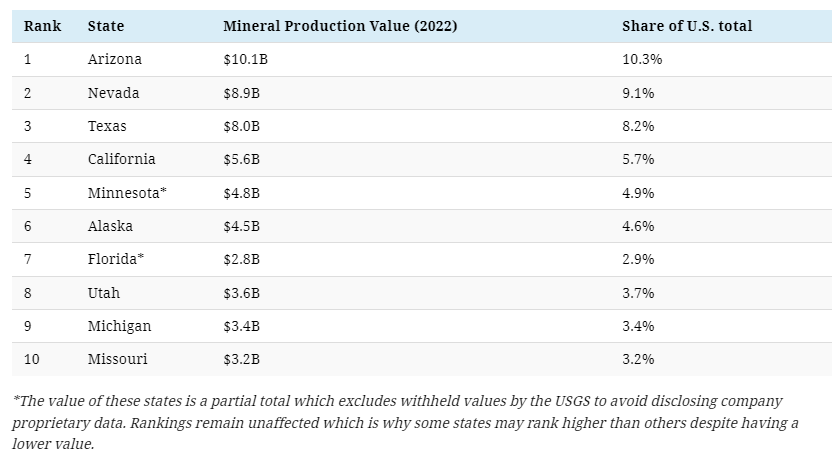
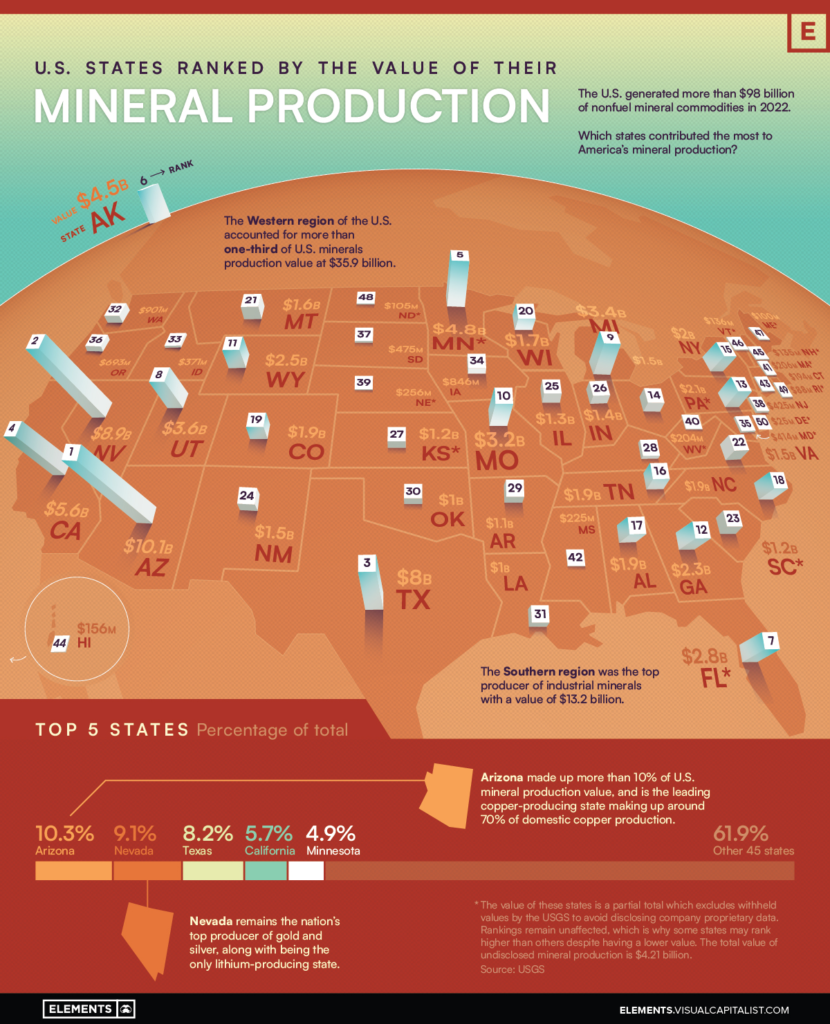
Mapped: US mineral production value by state in 2022

Visual Capitalist - Elements | March 21, 2023 | 

US states ranked by the value of their mineral production

The US produced $98.2 billion worth of nonfuel minerals in 2022, but which states made up the majority of the mining?


This map uses data from the USGS to map and rank US states by the value of their nonfuel mineral production in 2022.

The ranking takes into account the mining of nonfuel minerals that are split into two main categories: metallic minerals (like gold, copper, or silver), and industrial minerals (like phosphate rock, various types of clay, and crushed stone).
The top mineral-producing states in the US

Arizona tops the list of mineral-producing states, with $10.1 billion worth of minerals which account for 10.3% of the US total, largely due to the state’s prolific copper production. The state of Arizona accounted for around 70% of domestic copper production in 2022, and as a result also produces large amounts of molybdenum as a byproduct.

The state of Nevada was the next top mineral producer at $8.9 billion worth of minerals, thanks to its longstanding leadership in gold mining (accounting for 72% of US gold production in 2022) and by having the only operating lithium project in America.

States in the Western region of the US dominate the ranking of top mineral-producing states, holding the top two spots and making up half of the top 10 when it comes to total mineral production value.


Texas rounds out the top three at $8 billion worth of minerals produced in 2022, largely thanks to its dominant production of crushed stone. The state of Texas was the top producer of crushed stone in 2022 at more than $2.8 billion worth, nearly double that of the next largest producer, Florida, which produced $1.5 billion worth.
What minerals is the US producing the most of?

Nonfuel mineral production is categorized into two main categories by the USGS, metals/metallic minerals and industrial minerals.

While not as shiny, the produced value of industrial minerals far outweighs that of metallic minerals. While $34.7 billion worth of metals were produced in 2022, industrial mineral production value was nearly double at $63.5 billion.

Construction aggregates like construction sand and gravel along with crushed stone made up almost half of industrial minerals production at $31.4 billion, with crushed stone being the leading mineral commodity overall at $21 billion of production value.

Following crushed stone, the next top minerals produced but the US were (in decreasing order of value): cement, copper, construction sand and gravel, and gold.

Although the value of metals production decreased by 6% compared to 2021, industrial minerals production increased by 10% year-over-year, resulting in an overall increase in America’s overall nonfuel mineral production of 4%.

(This article first appeared in the Visual Capitalist Elements)
Artists are calling out the gross corporate greed of MONOPOLY Ticketmaster


The Cure’s Robert Smith recently convinced Ticketmaster to refund ‘unduly high’ fees to their fans – could this be the start of artists holding the ticket-selling giant to account?

At present, you’d be hard-pressed to find a music fan with any positive thoughts about Ticketmaster. While from two very different musical camps, The Cure’s Robert Smith and his goth army seem ready to join the Swifties in a battle against the ticketing giant as another fan base burned by pricing.

As tickets went on sale for the band’s US tour, prices were nearly doubled thanks to hefty service fees, facility charges and a processing fee. Despite purposefully setting their prices at an accessible limit with tickets as low as $20 and opting out of dynamic prices during apparent conversations with the platform, Cure fans still got shafted. In a series of tweets to fans, Smith has said he is “as sickened as you all are” and has actually convinced Ticketmaster to refund fans their fees. But the fact this happened at all when The Cure supposedly did everything ‘right’, following recent horror stories from Taylor Swift and Beyoncé’s ticket sales, begs the question: what can be done about the Ticketmaster problem?

The carnage of Taylor Swift’s Eras Tour pre-sale is still in the news, where Ticketmaster claimed bots hacked the verified fan presale, causing ticket prices to hike into the tens of thousands from the original price range of $49 to $499 for tickets. Despite the insane prices, the platform somehow managed to sell every ticket to the tour, causing the general pre-sale to be cancelled after 2.4 million tickets were sold. This was all a result of ‘dynamic pricing’, but what does that even mean?
READ MORE


The inside story of comfy synth, the internet’s snuggliest microgenre

Indie legends Yo La Tengo perform in drag to protest Tennessee’s drag ban


Not too dissimilar from the way hotels or airlines work, dynamic pricing puts the cost of a gig ticket in line with the amount of demand, meaning that the more people in the queue to grab a Beyoncé ticket, the more expensive that ticket is going to get. Case in point: Beyoncé’s ‘Golden Circle’ tickets were originally priced at £140, but have now surged to over £400.

To Ticketmaster, this is all part of a protective policy, apparently designed to protect tickets from falling into the hands of scalpers, or being snapped up for cheap during pre-sale hacks and sold on for heavily inflated prices. But it’s ironic that their solution is to essentially do that price hiking themselves and punish the fans. Surely all of this only comes down to one thing – greed. Laid out clearly in The Cure’s situation, as Robert Smith pushed for answers as to how these added fees were justified, it felt malicious, like the ticketing giant couldn’t resist getting their slice while musicians make active steps to keep their shows accessible.

A key piece to the puzzle as to why and how Ticketmaster keep getting away with this is the fact that Ticketmaster is owned by Live Nation. The company behind the Astroworld tragedy, Live Nation dominate the live music industry – they put on shows, own venues, and even manage some artists. As a result, a lot of venues owned by the company work exclusively with Ticketmaster, with their current list of properties in the UK including 51 per cent of the Academy Music Group. Beating their competitors in every way from higher employee numbers to billions in yearly profit, the result is that Live Nation and Ticketmaster are impossible to beat and near impossible for artists to avoid. As they continue to dominate the industry, they create tighter ticket verifying systems to avoid fakes and grow their operating size to run huge projects like global stadium tours that other platforms like Eventbrite or Dice just couldn’t handle. At present, there really is no viable ticket-selling alternative for major artists to turn to.

This is not a surprise. Even back in 2009 when Live Nation and Ticketmaster first merged, major artists like Bruce Springsteen condemned the deal saying, “the one thing that would make the current ticket situation even worse for the fan than it is now would be Ticketmaster and Live Nation coming up with a single system, thereby returning us to a near monopoly situation in music ticketing.” Initially, the UK’s Competition Commission even ruled against the merger as the body that protects against a single body monopolising an industry, stating the move would harm competitors and “limit the development of competition in the market for live music ticket retailing”.

For as long as we live under a capitalist system, we need competition. It keeps prices down and holds companies accountable, as we consumers can just go off and shop elsewhere if we feel we’re being treated unfairly. At present, with no other ticketing site to really rival them in any legitimate way when it comes down to big concerts, Ticketmaster can and will do what they want. Sure, Robert Smith can kick off and they might pay back $10 to each customer this time, but they’ll do it all again the next time round. Similarly, Taylor Swift fans can attempt to take down the giant with a lawsuit, but it’ll just go on the pile with the 15 other lawsuits that have been filed in the last five years – and besides, the conglomerate can usually shake these off by claiming fans “repeatedly agreed” to arbitrate any disputes with the site. In other words, as they technically don’t force fans to buy expensive tickets, they can wash their hands of responsibility.

But maybe there’s hope for change. It’s undoubtedly welcome news to hear that The Cure are standing up to the giant, and there’s been no word on The Eras Tour coming to the UK or any whisper of tickets for the global legs. The last we heard from Taylor was: “I’m trying to figure out how this situation can be improved moving forward.” Previously taking on Spotify and Apple Music, if any artist can stand her ground, perhaps it’s Taylor – many fans are wondering if the star might launch her own ticketing platform and bring the process in-house. Right now, there doesn’t seem to be any other escape from the nightmare, unless major stars like Smith and Swift step up to help save us.


Nuclear contamination testing planned at St. Louis-area park

IS PARK RADIOACTIVE?

The U.S. Army Corps of Engineers plans to test for radioactive contamination at a suburban St. Louis park that sits along a notoriously toxic creek, a Corps official said Tuesday.

The Corps of Engineers is seeking permission from St. Louis County to test soil and water at Fort Belle Fontaine Park, a popular spot for hikers with high bluffs and panoramic views. The park sits about three miles from where the Missouri River flows into the Mississippi River.

Coldwater Creek runs through the park. The notoriously contaminated creek has been a headache for decades, since radioactive waste got into the waterway in the 1950s. Residents who lived along the creek as children in the 1960s and later have blamed illnesses, including rare cancers, on playing in the creek.

“We were never, as kids, supposed to go down there, but of course we did,” said Kim Visintine, a member of the Coldwater Creek Group, which advocates for testing and cleanup.

A division of the Corps of Engineers known as the Formerly Utilized Sites Remedial Action Program, or FUSRAP, is responsible for cleanup of contamination along the creek. Jon Rankins, senior health physicist for FUSRAP, said the effort at the park is part of a plan to test all properties within the Coldwater Creek floodplain.

“We don’t anticipate finding contamination due to the elevated topography, and have not found contamination in the immediate vicinity of the park," Rankins said in a statement.

Still, testing was welcomed by local activist groups. Visintine noted that the park is far removed from the residential areas where children played in the creek.

“It’s kind of in the middle of nowhere,” she said.

Coldwater Creek was contaminated with radioactive waste generated when Mallinckrodt Chemical processed uranium in the 1940s and 1950s for atomic weapons. The waste was initially stored at Lambert Airport, near the creek, then later trucked to an industrial area that also borders the creek.

The site near the airport has largely been cleaned up but remediation of the creek itself won’t be finished until 2038, Corps officials have said. Meanwhile, The U.S. Centers for Disease Control and Prevention in 2016 urged people to stay away from Coldwater Creek.

Last year, Jana Elementary School in the town of Florissant was closed after testing by a private company found contamination on the kindergarten playground and inside the building. The private study was funded by lawyers whose clients are suing over radioactive contamination in Coldwater Creek, which runs near the school.

The results prompted the Corps of Engineers to conduct its own investigation. The agency found no contamination inside the school or in multiple soil samples on the outside, and a third round of testing also found no harmful levels of radioactive material. Still, the school remains closed.

 Analysis

Weather tracker: sea surface temperatures hit record high

Azure Prior (Metdesk)

Analysis shows record occurred after La Niña period, when temperatures across central and eastern Pacific tend to be cooler

Sea surface temperatures (SSTs) reached a record high on 16 March this year, surpassing the previous record set in March 2016, according to an analysis by the US’s National Oceanic and Atmospheric Administration. This is particularly surprising as it occurred after three years of La Niña, where SST anomalies across the central and eastern Pacific tend to be cooler than normal. The previous record set in 2016 was recorded after an El Niño: this would be more normal as SSTs across the central Pacific are warmer than average and therefore have time to build warmth at the ocean surface. It means a particularly intense El Niño year or a long period of Pacific Ocean warming is no longer necessary to achieve record high global SSTs.

Meanwhile, in Australia a heatwave has been building throughout the past week, bringing scorching conditions across much of the country with many weather stations breaking their March maximum temperature records as well as their highest minimum temperature records. By Sunday, many areas of New South Wales in particular recorded temperatures in the high 30s and low 40s celsius. For example, Beaudesert Drumley Street, a station near Brisbane, registered a record high temperature for March of 38.4C on 17 March and Wilcannia reached a scorching 43.8C on 19 March. This hot spell is also not likely to break down completely until later next week with temperatures continuing into the high 30s celsius. With the addition of an El Niño on the horizon later this year, Australia could see the return of drought conditions.

At the other extreme, the once dry and sunny California will continue to experience low pressure systems from the west bringing rain, sleet and hill snow across the state throughout the coming week. By midweek, cumulative rainfalls are likely to reach 30-50mm with several more centimetres of accumulation expected on high ground. A huge portion of California has received about 300% of rain for a normal March, with closer to 500% in mountainous areas. Little let-up in the atmospheric river bringing these soggy conditions will probably make this year significantly wet and potentially record-breaking for the state.

More than a third of Ontario job vacancies remained unfilled, report finds — and sick days are surging too

More than 36% of vacancies remained unfilled in Q3 2022, according to the Ontario Financial Accountability Office, and more than 400,000 workers were absent due to illness or disability.


By Ghada Alsharif
Business Reporter
Tue., March 21, 2023

Long-term job vacancies in Ontario reached a record high in 2022 as hiring challenges continued to wreak havoc on the labour market, according to the province’s financial watchdog.

Of all job vacancies in Ontario, 36.3 per cent remained unfilled for 90 days or more in the third quarter of 2022, according to the Financial Accountability Office’s report on the province’s labour market performance last year, released on Tuesday.

And employment difficulties aren’t just local. Across the country, employers struggle to find workers. Recent Statistics Canada data shows nearly a million jobs unfilled in the third quarter of 2022. Demand for labour, economists say, is strong across most sectors as people retire and workers seek out higher paying jobs with better working conditions.

“If there’s a simple and effective way to fill vacancies, it’s to pay (workers) more,” says Robert Kavcic, chief economist at BMO Capital Markets.

Adding to the strain in Ontario, a record 5.2 per cent of employees, some 404,100 workers, were absent from their jobs either a full week or part of a week due to illness or disability in 2022 as pandemic restrictions were lifted. This marks a 22 per cent jump over the 2017-2019 average, the report said.


Meanwhile, five of 16 Ontario industries operated with fewer employees last year, remaining below their pre-pandemic 2019 level of employment, including in food services, agriculture, business, transportation and warehousing.

At the same time, the FAO says employment rose by 338,300 jobs last year, which when combined with numbers from 2021, indicates the strongest two-year period of job gains on record.

A recent poll by business consulting firm Robert Half shows that half of Canadian workers intend to look for a new job within the first six months of 2023.

A higher salary, better benefits and more advancement opportunities were among the main reasons that respondents said they would be looking for a new gig.

According to a Robert Half survey of more than 1,100 workers in Canada, four in 10 do not feel fairly paid for their current role.

But for the second consecutive year, workers’ wage growth did not keep up with inflation, according to Tuesday’s FAO report. While the average hourly wage of Ontarians increased 4.2 per cent to $32.94 in 2022, it remained well below the 6.8 per cent inflation rate, the highest in 40 years.

At the same time there has been a big shift in workers’ attitudes since the start of the pandemic, says Sheila Block, a senior economist with the Canadian Centre for Policy Alternatives.

“A disproportionate share of the vacancies are in low wage industries that have very tough working conditions,” Block said. “Pandemic related shutdowns allowed people to get off the hamster wheel and evaluate where they were working and what their working conditions were.”

Many workers in public facing jobs — including accommodation and food services — where demand dropped during COVID-19 lockdowns or where the risk of infection was higher, left for employment in other sectors and have not returned.

“As we’ve seen, wage increases have not kept up with inflation,” Block said. And as inflation continues to drive up the cost of living and necessities “people are very hesitant to take on a job that isn’t going to pay the bills.”