For Wilderness to Remain Wild, It Must Remain Unmanipulated
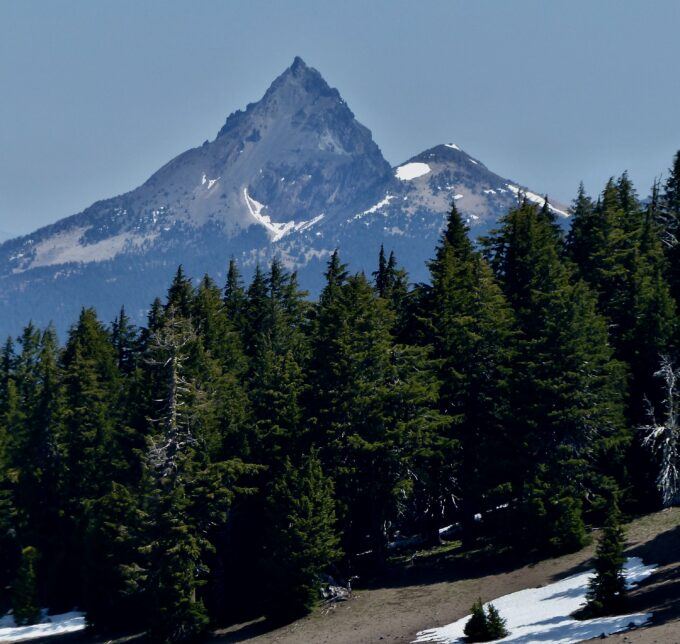
Mount Thielsen Wilderness, southern Oregon Cascades. Photo: Jeffrey St. Clair.
Clare Boerigter’s recent piece in The Conversation on manipulating designated Wilderness areas showed a profound misunderstanding about Wilderness, its history, its stewardship policies, and the Wilderness Act itself. Her proposed solution would result in the loss of the very quality for which Congress designated Wildernesses: their wildness.
Boerigter, a U.S. Forest Service fire researcher, suggests that we use active management interventions and manager-ignited fire in Wilderness to counter the impacts of climate change and to replicate Indigenous burning practices. In doing so, she reflects an all-too-common bias within the federal land management agencies for active management activities and projects. She also reflects a similar all-too-common hubris and arrogance in those same federal agencies that they know what’s best for Wilderness, that their choices for desired future conditions in Wilderness should take precedence over Nature’s choices.
Boerigter’s proposal flies in the face of wilderness policy, history, and the provisions of the 1964 Wilderness Act itself. The one central purpose of the Wilderness Act, its prime directive if you will, is to preserve wilderness character, an area’s wildness. In fact, the Wilderness Act is so emphatic about that point that it says it twice: “[E]ach agency administering any area designated as wilderness shall be responsible for preserving the wilderness character of the area and shall so administer such area for such other purposes for which it may have been established as also to preserve its wilderness character.” The federal courts have consistently agreed that this is the central purpose of this law.
Howard Zahniser, the visionary conservationist who wrote the 1964 Wilderness Act, also wrote extensively about wilderness. In one of his well-known passages, written 11 years before the Wilderness Act passed Congress, he explained, “We must remember always that the essential quality of the wilderness is its wildness.”
Yet Boerigter wants to “improve” or freeze ecological conditions within Wilderness with active management and manipulation, even though doing so will result in a loss of the area’s wildness. The Wilderness Act does not direct us to preserve any certain ecological condition or forest type, but rather to preserve the area’s wildness, even if some of us humans may not always like all the outcomes that Nature might devise.
Boerigter also wants to manipulate Wilderness to honor or replicate the practices of “Indigenous peoples, who in fact tended those lands for thousands of years.” While her intent to honor Indigenous peoples is honorable, Boerigter is off-base here as well. She cites trail networks, scarring of tree bark, and berry picking as examples of how Indigenous peoples influenced the landscapes.
Here again, Boerigter’s misunderstanding of wilderness history, stewardship, and law comes through. The 1964 Wilderness Act defines Wilderness in part as “untrammeled.” Untrammeled does not mean “untouched” or “pristine,” as Boerigter implies. The Wilderness Act does not in fact contain either word. Untrammeled rather means unmanipulated, unconfined, uncontrolled, or unrestrained. An untrammeled Wilderness would allow ecological and evolutionary forces to operate without restraint, modification, or manipulation. If Indigenous people made trails, or scarred bark, or picked berries, or engaged in myriad other activities that had impacts on these places—much like many allowed uses do today—those actions don’t violate the meaning of “untrammeled” within the context of the Wilderness Act. Nor does the law require us now to replicate those activities.
And recent research published in the journal Ecological Citizen has confirmed that the use of fire and other impacts by Indigenous people were fairly localized to Indigenous settlement areas and not universal across the entire landscape where many Wildernesses now are located.
Howard Zahniser, who thought deeply about Wilderness, often wrote that we humans need to approach Wilderness with humility and restraint. In his famous 1963 essay, he encouraged us to be “guardians, not gardeners” with respect to Wilderness, again utilizing humility and restraint to protect, not manipulate, Wilderness. Boerigter’s approach would instead substitute the hubris and arrogance in the federal agencies for the humility and restraint that Wilderness needs, destroying the wildness that makes these areas so special in the first place. Instead of Boerigter’s approach, let’s instead continue trying to keep Wilderness wild.

No comments:
Post a Comment