Against Cancellation: Chomsky and the Cyclical Emasculation of the Left
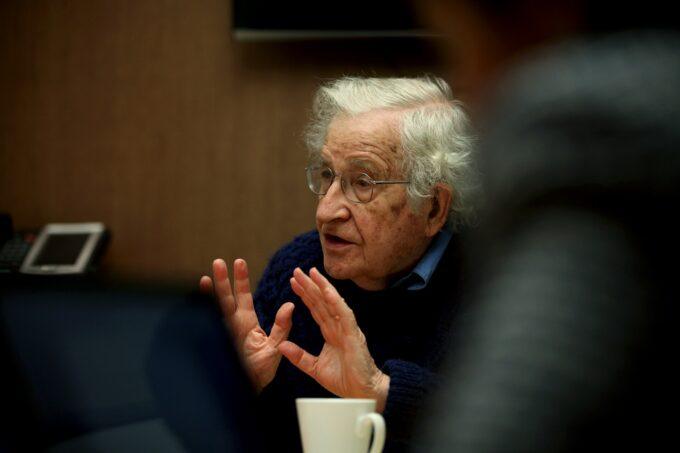
Photograph Source: Cancillería del Ecuador from Ecuador – CC BY-SA 2.0
A decade after the razzia on the Ecuadorian embassy in London, we still inhabit the aftermath of the left’s abandonment of Julian Assange. Wikileaks was the global mainframe for publishing “leaks” by anonymous citizen-activists. That bottom-up phenomenon bypassed all state and partisan controls, often sparking mass protest and indignation against atrocities like the Iraq war. It has not been replaced. Sites like the Intercept and Dropsite, staffed by mostly Democrat-affiliated Americans, seem partisan by comparison.
Instead, what has awkwardly replaced Wikileaks ten years on is Trump’s D.o.J’s file-dumping, with Pam Bondi announcing the next big “leak” or declassification of archives. The first wave of freed files concerned the assassinations of iconic Americans whose deaths had remained mysterious: JFK and Martin Luther King Jr.
There are important differences, however, between the transnational cyber-anarchist platform called Wikileaks—hailed as an “intelligence agency for the people” though it was more likely the online prototype for such a revolutionary organization—and the “leaks” being desperately disseminated to convince supporters that Trump is a genuine enemy of the Deep State.
One crucial difference is the way declassified material is received and interpreted. With Wikileaks, there was a sense of adventure, as ordinary citizens felt they had become investigators unveiling high-level corruption. Trump’s big file-dumps are top-down, meant for passive consumption. This consumptive, tabloid dynamic turns particularly salient with the Epstein disclosures. Most disturbing is the high speed at which many celebrity leftists united in a lynch mob against a 97-year-old man on his deathbed.
The irony is that Noam Chomsky spent much of his life reading and synthesizing the contents of declassified government documents, to explain them to the public. This constituted his life’s work outside the field of linguistics, when he stood alone as a critic of corporate media, on a paladin-like quest to unmask the cruelty of American foreign policy.
Other than Chomsky, very few American activists were intellectually capable of dismantling the arguments of Ivy League liberals who romanticized US foreign policy as a heroic force, and as a wellspring of American affluence—enabled by resources from faraway countries toiling under police-states. Chomsky pierced past the Pollyanna Norman Rockwell-aesthetic of American postwar self-glorification and narcissism. The bygone age of the free internet opened the floodgates for uncensored war-photography, for alternative media, and unfiltered knowledge which confirmed the Chomskyan critique for a popular audience throughout the 2000s. But the internet also drove the dissolution of local newspapers, formerly the bedrocks of blue-collar dissident journalism. Digitization’s erasure of small newspapers gave way to dilettantism and the clickbait business-model of media, which harvests its financial boom during moral outrages of the kind now whirlpooling around Epstein’s mythologized enigma.
Had it not been for Chomsky, the American left would be an even more sclerotic and dismissible population than it is. Progressive personalities who became household names like Chris Hedges, Ana Kasparian and Briahna Joy-Gray might never have reached audiences or become wealthy were it not for Chomsky’s having made cracks in the hegemonic common-sense of middle-class America. For that reason, there is an eerie energy, reminiscent of Dostoyevsky’s Brothers Karamazov, of parricidal narcissism pervading the latest wave of Me-Too-style denunciations against a man who has literally lost the ability to speak.
The vitriol also recalls the Two-Minutes Hate ritual in Orwell’s 1984, in which enraged party-members smash furniture when they see a mugshot of the traitor Immanuel Goldstein on screen. Epstein-fever has united previously irreconcilable factions within the culture wars: mainstream Democrats, on their eternal quest to find the scandal that will finally undo Trump (they still can’t understand that Trump, unlike mainstream politicians like Mandelson, thrives in scandal) join hands with MAGA and Pro-Palestine anti-imperialists.[1] The ritualized sentimental violence is also directed against Chomsky’s wife and caretaker, Valeria. It begs the question of who’s next—after all, Epstein had also befriended astrophysicist Stephen Hawking, who, despite being utterly paralyzed, became associated with the “global elite” engaged in top-secret Caribbean orgies.
Nobody seems willing to risk being the Devil’s Advocate by asking questions. Even if such questions would be perfectly consequent with the assertions they’ve been making about Epstein, such as his alleged connections to espionage.
Long before the Palestine cause became famous among Western sympathizers, Chomsky once stood out among the most hated foreign public figures in Israeli society and press. One would think that for the Israeli public, Chomsky ranked on the same tier as Arab and Iranian generals. Chomsky was Israel’s very own Immanuel Goldstein: commonly vilified as a race-traitor.[2] If Epstein was—as so many online commentators are convinced—the master spy for Tel Aviv, would it not then make sense for Epstein to infiltrate the private life of a veteran “public enemy” of Israel?
An old smear often leveraged at Chomsky, went that his entire career was predicated upon derogation of Israel. But Chomsky assiduously examined every US-to-client-state relationship on earth, whether in Africa, Asia or Latin America. He is perhaps the only reason why anyone in the contemporary West knows about the genocide perpetrated by Suharto’s Indonesia against the people of East Timor.
As Chomsky nears the end, certain left opinion-makers like Presbyterian minister-turned-podcaster Chris Hedges seem impatient to hammer nails into the coffin-lid. These intra-Left detractors are not merely doing away with a famous man’s reputation. They are, willingly or unconsciously, eradicating a methodology for observing geopolitics at work in the world. Much of this has its background in fissures that started within the pro-Palestine movement in the 2000s.
Journalist Alan MacLeod, heir of Scottish aristocracy and vociferator for the oppressed, went on Briahna Joy Gray’s podcast for an episode titled “Chomsky FANTASIZED about Epstein Island”. In his hatchet-job for Mint Press News, MacLeod mischaracterizes Chomsky as some kind of Dershowitz: Epstein’s “crisis manager”. MacLeod also calls Chomsky an “anti-feminist guy” “like Jordan Peterson”; a secret underminer of #MeToo.
The millenial left’s quarrel over Chomsky is not that new. It can be traced back to grievances and grudges that resulted from Chomsky’s disagreements with the Boycott Divestment Sanctions movement, both on tactics and during the debates over the One Vs. Two State Solutions. The purpose of this essay is not to advocate for either stratagem—both seem less relevant after the ruination of Gaza. Instead, my aim is to briefly outline the roots of the intra-left campaigns against Chomsky.
MintPress News’ co-founders, like Mnar Adley (herself a Palestinian-American activist) align with specific sectors of the BDS movement that had finally condemned Chomsky as a reactionary or a “soft Zionist”, on account of his insufficiently radical positions on Palestine in these intra-left disputes.[3] In a tweet illustrative of the falling-out, Ali Abumina, director of The Electronic Intifada web-magazine, called Chomsky “a liberal Zionist in radical clothing”. Before that, the organization US Campaign for the Academic and Cultural Boycott of Israel ran a hostile articleportraying Chomsky as a dishonest double-agent doing “damage control” for Israel.
Many of these detractors within Palestine solidarity movements pointed to Chomsky’s having affirmed that he, as a 5-year-old, had decided he was a Zionist. But there were many Zionisms at the time which did not survive. Chomsky’s obsolete version of Zionism was the ideology of the Achad Ha’am, an activist who was perhaps one of most vehement opponents of Herzl and of Herzl’s ideas of statehood within the Zionist movement. Ha’am excoriated the Zionist congresses for bourgeois self-congratulation[4]. He argued that Jews should not move en masse to Palestine but should instead build a cultural and media center in Jerusalem, which would inform the struggle for Jewish civil rights in the diaspora. Ha’am’s exceptionally prescient view on what was then called “the Arab question” are made explicit in pamphlets like “Wrestling with Zion”, where he wrote, circa 1891
“We must surely learn, from both our past and present history, how careful we must be not to provoke the anger of the native people by doing them wrong, how we should be cautious in our dealings with a foreign people among whom we returned to live, to handle these people with love and respect and with justice and good judgment. And what do our brothers (referring to fellow Jewish settlers) do? Exactly the opposite! They were slaves in their Diasporas, and suddenly they find themselves with unlimited freedom, wild freedom that only a state like Turkey can offer. This sudden change has planted despotic tendencies in their hearts, as always happens to former slaves[…]”[5]
Ha’am’s extinct, heterodox Zionism would be considered anti-Zionist by later standards.
Though Chomsky since 1969 called Israel’s founding a crime, he also stubbornly insisted that a two-state resolution represented the only realistic ending of Israel’s military occupation of Gaza, the West Bank, and East Jerusalem. Due to his aphasia, we don’t know whether Chomsky’s position changed after the devastation of Gaza.
Perhaps the problem was the complex ways in which Chomsky described the functioning of oppressive US client-regimes within a world-wide, neo-colonial system. Insofar as certain left anti-Chomsky factions are concerned, we are wasting our time talking about East Timor or any other catastrophe, because in their purview the sole issue is Palestine-Israel. Anyone talking about the crimes of other, lesser-known US authoritarian client states must somehow link these to Israel: for example, MintPress published a long “investigative reporting” piece claiming the problems in Haiti can all be traced back to a single Sephardi-Jewish Haitian oligarch who happens to own a beach-house in Tel Aviv. Now the claim is that Epstein’s imagined Mossad blackmail-machine is what makes the empire go round. This is the vulgarization of anti-imperialism: we conflate the vast constellation of US client regimes with just one particularly privileged junta state; we forget that US global policy, at least pre-2023, kills more civilians in a month than Israel did in a year. The idea that everything one dislikes in the world is another Israeli front makes for an all-too-easy leap from that mindset, into believing that all things are Epstein: suddenly, Gaza is Epstein; Epstein is also Netanyahu; Chomsky was all along loyal to Israel despite being its foremost Jewish critic. For the MintPress club, the Epstein factor explains Chomsky’s having expressed what many pro-Palestine activists found to be self-contradictory ideas about how to solve the Palestinian crisis.
Three years into the livestreamed genocide, protestors are floundering in Western post-democratic societies, dumbfounded by their inability to make their governments stop funneling weapons and logistical support to Israel. Most blatant among these collaborationist governments is the figure of Keir Starmer, who was voted into power by progressives, only to then jail geriatric Palestine Action protestors, while sending the Royal Air Force to aid the IDF with reconnaissance flights over Gaza. That Starmer’s appointee Peter Mandelson soiled himself with Epstein ties, only augments the desperate determination to perceive Epstein as epicenter of the global web of influence which would explain Labour’s accommodation of the genocide and now, Trump’s war in Iran.
Epstein, if a maestro of anything, excelled at inserting himself into the company of influential, famous, or admired persons. Whether or not he proved an asset to intelligence agencies, he was a savant and a hanger-on, who used his money not as Jeff Bezos does—to build a house with innumerable bathrooms: Instead, Epstein purchased the companionship of scientists, politicians, and thinkers who appeared to be at the red-hot center of making history. All in the hope that his name, too, would figure in the credits. That project at the core of Epstein’s life has failed: If anything, contact with the dead (by murder or suicide) money-manager now overshadows the legacies of these luminaries.
There is something more tragic in how a frustrated mass of people who found themselves unable to help the Palestinians, now lock arms with village demagogues like Marjorie Taylor Greene in believing that Epstein’s alleged sexual blackmail of powerful people is the missing link to understand the US-Israeli alliance. Underlying this conspiracy-theory is a naïve and stubborn belief in American innocence: as Kasparian and Cenk Uygur say on The Young Turks show, “We’re occupied’’—implying that America was merely hijacked by foreign, rather than local elites. The solution, following this logic, is to Make America Great Again. Many spectators desperately want to believe that listening to Epstein-victims (who, in most cases, as highlighted by the journalism of Michael Tracey, were overwhelmingly adults when they entered the Epstein sexual entourage of hired escorts) has anything to do with the liberation of Gaza.[6]
The conflation is most unfair to the Palestinians. The specter of Epstein has somehow displaced attention for Gaza by being equivocated with it. Nobody is decrying the unhinged nature of this trade-off. The televised arrogance of Netanyahu, who effortlessly degrades international law, as the UN and the EU look even more emasculated than previously, are factors feeding the collective despair, now requiring release in a scapegoat-mechanism. The helplessness of Westerners beholding the deaths of Gazan and now Iranian children, adds to the allure of the false equation of Epstein with the Israeli war-machine. But compare the costs of protesting Elbit systems in the UK (incarceration) to the consequences for spreading online Epstein-slop (likes on social media, invitations to podcasts!)
The anomie is reviving and re-legitimizing what were once dormant atavisms of antisemitism. Such a dangerously oversimplified anti-imperialism mirrors the worldview of Candace Owens, who can keep a straight face when she claims that Monica Lewinsky was a Mossad agent, sent by Epstein to seduce Clinton into sabotaging Arafat at the 2000 Camp David Summit. At best, this reveals an American nostalgia for Cold War cloak-and-dagger mythos about Soviet honeytraps. Those were more heroic times.
The antidote for simple-minded anti-imperialism —which foregoes analysis of the dynamics of the worldwide US-to-client-state relationships—was, precisely, Chomsky’s methodical and complex anti-imperialism. He defenestrated 9/11 and JFK conspiracy theories as farcical traps that benefit the empire instead of exposing it. Now, Chomsky is cancelled by the very figures on the left who deserted Assange over Swedish counterfeited Me-too allegations that turned out to be CIA ploys. Chomsky’s erasure deprives us of a bulwark of intellectual maturity within the left, which prevented the resurgence of antisemitic lore and anti-Masonic phantasmagoria. We all know where that ultimately leads.
Notes.
[1] This coming-together of disparate factions united by lynching, confirms the theories of late philosopher René Girard in “Violence and the Sacred”. For Girard, the purpose of the scapegoat in primitive societies serves to ameliorate divisions that might otherwise lead to cyclical violence, by ritually sacrificing a scapegoat. All parties know that the scapegoat is not the culprit of the original offense requiring sacrifice yet is somehow related to the culprit (by clan, tribe/ethnicity or other kinship).
[2] For a relatively recent example, see the Ynet article by Israeli Knesset MK Arieh Eldad, justifying the 2010 entry ban against Chomsky. https://www.ynetnews.com/opinions-analysis/article/3891448
[3] In one interview, when asked about Chomsky’s criticisms of certain aspects of the BDS program, BDS-spokesman Omar Bhargouti at first declined to attack Chomsky, but then spoke of “soft Zionists”, of whom he said, “The BDS movement has stripped them of their gatekeeping status. Before the BDS movement, they used to be the gatekeepers, telling people what’s allowed and what’s not allowed in support of Palestinian rights: you shall go that far, and you shall stop at that point.” Weblink source: https://www.amandla.org.za/omar-barghouti-the-ongoing-intifada/
[4] See “The Jewish State and the Jewish Problem” by Ahad Ha’am (Asher Ginsberg) 1897. Source: Jewish Virtual Library
[5] Quoted in Wrestling with Zion, Grove Press, 2003 PB, p. 15. Weblink
[6] Recently released correspondence published on the US Department of Justice website between prosecutor Maureen Comey, Kash Patel and Dan Bongino, reveals that there is still a lack of evidence when it comes to the crucial claims about Epstein. There is no comparable dearth of evidence when it comes to the IDF’s killing of Palestinian children. Source URL: https://www.justice.gov/age-verify?destination=/epstein/files/DataSet%2010/EFTA01649081.pdf
Also see Michael Tracey’s Subtack piece on the DoJ, https://www.mtracey.net/p/government-deceiving-epstein

No comments:
Post a Comment