March 13, 2026
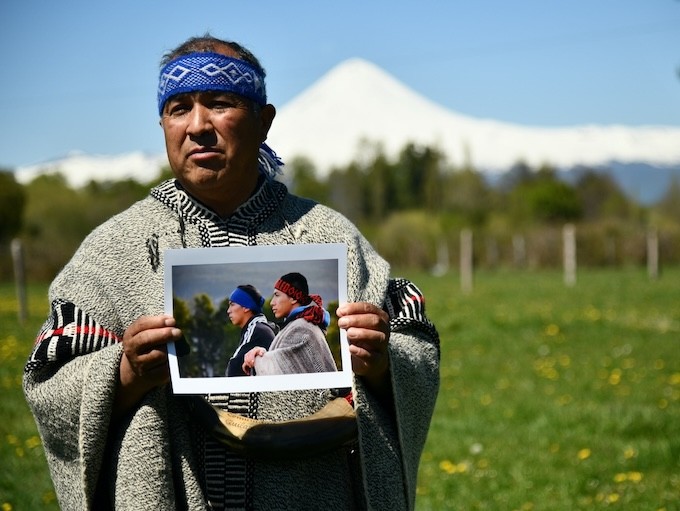
Mapuche Lonko (chief) holding photo of imprisoned activists. : Photo: LangellePhoto.org
Santiago, Chile.
On March 11, 2026 far-right politician José Antonio Kast was inaugurated as president of Chile, marking a sharp shift in the country’s political direction. Kast, 55, is a polarizing figure whose political career—and family history—have drawn international attention.
Human rights groups and Indigenous organizations warn that Kast’s policies toward the Mapuche people—and his admiration for the former dictatorship of Augusto Pinochet—suggest that existing conflicts in Chile over land, democracy, and civil rights may deepen under the new administration.
A Legacy Linked to the Pinochet Era
The son of a former Nazi Party member, Kast built his campaign around strict immigration policies, pledging to expel tens of thousands of undocumented migrants.
His older brother, Miguel Kast, served as a senior official and economist during the Pinochet military regime and played a key role in shaping Chile’s neoliberal economic reforms following the 1973 U.S.-backed overthrow of democratically elected socialist President Salvador Allende.
Observers note that Kast’s rise reflects the enduring influence of Pinochet-era economic and political networks within Chilean politics.
The Unfinished Uprising
Kast’s presidency also follows the massive 2019 popular uprising in Chile, when millions of people took to the streets demanding an end to crushing neoliberal economic policies and other lingering legacies of the Pinochet dictatorship. On International Women’s Day, March 8, days before Kast’s inauguration, women marched en masse throughout Chile in the largest protests since the uprising. Sibila Sotomayor Van Rysseghem, co-founder of feminist collective LASTESIS, said, “everything we believe in is in danger right now–women, queer people’s rights, migrant rights, Indigenous rights, the arts, culture, and activism.”
Mapuche organizations and activists were among the most visible forces in the 2019 mobilizations, linking Indigenous land struggles and state repression in southern Chile to broader national demands for social and political transformation.
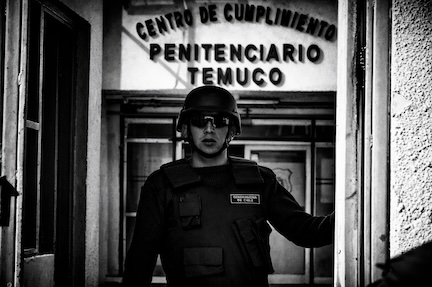
Outside of the Prison in Temuco Chile, where numerous Mapuche political prisoners are held. LangellePhoto.org (2024).
Mapuche Land Struggles
For many Mapuche communities in southern Chile, the conflict over land is not abstract politics but a daily struggle for water, territory, and cultural survival.
For decades, Mapuche communities have resisted land dispossession, large-scale industrial forestry plantations, and the militarization of their territories—making the conflict one of Chile’s most persistent human rights and Indigenous rights issues.
“Under the Pinochet dictatorship, repression and human rights abuses were extreme, and large swaths of Mapuche territory were handed over to the timber industry,” said Anne Petermann, Executive Director of Global Justice Ecology Project.
“Since 2004, we have documented the devastating impacts of industrial pine and eucalyptus plantations on Mapuche communities, including loss of access to fresh water, land for growing food, and increasingly severe wildfires. Under Presidents Piñera and Boric, we witnessed violent state repression against Mapuche people trying to recover their ancestral lands. Now, under Kast—the most right-wing president since Pinochet—we are deeply concerned that the new administration will adopt an even more hardline approach to these conflicts.”
Given the increasing repression of Mapuche communities during the Boric administration—including new usurpation and anti-terrorism laws that criminalize Mapuche land recovery efforts—human rights and Indigenous solidarity groups are raising alarms about what Kast’s far-right government could mean for Indigenous communities.
Strategic Resources and Global Stakes
Chile’s political direction also carries significant global economic implications.
The country holds some of the world’s largest copper reserves as well as important deposits of rare earth minerals—resources increasingly strategic to global supply chains for electronics, renewable energy technologies, and defense industries.
Regional Politics and U.S. Influence
Kast joins a broader international and South American trend toward right-wing leadership and authoritarian-leaning policies, raising questions about the future of democratic institutions and human rights across the region.
At the same time, right-leaning and populist movements are gaining momentum in Latin America, including Argentina’s Javier Milei, El Salvador’s Nayib Bukele, and Ecuador’s Daniel Noboa.
On March 7 in Doral, Florida, Kast attended U.S. President Donald Trump’s “Shield of the Americas” meeting. Trump acknowledged Chile’s president-elect and stated that he had endorsed him.
Critics viewed the gathering as a Trump-driven effort to reassert American dominance in the region through a militarized, security-focused approach to hemispheric policy.
In the shadow of the recent attack on Iran and escalating global geopolitical tensions, U.S. Secretary of War Pete Hegseth made the ironic and ominous statement at the “Shield of the Americas” meeting that the United States had long focused on borders in far-flung regions “and not our own borders, our own Western Hemisphere.”
Earlier this year, on January 3, U.S. forces captured Venezuelan President Nicolás Maduro and his wife, Cilia Flores, during a military raid in Caracas and transported them to the United States to face narcoterrorism and drug trafficking charges, as part of an effort to regain control of Venezuela’s oil reserves.
An Uncertain Political Future
Kast has already pulled his incoming administration out of transition talks with outgoing “left” President Gabriel Boric, raising concerns among observers about the tone of Chile’s political transition.
As Kast assumes office, human rights observers warn that Chile may be entering a new and uncertain phase in the long struggle over land, democracy, and Indigenous rights.
Orin Langelle is a co-founder of Global Justice Ecology Project and is director of Langelle Photography
Global Justice Ecology Project is an international organization that works in solidarity with Indigenous Peoples and forest-dependent communities to defend human rights, biodiversity, and climate justice.

No comments:
Post a Comment