After three men from the West Bank village of Abu Falah were killed in an Israeli settler pogrom, residents say they feel "paralyzed" and "humiliated" that they can be killed in front of their homes without consequences.
By Qassam Muaddi
March 13, 2026
Mondoweiss
Mondoweiss
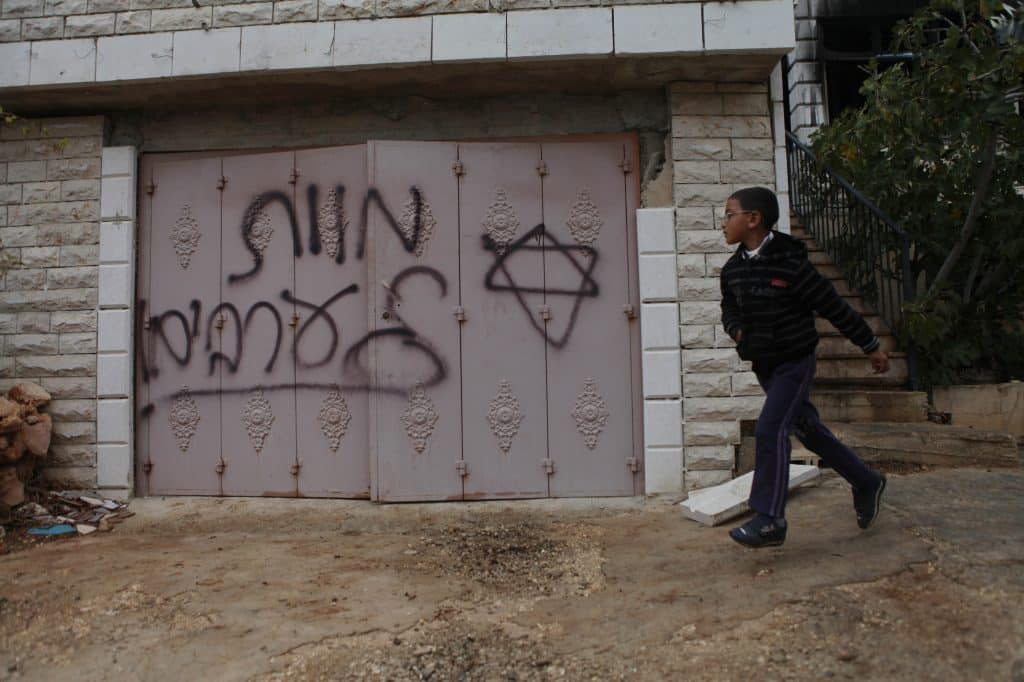
A Palestinian boy walks past Hebrew grafitti that reads “Death to Arabs” written by Israeli settlers on the door of the Hamayel family home in the Palestinian village of Abu Falah, northeast of Ramallah, November 23, 2014. (Photo: Shadi Hatem/APA Images)
The streets of the Palestinian village of Abu Falah, northeast of Ramallah, are quiet. They usually would be on a Ramadan afternoon, but this is different. An inexplicable tension hangs in the air, and even the children walking along the sidewalk are restrained, staring at the unknown car with suspicion. An elder sits in front of a store looking away anxiously, as if expecting something to happen. Along the main street, three faces greet the visitors, looking down from posters hanging from power lines and closed storefronts.
At the center of the village, cars are parked in front of the large Abu Falah public hall. Mourners have congregated on the third day of a funeral wake to pay their respects to the families of three slain Palestinian men, killed by Israeli settlers on the night of March 7. Two of the victims are older men, Muhammad Murra, 57, and Fari’ Hamayel, 55, while the third, Thaer Hamayel, was 30.
They weren’t the only Palestinians whose lives were taken by Israeli settlers that week. A few days earlier, another Israeli attack killed brothers Muhammad and Fahim Muammar in the village of Qaryut, east of Nablus. Another Palestinian, Ameer Shanaran, was killed by an Israeli settler in Masafer Yatta of the South Hebron Hills on the same day as the Abu Fallah killings.
The streets of the Palestinian village of Abu Falah, northeast of Ramallah, are quiet. They usually would be on a Ramadan afternoon, but this is different. An inexplicable tension hangs in the air, and even the children walking along the sidewalk are restrained, staring at the unknown car with suspicion. An elder sits in front of a store looking away anxiously, as if expecting something to happen. Along the main street, three faces greet the visitors, looking down from posters hanging from power lines and closed storefronts.
At the center of the village, cars are parked in front of the large Abu Falah public hall. Mourners have congregated on the third day of a funeral wake to pay their respects to the families of three slain Palestinian men, killed by Israeli settlers on the night of March 7. Two of the victims are older men, Muhammad Murra, 57, and Fari’ Hamayel, 55, while the third, Thaer Hamayel, was 30.
They weren’t the only Palestinians whose lives were taken by Israeli settlers that week. A few days earlier, another Israeli attack killed brothers Muhammad and Fahim Muammar in the village of Qaryut, east of Nablus. Another Palestinian, Ameer Shanaran, was killed by an Israeli settler in Masafer Yatta of the South Hebron Hills on the same day as the Abu Fallah killings.
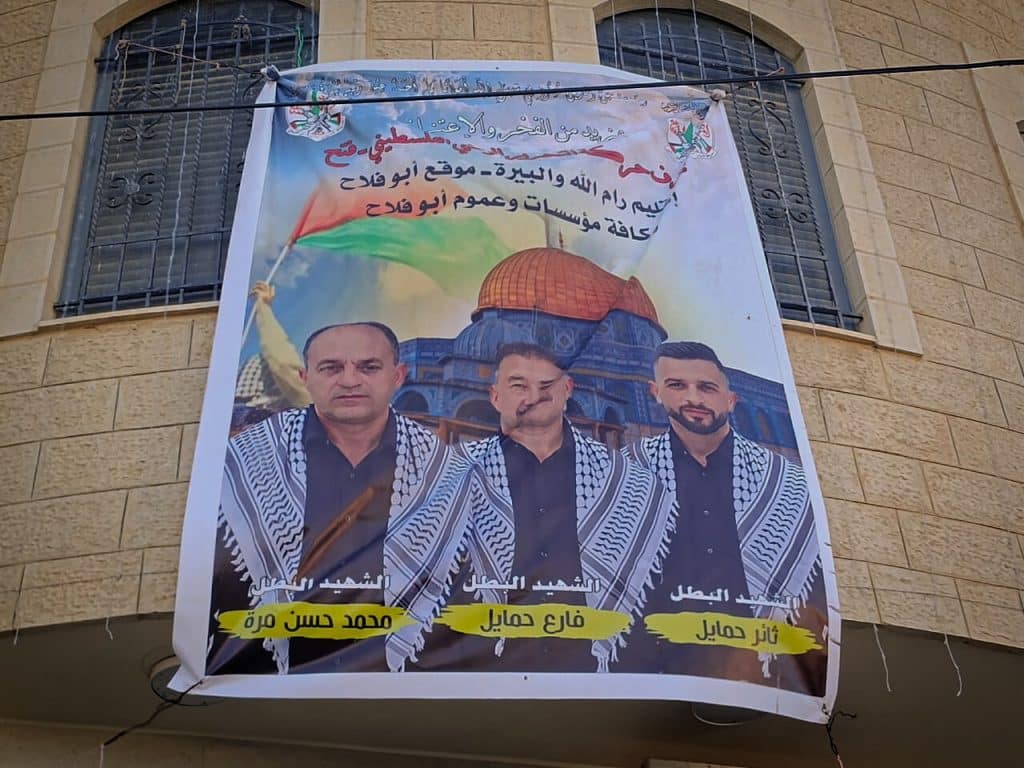
The three martyrs of Abu Falah, March 2026. (Photo: Qassam Muaddi/Mondoweiss)
In total, settler pogroms had killed five Palestinians in the West Bank in less than a week, part of a broader escalation in settler violence and Israeli military restrictions on the lives of Palestinians since the start of the ongoing U.S.-Israeli war on Iran.
Settler violence has been on the rise in the West Bank for months, with 486 attacks recorded in January, according to Bedouin’s rights defense group al-Baidar, while in February, settlers launched 511 attacks, the Palestinian Wall and Settlements Resistance Commission reported.
The recent deadly attack on Abu Falah is significant because it lies deeper inland amid Ramallah’s central hill country; in contrast, settler attacks in the governorate have largely concentrated around the line of villages on the eastern edges of Ramallah overlooking the Jordan Valley, such as al-Mughayyir, Turmus Ayya, Deir Dibwan, and Taybeh.
While Abu Falah has experienced attacks over the past two years, none of them were as coordinated and deadly as the one that took the lives of the three men in early March. Muwafaq Omari, a resident of the village, says that ever since settlers established an outpost near the village in the wake of October 7, they have launched occasional raids on the outskirts of town, primarily targeting farmland and burning wheat and barley crops during the harvest season. “But those attacks were small in number, and there were no casualties,” Omari told Mondoweiss. “We never imagined that settlers would attack in the dozens and shoot firearms, as they did last week.”
It was late at night, after the evening prayers that are customarily held after breaking the Ramadan fast. Omari was returning home from the prayers when he received a call from his daughter. She lived at the edge of the village, where settler attacks are more frequent. “She was frightened, and said that settlers were attacking houses and that some young men were trying to push the settlers off,” Omari recalls. “I panicked and rushed to the location, but couldn’t reach my daughter’s house. It was too risky.”
His daughter, still in shock from the day’s events, declined to speak to Mondoweiss.
Muhammad Abu Karsh, another resident of Abu Fala in his thirties, is a Civil Defense volunteer in the village. “I was home when a friend called me and said that the settlers were attacking, and several were injured,” he recounts. “I rushed to the location and didn’t even have time to put my civil defence jacket on.”
When he arrived, he saw dozens of settlers roaming in the fields, some of them minors, throwing stones at a distance. “About half an hour later, a white pick-up truck arrived on the settlers’ side, this time with firearms that appeared in the hands of settlers,” Abu Karsh continues. “The settlers then opened fire into the crowd. That’s when everybody began to run back to the village, including myself.”
But the settlers went after them, continuing to shoot. “The settlers came so close that they were shooting in between the houses, and Muhammad Murra’s house was one of them. He was shot in front of his own house, but I didn’t look back. And I didn’t know that in the first shots, Thaer and Fari’ were the first casualties,” Abu Karsh added.
In total, settler pogroms had killed five Palestinians in the West Bank in less than a week, part of a broader escalation in settler violence and Israeli military restrictions on the lives of Palestinians since the start of the ongoing U.S.-Israeli war on Iran.
Settler violence has been on the rise in the West Bank for months, with 486 attacks recorded in January, according to Bedouin’s rights defense group al-Baidar, while in February, settlers launched 511 attacks, the Palestinian Wall and Settlements Resistance Commission reported.
The recent deadly attack on Abu Falah is significant because it lies deeper inland amid Ramallah’s central hill country; in contrast, settler attacks in the governorate have largely concentrated around the line of villages on the eastern edges of Ramallah overlooking the Jordan Valley, such as al-Mughayyir, Turmus Ayya, Deir Dibwan, and Taybeh.
While Abu Falah has experienced attacks over the past two years, none of them were as coordinated and deadly as the one that took the lives of the three men in early March. Muwafaq Omari, a resident of the village, says that ever since settlers established an outpost near the village in the wake of October 7, they have launched occasional raids on the outskirts of town, primarily targeting farmland and burning wheat and barley crops during the harvest season. “But those attacks were small in number, and there were no casualties,” Omari told Mondoweiss. “We never imagined that settlers would attack in the dozens and shoot firearms, as they did last week.”
It was late at night, after the evening prayers that are customarily held after breaking the Ramadan fast. Omari was returning home from the prayers when he received a call from his daughter. She lived at the edge of the village, where settler attacks are more frequent. “She was frightened, and said that settlers were attacking houses and that some young men were trying to push the settlers off,” Omari recalls. “I panicked and rushed to the location, but couldn’t reach my daughter’s house. It was too risky.”
His daughter, still in shock from the day’s events, declined to speak to Mondoweiss.
Muhammad Abu Karsh, another resident of Abu Fala in his thirties, is a Civil Defense volunteer in the village. “I was home when a friend called me and said that the settlers were attacking, and several were injured,” he recounts. “I rushed to the location and didn’t even have time to put my civil defence jacket on.”
When he arrived, he saw dozens of settlers roaming in the fields, some of them minors, throwing stones at a distance. “About half an hour later, a white pick-up truck arrived on the settlers’ side, this time with firearms that appeared in the hands of settlers,” Abu Karsh continues. “The settlers then opened fire into the crowd. That’s when everybody began to run back to the village, including myself.”
But the settlers went after them, continuing to shoot. “The settlers came so close that they were shooting in between the houses, and Muhammad Murra’s house was one of them. He was shot in front of his own house, but I didn’t look back. And I didn’t know that in the first shots, Thaer and Fari’ were the first casualties,” Abu Karsh added.

Armed settler youth in September 2024. (Photograph by Omri Eran Vardi)
‘Unprecedented trauma’ in Abu Falah
In the public hall, men sit in rows of chairs, some of them chatting as a few young men walk between the rows serving bitter coffee. One man in a red kufiyyeh sits in complete silence, as if contemplating. “That is my grandfather from my mother’s side, he hasn’t yet comprehended the loss of Thaer,” says Saif Hamayel, 26, the brother of Thaer Hamayel, one of the three victims.
“My other grandfather on my father’s side has been missing since 1967, when he left to join the fida’iyyin [PLO guerrilla fighters] during the war. He was never heard from again,” Saif says. “My father was his only son, and he was only one year old. That’s the same age as Thaer’s son, who will also now grow up without a father alongside his three-year-old sister.”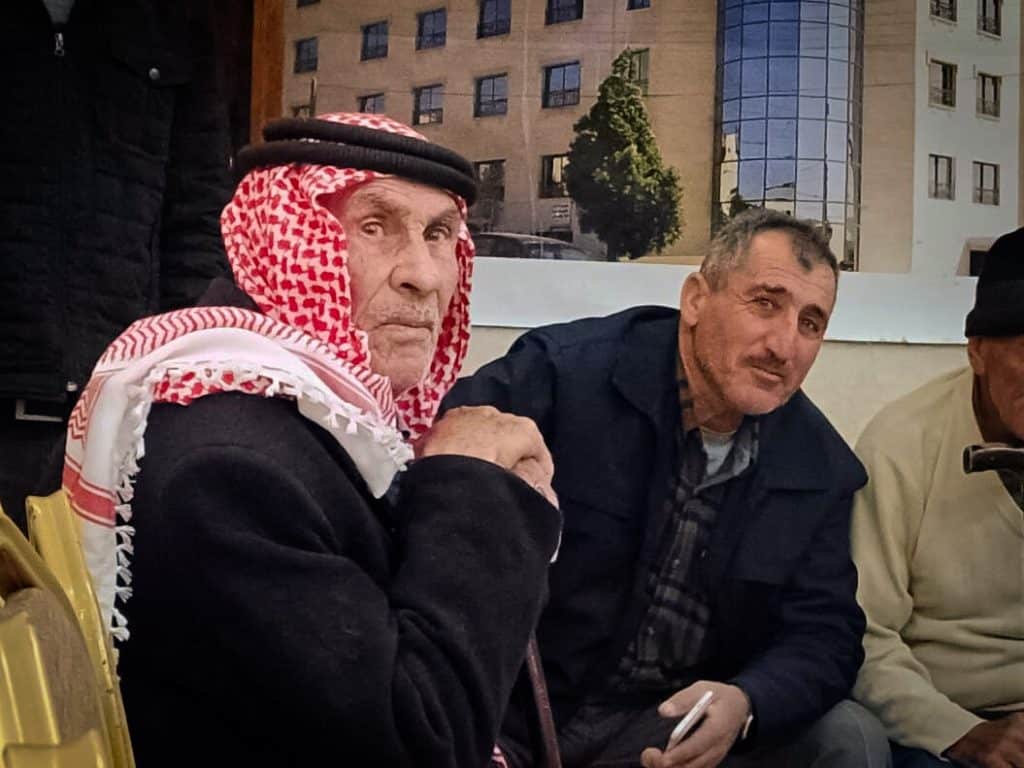 Abu Falah public hall. (Photo: Qassam Muaddi/Mondoweiss)
Saif stands up to accept condolences from a new group of mourners who enter the hall, one of whom embraces him in clear emotion. After a while, Saif returns to his seat and continues to speak. “On Saturday, Thaer walked by the store where I work in Ramallah and just waved at me, smiling,” Saif sighs with a light smile. “We didn’t talk. He didn’t say anything. It was the last time I saw my brother alive.”
The next time he saw his brother dead was in the middle of the attack. “That same night, I was volunteering in transporting the wounded. At one point, there was a young man shot in the head and bleeding from the ears, and I rushed to help him,” Saif recounts. When he looked at the man’s lifeless face, it was Thaer.
‘Unprecedented trauma’ in Abu Falah
In the public hall, men sit in rows of chairs, some of them chatting as a few young men walk between the rows serving bitter coffee. One man in a red kufiyyeh sits in complete silence, as if contemplating. “That is my grandfather from my mother’s side, he hasn’t yet comprehended the loss of Thaer,” says Saif Hamayel, 26, the brother of Thaer Hamayel, one of the three victims.
“My other grandfather on my father’s side has been missing since 1967, when he left to join the fida’iyyin [PLO guerrilla fighters] during the war. He was never heard from again,” Saif says. “My father was his only son, and he was only one year old. That’s the same age as Thaer’s son, who will also now grow up without a father alongside his three-year-old sister.”
Abu Falah public hall. (Photo: Qassam Muaddi/Mondoweiss)Saif stands up to accept condolences from a new group of mourners who enter the hall, one of whom embraces him in clear emotion. After a while, Saif returns to his seat and continues to speak. “On Saturday, Thaer walked by the store where I work in Ramallah and just waved at me, smiling,” Saif sighs with a light smile. “We didn’t talk. He didn’t say anything. It was the last time I saw my brother alive.”
The next time he saw his brother dead was in the middle of the attack. “That same night, I was volunteering in transporting the wounded. At one point, there was a young man shot in the head and bleeding from the ears, and I rushed to help him,” Saif recounts. When he looked at the man’s lifeless face, it was Thaer.
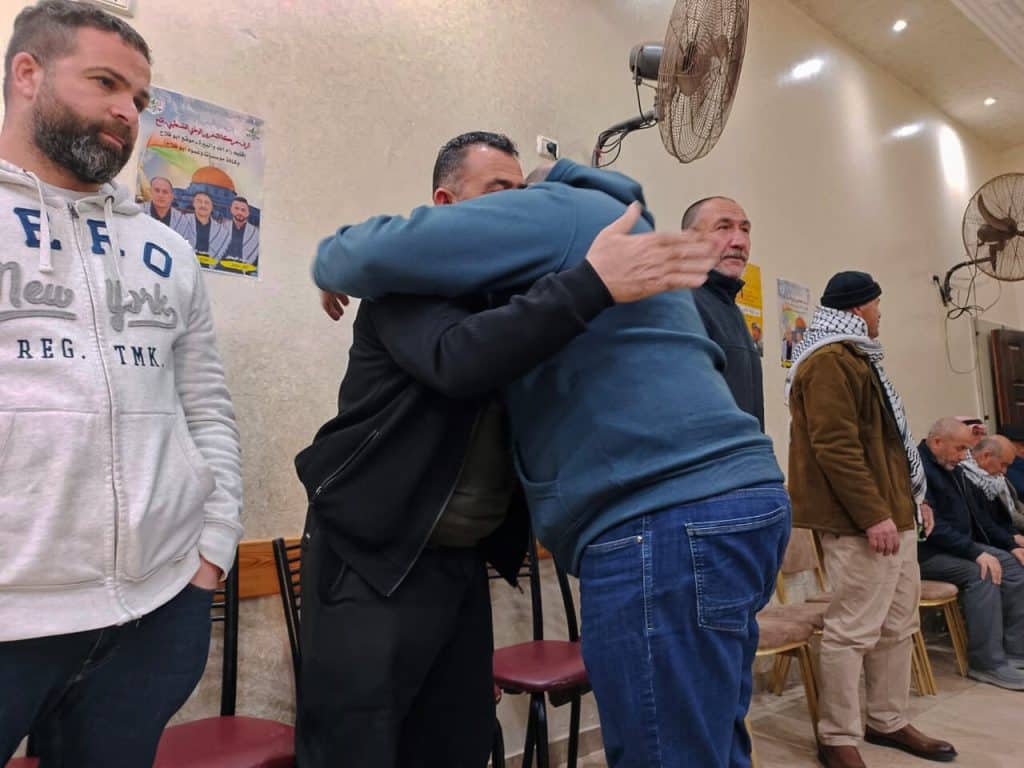
Abu Falah public hall. (Photo: Qassam Muaddi/Mondoweiss)
Thaer used to work in construction. His brother recalls that he loved life and always smiled, “He liked stopping by the village to say hello to people, and he was always ready to help,” says Seif.
Beside Saif sits a man in his fifties. He turns the prayer beads, a misbaha, in his hand, his face expressionless. I learn that his name is Yasser, the younger brother of another of the three martyrs, 55-year-old Fari’ Hamayel. As he listens to Saif’s account, he shares his own. “Thaer was among the first to rush to the location when settlers attacked, and he saw Fari’ there,” Yasser says. “They were together when I spoke with Fari’ on the phone during the settler attack.”
“There’s a feeling of vulnerability and humiliation that you can be killed in our own town without consequences.”Muhammad Abu Karsh
That was the last time he spoke to his brother, he says, before turning his eyes back to the ground, resuming turning the beads of the misbaha. He continues talking without looking up. “I never imagined that Fari’ would die this way. We worked together in stone cutting, because there are a lot of stone quarries in our region,” he says.
When they were young, Fari’ decided to try his luck in America. They were the only three years he and his brother were apart. When he finally came back to Palestine, he married and had children. “We raised our kids together,” Yasser says. “I knew that he was killed in the morning, and I still can’t understand what happened.”
Thaer used to work in construction. His brother recalls that he loved life and always smiled, “He liked stopping by the village to say hello to people, and he was always ready to help,” says Seif.
Beside Saif sits a man in his fifties. He turns the prayer beads, a misbaha, in his hand, his face expressionless. I learn that his name is Yasser, the younger brother of another of the three martyrs, 55-year-old Fari’ Hamayel. As he listens to Saif’s account, he shares his own. “Thaer was among the first to rush to the location when settlers attacked, and he saw Fari’ there,” Yasser says. “They were together when I spoke with Fari’ on the phone during the settler attack.”
“There’s a feeling of vulnerability and humiliation that you can be killed in our own town without consequences.”Muhammad Abu Karsh
That was the last time he spoke to his brother, he says, before turning his eyes back to the ground, resuming turning the beads of the misbaha. He continues talking without looking up. “I never imagined that Fari’ would die this way. We worked together in stone cutting, because there are a lot of stone quarries in our region,” he says.
When they were young, Fari’ decided to try his luck in America. They were the only three years he and his brother were apart. When he finally came back to Palestine, he married and had children. “We raised our kids together,” Yasser says. “I knew that he was killed in the morning, and I still can’t understand what happened.”
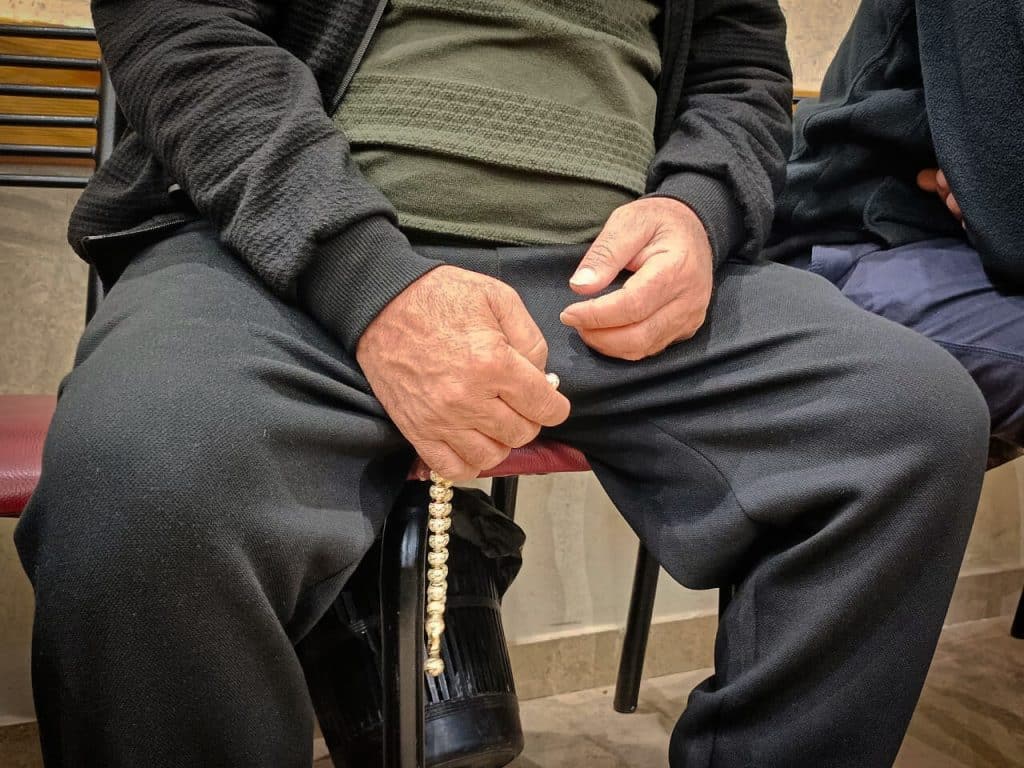
Abu Falah public hall. (Photo: Qassam Muaddi/Mondoweiss)
The settler attack ended at around 2 a.m., according to residents, only to give way to an Israeli army raid, which lasted until the morning. “The occupation army was nearby the whole time, and it did nothing to stop the settlers. They only came in when the settlers began to withdraw,” says Muhammad Abu Karsh, the Civil Defense volunteer. “We all rushed back to our homes as the military jeeps entered and began launching tear gas and stun grenades all over the place.
The army remained in the village until sunrise. When they left, people began to gather in the mosque, where it was confirmed that Fari’ and Thaer were killed, in addition to Muhammad Murra, who was shot by a settler in front of his house.
“The trauma is unprecedented in Abu Falah,” Abu Karsh reflects. “We are still in the middle of it. People don’t leave their homes anymore. Life seems paralyzed. There’s a feeling of vulnerability and humiliation that you can be killed in our own town without consequences, without justice being served.”
The settler attack ended at around 2 a.m., according to residents, only to give way to an Israeli army raid, which lasted until the morning. “The occupation army was nearby the whole time, and it did nothing to stop the settlers. They only came in when the settlers began to withdraw,” says Muhammad Abu Karsh, the Civil Defense volunteer. “We all rushed back to our homes as the military jeeps entered and began launching tear gas and stun grenades all over the place.
The army remained in the village until sunrise. When they left, people began to gather in the mosque, where it was confirmed that Fari’ and Thaer were killed, in addition to Muhammad Murra, who was shot by a settler in front of his house.
“The trauma is unprecedented in Abu Falah,” Abu Karsh reflects. “We are still in the middle of it. People don’t leave their homes anymore. Life seems paralyzed. There’s a feeling of vulnerability and humiliation that you can be killed in our own town without consequences, without justice being served.”
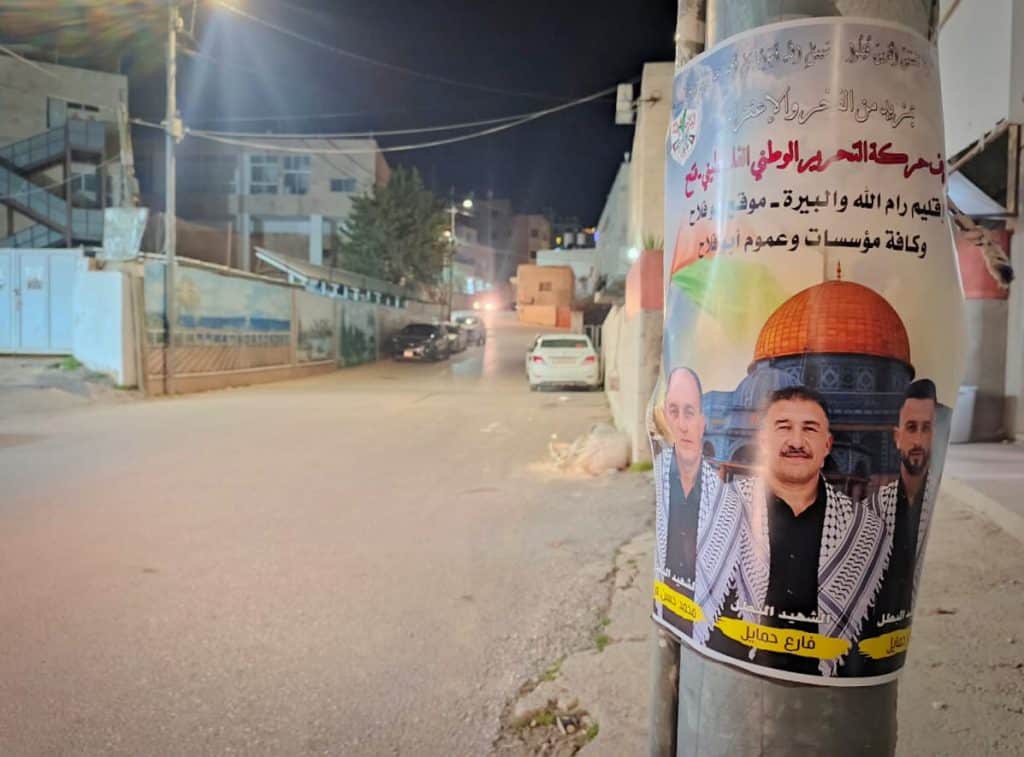
The three martyrs of Abu Falah, March 2026. (Photo: Qassam Muaddi/Mondoweiss)
This absence of justice is a matter of Israeli governmental policy. Last January, Israel’s hardline National Security Minister, Itamar Ben-Gvir, allowed for 18 additional Israeli settlements in the West Bank to issue firearm permits to settlers. In November 2024, the Israeli government cancelled the procedure of administrative detention for Israeli settlers in the West Bank, making it more difficult to arrest settlers accused of violent attacks against Palestinians.
The evening call to prayer marks the hour of iftar, when the community breaks its fast. Family members of the slain insist that mourners stay for the meal. Outside the public hall, people begin walking home as night falls in a remarkable silence. The street in the center of Abu Falah empties suddenly, while the faces of the three victims watch over it from the posters.
Qassam Muaddi
Qassam Muaddi is the Palestine Staff Writer for Mondoweiss. He covers social, political, and cultural developments in Palestine, and has written for several outlets in English and French, including the Catholic Terre Sainte Magazine and other outlets. Follow him on Twitter/X at @QassaMMuaddi.
This absence of justice is a matter of Israeli governmental policy. Last January, Israel’s hardline National Security Minister, Itamar Ben-Gvir, allowed for 18 additional Israeli settlements in the West Bank to issue firearm permits to settlers. In November 2024, the Israeli government cancelled the procedure of administrative detention for Israeli settlers in the West Bank, making it more difficult to arrest settlers accused of violent attacks against Palestinians.
The evening call to prayer marks the hour of iftar, when the community breaks its fast. Family members of the slain insist that mourners stay for the meal. Outside the public hall, people begin walking home as night falls in a remarkable silence. The street in the center of Abu Falah empties suddenly, while the faces of the three victims watch over it from the posters.
Qassam Muaddi
Qassam Muaddi is the Palestine Staff Writer for Mondoweiss. He covers social, political, and cultural developments in Palestine, and has written for several outlets in English and French, including the Catholic Terre Sainte Magazine and other outlets. Follow him on Twitter/X at @QassaMMuaddi.
Why is Israel trying to cause an ‘explosion’ in the West Bank?
Israel is cracking down on Palestinians in the West Bank and pushing the territory to the brink of a major conflagration. Here's why.
Creating ‘irreversible’ facts on the ground
Israel has entered a phase where it is trying to bring its conflict with its enemies to a “decisive end,” according to Palestinian historian Bilal Shalash.
This is clearly evidenced in its ongoing aggression in Iran and Lebanon, but the West Bank is another arena where Israel seeks to clear the deck. “Israel is motivated by the fact that its main sponsor and ally, the U.S., is trying to do the same thing at a global scale, from Latin America to Iran,” Shalash explains. “And in the case of Iran, it also happens to be the center of opposition to Israel’s domination in the region.”
Shalash argues that this marks a break with the previous Israeli policy of launching smaller-scale periodic crackdowns on Palestinian communities in a bid to avoid a major conflagration. Such limited waves of repression, which Shalash says Israeli officials have called “mowing the lawn,” were designed to keep political tensions below a certain threshold, and were “followed by periods of relative stability,” he explains.
This philosophy has been the doctrine governing Israel’s regime since it occupied the West Bank in 1967, Shalash explains. “Israeli generals recommended that as long as daily life went on normally, without any large-scale upheavals, Israel could deal with acts of resistance individually,” he noted.
“Israel has effectively dismantled all social structures that could produce any collective reaction to what it is doing in the West Bank.”Khaled Odetallah
But historically, Shalash says, Israel has also interrupted this strategy in favor of escalating its crackdown on Palestinians when a large-scale wave of Palestinian resistance caught it by surprise. “This was the case in the late 1960s and early 1970s, when there was a wave of Palestinian armed resistance,” he explained. “And in the late 1980s and early 1990s, which was in response to the First Intifada.”
Other events included Operation Defensive Shield in 2002, which responded to the Second Intifada, and the current unprecedented escalation over the past two years, which followed October 7, 2023.
The latter campaign, however, has also marked a qualitative shift, according to Shalash, who explains that the Hamas attack made Israeli leaders conclude that “mowing the lawn” no longer worked. “This intensified wave of Israeli repression has a new feature: it is attempting to create demographic and geographic realities that are irreversible,” he said.
Those irreversible facts are the displacement of thousands of Palestinians, sometimes erasing communities in their entirety, from large parts of the West Bank while de facto annexing those areas. It is supposed to lead to what Shalash describes as a “‘decisive’ outcome” in which “Palestinians would be cornered in isolated ghettoes inside an annexed territory.”
“They would have no political system of their own, and they would live in conditions that push them to leave the country in large numbers,” Shalash explained.
Whether this actually comes to pass, however, depends on how Palestinians react, Shalash stresses.
This particular factor is the main difference between the current Israeli crackdown and previous ones, says Khaled Odetallah, the founder of Palestine’s Popular University and one of the co-editors of Al-Janub: The Palestinian Journal for Liberation Studies.
“The difference is that this time Israel is also taking advantage of the general paralysis in Palestinian society as a result of a heavy crackdown that has been ongoing for several years, and which has only doubled since October 2023,” Odetallah pointed out.
“Israel has effectively dismantled all social structures that could produce any collective reaction to what it is doing in the West Bank, from shutting down NGOs and human rights associations, to mass-arresting union and student activists, and even by displacing entire refugee camps, in Jenin and Tulkarem,” he noted.
In the absence of a strong Palestinian entity that is capable of pushing back, Odetallah says, “it is difficult to see how the ‘decisive’ process that Israel has set in motion in the West Bank can be halted.”
How to resist Israel’s ‘decisive’ plan
The situation Shalash and Odetallah paint is dire. But Odetallah says that things might even get worse.“The Palestinian Authority’s entire relevance relies on the Gulf states’ insistence on a Palestinian state as a condition of normalizing relations with Israel,” Odetallah explains, “But that might change as a result of the ongoing war on Iran.”
“We are not in the prelude to this ‘decisive’ process,” Odetallah says. “We are in the middle of it. It would normally trigger a reaction. But so far, that remains completely absent.”
For Odetallah, the main thing Palestinians need to consider now is to remain on their lands and to resist the unrelenting pressures that Israel is exerting upon Palestinian communities to pack up and leave. Palestinians have called this strategy sumud, or “steadfastness.” But Odetallah doesn’t consider it a passive position. “It is an effort to sustain people’s capacity to stay and live as a collective,” he explained. “This steadfastness requires a lot of work, socially and economically, and a lot of support, too, especially since the current ‘decisive’ Israeli offensive doesn’t show any sign of stopping.”
Since the beginning of Ramadan, three weeks ago, Israeli forces have conducted more than 200 arrests in the West Bank, according to the Palestinian Prisoners Club, which has also reported an increase in raids on Palestinian prisoners’ cells by Israeli prison service forces. Meanwhile, Israeli forces have demolished more than 300 Palestinian properties in the West Bank since the beginning of the year, according to the Jerusalem Legal Aid Center. This reality is coupled with the skyrocketing of Israeli settler violence, which has killed five Palestinians in the West Bank in the last week alone.
These measures are all coming to a head in the lead-up to the Israeli elections, due next November. In mid-February, Smotrich laid out his vision for the tasks of the Israeli government’s upcoming tasks in a public speech from a West Bank settlement. He stressed that the next Israeli government must “revoke the Oslo Accords and extend Israeli sovereignty” to the West Bank. He also said that Israel must “take practical steps to encourage emigration” of Palestinians out of the West Bank and Gaza.
According to Smotrich, this would secure a “long-term solution” to the Palestinian question. This “solution” is ethnic cleansing by any other name.
This is why the Israeli government is trying to provoke an eruption in the West Bank. It wants to use it as an excuse to move toward the “decisive” action it has sought for decades.
Israel is cracking down on Palestinians in the West Bank and pushing the territory to the brink of a major conflagration. Here's why.
March 11, 2026
Mondoweiss
Mondoweiss
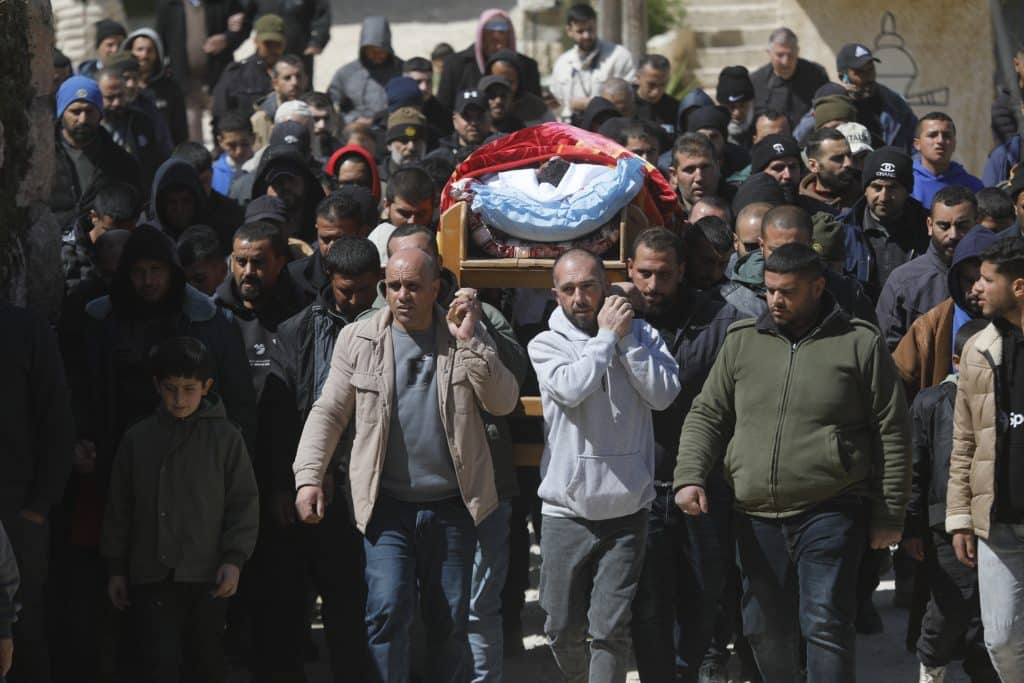
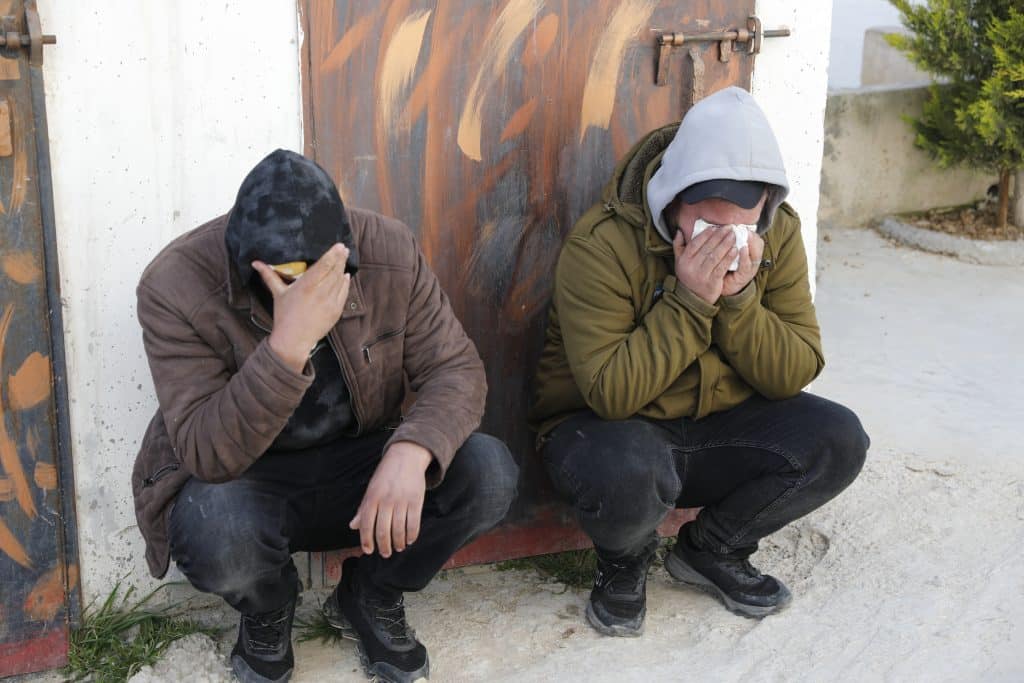
Residents of Yatta, south of Hebron, mourn the death of 27-year-old Amir Shanaran, who was killed by an Israeli settler, March 8, 2026. (Photo: Mamoun Wazwaz/APA Images)
Israel’s accelerating crackdown on the West Bank over the past two years has reached the point of feeling like the new normal. Palestinians say that the strangulation of their daily lives is here to stay, with many describing the regime of closures and land seizures as “irreversible.”
But this crackdown also runs contrary to the longstanding Israeli policy of avoiding “friction” in the West Bank to prevent an “explosion” among Palestinians in response to Israeli repression. This was the dominant approach of successive Israeli governments up until October 7, 2023.
In late February of this year, shortly before the beginning of Ramadan, the Israeli army and security branches warned the Israeli government of a possible escalation in Palestinian “violence” in the West Bank. The holy month has been known in the past to coincide with mounting political tensions due to the role the al-Aqsa Mosque in galvanizing protests around the right of Palestinians to pray freely at the holy site. Israel historically attempted to maintain calm during these months by allowing Palestinians from the West Bank to obtain permits to visit al-Aqsa.
But this year, Israel broke with convention, using only 10,000 permits for Palestinians to visit during Ramadan, a historic low made worse by the restriction of the permits to children under 12, men over 55, and women over 50. Then, once the U.S.-Israeli war on Iran started, Israel revoked all Ramadan-related permits.
These measures come after Israeli settlers stormed the al-Aqsa compound 24 times during February alone, with thousands of Israelis taking part in Jewish religious rituals in violation of the accepted status quo at the site.
This all represents a sharp escalation, given that similar provocations at al-Aqsa in Ramadan have elicited widespread protests across Jerusalem and the West Bank in the past. The most notable example was the 2021 “Unity Intifada” that broke out in response to settler provocations at al-Aqsa and the threat of displacing residents of the Sheikh Jarrah neighborhood.
It is as if the Israeli government is deliberately trying to provoke an eruption in the West Bank, running contrary to all warnings from the Israeli security establishment of an imminent “security escalation.” But why would Israel want such a conflagration?
Israel’s accelerating crackdown on the West Bank over the past two years has reached the point of feeling like the new normal. Palestinians say that the strangulation of their daily lives is here to stay, with many describing the regime of closures and land seizures as “irreversible.”
But this crackdown also runs contrary to the longstanding Israeli policy of avoiding “friction” in the West Bank to prevent an “explosion” among Palestinians in response to Israeli repression. This was the dominant approach of successive Israeli governments up until October 7, 2023.
In late February of this year, shortly before the beginning of Ramadan, the Israeli army and security branches warned the Israeli government of a possible escalation in Palestinian “violence” in the West Bank. The holy month has been known in the past to coincide with mounting political tensions due to the role the al-Aqsa Mosque in galvanizing protests around the right of Palestinians to pray freely at the holy site. Israel historically attempted to maintain calm during these months by allowing Palestinians from the West Bank to obtain permits to visit al-Aqsa.
But this year, Israel broke with convention, using only 10,000 permits for Palestinians to visit during Ramadan, a historic low made worse by the restriction of the permits to children under 12, men over 55, and women over 50. Then, once the U.S.-Israeli war on Iran started, Israel revoked all Ramadan-related permits.
These measures come after Israeli settlers stormed the al-Aqsa compound 24 times during February alone, with thousands of Israelis taking part in Jewish religious rituals in violation of the accepted status quo at the site.
This all represents a sharp escalation, given that similar provocations at al-Aqsa in Ramadan have elicited widespread protests across Jerusalem and the West Bank in the past. The most notable example was the 2021 “Unity Intifada” that broke out in response to settler provocations at al-Aqsa and the threat of displacing residents of the Sheikh Jarrah neighborhood.
It is as if the Israeli government is deliberately trying to provoke an eruption in the West Bank, running contrary to all warnings from the Israeli security establishment of an imminent “security escalation.” But why would Israel want such a conflagration?
Residents of Yatta, south of Hebron, mourn the death of 27-year-old Amir Shanaran, who was killed by an Israeli settler, March 8, 2026. (Photo: Mamoun Wazwaz/APA Images)
Creating ‘irreversible’ facts on the ground
Israel has entered a phase where it is trying to bring its conflict with its enemies to a “decisive end,” according to Palestinian historian Bilal Shalash.
This is clearly evidenced in its ongoing aggression in Iran and Lebanon, but the West Bank is another arena where Israel seeks to clear the deck. “Israel is motivated by the fact that its main sponsor and ally, the U.S., is trying to do the same thing at a global scale, from Latin America to Iran,” Shalash explains. “And in the case of Iran, it also happens to be the center of opposition to Israel’s domination in the region.”
Shalash argues that this marks a break with the previous Israeli policy of launching smaller-scale periodic crackdowns on Palestinian communities in a bid to avoid a major conflagration. Such limited waves of repression, which Shalash says Israeli officials have called “mowing the lawn,” were designed to keep political tensions below a certain threshold, and were “followed by periods of relative stability,” he explains.
This philosophy has been the doctrine governing Israel’s regime since it occupied the West Bank in 1967, Shalash explains. “Israeli generals recommended that as long as daily life went on normally, without any large-scale upheavals, Israel could deal with acts of resistance individually,” he noted.
“Israel has effectively dismantled all social structures that could produce any collective reaction to what it is doing in the West Bank.”Khaled Odetallah
But historically, Shalash says, Israel has also interrupted this strategy in favor of escalating its crackdown on Palestinians when a large-scale wave of Palestinian resistance caught it by surprise. “This was the case in the late 1960s and early 1970s, when there was a wave of Palestinian armed resistance,” he explained. “And in the late 1980s and early 1990s, which was in response to the First Intifada.”
Other events included Operation Defensive Shield in 2002, which responded to the Second Intifada, and the current unprecedented escalation over the past two years, which followed October 7, 2023.
The latter campaign, however, has also marked a qualitative shift, according to Shalash, who explains that the Hamas attack made Israeli leaders conclude that “mowing the lawn” no longer worked. “This intensified wave of Israeli repression has a new feature: it is attempting to create demographic and geographic realities that are irreversible,” he said.
Those irreversible facts are the displacement of thousands of Palestinians, sometimes erasing communities in their entirety, from large parts of the West Bank while de facto annexing those areas. It is supposed to lead to what Shalash describes as a “‘decisive’ outcome” in which “Palestinians would be cornered in isolated ghettoes inside an annexed territory.”
“They would have no political system of their own, and they would live in conditions that push them to leave the country in large numbers,” Shalash explained.
Whether this actually comes to pass, however, depends on how Palestinians react, Shalash stresses.
This particular factor is the main difference between the current Israeli crackdown and previous ones, says Khaled Odetallah, the founder of Palestine’s Popular University and one of the co-editors of Al-Janub: The Palestinian Journal for Liberation Studies.
“The difference is that this time Israel is also taking advantage of the general paralysis in Palestinian society as a result of a heavy crackdown that has been ongoing for several years, and which has only doubled since October 2023,” Odetallah pointed out.
“Israel has effectively dismantled all social structures that could produce any collective reaction to what it is doing in the West Bank, from shutting down NGOs and human rights associations, to mass-arresting union and student activists, and even by displacing entire refugee camps, in Jenin and Tulkarem,” he noted.
In the absence of a strong Palestinian entity that is capable of pushing back, Odetallah says, “it is difficult to see how the ‘decisive’ process that Israel has set in motion in the West Bank can be halted.”
How to resist Israel’s ‘decisive’ plan
The situation Shalash and Odetallah paint is dire. But Odetallah says that things might even get worse.“The Palestinian Authority’s entire relevance relies on the Gulf states’ insistence on a Palestinian state as a condition of normalizing relations with Israel,” Odetallah explains, “But that might change as a result of the ongoing war on Iran.”
“We are not in the prelude to this ‘decisive’ process,” Odetallah says. “We are in the middle of it. It would normally trigger a reaction. But so far, that remains completely absent.”
For Odetallah, the main thing Palestinians need to consider now is to remain on their lands and to resist the unrelenting pressures that Israel is exerting upon Palestinian communities to pack up and leave. Palestinians have called this strategy sumud, or “steadfastness.” But Odetallah doesn’t consider it a passive position. “It is an effort to sustain people’s capacity to stay and live as a collective,” he explained. “This steadfastness requires a lot of work, socially and economically, and a lot of support, too, especially since the current ‘decisive’ Israeli offensive doesn’t show any sign of stopping.”
Since the beginning of Ramadan, three weeks ago, Israeli forces have conducted more than 200 arrests in the West Bank, according to the Palestinian Prisoners Club, which has also reported an increase in raids on Palestinian prisoners’ cells by Israeli prison service forces. Meanwhile, Israeli forces have demolished more than 300 Palestinian properties in the West Bank since the beginning of the year, according to the Jerusalem Legal Aid Center. This reality is coupled with the skyrocketing of Israeli settler violence, which has killed five Palestinians in the West Bank in the last week alone.
These measures are all coming to a head in the lead-up to the Israeli elections, due next November. In mid-February, Smotrich laid out his vision for the tasks of the Israeli government’s upcoming tasks in a public speech from a West Bank settlement. He stressed that the next Israeli government must “revoke the Oslo Accords and extend Israeli sovereignty” to the West Bank. He also said that Israel must “take practical steps to encourage emigration” of Palestinians out of the West Bank and Gaza.
According to Smotrich, this would secure a “long-term solution” to the Palestinian question. This “solution” is ethnic cleansing by any other name.
This is why the Israeli government is trying to provoke an eruption in the West Bank. It wants to use it as an excuse to move toward the “decisive” action it has sought for decades.
Israel ‘strangles’ West Bank amid war on Iran
With the world's attention focused on the U.S.-Israeli war on Iran, Israel is making conditions unlivable for Palestinians in the West Bank. Residents say that every Israeli measure to "strangle" Palestinians feels like it's "irreversible."
With the world's attention focused on the U.S.-Israeli war on Iran, Israel is making conditions unlivable for Palestinians in the West Bank. Residents say that every Israeli measure to "strangle" Palestinians feels like it's "irreversible."
March 7, 2026
Mondoweiss

Mondoweiss
Palestinians wait at an Israeli military checkpoint near Nablus after Israeli forces close checkpoints and iron gates at the entrances of Palestinian cities during the ongoing U.S.-Israeli war on Iran, March 3, 2026. (Photo: Mohammed Nasser/APA Images)
It is the thirteenth day of the holy month of Ramadan, and Palestinian roads in the West Bank are almost empty at sunset as people break their fast. Since the U.S.-Israeli war on Iran started last Saturday, the Israeli army has closed all checkpoints between Palestinian towns and cities, paralyzing movement.
The road closures came amid unprecedented economic pressure. Around 160,000 Palestinians who worked as daily laborers in Israel or Israeli settlements before October 7, 2023, have had their work permits revoked by Israel. In addition, the Palestinian Authority (PA), which is the largest employer in the West Bank, hasn’t been able to pay full salaries for two years, since Israel continues to withhold customs funds that it collects on behalf of the PA in accordance with the 1993 Oslo Accords.
But this Ramadan, Palestinians are also facing a new surge in settler violence, crippling their access to what remains of their lands, largely away from international attention.
Road blocks
On the first day of the war, the Israeli army installed a new iron gate on the road between the towns of Deir Jarir and Silwad, northeast of Ramallah. Along with another iron gate at the other end of Silwad, installed during the first Gaza ceasefire in January of last year, the Palestinian town has become virtually trapped in a cage.
With some 8,000 inhabitants, Silwad is the commercial and administrative center of the eastern Ramallah area, with a courthouse, an emergency medical center, a public registration office, and multiple commercial centers serving 12 Palestinian villages. More importantly, since the Israeli army blocked most of the roads in October 2023, Silwad has become the only way for around 28,000 Palestinians to reach Ramallah.
Near the town’s main roundabout, a small soft drinks shop is open, with only two customers inside. It would usually be full after Iftar on a Ramadan evening, but this Ramadan is different. “It’s not just the closure, “Ahmad, the shop owner, tells Mondoweiss. “Things have already been very difficult for people this year. Even before the war broke out, families had been saving every shekel.”
Travel has also become unpredictable since the war started, Ahmad says, with soldiers closing the gate and searching cars for hours every day. “Fewer people stop by, and now with the new gate on the other side of town, we will be even more isolated,” he pointed out. “The occupation is strangling us, separating each town and village.”
As soon as the war on Iran started, the Israeli army announced the closure of all checkpoints across the West Bank. These included the Zaatara checkpoint, halfway between Ramallah and Nablus in the north, and “the Container” checkpoint between Ramallah and Bethlehem to the south. These checkpoints are the primary nodes connecting the three main regions of the West Bank — north, center, and south. Shutting them down has hermetically sealed West Bank cities, while the countryside is blockaded through the tightening of hundreds of local checkpoints and iron gates, much like the ones around Silwad.
The Israeli army partially reopened some of these gates after the fourth day of the war on Tuesday, maintaining closures for hours at a time during the day and only periodically opening them to ease a fraction of the congestion. The situation became so unpredictable that the PA decreed last Tuesday that schools were to be closed and classes held online. Only employees who couldn’t work from home were to be called to work.
No access to Jerusalem
Simultaneously, the Israeli army sealed off the West Bank entirely, adding to the strangulation. Palestinians were unable to travel to Jerusalem or abroad via the Allenby Bridge, which connects the West Bank to Jordan, for five days. Even before the war, Israel had drastically restricted the access of Palestinians from the West Bank to Jerusalem, an unprecedented measure during Ramadan.
The Israeli army had previously announced that only Palestinians younger than 12 and older than 50 for women and 55 for men were considered eligible for an entry permit to visit al-Aqsa Mosque. Only 10,000 permits were granted. In previous years, Palestinians of these age groups were allowed into Jerusalem without a permit during Ramadan.
After the war, even these limited permissions were revoked wholesale.
“Praying at Al-Aqsa Mosque during Ramadan is an important part of celebrating the holy month for us,” Ahmad, the shop-owner, said. “We knew that this year, entry to Jerusalem would be more restricted than before. But when the war began, they revoked everything.”
He added that his brother had brain surgery scheduled in Jerusalem and had gone through the full process to obtain a permit, including submitting a report from the Israeli doctor who was supposed to operate on him. The permit was finally approved, he said, but it was also revoked, just as his brother was preparing for the operation.
Settler violence surges
The didn’t only bring with it tightening restrictions and blanket closures. It also emboldened groups of Israeli settlers to launch attacks on villages in the countryside. Five minutes from Silwad, in the town of Taybeh, a resident who asked not to be named described what they said was the largest settler incursion yet into the town, which took place on the second day of the war.
According to the resident, about eight settlers arrived by car carrying sticks and drove all the way into the center of Taybeh, something they said settlers had previously done only on the outskirts. The group moved through the town for nearly an hour while Israeli soldiers watched from roughly a hundred meters away. Residents stayed indoors or kept their distance as settlers damaged a parked car and stole two horses from a nearby stable before leaving.
“For about an hour, life in the town was paralyzed,” the resident said, as people avoided the settlers out of fear of being attacked or drawn into a confrontation. That would have ended with Israeli soldiers intervening and making arrests. Incidents like these, the resident added, are increasingly part of “daily life,” leaving residents feeling that there is “no safety” even in a town long considered peaceful.
The attack on Taybeh isn’t an isolated incident. Israeli settlers have intensified their raids on Palestinian villages and the outskirts of towns across the West Bank.
In the village of Qusra, east of Nablus, settlers attacked Palestinian farmers and Israeli peace activists accompanying them last Friday, only a day before the war began. They were beaten with sticks, sending at least one person to the hospital. Three days later, the village was targeted in another settler pogrom. According to the village’s social media pages, the attack left an elderly resident injured.
In the nearby village of Qaryout, also east of Nablus, settlers opened fire on Palestinians during an attack on Monday, the third day of the war. Two brothers were killed near their home, Fahim and Muhammad Muammer, ages 48 and 51.
In Masafer Yatta in the south Hebron Hills, residents say Israeli settler violence has become a near-daily occurrence in the area since last week. Incidents have included raids on homes, the harassment of families, shootings at farmers, shepherds being driven from grazing lands, and releasing livestock onto Palestinians’ property in order to damage their agriculture.
Meanwhile, the PA’s settlement watchdog, the National Bureau for the Defense of Land (NBDL), reported on Saturday that the Israeli government had begun discussing a plan to build over 1,300 settlement housing units in the Qalqilya governorate in the northwestern West Bank. The project would narrow the distance between two major settlements in the area.
According to the NBDL, the Israeli cabinet has recently shifted from its previous practice of approving settlement projects four times a year to holding weekly meetings for that purpose. The Bureau described the move as the normalization and acceleration of “de facto annexation.”
Earlier in mid-February, Israel’s hardline Finance Minister, Bezalel Smotrich, who also oversees the military administration of the West Bank, said in a public speech that Israel should annex the entire territory and “encourage migration” of Palestinians. For Ahmad, the shop owner in Silwad, such policies are already being implemented in practice. It entails making life increasingly unlivable for Palestinians in the West Bank.
“It seems like everything they do is irreversible,” Ahmad said. “Every road blocked and every meter of land taken is definitive, and it only seems to get worse every day.” If such measures drew little reaction “when the whole world was watching” at the height of the Gaza genocide, he added, Israel is now likely to accelerate these policies even further, while global attention is focused on a major regional war.
It is the thirteenth day of the holy month of Ramadan, and Palestinian roads in the West Bank are almost empty at sunset as people break their fast. Since the U.S.-Israeli war on Iran started last Saturday, the Israeli army has closed all checkpoints between Palestinian towns and cities, paralyzing movement.
The road closures came amid unprecedented economic pressure. Around 160,000 Palestinians who worked as daily laborers in Israel or Israeli settlements before October 7, 2023, have had their work permits revoked by Israel. In addition, the Palestinian Authority (PA), which is the largest employer in the West Bank, hasn’t been able to pay full salaries for two years, since Israel continues to withhold customs funds that it collects on behalf of the PA in accordance with the 1993 Oslo Accords.
But this Ramadan, Palestinians are also facing a new surge in settler violence, crippling their access to what remains of their lands, largely away from international attention.
Road blocks
On the first day of the war, the Israeli army installed a new iron gate on the road between the towns of Deir Jarir and Silwad, northeast of Ramallah. Along with another iron gate at the other end of Silwad, installed during the first Gaza ceasefire in January of last year, the Palestinian town has become virtually trapped in a cage.
With some 8,000 inhabitants, Silwad is the commercial and administrative center of the eastern Ramallah area, with a courthouse, an emergency medical center, a public registration office, and multiple commercial centers serving 12 Palestinian villages. More importantly, since the Israeli army blocked most of the roads in October 2023, Silwad has become the only way for around 28,000 Palestinians to reach Ramallah.
Near the town’s main roundabout, a small soft drinks shop is open, with only two customers inside. It would usually be full after Iftar on a Ramadan evening, but this Ramadan is different. “It’s not just the closure, “Ahmad, the shop owner, tells Mondoweiss. “Things have already been very difficult for people this year. Even before the war broke out, families had been saving every shekel.”
Travel has also become unpredictable since the war started, Ahmad says, with soldiers closing the gate and searching cars for hours every day. “Fewer people stop by, and now with the new gate on the other side of town, we will be even more isolated,” he pointed out. “The occupation is strangling us, separating each town and village.”
As soon as the war on Iran started, the Israeli army announced the closure of all checkpoints across the West Bank. These included the Zaatara checkpoint, halfway between Ramallah and Nablus in the north, and “the Container” checkpoint between Ramallah and Bethlehem to the south. These checkpoints are the primary nodes connecting the three main regions of the West Bank — north, center, and south. Shutting them down has hermetically sealed West Bank cities, while the countryside is blockaded through the tightening of hundreds of local checkpoints and iron gates, much like the ones around Silwad.
The Israeli army partially reopened some of these gates after the fourth day of the war on Tuesday, maintaining closures for hours at a time during the day and only periodically opening them to ease a fraction of the congestion. The situation became so unpredictable that the PA decreed last Tuesday that schools were to be closed and classes held online. Only employees who couldn’t work from home were to be called to work.
No access to Jerusalem
Simultaneously, the Israeli army sealed off the West Bank entirely, adding to the strangulation. Palestinians were unable to travel to Jerusalem or abroad via the Allenby Bridge, which connects the West Bank to Jordan, for five days. Even before the war, Israel had drastically restricted the access of Palestinians from the West Bank to Jerusalem, an unprecedented measure during Ramadan.
The Israeli army had previously announced that only Palestinians younger than 12 and older than 50 for women and 55 for men were considered eligible for an entry permit to visit al-Aqsa Mosque. Only 10,000 permits were granted. In previous years, Palestinians of these age groups were allowed into Jerusalem without a permit during Ramadan.
After the war, even these limited permissions were revoked wholesale.
“Praying at Al-Aqsa Mosque during Ramadan is an important part of celebrating the holy month for us,” Ahmad, the shop-owner, said. “We knew that this year, entry to Jerusalem would be more restricted than before. But when the war began, they revoked everything.”
He added that his brother had brain surgery scheduled in Jerusalem and had gone through the full process to obtain a permit, including submitting a report from the Israeli doctor who was supposed to operate on him. The permit was finally approved, he said, but it was also revoked, just as his brother was preparing for the operation.
Settler violence surges
The didn’t only bring with it tightening restrictions and blanket closures. It also emboldened groups of Israeli settlers to launch attacks on villages in the countryside. Five minutes from Silwad, in the town of Taybeh, a resident who asked not to be named described what they said was the largest settler incursion yet into the town, which took place on the second day of the war.
According to the resident, about eight settlers arrived by car carrying sticks and drove all the way into the center of Taybeh, something they said settlers had previously done only on the outskirts. The group moved through the town for nearly an hour while Israeli soldiers watched from roughly a hundred meters away. Residents stayed indoors or kept their distance as settlers damaged a parked car and stole two horses from a nearby stable before leaving.
“For about an hour, life in the town was paralyzed,” the resident said, as people avoided the settlers out of fear of being attacked or drawn into a confrontation. That would have ended with Israeli soldiers intervening and making arrests. Incidents like these, the resident added, are increasingly part of “daily life,” leaving residents feeling that there is “no safety” even in a town long considered peaceful.
The attack on Taybeh isn’t an isolated incident. Israeli settlers have intensified their raids on Palestinian villages and the outskirts of towns across the West Bank.
In the village of Qusra, east of Nablus, settlers attacked Palestinian farmers and Israeli peace activists accompanying them last Friday, only a day before the war began. They were beaten with sticks, sending at least one person to the hospital. Three days later, the village was targeted in another settler pogrom. According to the village’s social media pages, the attack left an elderly resident injured.
In the nearby village of Qaryout, also east of Nablus, settlers opened fire on Palestinians during an attack on Monday, the third day of the war. Two brothers were killed near their home, Fahim and Muhammad Muammer, ages 48 and 51.
In Masafer Yatta in the south Hebron Hills, residents say Israeli settler violence has become a near-daily occurrence in the area since last week. Incidents have included raids on homes, the harassment of families, shootings at farmers, shepherds being driven from grazing lands, and releasing livestock onto Palestinians’ property in order to damage their agriculture.
Meanwhile, the PA’s settlement watchdog, the National Bureau for the Defense of Land (NBDL), reported on Saturday that the Israeli government had begun discussing a plan to build over 1,300 settlement housing units in the Qalqilya governorate in the northwestern West Bank. The project would narrow the distance between two major settlements in the area.
According to the NBDL, the Israeli cabinet has recently shifted from its previous practice of approving settlement projects four times a year to holding weekly meetings for that purpose. The Bureau described the move as the normalization and acceleration of “de facto annexation.”
Earlier in mid-February, Israel’s hardline Finance Minister, Bezalel Smotrich, who also oversees the military administration of the West Bank, said in a public speech that Israel should annex the entire territory and “encourage migration” of Palestinians. For Ahmad, the shop owner in Silwad, such policies are already being implemented in practice. It entails making life increasingly unlivable for Palestinians in the West Bank.
“It seems like everything they do is irreversible,” Ahmad said. “Every road blocked and every meter of land taken is definitive, and it only seems to get worse every day.” If such measures drew little reaction “when the whole world was watching” at the height of the Gaza genocide, he added, Israel is now likely to accelerate these policies even further, while global attention is focused on a major regional war.

No comments:
Post a Comment