Tuesday, August 01, 2023

Sun ‘umbrella’ tethered to asteroid might help mitigate climate change


Peer-Reviewed Publication

UNIVERSITY OF HAWAII AT MANOA

Rendering of sun umbrella 

IMAGE: ARTIST’S RENDITION OF THE PROPOSED SOLAR SHIELD TETHERED TO AN ASTEROID AS A COUNTERWEIGHT. view more 

CREDIT: CREDIT: BROOKS BAYS/UH INSTITUTE FOR ASTRONOMY


New algorithm ensnares its first ‘potentially hazardous’ asteroid

Reports and Proceedings

UNIVERSITY OF WASHINGTON

2022 SF289 orbit video 

VIDEO: VIDEO SHOWING THE ORBIT OF 2022 SF289 (IN GREEN) RELATIVE TO THE ORBIT OF EARTH (BLUE) AND OTHER PLANETS IN THE SOLAR SYSTEM (VENUS IN ORANGE, MARS IN RED). LINK TO ORIGINAL FILE: HTTPS://DRIVE.GOOGLE.COM/FILE/D/1KCSKCXBHMWMFMC_U00JTPY5ZJ0HM5EF4/VIEW?USP=SHARING CREDIT: JOACHIM MOEYENS/UNIVERSITY OF WASHINGTON/OPENSPACE YOUTUBE NARRATED VIDEO: HTTPS://WWW.YOUTUBE.COM/WATCH?V=BSUUWT4UDKG view more 

CREDIT: JOACHIM MOEYENS/UNIVERSITY OF WASHINGTON/OPENSPACE


Link to Google Drive folder containing images, videos and caption/credit information:

https://drive.google.com/drive/folders/19LP7UZbVKkTXSFds6DaKSy1lp014Hw4z?usp=sharing


Link to release:

https://www.washington.edu/news/2023/07/31/heliolinc3d/


An asteroid discovery algorithm — designed to uncover near-Earth asteroids for the Vera C. Rubin Observatory’s upcoming 10-year survey of the night sky — has identified its first “potentially hazardous” asteroid, a term for space rocks in Earth’s vicinity that scientists like to keep an eye on. The roughly 600-foot-long asteroid, designated 2022 SF289, was discovered during a test drive of the algorithm with the ATLAS survey in Hawaii. Finding 2022 SF289, which poses no risk to Earth for the foreseeable future, confirms that the next-generation algorithm, known as HelioLinc3D, can identify near-Earth asteroids with fewer and more dispersed observations than required by today’s methods.

“By demonstrating the real-world effectiveness of the software that Rubin will use to look for thousands of yet-unknown potentially hazardous asteroids, the discovery of 2022 SF289 makes us all safer,” said Rubin scientist Ari Heinze, the principal developer of HelioLinc3D and a researcher at the University of Washington.

The solar system is home to tens of millions of rocky bodies ranging from small asteroids not larger than a few feet, to dwarf planets the size of our moon. These objects remain from an era over four billion years ago, when the planets in our system formed and took their present-day positions.

Most of these bodies are distant, but a number orbit close to the Earth, and are known as near-Earth objects, or NEOs. The closest of these — those with a trajectory that takes them within about 5 million miles of Earth’s orbit, or about 20 times the distance from Earth to the moon — warrant special attention. Such “potentially hazardous asteroids,” or PHAs, are systematically searched for and monitored to ensure they won’t collide with Earth, a potentially devastating event.

Scientists search for PHAs using specialized telescope systems like the NASA-funded ATLAS survey, run by a team at the University of Hawaii’s Institute for Astronomy. They do so by taking images of parts of the sky at least four times every night. A discovery is made when they notice a point of light moving unambiguously in a straight line over the image series. Scientists have discovered about 2,350 PHAs using this method, but estimate that at least as many more await discovery.

From its peak in the Chilean Andes, the Vera C. Rubin Observatory is set to join the hunt for these objects in early 2025. Funded primarily by the U.S. National Science Foundation and the U.S. Department of Energy, Rubin’s observations will dramatically increase the discovery rate of PHAs. Rubin will scan the sky unprecedentedly quickly with its 8.4-meter mirror and massive 3,200-megapixel camera, visiting spots on the sky twice per night rather than the four times needed by present telescopes. But with this novel observing "cadence," researchers need a new type of discovery algorithm to reliably spot space rocks.

Rubin’s solar system software team at the University of Washington’s DiRAC Institute has been working to just develop such codes. Working with Smithsonian senior astrophysicist and Harvard University lecturer Matthew Holman, who in 2018 pioneered a new class of heliocentric asteroid search algorithms, Heinze and Siegfried Eggl, a former University of Washington researcher who is now an assistant professor at the University of Illinois at Urbana-Champaign, developed HelioLinc3D: a code that could find asteroids in Rubin’s dataset. With Rubin still under construction, Heinze and Eggl wanted to test HelioLinc3D to see if it could discover a new asteroid in existing data, one with too few observations to be discovered by today’s conventional algorithms.

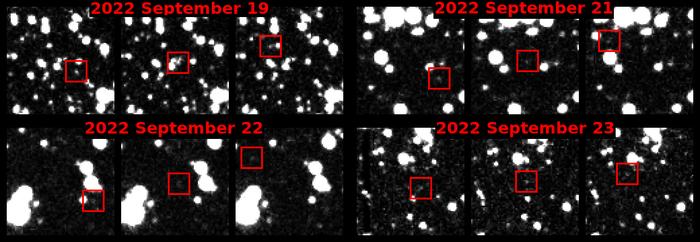
John Tonry and Larry Denneau, lead ATLAS astronomers, offered their data for a test. The Rubin team set HelioLinc3D to search through this data and on July 18, 2023 it spotted its first PHA: 2022 SF289, initially imaged by ATLAS on September 19, 2022 at a distance of 13 million miles from Earth.

In retrospect, ATLAS had observed 2022 SF289 three times on four separate nights, but never the requisite four times on one night to be identified as a new NEO. But these are just the occasions where HelioLinc3D excels: It successfully combined fragments of data from all four nights and made the discovery.

“Any survey will have difficulty discovering objects like 2022 SF289 that are near its sensitivity limit, but HelioLinc3D shows that it is possible to recover these faint objects as long as they are visible over several nights,” said Denneau. “This in effect gives us a ‘bigger, better’ telescope.”

Other surveys had also missed 2022 SF289, because it was passing in front of the rich starfields of the Milky Way. But by now knowing where to look, additional observations from Pan-STARRS and Catalina Sky Survey quickly confirmed the discovery. The team used B612 Asteroid Institute’s ADAM platform to recover further unrecognized observations by the NSF-supported Zwicky Transient Facility telescope.

2022 SF289 is classified as an Apollo-type NEO. Its closest approach brings it within 140,000 miles of Earth’s orbit, closer than the moon. Its diameter of 600ft is large enough to be classified as “potentially hazardous.” But despite its proximity, projections indicate that it poses no danger of hitting Earth for the foreseeable future. Its discovery has been announced in the International Astronomical Union’s Minor Planet Electronic Circular MPEC 2023-O26.

Currently, scientists know of 2,350 PHAs but expect there are more than 3,000 yet to be found.

“This is just a small taste of what to expect with the Rubin Observatory in less than two years, when HelioLinc3D will be discovering an object like this every night,” said Rubin scientist Mario Jurić, director of the DiRAC Institute, professor of astronomy at the University of Washington and leader of the team behind HelioLinc3D.  “But more broadly, it’s a preview of the coming era of data-intensive astronomy. From HelioLinc3D to AI-assisted codes, the next decade of discovery will be a story of advancement in algorithms as much as in new, large, telescopes.”

Financial support for Rubin Observatory comes from the U.S. National Science Foundation, the U.S. Department of Energy and private funding raised by the LSST Corporation.

###

For more information, contact Heinze at aheinze@uw.edu and Jurić at mjuric@uw.edu.


Link to Google Drive folder containing images, videos and caption/credit information:

https://drive.google.com/drive/folders/19LP7UZbVKkTXSFds6DaKSy1lp014Hw4z?usp=sharing


Link to video showing the orbit of 2022 SF289 relative to the orbit of Earth and other planets in the solar system:

https://drive.google.com/file/d/1kCsKCxbHmWmFMC_u00JtpY5zJ0HM5EF4/view?usp=sharing

Credit: Joachim Moeyens/University of Washington/OpenSpace
 

Link to narrated video:

https://drive.google.com/file/d/1xFPFdJCDnGBGhG5pCtevf08CjSevrHYj/view?usp=sharing

YouTube: https://www.youtube.com/watch?v=bsuUWt4udKg

Credit: Joachim Moeyens/Ari Heinze/Nikolina Horvat/University of Washington/OpenSpace


Additional resources:

  • Photos of the Vera C. Rubin Observatory
  • Videos of the Vera C. Rubin Observatory

For the first time bioelectronic medicine researchers at the Feinstein Institutes restore feeling and lasting movement in man living with quadriplegia

Using brain implants, artificial intelligence and novel stimulation electrodes, a double neural bypass technology restores a man’s sense of touch and movement after a 2020 diving accident


THE FEINSTEIN INSTITUTES FOR MEDICAL RESEARCH AT NORTHWELL HEALTH

Man Living With Paralysis Has Feeling, Lasting Movement Restored in Arm and Hand 

VIDEO: USING BRAIN IMPLANTS, AI, AND NOVEL STIMULATION TECHNOLOGY, RESEARCHERS COMPLETE THE FIRST 'DOUBLE NEURAL BYPASS' view more 

CREDIT: THE FEINSTEIN INSTITUTES FOR MEDICAL RESEARCH AT NORTHWELL HEALTH


MANHASSET, NY – In a first-of-its-kind clinical trial, bioelectronic medicine researchers, engineers and surgeons at Northwell Health’s The Feinstein Institutes for Medical Research have successfully implanted microchips into the brain of a man living with paralysis, and have developed artificial intelligence (AI) algorithms to re-link his brain to his body and spinal cord. This double neural bypass forms an electronic bridge that allows information to flow once again between the man’s paralyzed body and brain to restore movement and sensations in his hand with lasting gains in his arm and wrist outside of the laboratory. The research team unveiled the trial participant’s groundbreaking progress four months after a 15-hour open-brain surgery that took place on March 9 at North Shore University Hospital (NSUH).

“This is the first time the brain, body and spinal cord have been linked together electronically in a paralyzed human to restore lasting movement and sensation,” said Chad Bouton, professor in the Institute of Bioelectronic Medicine at the Feinstein Institutes, vice president of advanced engineering at Northwell Health, developer of the technology and principal investigator of the clinical trial. “When the study participant thinks about moving his arm or hand, we ‘supercharge’ his spinal cord and stimulate his brain and muscles to help rebuild connections, provide sensory feedback, and promote recovery. This type of thought-driven therapy is a game-changer. Our goal is to use this technology one day to give people living with paralysis the ability to live fuller, more independent lives.”

Paralyzed from the chest down, Keith Thomas, 45, of Massapequa, NY, is the first human to use the technology. During the height of the pandemic, on July 18, 2020, a diving accident caused Mr. Thomas to suffer injury at the C4 and C5 level of the vertebrae in his spine, leaving him unable to move and feel from the chest down. Alone and isolated in the hospital for more than six months, Mr. Thomas found new hope by participating in Prof. Bouton’s clinical trial and is grateful to be a part of something so historic and much larger than himself.

“There was a time that I didn’t know if I was even going to live, or if I wanted to, frankly. And now, I can feel the touch of someone holding my hand. It’s overwhelming,” said Mr. Thomas. “The only thing I want to do is to help others. That’s always been the thing I’m best at. If this can help someone even more than it’s helped me somewhere down the line, it’s all worth it.”

Over a hundred million people worldwide live with some form of movement impairment or paralysis. This clinical trial aims to restore lasting physical movement – outside of the research lab – and re-establish the sense of touch.

Feinstein Institutes’ researchers and clinicians, including Santosh Chandrasekaran, PhD and Adam Stein, MD, chair of  physical medicine and rehabilitation at Northwell Health, spent months mapping Mr. Thomas’ brain using functional MRIs to help pinpoint the areas responsible for both arm movement and for the sensation of touch in his hand. Armed with that information, surgeons performed a grueling 15-hour surgery at NSUH, during parts of which the study participant was awake and giving surgeons real-time feedback. As they probed portions of the surface of his brain, Mr. Thomas would tell them what sensations he was feeling in his hands.

“Because we had Keith’s images, and he was talking to us during parts of his surgery, we knew exactly where to place the brain implants,” said Ashesh Mehta, MD, PhD, professor at the Feinstein Institutes’ Institute of Bioelectronic Medicine, director Northwell’s Laboratory for Human Brain Mapping and the surgeon who performed the brain implant. “We inserted two chips in the area responsible for movement and three more in the part of the brain responsible for touch and feeling in the fingers.”

Back in the lab, through two ports protruding from Mr. Thomas’ head, he connects to a computer that uses AI to read, interpret and translate his thoughts into action, known as thought-driven therapy and the foundation of the double neural bypass approach.

The bypass starts with Mr. Thomas’ intentions (ie. he thinks about squeezing his hand), which sends electrical signals from his brain implant to a computer. The computer then sends signals to highly flexible, non-invasive electrode patches that are placed over his spine and hand muscles located in his forearm to stimulate and promote function and recovery. Tiny sensors at his fingertips and palm send touch and pressure information back to the sensory area of his brain to restore sensation. This two-arm electronic bridge forms the novel double neural bypass aimed at restoring both movement and the sense of touch. In the lab, Mr. Thomas can now move his arms at will and feel his sister's touch as she holds his hand in support. This is the first time he has felt anything in the three years since his accident.

Remarkably, researchers say Mr. Thomas is already starting to see some natural recovery from his injuries thanks to this new approach, which could reverse some of the damage for good. His arm strength has more than doubled since enrolling in the study and he is beginning to experience new sensations in his forearm and wrist, even when the system is off.

Previous research by Prof. Bouton, and later, by other groups, used a single neural bypass to help people move paralyzed limbs again with their thoughts. In those cases, doctors implanted one or more microchips in the brain that bypassed the spinal cord injury altogether and used stimulators to activate target muscles. However, that approach only worked while participants were hooked up to computers, often only available in laboratories, and did not restore movement and feeling in the actual limb while promoting plasticity for long-lasting natural recovery.

The hope is that the brain, body and spinal cord will relearn how to communicate, and new pathways will be forged at the injury site thanks to the double neural bypass, similar to how a kidney can regenerate to overcome trauma or disease.

“Millions of people live with paralysis and loss of feeling, with limited options available to improve their condition, “ said  Kevin J. Tracey, MD, president and CEO of the Feinstein Institutes and Karches Family Distinguished Chair in Medical Research. “Prof. Bouton and his team are committed to advancing new bioelectronic technologies and open new clinical paths to restore movement and sensation.” 

To download videos and photos of Mr. Thomas in the lab, in surgery and including sound bites from Prof. Bouton, Dr. Mehta and Mr. Thomas, click here.

The Feinstein Institutes for Medical Research is the global scientific home of bioelectronic medicine, which combines molecular medicine, neuroscience and biomedical engineering. At the Feinstein Institutes, medical researchers use modern technology to develop new device-based therapies to treat disease and injury. 

Built on years of research in molecular mechanisms of disease and the link between the nervous and immune systems, our researchers discover neural targets that can be activated or inhibited with neuromodulation devices, like vagus nerve implants, to control the body’s immune response and inflammation. If inflammation is successfully controlled, diseases – such as arthritis, pulmonary hypertension, Crohn's disease, inflammatory bowel diseases, diabetes, cancer and autoimmune diseases – can be treated more effectively. Beyond inflammation, using novel brain-computer interfaces, our researchers developed techniques to bypass injuries of the nervous system so that people living with paralysis can regain sensation and use their limbs. By producing bioelectronic medicine knowledge, disease and injury could one day be treated with our own nerves without costly and potentially harmful pharmaceuticals.

Keith Thomas, who lives with paralysis, poses with the research team at Northwell Health’s Feinstein Institutes for Medical Research that worked with him for months to restore lasting movement and feeling in his arm and hand. The first-of-its-kind ‘double neural bypass’ system uses brain implants and artificial intelligence to allow signals to and from Thomas’ brain to bypass the site of his injury.

CREDIT

About the Feinstein Institutes 

The Feinstein Institutes for Medical Research is the home of the research institutes of Northwell Health, the largest health care provider and private employer in New York State. Encompassing 50 research labs, 3,000 clinical research studies and 5,000 researchers and staff, the Feinstein Institutes raises the standard of medical innovation through its five institutes of behavioral science, bioelectronic medicine, cancer, health system science, and molecular medicine. We make breakthroughs in genetics, oncology, brain research, mental health, autoimmunity, and are the global scientific leader in bioelectronic medicine – a new field of science that has the potential to revolutionize medicine. For more information about how we produce knowledge to cure disease, visit http://feinstein.northwell.edu and follow us on LinkedIn. 


UK scientists pledge to address future of semiconductors


Semiconductors have become vital to world manufacturing and are used in all mobiles and computers


Business Announcement

UNIVERSITY OF SOUTHAMPTON

Semiconductors are used in all mobiles and computers 

IMAGE: SEMICONDUCTORS ARE USED IN ALL MOBILES AND COMPUTERS, ALONGSIDE HEALTHCARE, TRANSPORT AND CLEAN ENERGY view more 

CREDIT: UNIVERSITY OF SOUTHAMPTON


The future of semiconductors – which are used to power billions of electrical items worldwide – will be driven by UK scientists who have allied with big tech businesses to train a new generation of skilled workers.

Experts from the University of Southampton have joined the launch of the new Semiconductor Education Alliance which intends to address global shortages of electronic device designers and upskill the existing workforce.

Semiconductors have become vital to world manufacturing businesses and are used in all mobiles and computers, alongside healthcare, transport and for clean energy technology.

The new Alliance will see Southampton’s School of Electronics and Computer Science partner with leading firms including Arm, Cadence, Synopsys, ST, Arduino, Taiwan’s TSRI, the All India Council for Technical Education, alongside the universities of Cambridge and Cornell.

Professor Geoff Merrett, from the University of Southampton, said: “We have collaborated with individual partners over many years, but uniting as a global Alliance gives a shared focus in addressing the design skill challenge.

“Southampton will lead on developing two important global communities of practise among the academic community. The first to improve delivery of skills in electronic design and the second in using state-of-art design to improve academia’s ability to improve research outcomes.”

The University of Southampton helped pioneer the creation of electronics more than 60 years ago – and was among the first developers of the semiconductor technology.

Professor Mark Spearing, Vice-President Research and Enterprise at the University of Southampton, said: “The Alliance’s goals of creating global communities of practice, promoting the sharing of knowledge and developing the skills we need to build a better, more sustainable, and inclusive world are goals we share in common, and we look forward to addressing these shared challenges.”

Developing skills and talent is one of the three key initiatives identified by the UK government’s new semiconductor strategy – alongside new research and better infrastructure – which it said the industry has recognised as barriers to progress.

The new Alliance intends to address these challenges by bringing together industry and academic experts, including Southampton, to upskill the industry by improving STEM education, apprenticeships, and industry-led learning.

Gary Campbell, Executive Vice President of Central Engineering at Arm, said: "The Semiconductor Education Alliance is bringing together key stakeholders across industry, academia and government to address the growing challenges of both finding talent and upskilling the existing workforce.

“With one of the oldest dedicated departments in Electronics, and more than 60 years as a nationally recognised centre in semiconductors, the University of Southampton is a partner that brings significant academic strength to the alliance.”

Read about Southampton’s School of Electronics and Computer Science and its pioneering work in semiconductor development at www.arm.ecs.soton.ac.uk.

Or find out more about the Semiconductor Education Alliance at www.arm.com/resources/education.

ENDS
453 WORDS

New optimization strategy boosts water quality, decreases diversion costs


CHINESE SOCIETY FOR ENVIRONMENTAL SCIENCES

Fig.1 

IMAGE: GRAPHICAL ABSTRACT. view more 

CREDIT: ENVIRONMENTAL SCIENCE AND ECOTECHNOLOGY


Lakes worldwide are grappling with the effects of eutrophication, such as algal blooms, primarily due to excessive nitrogen and phosphorus. The detrimental environmental effects of anthropogenic activities and climate change further aggravate the situation, thereby necessitating improved and effective measures. Inter-basin water diversion has emerged as a prominent solution, with projects like the South-North Water Diversion Project and the Niulan River–Dianchi Water Diversion Project in China. These projects aim to enhance the lake water quality by augmenting available water resources and accelerating water circulation. However, traditional water diversion measures have struggled with the conundrum of enhancing water quality while minimizing the volume of diverted water.

In a new study published in the journal Environmental Science and Ecotechnology, researchers from Peking University developed an innovative strategy, called Dynamic Water Diversion Optimization (DWDO), to underscores the pressing need to address the persistent challenge of improving water quality in eutrophic lakes. This innovative strategy, which couples deep reinforcement learning with a complex water quality model, was tested in Lake Dianchi, China's largest eutrophic freshwater lake. The DWDO model significantly reduced total nitrogen and total phosphorus concentrations by 7% and 6%, respectively, while annual water diversion saw a staggering drop of 75%.

Highlights

  1. Dynamic water diversion optimization (DWDO) is proposed.
  2. DWDO couples deep reinforcement learning and a complex water quality model.
  3. DWDO improves water quality and reduces diversion costs simultaneously.
  4. DWDO is efficient and robust under various model parameter uncertainty.

DWDO integrates deep reinforcement learning into a comprehensive water quality model. This ground-breaking method identifies the impacts of various factors, such as meteorological indicators and the water quality of both the source and the lake, on optimal water diversion. It demonstrates the adaptability of water diversion in response to a single input variable's specific value and multiple factors influencing real-time adjustment of water diversion. DWDO's efficacy lies in its robustness under different uncertainties and shorter theoretical training time compared to traditional simulation-optimization algorithms. This robustness allows it to support effective decision-making in water quality management, thereby expanding its potential for broader application. The researchers were also able to extract key insights from DWDO through interpretable machine learning. They uncovered the significant drivers behind the optimal diversion decisions and their contributions to water quality improvement. DWDO was also rigorously tested under diverse sets of hyperparameters, confirming its robustness and flexibility.

Overall, the DWDO strategy provides a promising tool for eutrophication control. By ensuring a dynamic balance between water quality improvement and operational costs, DWDO could become an essential part of future water quality management and restoration strategies. This innovative approach marks a significant advance in tackling the global challenge of improving water quality in eutrophic lakes. As we continue to face the twin threats of increasing anthropogenic activities and climate change, the demand for such adaptive and robust solutions will only intensify.

###

References

Funding information

National Social Science Foundation of China (21AZD060)

National Natural Science Foundation of China (51721006)

High-Performance Computing Platform of Peking University

DOI

10.1016/j.ese.2023.100298

About Environmental Science and Ecotechnology

Environmental Science and Ecotechnology (ISSN 2666-4984) is an international, peer-reviewed, and open-access journal published by Elsevier. The journal publishes significant views and research across the full spectrum of ecology and environmental sciences, such as climate change, sustainability, biodiversity conservation, environment & health, green catalysis/processing for pollution control, and AI-driven environmental engineering. The latest impact factor of ESE is 12.6, according to the Journal Citation ReportTM 2022.


Rio Pará contributes high trace metal concentrations to the Amazon estuary


Overlooked riverine inputs of dissolved neodymium and hafnium to the ocean


Peer-Reviewed Publication

HELMHOLTZ CENTRE FOR OCEAN RESEARCH KIEL (GEOMAR)


The Amazon River is the largest river in the world. It discharges about one fifth of global freshwater runoff, resulting in a freshwater plume rich in nutrients and trace elements entering the Atlantic Ocean. Until now, it was assumed that the suspended solids partially dissolve in the water plume of the estuary and thus represent an important source of trace metals, but latest results refute this theory. Isotopes of the elements neodymium (Nd) and hafnium (Hf) were examined. These can serve as tracers or origin, i.e. their analysis can be used to determine where water masses come from. Each river has its own isotopic signature that represents the source rock in the hinterland.

"A previous study had found an increase in the dissolved concentration and variability of neodymium isotopes in the Amazon estuary and concluded that these are dissolved from particles carried by the river on its way to the open ocean," says the study's first author Antao Xu. He is a PhD student in the Chemical Paleoceanography group headed by Professor Dr Martin Frank at GEOMAR Helmholtz Centre for Ocean Research Kiel, who was co-chief scientist of the METEOR expedition M147 (official GEOTRACES process study GApr11) in the Amazon estuary (chief scientist was Prof. Dr Andrea Koschinsky, Constructor University Bremen). "We have now disproved this conclusion," says Martin Frank. "We can show that the changes in isotope composition are a result of the admixture of freshwater from the nearby Pará River."

The input of the neighboring Pará River south of the Amazon mouth shows significantly elevated dissolved neodymium and hafnium concentrations. At the same time, it has a low pH value. This led to another important finding. Co-author Ed Hathorne says: "We looked at the relationship between neodymium concentration and pH in rivers around the world." It turned out that neodymium concentration can be directly inferred from pH. This allowed a revised estimate of the global dissolved riverine neodymium flux, which is at least three times higher than previously thought, according to co-author Georgi Laukert of Dalhousie University, Halifax, Canada and the Woods Hole Oceanographic Institution, Woods Hole, USA.

The study is part of the international long-term project GEOTRACES, which aims to map the global distribution of trace metals dissolved in seawater and their isotopes in order to gain a better understanding of their sources, sinks and distribution pathways. As paleo-oceanographer, Martin Frank and his working group are actually interested in trace metals in their function as indicators of past climate history and ocean processes. "The isotopic composition serves us as a proxy for the ocean circulation of the past," says Frank. "However, we still need a better understanding of the controlling processes in today's ocean to be able to apply these proxies more reliably." This is in line with the transdisciplinary approach of integrating research at GEOMAR, for which "metals in the ocean" is a thematic focus. Frank: "In order to be able to develop reliable models for the entire ocean-atmosphere-climate system, we need to better understand the global ocean circulation and the distribution of trace metals coupled to it, for which we need to know the inputs of trace elements from land."

About GEOTRACES:

GEOTRACES is a global programme which aims to improve the understanding of biogeochemical cycles of trace elements and their isotopes in the marine environment. Much of what is known about ocean conditions in the past and, therefore, about the ocean’s role in climate variability, is derived from trace element and isotope patterns recorded in marine archives (sediments, corals, etc.). Improved knowledge of the processes governing the distribution these tracers in the modern ocean can improve our understanding of past ocean conditions recorded by marine archives, based on which predictions of future changes can be made more reliably.


School meals would be even healthier if compliant with US nutrition standards, study finds


Aligning student meals to the 2020-2025 Dietary Guidelines for Americans would further support children’s well-being and cut healthcare costs into adulthood, say Friedman School of Nutrition Science and Policy researchers


Peer-Reviewed Publication

TUFTS UNIVERSITY

Fully synchronizing school meals with the Dietary Guidelines for Americans, 2020-2025 could positively impact hundreds of thousands of children into their adulthood, with the added benefit of saving billions in lifetime medical costs 

IMAGE: FULLY SYNCHRONIZING SCHOOL MEALS WITH THE DIETARY GUIDELINES FOR AMERICANS, 2020-2025 COULD POSITIVELY IMPACT HUNDREDS OF THOUSANDS OF CHILDREN INTO THEIR ADULTHOOD, WITH THE ADDED BENEFIT OF SAVING BILLIONS IN LIFETIME MEDICAL COSTS view more 

CREDIT: ALONSO NICHOLS/TUFTS UNIVERSITY


Today’s school meals are much healthier than they were for the parents of American kids, but still 1 in 4 school meals are of poor nutritional quality. The latest Dietary Guidelines for Americans (DGA), in place for 2020-25, call for meals with less sugar and salt and with more whole grains.

Fully synchronizing school meals with these new standards could positively impact hundreds of thousands of children into their adulthood, with the added benefit of saving billions in lifetime medical costs, investigators from the Friedman School of Nutrition Science and Policy at Tufts University report July 31 in The American Journal of Clinical Nutrition. By modeling the national implementation of updated school lunch guidelines, the research team found even incomplete compliance by schools would lead to overall reductions in short- and long-term health issues for participating K-12 students.

“On average, school meals are healthier than the food American children consume from any other source including at home, but we’re at a critical time to further strengthen their nutrition,” says senior author Dariush Mozaffarian, a cardiologist and Jean Mayer Professor of Nutrition at the Friedman School. “Our findings suggest a real positive impact on long-term health and healthcare costs with even modest updates to the current school meal nutrition standards.”

The researchers utilized a simulation model to derive a data-driven estimate of three changes to the school meal program, including limiting percent of energy from added sugar to lower than 10% of total energy per meal, requiring all grain foods to be whole grain, and lowering sodium content to the Chronic Disease Risk Reduction amount for sodium intake in the 2020-2025 DGA. A portion (35%) of these dietary changes were estimated to continue into adulthood. If all schools fully complied with the new standards, these were estimated to prevent more than 10,600 deaths per year due to fewer diet-related diseases, saving over $19 billion annually in healthcare-related costs during later adulthood. The worst-case estimate, in which schools remained with their current food offerings, saved a little over half as many lives and healthcare dollars.

School meals aligning to new dietary guidelines for added sugars, sodium, and whole grains would have modest, but important, short-term health benefits for children. For example, these changes were estimated to reduce elementary and middle school students’ body mass index (BMI) by 0.14 and systolic blood pressure by 0.13 mm Hg. Benefits were about half as large for high school students because fewer older students eat school-provided meals.

“Using a comparative risk assessment model, our estimations are based on the best available, nationally representative data on children and adults and the best available evidence on how dietary changes in childhood relate to BMI and blood pressure, how dietary changes persist into adulthood, and how diet influences disease in adulthood,” says first author Lu Wang, a postdoctoral fellow at the Friedman School. “Our new results indicate that even small changes to strengthen school nutrition policies can help students live longer, healthier lives.”

The study’s findings, which cannot prove the outcomes they describe but are derived from a mathematical model based on the best available demographic and health data, are timely given the United States Department of Agriculture’s recent commitment to updating the school meal nutrition standards to align with the 2020-2025 dietary guidelines. The price to fully implement new school meal standards is yet to be determined, but previous alignments suggest it would add at least another $1 billion nationally to the cost of these programs, or only about 5 percent of the total predicted annual long-term healthcare savings this change would yield.

Research reported in this article was supported by an award from the National Institutes of Health's National Heart, Lung, and Blood Institute (R01HL115189) and the Center for Science in the Public Interest. Complete information on authors, funders, methodology, and conflicts of interest is available in the published paper. The content is solely the responsibility of the authors and does not necessarily represent the official views of the funders.