Wednesday, August 16, 2023

WAR CRIME
Ethiopia Amhara: Air strike kills at least 26 in Finote Selam

George Wright - BBC News
Mon, August 14, 2023 

A suspected air strike in Ethiopia's Amhara region has killed at least 26 people, a hospital official said.

The strike in Finote Selam on Sunday was among the most deadly in the region, where the army has been fighting Fano, a paramilitary force.

Ethiopia's human rights commission has expressed "grave concern" over the "deadly hostilities".

PM Abiy Ahmed's government imposed a six-month state of emergency across Amhara on 4 August.

The fighting has been fuelled by Fano accusations that the federal government is trying to weaken Amhara's defences.

It is Ethiopia's worst crisis since a civil war in the northern Tigray region ended in November. Fano backed federal forces during the Tigray war.


Fano has refused to disarm, prompting the federal government to deploy the army.

The hospital official told the AFP news agency that all the victims who arrived on Sunday were "wearing either casual civilian clothing or Sunday traditional clothes".

"The casualties range from a 13-year-old child to the elderly," he said. "I didn't get the chance to see what caused the explosion... but residents said it was a drone strike".

A university teacher who was visiting a relative in the hospital told Reuters he had seen 14 bodies there and been told by a medical worker that another 12 had died.

Fifty-five more are being treated for injuries sustained in the explosion, a hospital official said.

The Ethiopian Human Rights Commission (EHRC) called on "conflicting parties to immediately end" all alleged violations of human rights laws.

The violence has led to drastic action, such as the Israeli government evacuating its citizens and Jewish people from the area last week. Amhara is home to thousands of members of the Jewish community.

The EHRC said has documented the killing of protesters, the looting of weapons and ammunition from police stations and prisons, and the targeting of Amhara regional administration officials.


Why Ethiopia's Amhara militiamen are battling the army


BBC
Tue, August 15, 2023 

Amhara Fano militia fighters in Lalibela, on December 7, 2021

Ethiopia's Prime Minister Abiy Ahmed has found himself at the centre of a new conflict - this time in the vitally important Amhara region that marshalled its troops to help him thwart an attempt by rival Tigrayan forces to topple him.

The conflict is the latest sign that Mr Abiy is battling to live up to his Nobel laureateship - an honour bestowed on him in 2019 for ending long-running hostilities with Eritrea and setting Ethiopia on the path of democracy after almost three-decades of iron-fist rule.

But Mr Abiy's reputation as a peacemaker and democrat has been further tarnished by the conflict in Amhara - the second-biggest region in Ethiopia.

The violence has raised alarm internationally, with Israel evacuating its citizens and Jewish people from the region last week.

So who is fighting in Amhara?

Mr Abiy is facing a formidable challenge to his power from militias known as Fano - an Amharic word loosely translated as "volunteer fighters". The phrase was popularised in the 1930s, when "volunteer fighters" joined the army of Emperor Haile Selassie to fight Italian invaders.

It is still used today by the farmers and young men who have formed militias to defend the Amhara people whose future, they believe, is threatened by the government and other ethnic groups.

Although they have no unified command structure, these militias - or Fano - have demonstrated their strength in recent weeks by:

carrying out what Ethiopia's Minister of Peace Binalf Andualem called "horrific attacks" on army camps


briefly taking control of the airport in Lalibela, a historic city famous for its rock-hewn churches


advancing into the two biggest regional cities - Bahir Dar and Gondar - as well as the industrial city of Debrebirhan, before being beaten back by government forces


looting of weapons and ammunition from police stations


raiding a prison in Bahir Dar, and freeing thousands of inmates - including fellow militiamen.

The crisis is so serious that many people say the Amhara state government - controlled by Mr Abiy's ruling Prosperity Party (PP) - is on the brink of collapse, with key officials having fled to the federal capital, Addis Ababa, for fear of being attacked.

What triggered the conflict?


The violence can be traced back to the peace deal signed by the federal government and the Tigray People's Liberation Front (TPLF) to end the two-year civil war that saw Tigrayan forces advance towards Addis Ababa in 2021, before being forced to retreat back north.

The agreement - brokered by the African Union (AU), with the backing of the US - was widely welcomed as an attempt to restore stability in Ethiopia - a vast country that has long been regarded as a lynchpin for security in the Horn of Africa and as the birthplace of pan-African unity.
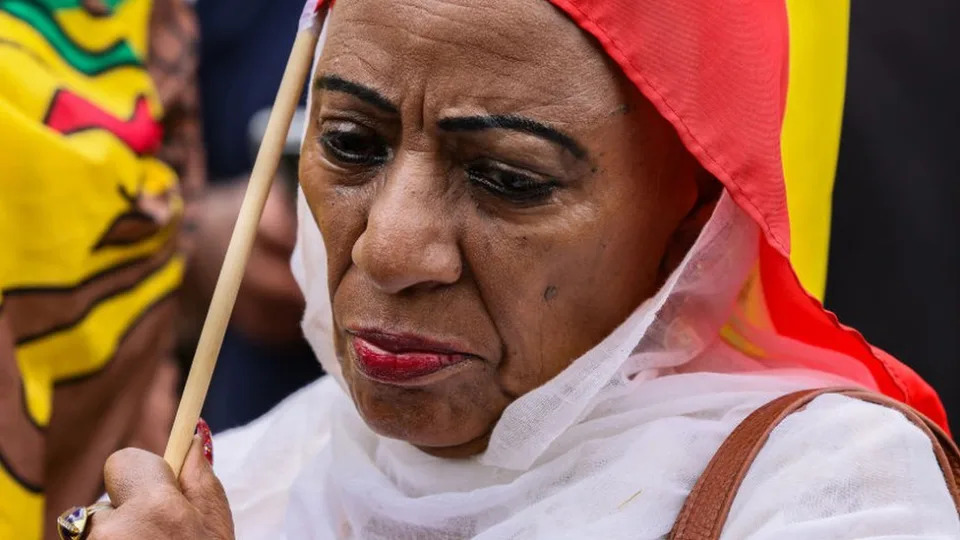
Amharas in the diaspora have been rallying in support of their people back home

But the deal was met with deep suspicion among Amharas as they were excluded from the talks despite the fact that the Fano militias and Amhara special forces - a paramilitary group linked to the regional government - fought on the side of the federal army.

The influential US-based campaign group, the Amhara Association of America, went as far as to describe it as a "war pact" - a charge denied by Mr Abiy's government.

Nevertheless, the perception took root in Amhara, especially after Mr Abiy then announced plans to dismantle the special forces present in each of Ethiopia's 11 ethnically based regions.

He proposed that the special forces - which are thought to number in the tens of thousands - be integrated into the federal army and police force in order to foster ethnic unity and to prevent regional forces being drawn into conflicts - as was the case in Tigray when its special forces joined the rebellion against Mr Abiy's government in 2020, more than two years after he assumed the premiership.

But many Amharas saw his plan as a red flag, arguing it would leave them vulnerable to attacks from neighbouring Tigray - their historic rivals for land and power in Ethiopia.

Though some of the Amhara special forces have agreed to integrate into the army and police, many others have deserted to the Fano, hiding in mountains and villages and using their weapons to carry out raids on government and military posts.

In some towns and villages, the militias have tried to establish their own administrations, in a direct threat to the power of the government.

What has been Mr Abiy's response?


So far, the prime minister has primarily relied on military force, with the lower chamber of parliament endorsing, on Monday, his decision to declare a six-month-long state of emergency in the region.

This has placed Amhara under the de facto control of the security services. The region has been divided into four command posts, falling under the overall control of a committee chaired by intelligence chief Temesgen Tiruneh.

The heavy deployment of troops has been backed up by airpower. On Sunday, an air strike was carried out in the town of Finote Selam, reportedly killing at least 26 people at an anti-government demonstration.

This has fuelled speculation that the army will increasingly use its airpower to repel the territorial gains of the Fano, though it carries the risk of causing civilian casualties

The government has neither confirmed nor denied that an air strike took place.
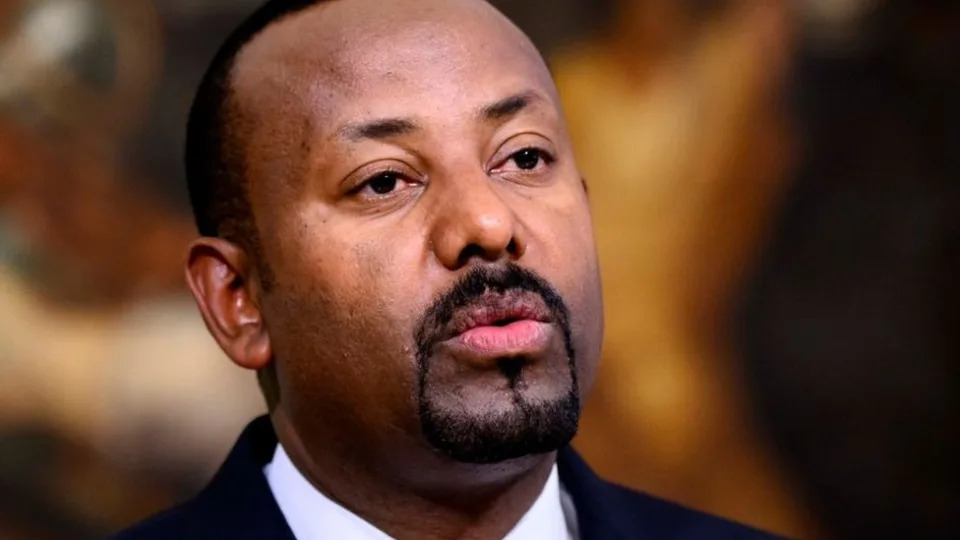

Ethiopia's Prime Minister Abiy Ahmed was seen as unifying figure when he took office in 2018

Night-time curfews have been declared in six cities - including the regional capital, Bahir Dar - forcing people to stay indoors.

The security forces have also set up check-points across the region, with reports that many Amharas have in recent months been barred from travelling to Addis Ababa, raising concerns of ethnic profiling.

The authorities say they are trying to prevent potential trouble-makers from infiltrating the city. But this has fuelled the anger of Amharas, and has increased their sense of alienation from the federal government.

What's the way out of the crisis?


During Monday's parliamentary debate, Ethiopia's former Foreign Minister Gedu Andargachew - who was once also the leader of the Amhara regional government - said it was clear that the ruling party had lost its support there.

He said there was a need to enter into dialogue, and to form a new interim administration in the region, but so far there is no sign of this happening.

Some analysts point out that there is also conflict in other parts of Ethiopia - including in Mr Abiy's political heartland of Oromia, where the Oromo Liberation Army (OLA) rebel group is fighting for what it calls "self-determination".

The federal government held peace talks with the rebels in April, but they failed to achieve a breakthrough, with the region still hit by conflict.

Oromos form the largest ethnic group in Ethiopia, followed by Amharas.

The OLA has been accused of widespread atrocities against Amharas in Oromia, raising fears that it wants to drive them out of the region. The OLA denies targeting Amharas.
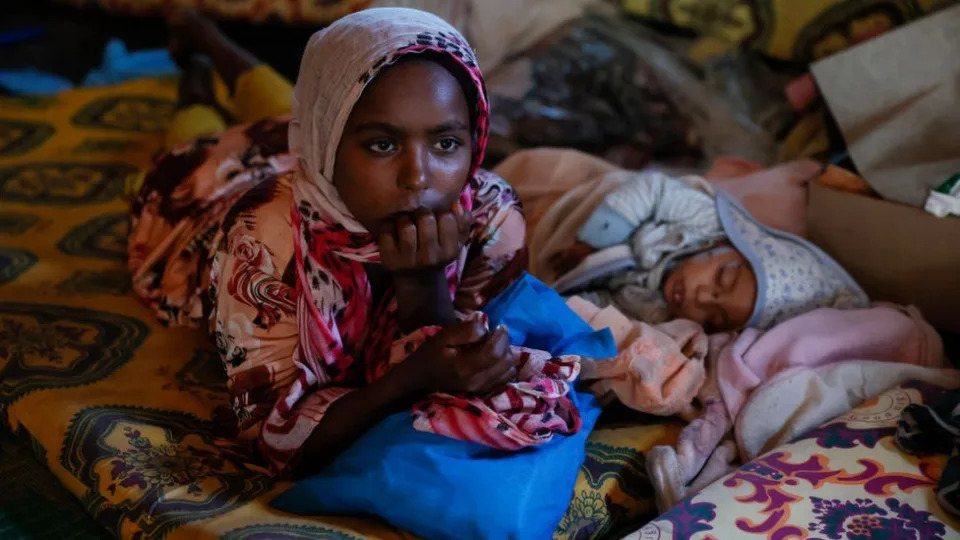

Violence in Ethiopia has forced millions of people to flee their homes

When he took office, Mr Abiy championed his vision of Mademer, or "coming together", and ended state repression by unbanning opposition groups, freeing political prisoners and allowing exiles to return.

He also launched the PP, a merger of different ethically based parties, believing that it would promote nationhood in a country where ethic loyalties are strong.

But critics say that Ethiopia has returned to repressive rule, with Mr Abiy battling to gain popular support for his vision - the latest sign of this being the conflict in Amhara.

It is unclear what the prime minister plans to do next but some analysts say he needs to convene a national forum where political and ethnic groups can discuss how best to resolve their differences so that peace returns to a nation torn apart by conflict.
Hawaii wildfires: Joe Biden vows to visit soon amid criticism


Bernd Debusmann Jr in Washington, 
Max Matza in Maui, 
and Christy Cooney in London 
- BBC News
Tue, August 15, 2023 

US President Joe Biden says he will travel to Hawaii "as soon as he can" amid criticism of his response to the island's deadly wildfires.

Speaking in Milwaukee on Tuesday, Mr Biden said he wanted to ensure that the people in the state had "everything they need".

The death toll from the fires is now 101 with some 1,300 people missing.

Hawaii residents have complained about the pace of the federal government's response to the disaster.

While at Rehoboth Beach, Delaware, over the weekend, Mr Biden was asked by a reporter about the rising death toll in Hawaii, and responded: "No comment."

The president said on Tuesday he had not yet visited because of concerns that doing so would divert resources and attention from the humanitarian response. Jill Biden will accompany him to Hawaii, he said.

"I don't want to get in the way. I've been to too many disaster areas," Mr Biden said. "I want to be sure we don't disrupt ongoing recovery efforts."

Over 500 federal emergency personnel have so far been dispatched to help with relief efforts, including 150 search and rescue specialists.

Additional personnel are being sent to Maui to help those already on the ground, Mr Biden added.

He said that "all available federal assets" in the region would be used for recovery efforts, including the US military and Coast Guard.

"It's painstaking work. It takes time and it's nerve wracking," the president said.

Emergency workers search through destroyed neighbourhoods in the Maui city of Lahaina, Hawaii

The US Small Business Administration has also begun offering low-interest disaster loans to help local residents rebuild.

The Federal Emergency Management Agency (Fema) has approved one-time payments of $700 (£550) per household to help with immediate needs in the wake of the disaster.

"Every asset they need will be there for them," said Mr Biden. "And we'll be there in Maui as long as it takes."

In a video update on Tuesday, Governor Josh Green said he and Mr Biden were speaking "often" and would work out a time for the president to visit once "the heart-breaking work is done on the ground finding those we've lost".

Identifying Hawaii wildfire victims could take years


'Raised to hate tourists' - Fires fan tensions on Maui


When the fires hit, Maui's warning sirens were deathly silent

Officials in Hawaii have said they expect the death toll to rise in the coming days as more bodies are recovered from the worst hit parts of Maui. Only 25% of the affected area has so far been searched for human remains.

Approximately 80% of Lahaina - a town of about 12,000 residents - was destroyed in the blaze.

On the ground in Maui, many residents told the BBC they have been frustrated at the scale and the speed of the recovery efforts.

One resident, Les Munn, said he had so far received $500 from Fema - less than the price of a night in most hotel rooms on the island.

For now, he is still sleeping on a cot in a shelter.


Joe Biden in Milwaukee

Another local, Felicia Johnson, said that "everybody wants the glory but nobody wants to put their feet on the ground".

On a street above the fire line in Lahaina, one woman said she feared she would starve to death in the days after the fire.

But now people are dropping bags of ice, water, clothing, batteries and small solar chargers at her neighbour's home, one of several grassroots relief supplies hubs co-ordinated by locals in the area.

Ahead of a second trip into the worst-hit area, Amory Mowrey spent $1,700 to load his and his friend's SUVs with toilet paper, cases of water, packs of batteries and sacks of rice.

"We're just trying to get supplies as fast as possible into the affected areas so people get what they need," he said. "There's a lack of response, it felt like, from large organisations."

Others expressed frustration that locally sourced supplies were being turned away by government officials, or that road closures had prevented people from entering Lahaina to help.

"The government's getting in the way of people helping," said Liz Germansky, who lost her home in the fire.

"I don't think the government could have done less," she told the BBC while sitting in a traffic jam on the island.

"The way things are unfolding right now is typical of what we all experienced on Tuesday... it's no wonder that this got so out of hand."

Additional reporting by Regan Morris in Maui

Videos put scrutiny on downed power lines as possible cause of deadly Maui wildfires

Tue, August 15, 2023


Awakened by howling winds that tore through his Maui neighborhood, Shane Treu went out at dawn and saw a wooden power pole suddenly snap with a flash, its sparking, popping line falling to the dry grass below and quickly igniting a row of flames.

He called 911 and then turned on Facebook video to livestream his attempt to fight the blaze in Lahaina, including wetting down his property with a garden hose.

“I heard ‘buzz, buzz,’” the 49-year-old resort worker recounted to The Associated Press. “It was almost like somebody lit a firework. It just ran straight up the hill to a bigger pile of grass and then, with that high wind, that fire was blazing.”

Treu’s video and others captured the early moments of what would become the deadliest U.S. wildfire in more than a century. Now the footage has emerged as key evidence pointing to fallen utility lines as the possible cause. Hawaiian Electric Co. faces criticism for not shutting off the power amid high wind warnings and keeping it on even as dozens of poles began to topple.

A class-action lawsuit has already been filed seeking to hold the company responsible for the deaths of more than 100 people. The suit cites the utility’s own documents showing it was aware that preemptive power shutoffs such as those used in California were an effective strategy to prevent wildfires but never adopted them.

“Nobody likes to turn the power off — it’s inconvenient — but any utility that has significant wildfire risk, especially wind-driven wildfire risk, needs to do it and needs to have a plan in place,” said Michael Wara, a wildfire expert who is director of the Climate and Energy Policy Program at Stanford University. “In this case, the utility did not.”

“It may turn out that there are other causes of this fire, and the utility lines are not the main cause,” Wara said. “But if they are, boy, this didn’t need to happen.”

Hawaiian Electric declined to comment on the accusations in the lawsuit or whether it has ever shut down power before due to high winds. But President and CEO Shelee Kimura noted at a news conference Monday that many factors go into that decision, including the possible effect on people who rely on specialized medical equipment and firefighters who need power to pump water.

“Even in places where this has been used, it is controversial, and it’s not universally accepted,” she said.

Maui Police Chief John Pelletier also expressed frustration at the news conference that people were complaining both that power was not cut off earlier and that too many people were unaccounted for because of a lack of cellphone and internet service.

“Do you want notifications or do you want the power shut off?” he said. “You don’t get it both ways.”

Mikal Watts, one of the lawyers behind the lawsuit, told the AP this week that he was in Maui, interviewing witnesses and “collecting contemporaneously filmed videos.”

“There is credible evidence, captured on video, that at least one of the power line ignition sources occurred when trees fell into a Hawaiian Electric power line,” said Watts, who confirmed he was referring to Treu’s footage.

Treu recorded three videos to Facebook on Aug. 8 starting at 6:40 a.m., three minutes after authorities say they received the first report of the fire. Holding a hose in one hand and his phone in the other, he streamed live as the first police cruisers arrived and can be heard warning officers about the live power lines laying in the road.

At one point, he zooms the camera in on a cable dangling in a charred patch of grass, surrounded by orange flames.

Treu’s neighbor, Robert Arconado, also recorded videos that he provided to the AP. Arconado’s footage, which starts at 6:48 a.m., shows a lone firefighter headed toward the flames as they continued to spread west downhill and downwind along Lahainaluna Road, toward the center of town.

By 9 a.m., Maui officials declared the fire “100% contained,” and the firefighters left. But about 2 p.m., Arconado said the same area had reignited.

A video he filmed at 3:06 p.m. shows smoke and embers being carried toward town as howling winds continued to lash the island. Arconado continued to film for hours, as towering pillars of flame and smoke billowed from the neighborhoods downhill, forcing people to jump into the ocean to escape.

“It was scary, so scary,” Arconado said. “There was nowhere to go. … I witnessed every single thing. I never go to sleep.”

Treu’s and Arconado’s homes were spared, but satellite imagery reviewed by the AP shows that starting about 500 yards downwind whole neighborhoods were reduced to ash. Though experts say the early evidence suggests multiple blazes may have been ignited in and around Lahaina on Aug. 8, there were no recorded lightning strikes or other apparent natural causes for the fires.

Robert Marshall, CEO of Whisker Labs, a company that collects and analyzes electrical grid data, said sensors installed throughout Maui to detect sparking power lines showed a dangerously high number of such live wire incidents that night and into the following morning. The sensors, 70 in all, record breaks in electric transmission after trees fall on power lines or other accidents, and they showed dozens of such faults in areas where fires likely broke out and around the time the blazes probably started.

The faults, which Marshall likened to a series of circuit breakers tripping at the same time, were remarkable for the amount of power lost, a third of the usual 120 volts coursing through lines. Marshall said he couldn’t say whether any of the sparks resulted in a fire, only noting that there were many opportunities for it to happen.

“A substantial amount of energy was discharged,” said Marshall, pointing to a graph on his computer screen with several lines plunging at the same time. “Any one of these faults could have caused a wildfire, any could have been an ignition source.”

After the 2018 Camp Fire in northern California killed 85 people in a disaster caused by downed power lines, Pacific Gas & Electric agreed to pay more than $13.5 billion to fire victims. State regulators adopted new procedures requiring utilities to turn off the electricity when forecasters predict high winds and dry conditions that might cause a fire to spread.

In Maui, the National Weather Service first began alerting the public about dangerous fire conditions on Aug. 3. Forecasters issued a “red flag warning” on Aug. 7, alerting that the combination of high winds from a Category 4 hurricane churning offshore and drought conditions driven by climate change would create ideal conditions for fire.

Even though Hawaiian Electric officials specifically cited the Camp Fire and California’s power shutoff plan as examples in planning documents and funding requests to state regulators, on the day of the Maui fire there was no procedure in place for turning off the island’s grid.

Wara said the video posted by Treu also raised questions about Hawaiian Electric’s assertion that it had disabled an automatic recharge mechanism that turns electricity back on after a failure because it appeared that the downed wire Treu recorded was still live.

Hawaii Attorney General Anne Lopez announced last week that she opened “a comprehensive review of critical decision-making and standing policies leading up to, during and after the wildfires.”

Hawaiian Electric’s Kimura said the company had started its own investigation. Its shares have plummeted by 60% over the last week on fears the company may have to pay big damages.

Watts, one of the lawyers suing the company, said the fire that destroyed Lahaina was predictable, given the weather and fuel conditions. He said Hawaiian Electric documents show the company knew its grid on Maui was degraded after decades of neglect. Old power poles were supposed to be replaced between 2019 and this year, but he alleges the company delayed the work.

“That is why the town of Lahaina is decimated, thousands are now homeless and hundreds will mourn the loss of their innocent loved ones,” he said. “This is an unprecedented tragedy that was an entirely preventable tragedy.”

Jennifer Potter, who lives in Lahaina and until last year was a member of the Hawaii Public Utilities Commission, said a comprehensive wildfire mitigation plan should have been established years ago.

“There’s more that could have been done. Now we have 20/20 hindsight,” she said. “This just doesn’t need to happen anymore.”

___

Biesecker reported from Washington, Condon from New York and McDermott from Providence, Rhode Island.

___

Contact AP’s global investigative team at Investigative@ap.org.

Michael Biesecker, Bernard Condon And Jennifer Mcdermott, The Associated Press
Jakarta: Living with asthma in the world's most polluted city


Trisha Husada, Quin Pasaribu and Kelly Ng - in Jakarta and Singapore
Tue, August 15, 2023 

Skyscrapers in Jakarta shrouded by toxic smog

Multiple doctors have advised Farah Nurfirman to leave her hometown Jakarta for her health's sake.

The 22-year-old asthmatic often wears a mask and carries an inhaler, but the air quality in the city is not helping.

The Indonesian capital, which has long wrestled with air pollution, was ranked the most polluted city on global charts nearly every day last week.

President Joko Widodo on Monday even mandated that all civil servants work from home amid worsening air quality.

Last week, Jakarta saw its airborne concentration of the pollution particles known as PM2.5 outpace other heavily polluted cities such as Riyadh, Doha and Lahore, according to live data from Swiss air quality technology company IQAir. The company ranks pollution in major cities in real time every day.

Jakarta has also been consistently ranked among the 10 most polluted cities globally since May. The capital city and its surrounding region are home to about 30 million people.

These days, Farah also carries an oximeter - a device usually placed on a fingertip to measure oxygen levels in someone's blood - to better monitor her condition.

"For people with asthma, even if your oxygen levels fall just a little, you can really feel it. And it's not just tightness, my chest really hurts. So it's hard to breathe," said Farah, who works as an intern at a marketing agency.

"My asthma is severe and also hereditary. Every doctor told me to move out of Jakarta. 'Get out of Jakarta if you want to get better, or you will continue to be like this,' they'll say."

"I am quite tired because I can't do anything. But this is where I live. Apart from wearing a mask, there is not much I can do," Farah said.

Local authorities blame the pollution spike on the dry season and vehicle emissions, and will soon carry out random checks on vehicles and force drivers to undergo emission tests.

President Widodo urged weather modification to produce artificial rain in Greater Jakarta, and advised companies to impose hybrid working.

The city government is also considering an order for half of its civil servants to work from home.

But Jakarta residents like Juan Emmanuel Dharmadjaya find themselves in a dilemma. "I really want to stay in Indonesia because this is where I was born and my family is here. But the air pollution is a silent killer."

The 22-year-old previously suffered from tuberculosis and now has sinus issues. The deteriorating air quality is taking a toll on his health, he said.

"I cannot focus on my daily life because my nose gets runny and very itchy all the time," said Juan, who works in the IT industry.

Alluding to his time as a student in Germany, he said: "In Europe, I've never had a runny nose or cough even during the winter when the temperature goes below freezing. But when I returned to Jakarta, my nose immediately ran. It's so bad and clogged."

Sigit Reliantoro, a senior official at Indonesia's Ministry of Environment and Forestry, told reporters at a press conference last Friday that dry air in June, July, and August has "invariably" led to an escalation of air pollution in Jakarta.

Dry air typically means pollutants remain suspended in the air for extended periods. Wildfires are also more common during dry seasons.

Government research shows that vehicle emissions account for 44% of air pollution, Sigit noted.

But activists like Muhammad Aminullah believe factories and coal-fired power plants are the primary contributors to Jakarta's toxic smog.

Although Indonesia has big ambitions to cut carbon emissions - such as by phasing out coal for electricity by 2056 - it is currently the world's biggest exporter of thermal coal. Phasing out coal is costly because of the large numbers of people employed in related industries in Indonesia.

The government has not come down hard enough on these industries because of "economic and political interests," said Aminullah, who leads The Indonesian Forum for the Environment, also known as Walhi. He claims that the ashes from burning coal are not properly managed even if the plant is located near a community settlement.

Amrin (not his real name), who lives near a coal-fired power plant, is among those affected.

He told the BBC his family used to store rainwater for bathing and consumption. But that was no longer feasible after the plant started operating in 2009.

"We don't dare to do that anymore because the water collected is black and contaminated by a lot of thick black dust on the roof," he said.
A Pennsylvania study suggests links between fracking and asthma, lymphoma in children

Tue, August 15, 2023 


HARRISBURG, Pa. (AP) — Children who lived closer to natural gas wells in heavily drilled western Pennsylvania were more likely to develop a relatively rare form of cancer, and nearby residents of all ages had an increased chance of severe asthma reactions, researchers said in reports released Tuesday evening.

The taxpayer-funded research by the University of Pittsburgh adds to a body of evidence suggesting links between the gas industry and certain health problems.

In the reports, the researchers found what they called significant associations between gas industry activity and two ailments: asthma, and lymphoma in children, who are relatively rarely diagnosed with this type of cancer.

The researchers were unable to say whether the drilling caused the health problems, because the studies weren’t designed to do that. Instead, the researchers combed health records to try to determine possible associations based on how close people lived to natural gas wells, while industry groups pointed to what they say are weaknesses of the studies’ assumptions and the limitations of its data.

The reports were released at the start of a Tuesday evening public meeting to discuss the findings, hosted by University of Pittsburgh School of Public Health and the state Department of Health, on the campus of state-owned Pennsylvania Western University.

At the meeting, community activists and distressed parents urged department officials and Pitt researchers to do more to protect public health as gas drilling continues to expand.

Raina Rippel, former director of the Southwest Pennsylvania Environmental Health Project, called the findings the “tip of the toxic iceberg and we are only just beginning to understand what is out there.”

There is, she warned, “a lot more cancer waiting in the wings.”

In the cancer study, researchers found that children who lived within 1 mile (1.6 kilometers) of a well had five to seven times the chance of developing lymphoma compared with children who lived 5 miles (8 kilometers) or farther from a well. That equates to 60 to 84 lymphoma cases per million children living near wells, versus 12 per million among kids living farther away.

For asthma, the researchers concluded that people with the breathing condition who lived near wells were more likely to have severe reactions while gas was being extracted compared with people who don’t live near wells. However, researchers said they found no consistent association for severe reactions during periods when crews were building, drilling and fracking the well.

The four-year, $2.5 million project is wrapping up after the state’s former governor, Democrat Tom Wolf, in 2019 agreed to commission it under pressure from the families of pediatric cancer patients who live amid the nation’s most prolific natural gas reservoir in western Pennsylvania.

An extremely rare form of bone cancer, Ewing sarcoma, had been diagnosed in dozens of children and young adults in a heavily drilled area outside Pittsburgh, and those families were instrumental in pushing Wolf to commission the study.

But the researchers said they found no association between gas drilling and childhood leukemia, brain and bone cancers.

Meanwhile, the researchers said their findings on preterm births and birth weights among families living closer to gas wells echoed the mixed conclusions in similar studies. There were hints that gas production might reduce birth weights by less than an ounce on average.

Edward Ketyer, a retired pediatrician who sat on an advisory board for the study, called the asthma findings a “bombshell.” He said he expected that the studies would be consistent with previous research showing the “closer you live to fracking activity, the increased risk you have of being sick with a variety of illnesses.”

“The biggest question is, why is anybody surprised about that?” said Ketyer, who is president of Physicians for Social Responsibility Pennsylvania.

A number of states have strengthened their laws around fracking and waste disposal over the past decade. However, researchers have repeatedly said that regulatory shortcomings leave an incomplete picture of the amount of toxic substances the industry emits into the air, injects into the ground or produces as waste.

The Pennsylvania-funded study comes on the heels of other studies that found higher rates of cancer, asthma, low birth weights and other afflictions among people who live near drilling fields around the country.

The gas industry has maintained that fracking is safe, and groups reviewing the studies said Tuesday that protecting public health is their highest priority.

The study’s findings are emerging under new Gov. Josh Shapiro, also a Democrat, who succeeded Wolf in January. His administration said Tuesday that it is working on various fronts to improve public health in response to the studies.

The advent of high-volume hydraulic fracturing combined with horizontal drilling miles deep in the ground over the past two decades transformed the United States into a worldwide oil and gas superpower.

But it also brought a torrent of complaints about water and air pollution, and diseases and ailments, as it encroached on exurbs and suburbs in states including Texas, Colorado and Pennsylvania.

Establishing the cause of health problems is challenging.

It can be difficult or impossible for researchers to determine exactly how much exposure people had to pollutants in air or water, and scientists often cannot rule out other contributing factors.

Because of that, environmental health researchers try to gather enough data to gauge risk and draw conclusions.

___

Follow Marc Levy on Twitter: http://twitter.com/timelywriter

Marc Levy, The Associated Press

Tuesday, August 15, 2023

UFO ALTERNATE FACTS


TWO SYSTEMS OF JUSTICE
Trump's time in Fulton County Jail will be brief. Others die waiting


Madeline Halpert & Kayla Epstein - Reporting From Atlanta, Georgia
BBC
Tue, August 15, 2023 

Fulton County Jail has come under fire for allegations of unsanitary living conditions and negligence

In the coming days, Donald Trump will turn himself in to police in Georgia. His initial brush with the local criminal justice system is expected to last just hours - most other defendants are not so lucky.

Authorities announced on Wednesday that Mr Trump and his fellow 18 defendants are "expected" to be booked at the Fulton County Jail in Atlanta before being arraigned at the courthouse, though they warned "circumstances may change".

He must appear by 25 August to face charges of trying to overturn the result of the 2020 election in the state.

The local sheriff, Pat Labat, has said that officials will follow "normal practices" when processing Mr Trump.

But experts said he will probably have a very different experience from those who languish in the county's notoriously unsafe jail for weeks, months or even years while awaiting trial.

In the US, criminal defendants wait in a jail if they have been arrested, are awaiting trial without bail, or are serving a short sentence behind bars. Prisons are where criminals serve longer sentences after conviction.

Hundreds of people were held at Fulton County Jail for more than 90 days because they had yet to be formally charged or could not afford to pay the bail bond required for their release, according to a September 2022 report from the American Civil Liberties Union (ACLU).

The report also found 117 people had waited in jail for more than a year because they had not been indicted; 12 had been held for two years for the same reason.

"It's essentially been overcrowded since it was built," said Fallon McClure of the ACLU of Georgia. "This has just been a perpetual cycle over and over for years."
'Rapidly eroding' conditions

Built in 1985 to house around 1,300 inmates, Fulton County Jail has held more than 3,000 people in recent years.

The jail provides "unhygienic living conditions" that have led to outbreaks of Covid-19, lice and scabies, a report by the Southern Center for Human Rights said. It found inmates were "significantly malnourished" and dealing with a condition called cachexia, also known as wasting syndrome.

Waiting in these dilapidated conditions has proven deadly for some.

Last week, a 34-year-old man was found unconscious in a medical unit cell at the jail, where he had been held since 2019. He was resuscitated, but then died at the hospital, according to the Fulton County Sheriff's office.

He was the sixth person this year to die in the county jail system in 2023


The mafia-busting law Trump is charged under in Georgia

US inmate died in insect-infested 'death chamber'

Noni Battiste-Kosoko was just 19 when she died in Fulton County Jail custody in July after being arrested on a less serious misdemeanour charge. Deputies found her unresponsive in her cell in the Atlanta City Detention Center, an additional space the county is leasing to alleviate overcrowding at the main jail.

Battiste-Kosoko's family has still not been given a cause for her death or found out the results of her post-mortem examination, her family's lawyer told the BBC.

"There has been a consistent and unsettling pattern of poor healthcare and inmates dying at the jail under mysterious circumstances," said Roderick Edmond.

The Fulton County Sheriff's Office told the BBC it was still awaiting a final report from the autopsy, and that it was investigating the incident.

Battiste-Kosoko's death came just before Fulton County this month agreed to pay $4m (£3.1m) to the family of a man who died in the jail covered in bed bug bites.

An independent autopsy found 35-year-old Lashawn Thompson died in the jail's psychiatric wing last September because of "severe neglect" from jail staff. His death sparked an investigation from the US Department of Justice into conditions at the jail, access to medical care and excessive use of force by officers.
An escalating issue

When it was built in the 1980s, the jail was "state of the art", said Dr Edmond, the attorney. "But it is no longer. That jail needs to be demolished and the citizens of Fulton County need to dig deep and pay the tax dollars to build a brand new jail."

The Fulton County Sheriff's Office itself has acknowledged conditions at the building are "dilapidated and rapidly eroding". It has also called for the construction of a new $1.7bn jail.

"There's been a lot of talk of cleaning it up," said Ms McClure of the ACLU. "We have not really seen or heard anything particularly significant. It seems like a lot of posturing."

Who is Fulton County prosecutor Fani Willis?

Ms McClure said a number of factors have led to overcrowding in the Fulton County Jail system. For one, people charged with misdemeanours in the county are arrested and taken into custody, unlike some other Georgia jurisdictions, where defendants are generally released and given a future court date for minor offences, she said.

The county has also faced a backlog of cases because of the Covid-19 pandemic, and most recently, a slew of indictments under the Racketeer Influenced and Corrupt Organizations (Rico) Act unrelated to the Trump case, she said.

Mr Trump and his co-defendants were charged for violating the same statute this week. But indictments under the law, passed in the 1970s to help take down organised crime groups like the mafia, are complex and resource intensive, experts say.

"There's the assumption that other cases aren't getting indicted because this is taking up so much time," Ms McClure said.
'Kid gloves'

Mr Trump is likely to bypass all of this dysfunction when he is processed in Fulton County, experts said.

While prosecutors have not released details of how Mr Trump will be booked this time, there are clues from the expedited process at his three previous arraignments in New York, Florida and Washington DC, where he has denied all charges.

Upon arriving at these courthouses, Mr Trump had his basic information and fingerprints taken like any defendant. But he was sequestered away from other criminal defendants and quickly whisked up to a courtroom, surrounded by Secret Service and US Marshals. Authorities have cited heightened security concerns in making these arrangements.

Unlike many defendants, he has not had a mugshot taken nor has he been handcuffed. Authorities have said there is no need for either, since there are plenty of photos of Mr Trump already and he is not considered a flight risk.

When his hearings have concluded, his protective detail have quickly escorted him back to a waiting motorcade, which takes him to his private plane.

Some version of this routine is likely to play out in Fulton County, experts said.

The contrast in experiences rankled some defence attorneys who have worked in Fulton County for years.

"He's gonna be treated with kid gloves because he's a former president," said Keisha Steed, an Atlanta-area criminal defence attorney who once worked as a public defender.

"And our clients are going to be kicked in the teeth."
Travis King: North Korea says US soldier fled because of racism in army

Jean Mackenzie and Derek Cai - in Seoul and Singapore
Tue, August 15, 2023 

Private Travis King dashed across the border to North Korea last month

North Korea has said US soldier Travis King crossed into its territory last month because of "inhuman maltreatment and racial discrimination" in the army.

The 23-year-old private dashed across the border from South Korea on 18 July while on a guided tour.

Private King admitted to crossing illegally and wanted refuge in the North, state media reported.

Washington said it could not verify the claims, which are Pyongyang's first public comments on the case.

Concerns have been growing for the welfare of the US soldier, who has not been heard from or seen since his crossing.

The US is trying to negotiate Private King's release with the help of the UN Command, which runs the border area, and has a direct phoneline to the North Korean army.

Responding to the North Korean report on Wednesday, a Pentagon official said their priority was to have Private King brought home safely "through all available channels".

How to negotiate with world's most secretive country

North Korea has given no information on how it plans to treat Private King but said the soldier admitted he had "illegally" entered the country.

State news agency KCNA did not say if he would face prosecution or punishment.

In the report, there was no mention of his current whereabouts or condition.

"During the investigation, Travis King confessed that he had decided to come over to the DPRK [North Korea] as he harboured ill feeling against inhuman maltreatment and racial discrimination within the US Army," KCNA reported.

"He also expressed his willingness to seek refuge in the DPRK or a third country, saying that he was disillusioned at the unequal American society."

Private King is a reconnaissance specialist who has been in the army since January 2021 and was in South Korea as part of his rotation.

Before crossing the border, he served two months in detention in South Korea for assault charges and was released on 10 July.

He was supposed to fly back to the US to face disciplinary proceedings but managed to leave the airport and join a tour of the Demilitarised Zone (DMZ), which separates North and South Korea.

The DMZ, one of the most heavily fortified areas in the world, is filled with landmines, surrounded by electric and barbed wire fencing, and monitored by surveillance cameras. Armed guards are supposed to be on alert 24 hours a day although witnesses say there were no North Korean soldiers present when Private King ran over.

His family have previously told US media that he had relayed experiencing racism in the army. They also said his mental health appeared to have declined prior to his disappearance.

"It feels like I'm in a big nightmare," said his mother Claudine Gates, adding the family was desperate for answers.

North Korea is one of the few countries still under nominally communist rule and has long been a highly secretive and isolated society.

Its government, led by Kim Jong-un, also stands accused of systematic human rights abuse.

Analysts say the detainment of Travis King has played into North Korea's anti-US messaging, at a time when relations between the two countries are their worst in years.

Pyongyang will most likely have relished the opportunity to highlight racism and other shortcomings in American society, especially given the international criticism it receives for human rights abuses.

The UN Security Council is due to hold a meeting on Thursday to discuss the human rights situation in North Korea for the first time since 2017.

Ahead of its comments on Travis King, North Korean media had put out a statement on the UN meeting, which will be led by the US.

"Not content with fostering racial discrimination and gun-related crimes, the US has imposed unethical human rights standards on other countries", it read.
Pushing back on limits elsewhere, Vermont’s lieutenant governor goes on banned books tour


Tue, August 15, 2023 

WATERBURY, Vt. (AP) — On a recent Sunday afternoon, Vermont’s lieutenant governor was at a local library, reading a book about two male penguins to a crowd of nearly two dozen. This was not the first stop for Lt. Gov. David Zuckerman nor would it be the last.

While officials in some other states are banning or restricting certain books in schools and libraries, Zuckerman, in liberal Vermont, has taken a different tack: reading and discussing them at libraries and bookstores around the state.

These bans often target books that feature LGBTQ+ characters; talk about gender and sexuality; highlight racial disparities; or talk about difficult issues such as substance abuse and cases of police violence,” Zuckerman, a Democrat, said in a statement when he announced the tour in June. “Students, teachers, and curious minds should be able to access materials that spark critical thinking, cover difficult topics, and appeal to diverse interests without fear of government interference.”


While Vermont hasn't “fallen victim" to the trends in some other states, Zuckerman said that does not mean that books have not been challenged in this state. He said individuals have run for school board seats with the idea of curriculum management in mind and topics around race, and gender and identity have been elevated at school board meetings in recent years.

He hopes the book reading tour will highlight what he sees as the value of representation, free speech, open dialogue and the exchange of ideas.

According to the American Library Association, attempted book bans and restrictions at school and public libraries set a record in 2022. The association compiled more than 1,200 challenges in 2022 — nearly double the previous record total in 2021.

PEN America also said it found more than 2,500 instances of books being banned — affecting more than 1,600 titles — from July 2021 to June 2022. Texas and Florida were the states with the most bans, according to the organization's 2022 report.

During his reading at Bridgeside Books in Waterbury on Sunday, Zuckerman read the book, “And Tango Makes Three,” which is based on the true story of two male penguins who were devoted to each other at the Central Park Zoo in New York. A zookeeper who saw them trying to incubate an egg-shaped rock gave them an egg from a different penguin pair with two eggs. The chick that hatched was cared for by the male penguins and named Tango.

The book, written by Peter Parnell and Justin Richardson, is listed among the 100 most subjected to censorship efforts over the past decade, as compiled by the American Library Association.

Zuckerman was joined by three Vermont authors, who each read segments from other banned books, including “Monster,” by Walter Dean Myers, and the bestselling children's picture book “Where the Wild Things Are,” by Maurice Sendak, which was pulled off some shelves when it first came out in 1963.

“I think books are a place for kids to explore and to be things that they’re not or see what it’s like to be something else," said children's author and illustrator Sarah Dillard. “To take that away from them I think is putting them at a huge disadvantage for being in the real world.”

Paul Macuga, of Essex Junction, who attended the reading, said what frightens him about the move to restrict or ban books is that it's coming from organized groups like Moms for Liberty — a conservative “parental rights” group that has gained national attention for its efforts to influence school curriculum and classroom learning, as well as its conservative support and donor funding.

“It’s not a bunch of disorganized kooks," he said. "It is a very well put together, with a lot of professional backing of people that know how to do this stuff,” he said.

Several other attendees, including the local library director, recommended that people keep tabs on what’s happening in their communities, and get on their library commissions and attend board meetings to rebuff any moves to restrict books.

Tanya Lee Stone, who is the author of a banned book — “A Bad Boy Can Be Good for a Girl,” which she described as a cautionary tale about three very different girls consecutively dating a stereotypically bad guy — said there are organized people on the other side, too.

“The National Council Against Censorship is a very large organization that’s dedicated to this,” she said.

Stone said people who ban books often have not read them. And a number of people at the reading, including attendees, authors and Zuckerman, said the bans are based on fear.

She said her goal in life is to write material that will educate, help and inspire young people. "To basically be accused of hurting young people is sort of the farthest thing from what you want to have happen. And that’s basically what people who are banning books and censoring books are doing,” Stone said.

Lisa Rathke, The Associated Press
Jamaican migrant worker granted federal health care after being fired from N.S. farm

The Canadian Press
Mon, August 14, 2023 


HALIFAX — A migrant worker diagnosed with cervical cancer shortly after arriving in Nova Scotia has been granted health insurance under a federal program, but advocates continue to call on the province to expand health coverage to people without permanent residency.

Kerian Burnett arrived from Jamaica in April 2022 to work on a Colchester County strawberry farm. She told a news conference in Halifax on Monday that after falling ill, she was fired and forced to navigate a cancer diagnosis without medical coverage.

Her lawyer, Thiago Buchert, told reporters, "Right when she needed it, she lost her health insurance."

Other provinces provide migrant workers with public health coverage, but migrants in Nova Scotia must have a one-year work permit to be eligible for care, said Buchert, who is with the Halifax Refugee Clinic.

"Imagine if everything in your life relied on you maintaining a job," he said, "That's the kind of vulnerability and dependency that migrant workers face."

Buchert said that after nearly eight months, Burnett was granted health insurance under the interim federal health program. Burnett was also granted emergency temporary residence until January 2024, he said, and will be able to continue her cancer treatment in Canada, as her doctors recommended.

Burnett said that after she was diagnosed with cancer she received care — chemotherapy, radiation and several surgeries — at the discretion of hospitals because she was uninsured. Fighting for coverage while receiving treatment for cancer has been a long, challenging road, she said, describing the "humiliation" of being turned away from hospitals and paying out of pocket for prescriptions.

"So I had to fight," she said. "It was a long fight, and a hard process, which I think is unfair because we're dealing with someone's life here. Once you die, there's no coming back."

Stacey Gomez, with migrant advocacy group No One Is Illegal – Nova Scotia, told reporters Monday that while Burnett's case is a win, a permanent solution is needed.

"We regularly see migrant workers who are injured or who are severely ill, who are repatriated back to their home country without getting proper medical attention," she said, adding that workers often don't speak out over fears of being fired, sent back to their home countries and barred from working again in Canada.

The migrant justice group is calling on the Nova Scotia government to provide health-care coverage to all migrant workers in the province. Gomez said her group is among several others that are pressuring the federal government to grant permanent immigration status to all migrants across the country.

"This would ensure migrant workers have access to essential services like health care," she said, "that they are fully able to exercise their labour rights and able to be with their families."

Burnett said she is motivated by her family, especially her five-year-old granddaughter back in Jamaica.

"She gives me the hope to move on in life."

This report by The Canadian Press was first published Aug. 14, 2023.

Marlo Glass, The Canadian Press


US-focused Opera News, to cease publication in November after 87 years

The Canadian Press
Tue, August 15, 2023 


NEW YORK (AP) — Opera News, an 87-year-old publication focused on the Metropolitan Opera and spotlighting the art form in the U.S., will print its final issue in November and be incorporated into Britain-based Opera magazine.

The Met announced Tuesday that the Metropolitan Opera Guild, a separate company formed in 1935 by Eleanor Belmont to aid the opera house, will scale back operations and become a supporting organization of the Met. The opera company will take over the education program that allows about 12,000 school children each year to attend dress rehearsals.

Opera News has a 43,000 circulation, including 32,000 in print and 11,000 digital. It is distributed to 28,000 Guild members and has an additional 9,000 paid subscribers. After publishing biweekly during the opera season since 1940, Opera News added monthly summer editions in 1972 and switched to a year-round monthly schedule in 2008.

“It really is the result of several years of declining economic fortunes,” Met general manager Peter Gelb said. “What they’re suffering is what many non-profits have been suffering, which is a situation where the earned revenues and donations are not enough to keep up with the expenses.”

Eleanor Belmont, a philanthropist married to financier August Belmont Jr., founded the guild to increase public support for the Met at a time the company's finances were struggling during the Great Depression.

The guild had revenue of $3.2 million in the fiscal year ending June 30, 2022, a drop from $4 million in the prior year. That was down from $11.9 million in the year ending June 30, 2019, the last before the coronavirus pandemic.

The Met said 20 Guild employees will get severance packages but the opera company hoped to hire several. Guild board members are being invited to join the Met board. The annual Opera News Awards and luncheon honoring singers will be discontinued.

Opera magazine has 20,000 print subscribers and estimates it has 60,000 readers. It has a four-person editorial office.

John Allison, Opera’s editor, said it had not yet been decided whether to arrange a U.S. printing plant. Rebecca Paller, who has written for Opera, will become its U.S. editor, and Opera will add a focus on Met theater telecasts and radio broadcasts,

“We’ve always covered the American scene in a lot of detail, and here really what we’ll be doing is just I guess you might say upgrading the American coverage,” Allison said. “In that sense, it should be quite seamless.”

Ronald Blum, The Associated Press