Wednesday, August 16, 2023

My husband works for UPS and I wish people could see how hard his job is — and why the new $170,000 contract deal is well deserved

Fortesa Latifi
Updated Wed, August 16, 2023 

Kourtney is married to a UPS driver.
Courtesy of Kourtney

  • Kourtney is married to a UPS driver in Rhode Island.

  • Kourtney says she sees how hard the job is and drivers deserve the new $170,000 contract deal.

  • She believes people shouldn't be upset about the deal because blue-collar workers deserve fair pay.

This as-told-to essay is based on a conversation with Kourtney, a 30-year-old hairdresser and wife of a UPS driver in Rhode Island. Her last name has been omitted for privacy reasons. The following has been edited for length and clarity.

After the Teamsters union secured a win guaranteeing that UPS delivery drivers would make $170,000 in salary and benefits by the end of a 5-year period, people in tech and other white-collar workers had a lot to say about it. As the wife of a UPS driver, so do I.

Let's start with the facts. The $170,000 is not a base salary — it takes into consideration healthcare and pension benefits. But that's not even what bothers me most about people's reactions, which range from wondering why drivers would make that much money to calling them overpaid and undeserving.

I really want people to think about why they believe UPS workers don't deserve to be fairly compensated

It seems like a lot of it has to do with the snobbery white-collar workers feel toward blue-collar workers. I'm a hairdresser so I see it in my work, too. Some people just feel like they're better than us and that we don't deserve nice things or stability.

I feel like college-educated white-collar workers don't believe blue-collar workers deserve to live a comfortable life — even though service workers are the backbone of society. They're the most physically skilled ones and they're the ones performing jobs nobody else wants to do. Despite that, they're constantly taken for granted.

If you're upset about my husband's salary, you should be looking at the CEO of your company. The truth is, the CEO of your company makes, on average, 272 times more than the average worker. This is the design of capitalism. It pits workers against each other.

I wish people could see how hard my husband's UPS job is

Every morning, he leaves the house before our kids are awake and comes home each night after they're asleep. When he returns, he's covered in dirt from head to toe. There isn't air conditioning in his truck and he sends me photos of the infrared thermometer reading 115 degrees. I worry so much about him in those physically demanding conditions that I track his location just to make sure he's always moving.

This is an incredibly difficult job. Even driving a truck of that size requires specific skill, but people just think "oh, I could be a delivery driver" and they have no idea what it actually takes.

All these delivery drivers just want to live a comfortable life

They're not asking to be millionaires. They just want to be able to provide for their families and enjoy their lives on the weekends after working hard all week. It's not a crime to want a comfortable life.

It's normal to want to be able to go on vacation and have a nice car and be able to enjoy your life. I've seen, firsthand, how hard these drivers work. I know how important they are to the economy and to our country — and obviously UPS does too, as evidenced by the tentative agreement with the union.

If UPS believes these workers should be paid more, that's none of your business

Workers are the ones that make the corporation profitable and that's what makes shareholders happy. They deserve to be compensated for that. We all deserve to be fairly compensated for our labor.

I don't think the people who are complaining have any idea what it's like to be a UPS driver, but I do because I see it every day.

Editor's note: A UPS spokesperson sent the following statement to Insider:

"The safety and well-being of every UPSer is our top priority. We have been steadily building on our efforts to protect our people in the face of increasingly hot temperatures, provide a safe work environment, and make working at UPS a great experience for employees as they serve our customers and strengthen our communities.
"We have worked with top experts in heat safety to study our working conditions and further improve our trainings and protocols to help our employees work safely — especially on hot days. Improvements include:


How truck driving became one of the worst jobs in the US

More than 3 million people drive trucks in the US, but the job is no longer the golden ticket it once was to a middle-class life. At the start of the pandemic, truck drivers were celebrated as frontline workers, but now many of them say they feel forgotten again.


Middle class Americans are moving straight into fire and drought because they can't afford to live in the cities that are safer from climate change

Eliza Relman
Updated Tue, August 15, 2023

An aerial view of homes in the Phoenix suburbs on June 9, 2023 in Queen Creek, Arizona.
Mario Tama/Getty Images

  • Rising housing costs have helped push Americans into parts of the country more vulnerable to climate change.

  • US counties that have the most at-risk homes are all growing in population.

  • The trend shows how the burden of climate change is falling disproportionately on less affluent people.

The skyrocketing cost of housing has pushed many Americans to trade their lives in big coastal cities like New York and San Francisco for more affordable ones in Sunbelt cities and Southern suburbs.

But that move could cost more in the long-run.

These more affordable regions of the country are also facing much more severe impacts of climate change, including extreme heat, wildfires, floods, and droughts. People are pouring into flood-prone Florida, moving into Houston not long after Hurricane Harvey devastated the city in 2017, and relocating to parts of the West and Southwest dealing with the worst droughts and wildfires in the country.

Rather than leaving areas at high risk of natural disasters and other climate issues, more Americans are moving into them. US counties that have the most at-risk homes are all growing in population, while those with the fewest at-risk homes are almost all losing residents, according to a 2021 Redfin analysis.

The pandemic exacerbated this trend. There's been a recent spike in people moving from more expensive cities to lower-cost, smaller places farther from large metros and closer to natural amenities, in part due to the rise in remote work. These locations – like Bend, Oregon, which is vulnerable to wildfires — tend to be more at risk of natural disasters. The number of loan applications for homes in high-risk areas rose from 90,462 in February 2020 to 187,669 in February 2022, Freddie Mac reported.

In the longer-term, this trend will put many more Americans at risk of losing their homes to wildfires and floods, or being hurt or killed by extreme heat, or suffering from a lack of water. Rich people are already better able to protect themselves from natural disasters and other climate impacts, whether by fleeing, hiring private firefighters, or retrofitting their homes. But if lower-risk cities continue to price people out, the burden of climate change will fall even more disproportionately on less affluent communities.

Experts say there are ways that local, state, and federal governments can help to reverse this dangerous trend.

A recent Brookings Institution report recommended several ways that policymakers can encourage Americans to seek climate safety. First, the researchers say that Congress and the the Federal Housing Finance Agency should work with mortgage lenders and property insurers to factor climate risk into their rates, charging homeowners more based on how much risk they're taking on.

Often, homebuyers don't know what kinds of climate risks their property faces, so state and local governments should develop rules about what information needs to be disclosed to a potential homebuyer and then impose higher taxes on riskier property.

"Higher fees in risky areas serve two purposes: they encourage price-sensitive households to choose safer locations, and they also provide local governments with more revenue to upgrade the climate resilience of infrastructure," Jenny Schuetz and Julia Gill of Brookings write.

Zoning and other land-use regulations, they argue, should be reformed to encourage more dense development in safer places and less sprawl into particularly climate-impacted areas.

Homeowners and landlords in riskier places also need to do more to retrofit homes to make them more fire and wind proof and more energy efficient. The researchers recommend that local policymakers think more carefully about where to invest infrastructure — including roads, schools, and water and sewage capacity — in climate-impacted areas to either discourage or encourage people to move to certain areas.

Siemens to make solar energy equipment for US market in Wisconsin

Reuters
Tue, August 15, 2023 


(Reuters) - German conglomerate Siemens said on Tuesday it will start producing solar energy equipment in the United States in 2024 through a contract manufacturer in Wisconsin.

The announcement marks a move by one of the world's largest manufacturers to capitalize on incentives in President Joe Biden's year-old landmark climate change law to boost American-made supplies of solar energy components and compete with China.

Siemens will produce solar string inverters, devices that convert energy generated from solar panels into usable current, for the U.S. utility-scale market, it said in a statement. The products will be made at a facility in Kenosha, Wisconsin, operated by Sanmina.

"Working with Sanmina to establish this new production line, Siemens is well positioned to address supply challenges our country is facing as we work to localize production for green and renewable infrastructure," Brian Dula, vice president of electrification and automation at Siemens Smart Infrastructure USA, said in the statement.

The work for Siemens will create up to a dozen jobs at the factory to start, the company said. Production will scale up to a capacity of 800 megawatts of inverters per year.

The Inflation Reduction Act has unleashed $100 billion in investment in the domestic solar sector in the last year, including $20 billion for solar and storage manufacturing, the top U.S. solar trade group said this week.

More than 50 solar manufacturing facilities have been announced or expanded since the IRA passed, according to the Solar Energy Industries Association study. That includes about 7 gigawatts of inverter capacity.

IRA tax credits incentivize both producers and buyers of domestically made clean-energy equipment. For example, solar projects that use American-made equipment, including inverters and other components, can qualify for a bonus tax credit worth 10% of the project's cost.

(Reporting by Nichola Groom in Los Angeles; Editing by Matthew Lewis)

Accounts of 'body checks' at Miss Universe Indonesia shock the nation as contestants speak out

ANDI JATMIKO
Updated Tue, August 15, 2023 


Indonesia Miss Universe
In this image made from video, contestant of Miss Universe Indonesia Priskila Ribka Jelita, center, talks with her mother, Maria Napitupulu, right, and lawyer Melisa Anggraini during an interview with the Associated Press Television in Jakarta, Indonesia, Tuesday, Aug. 15, 2023. The lawyer of a number of contestants of Miss Universe Indonesia pageant said Tuesday they have filed complaints with police, accusing local organizers of sexual harassment. 
(AP Photo/APTN)


JAKARTA, Indonesia (AP) — Their dreams of representing Indonesia in the 2023 Miss Universe pageant turned to nightmares when they were forced to undergo “body checks” in front of local organizers. Now seven contestants have filed complaints with the police, accusing the organizers of sexual harassment, their lawyer said Tuesday.

During the July 29-Aug. 3 Miss Universe Indonesia contest in the capital of Jakarta — and ahead of the show's Grand Final event — the contestants were told to strip to their underwear for “body checks” for scars or cellulite, said lawyer Melissa Anggraini.

The checks took place in a ballroom at the downtown Sari Pacific Hotel, where the contest was held, with about two dozen people present, including men. Five of the contestants said they were then photographed topless, Anggraini said.

“We have obtained some evidences, even videos showing that the organizer had carried out ‘body checks’,” she added.


One of her clients, 23-year-old model Priskila Ribka Jelita who represented West Java province in the pageant, recounted her “body check” ordeal in an interview with The Associated Press.

“When they asked me to open my bra ... I was shocked! But I couldn’t speak or refuse," she said. “When I tried to cover my breast with my hand, I was even scolded and yelled at.”

“I was totally confused, nervous and humiliated, especially when I was told to lift my left leg on the chair” for an inspection up the inside of her leg, Jelita said.

After news of the “body checks” leaked out, the Miss Universe Organization cut its ties with its Indonesian franchisee. The New York-based organization said in a statement late Saturday that it had decided to sever ties with PT Capella Swastika Karya, the franchisee, and its National Director Poppy Capella.

“In light of what we have learned took place at Miss Universe Indonesia, it has become clear that this franchise has not lived up to our brand standards and ethics,” the Miss Universe Organization said on the social media platform X, formerly known as Twitter.

The organization also said it would be cancelling this year’s Miss Universe Malaysia as the Indonesian franchisee also holds the license for the neighboring country's pageant.

It said it would make arrangements for the Indonesia 2023 title holder, Fabienne Nicole Groeneveld, who won in Jakarta, to compete in the upcoming Miss Universe pageant, to be held in El Salvador later this year.

Groeneveld was not among the contestants who filed a complaint.

Jelita's mother, Maria Napitupulu, said she found out what happened to her daughter only after reading her daughter’s post on Instagram, where she recounted the ordeal.

“It’s very sad and this really hurts me,” Napitupulu said, tears streaming down her cheeks.

In March, Indonesian beauty company PT Capella Swastika Karya took over the license for Miss Universe Indonesia from Yayasan Putri Indonesia, or YPI, an Indonesian foundation that had held the license for 30 years.

Capella, a former singer and the franchisee's manager, could not be reached for comment.

In a post on the franchisee's Instagram account, Capella on Saturday denied she had any knowledge of or was in any way involved in any “body checking” of the contestants. She also said that she was against every form of “violence and sexual harassment.”

In its statement, the Miss Universe Organization said no measurements of height, weight, or body dimensions are required to join the pageant, and thanked the Indonesian contestants who have shown "bravery in speaking out.”

“To the women who came forward from the Indonesian pageant, we are sorry that this was your experience with our organization,” it said, adding that it was also evaluating current franchise agreements and policies to prevent this type of conduct from occurring again.

Since the “body checks” news broke, controversy over the pageant has been mounting in Indonesia, the world’s most populous Muslim-majority nation. The country has a reputation as a tolerant, pluralist society that respects freedom of expression.

Most Muslims in Indonesia, a secular country of 277 million people, are moderate, but a small hard-line fringe has become more vocal in recent years.

In 2013, several conservative Muslim groups staged a massive protest against the Miss World competition in Indonesia, prompting the organizers to move the contest from Jakarta to the resort island of Bali. All of the more than 130 contestants were required to wear Bali’s traditional long sarongs instead of the bikinis that have historically been a symbol of the competition.

___

Associated Press writer Niniek Karmini in Jakarta, Indonesia, contributed to this report.
“We Will Use All The Tools At Our Disposal”: Israeli Networks Form Emergency Forum To Oppose New Government Media Bill

Max Goldbart
Wed, August 16, 2023 


Israeli networks have taken the unprecedented step of banding together to form an emergency group forum opposing the government’s new media bill.

A statement from Reshet 13, Keshet 12 and public broadcaster Kan said the Israeli TV Channels Forum will “operate in an emergency mode in order to prevent the expected harm to media independence and freedom of the press as a result of the reform.”


The group of decades-old channels are responding to a bill championed by Prime Minister Benjamin Netanyahu’s Communications Minister Shlomo Karhi, which they say has made “the takeover of the media market the government’s next target” – following the controversial judicial reform. The forum is already active and prominent execs from various channels, legal advisors and regulatory personnel will convene for the first time in the coming days.

The proposals, which are expected to pass but not for months, include the significant reduction of local original content quotas, the creation of a new regulator whose members would largely be chosen by the government and which could meddle with Israeli content, the cancellation of the requirement for networks to obtain independent licenses in order to broadcast news content and the oversight of ratings data by a government committee.

Today, the new forum said it will “use all the tools at its disposal to prevent the dangerous move of a hostile takeover of the Israeli media,” although it didn’t elaborate on next steps.
“Second to none”

Having a “political body that controls the news and TV market in Israel is second to none in the democratic world,” its statement said.

“The expected bill is intended to blatantly intervene in the economic sphere as well, by rewarding specific media outlets – that the government desires to reward – with specified benefits and exemptions from payment,” added the statement. “At the same time, the bill confiscates the rights of free channels, eliminates the local production industry, and severely harms Israeli public broadcasting and the Israeli music industry.”

The group already issued a joint statement against the bill last month. Karhi’s department has responded by saying the proposal will in fact “enhance competition and bolster freedom of speech,” claiming that those opposed are “media monopolies who have a vast interest to keep the market closed.”

“This proposed piece of legislation is aimed at alleviating congestion and removing all redundant government regulation from the market,” a spokesman told Deadline last week. “In fact, the legislation is explicitly designed to not intervene in any content while opening up the market, essentially enabling more players to enter the market, therefore directly increasing the aspect of freedom of speech.”

The legislation is expected to pass later this year and come into force in early 2024.

Protests have been raging in Israel for months since Netanyahu appointed potentially the most right-wing government in the nation’s short history, which plans to bring in laws to impinge LGBTQ+ rights and has rubberstamped judicial reform that weakens the power of the Supreme Court.
'Wounded Indian' sculpture given in 1800s to group founded by Paul Revere is returning to Boston

MARK PRATT
Tue, August 15, 2023 

This May 31, 2023 photo provided by Cultural Heritage Partners, PLLC, shows the statue "Wounded Indian" sculpted in 1850 by Peter Stephenson and modeled on the ancient Roman statue "Dying Gaul," in a gallery at the Chrysler Museum of Art, in Norfolk, Va. The marble statue that depicts the heart-wrenching scene of a felled Native American pulling an arrow from his torso is being returned to the Boston-area organization cofounded by Paul Revere that thought it had been destroyed decades ago. 

(Stewart Gamage/Cultural Heritage Partners, PLLC via AP) 


BOSTON (AP) — A marble statue that depicts a felled Native American pulling an arrow from his torso is being returned to the Boston-area organization cofounded by Paul Revere that thought it had been destroyed decades ago.

“Wounded Indian,” sculpted in 1850 by Peter Stephenson and modeled on the ancient Roman statue “Dying Gaul,” was a gift to the Massachusetts Charitable Mechanic Association in 1893 and was displayed in its exhibition hall, according to Cultural Heritage Partners, the law firm that represented the Boston organization during negotiations.

That hall was sold in 1958, and the association was told that during the chaos of moving and distributing its assets to other area cultural institutions, the sculpture was accidentally destroyed and tossed away.

But the life-size piece showed up 30 years later at the Chrysler Museum of Art in Norfolk, Virginia.

The mechanic association started pressuring the Chrysler Museum for the sculpture's return as far back as 1999 and stepped up its efforts a few years ago, when it brought in a researcher to establish ownership and hired a lawyer.

But the dispute was not resolved until Aug. 9, when the Chrysler's trustees agreed to return the statue.

"It feels great to get the piece back because we really felt that there wasn't any question that it was our statue," said Peter Lemonias, the treasurer and past president of the mechanic association, who chaired the panel that worked on getting it back. “We were perplexed as anyone as to how it got away."

It is headed back to Boston at a time when 19th-century art depicting Native Americans is under increased scrutiny. Like its inspiration, “Wounded Indian” depicts a vanquished foe considered primitive by the artist's cultural standards.

The statue dates to the end of the Removal Era, when Native tribes were being pushed west to make way for white settlers. Art of the era reflects nostalgia and myth about growth that came at the expense of suffering by Indigenous people.

“When you look at the representations of American Indians in American art, they are often depicted in terms of tragedy, in this classical sense of overwhelming and undeterrable forces resulting in these tragic consequences, like it's destiny," said David Penney, an associate director of the Smithsonian Institution’s National Museum of the American Indian.

Lemonias thinks “Wounded Indian” is respectful.

“This is a solemn moment, maybe his dying breath, and I feel Stephenson was viewing the scene with a lot of empathy,” he said.

So what changed in the dispute over the statue? Greg Werkheiser, a founding partner at Cultural Heritage Partners, pointed to three things: the factual record of the statue's provenance; public pressure on the Chrysler Museum spurred by an article in The Washington Post that detailed the dispute; and an FBI investigation into the sculpture's ownership.

The dispute was resolved without litigation.

The Chrysler Museum got the piece from a now-deceased collector named James Ricau, who had a reputation in the art world for not being able to document how he obtained some of his objects, Werkheiser said.

Ricau said he had bought the statue from a reputable Boston art gallery in 1967, but that gallery said it had no record of the transaction, he said.

The Chrysler Museum said in a statement that it “acquired the piece in good faith in the 1980s,” but that “it was in the best interests of all parties to end the dispute.”

“The Chrysler is pleased with the amicable resolution, and we wish the best for the MCMA,” Chrysler Museum Director Erik H. Neil said in a statement.

“The impending return of this exquisite statue to Boston is a triumph not only for MCMA, but also for all Bay Staters and Americans who appreciate that this outstanding work of art was created in Boston, by a then-Bostonian, given to a Boston civic organization, for a Boston-area audience," the mechanic association said in a statement.

Revere, the silversmith more famous for alerting colonists to the impending arrival of a British column before the battles of Lexington and Concord in April 1775, was a founder and first president of the Massachusetts Charitable Mechanic Association, established in 1795 to promote the mechanical arts and trades.

Today, based in suburban Quincy, it provides charitable support to organizations that teach or employ troubled and disabled youths. Paul Revere III is on its board and serves as general counsel.

The statue should be shipped back to Boston by early September, said Lemonias, and the next task will be finding a museum willing to house it and display it publicly.

It should be displayed and interpreted only with more historical context, Penney said.

“I think it would be helpful if we looked at this statue in a more critical way," he said.

UK
Rishi Sunak tells striking doctors to take pay deal and ‘get back to treating patients’

Michael Searles
Tue, August 15, 2023 

Rishi Sunak speaks to staff and patients during a visit to Milton Keynes University Hospital.
 - Simon Dawson / No 10 Downing Street/


Junior doctors should accept the pay deal on offer so “we can all get back to treating patients and getting waiting lists down”, Rishi Sunak has said.

The Prime Minister said progress on tackling record NHS backlogs “has stalled because of the industrial action” and the current pay offer is a larger increase than “almost every other workforce in the public sector”.

Junior doctors finished a 96-hour walkout at 7am on Tuesday - their fifth round of action - which has cost the NHS in excess of £1 billion.

Speaking from Buckinghamshire Hospital to announce £250 million funding for 900 new NHS beds, Mr Sunak said: “I’m pleased that we’ve practically eliminated the number of people waiting two years. Earlier this year we practically eliminated the number of people waiting one-and-a-half years.

“Unfortunately, the progress that we were making has stalled because of the industrial action.”

The latest figures show 7.6 million people are on the waiting list. The NHS missed a target to eliminate the number of patients waiting 18-months by April, which now stands at 7,000.

Junior doctors rally near Downing Street while striking in London on Friday, - Chris J. Ratcliffe/Bloomberg

The British Medical Association (BMA) is seeking “pay restoration” of 35 per cent for 15 years of under-inflation pay rises, but the Government has said its current offer of 8.8 per cent on average is “final”.

Mr Sunak said the Government had settled pay negotiations “with the vast majority of workers in the public sector” and that in the NHS “over a million NHS workers accepted” the deal.

“That includes nurses, and many others, half a dozen unions in the NHS staff council recommended that their members accepted that offer, and they have,” he said. “I’m very grateful to them for that.”

He added: “A nine per cent pay increase for a typical junior doctor. That is a larger pay increase than almost every other workforce in the public sector.

“Now, we’ve been very clear, we think that is fair, we’ve accepted it in full, and now as I’ve said previously, we’d urge junior doctors and consultants to accept the recommendations of an independent body.”

Hospital consultants have strike dates planned for later in Augst and September.

NHS officials have said that more than one million operations and appointments are likely to have been postponed due to strikes.

Dr Rob Laurenson and Dr Vivek Trivedi, co-chairmen of the BMA’s junior doctors committee, said: “This Government and the Health Secretary have grown increasingly intransigent, belligerent and unwilling to talk about how we can end this dispute, and indeed are now expending more energy on making spurious claims about the reasons for our legitimate campaign than they are about settling the dispute.”


US Shale Wells Are Losing Oil Output Faster Than Expected, Study Says

Mitchell Ferman
Tue, August 15, 2023


(Bloomberg) -- The steep drop in output from US shale wells is turning out to be worse than expected, forcing oil drillers to work even harder to keep production from slipping, research firm Enverus said in its latest report.

The firm’s conclusion that there won’t be a surge of American oil production comes after the amount of crude extracted from US shale wells doubled in the past decade. The falling output rate over time highlights a fact of life for US shale explorers: oil wells are most prolific in early months of production, with gushers quickly turning to trickles. That reality is why oil output boomed during the shale revolution of the 2010s as companies chased production growth at all costs.

Now, however, most of the land is already owned or leased, offering few opportunities to drill new areas with vast oil reserves. Companies are considering a range of drilling and production strategies to maximize what they get out of each well such as drilling wells closer together, which makes the shale patch a more dense and difficult place to increase the rate of production.

“Summed up, the industry’s treadmill is speeding up and this will make production growth more difficult than it was in the past,” said Dane Gregoris, managing director at Enverus Intelligence Research and author of the report published Tuesday.

In the Permian Basin of west Texas and southeast New Mexico, North America’s most productive oil field, the rate of well production in the Midland area has declined by 0.5% each year since 2014. Well production at the nearby Delaware region has fallen by even more since that time.

--With assistance from David Wethe.
Prospect of Kenyan troops in Haiti has sparked concerns – but may also prompt soul-searching across the Americas over lack of action

Jorge Heine, 
Interim Director of the Frederick S. Pardee Center for the Study of the Longer-Range Future, 
Boston University
Wed, August 16, 2023 
THE CONVERSATION

Haitian authorities are fighting a losing battle against organized gangs. Richard Pierrin/AFP via Getty Images


The kidnapping and subsequent release of U.S. nurse Alix Dorsainvil and her young daughter in Haiti in early August 2023 drew brief international attention to crime in the impoverished Caribbean nation.

But the truth is that such kidnappings are commonplace for Haitians, and they rarely receive attention from outside the country itself. Indeed, Haiti has become a forgotten crisis to many international bodies and foreign governments. News that Kenya has offered to lead an international effort to bring order to the country only underscores the lack of action by other nations closer to Haiti.

As someone who has written a book, “Fixing Haiti,” on the last concerted outside intervention – the United Nations’ stabilizing mission (MINUSTAH) – I fear the lack of action by countries in the Americas could increase the risk of Haiti transitioning from a fragile state to a failed one. MINUSTAH was the first U.N. mission formed by a majority of Latin American troops, with Chile and Brazil taking the lead. The prospect of outsourcing that role now to Kenya may have sparked concerns from human rights groups, but it might also lead to soul-searching questions in capitals from Washington to Brasília, as well as at United Nations headquarters in New York.
At the mercy of gangs

Haiti has been falling into chaos for the last two years, ever since the murder of President Jovenel Moïse in July 2021. A subsequent earthquake that struck the southern part of the country only further worsened the plight of Haitians.

Today, the country is not only the poorest in the Americas, but is also among the most destitute in the world. Some 87.6% of the population is estimated to be living in poverty, with 30% in extreme poverty. Life expectancy is just 63 years, compared with 76 in the United States and 72 in Latin America and the Caribbean as a whole.

Meanwhile, crime is so pervasive that it makes it almost impossible to move from one city to another due to the risk of being attacked by gangs, which control almost two-thirds of the country. Things have gotten so bad that the U.S. State Department has evacuated all nonessential personnel and recommended that U.S. citizens leave the country as soon as possible.
Recipe for disaster

International intervention in Haiti has been long overdue. Yet, until now, the attitude of the international community has, from my perspective, been largely to look away.

From a humanitarian perspective and in terms of regional security, to allow a country in the Americas to drift into the condition of a failed state controlled by a fluid network of criminal gangs is a recipe for disaster. Yet governments and transnational bodies in the region are unwilling to step up to confront the crisis directly despite pleas from Haiti and the U.N..

The Organization of American States – which in the past played an important role in Haiti and for which I served as an observer to the country’s 1990 presidential elections – and the Community of Latin American and Caribbean States have been criticized over their slow response to the Haitian crisis. The Caribbean Community, or CARICOM, has held a number of meetings on the Haitian crisis. But that bloc is bound by a strict noninterference policy.

The United States, in turn, having left Afghanistan in 2021 after a tumultuous 20-year occupation, appears reluctant to send troops anywhere.

Rather, Washington would prefer that others take up the role of peacekeeper this time. In response to the offer from Kenya, the State Department said it “commends” the African nation for “responding to Haiti’s call.”

Part of this reluctance in the Americas could also be related to the perception – in my view, a misperception – of how past interventions have played out. The United Nations mission from 2004 initially managed to stabilize Haiti after another rocky period. In fact, the country made significant strides before it was hit by a devastating earthquake in 2010.

There were bad missteps, for sure, after 2010. A cholera outbreak brought to Haiti by infected troops from Nepal resulted in more than 800,000 infections and 10,000 deaths. Sexual misconduct by some of the U.N.‘s blue helmets further tarnished the mission.

But the notion that MINUSTAH was a failure is, in my view, quite wrong. And the end of the mission in 2017 certainly didn’t see improved conditions in Haiti. Indeed, after the mission ended, criminal gangs had the run of the country once again, and proceeded accordingly.


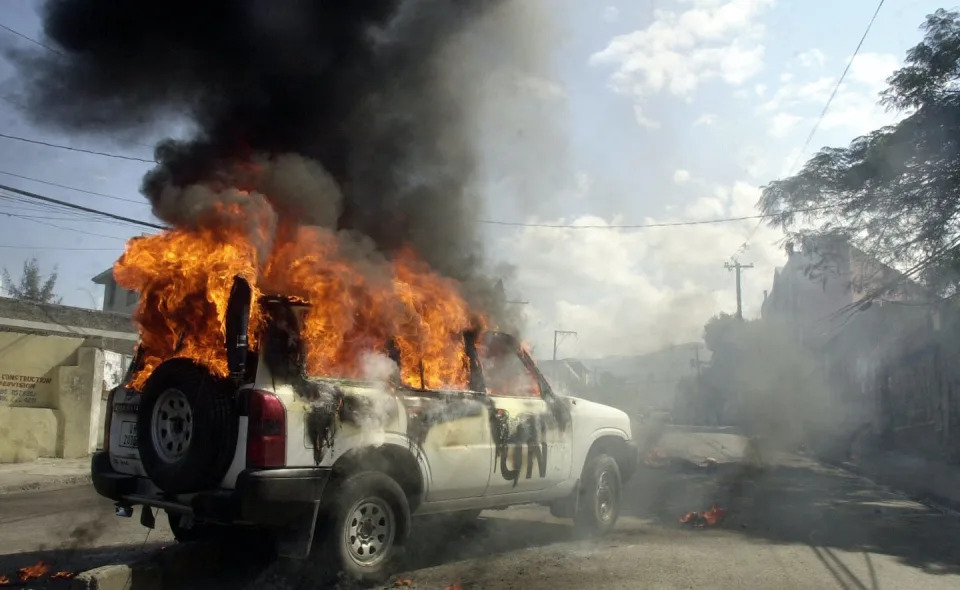
A U.N. mission car is burned by demonstrators in Haiti on Dec. 20, 2006. Thony Belizaire/AFP via Getty Images

Yet the perceived failure of the U.N. mission has become the basis of a view held by some Haiti watchers that international interventions are not only unsuccessful or misconceived, but also counterproductive.

Such a view forms the backbone of the notion of Haiti as an “aid state” – as opposed to a “failed state.” In this view, international interventions and the inflow of foreign funds have created a condition of dependency in which the country gets used to having foreigners make key decisions. This, the argument goes, fosters a cycle of corruption and mismanagement.

There is no doubt that some previous interventions left much to be desired, and that any new initiative would have to be conducted in close cooperation with Haitian civil society to avoid such pitfalls.

But I believe the notion that Haiti, in its current state, would be able to lift itself up without the help of the international community is wishful thinking. The nation has moved too far down the direction of gang control, and what remains of the Haitian state lacks the capacity to change that trajectory.
A duty to intervene?

Moreover, there is an argument to be made that the international community bears responsibility for the Haitian tragedy and is duty-bound to try to fix it.

To use one example from the relatively recent past: Haiti, until the early 1980s, was self-sufficient in the production of rice – a key staple there. Yet, pressured by the United States in the 1990s, the country lowered its agricultural tariffs to the bare minimum and, in so doing, destroyed local rice production. Former U.S. President Bill Clinton later apologized for the policy, but its legacy still lasts.

Haiti today has to import most of the rice it consumes, largely from the United States. And there isn’t enough of it to go around for all Haitians – the U.N. estimates that nearly half of Haiti’s population of 11.5 million is food-insecure.

Indeed, from its very beginning as an independent nation in 1804, Haiti has suffered the consequences of its unique place in history: It was simply too much for white colonial powers to see Haiti thrive as the first Black republic resulting from a successful slave rebellion.

France retaliated to the loss of what was once considered the world’s wealthiest colony by exacting reparations for a century and a half. Payments from Haiti flowed until 1947 — to the tune of US$21 billion in today’s dollars. The United States took 60 years to recognize Haiti, and invaded and occupied the nation from 1915 to 1934.

However, any thoughts of atoning for past actions seem far from the minds of those looking on as the chaos in Haiti spirals. Rather, many appear to have the kind of mindset expressed in 1994 by current U.S. President Joe Biden when, as a senator discussing the rationale for various interventions, he noted: “If Haiti just quietly sunk into the Caribbean, or rose 300 feet, it wouldn’t matter a whole lot for our interests.”

This article is republished from The Conversation, an independent nonprofit news site dedicated to sharing ideas from academic experts.

It was written by: Jorge Heine, Boston University.


Read more:


Haiti’s president assassinated: 5 essential reads to give you key history and insight


In Haiti, climate aid comes with strings attached

Jorge Heine is a founder and sits on the board of Diplomats Without Borders and is a member of Chile's Party for Democracy, the International Political Science Association, the International Studies Association and of the Foro Permanente de Política Exterior, a Chilean foreign policy think.
View comments (43)
WORKERS CAPITAL
CANADA / US investor group clinches tax credit deal for $1.5 bln renewable power acquisition


Wed, August 16, 2023 
By Isla Binnie

NEW YORK, Aug 16 (Reuters) - Invenergy Renewables, Blackstone and Canada's second-largest pension fund said on Wednesday they struck a deal with Bank of America to help buy wind and solar plants worth $1.5 billion, capitalising on a new tax structure included in President Joe Biden's landmark climate law.

Developers and investors are working on ways to take advantage of a provision in the 2022 Inflation Reduction Act(IRA) which gives companies tax breaks for funding the clean energy projects which can help wean the world off fossil fuels.

Invenergy said in a statement it agreed to sell tax credits worth $580 million to Bank of America, and put those funds towards buying 14 projects from American Electric Power.


Policymakers hope the new system will bring more money from fresh sources into renewables projects which have long relied on a limited group of large banks which can handle the process of buying equity stakes and taking the associated tax breaks.

This is the first large-scale transaction of its kind to be publicly announced, Bank of America's global head of sustainable finance Karen Fang said in the statement.

It "creates a financeable transferability product that will be used to scale the growth of renewable energy," Fang said.

Around $4 trillion will need to be spent on clean energy development globally each year by 2030 to allow the world's economies to cut greenhouse gas emissions to net zero, meaning no more than can be captured by natural sinks like forests or using technology, the International Energy Agency said.

Analysts at investment bank Credit Suisse have estimated the IRA could lead to the generation of tax credits worth $576 billion by 2031.

Treasury Department and Internal Revenue Service published rules on how to regulate tax credit transfers in June, and they are expected to launch an online registry by the end of 2023.

Private equity firm Blackstone has invested around $4 billion in Invenergy. Its fellow investors include Canada's Caisse de depot et placement du Quebec.

 (Reporting by Isla Binnie Editing by Marguerita Choy)