Friday, March 29, 2024


Blueprint for mandating indoor air quality for public buildings in form of standards


Peer-Reviewed Publication

QUEENSLAND UNIVERSITY OF TECHNOLOGY

QUT Professor Lidia Morawska 

IMAGE: 

PROFESSOR MORAWSKA IS LEADING INTERNATIONAL EXPERTS PRESENTING A BLUEPRINT FOR NATIONAL INDOOR QUALITY STANDARDS FOR PUBLIC BUILDINGS.

view more 

CREDIT: QUT


  • International experts set out standards for monitoring three key indoor pollutants
  • Adequate ventilation for number of occupants and activities must be taken into account
  • Carbon dioxide and PM2.5 particles and carbon monoxide are three pollutants requiring monitoring to assess healthy

    The experts addressed setting standards for three key indoor pollutants – carbon dioxide (CO2), carbon monoxide (CO), PM2.5 which are particles so small they can lodge deep in the lungs and enter the bloodstream - and ventilation rate.

    Distinguished Professor Morawska, from the QUT School of Earth and Atmospheric Sciences, internationally known, among others, for leading the appeal to the WHO to recognise the airborne transmission spread of the Covid-19 virus early in the pandemic, has continued to raise the importance of adequate indoor air quality for public spaces.

    “M­­­ost countries do not have any legislated indoor air quality (IAQ) performance standards for public spaces that address concentration levels of IA pollutants,” Professor Morawska said.

    “To have practical value, IAQ standards must be implementable by designing new buildings that are built, operated and maintained to standard or retrofitted to meet the standards.

    “While there is a cost in the short term, the social and economic benefits to public health, wellbeing and productivity will likely far outweigh the investment in cost in achieving clean indoor air.”

    Professor Morawska said COsensors were readily available, inexpensive and robust and should be used as a proxy to measure pathogens and COduring human occupancy in a public space.

    “COcan serve as a proxy for occupant-emitted contaminants and pathogens and to effectively assess ventilation quality,” she said.

    “We propose a COconcentration level of 800ppm with the proviso that outdoor concentration is used as a baseline and recognition of the fact that outdoor concentrations are increasing due to emissions to the atmosphere that outweigh removal.

    “Another key indicator of air quality we addressed is the amount of PM2.5 and we propose the WHO air quality guidelines as a basis for indoor air quality standards but with a 1-hour averaging time, as the 24 hours of the WHO AQG is much longer than people usually spend in public places.”

    Professor Morawska said mechanical ventilation systems should remove and dilute human-emitted and other indoor-generated pollutants at a higher rate than their production so that they would not accumulate in indoor air.

    “The technologies for measuring ventilation already exist in most modern mechanically ventilated buildings but monitoring ventilation rates in terms of clean air delivered to the space requires us to consider the number of people and their activities in the space to ensure adequate IAQ.

    “A practical ventilation standard could be air from outside (assumed to be clean), or clean recirculated air to the entire occupied zone and with airflow not directed from one person to another.

    Additional measures in support of ventilation, such as air cleaning and disinfection, could greatly reduce the need to increase the outdoor air supply, which carries a heavy energy demand.

    “Filtering recirculated air is an effective way to reduce concentration of, and thus our exposure to, airborne particulate matter, allergens and pathogens.”

    Mandating indoor air quality standards in public buildings was published in Science.

    The expert contributors were  Professor Morawska, Professor Belinda Bennett, and Professor Amanda Kennedy, QUT, Australia; Associate Professor Joseph Allen, Harvard University, USA; Professor William Bahnfleth, The Pennsylvania State University, USA; Professor Philomena M. Bluyssen and Professor Atze Boerstra, Delft University of Technology, The Netherlands; Professor Giorgio Buonanno, University of Cassino and Southern Lazio, Cassino, Italy; Professor Junji Cao, Chinese Academy of Science, China; Professor Stephanie J. Dancer, Edinburgh Napier University, UK; Professor Andres Floto and Dr Charles Haworth, University of Cambridge, UK; Francesco Franchimon, Franchimon ICM, The Netherlands;  Professor Trish Greenhalgh, University of Oxford, UK;  Jaap Hogeling, International Standards at ISSO, The Netherlands;  Associate Professor Christina Isaxon and Associate Professor Aneta Wierzbicka, Lund University, Sweden;  Professor Jose L. Jimenez and Professor Shelly L. Miller, University of Colorado, USA; Professor Prashant Kumar, University of Surrey, UK; Professor Jarek Kurnitski, Tallinn University of Technology, Estonia;  Professor Yuguo Li, University of Hong Kong, China;  Associate Professor Marcel Loomans, Eindhoven University of Technology, The Netherlands;  Professor Guy Marks, University of New South Wales;  Professor Linsey C. Marr, Virginia Tech, USA, Professor Livio Mazzarella, Politecnico di Milano, Italy; Professor Arsen Krikor Melikov and Professor Pawel Wargocki, Technical University of Denmark, Denmark;  Professor Donald K. Milton, University of Maryland;  Professor Jason Monty, University of Melbourne, Australia; Associate Professor Peter V. Nielsen, Aalborg University, Denmark; Professor Catherine Noakes, University of Leeds, UK; Professor Jordan Peccia, Yale University, USA; Professor Kimberly A. Prather, University of California, USA; Professor Xavier Querol, Institute of Environmental Assessment and Water Research, Spain; Professor Tunga Salthammer, Fraunhofer WKI, Germany; Professor Chandra Sekhar  and Associate Professor Kwok Wai Tam, National University of Singapore, Singapore; Associate Professor Olli Seppänen, Aalto University Finland;  Professor Shin-ichi Tanabe, Waseda University, Japan; Associate Professor Julian W. Tang, University of Leicester, UK;  Associate Professor Raymond Tellier, McGill University, Canada; Professor Maosheng Yao,Peking University, China.

    ventilation levels


U.S. landfills emit significant amounts of methane


AMERICAN ASSOCIATION FOR THE ADVANCEMENT OF SCIENCE (AAAS)


A new survey finds that United States open landfills are emitting significant amounts of methane, one of the most important greenhouse gases causing global climate change. The study by Daniel Cusworth and colleagues was conducted using airborne imaging spectrometers that observe methane emissions and is the largest airborne or ground-based survey of U.S. landfills to date, representing 20% of the nation’s landfills. Among the 250 sites across 18 states surveyed between 2018 and 2022, the researchers were able to detect significant point-source methane emissions at 52% of sites. This percentage “far exceed[s] the point-source detection rate from other methane emission sectors,” Cusworth et al. conclude, suggesting that solid waste is an important contributor to greenhouse gas emission in the U.S. The findings also uncover a large discrepancy in the emission estimates calculated by airborne detection and more traditional estimates made by walking over landfill sites. On average, aerial emission rates were a factor 2.7 higher than those reported to the U.S. Greenhouse Gas Reporting Program, the researchers note. Point-source emissions are emission “hotspots” confined to a local area, as compared to emissions spread over a broad area of the landfill. Point-source emissions are important to regulate because they often represent a significant emission source and are more likely to be linked to the dynamic operations of a landfill. The point-source emissions observed in the study sometimes persisted for months or even years. The researchers even found a distinct population of landfills where point-source activity continued almost throughout the entire study period. “This long-duration population represents more than 60% of all landfills, and 87% of all quantified emissions,” the researchers write.

Revolving Door Spins as Ex-Fossil Fuel Regulator Joins Carbon Capture Firm

"This move is intended to make sure policymakers continue to make bad bets on carbon capture ever working," said one critic.


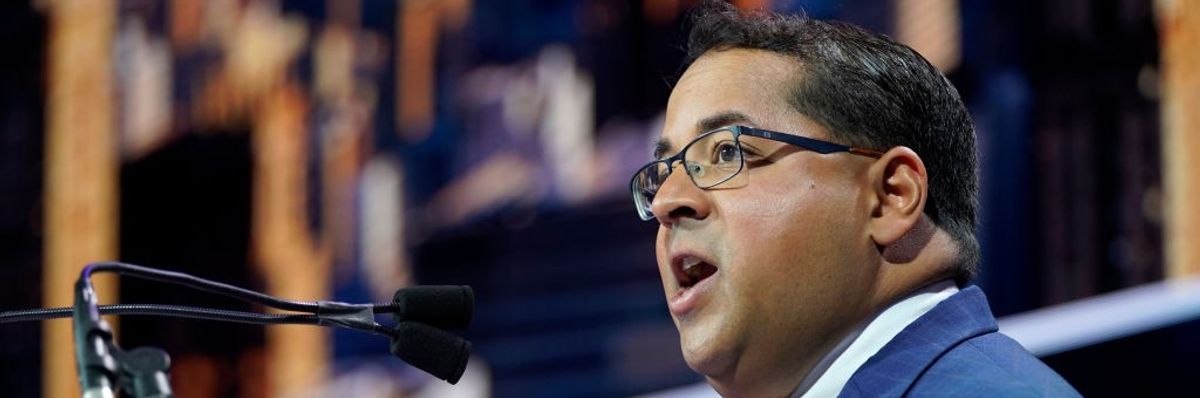
Neil Chatterjee, then-chairman of the Federal Energy Regulatory Commission, spoke at a summit in New York City on September 23, 2019.
(Photo: Riccardo Savi/Getty Images for Concordia Summit)

"Carbon capture has a long history of failure in the real world, but these companies have had great success in securing billions in government handouts."


JESSICA CORBETT
Mar 27, 2024
COMMON DREAMS

CarbonCapture Inc. on Wednesday announced the appointment of Neil Chatterjee to its board of directors—sparking fresh criticism of technology to capture and store carbon dioxide, the former U.S. regulator, and the revolving door between government and industry.

Chatterjee was appointed to the Federal Energy Regulatory Commission in 2017 by then-President Donald Trump, now the presumptive Republican presidential nominee. Chatterjee served as FERC's chair twice before his term expired in 2021. Prior to joining the commission, he advised U.S. Senate Minority Leader Mitch McConnell (R-Ky.) on energy.

"After greenlighting oil and gas expansion at FERC, Chatterjee is now capitalizing off of attempts to undo those harms," Hannah Story Brown, a senior researcher in climate and governance at the Revolving Door Project, told Common Dreams. "It would have been far less costly to the public interest and the public purse if Chatterjee had helped stanch the flow of carbon pollution into our atmosphere when he was in the position to."

"After greenlighting oil and gas expansion at FERC, Chatterjee is now capitalizing off of attempts to undo those harms."

Food & Water Watch policy director Jim Walsh said that "the so-called 'carbon capture' industry relies on billions of dollars in giveaways from the federal government, so it should not be a surprise that a company like this would add a Beltway insider to its board of directors."

CarbonCapture Inc.'s statement on Chatterjee celebrates his "deep ties in Washington and across the industry," saying that "in his time on Capitol Hill and at FERC, he established a reputation as a bipartisan operator who built alliances and cut through red tape."

The company's CEO, Adrian Corless, said that Chatterjee's "deep understanding of the energy landscape in the U.S. and abroad will be incredibly important as we source large amounts of clean energy in the face of grid expansion challenges and bottlenecks."

The firm builds "deeply modular" direct air capture (DAC) machines, which "use solid sorbents that soak up atmospheric CO2 when cooled and release concentrated CO2 when heated," as its website details. "The captured CO2 can then be permanently stored underground or used to make synthetic fuels, low-carbon concrete, carbon black, or other industrial products that require clean CO2."

Stressing the need to "decarbonize the atmosphere as quickly as possible," Chatterjee said Wednesday that "CarbonCapture's groundbreaking, modular direct air capture machines have put our country on the fast track to scale a proven solution at the speed and cost necessary to make a meaningful impact."

Food & Water Watch agrees that the warming world requires swift and sweeping action on planet-heating pollution. Along with advocating for a rapid and just global phaseout of fossil fuels, the group prioritizes "calling foul on fake solutions" to the climate emergency.

"The fossil fuel industries are eager to tout carbon waste sequestration and direct air capture because they bolster the dominance of dirty energy sources like oil and gas," Walsh told Common Dreams. "This is why they are called 'false solutions'—they delay the necessary actions to get off fossil fuels."

Citing an International Energy Agency analyst in an article about the "major hurdles" that remain as DAC ramps up, Yale Environment 360reported last week that "about three-quarters of all globally captured CO2 (which comes mainly from industrial flue stacks) is currently being used for enhanced oil recovery," which involves injecting CO2 into wells to bury it and extract more oil.

As a pair of Walsh's colleagues detailed for Food & Water Watch's website last year, other issues with DAC include the technology's high energy needs, toxic solvents, and risky storage options.

"Carbon capture has a long history of failure in the real world, but these companies have had great success in securing billions in government handouts," Walsh said. In terms of Chatterjee's appointment, he added that "this move is intended to make sure policymakers continue to make bad bets on carbon capture ever working."

As Story Brown pointed out, "Neil Chatterjee's prototypical spin of the revolving door, moving from pro-industry regulator to regulated industry, comes with added irony."

"As a regulator, he positioned himself as preferring market-based 'solutions' over government mandates, subsidies, and regulations," she explained. "But all that skepticism apparently vanished when he joined the carbon capture business, whose only hope of profitability comes from government subsidies like those in the Inflation Reduction Act."


Corless was among those who welcomed what Timecalled a "bonanza for the carbon capture industry" in the 2022 legislation. Shortly before President Joe Biden signed the bill, the CEO said that "it's going to make it easy for us to raise the capital to build the project earlier and to build it faster."

However, it's not just the government that is bankrolling CarbonCapture Inc. and similar ventures, as Story Brown noted.

"Neil Chatterjee hasn't left the lure of market magic behind," she said. "His firm has pre-sold millions in carbon removal credits so that energy-guzzling firms from Amazon to Aramco can greenwash their operations."
'Troublemakers' Block Amazon HQ Over Plan to Link Data Centers With Gas Pipeline


"Amazon is breaking its Climate Pledge by powering new data centers with fracked gas," said one member of the new activist group. "So we came to demand that they honor the pledge."


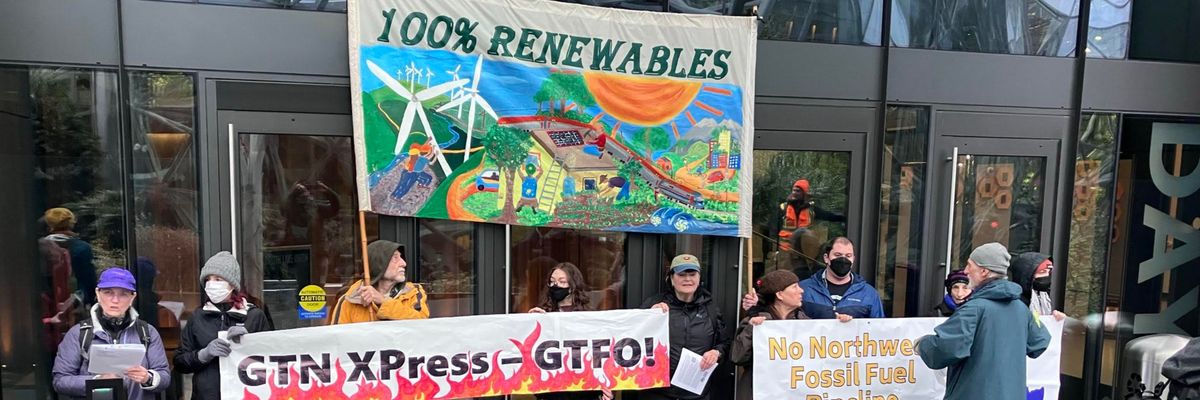
Members of the Troublemakers activist group block an entrance to Amazon's headquarters in Seattle on March 27, 2024.
(Photo: The Troublemakers)

BRETT WILKINS
Mar 27, 2024
COMMON DREAMS

A recently formed group of climate activists on Wednesday shut down entrances to Amazon's downtown Seattle headquarters to protest the tech titan's plans to link some of its data centers with an upgraded fracked gas pipeline.

Members of the Troublemakers—who describe themselves as "an ever-growing community of people who are committed to taking action for life on Earth"—blockaded the doors to the Day 1 Building on 7th Ave. in opposition to Amazon Web Services' (AWS) plan to connect three data centers near Boardman, Oregon to TC Energy's Gas Transmission Northwest (GTN) XPress Project.

As Common Dreamsreported last October, GTN XPress, which has been approved by the Federal Energy Regulatory Commission, would upgrade compressor stations in Kootenai County, Idaho; Sherman County, Oregon; and Walla Walla County, Washington. TC Energy plans to boost the 60-year-old pipeline's capacity by 150 million cubic feet of fracked gas by increasing the conduit's pressure.


"The decision to use fracked gas from the GTN XPress adds to Amazon's carbon emissions problems," the Troublemakers said in a statement. "Amazon's 2022 carbon emissions totaled 71.27 million metric tons, marking an 18% rise from 2020 and a 40% surge since 2019, the year Amazon unveiled its Climate Pledge. This alarming trend is in stark contrast to the global imperative to halve emissions by 2030."

The group wrote in a March 19 letter to Amazon CEO Andy Jassy:
Amazon prides itself on innovation. Using fossil fuel is not innovation... It is relying on a dying technology that is killing the planet. Utilizing GTN XPress would increase Amazon's carbon footprint and contribute greatly to climate change... We urge you to publicly commit to financing solar or wind projects to provide clean energy for Amazon's operations, and reject the GTN XPress.

The Troublemakers are calling on Amazon to:Publicly renounce the plan to connect to GTN XPress;
Commit to not powering AWS data centers with fossil fuels; and
Commit to using 100% renewable energy in each operation while funding wind and solar generation, storage, and distribution.

"We see Amazon's greenwashing every time we pass by Climate Pledge Arena," said Troublemaker Valerie Costa, who was referring to the home of the Seattle Kraken and Seattle Storm professional sports franchises. "Until Amazon drops its plan to buy fracked gas from GTN XPress, we'll keep showing up. Every fossil fuel project in the [Pacific Northwest] will be met with fierce resistance."

Leonard Sklar, a scientist and Troublemaker, asserted that "Amazon is breaking its Climate Pledge by powering new data centers with fracked gas. So we came to demand that they honor the pledge."

"We know they have the power to be 100% renewable energy," he added, "and that's what this moment requires."

'Enough Is Enough': Ireland Joins ICJ Genocide Case Against Israel

"What  we are seeing in Gaza now, represents the blatant violation of international humanitarian law on a mass scale," said one top Irish official.


Palestinian and South African flags are seen at a January 13, 2024 protest for Gaza in Dublin, Ireland.

(Photo: Stringer/Andalou via Getty Images)

BRETT WILKINS
Mar 27, 2024
COMMON DREAMS

Citing Israel's "blatant" human rights violations in Gaza, Ireland's second-highest-ranking official said Wednesday that the country will join the South Africa-led genocide case before the International Court of Justice in The Hague.

Irish Tánaiste Micheál Martin—the equivalent of a deputy prime minister in other parliamentary nations—said that Ireland decided to intervene in the case after analyzing the "legal and policy issues" pertaining to the case under review by the United Nations' top court.

"It is for the court to determine whether genocide is being committed," Martin—who also serves as Ireland's foreign and defense minister—said in a statement. "But I want to be clear in reiterating what I have said many times in the last few months; what we saw on October 7 in Israel, and what we are seeing in Gaza now, represents the blatant violation of international humanitarian law on a mass scale."


Martin continued:
The taking of hostages. The purposeful withholding of humanitarian assistance to civilians. The targeting of civilians and of civilian infrastructure. The indiscriminate use of explosive weapons in populated areas. The use of civilian objects for military purposes. The collective punishment of an entire population.

The list goes on. It has to stop. The view of the international community is clear. Enough is enough. The U.N. Security Council has demanded an immediate cease-fire, the unconditional release of hostages, and the lifting of all barriers to the provision of humanitarian assistance at scale. The European Council has echoed this call.

South Africa's case—which is supported by over 30 countries, the Arab League, African Union, and others—incisively details Israel's conduct in the war, including the killing of tens of thousands of Palestinians, mostly women and children; the wounding of tens of thousands more; the forcible displacement of 90% of the besieged enclave's 2.3 million people; and the inflicting of conditions leading to widespread starvation and disease. The filing also cited numerous genocidal statements by Israeli officials.

On January 26, the ICJ issued a preliminary ruling that Israel is plausibly committing genocide in Gaza and ordered its government and military to prevent genocidal acts. Palestinian and international human rights defenders say Israel has ignored the order.

A draft report released this week by the U.N.'s Human Rights Council found "reasonable grounds to believe" that Israel is committing genocide in Gaza, a move that came on the same day as the U.N. Security Council passed a resolution demanding an immediate cease-fire in the ongoing war.

"The situation could not be more stark; half the population of Gaza face imminent famine and 100% of the population face acute food insecurity," said Martin. "As the U.N. secretary-general said as he inspected long lines of blocked relief trucks waiting to enter Gaza during his visit to Rafah at the weekend: 'It is time to truly flood Gaza with lifesaving aid. The choice is clear: surge or starvation.' I echo his words today."

In a St. Partick's Day White House meeting with U.S. President Joe Biden—a staunch supporter of Israel—Irish Toaiseach (Prime Minister) Leo Varadkar, who announced earlier this month that he would soon step down, said that "the Irish people are deeply troubled about the catastrophe that's unfolding before our eyes in Gaza."

"And when I travel the world, leaders often ask me why the Irish have such empathy for the Palestinian people," he added. "And the answer is simple: We see our history in their eyes—a story of displacement, of dispossession and national identity questioned and denied, forced emigration, discrimination, and now hunger."
'Horrifying' Footage Shows IDF Killing Two Gazans, Burying Their Bodies With a Bulldozer

"When the Israeli army can do these things and get away with it, it can only then do more of it knowing that it will not meet any punishment," said one analyst.


A screengrab from video footage broadcast by Al Jazeera shows Israeli forces burying the bodies of two Palestinians with a bulldozer.
(Photo: Al Jazeera)

JAKE JOHNSON
Mar 28, 2024
COMMON DREAMS

Video footage broadcast Wednesday by Al Jazeera shows Israeli soldiers gunning down two Palestinians on the coast of northern Gaza, even as one of them waves what appears to be a piece of white fabric.

The footage shows one of the men walking in the direction of an Israeli military vehicle with both hands raised. Despite the absence of any clear evidence that the man posed a threat, Israeli forces shot him from a short distance away. Another man is seen on the ground not far behind.

Al Jazeera's Tareq Abu Azzoum said the killings took place near where World Central Kitchen recently dropped off food aid.

The video then shows Israeli soldiers burying the bodies with a bulldozer.

"Probably certain words should be invented for this sort of thing," Marwan Bishara, AI Jazeera's chief political analyst, said in response to the footage. "I am not sure we have the sufficient vocabulary to describe this sort of twilight zone of Israel's fantasy of being the world's most moral army."

"It's a fantasy that meets the reality of a genocide," Bishara added. "An attempt to kill or destroy much of Palestine and Palestinians and hide the evidence and lie about it. When the Israeli army can do these things and get away with it, it can only then do more of it knowing that it will not meet any punishment."

Watch:


Richard Falk, former United Nations special rapporteur on the human rights situation in the occupied Palestinian territories, toldAl Jazeera that the footage provides "vivid confirmation of continuing Israeli atrocities" and spotlights the "unambiguous character of Israeli atrocities that are being carried out on a daily basis."

"The eyes and ears of the world have been assaulted in real-time by this form of genocidal behavior," said Falk. "It is a shocking reality that there has been no adverse reaction from the liberal democracies in the West. It is a shameful moment."

The Euro-Mediterranean Human Rights Monitor, whose board Falk chairs, has documented numerous examples of Israeli soldiers conducting close-range field executions in Gaza since October 7, when Israel launched its latest assault following a Hamas-led attack.

In less than six months, Israeli forces have killed more than 32,500 people in Gaza and sparked one of the worst humanitarian catastrophes in modern history.

The video footage emerged just days after the United Nations Security Council approved a resolution demanding an immediate cease-fire in Gaza. The U.S., Israel's leading arms supplier, abstained from the vote and falsely claimed the measure was "nonbinding."

The Israeli government, for its part, immediately signaled that it would disregard the resolution, just as it has ignored orders from the International Court of Justice.

Sophie McNeill, a human rights campaigner, called the footage released Wednesday "horrifying" and demanded that the International Criminal Court "urgently prioritize investigating and charging all those carrying out war crimes in Gaza."

"There just so happened to be a camera here in this moment. What are we not seeing?" McNeill asked. "This impunity must end."
Draft UN Report Finds Israel Has Met Threshold for Genocide

"Israel's genocide on the Palestinians in Gaza is an escalatory stage of a long-standing settler-colonial process of erasure."


The bodies of victims of the October 31, 2023 Israeli bombing of the
 Jabalia refugee camp in the Gaza Strip are lined up outside the Indonesian 
Hospital in Gaza City.
(Photo: Fadi Alwhidi/Anadolu via Getty Images)


BRETT WILKINS
Mar 25, 2024
COMMON DREAMS'

The United Nations Human Rights Council on Monday published a draft report that found "reasonable grounds to believe" that Israel is committing genocide in Gaza, a move that came on the same day as the U.N. Security Council passed a resolution demanding an immediate cease-fire in the ongoing war.

The advance unedited version of the report—entitled Anatomy of a Genocide—concludes that Israel's far-right government and military "have intentionally distorted jus in bello principles, subverting their protective functions, in an attempt to legitimize genocidal violence against the Palestinian people."

"The overwhelming nature and scale of Israel's assault on Gaza and the destructive conditions of life it has inflicted reveal an intent to physically destroy Palestinians as a group," the draft report states, enumerating Israeli actions that violate Article II of the Convention on the Prevention and Punishment of the Crime of Genocide: "Killing members of the group; causing serious bodily or mental harm to group members; and deliberately inflicting on the group conditions of life calculated to bring about its physical destruction in whole or in part."

"Israel has de facto treated an entire protected group and its life-sustaining infrastructure as 'terrorist' or 'terrorist-supporting,' thus transforming everything and everyone into either a target or collateral damage, hence killable or destroyable," the paper continues. "In this way, no Palestinian in Gaza is safe by definition. This has had devastating, intentional effects, costing the lives of tens of thousands of Palestinians, destroying the fabric of life in Gaza, and causing irreparable harm to its entire population."


Israel rejected the report as "an obscene inversion of reality."

According to Palestinian and international humanitarian officials, Israel's 171-day Gaza onslaught has killed at least 32,333 Palestinians, most of them women and children, while wounding nearly 75,000 others and displacing around 90% of Gaza's 2.3 million people. Thousands more Palestinians are missing and believed to be dead and buried beneath the rubble of bombed buildings. Disease and deadly starvation caused and exacerbated by Israel's siege and blockade of Gaza are spreading rapidly.

"Israel's genocide on the Palestinians in Gaza is an escalatory stage of a long-standing settler-colonial process of erasure," the draft report asserts. "For over seven decades this process has suffocated the Palestinian people as a group—demographically, culturally, economically, and politically—seeking to displace it and expropriate and control its land and resources."

Referring to the flight and ethnic cleansing of more than 750,000 Arabs from Palestine during the foundation of the modern state of Israel in 1948, the paper contends that "the ongoing Nakba must be stopped and remedied once and for all. This is an imperative owed to the victims of this highly preventable tragedy, and to future generations in that land."

"The ongoing Nakba must be stopped and remedied once and for all."

The draft report urges U.N. member states to "enforce the prohibition of genocide in accordance with their... obligations" under international law. In January, the U.N.'s International Court of Justice (ICJ) found that Israel was "plausibly" perpetrating genocide in Gaza and ordered the country's government to "take all measures within its power" to prevent genocidal acts. Human rights defenders say Israel has ignored the order.

"Israel and those states that have been complicit in what can be reasonably concluded to constitute genocide must be held accountable and deliver reparations commensurate with the destruction, death, and harm inflicted on the Palestinian people," the publication argues.

The draft report recommends measures including:Immediate implementation of an arms embargo on Israel, as it appears to have failed to comply with the binding measures ordered by the ICJ;

Immediate referral of the situation in Palestine to the International Criminal Court in support of its ongoing investigation;

Ensuring that Israel, as well as states who have been complicit in the Gaza genocide, acknowledge the colossal harm done, commit to nonrepetition, with measures for prevention and full reparations, including the full cost of the reconstruction of Gaza;
Deploying an international protective presence to constrain the violence routinely used against Palestinians in the occupied territories; and
Ensuring that the United Nations Relief and Works Agency for Palestine Refugees in the Near East (UNRWA) is properly funded to enable it to meet the increased needs of Palestinians in Gaza.

Israel on Monday informed the U.N. that it will no longer allow UNRWA convoys carrying food aid into northern Gaza, even as the Palestinians are starving to death, a move that one humanitarian campaigner called a "death sentence."


State Department Spokesman Urged to Resign Over 'Despicable' Attack on UN Expert


One critic described Matthew Miller's attack on United Nations special rapporteur Francesca Albanese as a "Trumpian smearing of a principled human rights expert."


U.S. State Department spokesperson Matthew Miller speaks to reporters during a press briefing on March 25, 2024.

(Photo: Mostafa Bassim/Anadolu via Getty Images)

JAKE JOHNSON
Mar 28, 2024
COMMON DREAMS

U.S. State Department Matthew Miller faced calls to resign Thursday after he accused a United Nations special rapporteur of engaging in antisemitism—an attack that came days after the human rights expert presented a report concluding that Israel's assault on Gaza has met the threshold of genocide.

Asked about the report during a press briefing on Wednesday, Miller said the U.S. has "for a longstanding period of time opposed the mandate of this special rapporteur, which we believe is not productive."

"And when it comes to the individual who holds that position, I can't help but note a history of antisemitic comments that she has made that have been reported," Miller added, pointing to comments that Francesca Albanese—the U.N. special rapporteur on the human rights situation in the occupied Palestinian territories—"made in December that appeared to justify the attacks of October 7."


It's not entirely clear which comments Miller was referencing.

In an interview with Jewish News Syndicate in December, Albanese was asked whether Palestinian militants' killing of Israeli soldiers on October 7 was a violation of international law. Albanese, an Italian attorney and academic, said that "killing a soldier is a tragedy under international law, but when there is an armed conflict, like in this case, killing a soldier is not illegal."

But Albanese stressed in the interview that the Hamas-led attacks on Israeli civilians—including the taking of hostages—were "not legitimate resistance."

"These are crimes and cannot be justified," she added.

Miller's attack on Albanese Wednesday—which echoed earlier attacks on the special rapporteur by U.S. officials and lawmakers—sparked immediate backlash and calls for his resignation.

"Matthew Miller should be forced to resign for trying to endanger the life of a U.N. official with falsehoods," Ashish Prashar, a spokesperson for Gaza Voices, said in a statement. Albanese said earlier this week that she has faced threats following the publication of her report accusing Israel of committing genocide in the Gaza Strip.


Rohan Talbot, director of advocacy and campaigns at Medical Aid for Palestinians, called the State Department spokesman's remarks a "truly despicable, Trumpian smearing of a principled human rights expert."

"Note the lack of substantive rebuttals of her careful analysis, and the resort to ad hominem attacks," Talbot wrote on social media. "Not the sign of a confident administration."

"Israel has a long history of weaponizing false charges of antisemitism to attack and undermine those fighting for human rights for Palestinians."

The Israeli government has similarly attempted to cast Albanese as an antisemite, drawing pushback from human rights organizations and academics who say the claim is a baseless attempt to discredit her work.

"Israel has a long history of weaponizing false charges of antisemitism to attack and undermine those fighting for human rights for Palestinians—and U.N. officials and experts have been among the most consistent victims of those attacks," Phyllis Bennis, director of the New Internationalism Project at the Institute for Policy Studies, told Common Dreams.

"Almost 15 years ago Richard Falk," Bennis added, "an internationally respected Princeton professor of international law who had just been appointed special rapporteur, was not only denied access to the occupied Palestinian territory to carry out the terms of his U.N. mandate, but was also arrested and jailed by Israeli authorities."

"Since then every special rapporteur has been similarly excluded, their mandate and their work undermined, and their commitment to international law and human rights attacked as antisemitic," she said. "Francesca Albanese has been among the bravest of these SRs, maintaining her commitment to calling out all violations of international law relevant to her mandate—including when Israel has violated international covenants against apartheid and now, against genocide."

Albanese's 25-page report, which she delivered to the U.N. Human Rights Council on Tuesday, argues that "the overwhelming nature and scale of Israel's assault on Gaza and the destructive conditions of life it has inflicted reveal an intent to physically destroy Palestinians as a group."

"There are reasonable grounds to believe that the threshold indicating the commission of the following acts of genocide against Palestinians in Gaza has been met: killing members of the group; causing serious bodily or mental harm to groups' members; and deliberately inflicting on the group conditions of life calculated to bring about its physical destruction in whole or in part," the report states. "Genocidal acts were approved and given effect following statements of genocidal intent issued by senior military and government officials."

Amnesty International praised the report as "a crucial body of work that must serve as a vital call to action."

The Biden State Department has publicly rejected genocide accusations against Israel as "meritless" and said it has not found Israel's military to be in violation of international law during its monthslong war on Gaza—an assessment that conflicts with the findings of leading human rights organizations and U.N. experts.

Intel Brags of $152 Billion in Stock Buybacks Over Last 35 Years. So Why Does It Need an $8 Billion Subsidy?


What’s to stop the chip-making giant from shoveling taxpayer grants into more stock buybacks?


An illustration of INTEL and the US dollar is being displayed in Suqian City, Jiangsu Province, China, on February 17, 2024. The Biden administration is currently negotiating to provide more than $10 billion in subsidies to Intel Corp., which may include loans and direct grants.
(Photo Illustration by Costfoto/NurPhoto via Getty Images)


LES LEOPOLD
Mar 27, 2024
Common Dreams

Intel, the largest chip maker in America, with 2023 revenues of $54 billion, has just been awarded an $8.5 billion grant from the federal CHIPS and Science Act, plus $11 billion in favorable loans.

In addition to badly needed microchips, Intel produces totally useless stock buybacks. On its website the company proudly proclaims to have spent $152 billion on stock buybacks since 1990. That’s not a typo: $152,000,000,000. Which is why I call it "Stock Buybacks ĐŻ Us."

Intel took $152 billion of its revenues, some portion of which could have been used for R&D and building new microchip facilities in the U.S. as well as paying workers more, and instead funneled it to its largest Wall Street stockholders and corporate executives, enriching the top fraction of the top one percent.

A company repurchasing its own shares sees earnings per share rise because there are fewer shares in circulation. Share prices rise, though nothing new is made, and the largest stockholders, including top Intel executives, cash out with eye-popping profits. Intel CEO Pat Gelsinger hauled in $179 million in 2021, most of it coming from stock-related compensation.

How can you tell if such a large company is using CHIPS money or other money to conduct its buybacks? You can’t.

Stock buybacks are a form of stock manipulation, which is why they were outlawed by the Securities and Exchange Commission after the Great Depression, up until deregulation in 1982, that limited buybacks to two percent of profits. Now it’s all the buybacks your corporation can eat, with nearly 70 percent of all corporate profits going to this form of stock manipulation.

So, why are we giving Intel another $8 billion?

National security is at risk, we are told. Semi-conductors are far too important to our defense and to our economy to be produced overseas, especially in or anywhere near China, our communist enemy de jure. If we don’t bribe Intel to build here, the argument goes, they just might go elsewhere. They are in business to produce profits (and stock buybacks) not national security.

But the biggest selling point, as always, from politicians of both parties, is Jobs! Jobs! Jobs! The White House calculates that Intel will generate 20,000 temporary construction jobs and 10,000 more permanent manufacturing jobs because of this grant.

But what’s to stop Intel from shoveling taxpayer grants into more stock buybacks?

Not much. Senator Chris Van Hollen (D-Md.) writes:
“While the legislation specifically prohibits the use of CHIPS funds for stock buybacks and dividend payments, these restrictions do not explicitly prohibit award recipients from using CHIPS funds to free up their own funds, which they can then use for those purposes.”

Senator Elizabeth Warren (D-Mass.) is already worried that BAE Systems, a much smaller CHIPS recipient, but also a buyback recidivist, has not said it would refrain from stock buybacks for the duration of its CHIPS money.

Intel hasn’t made that pledge either. In fact, Intel’s website states it still has authorization to conduct another $7.24 billion in stock buybacks.

How can you tell if such a large company is using CHIPS money or other money to conduct its buybacks? You can’t.

Doesn’t the CHIPS Act prohibit Intel from conducting mass layoffs?

Not a chance.

Intel could very well increase jobs in some locations while cutting jobs in other locations. And there is evidence that they are doing that right now.

As the CHIPS Act was moving through Congress in 2022, strongly lobbied for by CEO Gelsinger, Intel laid off approximately 2,000 employees in California. Now, the company says, it “is working to accelerate its strategy while reducing costs through multiple initiatives, including some business and function-specific workforce reductions in areas across the company."

What that word salad means is that by the time Intel creates 10,000 new manufacturing jobs, it will have laid off more workers than that. And they know there’s nothing the government will do about it.

Why are most politicians so gutless about preventing mass layoffs?

That’s a longer story that I cover in Wall Street’s War on Workers. Simply put, our political system refuses to acknowledge that mass layoffs are the ruination of working people.

By the time Intel creates 10,000 new manufacturing jobs, it will have laid off more workers than that. And they know there’s nothing the government will do about it.

More than 30 million working people have suffered through mass layoffs since 1996. Last year there were more than 260,000 jobs lost in the highly prosperous tech sector, with another 50,000 so far this year. In January 2024, there were 82,000 layoffs across the economy. Many of those workers will suffer greatly both from financial loss and deterioration of their health. (For those worried about the catastrophic impact of artificial intelligence, the Challenger Report claims AI killed only 381 jobs in January 2024.)

It should be a no-brainer for the government to make a simple regulation:
If you are supping at the taxpayer trough, you can’t conduct compulsory layoffs of taxpayers. All your layoffs must be voluntary. That is, you have to buy workers out. No forced layoffs!

Most elected leaders believe that regulating corporations about how they can and can’t destroy jobs is blasphemy, an attack on sacred capitalist freedoms, something that only the Communists would do! In addition to the ideological blowback, the political establishment actually buys the corporate line that halting mass layoffs would make corporations uncompetitive, which is total nonsense.

Here’s a telling piece of evidence.

In 2021, Siemens Energy, the German-based company with 90,000 employees globally, decided to stop making equipment used in oil extraction and fracking. In Germany, 3,000 workers were to lose their jobs, and another 1,700 in the U.S.

In Germany, companies must live within a legislated system of codetermination, meaning that half the seats on a company’s board of directors are held by worker representatives, and labor-management committees run the day-to-day operations of each facility. (As an aside, this system was urged upon German businesses by the U.S. after WWII, because we believed unionized workers were less likely than their bosses to cozy up to fascists.)

The political establishment actually buys the corporate line that halting mass layoffs would make corporations uncompetitive, which is total nonsense.

In Germany, the workers used their power to persuade Siemens management to agree to no forced layoffs. On top of that, Siemens agreed not to shut down six facilities and instead put other production lines in them.

In the United States? All 1,700 workers lost their jobs AND the president of Siemens USA was invited to the infrastructure bill signing ceremony. In honor of the legislation she had the gall to say, “This is a historic moment in America – one that sets the stage for decarbonizing the economy, boosting U.S. manufacturing, creating jobs, and increasing equity.”

Moral of the story: In addition to fabricating hypocritical public statements, global corporations have incredible flexibility and resources to modify production, employment, wages, and working conditions. “No forced layoffs” would not put Siemens or Intel or any other global corporation out of business. Instead, there might be a microscopic dip in stock buybacks!

Every single company that is getting a CHIPS grant has the capacity to modify its operations to avoid forced layoffs, just as Siemens has done in Germany. In fact, every company that gets a federal contract should agree to do the same, as well as forswearing stock buybacks.

There’s only one way out of this non-stop shakedown: expand labor unions and build a powerful mass movement.

The second moral of the story: Wall Street and corporate America are so accustomed to getting their way that they will only pursue national goals when they are bribed. No matter how rich, no matter how large their stock buyback scams, they want our tax dollars with no strings attached. And very few politicians have the nerve to resist.

There’s only one way out of this non-stop shakedown: expand labor unions and build a powerful mass movement. Until we, the people, rise up and demand it, no one will derail the Wall Street gravy train that runs from our pockets to theirs via stock buybacks and pink slips.

And we wonder why so many Americans think the system is rigged and that democracy isn’t working for us.

Our work is licensed under Creative Commons (CC BY-NC-ND 3.0). Feel free to republish and share widely.


LES LEOPOLD is the executive director of the Labor Institute and author of the new book, “Wall Street’s War on Workers: How Mass Layoffs and Greed Are Destroying the Working Class and What to Do About It." (2024). Read more of his work on his substack here.
Full Bio >