Sunday, April 21, 2024


REVERSE ENGINEERING
China's latest supersonic spy drone looks a lot like the Lockheed D-21 that crashed there in 1971

Benjamin Brimelow
Sat, April 20, 2024 


Lockheed developed a spy drone in the 1960s that crashed in China.


China recently debuted a supersonic drone that bears a striking resemblance to Lockheed's D-21.


The D-21's urgent development was marked by ambition and tragedy.

On March 20, 1971, a specially modified US Air Force B-52 bomber from the 4200th Support Squadron took off from Andersen Air Force Base in Guam carrying a unique aircraft mounted under its wing.

The aircraft, shaped like a dart and painted black, was a D-21 supersonic reconnaissance drone. It was to be the fourth such drone to conduct aerial reconnaissance of China's Lop Nor nuclear test site in northwestern China, and despite its sophistication, it would crash into the very country it was intended to spy on.

Created by the renowned Lockheed Corporation, the D-21 was the most advanced unmanned aircraft of its time. Intended to bridge a gap between burgeoning satellite technology and manned reconnaissance flights, the drone's development was filled with ambition, urgency, and tragedy.

Ultimately unsuccessful, the drone would be relegated to the annals of aviation history if not for the appearance of a strikingly similar Chinese drone unveiled at a recent military parade. This delta-shaped drone of similar size also requires being launched by a mothership. But Chinese engineers claim advances that go much farther than the D-21, reaching 30 miles into the atmosphere and speeds up to Mach 6.

This is what we know about the high-flying Chinese spy drone and the D-21 upon which it could be based.

An urgent need

The origins of the D-21 start in 1960, when Francis Gary Powers and his U-2 spy plane were shot down over the Soviet Union by a Soviet surface-to-air missile. The incident pushed President Dwight Eisenhower to discontinue all manned reconnaissance flights over the Soviet Union to avoid future casualties and embarrassments.

But the need to surveil Soviet military sites was still vital, and while reconnaissance satellites were starting to be launched into space, the technology was nascent. Satellites carried a limited amount of film despite being in orbit for days, had limited repositioning ability, and were not as available for short-notice launches in emergencies compared to manned aircraft.

A faster and higher-flying successor to the U-2, the A-12, was in development. However, as a conventional aircraft, it still had to be manned, and the White House and CIA alike were both reluctant to risk the capture of another pilot, especially if it also meant losing an even more advanced aircraft in the process.

Consequently, the CIA needed a stopgap solution until the satellite programs matured. In 1962, the Central Intelligence Agency approached Lockheed's Skunk Works division (which created the U-2 and the A-12) for such a solution.
High altitude, high speed

Lockheed's solution was to create an unmanned high-altitude high-speed reconnaissance aircraft with similar capabilities as the A-12, but much smaller. Originally designated as the Q-12, the drone utilized a delta wing design, had a wingspan of 19 feet, and measured 42 feet long.

It was powered by a Marquardt RJ43-MA-20S4 ramjet engine that ran the entire length of the aircraft. Capable of producing 11,500 lbs. of thrust, the engine gave the drone a top speed of Mach 3.3, and enabled it to reach an altitude of 95,000 feet. The D-21's range, meanwhile, was over 3,000 miles.

Because it was powered by a ramjet engine, the drone had to be launched from a mothership once it reached a speed where the ramjet could be activated. A modified A-12 was judged to be the best candidate. Redesignated as the M-21, the jet would carry the drone, redesignated as the D-21, on its fuselage, then release it once it reached a speed where the ramjet could be activated.

Once released, the D-21 would fly a pre-programmed route utilizing an internal navigation system to the area of interest, where it would take photos.

Once taken, the D-21 would fly to a designated area, eject its film cannister, then self-destruct. The film cannister, meanwhile, would be snatched from the sky as it parachuted down by a waiting JC-130B, or be collected by a Navy vessel.

Dubbed Project Tagboard, the first carry test occurred on December 22, 1964, with the first separation and flight test occurring on March 6, 1966. Two more largely successful tests followed.

But the fourth flight test, on July 30, ended in tragedy when the D-21 collided with the M-21 after release, destroying both aircraft. Pilot Bill Park and Launch Control Officer Ray Torrick successfully ejected, but Torrick's flight suit was likely torn in the process, leading to it filling with water when both men landed in the ocean, causing him to drown.

After the crash, it was decided that using M-21s as a mothership was too dangerous. Instead, a modified B-52H would be used, carrying up to two drones under its wings. As the bomber was unable to fly at the speed required to activate the D-21's scramjet engine, a 44-foot rocket booster was attached underneath it. After release, the booster would ignite to bring the D-21 to the required speed, then detach after its scramjet came online.

A B-52H bomber carries the D-21B. A rocket booster provided the acceleration to start the drone's ramjet engine.US Air Force
Senior Bowl

Now dubbed Project Senior Bowl, the new system was tested multiple times between September 1967 and early 1969 with mixed results. The D-21's first fully successful test occurred on June 16, 1968, which saw it fly some 3,000 miles at 90,000 feet.

Despite its spotty success record, the drone was approved for limited service in 1969. Flying out of Andersen Air Force Base, the D-21s were given the task of spying on China's Lop Nor nuclear test site, where China had detonated its first nuclear weapon five years earlier.

But while the tests had mixed results, the missions were all failures.

The first mission, on November 9, 1969, was perhaps the worst. After launching from its mothership and reaching Lop Nor, contact with the D-21 was lost, and it disappeared.

In fact, the drone continued flying all the way into the Soviet Union, and crashed in the Siberian wilderness. With the wreckage recovered, Soviet engineers drew up plans for a reverse-engineered copy called the Voron, but the project was never pursued.

After more than a year of further testing and preparation the second mission was flown on December 16, 1970. The D-21 launched successfully, reached Lop Nor, took its photographs, and arrived at the return point, but the film canister's parachute didn't deploy properly after ejection, and it was lost at sea.

The third mission, on March 4, 1971, proceeded similarly. The film canister's parachute deployed successfully, but the JC-130B failed to recover it before it splashed into the water. A Navy destroyer attempted to recover the floating canister, but accidentally collided with it, causing it to sink.

The fourth and final mission two weeks later was a complete failure, with the D-21 crashing into China's southwestern Yunnan province while en route to Lop Nor. The drone was recovered by the Chinese, and is on display at the Chinese Aviation Museum in Beijing.

With Senior Bowl resulting in four operational failures, and with each drone costing at least $2.5 million, the D-21 program became hard to justify — especially as satellites were becoming more advanced.

Consequently, the program was canceled in July 1971.

Of the 38 D-21's built, 21 had been used in tests or operations. The remaining D-21s were put into storage, and eventually made their way to the boneyard at Davis-Monthan Air Force Base in Tucson, Arizona.

Apart from the crashed model at the Chinese Aviation Museum, 11 D-21s are on display in the United States.


A WZ-8 reconnaissance drone is on display at the 13th China International Aviation and Aerospace Exhibition on September 28, 2021 in Zhuhai, China.Chen Xiao/Getty Images
A Chinese copy?

The D-21 had largely faded from public memory until 2019, when, at the military parade commemorating the 70th Anniversary of the People's Republic of China on October 1, China unveiled a similar-looking drone.

Dubbed the WZ-8, the drone is a delta-wing design, about 37 feet long, and has a wingspan of 22 feet. Instead of a scramjet running the length of the body, it is powered by two rocket motors.

Like the D-21, the WZ-8 must be launched by a mothership during flight — specifically an H-6M, a version of the H-6 strategic bomber modified to carry cruise missiles on external hardpoints.

Chinese media has reported that the WZ-8 is capable of flying 160,000 feet and as fast as Mach 6. Its sensor suite reportedly includes a daylight electro-optical sensor and a synthetic aperture radar.

Documents reportedly leaked from US intelligence sources last year revealed that China has "almost certainly" established its first operational WZ-8 unit.

One document, alleged to originate from the US National Geospatial-Intelligence Agency, claims that the unit is based at Liuan Airfield, and that its missions could include high-altitude reconnaissance flights of the South Korean coast and virtually all of Taiwan.

According to the document, the drone would be released from its mothership just off the northern or eastern Chinese coast, execute its mission, then return and land at Chinese coastal airfields, whereupon it would be loaded back on an H-6M bomber and return to Liuan. The document lists the WZ-8 as being capable of flying up to 100,000 feet at Mach 3.

It has been separately speculated that the WZ-8 could be used to track US carrier battle groups in the Pacific in real time.

Subsequent reporting confirmed the presence of at least one WZ-8 at Liuan Airfield. The base, which is reportedly home to the 29th Air Regiment of the People's Liberation Army Air Force's 10th Bomber Division, has been receiving extensive upgrades since at least early 2019.

Benjamin Brimelow is a freelance journalist covering international military and defense issues. He holds a master's degree in Global Affairs with a concentration in international security from the Fletcher School of Law and Diplomacy. His work has appeared in Business Insider and the Modern War Institute at West Point.

West Bank holds general strike to protest Israeli violence

DPA
Sun, April 21, 2024 

Empty streets and closed stores are seen during a general strike in Hebron, to mourn those killed in Tulkarm, in the Israeli-occupied West Bank. Mamoun Wazwaz/APA Images via ZUMA Press Wire/dpa


People in the West Bank launched a general strike on Sunday in protest against Israel's killing of Palestinians in a refugee camp in Tulkarm and in the Gaza Strip.

The Fatah movement, among other groups, had called for the strike.

According to eyewitnesses, there was hardly any traffic on the streets of Ramallah on Sunday morning and stores were closed.


In the northern West Bank city of Hebron, meanwhile, two Palestinians were shot dead by Israeli soldiers on Sunday morning.

The Palestinian Ministry of Health reported that it had been informed of the men's deaths by the Israeli authorities.

According to the army, they had previously attacked Israeli soldiers at a checkpoint.

The situation in the West Bank has worsened significantly since the war between Israel and the militant Palestinian organization Hamas in the Gaza Strip began on October 7.

According to the Ministry of Health, more than 450 Palestinians have been killed in the West Bank alone since then, most of them died in Israeli attacks.

In Gaza, more than 33,000 people have been killed in the last six months and many more thousands injured.

Israeli forces carried out a major operation in the West Bank until Saturday evening. According to the army, they killed at least 10 gunmen. Nine Israeli security forces were also injured in battles in the Nur Shams refugee camp in Tulkarm.

The Ministry of Health in the West Bank reported 14 dead and several injured in the operation, including a 16-year-old.

Israel took control of the West Bank and East Jerusalem in the 1967 Six-Day War. The Palestinians claim the territories for their own state with East Jerusalem as its capital.


Empty streets and closed stores are seen during a general strike in Hebron, to mourn those killed in Tu

"THE MOST MORAL ARMY IN THE WORLD"

US set to sanction an entire IDF battalion with a history of alleged human rights abuses on the West Bank, report says


Rebecca Rommen
Sun, April 21, 2024 

The US is set to sanction an IDF unit following reported human rights abuses, Axios reports.


The Netzah Yehuda battalion was implicated in the death of an 80-year-old US citizen in 2022.


Israel's Prime Minister Benjamin Netanyahu decried the US decision, calling it "a moral low."


The US is poised to sanction a controversial battalion in the Israel Defense Forces (IDF) for reported human rights abuses, Axios reported.

Secretary of State Antony Blinken is expected to announce sanctions against the Netzah Yehuda battalion for alleged human rights violations in the occupied West Bank.

It would be the first time the US has imposed sanctions on an Israeli military unit. The battalion is composed of over 900 soldiers.

The news of the possible sanctioning of the IDF unit came as the House of Representatives on Saturday passed a bill that includes more than $14 billion in military aid to Israel as well as $9 billion in humanitarian assistance, much of which will go to Gaza.

The unprecedented sanctions will prohibit the battalion and its members from receiving US military assistance or training.

The imposed measures are in accordance with the 1997 Leahy vetting policy, which forbids US foreign aid and Defense Department training programs from going to foreign security, military, and police units credibly alleged to have committed human rights violations.

In 2022, the State Department requested the US embassy interview Israelis and Palestinians about the battalion's conduct in the West Bank following reports of abuse of Palestinians, the Israeli outlet Haaretz, reported.

Last month, a State Department panel recommended that Blinken disqualify multiple Israeli military and police units operating in the West Bank from receiving US aid, ProPublica reported.

Blinken confirmed on Friday that he had made determinations based on this investigation and stated, "You can expect to see them in the days ahead" regarding the sanctions, per Axios.

Senior members of the Israeli government pushed back at the potential sanctions move against the Netzah Yehuda battalion.

"Sanctions must not be imposed on the Israel Defense Forces," Israeli Prime Minister Benjamin Netanyahu wrote on X.

"At a time when our soldiers are fighting the monsters of terror, the intention to impose a sanction on a unit in the IDF is the height of absurdity and a moral low," he wrote.

Minister of Defense Benny Gantz wrote on X that the Netzah Yehuda battalion was "an inseperable part of the Israel Defence Forces."
Radical settlers

Israeli settlers hold a protest march from Tapuach Junction in the Israeli-occupied West Bank, April 10, 2023.REUTERS/Nir Elias

The Netzah Yehuda unit, part of the Kfir brigade, was originally set up in 1999 to accommodate the religious beliefs of recruits from ultra-Orthodox and national religious communities, including those from extremist settlements.

All of its members are men. The unit has a reputation for recruiting some radical settlers who are not accepted by other IDF formations, said Axios.

Historically, the Netzah Yehuda battalion has been primarily deployed in the West Bank, gaining notoriety for its treatment of Palestinians.

Notably, soldiers from the unit were accused in the death of Omar Assad, an 80-year-old US citizen, who died of a heart attack in 2022 after being detained, bound, gagged, and abandoned by members of the battalion.

While Israel has deployed the Netzah Yehuda battalion out of the West Bank since the incident, the unit has continued to serve— primarily in the country's north and in the Gaza Strip during the ongoing conflict with Hamas.

Business Insider contacted the State Department for comment.

Washington gives $3.8 billion in annual military assistance to Israel and has remained a steadfast ally throughout Israel's military campaign against Gaza, which has killed over 30,000 Palestinians.


US expected to sanction IDF unit over alleged human rights abuses

John Bowden
Sun, April 21, 2024 


A unit of the Israel Defense Forces (IDF) is expected to be sanctioned by the Biden administration this week after a ProPublica investigation claimed that the State Department sat for months on evidence of serious human rights abuses.

Reports of the expected move have enraged the Israeli government headed by Prime Minister Benjamin Netanyahu and comes as US-Israel relations continue to degrade under the stress of Israel’s military onslaught in the Gaza Strip.

The investigation published by the nonprofit investigative outlet ProPublica on Wednesday revealed that an internal State Department investigation had, months ago, identified several Israeli police and military units facing credible accusations of violating human rights — some even faced allegations of torture. It’s an investigation required by law, with the panel having been set up as part of the so-called “Leahy law”, which prohibits US funding from going to military or security units found to have committed atrocities.

According to ProPublica, the State Department board leading this investigation made recommendations to halt US assistance to these units months ago; Secretary of State Antony Blinken has not acted upon or published the findings, until now.

Now, Axios reports that the agency will take action this week and issue a ban on US military assistance to the Netzah Yehuda battalion, a controversial unit of the IDF which was set up to include ultra-Orthodox Israelis and is described by the Israeli newspaper Haaretz as a “West Bank militia” serving as part of the IDF. The unit draws recruits from the rightwing Israeli settler movement, which often is engaged in violent clashes with Palestinians. The settlement movement has also increasingly come under scrutiny by the Biden administration in recent weeks.

At a press conference on Friday, Mr Blinken was asked about the ProPublica investigation and told reporters that he would issue his response to the internal State Department probe “in the days ahead”.

Axios also reported on Saturday that the Netzah Yehuda battalion was not the only unit identified in the State investigation but others targeted in the probe had supposedly “remedied” their behaviour, evading sanctions.

The Independent has reached out to the State Department for comment.

Founded in 1999, the ultra-Orthodox Netzah Yehuda battalion was created to allow the service of Israel’s Haredi Jewish minority. The battalion’s existence is a point of conflict within that community, which largely opposes Israel’s mandatory military service requirements.


According to Axios, the battalion’s human rights record has been on the US government’s radar since at least 2022 after its members left an 80-year-old Palestinian-American man gagged and bound in the cold for hours, leading to his death.

Benjamin Netanyahu responded to news of the impending sanctions of the IDF Netzah Yehuda unit on Twitter, writing: “It is forbidden to impose sanctions on the Israel Defense Forces!”

“At a time when our soldiers are fighting the monsters of terror, the intention to impose a sanction on a unit in the IDF is the height of absurdity and a moral low,” said the prime minister. “The government headed by me will act by all means against these moves.”

Israeli PM Netanyahu says he will fight any sanctions on army battalions


 Israeli Prime Minister Benjamin Netanyahu convenes the weekly cabinet meeting, in Tel Aviv

Updated Sun, April 21, 2024

By Maayan Lubell

JERUSALEM (Reuters) -Israeli Prime Minister Benjamin Netanyahu said on Sunday he would fight against sanctions being imposed on any Israeli military units for alleged rights violations, after media reports said Washington was planning such a step.

Axios news site on Saturday reported that Washington was planning to impose sanctions on Israel's Netzah Yehuda battalion, which has operated in the occupied West Bank, though the Israeli military said it was not aware of any such measures.


On Friday, the United States announced a new series of sanctions linked to Israeli settlers in the West Bank, in the latest sign of growing U.S. frustration with the policies of Netanyahu, whose coalition government relies on settler parties.

"If anyone thinks they can impose sanctions on a unit of the IDF (Israel Defence Forces) - I will fight it with all my strength," Netanyahu said in a statement.

The State Department declined comment beyond remarks made on Friday by U.S. Secretary of State Antony Blinken.

Blinken said he had made "determinations" regarding accusations that Israel violated a set of U.S. laws that prohibit providing military assistance to individuals or security force units that commit gross violations of human rights.

Earlier this week, the Pro Publica investigative news organization reported that a special State Department panel known as the Israel Leahy Vetting Forum had recommended months ago to Blinken that multiple Israeli military and police units be disqualified from receiving U.S. aid, after allegations of human rights violations.

ON THE RISE

The incidents that were the subject of allegations took place in the West Bank and mostly occurred before Israel's war with Hamas in Gaza began on Oct. 7, the outlet said.

Before the Gaza war, violence had already been on the rise in the West Bank, land that the Palestinians seek for a state, and it has risen since with frequent Israeli raids, Palestinian street attacks and settler rampages in Palestinian villages.

The Israeli military said the Netzah Yehuda battalion is an active combat unit that operates according to the principles of international law.

"Following publications about sanctions against the battalion, the IDF is not aware of the issue," the military said. "If a decision is made on the matter it will be reviewed. The IDF works and will continue to work to investigate any unusual event in a practical manner and according to law,"

In 2022, Netzah Yehuda's battalion commander was reprimanded and two officers were dismissed over the death of an elderly Palestinian-American whom the unit's soldiers had detained in the West Bank, an incident that stirred concern in Washington.

There have been several other incidents in recent years, some captured on video, in which Netzah Yehuda soldiers were accused of or charged with abusing Palestinian detainees.

(Reporting by Ari Rabinovitch and Maayan Lubell in Jerusalem and Humeyra Pamuk in Washington; Editing by Hugh Lawson and David Holmes)


Biden admin sanctions Israel national security minister ally, reportedly weighs expanding to IDF unit

Greg Wehner
FOX
Sat, April 20, 2024 


The Biden administration could announce sanctions against an Israel Defense Forces (IDF) battalion for alleged human rights violations in the West Bank before the Oct. 7 attack on Israel by Hamas-led terrorists, according to reports.

Axios reported that U.S. Secretary of State Antony Blinken could announce the sanctions against IDF battalion "Netzah Yehuda" within days, marking the first time the U.S. will have placed sanctions on military units operated by Israel.

If sanctions are imposed, the battalion and its members would no longer receive any type of training or assistance from the U.S. military, sources reportedly told the publication.

The U.S. is prohibited under the Leahy Law, from providing any sort of foreign aid or defense department training to countries responsible for alleged human rights violations based on credible information.


Fox News Digital reached out to the U.S. State Department and White House but did not immediately hear back.

While speaking to reporters on Friday, Blinken was asked about Israel’s violations of human rights in the West Bank and recommendations made by his department to cut military aid to certain Israeli units.

Blinken started by saying the Leahy Law was important and applied across the board.

U.S. Secretary of State Antony Blinken (L) meets with Israeli Prime Minister Benjamin Netanyahu (R) in Tel Aviv, Israel on Nov. 3, 2023.

"When we’re doing these investigations, these inquiries, it’s something that takes time, that has to be done very carefully both in collecting the facts and analyzing them – and that’s exactly what we’ve done," he said. "And I think it’s fair to say that you’ll see results very soon. I’ve made determinations; you can expect to see them in the days ahead."

On Friday, the U.S. imposed sanctions on an ally of Israel’s national security minister and two entities that raised money for Israeli men who allegedly committed settler violence. The new sanctions came in addition to others placed on five settlers and two unauthorized outposts earlier this year. The increased sanctions also show growing frustration of Israeli Prime Minister Benjamin Netanyahu by the U.S.

Friday’s sanctions will reportedly freeze U.S. assets held by those targeted while also barring Americans from dealing with them.


Israeli Prime Minister Benjamin Netanyahu convenes the weekly cabinet meeting at the Defence Ministry in Tel Aviv, Israel, January 7, 2024.

Right-wing members of Netanyahu’s governing coalition that is pushing to expand Jewish settlements along with the annexation of the West Bank are reportedly upset with the Biden administration for making moves against the Israeli settlers.

Also adding fuel to the fire is the tension between Israel and Washington caused by the latter urging Israel to restrain themselves from attacking Iran.

One of the individuals sanctioned by the U.S. was Ben-Zion Gopstein, the founder and leader of the right-wing group Lehava. The group does not support Jewish assimilation with non-Jews and has about 5,000 members.

"Under Gopstein’s leadership, Lehava and its members have been involved in acts or threats of violence against Palestinians, often targeting sensitive or volatile areas," State Department spokesperson Matthew Miller said in a statement obtained by Reuters.

Miller warned that additional steps would be taken if Israel does not act to prevent extremist attacks as violence continues to escalate in the West Bank.

The European Union also agreed to impose sanctions against Lehava and other groups.

But the U.S. is not just targeting Israel. In fact, last week, White House National Security Advisor Jake Sullivan announced sanctions would be placed against Iran after its regime attacked Israel last Saturday.

The sanctions were announced as Republicans criticized the Biden administration for not being tough enough on Iran, pointing to a waiver extended by the White House in November 2023 that released $10 billion of previously escrowed funds to Iran.

Sullivan said that the actions the U.S. is taking will "continue a steady drumbeat of pressure to contain and degrade Iran’s military capacity and effectiveness and confront the full range of its problematic behaviors."

"Over the last three years, in addition to missile and drone-related sanctions, the United States has sanctioned over 600 individuals and entities connected to terrorism, terrorist financing and other forms of illicit trade, horrific human rights abuses, and support for proxy terrorist groups, including Hamas, Hezbollah, the Houthis, and Kataib Hezbollah," the statement added.

"The pressure will continue. We will not hesitate to continue to take action, in coordination with allies and partners around the world, and with Congress, to hold the Iranian government accountable for its malicious and destabilizing actions."

Fox News Digital's Andrea Vacchiano and Reuters contributed to this report.


US set to sanction ultra-Orthodox IDF battalion

Melanie Swan
Sun, April 21, 2024 

The Netzah Yehuda is an ultra-Orthodox battalion in the IDF 
- MENAHEM KAHANA/AFP

The US is set to sanction an ultra-Orthodox unit of the Israel Defence Forces (IDF) in what would be an unprecedented move.

If confirmed, Joe Biden’s White House would ban the Netzah Yehuda battalion from receiving US military supplies or training. The unit, made up exclusively of ultra-Orthodox fighters, has been accused of human rights violations in the occupied West Bank.

Antony Blinken, the US Secretary of State, said on Friday that he will soon reveal the results of an investigation using the Leahy Law, which prohibits military assistance to foreign security forces that violate human rights.

Israeli prime minister Benjamin Netanyahu has criticised the decision, calling it “the height of absurdity and a moral low”.

He was joined by his defence minister, Benny Gantz, who said sanctioning an IDF unit and its soldiers “sets a dangerous precedent”.

“The Netzah Yehuda battalion is an inseparable part of the Israel Defense Forces. It is subject to military law and is responsible for operating in full compliance with international law,” he said.

“The State of Israel has a strong, independent judicial system that evaluates meticulously any claim of a violation or deviation from IDF orders and code of conduct, and will continue to do so.”


Netzah Yehuda is made up exclusively of ultra-Orthodox fighters - MENAHEM KAHANA/AFP

The US is on a tightrope with Israel and its conflicts with Hamas in Gaza, as well as Iran. Washington has proffered financial and military support even as calls for restraint grow louder.

On Saturday night, the US announced $17 billion (£13.7 billion) in military aid to Israel in the midst of the sanctions scandal. It comes just one week after an aerial bombardment against Israel from Iran, in which a US-led coalition helped intercept almost all the 350 plus drones and missiles fired at the Jewish state.

“I intend on acting to have this decision changed,” Mr Gantz said of the sanctions on Sunday.

Investigations into the unit began when an 80-year-old Palestinian-American, Omar Awad, died in custody of the battalion in 2022. At the time, the IDF said that the unit’s commander was to be reprimanded and the relevant platoon commander and company commander would be removed from their positions and barred from commanding roles for two years.
Democrats Crushed Republicans in Average Stock Market Returns in 2023: 

SAY IT AIN'T SO, JOE


Here's Their Not-So-Subtle Secret to Success.

Keith Speights, 
The Motley Fool
Sun, Apr 21, 2024


The two major political parties are nearly at parity in the U.S. Congress. In the House of Representatives, Republicans narrowly outnumber Democrats 218 to 213 with four vacant seats resulting from recent resignations. In the Senate, Republicans have 49 seats compared to Democrats' 48 seats. However, three independents caucus with Democrats, giving the party a slim majority.

There's one area, though, where the two major parties aren't close at all. Democrats crushed Republicans in average stock market returns in 2023.
Lopsided returns

Last year was a good one for most investors. A new bull market that officially began in October 2022 picked up steam. The S&P 500 jumped over 24%.

Democratic members of Congress handily beat that level. Their average return was nearly 31.2%. Rep. Brian Higgins (D-N.Y.), who resigned from his seat in February 2024, was the biggest winner among congressional stock traders in 2023 with a jaw-dropping gain of 238.9%.

However, the GOP representatives and senators didn't fare nearly as well. The average 2023 return for Republican members of Congress was a hair under 18%. In a great year for stocks, the GOP delegation on Capitol Hill significantly underperformed the S&P 500.

To be sure, some Republicans in Congress were big winners. For example, Rep. Mark Green of Tennessee saw his stocks soar over 122%. The portfolios of Rep. Garret Graves of Louisiana and Rep. David Rouzer of North Carolina more than doubled in 2023. They were the outliers, though.
Democrats' not-so-subtle secret to success

Why did Democrats' gains trounce those of Republicans last year? Looking at the types of stocks the two parties invested in reveals the Democrats' not-so-subtle secret to success.

Republicans invested much more heavily in financial services stocks, oil stocks, and commodities than Democrats did. The banking crisis hurt bank stocks in 2023. Lower oil prices prevented most oil stocks from beating the market.

Meanwhile, Democrats as a group put more money in tech stocks. The impressive stock market gains of 2023 were due in large part to the terrific performances of the tech-heavy "Magnificent Seven" stocks.

All of the gains achieved by the top-performing Democrat member of Congress, Rep. Higgins, were due to his investment in Nvidia (NASDAQ: NVDA). The chipmaker was a popular pick for other Democratic members of Congress as well.

Nvidia benefited tremendously from the excitement over generative AI. The company couldn't keep up with the demand for its chips. Despite increased competition, Nvidia's graphics process units (GPUs) remain the gold standard for powering generative AI applications.

Amazon and Tesla were also among Democrats' favorite stocks. Both also enjoyed a tailwind from the AI boom. Amazon's shares soared 81% last year, while Tesla stock more than doubled.

Should you invest like congressional Democrats now?

Just as the political fortunes of Democrats and Republicans can shift over time, so can their investing gains. There's no guarantee that the kinds of stocks favored by Democrats last year will outperform those bought more heavily by Republicans in the future.

Valuation could be a key factor in the pendulum swinging. For example, Nvidia (a top stock with Democratic members of Congress in 2023) now trades at over 36 times forward earnings. Meanwhile, the forward earnings multiple for ConocoPhillips (an oil stock popular with Republicans) is only 13.8. It's possible that investing sentiment will move away from stocks priced at premium valuations to those with more attractive valuations.

Likewise, geopolitical events could shake things up. An escalation of the turmoil in the Middle East would likely cause oil prices to jump with oil stocks moving in lockstep.

Still, I think tech stocks -- including Nvidia -- should deliver exceptional returns over the long run thanks largely to the increasing adoption of AI. Regardless of which political party you like the most, investing in technology could pay off handsomely over the next decade and beyond.


Democrats Crushed Republicans in Average Stock Market Returns in 2023: Here's Their Not-So-Subtle Secret to Success. was originally published by The Motley Fool
Google CEO tells staffers the office is not a place to ‘debate politics’ after firing 28 for anti-Israel sit-ins

Shannon Thaler
Fri, April 19, 2024


Google CEO Sundar Pichai laid down the law to his global workforce after firing 28 workers who stormed company offices to protest the Big Tech giant’s ties to Israel.

In a heated 1,200-word memo, Pichai wrote Google “is a business, and not a place to act in a way that disrupts co-workers or makes them feel unsafe, to attempt to use the company as a personal platform, or to fight over disruptive issues or debate politics.”

“This is too important a moment as a company for us to be distracted,” he added in the memo sent late Thursday.

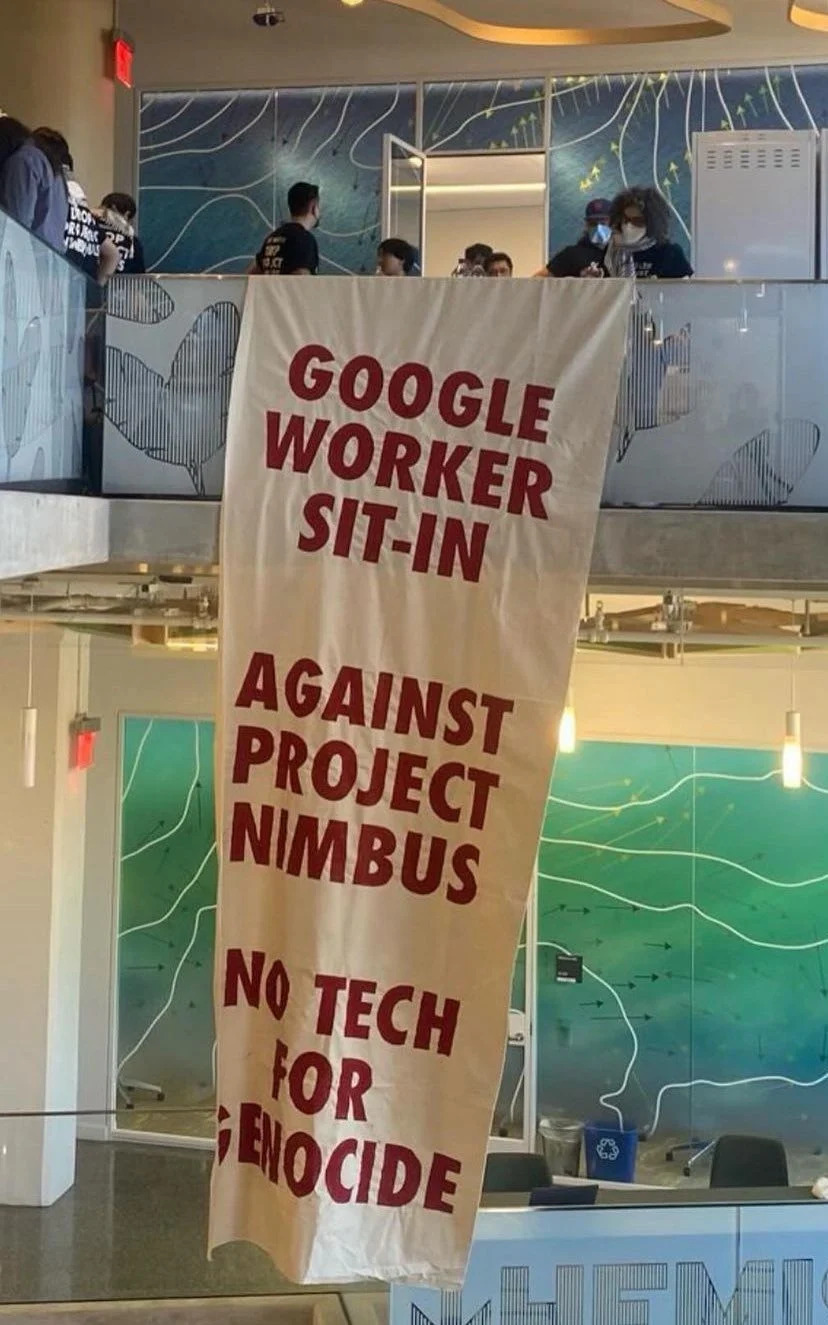
Pichai broke his silence two days after workers staged 10-hour sit-ins at the search giant’s offices in New York, Seatte and Sunnyvale, Calif., to attack Google’s $1.2 billion “Project Nimbus” contract with the Israel’s government as part of a “No Tech for Genocide Day of Action.”

Nine workers were arrested before Google ended up axing 28 staffers.

“When we come to work, our goal is to organize the world’s information and make it universally accessible and useful,” Pichai said in his memo.

“That supersedes everything else and I expect us to act with a focus that reflects that.”

Representatives for Google did not immediately respond to The Post’s request for comment.

Pichai’s message followed a missive sent by Google’s vice president of global security Chris Rackow, who called out the pro-Palestinian staffers after they occupied the Sunnyvale office of the company’s top Cloud executive.


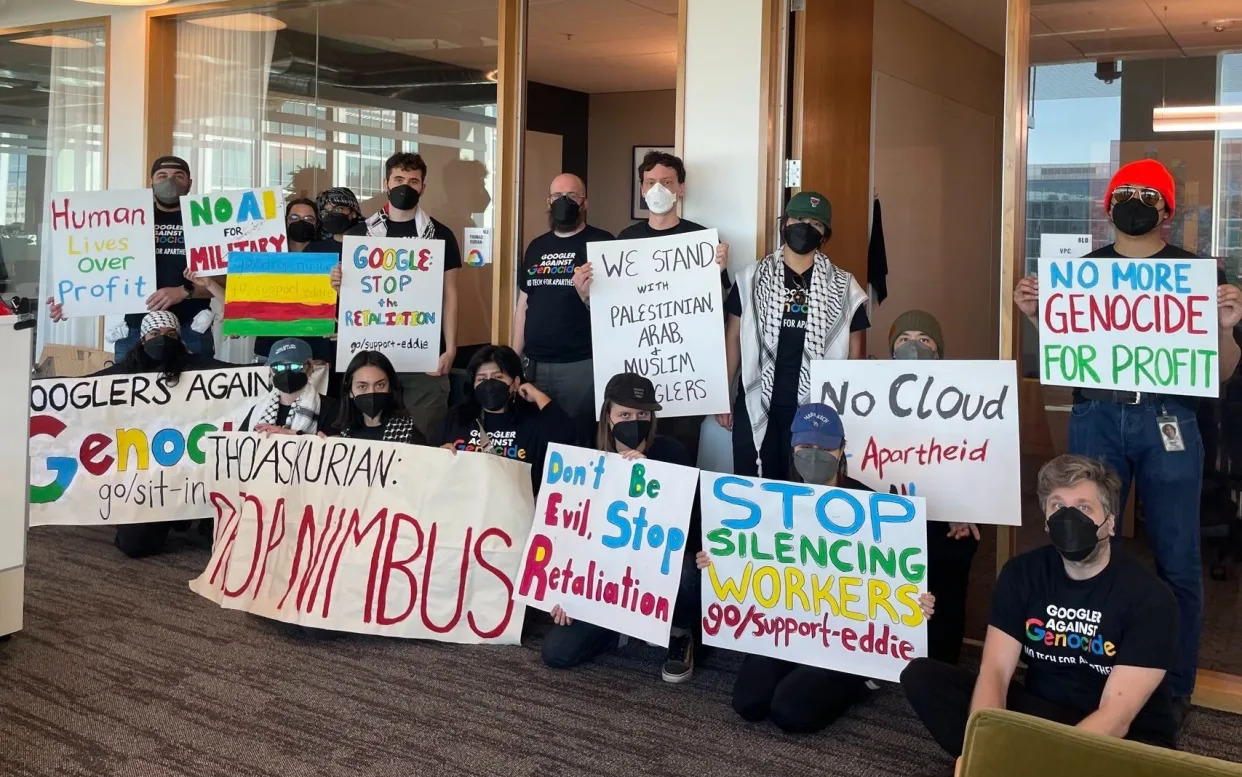
A large group of Google employees held signs protesting their company’s participation in “Project Nimbus” while protesting at the search engine giant’s offices on Tuesday. The 28 staffers involved were terminated the following day. X/@NoTechApartheid

“They took over office spaces, defaced our property, and physically impeded the work of other Googlers,” Rackow wrote. “Their behavior was unacceptable, extremely disruptive, and made co-workers feel threatened.”

In New York, workers took over the 10th floor of Google’s offices in the Chelsea section of Manhattan, while other protesters swarmed the company’s offices in Seattle

“Behavior like this has no place in our workplace and we will not tolerate it,” Rackow wrote. “It clearly violates multiple policies that all employees must adhere to — including our code of conduct and policy on harassment, discrimination, retaliation, standards of conduct, and workplace concerns.”


Some of the protestors at Google wore traditional Arab headscarves as they stormed and occupied the office of a top executive in California. X/@NoTechApartheid

The fired staffers were affiliated No Tech For Apartheid, which has been critical of Google’s response to the Israel-Hamas war and $1.2 billion “Project Nimbus” contract — in which Google Cloud and Amazon Web Services provide cloud-computing and artificial intelligence services for the Israeli government and military.

The group had posted several videos and livestreams of the protests on its X account — including the exact moment that employees were issued final warnings and arrested by local police for trespassing.

Google rival Meta — the parent of social media giants Facebook and Instagram — has similar policies at its Menlo Park, Calif., headquarters, where it tells staffers they cannot discuss issues including “health matters such as vaccine efficacy and abortion, legal matters such as pending legislation, political matters such as elections or political movements, and weapon ownership and rights.”


Workers took over the 10th floor of Google’s offices in Manhattan, while other protesters swarmed the company’s offices in Seattle. X/@NoTechApartheid

The initiative is part of Meta’s CEE, Community Engagement Expectations, which it implemented when it switched up its policies on internal communications in late 2022.

Google staff ordered to leave politics at home after anti-Israel protests

James Titcomb
TORY TELEGRAPH
Fri, April 19, 2024 

Google sacked 28 employees following anti-Israel protests at its California office - X/Katejsim


Google’s chief executive has told staff to leave their politics at home in a rebuke to employees who have campaigned against its work with the Israeli government.

Sundar Pichai said that the office was not a place “to fight over disruptive issues or debate politics” amid fierce disagreements between its employees.

The edict marks a decisive shift from Google, which has long been seen as a beacon of a collegiate Silicon Valley culture encouraging political debate.

Google once told employees to “bring their whole selves to work” and supported widespread political discussions on its internal discussion boards.

But the policy has threatened to backfire in recent years as the company has been rocked by a string of employee protests over defence contracts and gender inequality.


Google workers staged a sit-in over the company's work with Israel - X/MPower_Change

On Wednesday Google sacked 28 staff who had staged a protest at the company’s offices objecting to its work for the Israeli government.

“[We] need to be more focused in how we work, collaborate, discuss and even disagree,” Mr Pichai wrote in an email to employees.

“We have a culture of vibrant, open discussion that enables us to create amazing products and turn great ideas into action. That’s important to preserve. But ultimately we are a workplace and our policies and expectations are clear: this is a business, and not a place to act in a way that disrupts coworkers or makes them feel unsafe, to attempt to use the company as a personal platform, or to fight over disruptive issues or debate politics.

“This is too important a moment as a company for us to be distracted.

“When we come to work, our goal is to organise the world’s information and make it universally accessible and useful. That supersedes everything else and I expect us to act with a focus that reflects that.”

On Tuesday, employees staged a sit in at the company’s Silicon Valley and New York offices, wearing T-shirts bearing the slogan “Googler against genocide” and occupying the office of Thomas Kurian, the head of its cloud computing division.

Nine were arrested after refusing to leave.

Google sells cloud computing and artificial intelligence services to the Israeli military as part of a $1.2bn (£1bn) programme called Project Nimbus. The company has said it merely provides “generally available cloud computing services” to the project.

Addressing the protests on Wednesday, Google’s head of security Chris Rackow said the protests were “unacceptable, extremely disruptive, and made co-workers feel threatened”.

Google has gradually sought to crack down on fractious political debates in recent years. It recently made changes to its internal messaging tool to limit rows about the war in Gaza and discouraged political discussions during meetings.

It has come amid increasing protests over the company’s more controversial work, including an AI contract for the US military and a secret project to build a censored Chinese search engine, both of which have now been abandoned.

The company has also faced employee uprisings over how it treats women and over mass redundancies.

In 2017, it sacked an engineer after he circulated a memo arguing against Google’s efforts to close the gender gap.

Mr Pichai’s directive underlines a shift in Silicon Valley, where companies have often sought to foster a “mission driven culture”.

In 2020, the cryptocurrency company Coinbase said it would not allow discussions of politics and social issues at work, offering staff payoffs if they quit over the policy. The move was controversial at the time, with executives including Twitter’s then chief Jack Dorsey publicly criticising it and dozens of staff leaving.

Other tech giants including Facebook’s parent company Meta have sought to limit political discussions at work.

Google has recently faced criticism after its Gemini chatbot produced diverse images of Nazi soldiers and Vikings. Its founder Sergey Brin admitted that the chatbot “leans Left in many cases”.


Company Bosses Draw a Red Line on Office Activists

Business leaders are sending a warning to staff: Dissent that disrupts the workplace won’t be tolerated.

Vanessa Fuhrmans, Miles Kruppa and Lauren Weber
Sun, Apr 21, 2024

An Israeli cloud-computing contract that Google shares with Amazon drew protesters outside Google’s New York office this month. 
- Cristina Matuozzi/Sipa USA/Associated Press

Business leaders are sending a warning to staff: Dissent that disrupts the workplace won’t be tolerated.

Google’s decision to fire 28 workers involved in sit-in protests against the tech giant’s cloud-computing contract with the Israeli government is the most recent and starkest example of companies’ stricter stance. Rifts with employees have spilled into public view at National Public Radio, the New York Times and other workplaces. Bosses are losing patience with staff eager to be the conscience of their companies, especially as employees pressure them on charged issues such as politics and the war in Gaza, executives, board members and C-suite advisers say.

The moves are a correction to the last several years, when corporate leaders often brooked dissent and encouraged staff to voice their personal convictions. On issues such as immigration policy and racial justice, many chief executives publicly expressed corporate solidarity. Google, in particular, has long prided itself on an open work culture that fostered internal debate, much like a college campus.

It is an open question as to what rights workers really have to speak out on the job. “None of this is settled,” said Genevieve Lakier, a law professor at the University of Chicago.

Workers in the private sector aren’t protected by the First Amendment’s guarantees of free speech, and “there is still a lot of uncertainty about how much free expression by workers is consistent with the operations of the workplace,” she said.

Numerous workers reported being fired from companies after writing contentious social-media posts about the Oct. 7 Hamas attacks in Israel or the war in Gaza. At Google, leaders said the protesting workers violated company policy by taking over office spaces and disrupting work. While preserving the company’s open culture is important, Google CEO Sundar Pichai wrote to staff afterward, “we also need to be more focused in how we work, collaborate, discuss and even disagree.”
An unexpected firing

Hasan Ibraheem, a Google software engineer who was arrested and then fired after taking part in the protest at the company’s New York office, said the firings didn’t square with his image of Google when he was hired less than two years ago.

It was “the big company that was still fun and vibrant. You were allowed to express yourself,” said Ibraheem, 23, who had been active in pro-Palestinian demonstrations before joining Google.

Though he knew of a few co-workers who had quit because of their opposition to the $1.2 billion Israeli contract that Google shares with Amazon, called Project Nimbus, he said he opted to stay so he could protest the contract from within.

Google had been responsive to employee concerns about government work before. In 2018, it decided not to renew a separate Pentagon contract after that work became the subject of intense internal debate. The company also pledged not to make artificial-intelligence technology for military weapons and adopted a set of AI principles to guide its work.

“I wasn’t expecting that my labor would be going toward aiding a genocide, and that if I spoke up against that I would be instantly fired,” Ibraheem said. Google said that, unlike the contract it canceled in 2018, the Project Nimbus contract isn’t aimed at being used for weapons or intelligence work. Some employees say they are worried the company is still aiding Israel’s war efforts.

Demonstrators gathered outside a Starbucks in Berlin earlier this year to protest Israel’s military actions in Gaza. - Michael Kuenne/PRESSCOV/ZUMA Press

Google’s vice president of global security, Chris Rackow, told employees last week that the activists’ behavior “made co-workers feel threatened.” A Google spokesman said numerous staffers complained the protesters disrupted their work.

Other companies have found themselves in clashes with dissenting employees. This month, NPR suspended a senior editor—who subsequently resigned—after he published a critique of the radio network’s news coverage in another media outlet. The New York Times, where divisions over its Gaza war coverage have roiled the newsroom, investigated whether staffers leaked confidential materials to another publication. It closed the probe last week without any conclusive finding.

Starbucks sued the union representing around 410 of its more than 9,700 U.S. stores after local affiliates of Starbucks Workers United posted pro-Palestinian tweets and reshared an image of a bulldozer breaking through the fence encircling Gaza. The coffee chain alleged the union’s use of the Starbucks name and branding led people to misattribute such sentiment to the company. (The two sides have since said they are working toward resolving the litigation.)
Shifting pressures

Until recently, many company leaders viewed speaking out as less risky than appearing unresponsive to calls for social action—such as in the aftermath of George Floyd’s 2020 murder, when businesses voiced support for the Black Lives Matter movement.

But issues that have boiled over in workplaces since then—from state abortion bans to the war in Gaza—don’t lend themselves to simple pronouncements of solidarity or town halls where employees can share their personal experiences.

The perils of being ensnared in partisan politics is changing the calculus of how responsive companies should be to any issue that doesn’t directly affect business, some executives and corporate advisers say.

Many of them point to Disney’s now-resolved legal battle with Florida Gov. Ron DeSantis as a cautionary tale. The fight stemmed from Disney’s move in 2022 to publicly oppose Florida’s Parental Rights in Education bill, as it faced pressure from LGBTQ employees and advocacy groups. Last year’s damaging boycott of Anheuser-Busch InBev’s Bud Light—after the brand’s marketing promotion with a transgender influencer—has also made companies leery of moves that risk landing them in a culture war, they say.

Corporate leaders “are very concerned about public backlash, especially boards of directors,” said Jonathan Bernstein, founder and chairman of Bernstein Crisis Management, which advises companies on corporate communications and reputation management.

Ignoring workplace dissent isn’t an option either, he said. Several clients, he said, are wrestling with squabbling staff on email and Slack over issues ranging from the war in Gaza to U.S. politics.

Marissa Andrada, former chief people officer at Chipotle Mexican Grill and now a board director at Krispy Kreme, said she was surprised how swiftly Google moved to fire the protesting workers. In those situations, she said, “it is often better to take a pause, make sure all the facts are understood.”

Andrada recalls the aftermath of the U.S. Supreme Court’s 2022 decision to overturn Roe vs. Wade, when she was still at Chipotle. Among staff, there were varying views on the ruling, and “employees were asking what we stood for,” she said.

Chipotle’s health plan covered travel costs in other instances where workers’ medical treatment required out-of-state care. It would therefore do the same, if necessary, for family planning and abortion care, Chipotle said in a memo to its women’s employee resource group, which had raised the question.

“We didn’t make up a new rule or put out a public statement,” she said. “We looked at what was consistent with our existing policy and values.”
No way to avoid offense

Acting on employee demands risks offending workers with opposing views. Lisa Marshall, a housing attorney with a nonprofit law firm, woke up one day this year to discover that her union had passed a resolution condemning Israel’s attacks on Gaza.

Lisa Marshall found herself at odds with her union’s position on the war in Gaza. - Benjamin Marshall

Marshall, an Orthodox Jew, said she saw the resolution as a direct affront to her Jewish identity.

Leaving the union wasn’t an option in Massachusetts, where she works and lives. So she filed a request to the UAW, the parent of Marshall’s union, to be a religious objector, which allows her to withhold her union dues and pay them to a nonprofit instead. She now routes her dues to the Brandeis Center, a Jewish civil rights group that advised her during this process. Her union didn’t respond to requests for comment.

Marshall said she appreciates the union’s role in fighting for pay, job security, retirement plans and benefits, but believes the resolution was an overstep, and painful for Jewish members.

Google’s CEO made a similar point in explaining why the company had quickly fired its protesting employees.

“This is a business, and not a place to act in a way that disrupts co-workers or makes them feel unsafe, to attempt to use the company as a personal platform.” Pichai said in his email to staff.

“This is too important a moment as a company for us to be distracted,” he added.

Write to Vanessa Fuhrmans at Vanessa.Fuhrmans@wsj.com, Miles Kruppa at miles.kruppa@wsj.com and Lauren Weber at Lauren.Weber@wsj.com


Google scraps minimum wage, benefits rules for suppliers and staffing firms


Fri, Apr 19, 2024, 
By Daniel Wiessner

(Reuters) - Alphabet Inc's Google on Friday said it will roll back requirements that U.S. suppliers and staffing firms pay their employees at least $15 an hour and provide health insurance and other benefits, a move that could allow the tech giant to avoid bargaining with unions.

The elimination of the 2019 policy, along with other steps such as limiting access by temporary workers and vendors to internal systems, are designed to comply with shifting U.S. and global labor regulations related to contingent workers, a spokesperson for Mountain View, California-based Google told Reuters.


"These updates bring us in line with other large companies and simply clarify that Google is not, and has never been, the employer of our suppliers’ employees," the spokesperson said.

The announcement comes after the U.S. National Labor Relations Board in January ruled that Google was a so-called "joint employer" of workers provided by staffing firm Cognizant Technology Solutions and must bargain with their union. Google is appealing that decision.

The board relied in part on the 2019 policy, saying it allowed Google to exert control over the workers even though it does not employ them directly.

The labor board has moved to make it more difficult for companies to avoid bargaining with temporary and contract workers, including adopting a rule last year that said companies with indirect control over working conditions can be considered the employers of contract workers. A federal judge blocked the rule from taking effect in March.

The Google spokesperson on Friday said the company will continue to enforce a supplier code of conduct that requires vendors and staffing firms to provide safe working conditions and meet existing legal obligations.

Most of the company's suppliers operate in states that mandate a minimum wage of at least $15, the spokesperson said.

(Reporting by Daniel Wiessner in Albany, New York, Editing by Louise Heavens)
View Comments(31)


U$A

He thinks his wife died in an understaffed hospital. Now he’s trying to change the industry


KFF Health News, Kate Wells, Michigan Public
Fri, April 19, 2024 

For the past year, police Detective Tim Lillard has spent most of his waking hours unofficially investigating his wife’s death.

The question has never been exactly how Ann Picha-Lillard died on Nov. 19, 2022: She succumbed to respiratory failure after an infection put too much strain on her weakened lungs. She was 65.

For Tim Lillard, the question has been why.

Lillard had been in the hospital with his wife every day for a month. Nurses in the intensive care unit had told him they were short-staffed, and were constantly rushing from one patient to the next.

Lillard tried to pitch in where he could: brushing Ann’s shoulder-length blonde hair or flagging down help when her tracheostomy tube gurgled — a sign of possible respiratory distress.


So the day he walked into the ICU and saw staff members huddled in Ann’s room, he knew it was serious. He called the couple’s adult children: “It’s Mom,” he told them. “Come now.”

All he could do then was sit on Ann’s bed and hold her hand, watching as staff members performed chest compressions, desperately trying to save her life.

A minute ticked by. Then another. Lillard’s not sure how long the CPR continued — long enough for the couple’s son to arrive and take a seat on the other side of Ann’s bed, holding her other hand.

Finally, the intensive care doctor called it and the team stopped CPR. Time of death: 12:37 p.m.

Lillard didn’t know what to do in a world without Ann. They had been married almost 25 years. “We were best friends,” he said.

Just days before her death, nurses had told Lillard that Ann could be discharged to a rehabilitation center as soon as the end of the week. Then, suddenly, she was gone. Lillard didn’t understand what had happened.

Lillard said he now believes that overwhelmed, understaffed nurses hadn’t been able to respond in time as Ann’s condition deteriorated. And he has made it his mission to fight for change, joining some nursing unions in a push for mandatory ratios that would limit the number of patients in a nurse’s care. “I without a doubt believe 100% Ann would still be here today if they had staffing levels, mandatory staffing levels, especially in ICU,” Lillard said.

Last year, Oregon became the second state after California to pass hospital-wide nurse ratios that limit the number of patients in a nurse’s care. Michigan, Maine, and Pennsylvania are now weighing similar legislation.

But supporters of mandatory ratios are going up against a powerful hospital industry spending millions of dollars to kill those efforts. And hospitals and health systems say any staffing ratio regulations, however well-intentioned, would only put patients in greater danger.
Putting patients at risk

By next year, the United States could have as many as 450,000 fewer nurses than it needs, according to one estimate. The hospital industry blames covid-19 burnout, an aging workforce, a large patient population, and an insufficient pipeline of new nurses entering the field.

But nursing unions say that’s not the full story. There are now 4.7 million registered nurses in the country, more than ever before, with an estimated 130,000 nurses having entered the field from 2020 to 2022.

The problem, the unions say, is a hospital industry that’s been intentionally understaffing their units for years in order to cut costs and bolster profits. The unions say there isn’t a shortage of nurses but a shortage of nurses willing to work in those conditions.

The nurse staffing crisis is now affecting patient care. The number of Michigan nurses who say they know of a patient who has died because of understaffing has nearly doubled in recent years, according to a Michigan Nurses Association survey last year.

Just months before Ann Picha-Lillard’s death, nurses and doctors at the health system where she died had asked the Michigan attorney general to investigate staffing cuts they believed were leading to dangerous conditions, including patient deaths, according to The Detroit News.

But Lillard didn’t know any of that when he drove his wife to the hospital in October 2022. She had been feeling short of breath for a few weeks after she and Lillard had mild covid infections. They were both vaccinated, but Ann was immunocompromised. She suffered from rheumatoid arthritis, a condition that had also caused scarring in her lungs.

To be safe, doctors at DMC Huron Valley-Sinai Hospital wanted to keep Ann for observation. After a few days in the facility, she developed pneumonia. Doctors told the couple that Ann needed to be intubated. Ann was terrified but Lillard begged her to listen to the doctors. Tearfully, she agreed.

With Ann on a ventilator in the ICU, it seemed clear to Lillard that nurses were understaffed and overwhelmed. One nurse told him they had been especially short-staffed lately, Lillard said.

“The alarms would go off for the medications, they’d come into the room, shut off the alarm when they get low, run to the medication room, come back, set them down, go to the next room, shut off alarms,” Lillard recalled. “And that was going on all the time.”

Lillard felt bad for the nurses, he said. “But obviously, also for my wife. That’s why I tried doing as much as I could when I was there. I would comb her hair, clean her, just keep an eye on things. But I had no idea what was really going on.”

Finally, Ann’s health seemed to be stabilizing. A nurse told Lillard they’d be able to discharge Ann, possibly by the end of that week.

By Nov. 17, Ann was no longer sedated and she cried when she saw Lillard and her daughter. Still unable to speak, she tried to mouth words to her husband “but we couldn’t understand what she was saying,” Lillard said.

The next day, Lillard went home feeling hopeful, counting down the days until Ann could leave the hospital.

Less than 24 hours later, Ann died.

Tim Lillard holds a rosary with his late wife's name on it. It was given to him as a gift after her death in 2022. Over the past year, Lillard has become an advocate for legislation to limit the number of patients in a nurse's care. (Beth Weiler/Michigan Public)

Lillard couldn’t wrap his head around how things went downhill so fast. Ann’s underlying lung condition, the infection, and her weakened state could have proved fatal in the best of circumstances. But Lillard wanted to understand how Ann had gone from nearly discharged to dying, seemingly overnight.

He turned his dining room table into a makeshift office and started with what he knew. The day Ann died, he remembered her medical team telling him that her heart rate had spiked and she had developed another infection the night before. Lillard said he interviewed two DMC Huron Valley-Sinai nurse administrators, and had his own doctor look through Ann’s charts and test results from the hospital. “Everybody kept telling me: sepsis, sepsis, sepsis,” he said.

Sepsis is when an infection triggers an extreme reaction in the body that can cause rapid organ failure. It’s one of the leading causes of death in U.S. hospitals. Some experts say up to 80% of sepsis deaths are preventable, while others say the percentage is far lower.

Lives can be saved when sepsis is caught and treated fast, which requires careful attention to small changes in vital signs. One study found that for every additional patient a nurse had to care for, the mortality rate from sepsis increased by 12%.

Lillard became convinced that had there been more nurses working in the ICU, someone could have caught what was happening to Ann.

“They just didn’t have the time,” he said.

DMC Huron Valley-Sinai’s director of communications and media relations, Brian Taylor, declined a request for comment about the 2022 staffing complaint to the Michigan attorney general.
Following the money

When Lillard asked the hospital for copies of Ann’s medical records, DMC Huron Valley-Sinai told him he’d have to request them from its parent company in Texas.

Like so many hospitals in recent years, the Lillards’ local health system had been absorbed by a series of other corporations. In 2011, the Detroit Medical Center health system was bought for $1.5 billion by Vanguard Health Systems, which was backed by the private equity company Blackstone Group.

Two years after that, in 2013, Vanguard itself was acquired by Tenet Healthcare, a for-profit company based in Dallas that, according to its website, operates 480 ambulatory surgery centers and surgical hospitals, 52 hospitals, and approximately 160 additional outpatient centers.

As health care executives face increasing pressure from investors, nursing unions say hospitals have been intentionally understaffing nurses to reduce labor costs and increase revenue. Also, insurance reimbursements incentivize keeping nurse staffing levels low. “Hospitals are not directly reimbursed for nursing services in the same way that a physician bills for their services,” said Karen Lasater, an associate professor of nursing in the Center for Health Outcomes and Policy Research at the University of Pennsylvania. “And because hospitals don’t perceive nursing as a service line, but rather a cost center, they think about nursing as: How can we reduce this to the lowest denominator possible?” she said.

Lasater is a proponent of mandatory nurse ratios. “The nursing shortage is not a pipeline problem, but a leaky bucket problem,” she said. “And the solutions to this crisis need to address the root cause of the issue, which is why nurses are saying they’re leaving employment. And it’s rooted in unsafe staffing. It’s not safe for the patients, but it’s also not safe for nurses.”
A battle between hospitals and unions

In November, almost one year after Ann’s death, Lillard told a room of lawmakers at the Michigan State Capitol that he believes the Safe Patient Care Act could save lives. The health policy committee in the Michigan House was holding a hearing on the proposed act, which would limit the amount of mandatory overtime a nurse can be forced to work, and require hospitals to make their staffing levels available to the public.

Most significantly, the bills would require hospitals to have mandatory, minimum nurse-to-patient ratios. For example: one nurse for every patient in the ICU; one for every three patients in the emergency room; a nurse for triage; and one nurse for every four postpartum birthing patients and well-baby care.

Efforts to pass mandatory ratio laws failed in Washington and Minnesota last year after facing opposition from the hospital industry. In Minnesota, the Minnesota Nurses Association accused the Mayo Clinic of using “blackmail tactics”: Mayo had told lawmakers it would pull billions of dollars in investment from the state if mandatory ratio legislation passed. Soon afterward, lawmakers removed nurse ratios from the legislation.

Ann Picha-Lillard died at DMC Huron Valley-Sinai Hospital in Commerce Township, Michigan, in November 2022 at age 65. Months earlier, nurses and doctors at the health system had filed a complaint with the Michigan attorney general about staffing shortages affecting patient care. (Beth Weiler/Michigan Public)

While Lillard waited for his turn to speak to Michigan lawmakers about the Safe Patient Care Act in November, members of the Michigan Nurses Association, which says it represents some 13,000 nurses, told lawmakers that its units were dangerously understaffed. They said critical care nurses were sometimes caring for up to 11 patients at a time.

“Last year I coded someone in an ICU for 10 minutes, all alone, because there was no one to help me,” said the nurses association president and registered nurse Jamie Brown, reading from another nurse’s letter.

“I have been left as the only specially trained nurse to take care of eight babies on the unit: eight fragile newborns,” said Carolyn Clemens, a registered nurse from the Grand Blanc area of Michigan.

Nikia Parker said she has left full-time emergency room nursing, a job she believes is her calling. After her friend died in the hospital where she worked, she was left wondering whether understaffing may have contributed to his death.

“If the Safe Patient Care Act passed, and we have ratios, I’m one of those nurses who would return to the bedside full time,” Parker told lawmakers. “And so many of my co-workers who have left would join me.”

But not all nurses agree that mandatory ratios are a good idea.

While the American Nurses Association supports enforceable ratios as an “essential approach,” that organization’s Michigan chapter does not, saying there may not be enough nurses in the state to satisfy the requirements of the Safe Patient Care Act.

For some lawmakers, the risk of collateral damage seems too high. State Rep. Graham Filler said he worries that mandating ratios could backfire.

“We’re going to severely hamper health care in the state of Michigan. I’m talking closed wards because you can’t meet the ratio in a bill. The inability for a hospital to treat an emergent patient. So it feels kind of to me like a gamble we’re taking,” said Filler, a Republican.

Michigan hospitals are already struggling to fill some 8,400 open positions, according to the Michigan Health & Hospital Association. That association says that complying with the Safe Patient Care Act would require hiring 13,000 nurses.

Every major health system in the state signed a letter opposing mandatory ratios, saying it would force them to close as many as 5,100 beds.

Lillard watched the debate play out in the hearing. “That’s a scare tactic, in my opinion, where the hospitals say we’re going to have to start closing stuff down,” he said.

He doesn’t think legislation on mandatory ratios — which are still awaiting a vote in the Michigan House’s health policy committee — are a “magic bullet” for such a complex, national problem. But he believes they could help.

“The only way these hospitals and the administrations are gonna make any changes, and even start moving towards making it better, is if they’re forced to,” Lillard said.

Seated in the center of the hearing room in Lansing, next to a framed photo of Ann, Lillard’s hands shook as he recounted those final minutes in the ICU.

“Please take action so that no other person or other family endures this loss,” he said. “You can make a difference in saving lives.”

Grief is one thing, Lillard said, but it’s another thing to be haunted by doubts, to worry that your loved one’s care was compromised before they ever walked through the hospital doors. What he wants most, he said, is to prevent any other family from having to wonder, “What if?”

This story was originally featured on Fortune.com
Lululemon cutting over 100 jobs in Washington distribution centre closure

The Canadian Press
Fri, April 19, 2024 

In this article:


VANCOUVER — Lululemon Athletica Inc. says it is cutting more than 100 jobs as it plans to close a distribution centre in Washington state.

It says some employees at the Sumner, Wash. centre will be retrained and relocated to other facilities, but that "just over" 100 positions with be eliminated because of the closure.

The company says it decided to close the smaller distribution centre as part of a regular evaluation of its network.

Lululemon says its overall fulfilment strategy includes a multi-year investment to increase its capacity and support growth.

It says some of the employees could be moved to jobs at its recently opened distribution centre in the greater Los Angeles area.


The company says it is committed to supporting impacted employees through the transition.

This report by The Canadian Press was first published April 19, 2024.

Companies in this story: (TSX:LULU)

The Canadian Press


Nike to lay off 740 employees at Oregon headquarters


Reuters
Fri, April 19, 2024 

 The Nike swoosh logo is seen outside the store on 5th Ave in New York


(Reuters) - Nike will lay off about 740 employees at its world headquarters in Oregon, a letter showed on Friday, as the top sportswear maker looks to rein in costs after warning of a revenue dip in the first half of fiscal 2025.

The "second phase of impacts" would begin by June 28 at its headquarters, Michele Adams, Nike's vice president for people solutions, said in a legally mandated notice to state authorities.

The company's shares were up marginally in after-hours trading. They have declined nearly 13% this year.

Nike had in December announced a cost savings plan for $2 billion over the next three years, and in February said it would cut about 2% of its total workforce, or more than 1,600 roles.

It had about 83,700 employees as of May 31, 2023.


Several companies in the U.S. and Canada have announced new rounds of layoffs, following the spate of reductions in 2023, to cut costs in the face of an uncertain demand environment.

Nike in March flagged its revenues in the first half of fiscal 2025 would shrink by a low-single-digit percentage as it looks to scale back on some franchises.

(Reporting by Granth Vanaik in Bengaluru; Editing by Sriraj Kalluvila)