Saturday, September 21, 2024

MONOPOLY CAPITALI$M

A copper M&A frenzy masks big miners’ hesitation to build

Bloomberg News | September 19, 2024 |
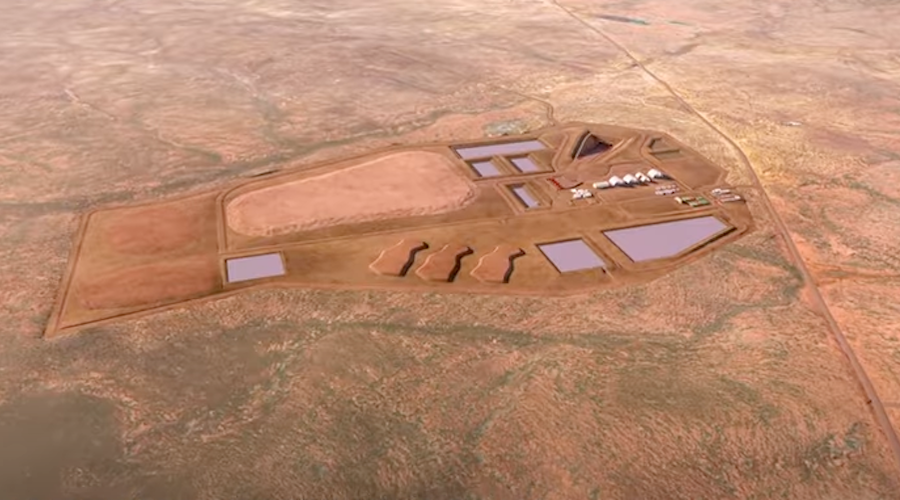

Computer rendition of Oak Dam facilities. Credit: BHP

In the dusty, treeless outback of Southern Australia, a brand new mining camp is home to a hundred workers, putting in 12-hour days, two weeks at a time. Dozens of trucks are scattered across the vast acreage, mounted with towering rigs drilling more than 2 kilometers (1.3 miles) underground. All are focused on the hunt for one of the world’s most coveted minerals: copper.


Oak Dam, discovered by BHP Group geologists in 2018, is a glimmer of hope for chief executive Mike Henry, who sees global copper demand doubling over the coming decades as the energy transition takes hold, and wants his company to produce more of it. The deposit is also a rarity — if all goes to plan, a new operation will be built here by the world’s largest miner, from scratch.

“Globally, there would be few companies conducting drilling campaigns of this scale, to this depth,” said Michael Fonti, BHP’s main exploration geologist at the site, pointing out a diagram of the cone-shaped deposit.

Fonti has spent more than two decades on sites much like this one, working most recently at the miner’s nearby Olympic Dam, a vast, challenging copper and uranium operation. But even for BHP — a $140 billion company which generated almost $12 billion in free cash flow in the last financial year — large, greenfield projects are scarce, and becoming more so. Deals, not discoveries, are grabbing the headlines.

Copper’s bull narrative, which helped prices hit an all-time high in May, is well understood. Electrification, wealthier populations and an expanding, energy-hungry technology sector are vast new sources of demand. An electric vehicle requires roughly three times the copper that goes into a conventional car, and the energy transition won’t happen without enough red metal for grids, batteries and chips.

This should all be prompting a surge in prospecting and digging, to ensure supply keeps up, especially as large, established mines age. It isn’t — and that risks making this much-needed metal punitively expensive.

Miners have been in spending purgatory for over a decade, atoning for the excesses of the last boom. For years, investors demanded generous returns, not production growth and certainly not risk. But now that diggers can open the purse strings again, high costs, slow permits and other hurdles are pushing the largest metal producers to buy — not build.

BHP, even with its effort to build out the copper belt of South Australia, is no exception.

Asked at its earnings briefing last month, Henry said the company was opportunistic about deals and not pursuing them at the expense of exploration, nor was BHP making a blanket decision on cost. There was no rule of thumb on buying or building, he said.

Still, in less than two years, BHP has bought copper and gold producer OZ Minerals for $6.4 billion, betting on South Australia’s copper province; tried and failed to buy peer Anglo American Plc for $49 billion, in large part for its South American copper mines; then in July agreed to buy copper miner Filo Corp. jointly with Lundin Mining Corp, a bet on a project in development on the Argentina/Chile border.

“Mining is cyclical, and a key factor driving the trend of buying over building is the point in the cycle,” said Campbell Cooper, a Melbourne-based advisor at Greenhill & Co., an investment bank. “Recent years have also seen an acceleration in the cost of building new mine capacity. Arguably that cost may not be fully reflected in equity valuations, making buying more attractive.”

Building from zero, in short, is both worryingly risky and unappealingly pricey.

No wonder, then, that only roughly a quarter of the sector’s sanctioned — or approved — projects between 2019 and 2023 were of the greenfield variety, according to analysts at Jefferies LLC. That’s down from more than half in the 2009 to 2013 period. The size of new projects is also shrinking.

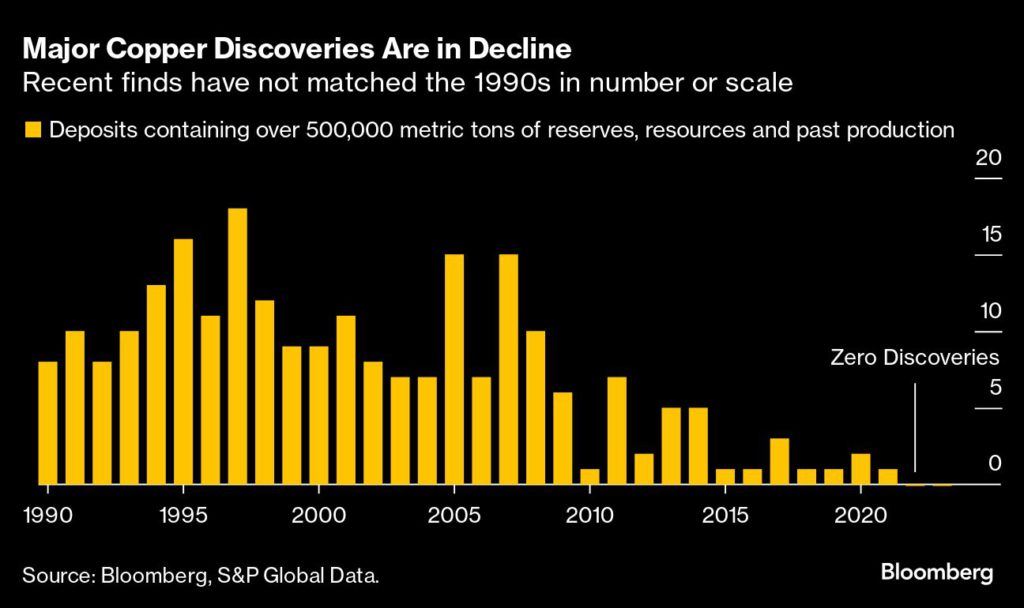
“There was a raft of copper discoveries in the 1950s, 60s, 70s, and 80s,” said BHP’s Fonti. “Everything being produced now is from that era of discoveries.” Escondida, the world’s largest copper mine, dates back to the late 1970s and early 1980s.

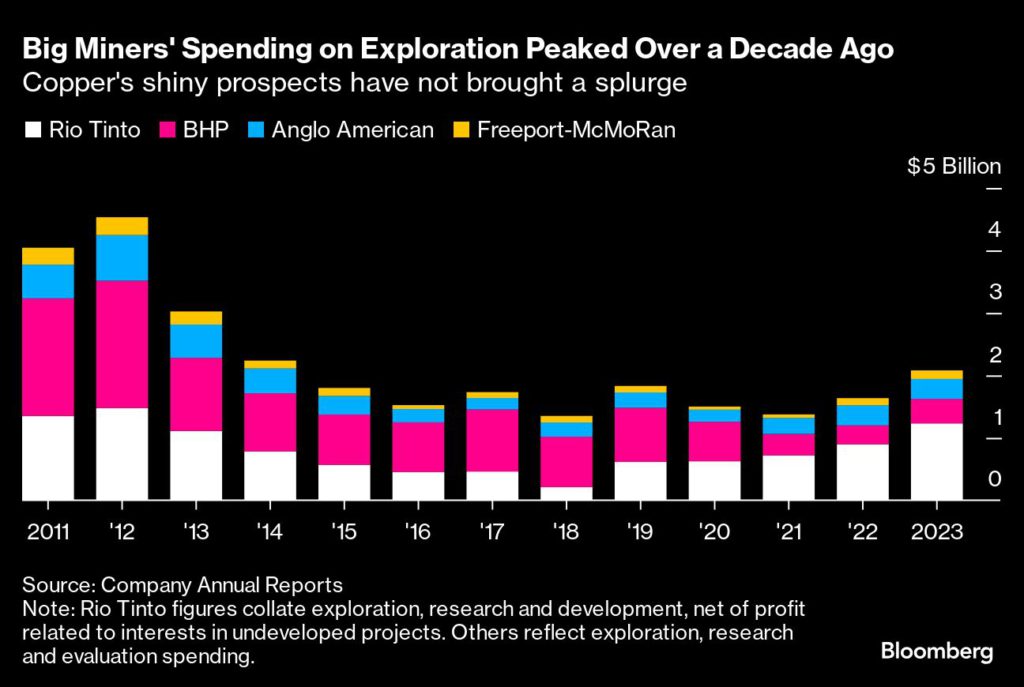
Of course, BHP has invested in development — it approved nearly $5 billion for its potash operation last year — but its exploration budget remains modest, even for copper. While it has nearly tripled its annual greenfield spending from the start of the decade to $124 million in the year to June, that compares to $324 million spent on greenfield exploration alone back in its 2012 financial year.

Peers follow similar patterns. Rio Tinto Group, which has not done large-scale deals of late, spent $300 million on greenfield exploration in 2023. Anglo American Plc and Freeport-McMoRan Inc have spent less. Glencore Plc does not detail exploration spending, but its focus has been on existing deposits in its portfolio.

“Ultimately the industry needs continual investment in exploration and new discoveries. M&A is important to put assets into the hands of the optimal owners, but will not materially increase overall industry supply,” said Sam Brodovcky, head of metals and mining M&A at Standard Chartered Plc. “And for key commodities such as copper, we need to increase supply not only to replenish depleting mines but also to keep up with growing demand as the world industrializes and transitions to clean energy.”

Henry says large players like BHP are well placed when it comes to adding supply. As greenfield risks increase, the industry’s behemoths can unlock more metal with the expansion of existing projects, thanks to large balance sheets and technical capability.

They are also betting on less risky exploration by supporting junior miners — as with BHP’s Xplor program, which provides modest funding with the potential for much more if prospecting is successful.

What is less clear is whether this will be enough to provide the metal the world needs.

Juniors, lower down the mining food chain, have long taken on much of the sector’s exploration risk. But that proportion is now increasing just as investment in smaller outfits falls.

“We’ve got to a point where we’re quite reliant on juniors to explore. It’s very difficult seeing that continuing if they’re not getting the equity that they need,” said Sandra Occhipinti, a geologist and researcher at Australia’s national science agency, Commonwealth Scientific and Industrial Research Organisation.

Richard Schodde, a veteran geologist and expert on South Australia’s copper belt, puts the number of discoveries made each year at only a handful. He describes BHP’s lucky strike at Oak Dam in 2018 “was probably the most spectacular” of recent years.

Price is clearly one reason holding back the splurge that could change that. Copper has enjoyed a bull run on fears of supply disruption and hopes of soaring green demand. Prices topped $11,000 a ton earlier this year. But the global economy is faltering and copper needs to reach $12,000 a ton — a near-30% jump on current prices — to incentivize large-scale investments in new mines, according to Olivia Markham, who co-manages the BlackRock World Mining Fund.


Copper’s improvement since the price trough of 2020 has not been enough. Costs are rising too fast as exploration teams need go deeper, into more technically challenging deposits or into less desirable regions.

Take Oak Dam, where the bottom of the deposit is some four kilometers underground — depths where heat from the earth’s core starts to become a problem. Or even Olympic Dam’s next phase of exploration, Olympic Dam Deeps. BHP’s recently acquired Filo asset in South America, meanwhile, sits some 5,000 meters above sea level, where the air is so thin helicopters struggle to hover.

“Once upon a time you could just kick rocks. It’s not for the faint-hearted — and only one exploration campaign out of a thousand results in a discovery,” says Karol Czarnota, a director at Geoscience Australia, a government agency set up to encourage mining. Oak Dam was found using some of its data.

One area of good news is technology. New gadgets and better geological information are allowing even the reassessment of existing repositories of data. Core libraries around Australia, for example, hold over 100 million meters of rocks from drilling campaigns of past booms, free for geologists looking for mineralization missed by others.

But even at Oak Dam, a deposit that was almost missed until new geophysics techniques could unlock it, that cheer is tempered. The slow pace of mine development means a final investment decision will not come until 2027 at the earliest. Copper production will still be years away.

(By Paul-Alain Hunt)
CHART: Global mining and metals – a quick reality check


Frik Els | September 19, 2024 | 


Back in black. 

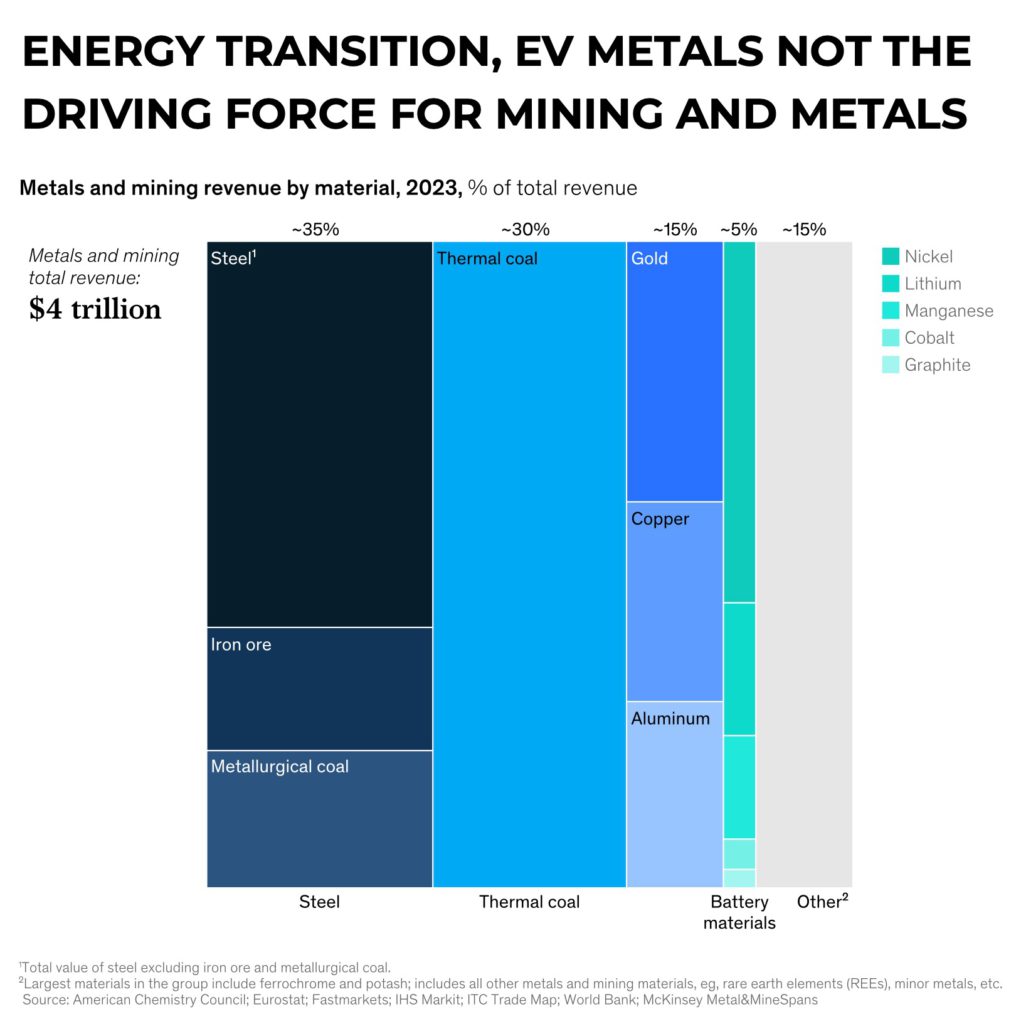
A new report by McKinsey’s energy and materials practice outlines a global mining and metals industry emerging from a few years of boom and bust and price fluctuations the consulting firm calls unprecedented in scale.


Nevertheless, says McKinsey, the industry is in healthier financial shape compared to historical averages.

From 2000 to 2023, metals and mining revenues grew by $1.7 trillion, a jump of roughly 75% and affording the industry a 70% slice of the overall materials business which also includes plastics, pulp, and building materials. As a whole, materials represent some 7% of the global GDP.

Profits in the industry have also been robust with mining, refining and metal fabrication EBITDA nearly doubling over the almost quarter century going from $500 billion to $900 billion.

Moreover, Mckinsey points out, mining and metal companies’ debt burden has decreased with net debt over EBITDA ratios of 1.3 times, well below the through-cycle average of 1.8 times.

“However, 2024 has already proven to be a more challenging year for the industry as overall economic growth slows down and the shift toward low-carbon technologies unfolds more slowly than expected, both of which are putting downward pressure on price levels, especially for battery materials, such as nickel and lithium,” McKinsey says.
Source: McKinsey’s Global Energy & Materials Practice
 – Global Materials Perspective 2024

Not only are battery and other metals associated with decarbonisation facing headwinds, the sector – even when lumping in bellwether copper – hardly makes up 15% of global metals and mining revenues. Until such time the copper price reaches the levels predicted by more outlandish scenarios, the share is not likely to grow much.

For instance, the market size of rare earths mining, and metal and alloy production (included in the other section of the graph) which is used in defence applications and many energy transition applications including wind turbines and motors for electric vehicles, is below $20 billion.

Thermal coal and steel account for around 60%–70% of revenues and production volumes of 7 billion tonnes and 2 billion tonnes respectively are more than 30 times higher than all other metals and minerals combined. Output by the largest among the latter, aluminum, at roughly 100 million tonnes, does not make much of a dent in the overall total.

The bulk of mining and metals activity and revenues remains subjected to the ups and downs of the global economy, particularly the outlook for China where the signs are not great.

While the green energy transition may rightfully represent a new dawn for mining, it’s still very early in the morning.

Vanadium is the new battery cathode chemistry, says Pure Lithium CEO


Amanda Stutt | September 20, 2024 


In labs all around the world, scientists are striving to perfect EV battery cathode chemistries – swoping out and switching up minerals in search of the most viable, economical, safe alternatives to provide the highest energy density at a cost that could be manufactured at scale.


While the most common cathode chemistries used in lithium-ion batteries today are lithium-iron-phosphate (LFP), nickel-cobalt-manganese (NCM) and lithium nickel cobalt aluminum oxide (NCA), Pure Lithium (PL), a privately held, Boston-based startup, says it has invented a unique lithium metal battery that swops nickel and cobalt for vanadium.

The company says it has found a way to make lithium batteries from scratch going from “from brine to battery” in less than 48 hours.


“We’ve taken lithium from four continents around the world and have made it into a pure metal electrode,” co-founder and CEO Emilie Bodoin told MINING.com in an interview. “We’re not that particular about the lithium source because our technology and our end product is very different than what everyone else is doing.”

In July, Pure Lithium won the startup Coup de Coeur Award at the World Materials Forum for its battery-ready lithium metal electrode and received the best new project award at Fastmarkets, competing against several more mature companies. 

Occidental subsidiary TerraLithium, through its joint venture with Berkshire Hathaway invested $15 million, Bodoin said, adding that Canadian firm E3 Lithium has been supplying the company with concentrate for two years.
Vanadium – the game changer

The disruptor in PL’s chemistry, Bodoin says, is vanadium. 

The company pairs its lithium metal anode with a vanadium oxide cathode that was invented by Nobel Prize winner Stan Whittingham, a key figure in the history of Li-ion batteries.

The company’s intellectual property portfolio (73 patents pending) includes a joint patent application with Professor Whittingham, who did the testing to demonstrate the better safety profile, Bodoin said.

“It works, and that’s what we’re using. It’s a simple concept. What we’re doing is so different than any other company,” Bodoin said.
Emilie Bodoin, CEO, PL.
 Image from LinkedIn

While vanadium, a naturally occurring mineral found in many uranium mines, doesn’t get a lot of attention, it is more abundant than nickel in North America and readily available in the US, which alleviates supply chain clogs.

There are active projects in Nevada – the Gibellini vanadium project, owned by Nevada Vanadium, which in August merged with Flying Nickel Mining, completed the federal permitting process last year for what could be the first primary vanadium mine in the US.

US uranium producer Energy Fuels is also producing commercial levels of high purity vanadium at its White Mesa Mill in Utah.

“You don’t hear a lot about vanadium –– it’s going to be the new cathode chemistry. It’s pretty perfect for lithium metal. And you can fit two lithium per one vanadium in it, and it won’t release oxygen. The stuff is so stable at temperature, it’s better than LFP. It’s better than anything,” Bodoin said.

“We have a very smooth, even elementally pure piece of lithium. So you’ve just taken a ton of cost and processing and travel out of the biggest problem with the battery.”
Scaling up Boston manufacturing facility

PL is scaling up its facility in Boston to manufacture, and Bodoin said the company will continue to demonstrate going from brine to battery by taking E3’s lithium concentrate, making it into electrode and making the battery in the same facility, which it aims to have up and running in the next 12 to 16 months. 

“We’ve made our same batteries work from four different continents worth of lithium to prove that we have a very robust production system,” Bodoin said. “The battery has to be really cheap, or no one’s going to want to buy it.” 

The CEO, who has been in the battery space for over 12 years, looks to the future in a highly competitive market with confidence.

“If you’re a DLE company on shark tank with me, you can’t compete because I’m making a whole battery and all the components for the battery. So, you’re just not going to win.”
Gold Reserve drops out of US bidding for shares in Citgo parent


Reuters | September 19, 2024 

A Citgo oil refinery in Lemont, Illinois. Source: Getty Images.

Canadian miner Gold Reserve said on Thursday it has dropped out of a US court-organized bidding for shares in a parent of Venezuela-owned oil refiner Citgo Petroleum, citing court delays, and uncertainty over the sales process.


The move came on the same day the court official overseeing the bidding asked the federal court in Delaware to grant him additional time to conclude discussions with a bidder on sale terms. Creditors filing parallel lawsuits against Venezuela have affected the talks, the official said in a filing.

Houston-based Citgo, the seventh largest US refiner by volume, is the crown jewel of Venezuela’s companies overseas and has been the target of creditors seeking compensation for late President Hugo Chavez’ nationalization wave and President Nicolas Maduro’s failed debt payments.

The court found the Citgo parent liable for debt defaults and expropriations and 18 creditors holding rulings totaling $21.3 billion are pursuing proceeds from the auction of shares in PDV Holding that was launched last October. Offers are not expected to cover that amount entirely.


Gold Reserve had submitted a bid on June 11 for shares in PDV Holding.

However, the company, which has a more than $1 billion claim, said in a statement it was concerned by a stay motion filed this week by Venezuela and PDV Holding, given the three extensions to naming a winner to date.

“We have worked with many great partners during this prolonged process but now, given the elapsed time, uncertainty and lack of visibility on the outcome, we are on our own and outside of the bidding,” said Paul Rivett, executive vice chair, in a statement.

He said the company hopes the court officer overseeing the bidding “will recommend a fair deal to the court and judgment creditors soon.”

Robert Pincus, the court official overseeing the sale, on Thursday sought a fourth delay to complete his negotiations on sale terms in a filing with the court. He asked to be given until Sept. 26 to continue talks and proposed the court now schedule a hearing on the recommendation for Dec. 3.

The court officer overseeing the auction “has not disclosed any specifics concerning the status of the negotiations” with the remaining bidders, Gold Reserve said.

The court also has not provided “any specifics concerning the procedures for other potential bidders to submit topping bids after the sales motion is filed,” it added.

(By Marianna Parraga; Editing by Gary McWilliams and Marguerita Choy)
KSA IMPERIALISM

Saudi Arabia targets control of Alba to bolster metals ambitions

Bloomberg News | September 19, 2024 |

Saudi Arabian Crown Prince Mohammed bin Salman. (Image: Wikimedia Commons)

Saudi Arabia aims to gain control of Bahrain’s aluminum smelter, furthering its plan for mining and metals to become a “third pillar” of the kingdom’s economy.


State-controlled Saudi Arabian Mining Co., known as Ma’aden, announced a series of deals this week involving Aluminium Bahrain B.S.C., or Alba. When those deals close, the Saudi company “hopes to be a majority shareholder in Alba,” Ma’aden chief executive officer Bob Wilt said in an interview in Riyadh.

Saudi Arabia’s de facto ruler, Crown Prince Mohammed bin Salman has put metals at the center of his Vision 2030, with Ma’aden tasked with growing the domestic industry. Ma’aden is targeting Alba as part of a bet that aluminum will prove crucial to both the energy transition and the oil-rich kingdom’s plans to diversify its economy.

Ma’aden, Bahrain’s Alba partner to pursue global aluminum business

“I’m very bullish on aluminum,” Wilt said. “The energy transition doesn’t happen without aluminum, so if we want to be a critical minerals and processing hub, we’ve got to control the feedstock.”

The deals announced over the past few days include Ma’aden acquiring a 21% stake in Alba from Saudi Basic Industries Corp. for over $1 billion. Ma’aden is also set to be issued new shares in Alba in exchange for its Saudi aluminum assets under a proposed merger agreement with the Bahrain firm. Ma’aden’s final stake in Alba will depend on due diligence, Wilt said.

“When we have the combination of us and Alba, and our growth plans, we’re easily in the top five” for global aluminum production, the CEO said.

As part of Saudi’s metals and mining drive, Ma’aden has also partnered with the kingdom’s powerful sovereign wealth fund to create Manara Minerals, an investment vehicle to buy up overseas assets. Manara’s first deal was snapping up a 10% stake in Vale SA’s base metals business.

After that “the phones started ringing and everybody’s interested” in Saudi Arabia’s metals plans, said Wilt, who is also acting CEO of Manara. “The world sees that Saudi Arabia is serious about making investments globally in mining assets and resources.”

For its next deal, Manara’s priority is getting more access to copper, Wilt said.

Manara was among the suitors considering bids for a stake in First Quantum Minerals Ltd.’s Zambian copper mines, people familiar told Bloomberg in April. The firm is also in talks to acquire a stake in a Pakistan copper and gold mining project, Bloomberg reported the same month.

(By Matthew Martin)
ALL CAPITALI$M IS STATE CAPITALI$M

US to award $3 billion to 25 projects for battery manufacturing sector


Reuters | September 20, 2024 | 

LMA material is expected to enable improved energy density, safety, and faster charging for advanced batteries. (Source: Albemarle)

The US Energy Department said Friday it plans to award $3 billion to 25 battery manufacturing sector projects in 14 states as the Biden administration works to shift the supply chain away from China.


The projects will increase domestic production of advanced batteries and battery materials and follows the adoption of US EV tax credit rules to shift battery production and critical minerals away from China.

The awards fund battery-grade processed critical minerals, components, battery manufacturing, and recycling, and will generate $16 billion in total investment for the projects and support 12,000 production and construction jobs, the department said.

“Mineral security is essential for climate security,” said White House climate adviser Ali Zaidi. “This sets us up to lead on the next generation of battery technologies – from solid state to other new chemistries.”

Albemarle is set to receive $67 million for a project in North Carolina to produce commercial quantities of anode material for next-generation lithium-ion batteries, while Honeywell is set to receive $126.6 million to build a commercial-scale facility in Louisiana to produce a key electrolyte salt needed for lithium batteries.

DOE plans to award Dow $100 million to produce battery-grade carbonate solvents for lithium-ion battery electrolytes, while Clarios Circular Solutions, which is partnering with SK ON and Cosmo Chemical, is set to receive $150 million for a project in South Carolina to recycle lithium-ion battery production scrap materials from SK ON, the battery unit of SK Innovation.

Currently most US production scrap is exported by material traders to be processed, mostly in China, DOE said.

DOE plans a $225 million award for production of lithium carbonate by SWA Lithium, jointly owned by Standard Lithium and Equinor, using direct lithium extraction (DLE) technology. DOE also plans to award $225 million to TerraVolta Resources to produce lithium from brine using DLE.

Revex Technologies, a partnership co-founded by Lundin Mining, is set to receive $145 million for three Michigan facilities to turn waste from the only operating US primary nickel mine to yield domestic nickel production for at least 462,000 EV batteries yearly.

DOE plans to award $166 million to South32 Hermosa in Patagonia, Arizona for the mining of high purity manganese sulfate monohydrate (HPMSM) for electric vehicle battery chemistries. Currently over 96% of HPMSM is made in China.

DOE also plans to award $166.1 million for another HPMSM project in Louisiana for Element 25 from manganese ore sourced from an Element 25 mine in Western Australia.

Group14 Technologies is to receive $200 million to develop a US-based silane manufacturing plant in Moses Lake, Washington. The largest source of silane today is China, a material needed for silicon batteries.

Birla Carbon is set to receive $150 million for next-generation synthetic graphite that will not use material from China.

DOE previously awarded $1.82 billion to 14 projects. DOE said the projects selected must complete negotiations and an environmental review before they are awarded.

(By David Shepardson; Editing by Stephen Coates)

South32’s Arizona manganese plant tapped for $166m US government grant

Staff Writer | September 20, 2024 | 

The Hermosa project in Arizona. (Image courtesy of South32.)

South32’s (LSE: S32; ASX: S32) Hermosa project in Arizona has been tapped for a US government grant of up to $166 million. This potential funding is part of the US Energy Department’s plans to invest $3 billion into the domestic battery manufacturing sector announced Friday.


Located in the Patagonia Mountains, about 80 km southeast of Tucson, the Hermosa project is targeted to produce two federally designated critical minerals — zinc and manganese — from the Taylor sulphide and Clark oxide deposits, respectively.

The Taylor deposit represents the first phase of the project, targeting first production in fiscal 2027. It has the potential to become one of the world’s largest, lowest-cost zinc producers, with a nameplate capacity of 4.3 million tonnes annually and unit costs of $86/tonne of ore processed, as shown in its feasibility study. Its initial mine life is estimated at 28 years.

Following the delivery of the feasibility study, the board of South32 approved an investment of $2.16 billion to fund the construction of key infrastructure for the zinc mine, which had already begun last year.

Also last year, Hermosa became the first mining project added to the US FAST-41 permitting process designed to promote faster development of clean energy assets.

According to South32, the infrastructure at the zinc mine would support future potential development of other deposits at the site, including the battery-grade manganese deposit at Clark, which is subject to further study.
Manganese facility

The DOE funding, once negotiated and secured, would provide 30% of the cost of its proposed commercial-scale manganese production facility, the Australian miner said in a press release on Friday.

While the exact location of the facility is yet to be determined, it will be in southern Arizona, South32 said. Construction for the manganese decline to enable bulk sampling through a demonstration plant and further underground exploration are continuing on schedule, with access targeted for the end of 2025.

The funding follows a $20 million award to the Hermosa project earlier this year from the Department of Defense Production Act Investment (DPAI) program to help accelerate the domestic production of battery-grade manganese.

“This project has the potential to provide a reliable, lower carbon and cost-effective domestic option for manganese products within the electric vehicle battery supply chain that currently relies entirely on foreign imports,” Pat Risner, president of South32 Hermosa said in the statement.

South32 says Hermosa could be scaled up as the only fully integrated source of battery-grade manganese for EV battery chemistries sufficient to supply the emerging North American market. Based on a third-party life cycle assessment, production from its deposit at Hermosa is projected to be the lowest carbon impact project in manganese chemicals in North America.

The US has not mined any manganese since the 1970s, and more than 95% of the current production of battery-grade manganese is currently in China, according to company estimates.


US closer to greenlighting ioneer’s Nevada lithium mine

Cecilia Jamasmie | September 19, 2024 | 


The Rhyolite Ridge lithium-boron project in Nevada. (Image courtesy of ioneer.)

The US Bureau of Land Management (BLM) cleared on Thursday one of the final regulatory hurdles for ioneer’s (ASX: INR) Rhyolite Ridge lithium mine in Nevada, a project that would be a key supplier of the electric vehicle battery metal to the local auto industry.


The proposed lithium mine, about 225 miles (362 km) north of Las Vegas, contains one of the largest sources of lithium in North America. It could produce enough of the metal to power nearly 370,000 electric vehicles per year.

The agency’s decision follows a review process spanning over more than six years, and is part of Washington’s ongoing efforts to strengthen domestic critical minerals production and counteract China’s dominance of battery mentals. If granted final approval, Rhyolite Ridge would be the first lithium project permitted by the Joe Biden administration.

Shares in ioneer soared on the news, closing more than 15% higher to A$0.19 each on the Australian Stock Exchange (ASX). This leaves the company with a market capitalization of A$432.42 million ($294m).

The Rhyolite Ridge asset is also home to a rare flower, which has given conservation groups arguments to oppose the project, highlighting the complexity of trying to balance the protection of biodiversity and the need for metals to reduce the globe’s emissions.

Rhyolite Ridge is the only known lithium-boron deposit in North America and one of only two known such deposits in the world.

BLM officials said they worked closely with local, state and tribal governments on the environmental review announced Thursday.

Once it is published in the Federal Register, the public will have 30 days to submit comments. After the review period, the BLM will publish a final environment impact analysis, with a final decision — essentially a mining permit — to be issued within 30 days after that.

The Rhyolite Ridge lithium project “represents another step by the Biden-Harris administration to support the responsible, domestic development of critical minerals to power the clean energy economy,” the BLM said in statement.

Laura Daniel-Davis, Acting Deputy Secretary of the Interior, noted the proposed mine exemplifies what can be achieved when industry, states, tribes, and stakeholders collaborate to ensure prompt consideration and adaptation of projects that meet the US energy needs while respecting cultural and environmentally sensitive areas.

Breaking away from imports

Lithium is one of 50 minerals identified as critical by the U.S. Geological Survey, which considers importance of the mineral to the country’s economy and national security and the vulnerability of its supply chains. Lithium batteries are used extensively in the growing market for portable electronic devices, vehicles, and grid storage applications.

The US government has already backed another lithium mine in Nevada. Lithium Americas’ (TSX: LAC) (NYSE: LAC) Thacker Pass project is targeting 80,000 tonnes per annum of battery-quality lithium carbonate (Li2CO3) production capacity in two phases of 40,000 tonnes. Phase 1 production is expected to commence in the second half of 2026. The project is expected to create 1,000 jobs during construction and 500 jobs during operations.

US mining policy is currently administered through multiple agencies, including the BLM, the Fish and Wildlife Service, and the Mine Safety and Health Administration.


Nippon Steel to sell $211 million in assets to manage debt amid US Steel deal

Reuters | September 20, 2024 

Credit: Nippon Steel

Nippon Steel plans to sell at least 30 billion yen ($211 million) in assets in this fiscal year to manage its debt, the Nikkei quoted its vice chairman as saying on Friday, as it waits to know the fate of its $14.9 billion bid for US Steel.


Earlier this year, Nippon Steel agreed with three Japanese megabanks for $16 billion in loans to fund the acquisition of US Steel. However, the deal is facing political opposition in the United States amid the Nov. 5 presidential elections.

Nippon Steel plans to sell at least 30 billion yen in assets including real estate and inventories to improve capital efficiency amid the US Steel takeover, the Japanese steelmaker’s vice chairman, Takahiro Mori, was quoted by Nikkei newswire as saying.

Nippon Steel did not immediately reply to a Reuters request for a comment.

The Japanese company’s debt-to-equity ratio is expected to increase to 0.9 from 0.5 as a result of the US Steel deal which both companies target to close by the end of December, pending approvals.

This ratio may come down to 0.7 by the end of March if certain steps are taken, Mori told Nikkei.

($1 = 142.0100 yen)

(By Katya Golubkova; Editing by Muralikumar Anantharaman)
Gold price breaks $2,600 barrier as Fed cut bets prolong historic run

Reuters | September 20, 2024 | 

Stock image.

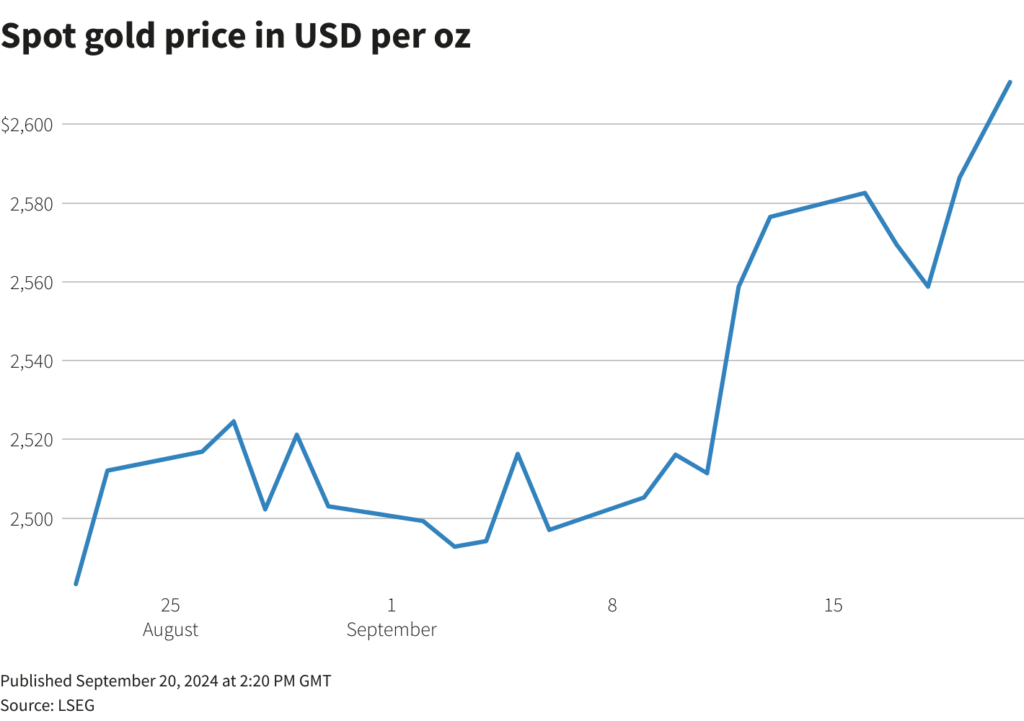
Gold soared above the $2,600 level on Friday for the first time, extending a rally boosted by bets for further US interest rate cuts, and rising tensions in the Middle East.


Spot gold was up 1.3% at $2,620.63 per ounce by 1:43 p.m. ET (1743 GMT), while US gold futures settled 1.2% higher to $2,646.20.


Bullion’s latest rally got a fillip after the Federal Reserve initiated an aggressive easing cycle on Wednesday with a half-percentage-point reduction, adding to the appeal for gold, which pays no interest.

Prices of the safe-haven asset have climbed 27% in 2024, their biggest annual rise since 2010, as investors also sought to hedge uncertainties spurred by prolonged conflicts in the Middle East and elsewhere.

The record rally could be poised for a correction, analysts said.

“Clearly, there’s still some buying activity associated with the Fed’s decision to begin their easing cycle with a big cut,” said Daniel Ghali, commodity strategist at TD Securities.

However, “the source of this buying activity remains off our radar,” given ETF inflows are relatively marginal and Asian buyers are still on a buyers’ strike, all signs of “extreme positioning,” Ghali added.

The record rally has eroded retail demand in top consumers China and India.

The rally in gold “should not go on forever,” Commerzbank said in a note, citing the expectation for rate cuts of only 25 basis points each at the Fed’s next two meetings.

Still, some analysts said gold could see more upward spikes.

“Geopolitical risks, such as ongoing conflicts in Gaza, Ukraine, and elsewhere, will ensure to sustain gold’s safe-haven demand,” Forex.com analyst Fawad Razaqzada said in a note.

Continued weakness in the dollar, which makes gold cheaper for holders of other currencies, offered additional tailwinds, analysts said.

Elsewhere, spot silver gained 1.2% to $31.16. Platinum fell 1.1% to $978.50 and palladium shed 0.5% to $1,074.84.

(By Anushree Mukherjee; Editing by Arpan Varghese, Barbara Lewis, Shreya Biswas and Alan Barona)
Zambian miners resist state taking bigger stake in resources

Bloomberg News | September 20, 2024 | 


Lusaka skyline, Zambia. Stock image.

Zambian mining companies met with the government to resolve differences over a proposed legal change that would potentially give the state a bigger share of its mineral resources.


Draft legislation under consideration in the southern African country’s parliament would enable Zambia to “acquire mining rights for investment by government.” The state would be able to buy a stake in an area before an exploration license was granted, and retain it after a discovery was made and the site developed.

That plan is opposed by the Zambia Chamber of Mines, whose members include units of First Quantum Minerals Ltd. and Barrick Gold Corp. Earlier in the week, the chamber said that in its current form, the new law would introduce “unaccountable and arbitrary” decision making.

The chamber met with Zambia’s Mines Ministry on Friday in the capital, Lusaka, to “reach an amicable settlement” on the contested clause. “The parties have developed a roadmap for the resolution of the matter within the shortest period of time,” they said in a joint statement.

The chamber also criticized plans outlined last month by Mines Minister Paul Kabuswe for the government to set up a state-owned firm to control at least 30% of the output of critical minerals, including copper, from future mines. Zambia, Africa’s second-biggest copper producer, is targeting a fourfold increase in output of the metal by early next decade.

(By William Clowes and Taonga Mitimingi)


SmartPropulsion: A Game Changer for Reducing Fuel & Ensuring Compliance

Propeller

Published Sep 17, 2024 3:06 PM by Emerson


Across the global marine industry, environmental sustainability and economic efficiency are becoming increasingly intertwined. Vessel owners and operators face pressure to adopt fuel-saving solutions to meet the ever-tightening regulatory standards such as the 2050 zero-emission target, as well as market expectations for greener shipping.

While many technologies promise efficiency improvements, they are often costly, complex to implement, and in some cases, simply cannot deliver the results they initially promise. This puts marine businesses at an impasse; if they fail to meet regulations, they simply cannot operate the ship. Even if they do comply today, they must achieve and maintain a CII rating that meets changing regulations. While also contending with rising fuel costs and new carbon tax legislation, making it critical to reduce operating costs.

Against such uncertainty, shipowners need to be sure they are making the right decisions, not only to ensure their profitability and compliance now, but to de-risk their future. The industry seeks a solution that is cost-effective to install, does not require dry docking, and guarantees the necessary fuel savings. One proven technology delivers all this and more, known as SmartPropulsion and it achieves impressive results.

SmartPropulsion – a game changer

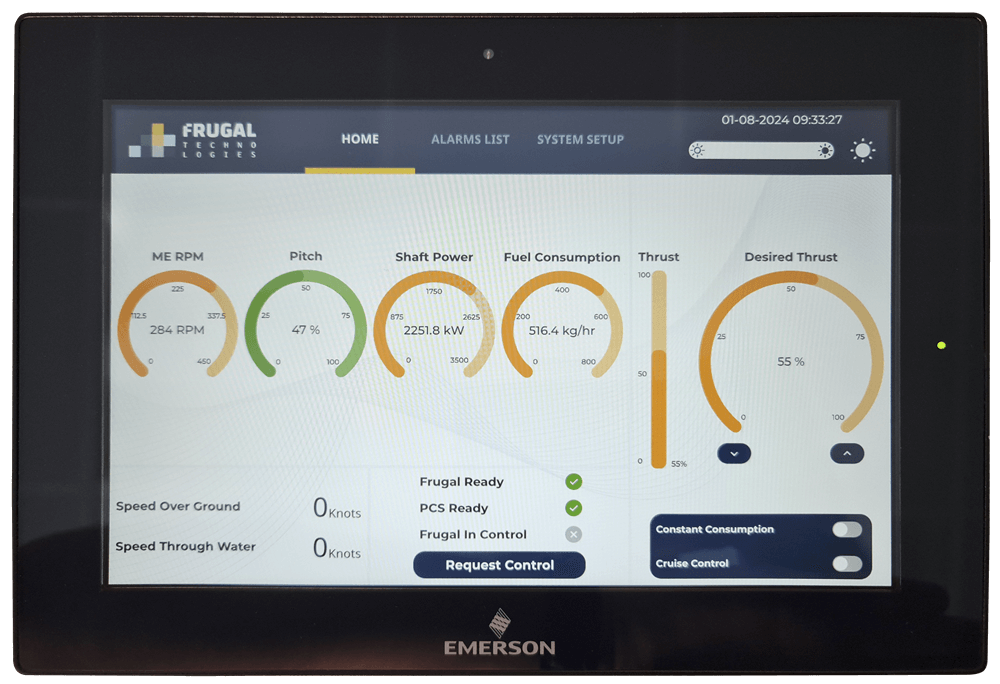
SmartPropulsion is an energy-saving solution from Emerson, powered by Frugal Technologies, that optimizes propulsion efficiency through AI and machine learning by monitoring and learning a vessel’s operating parameters in real time.

The reduction varies in accordance with propeller types, however a proven fuel saving of up to 15% has been documented in vessels equipped with CPPs, while fuel savings of up to 5% is documented in vessels equipped with FPPs. Every vessel goes through a business case evaluation, based on historical data, that evaluates the feasibility and return on investment. Not only does this mean they can save significant amounts on fuel costs, but SmartPropulsion also helps vessels to comply with existing and upcoming emissions regulations and achieve an optimal CII rating.

"We are proud to introduce SmartPropulsion, our latest innovation in collaboration with Frugal Technologies. Emerson is committed to making the world healthier, safer, smarter and more sustainable. With SmartPropulsion, we are taking a significant step forward in our commitment to sustainability, supporting our customers to navigate their daily challenges and realize their decarbonization goals." Jakob Noerr, vice president, marine solutions, Emerson.

Minimal CAPEX with significantly reduced OPEX

SmartPropulsion is compatible with all vessel types, engines, fuels, and propulsion systems. As an on-top solution, it interfaces directly with the existing Propulsion Control System, rather than the engine or propeller itself. This ensures proper equipment safety and gives a lower implementation cost compared to other energy-saving technologies.

Installation can be completed in three days, with no dry dock or off-hire days. This means vessels can be back in operation extremely quickly and can start delivering significant OPEX savings, with full return on investment (ROI) in as little as six months. The solution requires minimal training and, as a software-driven solution, maintenance is virtually non-existent.

Data-driven intelligence

SmartPropulsion uses cloud technology to combine Model Predictive Control and machine learning to collect and analyze data from the vessel’s operational parameters to create optimal propeller curves.

This means the system learns from experience over time. So, the longer it runs, the better it tracks the condition of the vessel and the more optimized the propulsion system becomes. On top of this, the vast amount of data collected can be integrated into existing intelligence solutions, generating insight for predictive maintenance. This enables users to solve any potential operational issues long before they become critical, saving considerable costs in repairs, associated downtime, and off-hire periods.

Proven results

SmartPropulsion is already proving its worth. Older vessels save more, but even relatively new vessels built according to old designs can have high savings.

For example, Uni-Tanker’s chemical tanker has seen a 12.2% improvement in fuel savings using SmartPropulsion, giving an ROI of only nine months and providing full documentation for CII reporting. Uni-Tankers was so impressed that they have installed SmartPropulsion on another eight vessels. Kristian Larsen, Technical Director at Uni-Tankers, commented: “With SmartPropulsion, we have a system that enables us to reduce the climate impact of our fleet while at the same time strengthening our competitiveness.”

In addition, Christiania Shipping has fitted two tankers with SmartPropulsion, giving an estimated 8-12% fuel savings each. Based on positive results Christiania Shipping upgraded more ships and now has eight CPP vessels and four FPP vessels installed with the solution. The FPP vessels are saving 2-4% of fuel and SmartPropulsion is also handling shaft power limitation according to calculated EEXI limits. Following these results, Christiania Shipping is planning to upgrade more of their vessels.

Based on data from already installed ships, we can estimate the fuel reduction for a typical container vessel of 6K TEU capacity with FPP. With 240 annual sailing days on average, it will consume an estimated 24K mt fuel. With SmartPropulsion installed, we can estimate a saving of approximately $4500K per year and ROI can be achieved in four months or less. Additionally, an estimated 2200mt of Co2 emission could be saved annually, significantly improving the CII rating for the vessel.

One to watch

Most vessel owners, managers, and operators would be pleased to gain even a one percent improvement in fuel efficiency. With SmartPropulsion, as much as 15 percent can be achieved, depending on the vessel's design, setup, and operational pattern. When other important factors are also taken into consideration, such as minimal implementation costs, significantly reduced OPEX, and low EU ETS costs, this innovative new technology looks to be a clear winner in terms of efficiency, safety, and value.

As regulations change, there will always be technologies in development to help vessels meet them. However, for the impressive results it delivers, SmartPropulsion is something we can expect to see on many more vessels in the future.

Visit Emerson to learn more about how SmartPropulsion can help improve the operation of your fleet, or contact Naveen Hegde, director, propulsion control and optimization, Emerson.

This article is sponsored by Emerson.

The opinions expressed herein are the author's and not necessarily those of The Maritime Executive.


Rolls-Royce Sells Naval Propulsor Business to Fairbanks Morse

propeller
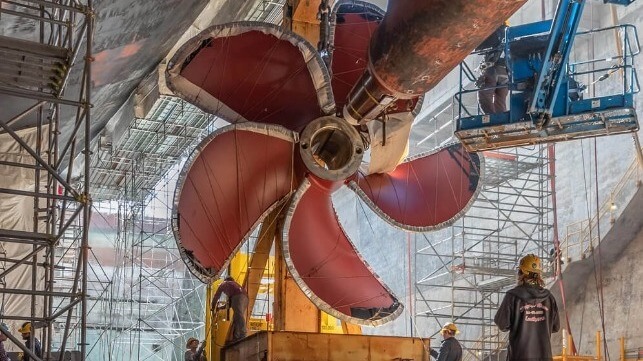
Propeller installation on the USS Nimitz (USN photo)

Published Sep 19, 2024 6:50 PM by The Maritime Executive


Rolls-Royce Sells Naval Propulsor Business to Fairbanks Morse


As part of its ongoing strategy to hone its operations to improve financial results, UK-based Rolls-Royce is selling its naval propulsors and handling business to Fairbanks Morse Defense, a leading U.S. defense contractor. The sale comprises operations in Mississippi and Massachusetts, as well as the specialized naval handling systems unit in Peterborough, Canada.

The CEO of Fairbanks Morse George Whittier is calling it a transformative deal for the company which already offers a diverse portfolio of engines, motors, and systems for naval craft. Fairbanks Morse is a leading supplier for U.S. Navy vessels as well as the U.S. Coast Guard, UK Royal Navy, Royal Canadian Navy, and Royal Australian Navy.

“The way that our products and services complement each other is unmatched in the defense industrial base,” said Whittier. “Combining our capabilities allows Fairbanks Morse Defense to substantially increase what we offer to our U.S. maritime defense customers while also offering our systems and components solutions to Rolls-Royce's global customer base.”  

The acquisition will include a range of propellers and waterjets for naval applications, as well as marine handling systems, which enable the deployment and recovery of manned and unmanned craft, and other cargo, from naval vessels. Rolls-Royce says that its propulsion equipment can be found on more than 95 percent of the U.S. Navy Surface Warfare fleet, including on all the U.S. aircraft carriers currently in service. In 2021, the company reached an agreement with Fincantieri Marinette Marine to design and manufacture up to 40 propellers for the Constellation-class (FFG-62) guided missile frigate program.

Rolls-Royce has two facilities in the United States including its marine propeller and waterjet manufacturing campus in Pascagoula, Mississippi that is responsible for producing controllable pitch propeller blades and hub body castings, large fixed-pitch propellers, and waterjets for the U.S. Navy. 

According to the company, it is the country’s only privately owned foundry that is qualified to cast propellers for the U.S. Navy’s surface and submarine fleet, making it a United States National Asset.  In 2022, the U.S. Department of Defense through the DPA Title III program provided a grant to support the construction of a new 26,000 facility, with foundry and machining equipment in Pascagoula.

The facility in Walpole, Massachusetts also works with ship propulsor systems and aftermarket services for the U.S. Navy, U.S. Coast Guard, and other international navies. It supports controllable pitch propellers, fixed propellers, and waterjets.

In addition to the propulsors, Fairbanks Morse Defense is acquiring Rolls-Royce Peterborough, Canada which supports the design and manufacture of handling systems, launch and recovery systems, and undersea sensors and systems for navies across the globe. Its products include the next-generation Mission Bay Handling System for the Global Combat Ship program, a frigate program for the UK Royal Navy, Royal Canadian Navy, and Royal Australian Navy.

They are also used on U.S. Navy fleet supports, amphibious ships, surface combatants, submarines, and more, as well as on U.S. Coast Guard vessels. Rolls-Royce handling systems are found on many of the U.S. Navy’s surface combatants.

Terms of the acquisition were not announced and the closing is subject to regulatory review and approval. Rolls-Royce will retain its Naval Gas Turbines and Generator Sets operations, which provide power dense solutions for naval propulsion and onboard power needs