It’s possible that I shall make an ass of myself. But in that case one can always get out of it with a little dialectic. I have, of course, so worded my proposition as to be right either way (K.Marx, Letter to F.Engels on the Indian Mutiny)
Wednesday, March 12, 2025
UK Says Burning Containership is Secured as Response to Collision Continues
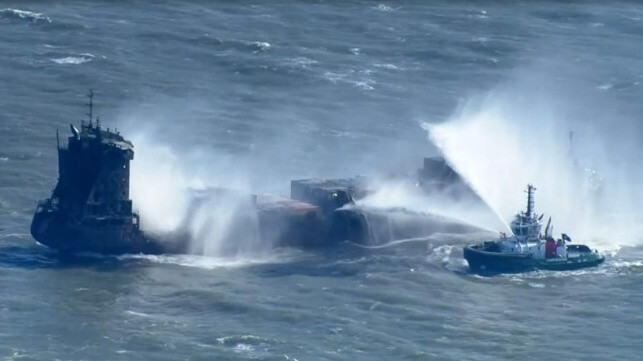
Firefight contines on the containership Solong which is drifting in the North Sea off England (Youtube video)
Response efforts continued to Monday’s incident off the east coast of England in which a Portuguese-flagged containership hit a U.S.-flagged tanker that was anchored near Hull, England. The updates from HM Coastguard provided late on Tuesday, March 11, indicate that the containership Solong was still burning but that fears that the vessel would sink were diminished. The fires were greatly reduced with some flames still visible on the main deck and firefighting is focusing on those areas. A tow line has also been attached as a salvage team works to control the vessel.
Earlier in the day, the Coastguard reported the vessel was drifting. Its last position was to the south of where it hit the Stena Immaculate. The containership had also drifted further east into the North Sea away from shore. The tug with the line is reported to be holding the containership in "a safer position."
Briefing Parliament earlier on Tuesday, the UK’s Minister for Aviation, Maritime and Security, Mike Kane, said “The assessment of HM Coastguard is, however, that it is unlikely the vessel will remain afloat.” He had reported, “Modelling suggests that, should the Solong remain afloat, it will remain clear of land for the next few hours.... Tug boats are in the vicinity to ensure the Solong remains away from the coast and to respond as the situation develops."
At 2320 last night local time the Coastguard reports the Solong separated from the Stena Immaculate and began to drift southwards. The Stena vessel was anchored approximately 10 miles off the coast near Hull, England, and remains there while the Coast Guard continues to track the Solong. Daylight images today show multiple fireboats near the containership spraying the fire.
In a statement, a spokesperson for the owners of the vessel Ernst Russ is now denying the reports of dangerous chemicals in some of the containers. “We are able to confirm that there are no containers on board ladened with sodium cyanide...,” they stated. “There are four empty containers that have previously contained the hazardous chemical and these containers will continue to be monitored.”
Images of the Stena Immaculate show the large fire is extinguished. Experts said they are remaining cautious however that there might still be fire below deck and they would be monitoring the vessel. Boskalis confirmed Dutch media reports that it has been retained to oversee the salvage operation for the tanker. The company said the timeline was unclear but that resources were already traveling to the ship.
The Coastguard also clarified previous reports saying that the 36 crewmembers were ashore and none were in hospitals. They said one was treated after coming ashore and declined further medical assistance. One crewmember from the Solong remains missing after the search was called off on Monday.
“We also recognize the dangers that others are faced with as they work to stabilize and secure the vessels and cargos involved,” Ernst Russ said in its statement. “Our team is actively engaged with all local authorities, and we will work with clean-up teams to ensure every effort is made to mitigate further impacts on the marine environment.”
The Coastguard reports teams are working with ship owners, salvors, and insurance companies. A Counter Pollution and Salvage Team is assessing the situation and is developing a plan ready for implementation as soon as the situation allows.
Speculation is running rampant on the Internet over the cause of the incident while CBS News interviewed one of the sailors from the Stena Immaculate. It’s reporting he said "a massive ship came from out of the blue" and that “it appeared as though nobody was on the bridge of the Solong at the moment of the crash.” The two vessels remained pinned together with the Solong continuing its forward momentum.
A spokesperson for the British Prime Minister however has told the media “I understand there doesn't appear to be any suggestions of foul play at this time." The investigations however are ongoing.
UK officials said its Marine Accident Investigation Branch is in touch with officials in Portugal and the United States, the flag states of the two vessels. Reports said there are internal discussions as to which country will lead the investigation although the MAIB is reported to already be in the area gathering information and possible evidence.
Video Released of Impact as Salvage Teams Prepare to Board Both Ships
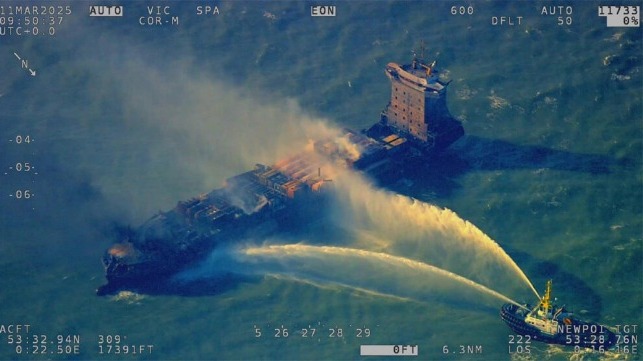
Firefighting efforts on the Solong on March 11 (Photo: Maritime and Coastguard Agency)
Officials from HM Coastguard and the shipping companies involved in Monday’s incident in the North Sea are reporting that the situation has stabilized aboard both ships as attention turns to planning the salvage operation. UK investigators are continuing to gather information while they wait for access to the data recorders aboard the two ships.
“The MCA is working with the salvage companies who are responding on behalf of the vessels’ owners and are working in full cooperation with all commercial and government partners. The overarching objective is to protect the public and the environment to the best of our ability, during this ongoing incident response,” HM Coastguard said in its update midday on Wednesday. “There have been no further reports of pollution to the sea from either vessel beyond what was observed during the initial incident.”
Thermal imaging from a neighboring vessel showing the allision as it happens -- note the weather conditions from the bridge view in the first images (Orca AI supplied)
"This video footage clearly shows the context of the accident, that is the fog conditions at the time, while the moment of impact is also shown clearly," commented Yarden Gross, CEO and Co-founder of Orca AI, a maritime operations platform utilizing artificial intelligence and computer vision to aid mariners. The company describes the video saying the footage comprises two videos, one captured by the SeaPod's day cameras showing the dense fog that would likely have prevented the crew of the feeder containership Solong from seeing the Stena Immaculate with the human eye. The second video captured by the SeaPod's thermal cameras shows the approach of the Solong and the explosion as it hit the tanker.
The fires aboard the containership Solong are being described as “greatly reduced in their extent and intensity” while the vessel’s owner Ernst Russ said in a statement that the operational response to fully extinguish the fire and stabilize its containership continues. It said that fire activity onboard had diminished since yesterday, but that the vessel continues to emit smoke with occasional reports of flames. Pictures show the vessel charred end to end. The containership continues to be held in a safe position offshore by a tug with additional support vessels remaining in the area.
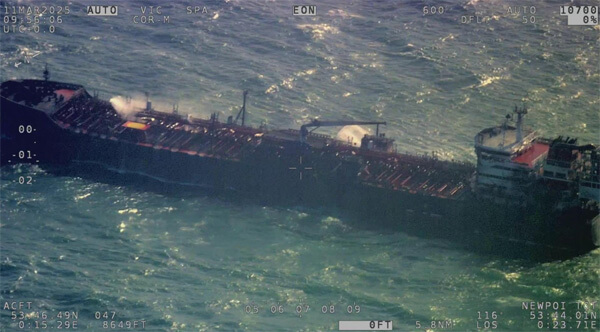
There are no visible flames on the Stena Immaculate, which remains at anchor with safety tugs in position nearby. The salvage team from Boskalis was hoping to carry out an onboard assessment on Wednesday afternoon.
Stena Immaculate on March 11 (Photo: Maritime and Coastguard Agency)
Erik Hanel, chief executive of Stena Bulk which owns the tanker said the company was working closely with Crowley which operated the tanker under charter for the U.S. government, and that once the fire has been fully extinguished, salvagers would conduct a comprehensive assessment of the damage.
Speaking with the BBC, Hanel said that they would not know the full extent of the structural damage until the teams got aboard. He said they “hoped a decision on what to do with it could be made over the next 24-48 hours.” Hanell said that they now believe only two of the vessel's 18 fuel tanks had leaked, with an estimated 10 percent of the cargo.
The investigators have not made any public comments although the Internet remains ripe with speculation. A spokesperson for Ernst Russ commented that the master of the vessel who was detained by the police and its entire team are “actively assisting with the investigations.” They confirmed that the master is a Russian national and the rest of the crew are a mix of Russian and Filipino nationals.
Media in the UK is also highlighting that the Solong was cited for a range of issues during Port State inspections in 2024. The vessel’s owners responded that the issues had been resolved at the time of the inspections. While deficiencies were identified during inspections in both the UK and Ireland last year, the vessel was not detained.
HM Coastguard said the operations would only proceed to the next phase when it was safe to do so. They have continued to monitor the temperatures aboard both vessels while also looking for any indications that the fires were flaring up or further pollution.
Captain of cargo ship in North Sea crash is Russian: vessel owner
UK police arrested a man after the Solong cargo ship slammed into the US-flagged Stena Immaculate - Copyright AFP/File Philip FONG
The arrested captain of a cargo ship that hit a stationary tanker in the North Sea causing a huge blaze is a Russian national, the ship’s owner told AFP Wednesday.
UK police arrested a man after the Solong cargo ship, owned by Ernst Russ, slammed into the US-flagged Stena Immaculate on Monday, leaving one crew member missing presumed dead.
“Ernst Russ confirms that the master is a Russian national,” the company said in a statement to AFP. “The rest of the crew are a mix of Russian and Filipino nationals.”
The confirmation comes after local police arrested a 59-year-old man on Tuesday on suspicion of manslaughter in connection with the incident, which took place off the northeast coast of England.
Ernst Russ said the man detained by Humberside police was the captain of the Portuguese-flagged Solong.
Early on Monday, the Solong ploughed into the Stena Immaculate, anchored about 13 miles (20 kilometres) off the northeastern port of Hull, setting both vessels alight.
The incident resulted in jet fuel from the tanker leaking into the North Sea, sparking concerns for the surrounding environment and wildlife, as well as questions about how it happened.
While the fire on the tanker had “greatly diminished with no visible flames” by Tuesday evening, according to its US-based operator Crowley, the volume of jet fuel released into the sea remained “uncertain”.
“Initial review shows impacts have been limited due to exposure to the fire and evaporation of the Jet A1 fuel,” Crowley said in a statement. – Missing presumed dead –
The UK Coastguard, which led the operation, rescued 36 people on Monday, including all of the 23 crew on the Stena Immaculate tanker, which had been chartered by the US military.
But a missing member of the Solong vessel crew was presumed dead, UK under-secretary for transport Mike Kane told parliament.
“Whether there was foul play, I think is speculation,” he said of the crash. “There is no evidence to suggest that, at the moment.”
The Stena Immaculate was on a short-term US military charter with Military Sealift Command, according to a spokesperson for the command, which operates civilian-crewed ships for the US Defense Department.
According to data collected by website VesselFinder, the impact of the crash displaced the tanker by “more than 400 metres”.
And the Daily Telegraph reported Wednesday that Irish officials found the Solong’s emergency steering compass was deficient during a routine safety check last year.
It was one of 10 deficiencies noted in the inspection carried out when the ship visited Dublin in July 2024.
UK agencies have been at the North Sea to probe air quality and environmental impacts, and investigations have started into how the cargo ship hit the tanker.
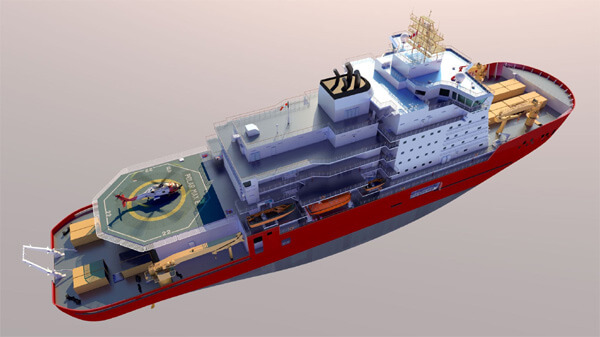
Canada Confirms Second Polar Icebreaker Order with Quebec’s Chantier Davie
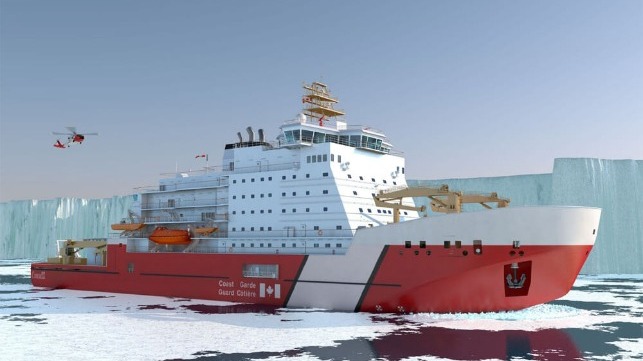
Canada confirmed the order with Davie for a heavy polar icebreaker (Davie)
The government of Canada confirmed the order for the second of its planned large polar icebreakers with Quebec’s Chantier Davie. The contract for the other large polar icebreaker was confirmed with Seaspan in Vancouver with both vessels being part of the country’s National Shipbuilding Strategy.
Davie has been contributing to the program for the two icebreakers which were first announced in May 2021, including a contract last fall for design work. Chantier Davie has already played a critical role in supporting Canada’s fleets, receiving over C$2.8 billion (US$1.9 billion) in contracts from 2012 to 2023 for various types of work on ships for the Canadian Coast Guard, the Royal Canadian Navy, and Transport Canada. The orders for the icebreakers come as the National Shipbuilding Strategy is marking its 15th anniversary and government officials highlighting it has contributed to Canadian shipyards delivering eight large vessels and 34 small vessels to the Royal Canadian Navy and the Canadian Coast Guard while supporting federal fleets with critical repair, refit, and maintenance work.
Davie reports work will begin in 2025 on its icebreaker project which it values at C$3.25 billion (before tax) (US$2.25 billion). Delivery on the design they are calling Polar Max to Canada by 2030. On Friday, March 7, the government of Canada reported the value of the contract at C$3.15 billion (before tax) (US$2.2 billion) for a similar vessel to be built at Seaspan’s Vancouver Shipyards in British Columbia.
“The contract awarded to Chantier Davie Canada for the build of a new polar icebreaker underscores our dedication to ensuring safe and efficient navigation in Arctic regions,” said Jean-Yves Duclos, Minister of Public Services and Procurement and Quebec Lieutenant. “This state-of-the-art vessel will not only strengthen our icebreaking fleet, but will also support critical scientific research and environmental protection efforts, and ensure national security in the Arctic.”
Davie reports it will be the first vessel built under the trilateral partnership announced in November 2024 between Canada, Finland, and the United States. Davie acquired Helsinki Shipyard in 2023 and it will provide support to the project. They note that Helsinki Shipyard has built more than half of the world’s icebreakers. Davie reports it plans to implement a workforce exchange, enabling Québec employees to learn world-class icebreaker construction expertise first-hand from their Finnish colleagues.
While the early phase of the polar icebreaker construction is underway, Davie reports modernization of its Lévis Shipyard will continue, giving it time to accelerate the hiring of skilled workers across all trades. According to the company, this will enable it to leverage its Canadian supply chain sooner than anticipated, while ensuring the completed polar icebreaker is delivered from Lévis.
The Canadian Coast Guard currently has 18 icebreakers of varying sizes and capabilities, making it the second-largest icebreaking fleet in the world. Canadian officials said these larger, more powerful polar icebreakers will ensure the Coast Guard’s operations continue at higher latitudes for longer periods while allowing it to strengthen Arctic security, advance high Arctic science, and better respond to maritime emergencies.
Ontario and Washington Back Down From Escalating Tariff Threats
The Sir Adam Beck Power Generating Complex on the Ontario side of Niagara Falls (Ontario Power Generation)
After days of back-and-forth threats, the White House and the premier of Ontario, Canada backed down from steep tariff hikes that would have hit consumers on both sides of the border.
Last week, in response to Trump's ongoing tariffs on Canadian goods, Ontario Premier Doug Ford announced that he would impose tariffs of 25 percent on all exports of electricity to U.S. customers - and pledged to raise the levy or shut off power exports completely if the White House added any more tariffs. "Believe me when I say I do not want to do this, I feel terrible for the American people, because it’s not the American people who started this trade war. It’s one person who’s responsible. That’s President Trump," Ford said.
The Canadian and American grids are deeply intertwined, and the states of Michigan, Minnesota and New York all import power from Ontario. The province estimated that about 1.5 million homes would be affected, and that the tariff would generate about $300-400,000 daily for Ontario's government. (Utilities in Minnesota and Michigan downplayed the impact and suggested that it would be negligible for the average household.)
Trump responded Tuesday by threatening to double tariffs on Canadian steel and aluminum to a total of 50 percent - a crippling impact on Canada's metal producers and on the U.S. manufacturers that rely upon a Canadian supply chain. He blasted Ford for using electricity as a bargaining chip and again called for the annexation of Canada.
“The only thing that makes sense is for Canada to become our cherished Fifty First State,” Trump said Tuesday morning. “The artificial line of separation drawn many years ago will finally disappear."
By the afternoon, tensions appeared to have cooled, at least temporarily. Ford announced that he had arranged a meeting with U.S. Secretary of Commerce Howard Lutnick to discuss renegotiation of the U.S. Mexico Canada Agreement (USMCA), the free trade deal that Trump negotiated in 2019. In response, Ford said that Ontario would suspend its 25 percent tariff on electricity exports, and the White House confirmed that it would suspend the threat to double tariffs on Canadian steel and aluminum.
A 25 percent U.S. tariff on steel and aluminum imports from all countries remains in effect, along with a 10 percent tariff on Canadian oil and a 25 percent tariff on all Canadian and Mexican goods that fall outside of the USMCA framework. An across-the-board 25 percent tariff on both USMCA members takes effect April 2, though implementation has been delayed twice.
Farmers begin to feel tariff pinch
In response to newly-imposed 20 percent U.S. tariffs on most Chinese goods, Beijing has imposed an array of retaliatory tariffs on American agricultural products, calibrated to target goods that China can replace with other sources. The tariffs include a 15 percent hike on U.S. exports of chicken, wheat and corn, and a 10 percent hike on soybeans, pork, beef and fruit. Goods that are already en route will not be affected, so long as they arrive by April 12.
"Farmers are frustrated. Tariffs are not something to take lightly and 'have fun' with. Not only do they hit our family businesses squarely in the wallet, but they rock a core tenet on which our trading relationships are built, and that is reliability," said Caleb Ragland, a soy farmer and the president of the American Soybean Association.
A "Floating Truck Stop" Could Alleviate Ontario's Highway Congestion
The increasing volume of east – west road traffic through North America’s busiest corridor at Toronto, Canada requires the development of new and alternative solutions for the future. One of the possibilities involves the operation of mega-scale roll-on, roll-off shipping to carry trucks along the northern region of Lake Ontario.
Introduction
A steadily increasing volume of road traffic travels along the highway that extends east from Chicago through Detroit, then across into Canada to Toronto and on to Montreal. Major east – west roads across Toronto have been widened and additional east – west roads having been built, but road traffic volumes have steadily increased along with congestion, with delays raising the cost of commercial transportation.
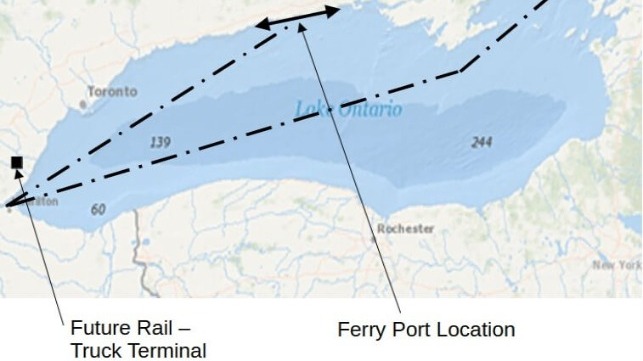
One possible option involves the construction of a tunnel under the main east – west highway through Toronto. A partial solution from CN Rail involves the construction of a new railway – truck container transfer terminal within a few miles northeast from the Port of Hamilton. In additional to the CN Rail container transfer terminal at Montreal, a private developer plans to build a railway – truck container transfer terminal along the main CN Rail line, southeast of Ottawa and with potential to transfer semi-trailers.
The maritime sector offers a solution in the form of a “floating truck stop” that would sail between the Port of Hamilton to a port located east of Toronto.
The Maritime Option
This option would borrow from several well-proven precedents, including the barge tows that sail along the southern Mississippi River. Barges measuring 35-feet width by 200-feet in length are lashed together 10-lengthwise and 7-side-by-side, yielding a floating assembly measuring 2,000-feet in length by 245-feet in width. Future research would need to explore the possible operation of coupled assemblies of Seaway-max size of barges, each measuring 75-feet width by 600-feet in length, each designed for roll-on, roll-off operation. Such barges could sail through waves in the western region of Lake Ontario that rarely exceed three feet in height.
Government regulation restricts the daily work duration for truck drivers who - after having completed their daily limit - are required to make a compulsory rest stop for up to 10-hours. Dispatchers might schedule drivers to arrive at a roll – on, roll – off terminal as their workday ends, to park their vehicles aboard a floating truck stop. An array of barges assembled into a tow or floating train would measure 225-feet width by between 1,800-feet and 2,400-feet in length, to be navigated by tugs coupled at the bow and stern ends and sailing at speeds of up to 12-knots.
Mega-size Barge Trains
Each barge would be designed to transit through Seaway size navigation lakes, with final assembly into a coupled train at either Port of Hamilton or along the Upper St. Lawrence River near the Port of Johnstown. Barge design would need to include the rapid loading and off-loading of several levels of trucks, with Port of Hamilton becoming the western terminal. There would be a need to develop a terminal for mega-size vessels east of the Port of Oshawa.
At that terminal and at Port of Hamilton, trucks with drivers would transfer between water transportation and the main highway. Barge assemblies that carry trucks and drivers would sail at 10 to 12-knots for a duration of up to 10-hours. An alternative option would involve drivers dropping off semi-trailers at a port for transfer on to a barge, then coupling to semi-trailers that had already been off-loaded. Barges that carry low-priority semi-trailers without drivers would measure 150-feet in width and sail between Ports of Hamilton and Johnstown.
Weather Factors
The Upper St. Lawrence River and Lake Ontario are located south of the Lower St. Lawrence River, which is open year-round to navigation between Montreal and the Atlantic Ocean. Ferry services do operate around Lake Ontario during the coldest winter months between mid-January to mid-March. During winter, ice booms are placed across the Upper St. Lawrence River, to the east of the Port of Johnstown and to assure smooth water flow to the hydroelectric power dam. Despite the winter closure of the St. Lawrence Seaway, barges could sail on Lake Ontario, including between the Ports of Hamilton and Johnstown.
The greatest demand for transportation along the main highway between Chicago and Montreal occurs between mid-March and mid-January, when weather conditions would allow for easier navigation. Severe winds blow across the Great Lakes between late October and mid-December, causing severe waves of 20-feet and 30-feet to occur in the eastern region of Lake Ontario. When the worst wave conditions occur, during early winter, barge assemblies would still be able to sail between ports located along the northern region of Lake Ontario.
Future Research
The logistics research institute at McMaster University at Hamilton has the capability to undertake comprehensive research into evaluating methods of moving increased future traffic volumes across and around Toronto. A railway – truck intermodal terminal located northeast of Hamilton and a companion terminal in Eastern Ontario offers potential to divert some truck traffic from the roads to the railway. In addition, a coupled assembly of barges would be able to carry the equivalent number of trucks as a fleet of intermodal trains, while serving as an overnight mobile truck stop that can divert trucks around Toronto traffic congestion.
The opinions expressed herein are the author's and not necessarily those of The Maritime Executive.
SDG: F FOR FAIL
No countries on track to meet all 17 UN Sustainable Development Goals
Machine-learning study highlights factors that may affect efforts to meet goals by target year 2030
Parallel plot of the 17 SDG. Comparison among all the yearly average SDG scores, from 2000 to 2022. Scale color goes from dark red (2000) to light blue (2022).
Credit: García-Rodríguez et al., 2025, PLOS One, CC-BY 4.0 (https://creativecommons.org/licenses/by/4.0/)
A new analysis reveals complex linkages among the United Nations’ (UN’s) 17 Sustainable Development Goals—which include such objectives as gender equality and quality education—and finds that no country is on track to meet all 17 goals by the target year of 2030. Alberto García-Rodríguez of Universidad Nacional Autónoma de México and colleagues present these findings in the open-access journal PLOS One on March 12, 2025.
In 2015, UN member countries adopted the Sustainable Development Goals with the aim of achieving “peace and prosperity for people and the planet.” However, setbacks such as the COVID-19 pandemic, climate change, and armed conflict have slowed progress, and more research is needed to clarify the underlying obstacles so they can be effectively addressed.
To help deepen understanding, García-Rodríguez and colleagues applied a suite of machine-learning tools to more than 20 years’ worth of continuous data, analyzing aggregated scores derived from 231 UN-designated indicators of progress toward the Sustainable Development Goals for 107 countries, as well as GDP data.
The analysis revealed complex linkages among the goals, with some acting synergistically and others as tradeoffs. For instance, the two goals of climate action and responsible consumption and production appear to support each other, but have a negative correlation with all 15 other goals, suggesting that our current economic system may hamper climate action goals. Meanwhile, the goal of no poverty appears to be synergistic with most other goals.
No country appears to be on track to meet all 17 goals by 2030. However, when countries are grouped according to geographical, cultural, and socioeconomic factors, different groups appear to be making progress on different goals. For instance, African and Asian countries (which have the lowest GDP) have low progress on such goals as no poverty, gender equality, and good health and well-being, but have the best progress on climate action and responsible consumption and production.
On the basis of these results, the researchers call for a new, systemic approach to achieve the 17 goals that is region-specific and accounts for the complex linkages between goals. The findings of this study could help inform such efforts.
The authors add: “It is evident that the current global production and consumption patterns are not aligning well with our climate action goals and seem to negatively impact other Sustainable Development Goals. If we genuinely aspire to a better future, immediate action is necessary.”
In your coverage, please use this URL to provide access to the freely available article in PLOS One: https://plos.io/43b9saS
Citation: García-Rodríguez A, Núñez M, Pérez MR, Govezensky T, Barrio RA, Gershenson C, et al. (2025) Sustainable visions: unsupervised machine learning insights on global development goals. PLoS ONE 20(3): e0317412. https://doi.org/10.1371/journal.pone.0317412
Author countries: Finland, Mexico, Argentina, US, Austria
Funding: Alberto García Rodríguez acknowledges financial support from the Centro de Ciencias de la Complejidad (C3), Universidad Nacional Autó noma de México (UNAM). The funder had no role in the design of the study, data collection and analysis, decision to publish, or preparation of the manuscript.
Credit: Alliance of Bioversity and CIAT / A.Manjella
For residents of Kibera, one of Nairobi’s largest informal settlements, access to nutritious food is often scarce. School meals are a lifeline for many families. But the case study of one small school is proving that- with the right ingredients- school meal programs can become even more beneficial. Research just published in Sustainability found that incorporating locally available, nutrient-rich crops into school meal programs can significantly improve nutrition for children while cutting costs.
Changing the Menu
In this case study, researchers examined the meal program offered at Volunteers Foundation Academy, where students typically receive a daily lunch of ugali (maize porridge) with a side of sukuma wiki (kale) or beans. While filling, these meals often lack essential nutrients. Using the World Food Programme’s School Meal Planner (SMP) PLUS software, researchers identified five neglected and underutilized species (NUS)—African nightshade, spider plant, Bambara groundnut, hyacinth bean, and slender leaf. These climate-resilient crops are rich in vitamins, protein, and minerals, but rarely found on people’s plates.
By incorporating these NUS, the new menus met 30% of children’s daily nutritional needs while reducing meal costs by up to 67%.
Policy support needed to nourish urban populations
"By tapping into local biodiversity, we can create cost-effective, nutritious meals that benefit both students and smallholder farmers, all while promoting sustainable food systems,"
say the researchers, who come from the University of Florence and Alliance of Bioversity International and CIAT.
The study calls for greater policy support to integrate local food procurement into school meal programs, ensuring long-term sustainability and economic benefits for local farmers. With nearly 80% of Kenyans unable to afford a healthy diet, investing in nutritious, locally-sourced school meals could transform school feeding programs into a game-changer that can nourish future generations.
Enhancing Nutrition and Cost Efficiency in Kenyan School Meals Using Neglected and Underutilized Species and Linear Programming: A Case Study from an Informal Settlement
Article Publication Date
11-Mar-2025
Why it’s good to be nostalgic – an international study suggests you may have more close friends!
Even teenagers can be nostalgic, and study of U.S. and Europeans shows those more nostalgic exceed at maintaining friendships
Do you have lots of close friends – and work hard to keep it that way? If you’ve answered “yes”, you are probably nostalgic.
People who are prone to nostalgia have more close friends and put more effort into maintaining their friendships and other relationships than less sentimental sorts.
That’s the finding of a new study of almost 1,500 individuals in the U.S. and Europe, published in the peer-reviewed journal Cognition and Emotion.
The finding is important because maintaining close relationships with others is essential for our health and wellbeing, say the researchers from the University at Buffalo, in the U.S., and Kyoto University, in Japan.
Previous studies have found that people who have friends and confidants are happier with their lives and less likely to suffer from depression. They are also less likely to die prematurely. Having strong ties with others also provides valuable support during difficult times.
Close relationships seem particularly important. However, our social circles tend to shrink as we get older.
In this new first study of its kind, the authors carried out three pieces of research into the links between nostalgia and the size of a person’s social network.
For the first experiment, a group of undergraduate students in the U.S. was surveyed about how nostalgic they were and about their friendships.
Nostalgia was measured by asking questions such as “how important is it for you to bring to mind nostalgic experiences?” and “how often do you experience nostalgia?”.
Other questions covered how motivated they were to make new friends and to maintain their existing friendships and how many people were in their social circle.
The students were aged 19, on average. They had an average of seven people they were very close to – so close that it would be difficult to imagine life without them. They also had another 21 people were still important to them.
Analysis of their answers showed that those who said they were nostalgic also put more importance on maintaining their friendships and had the most very close friendships and other relationships.
The second experiment looked at whether the same was true of non-students in the U.S. An online panel of adults answered the same questions as the students. They also did a short personality test.
The participants, whose average age was 40, had smaller social networks than the students. They had five people they were very close to, on average, and about 14 other people who were still important to them.
Once again, those who were nostalgic tended to put more effort into maintaining their friendships and had the most very close friendships and other relationships.
This was the case regardless of other personality traits, such as extraversion.
The third experiment used data from a long-running Dutch survey, the Longitudinal Internet Studies for Social Sciences (LISS), to examine the effect of nostalgia on social networks over a seven-year period.
This found that the participants became more nostalgic as they got older. When questioned in 2013, they scored an average of 3.95 for nostalgia, out of a possible seven. By 2019, this had risen to 4.21.
The participants who scored “high” or “medium” for nostalgia kept the same number of strong social ties over this period – people they could talk to about important matters.
In contrast, those with low levels of nostalgia had 18% fewer close relationships.
Taken together, the three sets of results indicate that a tendency to reminisce about happy times we spent with others helps realise the importance of such relationships – and motivates us to maintain them.
“People who feel nostalgic more often and value those memories are more aware of their important relationships and the need to nurture them,” says researcher Kuan-Ju Huang, a PhD student at Kyoto University in Japan. “This means these friendships may be more likely to last, even as we get older and our lives, interests and responsibilities, change.”
The study’s limitations include not distinguishing between friends, family members and romantic partners when measuring the size of a person’s social circle and limiting the research to two countries.
Mr Huang admits to being nostalgic and explains how this can begin for everyone at quite a young age: “I started my PhD as an international student in Japan during the Covid pandemic. During that time, I observed that many people, including myself, found comfort in listening to nostalgic music and watching old videos.
“There is evidence showing that young adults report nostalgic feelings slightly more frequently than middle-aged adults, while older adults report dramatically higher levels of nostalgia.
“High levels of nostalgia in young and older adults occur for different reasons. Life transitions during emerging adulthood, including leaving the family home and entering college or the workforce, may trigger a psychological need to find solace in nostalgia.
“Young adults may reminisce about their high school years or family moments when facing challenges during the transition to adulthood. For older adults, nostalgia is more likely to be associated with experiences about loss and feelings of a limited future
“Overall, my own experiences of nostalgia inspired this study and for us to explore how it can strengthen one’s social connections.”