It’s possible that I shall make an ass of myself. But in that case one can always get out of it with a little dialectic. I have, of course, so worded my proposition as to be right either way (K.Marx, Letter to F.Engels on the Indian Mutiny)
Wednesday, March 12, 2025
Retailers Continue to Front-Load Imports Prompting Cut in Q2 Forecast
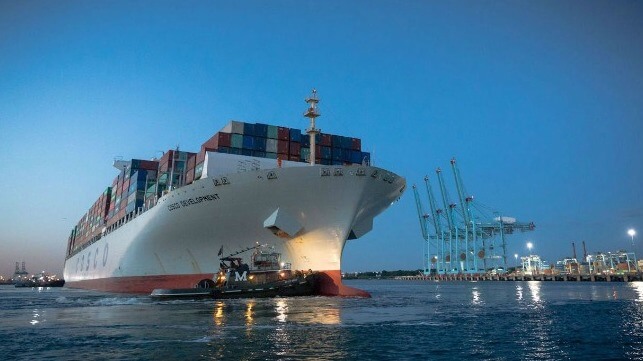
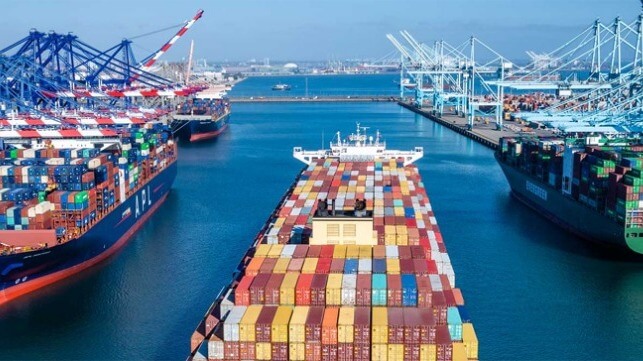
Container import volumes are elevated but expected to fall as Trump's tariffs impact retailers (Port of Los Angeles file photo)
Retailers are continuing to front-load their imports into U.S. ports due to the uncertainty over U.S. tariffs and the potential that the Trump administration will move to impose fees on Chinese-built ships reports the National Retail Federation. While the trade group expects volumes to remain elevated through the spring, its Global Port Tracker is reducing the forecast for second quarter imports versus last month’s outlook.
The group highlights the concerns among members and the elevated import levels so far in 2025 as seen for example on the reports of strong monthly volumes at the port of Los Angeles and Long Beach. However, after separately reporting declines in monthly consumer sales in both January and February, the NRF is now saying import volumes could see year-over-year drops this summer.
The National Retail Federation’s Port Tracker rallies container volumes at the major U.S. ports. The group raised its forecast by 3.5 percent for the first quarter while lowering its second quarter projection by 2.5 percent. It now expects possible year-over-year declines in import volumes to start in June and July, noting it would be the first decline since September 2023.
“Retailers are continuing to bring as much merchandise into the country ahead of rising tariffs as possible,” said Jonathan Gold, Vice President for Supply Chain and Customs Policy at the NRF. “The on-again, off-again tariffs against Canada and Mexico won’t have a direct impact on port volumes because most of those goods move by truck or rail. But new tariffs on goods from China that have already doubled from 10 to 20 percent are a concern, as well as uncertainty over ‘reciprocal’ tariffs that could start in April.”
The trade group notes that retailers have been working on supply chain diversification, but that doesn’t happen overnight. In the meantime, it says tariffs are taxes on imports ultimately paid by consumers, not foreign countries, and American families will pay more as long as they are in place. Economists have echoed this concern while Donald Trump this week dismissed talk of an impending recession due to his trade policies.
The NRF is projecting more than 6.4 million TEU for imports in the first quarter of 2025 noting that levels were up 4.4 percent in January over December and 13.4 percent year-over-year. It projects the momentum continued into February with a 6.1 percent increase, making it the busiest February in three years, a month that is traditionally slower as factories close in Asia during the Lunar New Year celebrations. It is forecasting a 10.8 percent increase year-over-year for March and a 5.7 percent increase year-over-year for April.
The retailers however are projecting the momentum will end with just a 2.8 increase in May followed by monthly year-over-year declines. June they project could be down 3.2 percent year-over-year and increasing to a 13.9 percent year-over-year decline in July. The forecast also shows container import volumes below 2 million TEU in July 2025 which would be the first time it has fallen below that level since March 2024.
The NRF is now forecasting a total of 12.78 million TEU for the first half of 2025. That would be up 5.7 percent versus last year.
The group notes if the Trump administration moves ahead with port fees on Chinese-built ships, that carriers might move to larger vessels. They expect the major lines would seek to consolidate calls at major ports rather than making multiple stops at smaller ports. Others have speculated that shippers might route move volumes through the Canadian and Mexican ports to reduce exposure to the proposed port fees.
The NRF believes the growing uncertainties and continuing “tariff turmoil” are increasing concerns and are likely to be reflected in import volumes as the year progresses.
Indonesia's $12B Gasoline Import Fraud Extends to Shipping
Anticorruption authorities in Indonesia are examining a sprawling fraud scheme at state energy giant Pertamina, which holds a near-monopoly on clean product distribution in the country. Executives at Pertamina allegedly set up a complex scheme to import gasoline from foreign refineries, inflate the price and skim money off the top at multiple points in the supply chain. The scheme touched chartering, procurement, blending and distribution, according to local authorities, and one U.S.-based shipping company is suspending the director of its Indonesian JV in response.
Indonesia's oil industry is highly concentrated, and a small "oil mafia" of well-placed officials and private individuals exert considerable control over the trade. Recently-elected President Prabowo Subianto campaigned on a promise to rein in this "mafia," and the Pertamina case is the first big test of that effort. (It is not the first time for Pertamina, which has undergone five previous corruption investigations in the past 10 years.)
According to local prosecutors, from 2018-23, a group of nine executives carried out fraudulent trades in order to increase their own earnings. The overall cost to the Indonesian state and local consumers came to about $12 billion.
According to officials, the starting point of the scheme was to declare that certain locally-produced crude was too poor in quality to be used in Indonesian refineries. This opened a legal avenue to import more expensive foreign-sourced gasoline to make up the artificial gap. At that point, the suspects allegedly purchased lower-quality 90 octane gasoline on the foreign market, then blended it and fraudulently resold it as higher-quality 92 octane gasoline in Indonesia. Motorists who used a low-quality fuel in an engine designed for high-octane gas could experience knocking and poor performance, and lawsuits are expected.
"An engine that continuously experiences knocking will lose combustion efficiency. Over time, carbon deposits will accumulate on the piston head and combustion chamber, drastically reducing performance," said Dr. Nur Aklis, a mechanical engineer at Universitas Muhammadiyah Surakarta (UMS).
Some of the suspects also allegedly inflated the cost of chartering to import this fuel by 13-15 percent, then pocketed the difference.
One individual arrested in connection with the scheme, Muhamad Kerry Adrianto, is also a director at the Indonesian joint venture operation of Navigator Gas (the firm is not accused of any involvement). The U.S.-listed LPG carrier operator has taken steps to remove Adrianto from his role, and expects that the change will have no material impact on its business.
This week, a Norwegian reefer ship narrowly avoided disaster after grounding on a remote shore in the Hebrides.
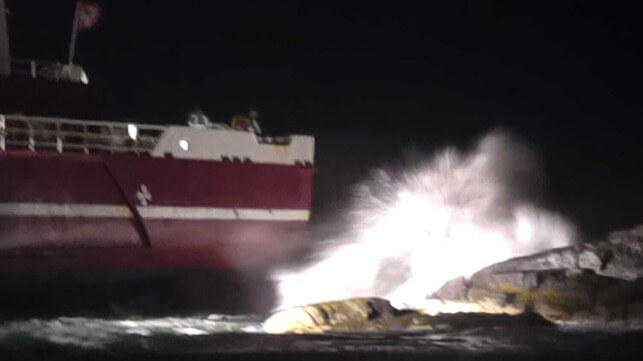
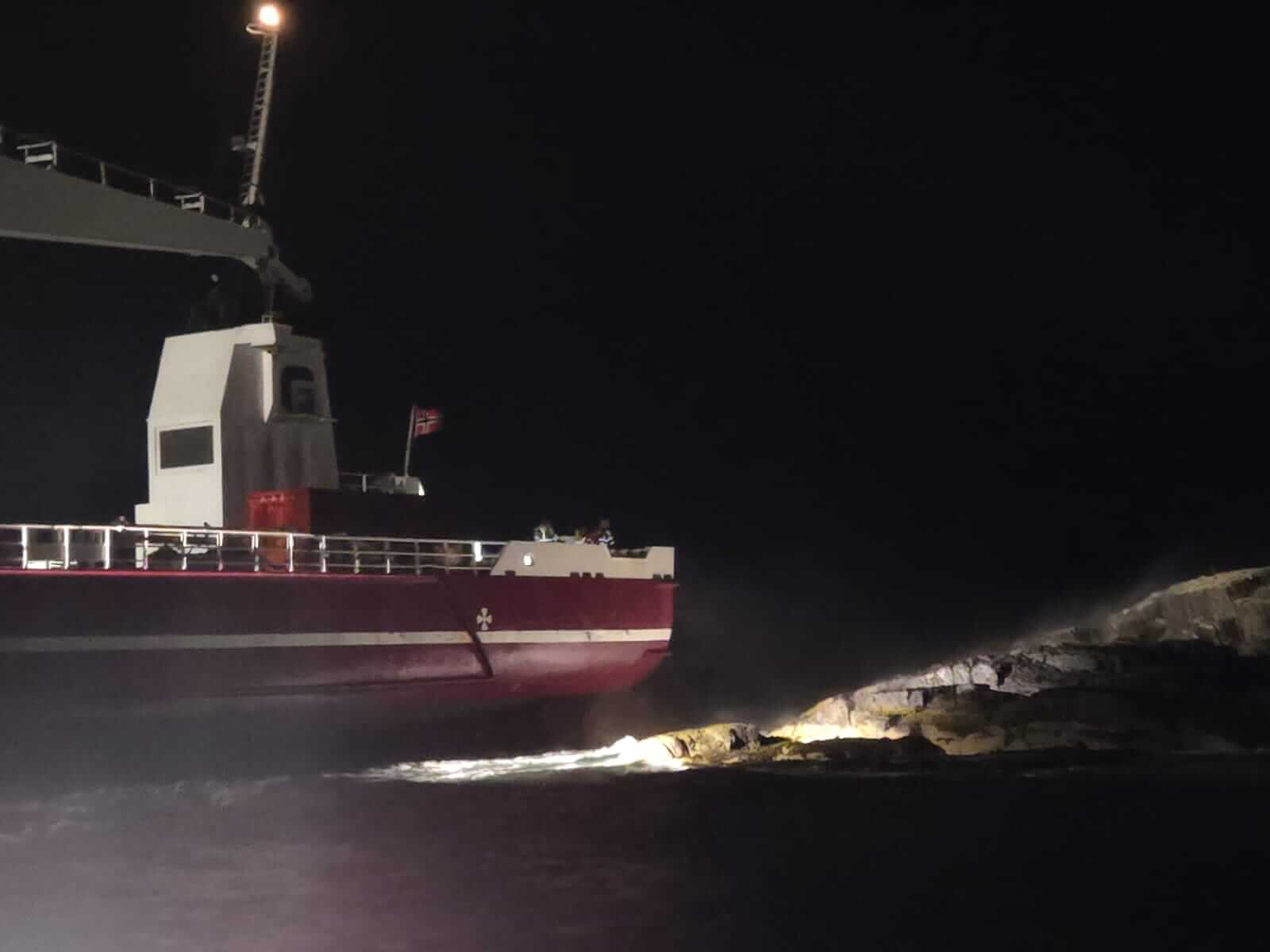
At about 0200 hours on Monday morning, the Norwegian-flagged reefer Rotsund dragged anchor and grounded on a rocky shoreline near the village of Breakish on the Isle of Skye. HM Coastguard received a distress call from the ship and called two local RNLI lifeboat stations in the port towns of Kyle and Portree.
The Kyle RNLI volunteer rescue team got under way at about 0225 and were on scene by 0240. They found that the Rotsund's stern was aground on the rocks, and that the wind and the seas were setting the vessel towards shore. There was a risk that the ship could have been pushed broadside onto the rocks, Kyle RNLI helmsman Daniel Elliot said.
Courtesy Kyle RNLI
There were no signs of pollution in the water, and no injuries were reported, so the lifeboat stood by while the Rotsund made efforts to free herself from the rocks. Portree's lifeboat arrived at about 0340 and joined the standby operation.
At about 0415, Rotsund's crew managed to free the ship using their own thrusters and engines. The RNLI stood by until a tug arrived on scene to assist Rotsund, then headed back into port.
"It was important that we stayed on scene to ensure that there was no unseen damage underneath the waterline which could pose a risk to the crew, or any pollution coming from the vessel which could pose a danger to the environment," said Elliot.
Rotsund is a 2,700 dwt reefer operated by Norlines, a coastwise shipping company specializing in local logistics within Norway.
Volgoneft Tanker Owners Face Lawsuits Over Kerch Strait Spill
Volgoneft 212's bow section as seen from its stern section, Dec. 15, 2024 (Russian social media)
The owners of the riverine tankers that split up and sank in the Black Sea in December are facing multiple lawsuits as Russian government agencies try to recover the cost of cleanup from the resulting spills.
The aging tankers Volgoneft-212 and Volgoneft-239 were built under the Soviet "river-sea" fleet program, a Cold War-era drive to build up inland shipping capacity. Russian shipping experts have questioned the fleet's suitability for open-water service in Black Sea winter weather, given that most of these sister ships are over 50 years old, and their design was never intended for rough surface conditions.
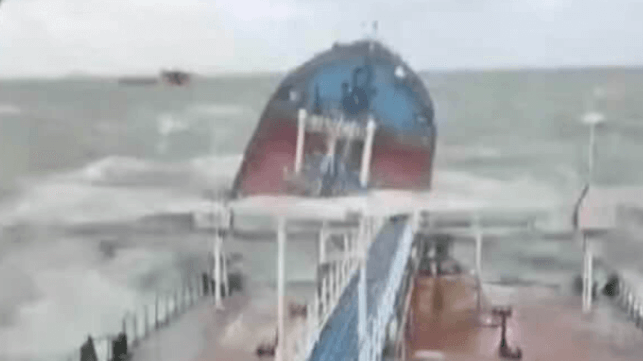
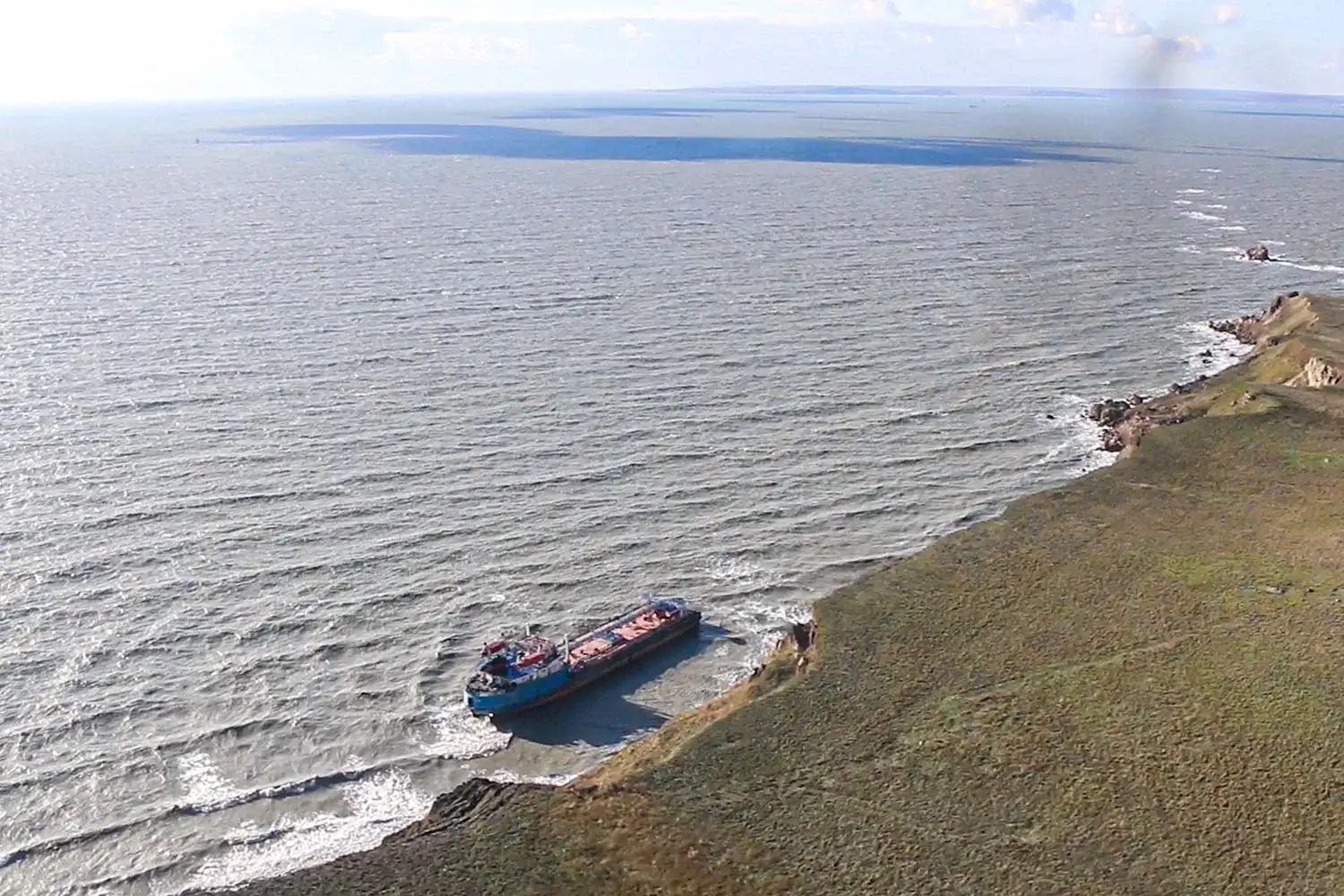
On December 15, Volgoneft-212 broke in half and sank in a severe storm about five nautical miles outside of the Kerch Strait. Waves in excess of 25 feet were forecast by Russia's meteorological agency in advance of the sinking, and the effects were enough to snap the aging tanker in half. The tanker was carrying about 4,300 tonnes of mazut, a Russian residual fuel oil produced from low-quality feedstocks. The tanker Volgoneft-239 broke up and grounded near Taman shortly after, spilling a similar load of mazut.
Courtesy Morspas
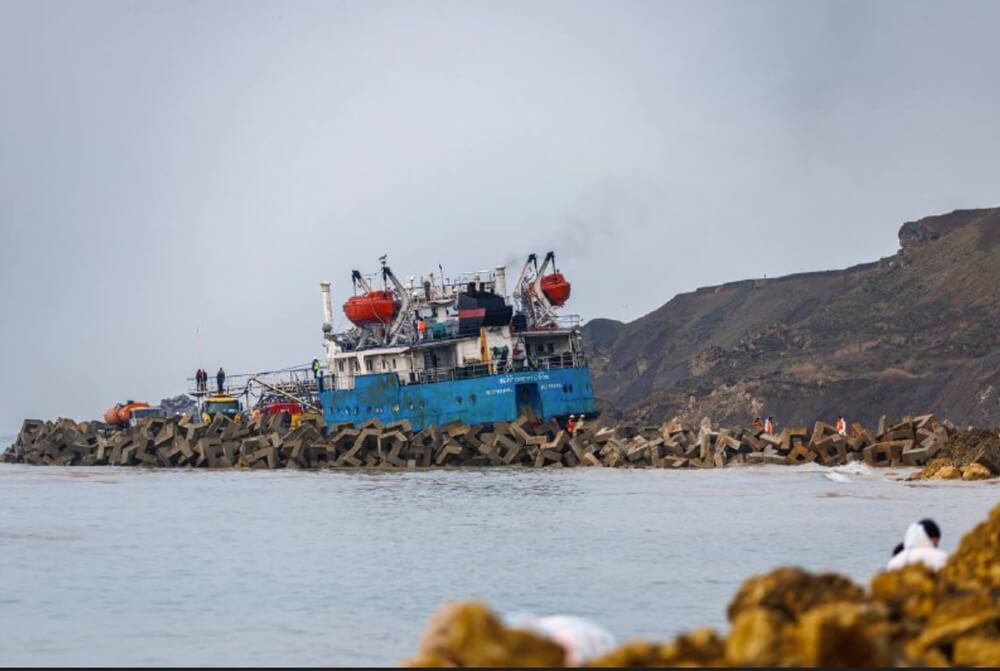
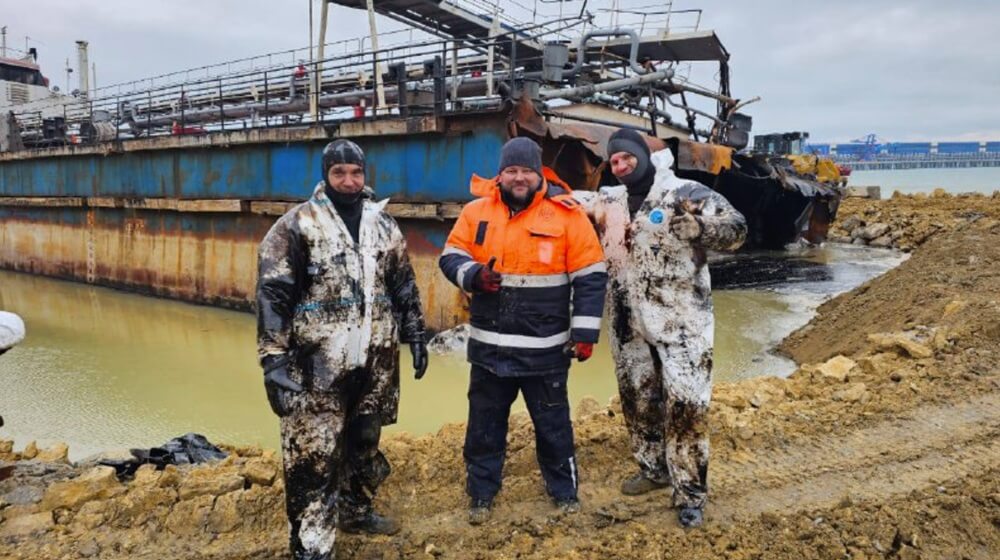
The cleanup effort for the wreck site of Volgoneft-239 took until the end of January, and it incurred significant costs. A response team led by Russian salvage agency Morspasluzhba (Morspas) built an earthen dike around the perimeter of the wreck, protecting it from wave action and creating a sheltered space for pollution abatement work to proceed. The oil was heated, pumped out and driven off by the truckload.
Morspas has sued Volgatransneft - the owner of the Volgoneft-239 - to recover the full cost of the cleanup, and the case is proceeding at an arbitration court in Krasnodar. Volgatransneft petitioned to have the lawsuit transferred to a court in Moscow, but Morspas objected, and the court refused the request. The hearings will begin in early April; the amount of the claim has yet to be fully calculated.
The same court has already fined Volgatransneft a minor penalty of $3,500 for alleged technical violations in connection with Volgoneft-239's sinking.
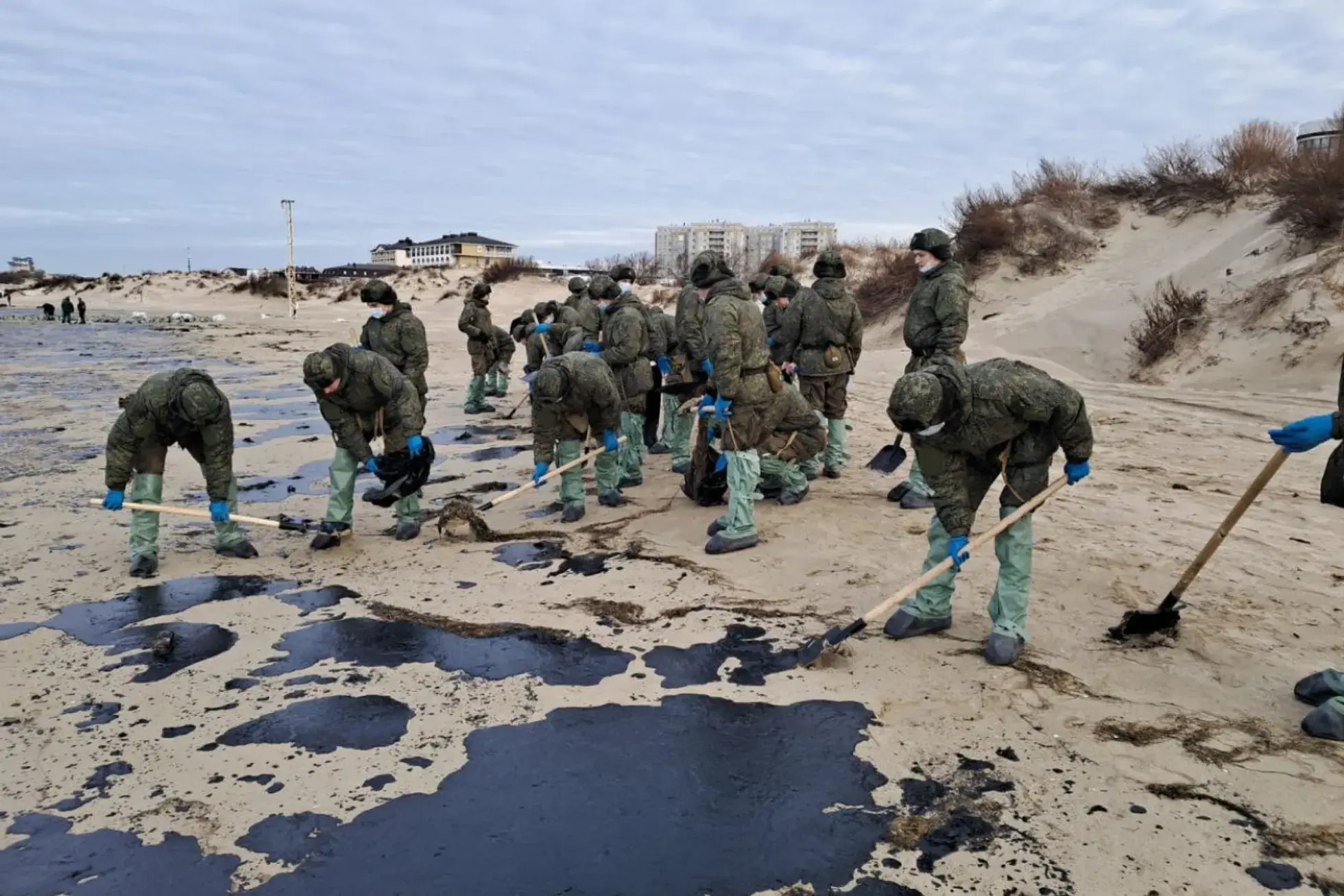
Courtesy City of Anapa
Separately, the city of Anapa has filed a claim of $2.4 million against Volgatransneft and Kama Shipping - the owner of the Volgoneft-212 - to recover the costs for the beach cleanup that followed the spills. The city administration plans to increase the claim when extra cleanup costs occur, as more washed-up waste is expected for years to come.
Experts consulted by Forbes put the estimated environmental damage from the spills at about $300 million. The tankers are insured for a maximum of about $30 million for pollution compensation, according to Alexei Kurinny, a Communist Party MP.
The lost vessels were part of a flotilla that provides bunkers for Russia's "dark fleet" near Novorossiysk, and helped transfer fuel oil to at least three U.S.-sanctioned tankers, according to Russian investigative news outlet IStories.
Russia’s Ministry of Transport has confirmed that the fuel oil aboard the tankers belonged to Rosneft, Russia's giant state oil company, which posted a profit of $14 billion in 2023.
Report: Russian Ballistic Missile Kills Four Seafarers in Odesa Port
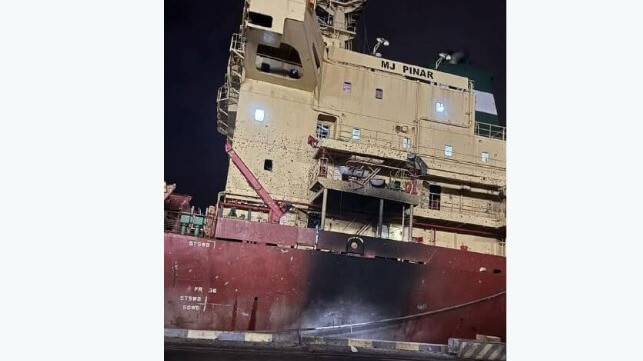
A fire was reported on the bulker MJ Pinar killing four crewmembers, injuring another crewmember and also one port employee (Telegram)
In posting on social media, Ukrainian authorities are reporting a deadly attack on the port of Odesa. It is being widely reported that four sailors aboard a Greek-managed bulker were killed during a Russian missile attack, a fifth crewmember injured, and an employee of the port company was also injured. The attack on Odesa comes as both sides have escalated their efforts on the front lines while the Trump administration continues to push for peace talks.
Hours after it was reported that Ukraine had launched a massive drone attack on Russia, sirens were warning of a missile attack against the city of Odesa this evening. According to the reports, the alarm was sounded around 2000 local time, and minutes later a large explosion was reported.
Serhiy Bratchuk of the Public Council at the Odessa OVA posted the reports online. It was later posted (but now deleted) by the Odesa Port Authority. Included with the posting is a picture of a fire-damaged bulker MJ Pinar.
The vessel which is registered in Barbados is not currently broadcasting an AIS signal. Many ships have gone dark entering the Black Sea and the ports of Ukraine. Its last signal placed the 30,465 dwt vessel at Sulina, Romania. A message to the vessel’s manager in Greece has not received a reply.
The reports indicate the vessel was on dock in Odesa loading 30,000 tons of wheat. At least one missile is reported to have struck the seawall causing extensive damage to the pier, terminal’s grain gallery, and other infrastructure. The report indicates there was a fire aboard the vessel that killed three Syrian and one Ukrainian crewmember and injured one other crewmember. The ship is reported to have a crew of 12 aboard. A port employee also aboard the vessel is reported to have been injured.
Today’s attack if confirmed could be the deadliest for seafarers in the port.
A delegation from the World Food Program was also visiting the port today. They toured the port facilities and met with officials to discuss the operations of the port and shipping corridor. The UN continues to place a high priority on food exports from Ukraine primarily to countries in Africa.
Today’s attack came the same day as it was reported that Ukrainian President Volodymyr Zelenskyy had sent a letter to Donald Trump and that the U.S. agreed to resume sharing military intelligence and shipping materials to Ukraine. Reports from the talks underway in Saudia Arabia are indicating a potential ceasefire in the three-year war. Ukraine had reportedly accepted a 30-day ceasefire proposed by the United States.
Vessels have occasionally become collateral damage during the long war with repeated reports of damage during attacks on the port. The feeder ship MSC Levante F was reported to have suffered damage at the beginning of March while it was docked in Odesa. The company later denied significant damage, but the Governor Oleh Kiper also wrote that two port employees sustained injuries in the same attack.
Houthis Reiterate Threat to Israeli Shipping Citing Lack of Aid to Gaza
Houthi spokesperson Yahya Saree in front of an image of the 2024 sabotage of the tanker Sounion
The Houthi militants reiterated their ban on shipping associated with Israel effective today, March 12, for regions including the Red Sea, Bab al-Mandeb, Gulf of Aden, and the “Arabian Seas.” The formal announcement issued on social media and in emailed messages to ship owners, operators, and trade associations followed an ultimatum issued by the group days ago complete with a slick propaganda video.
“Vessels that are wholly owned by Israeli individuals or entities, and/or sailing the Israeli flag, are prohibited from transiting through the Red Sea, the Arabian Sea, the Bab el-Mandeb Strait, and the Gulf of Aden,” the militants wrote in their message. The said that any Israeli vessels attempting to violate the ban would be subject to “military targeting.”
The group is citing the “failure to fully implement” the ceasefire agreement between Israel and Hamas. They assert that Israel is procrastinating including delays in opening the crossings into Gaza for the delivery of humanitarian aid.
“This ban will remain in effect until the crossings to the Gaza Strip are reopened and humanitarian aid, including food and medical supplies, is allowed to enter,” the Houthis declared.
Propaganda video posted by the Houthis as they reiterated their threat against Israeli shipping
The renewed threats come as the United States is pushing for more progress on the peace efforts in the region. Donald Trump on social media last week threatened Hamas if it did not immediately release all the hostages and bodies of Israelis that it is still holding.
Most of the major shipping companies however had previously said it was too soon to return to the region while the security efforts also continue. The EU renewed Operation Aspides and the command continues to cite its close protection missions for merchant vessels transiting the area. Lloyd’s List Intelligence reports in an analysis that transits through the Bal el-Mandeb remain down by more than half versus 2023.
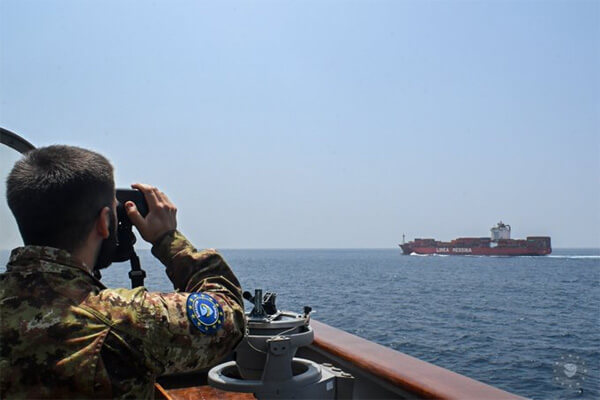
EUNAVFOR Aspides has continues its security efforts during the lull in Houthi attacks (Aspides)
Operators have also kept vessels out of the region due to the unpredictable nature of the attacks. In the past, the Houthis targeted vessels saying that the operators were supporting Israel or vessels with indirect associations with Israel. In some cases, it was believed the Houthis were using outdated information gained from the Internet.
The renewed threat comes almost three months after the group claimed its last attack on commercial shipping, the Maersk-operated containership Santa Ursula while it was transiting to Oman. The attacks had become less frequent during late 2024 although the group continued to target U.S. Navy vessels including claims of three launches against the carrier USS Harry S. Truman in the days leading up to the implementation of the ceasefire. They also continued to launch missiles toward Israel which had led to several retaliatory strikes by the Israel Defense Forces on ports and other facilities in Yemen.
Multiple Vessels Report GPS Disruption in Strait of Hormuz
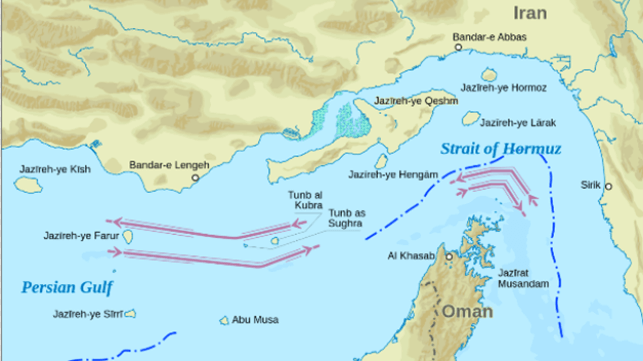
The Royal Navy's maritime security reporting arm has received multiple reports of GPS jamming in the Strait of Hormuz, a periodic hotspot for interference. Though not as frequent as it is in the Baltic, GPS disruption has occurred in the Strait before, and have previously been linked to Iranian actors.
The service's UK Maritime Trade Operations (UKMTO) office announced Monday that it has received reports from several vessels that have encountered GPS interference in the Strait of Hormuz. The disruptions lasted several hours, affected navigation systems, and required vessels to rely on traditional methods of navigation.
"Masters who experience disruption to electronic navigation systems (GPS / AIS / other PNT) anywhere within the UKMTO Voluntary Reporting Area (VRA) are requested to contact UKMTO watchkeepers," the office said in a statement.
In August 2019, amidst heightened regional tensions, the U.S. Maritime Administration warned that vessels could encounter "GPS interference, bridge-to-bridge communications spoofing, and/or other communications jamming with little to no warning." At the time, the agency also warned of VHF comms "falsely claiming to be US or coalition warships."
The 2019 jamming incident was linked to Iranian electronic warfare outposts on Abu Musa Island, located at the eastern entrance to the strait, a defense source told CNN.
Port Fees on Chinese Ships Would Hit U.S. Ag, Energy and Shipping
While businesses have been closely following the Trump administration's tariff policies, the seven-figure port fee proposal from the US Trade Representative (USTR) could have even deeper effects on American shipping interests. If adopted, Chinese-built ships - and global operators who use Chinese-built ships elsewhere - would have to pay millions of dollars for every port call in the U.S. Exporters would be required to ship an increasing percentage of their goods on U.S.-flagged tonnage, and eventually on scarce U.S.-built tonnage. This plan's steep costs could be enough to put some smaller companies out of business, drive others away from American shores, or end some categories of American exports altogether, maritime businesses and shippers warned in comments to the USTR.
ACL, the conro specialist that operates in Transatlantic trade, handles more than half of the American heavy machinery and equipment exports from New York, Baltimore and Norfolk to Europe. It is the only U.S.-headquartered carrier serving these American manufacturers on the East Coast. In a submission to the USTR, ACL explained that it went to China to buy all five of its specialized new conros because no one else would build them. In 2012, the few qualified U.S. yards said that they were booked seven years out with Navy work; Japanese yards didn't want to bid on such a small series; and Korean yards said that it wasn't worth the cost of doing a design for just five vessels. When ACL asked around in China, it received a competitive offer, and the vessels got built under class supervision in Shanghai.
If the multi-million-dollar fees went into effect, ACL said, it would make the company "totally uncompetitive versus the other carriers in the US trades," and ACL would be forced to shut down its U.S. operations. It would cease services, close its U.S. headquarters, lay off its staff and leave American shippers using foreign shipping services. Those foreign operators would become dramatically more expensive, ACL warned.
"US export container rates to Europe for a carrier with a Chinese-built fleet - now averaging $500 per 40-foot container today - would climb to around $2,500 per 40-foot overnight – a 500% increase – simply to cover the new service fee," ACL said. "American manufacturers would have less choice of carriers and face significantly higher transportation costs."
SeaPort Manatee, the largest port in Southwest Florida, noted that the port fees would likely end the U.S. operations of the regional line World Direct Shipping (WDS). WDS is a Florida-headquartered container line connecting the U.S. with Mexico, and supports about $1 billion a year in U.S. economic activity. "Cargo would be diverted from WDS vessels to trucks, resulting in 1,000 more trucks crossing the border each week, and increase congestion at Texas border crossings and increase wear/tear on U.S. highways," noted the port authority. "The proposed action is very likely to negatively impact United States supply chains . . . and negatively impact American businesses and families (e.g., lost jobs; increased cost of goods and services)."
U.S. agricultural interests are also concerned. The US Agriculture Transportation Coalition, a trade body for farmers who export goods by container, warned that the fees would "render US ag unaffordable and uncompetitive." The group believes that this would have an extreme impact on U.S. agricultural commodity exports. "Because there is ample substitute supply from other countries, it would end US ag sales to foreign markets," the association warned.
Energy Products Partners, a leading U.S. midstream firm, warned that the fees would also have a devastating impact on oil and gas exports. If the fees take effect, "there will be no ‘drill baby drill’ [and] the ‘liquid gold’ under our feet would stay in the ground," EPP warned.
The costs outlined by the USTR could also be just a starting point. Beijing could take its own actions in response, further raising costs, one established freight broker noted. "The reality is that, similar to the retaliation of U.S. trading partners to recent major tariff increases, similar fees would be imposed on U.S. ships calling Chinese ports," the broker warned.
The International Longshore and Warehouse Union (ILWU)'s Washington branch also pointed out that the extra charges could incentivize carriers to simply offload cargo outside of the United States - in Mexico or Canada - and then truck it across the border without paying the port fees. Without parallel restrictions to equalize costs at the land border, U.S. port traffic and longshore jobs could decline.
China Calls on US to Stop “Wrongdoings” Over Proposed Fees on Chinese Ships
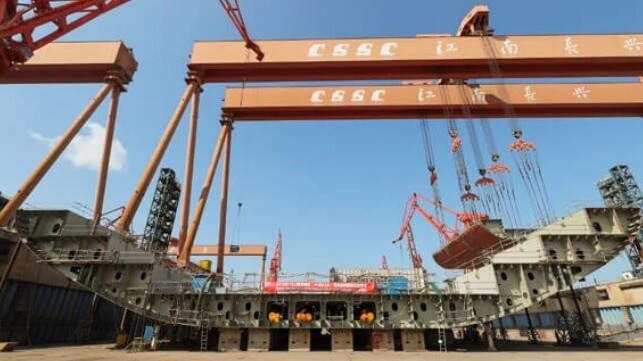
China continues to speak out against the U.S.'s targeing of its shipbuilding industry (CSSC file photo)
A spokesperson for China’s Foreign Ministry responded to a question from Reuters calling the proposed fees on Chinese-built ships “wrongdoings.” It comes as the war of words continues, and the trade war heats up after Donald Trump began imposing new tariffs.
The White House is yet to officially comment on its response to the U.S. Trade Representative’s finding that China unfairly subsidized and supported its shipbuilding industry. The report issued in January recommended actions after finding China was dominating shipbuilding through the state-owned industry and a broad system of support.
Reuters asked for comments from the Foreign Office after the news agency last week reported the Trump administration was seeking allied support for a series of fees against Chinese-built ships. It is believed the U.S. will charge a fee on any Chinese-built ship calling in U.S. ports regardless of the nationality of the shipowner. Further, the fee would be commensurate to the percentage of Chinese ships in the owner’s fleet.
“Such measures as imposing port fees and levying tariffs on cargo handling facilities hurt the U.S. itself as well as others,” Foreign Ministry spokesperson Mao Ning said during Monday’s press briefing. “The move not only hikes global maritime shipping costs and disrupts the stability of global industrial and supply chains, but also increases inflationary pressures in the U.S. and hurts the interests of American consumers and businesses.”
Industry analysts Alphaliner analyzed the global containership fleet. In its report, it says “37.8 percent of the current active containership fleet was built in Chinese shipyards.” It has been highlighted in other reports that this includes all the major carriers. MSC Mediterranean Shipping has drawn extensively on relationships with China and the Chinese leasing industry as it is building its fleet of ultra large container vessels. CMA CGM developed its large LNG-fueled ships in China and just this week Hudong-Zhonghua Shipbuilding is highlighting sea trials for a new generation of 24,000 TEU LNG-fueled containerships for CMA CGM.
The global containership order book is reported at nearly 800 vessels. Alphaliner reports that 70 percent of the orders are placed with Chinese shipyards. It notes that “out of the Top 10 shipyards in terms of vessels on order, seven are located in China.”
Chinese officials have been speaking out against the U.S. trade investigation since it was first launched in 2024. They have repeatedly said the problems with U.S. shipbuilding were long and deep-seated issues while China is using technology to advance its industry.
“The practice will ultimately fail to revitalize the U.S. shipbuilding industry,” said Mao Ning. “We urge the U.S. to respect facts and multilateral rules, and immediately stop its wrongdoings. China will take necessary measures to defend its lawful rights and interests.”
The U.S. Trade Representative’s office is currently receiving comments on its proposals. A public hearing is scheduled for March 24, which is the same day the comment period is due to close.
US takes rivalry with China to the high seas
AFP March 9, 2025 A China Coast Guard ship (top) and a Philippine supply boat were engaged in 2014 stand off in the South China Sea (AFP Photo/Jay Directo)
The United States may still have the world's most powerful navy but it seems to have realised that this is no longer sufficient to reassert US supremacy over the high seas.
If President Donald Trump's pronouncements on shipbuilding, the Panama Canal and Greenland are anything to go by, he wants to increase US sea power on several fronts -- just as China is already doing.
Beijing's expanding influence on the world's oceans is a challenge to Washington's efforts to protect its interests.
While the United States still dominates the seas militarily, it is weaker in other maritime sectors, such as merchant shipping and shipbuilding itself, analysts told AFP.
Trump told the US Congress last week that his administration would "resurrect" the country's nautical construction industry "including commercial shipbuilding and military shipbuilding".
On China, he has complained that Beijing "controls" the Panama Canal and has refused to rule out military force to wrest control of a vital strategic asset.
The president has been equally blunt about wanting to take over Greenland, a Danish territory whose untapped mineral and oil reserves he covets.
And he wants to tax any Chinese vessel that docks in US ports.
Researcher Sophie Quintin, of Portsmouth University in the UK, said Trump's approach smacked of a return to "navalism" -- a theory stressing the importance of sea power espoused by 19th-century US naval officer Alfred Mahan.
On the other hand, Trump might just be appealing to his populist voter base, the Make America Great Again (MAGA) faithful.
"It's difficult to know if it's the fruit of a real strategic reflection," said Alessio Patalano, a specialist in maritime strategy at King's College, London.
"In the end, it doesn't matter. Serving the interests of MAGA voters by restarting naval shipyards or taxing Chinese boats leads to a navalist policy."
- Chinese sea power -
In any case, China understands the importance of sea power, said Nick Childs of Britain's International Institute for Strategic Studies.
At a Paris conference last month, Childs pointed to China's rapid expansion in maritime sectors other than its own navy.
"There are the investments we've been hearing about in global ports, global maritime infrastructure and the weaponising of the fishing fleet," he said.
Washington is concerned by the expansion of Chinese shipping companies, which they see as serving the interests of the Beijing government.
"Beijing's economic control of port operations at strategic chokepoints across the world -- many of which are part of the Maritime Silk Road initiative -- pose a threat to the United States and its allies," opined US think tank the Jamestown Foundation in February.
It cited in particular two state-owned firms, COSCO and China Merchant Ports.
Beijing could also exert "significant influence" on a third, the privately owned Hutchison Port Holdings, which controls two ports on the Panama Canal, it said.
But Paul Tourret, of France's Higher Institute of Maritime Economics (ISEMAR), cautioned against too "simplistic" a reading of China's maritime policy.
"COSCO, for example, follows a financial logic. It merely delivers to the United States the goods that Americans consume," he said.
Nevertheless, pressure from Washington seems to have had some effect.
Hutchison announced last week it had agreed to sell its lucrative Panama Canal ports to a US-led consortium, although it insisted this was a "purely commercial" decision. - Gaps in US presence -
While the United States may have the world's most powerful navy, its merchant fleet is not in such good shape, said Quintin.
"US shipping companies have significantly declined and what remains of its commercial fleet is ageing," she said.
"That has repercussions for its strategic fleet," she added, referring to civilian ships used for military transport.
"Furthermore, the shipbuilding sector is in crisis."
Tourret agreed: "There's no way the US can build ships quickly."
"The problem with US shipbuilding is that they don't have the know-how of the Japanese and Koreans, and they don't have the scale of the Chinese, who churn ships out like biscuits," added Patalano.
"When Europe is one year behind on a military programme, the US is three or four years late," said a European industry source on condition of anonymity.
Trump's avowed desire to seize control of Greenland and Canada can also be viewed as a bid to regain US dominance over the seas.
Global heating is melting Arctic ice at an alarming rate, endangering natural ecosystems and contributing to further climate change.
But that melting could also open up the region to vessels -- both commercial and military -- and to oil and mineral exploration.
Those prospects have not been lost on China, Russia or the United States.
"The Arctic space will become increasingly important for power projection, especially for missile-launching submarines," said Patalano, who sees these as "an essential component of deterrence".
Here again, "the United States is lagging behind", said Quintin.
"While China is capable of deploying three icebreakers, the US Coast Guard struggles to keep its two ageing vessels in service," she said.
Continuing Resolution Puts U.S. Navy Maintenance, Recruitment at Risk
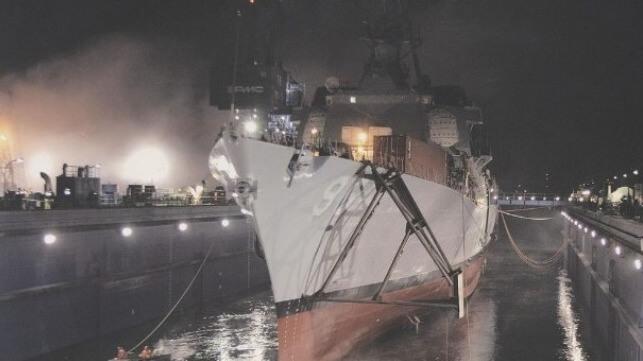
Arleigh Burke-class guided-missile destroyer USS William P. Lawrence starts a maintenance availability (USN file image)
The U.S. House of Representatives has passed a continuing resolution (CR) rather than a budget to fund the federal government for the rest of the year, leaving funding levels effectively flat across the board. Without a normal appropriations bill, the military services lack the funding to offset inflation and the authorities needed to conduct new programs. In testimony before the Senate Armed Services Committee today, Vice Chief of Naval Operations Adm. John Kilby said that the CR would have several significant effects: at a time when the Navy is working hard to maximize readiness, the flat funding of a full-year CR puts maintenance availabilities for 11 ships at risk. These yard periods would have to be pushed to next year or skipped altogether, which would create growth work and unexpected issues during the next maintenance availability.
The timing is poor for the Navy. Facing a growing challenge from China's massive fleet, and unable to compete with the PLA Navy on quantity, the service has embarked on a plan to do more with what it has. Under now-departed CNO Adm. Lisa Franchetti, the Navy set a goal to achieve 80 percent surge availability across the entire fleet, matching its targets for aircraft availability. That target remains in place under VCNO Adm. Kilby, who is performing the duties of CNO following Franchetti's dismissal.
"Our goal is to achieve and sustain an 80% combat-surge ready (CSR) posture. We began these efforts with naval aviation in 2018, improving the operational availability of tactical aircraft. We are now scaling our efforts across all aviation platforms, as well as in the surface and submarine communities," Adm. Kilby said in prepared testimony.
In addition to the effects of a CR on maintenance and readiness targets, Adm. Kilby warned that the lack of a proper budget could interfere with the service's progress on recruiting. The Navy had a serious recruiting shortfall in 2023, but made an all-out effort to turn it around and succeeded last year in hitting its numbers. Navy recruiters are outperforming targets this year, and the service is on track to reach 100 percent enlisted rating fill by the end of 2026 - so long as the CR doesn't derail the effort.
"I'm very concerned about the impact of the CR on that machine and slowing it down. We want to bring in all the people we need and bring down our gaps at sea, and a CR makes that a little more challenging," said Kilby.
The committee sought input from service leaders on what could be done to allow the armed forces to make the most of the funds they have, including more flexibility to use appropriations for new purposes. Kilby emphasized the value of budgetary flexibility to adapt to new technology and new threats - for example, to pivot funding to meet new drone and missile risks in the Red Sea. These changes are hard to do under a continuing resolution, Adm. Kilby said, so having more flexibility in the budget from the start would allow the Navy to make do more easily when a CR occurs.
Civilian DOD layoffs and an ongoing military-wide hiring freeze are a concern for the service leaders, but Kilby noted that two critical groups - public shipyard employees and the Military Sealift Command mariner pool - are exempt from these workforce reduction initiatives.
The Navy also came in for criticism for the persistent maintenance issues in the amphibious fleet, which have caused friction between the Navy and the Marine Corps for years. Just 13 out of 32 amphibs are currently available for deployment, and General Christopher J. Mahoney (USMC) testified that the current levels of amphib capacity are "not going to do it" to generate USMC warfighting capability. "We have got to get ahead of the maintenance curve, and that means years ahead," said Mahoney. Ranking member Sen. Mazie Hirono (D-HI) expressed frustration that the Navy has not solved this problem, and called the low level of amphib availability "unacceptable."
Congress Cuts Frigate and Landing Ship Programs to Fund Extra Destroyer
A brand new Arleigh Burke-class destroyer launched at Bath Iron Works (USN file image)
The House Republican caucus plans to pass a continuing resolution (CR) rather than a budget to cover the remainder of the fiscal year, a procedural option that keeps federal spending at constant levels and avoids a difficult fight over spending priorities. Overall, the proposed CR would raise defense spending by $6 billion year-on-year, roughly $16 billion below the amount needed to keep up with current levels of inflation.
The U.S. Navy has historically disliked CRs because they disrupt long-term shipbuilding and maintenance plans, which rely on a steady increase in funding levels. This one is different: it also adjusts several important line items, including an apparent cut in funding for the delayed Constellation-class frigate program.
The proposed CR sets a budget of $233 million for the Constellation-class for FY2025, a fraction of the $1.2 billion that the Navy requested this year. (The CR also includes five cost-to-complete adjustments for the frigate totaling $400 million, which will cover prior-year shipbuilding cost increases from FY2020-24.)
Also on the list of cuts is the Landing Ship Medium, a key priority for the Marine Corps and a frequent point of friction for the Navy. The line item for this intratheater transport ship has been reduced to just $30 million, down from a requested amount of $268 million.
The CR also boosts funding for destroyer construction by an unrequested $1.5 billion. The Navy typically buys two destroyers a year from GD Bath Iron Works in Maine and HII Ingalls Shipbuilding in Mississippi, and its long-term shipbuilding plan calls for orders of just under two per year through 2050.
In the past, defense officials have expressed skepticism about whether the two yards could follow through if given an order for a third destroyer a year. "We don’t see the yards being able to produce three a year. We don’t see them being able to produce two a year. And that’s just data," Pentagon comptroller Mike McCord told USNI in 2024. "Everybody’s struggling with skilled labor. Everybody’s struggling with supply chains."
Maine and Mississippi have politically powerful representation on the House and Senate Armed Services committees; Sen. Susan Collins (R-ME) told Roll Call that the funding for an extra destroyer was justified, given the strong recent performance of Arleigh Burke-class destroyers in the Red Sea.
The U.S. Navy Wants a Subsea Crawler to Defeat Sea Mines
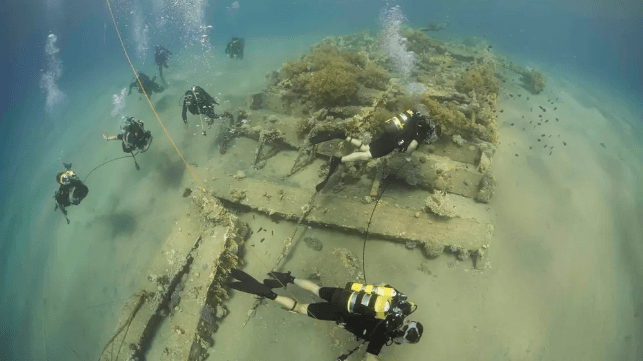
Mine clearance is a dangerous manual chore, as seen above in this exercise off Jordan (USN file image)
The U.S. Navy is interested in developing a remotely-operated robotic bottom crawler that can detect and disable sea mines and other threats on the seabed.
The service is seeking an unusual combination of exquisite attributes. The crawler must be lightweight (under 150 pounds) and must be able to swim on the surface autonomously for two nautical miles to reach offshore locations. It must be able to operate in water depths of up to 2,000 feet, and must be able to carry modular payloads of up to 100 pounds. In addition, it must be able to power itself - and any power-consuming attachments, like disruptors, short-range diagnostic sensors, and manipulators - for at least six hours at a time. One requirement is entirely unique to a mine clearance application: the device must meet specifications for low magnetic signature so that it can get to within three feet of influence-activated mines.
When submerged, the device would release a tethered float that would rise to the surface and enable a radio-frequency command link to operators on shore or in a nearby boat. Supervisory autonomy is desired but not a requirement.
"There is no commercial capability available" for an off-the-shelf solution, the Navy noted in a solicitation issued late last year.
Subsea crawlers have existed for years for research and cable-lay applications, but none have mine clearance capability. Commercially available base models include the Bayonet series by GreenSea IQ and the Geomar Viator, but these devices greatly exceed the weight limit specified by the solicitation, and lack the swimming self-deployment capability.
If successful, the crawler program may later become classified, the Navy said in its solicitation. Only U.S. firms can participate.
Australia Destroys Indonesian Fishing Boat for Illegal Shark Finning
The Australian Border Force has destroyed an Indonesian fishing boat after finding hundreds of illegally-obtained shark fins on board off the remote Northern Territory.
On February 11, the Australian authorities spotted and intercepted the Indonesian vessel fishing illegally near Croker Island, a sparsely-inhabited Aboriginal territory off the Cobourg Peninsula. Illegal fishing is a major issue in the Arafura Sea, and the ABF has allocated significant new resources to interdict and discourage Indonesian fishermen in Australia's northernmost waters.
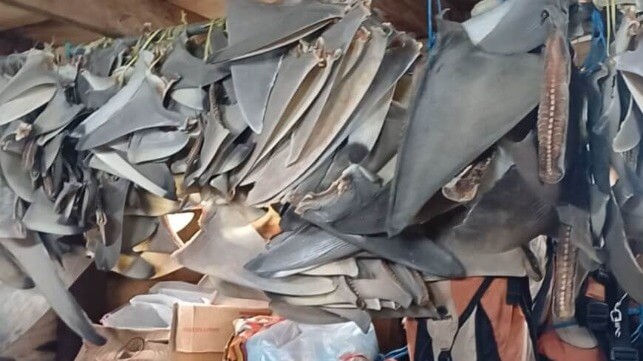
Aboard the vessel, the authorities found 339 shark fins, fishing equipment, and 200 kilos of salt for preserving illegal catch. Not present were the remaining portions of the sharks, indicative of a finning operation.
All seven fishermen aboard the vessel were arrested, and their vessel was seized and destroyed. The suspects were brought ashore in Darwin to face charges under the Fisheries Management Act, and all pleaded guilty on March 4.
The fishermen were released on an AU$1,000 undertaking to be on good behavior for at least five years. One suspect had an outstanding warrant for a prior offense, and he was sentenced to a month in prison.
"This illegal activity will not be tolerated in our waters. We will intercept you, you will lose your catch, your equipment and possibly even your vessel," said ABF Operation Lunar Commander Tracie Griffin.
The case brings the number of Indonesian fishermen prosecuted at Darwin to a total of 132 suspects in eight months. The ABF has also destroyed several other vessels, including two that were burned at sea last month.


 Courtesy City of Anapa