Tuesday, March 25, 2025

Trump puts staff at risk of Legionnaire's Disease with rush to ban remote work: report


Matthew Chapman
March 25, 2025 
RAW STORY


FILE PHOTO: U.S. President Donald Trump holds a signed executive order on tariffs on aluminum imports in the Oval Office of the White House in Washington, U.S., February 10, 2025. REUTERS/Kevin Lamarque//File Photo


President Donald Trump and his right-hand tech billionaire adviser Elon Musk demanded all remote and hybrid federal workers return to in-person office work or accept a "deferred resignation" buyout. But those forced back into the office are finding offices that aren't ready for this level of staffing, reported USA Today — to the point that the Trump administration is forcing many employees to provide their own hygiene products.

At least, that's the reality many workers are seeing at a Defense Department office at a Midwest Army base.

At that base, "supplies are so scarce that they have to bring their own toilet paper and paper towels," said the report. "To help out undermanned cleaning crews struggling to keep up with germ-riddled bathrooms and dirty workspaces, employees are told to pack up their trash and take it home with them."

But this humiliation is only the beginning of the problem for government offices that were wholly unprepared for a universal return to in-person work, the report continued.

For one thing, there's also a massive issue with parking, to the point where many are parking illegally out of desperation. They can't get proper breaks because the cafeterias aren't operational. There are also infestations of rats and cockroaches, and fears about Legionnaire's Disease, a serious type of pneumonia caused by Legionella bacteria that can be found in old buildings' ventilation systems.

This type of situation is not remotely uncommon, as previous reports find a similar situation facing government employees ordered to return to office for other agencies across the federal workforce. For example, a report earlier this month found workspace shortages at IRS offices, as workers struggle to cope with the year's tax season. And at one Federal Emergency Management Agency office, supervisors were told they may have to "flip a coin" to decide which workers get a desk that day.

Trump, for his part, has insisted that the return-to-office policy is necessary because otherwise federal workers might just go out golfing on the clock — even though, notably, he has already taken several extended golf vacations of his own in the few short months he has been back in the Oval Office.
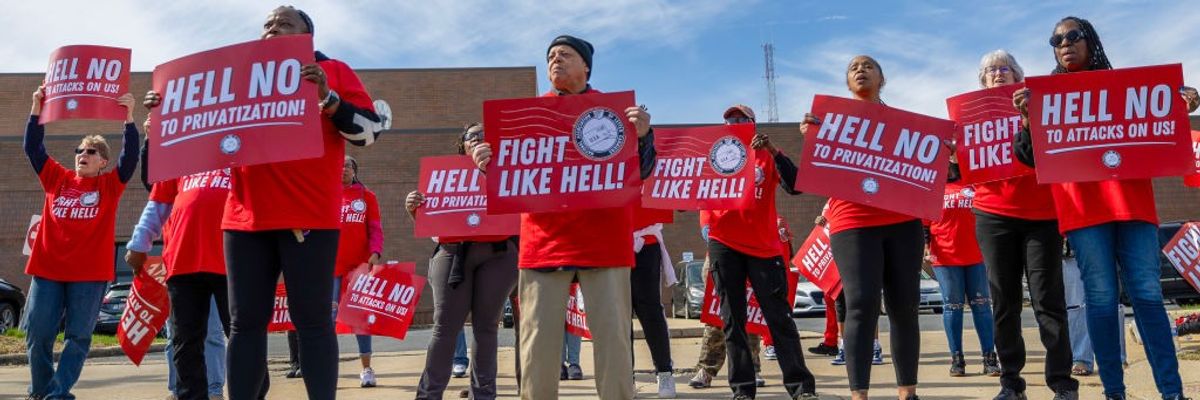
'The Privatizers Are Coming': DeJoy Is Gone, But US Postal Service Not Safe From Trump and Musk

President of the American Postal Workers Union says any effort by the Trump administration to seize control of the USPS Board of Governors "is unlawful and only makes clear their goal of breaking up and selling off the Postal Service to private corporations."


Members of the National Association of Letter Carriers and protesters gather at the United States Post Office in Washington, DC on March 23, 2025 in Washington, DC. Cuts by the Trump Administration and the Department of Government Efficiency (DOGE) could cut thousands of jobs across the United States.
Photo by Tasos Katopodis/Getty Images

Jon Queally
Mar 25, 2025
COMMON DREAMS

Postmaster General Louis DeJoy officially left office on Monday, but defenders of the U.S. Postal Service said the long-awaited departure of its reviled chief administrator does not mean the nation's public mail service is safe from the threat of privatization which they warn remains the goal of President Donald Trump and right-wing allies like Elon Musk.

"Make no mistake," said American Postal Workers Union president Mark Dimondstein in a statement, "Louis DeJoy was forced out by a presidential administration that is intent on breaking up and selling off the public Postal Service. Reports from last month made clear that the White House has plans for a hostile takeover of the Postal Service."

As Common Dreamsreported in February, President Donald Trump was accused of orchestrating an "outrageous, unlawful attack" on the USPS by plotting to terminate all the members of the Board of Governors and putting the agency under his direct control.

"Elon Musk is not about efficiency—he's about picking your pocket." —Mark Dimondstein, APWU President

Any such attack, Dimondstein said Monday, "is part of the ongoing oligarchs' coup against the vital public services our members and other public servants provide the country. We know that privatized postal services will lead to higher postage prices, and lower service quality to the public. No matter who leads the USPS, it is—and must remain—the People's Postal Service."

With DeJoy's resignation, and until the Board appoints a replacement, Deputy Postmaster General Doug Tulino will now serve as the interim Postmaster General.

In comments Tuesday morning at the National Press Club, part of a roundtable discussion with postal worker union leaders, Dimondstein acknowledged the controversial legacy of DeJoy, but added, "say what you want, it turned out he was not a privatizer," as he reiterated his belief that DeJoy was forced out by Trump, at least in part, to make way for someone more aggressive in that direction.

"The privatizers are coming," Dimonstein warned. "They are coming for you and your constitutional right to postal services."

"This is really a struggle between Wall Street and Main Street," he continued. "That's the only way that we can understand why anyone would want to privatize. A few people would gain more wealth—a few quick dollars—but the real shareholders of the Postal Service, the people of the country, would lose out with higher prices, less service, and of course the workers with less wages, benefits, and rights, which, rather than build strong communities, weakens our communities."

Postal Union Leaders roundtable

In his statement Monday, Dimondstein said:
The law is clear: the Postal Service was created by Congress as an independent agency, designed to be free from shifting political winds and dedicated solely to serving the country. The law is also clear that the Board of Governors, and it alone, is empowered to hire and fire the Postmaster General. Any attempt by this Administration to seize power from the Board of Governors is unlawful and only makes clear their goal of breaking up and selling off the Postal Service to private corporations.

The APWU calls on the Board of Governors to stand its ground and take its responsibilities seriously. The Board should move as quickly as possible to hire as the next permanent Postmaster General, someone committed to the public service mission of the USPS, who respects the rights of hardworking postal workers, and who will not break up and sell off our public Postal Service.


As part of the organized efforts this week to defend the Postal Service, coordinated actions led by the APWU and the National Association of Letter Carriers (NALC), which represents 295,00 active and retired postal workers, took place nationwide over recent days as unionized carriers and their allies demonstrated outside local post offices against plans to diminish services or moves toward privatization.

The union warns that the plan put in motion by DeJoy—who said worked hand-in-hand with Elon Musk's Department of Government Efficiency, or DOGE, to implement changes—would, in addition to massive job losses at the Postal Service:Abolish the Postal Regulatory Commission, leaving no independent regulatory authority on pricing and service;
Raise shipping costs, driving inflation higher for businesses and consumers; and
Sharply reduce service to rural America, including over 50 million addresses where private carriers often do not deliver.

As Dimondstein, citing moves by a "salivating" Wells Fargo bank about the profit potential if parcel service was taken away from the public Postal Service, warned in his remarks on Tuesday, "Elon Musk is not about efficiency—he's about picking your pocket. Turn it over to private profit, laugh all the way to the bank, and the people of this country are left holding the bag."

NALC president Brian Renfroe said DeJoy's departure marks an opportunity for the Board to appoint a new leader—one who "must continue modernizing and investing in USPS' infrastructure while maintaining quality universal service funded by postage, not taxpayer dollars."

In addition, said Renfroe, the new Postmaster General "must fundamentally believe in the agency as a public service and be committed to guaranteeing the universal service Americans rely on," a clear knock against any privatization efforts.

"We're trying to alert the public, the people of the country, that our postal services are truly in danger," Dimondstein said at a rally in Washington, D.C. on Sunday. "This is not a one-off day, this is the beginning of an ongoing fight."
Trump’s War on History Is Another Slouch Toward Authoritarianism

One of the hallmarks of fascist rule is the indoctrination of the public to believe in the “glorification of the nation.”


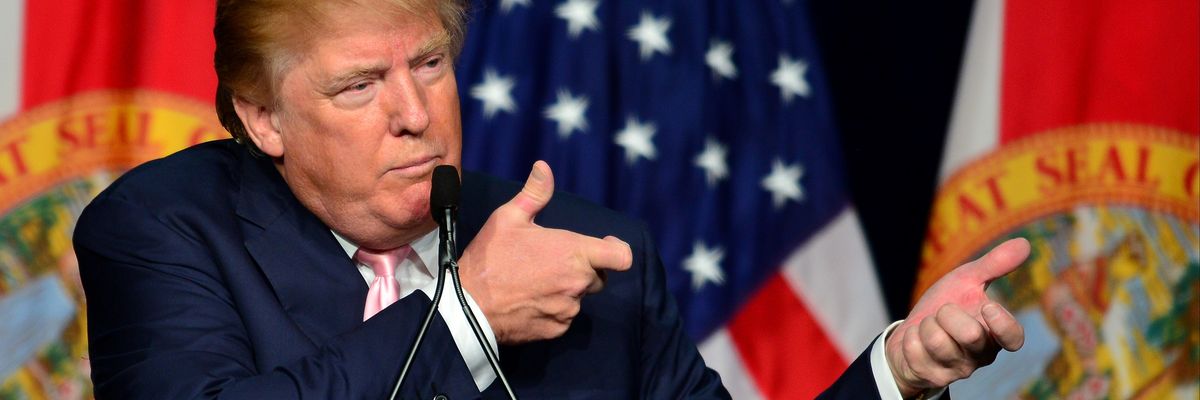
Then-Republican presidential candidate Donald J. Trump attends a campaigns rally In Florida at the Trump National Doral on October 23, 2015 in Doral, Florida.
(Photo: Johnny Louis/FilmMagic)


James Zogby
Mar 25, 2025
Common Dreams


Significant attention and concern have been generated by U.S. President Donald Trump’s early Executive Orders and actions. There has been extensive coverage of the president’s: empowering of Elon Musk’s orders to gut the federal workforce; shuttering USAID; plans to deport massive numbers of migrants and refugees, including those seeking asylum; on-again, off-again imposition of tariffs; flaunting the will of Congress by withholding appropriated funding; banning “diversity, equity, and inclusion” programs; restrictions on treatment of transgender young people; and defying court-ordered injunctions by claiming that the powers of the presidency can’t be restrained by the judiciary.

Buried in the flurry of President Trump’s Executive Orders is one that has been largely ignored, despite being potentially the most far-reaching of these presidential acts. Titled “Ending Radical Indoctrination in K-12 Schooling,” this diktat lays bare Trump’s intention to roll back the gains that have been made over the last half century by historians working to present a more accurate portrait of American and world history. Trump calls these efforts “anti-American, subversive, harmful, and false,” and demands instead that schools devote themselves to “patriotic education” that will “instill a patriotic admiration for our incredible Nation”—in other words, to teach the kind of history we learned three generations ago.

As late as the early 1960s when American schools taught “World History,” it was Eurocentric. It started with Stone Age man (in Europe), then passed onto the Greek and Roman Empires, the Holy Roman Empire, the “Dark Ages,” the emergence of the nation states of Europe, the discovery of the New World, the birth pangs that accompanied the first centuries of the United States (i.e., “fighting Indians” and a civil war over “states’ rights”), the Industrial Revolution, the two World Wars that sandwiched the Great Depression, and the challenges posed by the Soviet Union and the Cold War.

The celebrated American author Sinclair Lewis once predicted that “fascism would come to America wrapped in a flag, carrying a cross.” With these cautionary words in mind, attention must be paid to President Trump’s Executive Order.

In this narrative, the U.S. was depicted as the fulfillment of history, the conveyor of the values of freedom and democracy, and, as former Secretary of State Madeleine Albright was fond of saying, “the indispensable nation.”

There was no mention of African history or Islamic civilization. There were just four paragraphs devoted to China, which we were told was “opened up to the West” by Marco Polo. And the only mention of Arabs was in a short section on the ways nomadic peoples were forced to adapt to living under harsh conditions, including a few paragraphs each on the Arab bedouin of the desert and the Laplanders of the frozen tundra of Northern Europe.

American history was distorted and romanticized. Slavery was given short shrift as was the genocide and land theft committed against the Indigenous peoples of North America. This is what we were taught.

Things changed in the 1960s as a result of the cultural revolution in America that was prompted by the civil rights and then anti-Vietnam War movements. In their wake, there was the blossoming of other social and political movements, including women’s liberation and concern for the environment. The expanding consciousness inspired by this period of challenge and change led to a reexamination of American history and our place in the world. And with this came a focus on Black history, Native American history, women’s history, and an expansion of the writing and teaching of world history to include the perspectives and stories of peoples who had previously been ignored. This was not an effort to create multiple separate histories, but to ensure that future generations would benefit from learning a more complete and integrated human history.

Of course, there was pushback by conservatives who wanted to restore the mythologies of the past. It will be recalled that President Trump fired his opening salvo in this war on history during his first term when he denounced The New York Times’ stunning “1619 Project.” That massive undertaking put in focus the role of the conquering European settlers in America as they committed crimes of genocide against the Indigenous peoples they encountered and then introduced the massive and enormously destructive enterprise of slavery in the New World and its enduring legacy. Trump countered this effort with his “1776 Project” that sought to do nothing more than to restate the myth of America, shorn of its dark underside.

Trump’s new Executive Order is the latest iteration of this war on history. After decrying the “radical, anti-Americanism” that he claims teaches that the United States is “fundamentally racist, sexist, or otherwise discriminatory,” he calls for “an accurate, honest, unifying, and ennobling characterization of America’s founding” and “a celebration of America’s greatness and history.”

Trump goes further by calling for “Reestablishing the President’s Advisory 1776 Commission and Promoting Patriotic Education” that will be charged with sponsoring programs to encourage patriotic learning and glorification of America’s battles and war heroes. The order further requires that all educational institutions receiving federal funds must hold specific patriotic educational programs, and that “relevant agencies of government” shall monitor compliance with this requirement. In other words, do what we demand or lose your funding.

None of this is benign. One of the hallmarks of fascist authoritarian rule is the indoctrination of the public to believe in the “glorification of the nation.” The celebrated American author Sinclair Lewis once predicted that “fascism would come to America wrapped in a flag, carrying a cross.” With these cautionary words in mind, attention must be paid to President Trump’s Executive Order. It is a worrisome step down this dangerous path.


Our work is licensed under Creative Commons (CC BY-NC-ND 3.0). Feel free to republish and share widely.

James Zogby
Dr. James J. Zogby is the author of Arab Voices (2010) and the founder and president of the Arab American Institute (AAI), a Washington, D.C.-based organization which serves as the political and policy research arm of the Arab American community. Since 1985, Dr. Zogby and AAI have led Arab American efforts to secure political empowerment in the U.S. Through voter registration, education and mobilization, AAI has moved Arab Americans into the political mainstream. Dr. Zogby has also been personally active in U.S. politics for many years; in 1984 and 1988 he served as Deputy Campaign manager and Senior Advisor to the Jesse Jackson Presidential campaign. In 1988, he led the first ever debate on Palestinian statehood at that year's Democratic convention in Atlanta, GA. In 2000, 2008, and 2016 he served as an advisor to the Gore, Obama, and Sanders presidential campaigns.
Full Bio >


Canada Is Poised to Become a Partner in the US Assault on Immigrants

Canada is rapidly militarizing its borders as a sweetener deal to placate Trump and dodge the worst of his tariffs.
March 23, 2025  

Royal Canadian Mounted Police Corporal Keven Rouleau patrols along the Canada-U.S. border, near the border town of Stanstead, Quebec, Canada, on January 30, 2025.DAPHNE LEMELIN/AFP via Getty Images

The Trump administration promises to double down on what it says will be the fiercest deportation program in U.S. history. Judging by history and rhetoric, the administration has no qualms about stripping kids from their parents and spouses from their partners.

Many asylum seekers in the U.S., their advocates and liberal mainstream media have mused that some cornered refugees may flee up north to “tolerant” Canada, and find reprieve there.

It happened before in 2017, during Donald Trump’s first presidency. Fifty thousand foreign asylum seekers residing in the U.S. suddenly fled north to Canada. They benefited from a substantive exception (what anti-immigrant forces decried as a “loophole”) within the so-called Safe Third Country Agreement (STCA), a law signed in 2002 and implemented in 2004. The agreement sought to ensure that most people who enter Canada via the U.S. cannot claim asylum in Canada, and vice versa. The exception stipulated that the STCA only applied at official land border crossings, so asylum seekers who crossed into Canada through unofficial sites of entry were not subject to the STCA and therefore were still able to make a claim for refugee protection in Canada.

Following a surge of unofficial border crossings in 2017, Canada and the U.S. officially expanded the scope of the STCA in 2023 to remove this exception, making it more difficult for asylum seekers to claim protection in Canada.

Now, the exceptions to the STCA are much narrower: To escape its application, asylum seekers must show they already have family members in Canada who are citizens or permanent residents, or that they are unaccompanied minors, or that they hold a valid work or study permit or that they could face the death penalty in the U.S. if returned.

Trump’s Aggression Against Canada Is Boosting Liberal Party’s Election Chances
Annexation is implausible because Canadians know just how much the US has shredded its own social safety net. By Sasha Abramsky , Truthout February 22, 2025

Desperate asylum seekers from the U.S. cannot safely assume that a “welcoming” Canada perpetually awaits them. The idea of Canada as a “safe haven” for asylum seekers is a myth cultivated for far too long.

The fallacy of a welcoming Canada, an exceptional Canada that has a better moral compass than the U.S., is just that: a fallacy.

Justin Trudeau, the nation’s former prime minister who famously tweeted to the world in January 2017 that, “To those fleeing persecution, terror & war, Canadians will welcome you,” and the Liberal Party he led until recently are chief proponents of that fallacy.

In reality, Canada could be on course to have a “Trump Lite” government when its federal elections occur, by law, before October 20. Pollsters currently show the Liberals, now led by newly sworn-in Canadian Prime Minister Mark Carney, neck and neck with the Conservatives, though Trump’s trade war threats are boosting the chances of Carney’s party.


Canadian politicians are pretending to denounce the racist, anti-refugee dog whistles, while at the same time enacting new anti-immigrant laws.

The fiery, anti-refugee Conservative Party of Canada is refining its anti-immigrant rhetoric, emboldened by crass talk from Trump’s GOP across the border. Pierre Poilievre, the leader of the Conservatives and candidate to become Canada’s next prime minister, has lambasted refugees crossing from the U.S. as “illegals.”

Should he win, his first business of the day will likely be to curtail a range of Canada’s refugee intake policies. Already, Canada has scrapped the popular grandparents’ permanent resident visa sponsorship program, which allowed Canadian permanent residents and citizens to sponsor their non-Canadian parents to relocate to Canada as permanent residents. In 2024, when a populist outcry linking “too much immigration” with Canada’s strained public services got hot, Trudeau’s government removed that specific visa.

Refugees fleeing Trump’s immigrant crackdowns up north to Canada can expect swift detentions and pushbacks into the U.S. by Canada whether Poilievre wins or Carney’s party continues in power.

But it is simplistic to blame Canada’s opportunistic politicians alone for anti-refugee rhetoric. A growing mass of ordinary Canadians themselves are getting hostile to asylum seekers coming from the U.S. or elsewhere.

As the cost of living crisis rocks Canada, recent surveys have revealed that the majority of Canadians are now significantly opposed to more immigration and refugee intakes. They demand that the door be shut. Lots of ordinary Canadians wrongly believe that refugees are the reason why the country is facing a massive shortage of housing — 300,000 units for the 2024-2026 period. Hate marches are cropping up in Canadian cities with cowardly protesters making newcomers scapegoats for the government’s incompetence in housing, health care and wage growth.

Canadian politicians on both sides of the spectrum are pretending to denounce the racist, anti-refugee dog whistles, while at the same time enacting new anti-immigrant laws, such as slashing visas for students and skilled immigrants. For example, David McGuinty, the Liberal lawmaker who represents my constituency in Ontario, and who doubles as the public safety minister, is now a regular visitor to Washington, on pleading trips to convince the Trump administration that Canada is serious about militarizing its border.

Trump has publicly groaned that Canada is a bad “abuser,” taking advantage of the U.S. to enjoy a trade surplus while allowing drugs and undocumented immigrants over the border into the U.S. Of course, that’s a plain lie as per available data.

This is bad news for refugees thinking of heading up north. Canada is rapidly stiffening its borders with a high-tech arsenal as a sweetener deal to placate Trump and dodge his tariffs. Though it frames itself as a tougher alternative more ready to take on Trump’s hostile threats of a trade war and even annexation, the Conservative Party of Canada has gone out of its way to massage the U.S. president. It promises to activate all sorts of border drones, sensors and Black Hawk helicopters as part of a package to soothe Trump’s fury. “Send Canadian Forces troops, helicopters & surveillance to the border now,” yapped Poilievre in February, calling to “put Canada First.” It is unclear though whether Canada will source the border securitization gear from U.S. companies, considering how Trump’s tariffs on Canada have gravely soured business relations on either side.

If this Conservative vision becomes a reality, refugees from the U.S. who show up at Canada’s border fleeing Trump’s administration will likely be arrested, thrust back into the hands of U.S. border czars and deported to their home countries.

This article is licensed under Creative Commons (CC BY-NC-ND 4.0), and you are free to share and republish under the terms of the license.

Ray Mwareya is the 2017 recipient of the United Nations Correspondents Association Media Prize.
IRS, ICE Near Deal to Share Confidential Tax Data on Undocumented Immigrants

"No undocumented will trust the IRS ever again, and so they'll stop paying taxes," said one journalist. "And that was a pretty sweet deal for the U.S., since they did pay their fair share—billions of dollars each year."


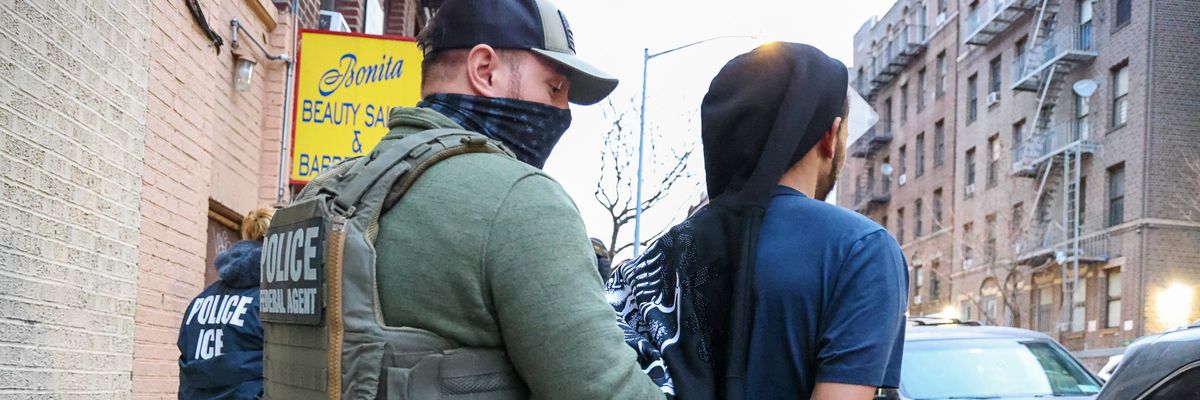
Law enforcement and immigration agents arrest a man on January 28, 2025 in New York City.
(Photo: U.S. Immigration and Customs Enforcement via Getty Images)


Julia Conley
Mar 24, 2025
COMMON DREAMS


Undocumented immigrants, who contribute nearly $100 billion in taxes each year and help fund benefits like Social Security and Medicare while remaining ineligible to receive them, are expected to soon lose the privacy afforded to them by a long-standing Internal Revenue Service policy as the IRS nears a deal with the Trump administration to help with immigration enforcement.


The IRS and Immigration and Customs Enforcement are reportedly closing in on an agreement under which Homeland Security Secretary Kristi Noem and acting ICE Director Todd Lyons could request taxpayer data, including names and addresses, of undocumented immigrants who are being investigated for violating immigration laws in order to help officials locate them to carry out deportations.

The Washington Postreported Saturday that after weeks of negotiations, the Trump administration is close to finalizing the deal in an effort to speed up its mass deportation agenda, under which hundreds of immigrants have been rounded up and sent to be detained in El Salvador despite a court order prohibiting their deportation. ICE deported 11,000 immigrants last month, with people who were only accused of committing civil immigration offenses targeted despite Trump's claims that people who had committed violent crimes would be targeted for deportation.

The IRS deal represents "a shocking breach of trust," said former Department of Homeland Security (DHS) official Juliette Kayyem.

The former IRS commissioner, Doug O'Donnell, refused to hand over taxpayer data when the administration requested it last month, and resigned shortly after. Melanie Krause, who replaced O'Donnell as acting commissioner, "quickly signaled an interest in collaborating with Homeland Security," according to the Post, and has met several times with DHS and Treasury officials.

Two immigrant rights groups, Centro de Trabajadores Unidos and Immigrant Solidarity Dupage, sued the IRS earlier this month to stop the agency from releasing taxpayer data to ICE and DHS, but last week the U.S. District Court for the District of Columbia refused to issue a temporary restraining order "after the IRS represented that information had not yet been released," according to government watchdog Public Citizen, which represented the plaintiffs.

"Attempts by the Trump administration to gain access to the confidential taxpayer databases to engage in mass removal of workers would violate the tax law that protects the privacy of all taxpayers and undermine the protections promised to every taxpayer who files tax returns with the IRS," said Nandan Joshi, an attorney with Public Citizen Litigation Group. "Attempting to gain access to personal and confidential taxpayer information crosses a line that Congress put into place after [former President] Richard Nixon used tax records to go after his enemies during Watergate."

Joshi said the IRS must disclose the terms of its "unprecedented information sharing agreement."

"The administration's desire to speed up their deportation agenda does not justify jettisoning decades of taxpayer protections," he said. "If this deal is being negotiated in good faith, the government should not need to keep it secret."

Matthew Soerens, vice president of advocacy and policy for World Relief, a Christian humanitarian group, said the group has long assured undocumented immigrant communities that people can file and pay their taxes without fear of being targeted by immigration authorities "because the IRS explicitly promised they won't talk to ICE."

Under the proposed deal between the IRS and ICE, said journalist Rafael Salido, no undocumented immigrant "will trust the IRS ever again, and so they'll stop paying taxes."


The administration's "attempt to hijack confidential taxpayer data for immigration enforcement in the middle of tax season is not only disturbing and unprecedented, it is reckless," said Kevin Herrera, legal director of Raise the Floor Alliance, which is also representing the plaintiffs in the lawsuit against the IRS.

Undocumented immigrants who file their taxes with individual taxpayer identification numbers "rely on legal protection of their private information to feel safe paying into programs like Social Security, Medicare, and thousands of other essential government services that all Americans use," said Herrera. "Without the assurance of privacy, our entire tax system will be eroded. We will not be idle while our communities are under attack. We will continue to seek judicial intervention and use every tool at our disposal to stop this administration's campaign of prejudice and terror."


ICE wants to deport 21 year-old green card holder because of her 'protesting'


Image: Shutterstock

Carl Gibson
March 25, 2025
ALTERNET

Agents with U.S. Immigration and Customs Enforcement (ICE) recently attempted to arrest and deport a 21 year-old legal permanent resident who has been in the United States since she was a child. She's now suing President Donald Trump's administration over the attempted arrest.

The New York Times reported Monday that Yunseo Chung, whose family emigrated to the U.S. when she was seven years old, is suing Trump and other top administration officials like Secretary of State Marco Rubio, Attorney General Pam Bondi and Homeland Security Secretary Kristi Noem, among others after federal agents raided her Columbia University dormitory on March 13. The lawsuit describes how ICE agents "executed search warrants" between 9 PM and 10 PM under the so-called "harboring" statute, looking for documents regarding her affiliation with Columbia, lease agreements and any immigration paperwork.

Attorneys for Chung, who was a valedictorian at her high school, argue that the warrant was obtained under false pretenses and that Chung was being singled out for her pro-Palestinian activism. They pointed to one revealing remark from an employee of Homeland Security Investigations (a sub-agency within ICE) in which Chung was told the State Department was seeking to revoke her green card "due to the situation with the protesting."

Chung's attorneys also revealed in the lawsuit that Perry Carbone, who is an assistant U.S. attorney for the Southern District of New York, said that the State Department was revoking Chung's visa. When Chung's lawyer told Carbone that she was a legal permanent resident with a green card, Carbone responded: "The secretary of state has revoked that, too." Carbone was apparently stonewalled when Chung's legal counsel informed him that Rubio didn't have the authority to unilaterally revoke a green card.

Monday's lawsuit against the Trump administration comes not long after Columbia University graduate student Mahmoud Khalil — who is married to a U.S. citizen — was arrested and put in deportation proceedings without being booked on any charges. Khalil, who was born in Syria, was a prominent figure in last year's pro-Palestinian demonstrations on Columbia's campus. Masked ICE agents also recently arrested Dr. Badar Suri Khan, who is a postgraduate student at Georgetown University and an Indian national legally in the U.S. on a student visa, and placed him in deportation proceedings.

Both Khalill and Khan are being detained under a statute that allows for the detention of noncitizens if the government believes their presence could constitute a threat to the administration's foreign policy. Chung argued in her lawsuit that her arrest, as well as the arrests of Khalil and Khan, were in retaliation for their pro-Palestinian activism.

"Officials at the highest levels of the federal government have made clear that they intend to use immigration enforcement to punish noncitizens who speak out in support of Palestinians and Palestinian rights, or who are perceived to have engaged in such speech," the lawsuit read. "Some opponents of these protest activities, including President Donald J. Trump, frequently mischaracterize peaceful protest and any speech in favor of Palestinian rights as inherently supportive of Hamas or terrorism and anti-Semitic."

Click here to read the Times' report in full (subscription required), 

and click here to read Chung's lawsuit.
Another Columbia Protester Targeted for Deportation Sues Trump

One of Yunseo Chung's attorneys said that the Trump administration's "efforts to punish and suppress speech it disagrees with smack of McCarthyism."


Yunseo Chung sued U.S. President Donald Trump and other administration officials for trying to deport her.
(Photo: CLEAR via The New York Times)

Jessica Corbett
Mar 24, 2025
COMMON DREAMS

Yunseo Chung, a junior at Columbia University, sued U.S. President Donald Trump and other top officials in the Southern District of New York on Monday, challenging "the government's shocking overreach in seeking to deport a college student... who is a lawful permanent resident of this country, because of her protected speech."

The 21-year-old, who moved from South Korea to the United States with her family at age 7, participated in some student protests on Columbia's campus "related to Israel's military campaign in Gaza and the devastating toll it has taken on Palestinian civilians," states the complaint. "Chung has not made public statements to the press or otherwise assumed a high-profile role in these protests. She was, rather, one of a large group of college students raising, expressing, and discussing shared concerns."

Earlier this month, she was arrested by the New York Police Department at a student sit-in "to protest what she believed to be the excessive punishments meted out by the Columbia administration to student protesters facing campus disciplinary proceedings," the document details. "Mere days later... the federal government began a series of unlawful efforts to arrest, detain, and remove Ms. Chung from the country because of her protected speech."

The suit asserts that Immigration and Customs Enforcement's (ICE) "shocking actions against Ms. Chung form part of a larger pattern of attempted U.S. government repression of constitutionally protected protest activity and other forms of speech," specifically, "university students who speak out in solidarity with Palestinians and who are critical of the Israeli government's ongoing military campaign in Gaza or the pro-Israeli policies of the U.S. government and other U.S. institutions."

Professors at other U.S. universities called the Trump administration's targeting of Chung " frightening" and "absolutely chilling to free speech."


In addition to Trump, Chung is suing Secretary of State Marco Rubio, U.S. Attorney General Pam Bondi, Homeland Security Secretary Kristi Noem, acting ICE Director Todd Lyons, and William Joyce, head of ICE's field office in New York. Her lawyers are seeking a temporary restraining order "barring the government from detaining her based on her protected speech and in the absence of independent, legitimate grounds."

Naz Ahmad, one of Chung's lawyers and co-director of Creating Law Enforcement Accountability & Responsibility (CLEAR), toldThe New York Times that the Trump administration's "efforts to punish and suppress speech it disagrees with smack of McCarthyism."

"Like many thousands of students nationwide, Yunseo raised her voice against what is happening in Gaza and in support of fellow students facing unfair discipline," Ahmad added. "It can't be the case that a straight-A student who has lived here most of her life can be whisked away and potentially deported, all because she dares to speak up."

The newspaper noted how Chung's case resembles that of Mahmoud Khalil, a permanent resident arrested earlier this month after helping lead protests at Columbia, where he finished graduate studies last year:
On March 10, Perry Carbone, a high-ranking lawyer in the federal prosecutor's office, told Ms. Ahmad, Ms. Chung's attorney, that the secretary of state, Mr. Rubio, had revoked Ms. Chung's visa. Ms. Ahmad responded that Ms. Chung was not in the country on a visa and was a permanent resident. According to the lawsuit, Mr. Carbone responded that Mr. Rubio had "revoked that" as well.

The conversation echoed an exchange between Mr. Khalil's lawyers and the immigration agents who arrested him and who did not initially appear to be aware of his residency status.

After his arrest, Mr. Khalil was swiftly transferred, first to New Jersey and ultimately to Louisiana, where he has been detained since. The statute that the Trump administration used to justify his detention and Ms. Chung's potential deportation says that the secretary of state can move against noncitizens whose presence he has reasonable grounds to believe threatens the country's foreign policy agenda. Homeland security officials have since added other allegations against Mr. Khalil.

Chung and Khalil, an Algerian citizen of Palestinian descent, aren't the only critics of Israel's assault on Gaza targeted by the administration. As Common Dreamsreported last week, masked immigration authorities "abducted"Badar Khan Suri, an Indian national and Georgetown University postdoctoral fellow on a student visa. A U.S. Department of Homeland Security (DHS) spokesperson said Rubio determined Suri's "activities and presence" in the United States "rendered him deportable."

Chung's complaint points to the cases of Khalil, Suri, Columbia graduate student Ranjani SrinivasanLeqaa Kordia, and Cornell University doctoral student Momodou Taal. The American-Arab Anti-Discrimination Committee earlier this month sued the president, Noem, and DHS on behalf of Taal, Cornell doctoral student Sriram Parasurama, and professor Mukoma Wa NgÅ©gÄ© over "the Trump administration's unconstitutional campaign against free speech."


California couple deported after 35 years in the US. Three daughters stunned

Story by Io Dodds
 • March 25, 2024 
THE INDEPENDENT UK


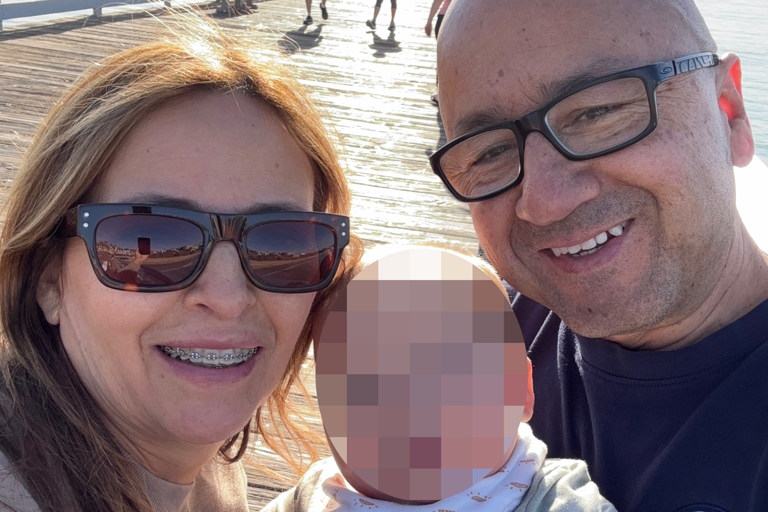
Gladys and Nelson Gonzalez© Gonzalez family

Two undocumented immigrants with no criminal history after coming to America and three U.S.-born children have been deported after 35 years living in California.

Gladys Gonzales, 55, and Nelson Gonzalez, 59, from Laguna Niguel in the hills south of Los Angeles, were arrested during one of their routine check-ins with U.S. Immigration Customs and Enforcement (ICE) on February 21 and detained for three and a half weeks before finally arriving in their native Colombia on March 18.

In a post on GoFundMe, the couple's three adult daughters — who are reportedly all U.S. citizens — said their parents never broke the law after arriving in the U.S. or missed an appointment with immigration authorities.

Remaining in the U.S. without authorization is a civil infraction, not a crime, whereas crossing the border without authorization is a criminal misdemeanor.

"This sudden occurrence has left us in shock," wrote the daughters. "For nearly four decades, they have built a life here — raising three daughters, giving back to their community, and recently welcoming their first grandchild.

"Now, they are being treated as criminals, held in detention centers, and facing deportation. This cruel and unjust situation has shattered our family emotionally and financially.

"Every day they remain detained is another stolen from their family, community, and their home."

A spokesperson for ICE confirmed the details of the case to The Independent, including that the couple had no criminal history.

The agency said that both people had entered the country in November 1989 near San Ysidro, California, and had ultimately "exhausted all legal options to remain in the U.S."

The case was first reported by The Orange County Register.

It appears to be yet another example of the Trump administration's sweeping crackdown on immigration, which has reportedly targeted not only violent criminals but permanent residents, backpackers, visiting academics, asylum seekers, pro-Palestinian activists with green cards, and undocumented immigrants with no criminal record.

Officials have invoked an 18th-century wartime law to deport hundreds of Venezuelan immigrants to El Salvador without standard legal procedures, apparently in defiance of a court order, the judge in the case has indicated

Gladys and Nelson Gonzalez came to the U.S. during a period of sustained violence and terrorism in Colombia, as the government fought a two-front war against drug cartels and left-wing guerillas.

According to ICE, Nelson Gonzalez filed for asylum in 1992 but his case was closed in 1998 after he "failed to attend an interview.”

The agency said that both Gonzalezes agreed to leave the country voluntarily in 2000, but then sought a legal way to remain through various courts and appeals processes over the next 21 years, until finally "exhaust[ing] all legal options" in August 2021.

ICE declined to say whether and on what basis the Gonzalezes were permitted to stay after that. But historically, many undocumented immigrants subject to deportation have been allowed to remain as long as they meet certain conditions and check in regularly with ICE.

This can be due to humanitarian reasons, health reasons, or simply being a low priority for removal.

The Independent has always had a global perspective. Built on a firm foundation of superb international reporting and analysis, The Independent now enjoys a reach that was inconceivable when it was launched as an upstart player in the British news industry. For the first time since the end of the Second World War, and across the world, pluralism, reason, a progressive and humanitarian agenda, and internationalism – Independent values – are under threat. Yet we, The Independent, continue to grow.


Canada, Europe Issue Travel Advisories After Tourists Detained in US

Countries have advised transgender and nonbinary travelers to exercise additional caution when planning trips to the US
.
Truthout
March 24, 2025

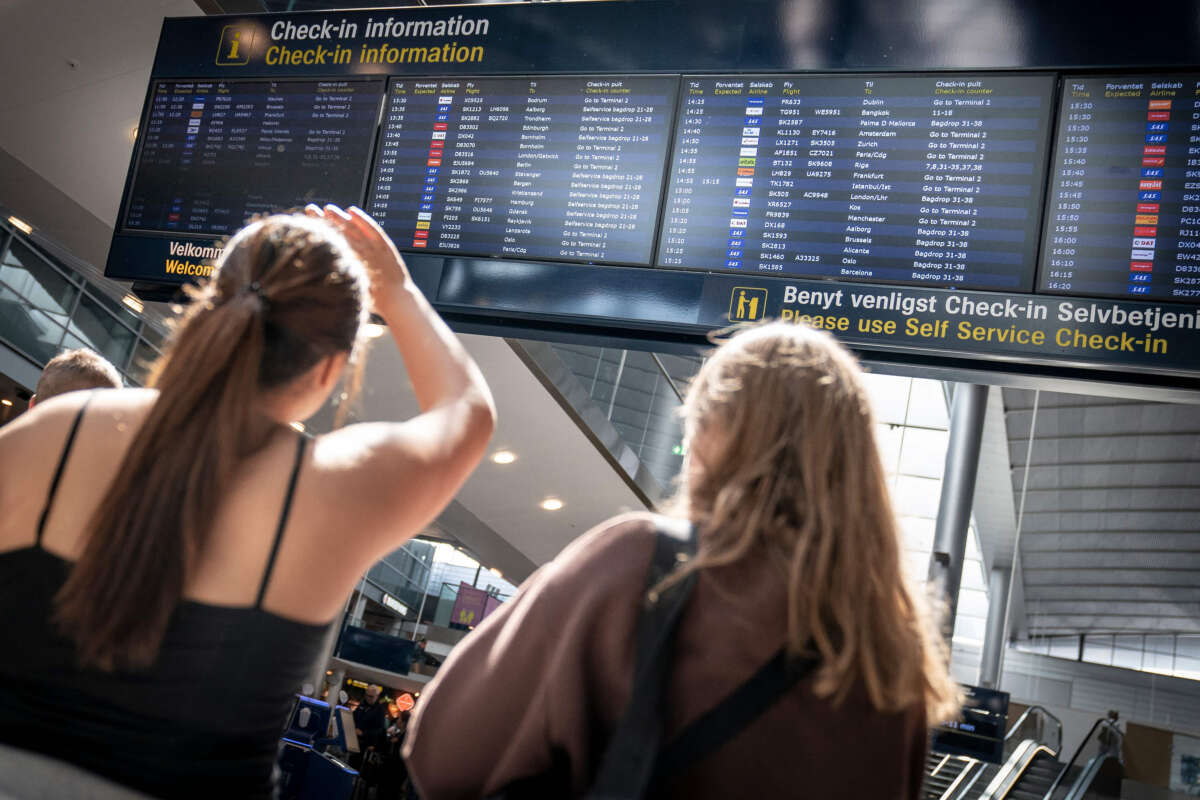
Passengers are seen at Copenhagen Airport in Denmark on July 19, 2022.Mads Claus Rasmussen / Ritzau Scanpix / AFP via Getty Images


Truthout is an indispensable resource for activists, movement leaders and workers everywhere. Please make this work possible with a quick donation.

Amid President Donald Trump’s crackdown on U.S. immigration, Canada and several European countries have issued travel advisories urging their citizens to closely follow the U.S.’s entry rules, citing recent detentions and deportations.

“We have seen too many stories of citizens being pulled out of airport lines, and being fingerprinted and deported, as if they were criminals. Citizens being kidnapped to illegal detention by ICE…this is not the actions of a Democratic nation,” said Charlie Angus, a leader of Canada’s New Democratic Party.

While the exact number of travelers from Europe and Canada who have been detained or deported by U.S. immigration authorities remains unknown, several cases have made headlines. German tourist Lucas Sielaff was detained for 16 days after returning from a trip to Mexico. “Nobody is safe there anymore to come to America as a tourist,” said Sielaff, who was on a 90-day U.S. tourist permit and engaged to an American citizen.

Jessica Brösche, another German tourist, was held for over six weeks, eight days of which were in solitary confinement. According to her friend, Brösche said ICE detention “was like a horror movie.”

“They were screaming in all different rooms. After nine days, she said she went so insane that she started punching the walls and then she’s got blood on her knuckles,” her friend said.

In other cases, a British woman was held for three weeks in what her family described as “horrendous conditions” due to a visa error, and Canadian actor Jasmine Mooney was reportedly detained for nearly two weeks under conditions her mother called “inhumane,” after trying to cross the Mexico-U.S. border with incomplete visa documentation.

“There was no explanation, no warning. One minute, I was in an immigration office talking to an officer about my work visa, which had been approved months before and allowed me, a Canadian, to work in the U.S.,” Mooney wrote for The Guardian. “The next, I was told to put my hands against the wall, and patted down like a criminal before being sent to an ICE detention center without the chance to talk to a lawyer.” Mooney was confined to a bare concrete cell with no natural light, constant fluorescent lighting, no blankets, and restricted bathroom access.

Other travelers have been denied entry at the border, including a French scientist whose electronic devices contained messages criticizing President Donald Trump. This has prompted U.S. universities, such as Brown, Columbia, Cornell, and UC Berkeley, to advise students not to leave the country for spring break.

“There is a strong chance that upon trying to reenter the country, [student protesters] are stopped in the airport and detained for their activism,” said UC Berkeley student Cole Stanton. “The general advice is to not go unless you absolutely have to.”

These warnings follow recent incidents involving activists detained by immigration authorities, including Mahmoud Khalil, a Palestinian green card holder married to a U.S. citizen, and Badar Khan Suri, a Georgetown University fellow on an employer-sponsored visa who is married to a Palestinian and has publicly condemned Israel’s genocide in Gaza.

Amid fears of deportation and detention sparked by increased immigration crackdowns — including news of a possible U.S. travel ban targeting several countries, including Afghanistan, Haiti, Iraq, Iran and Lebanon — the Trump administration’s attack on transgender people is also raising concerns among international travelers.

“You should avoid non-essential travel to the United States… Trans people who still may need to travel to, transit through or immigrate to the United States should exercise a very high degree of caution,” Celeste Trianon, a transfeminine East Asian-Canadian jurist, recently warned.

Denmark, Finland, and Germany have specifically advised transgender and nonbinary travelers to exercise additional caution when planning trips to the United States. Danish officials now recommend contacting the U.S. Embassy before travel, and Finland recently warned transgender residents that if their “current gender as recorded in their passport differs from the gender they were assigned at birth, U.S. authorities may deny entry.”

These warnings come in response to several anti-trans Trump administration directives, including the rollback of a U.S. State Department policy that previously allowed transgender, intersex, and nonbinary people to update their passports with the gender marker “X,” as well as a travel ban targeting transgender athletes
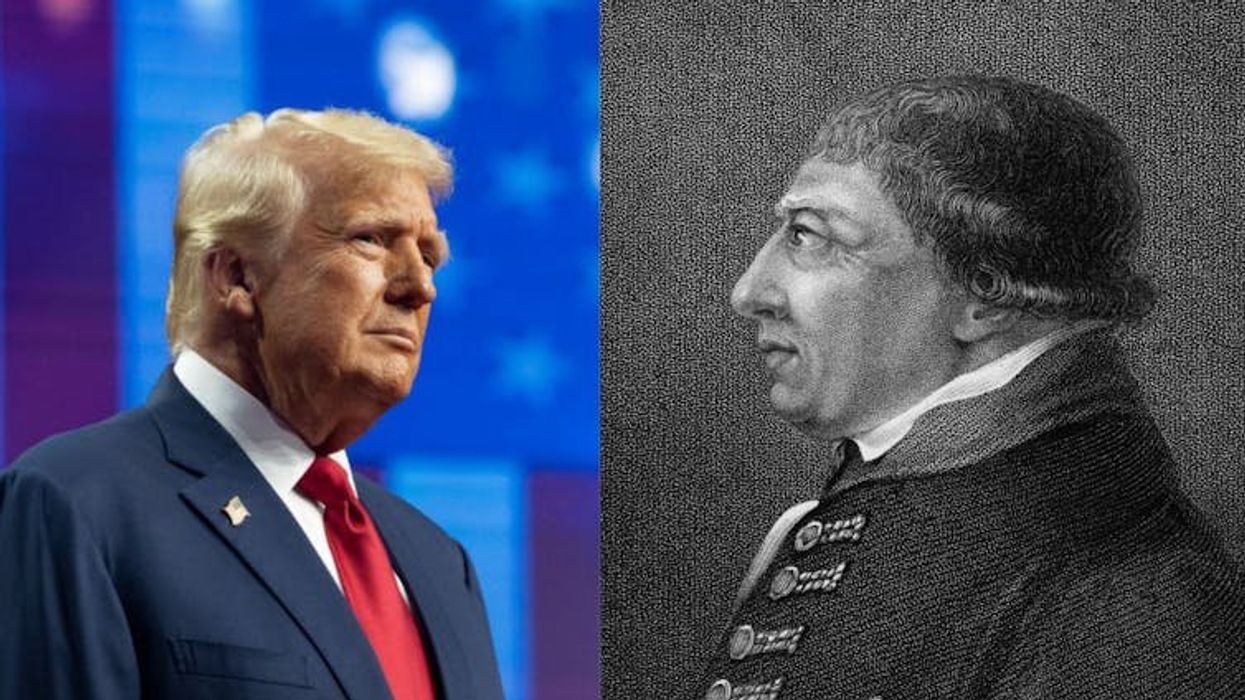
Comparisons between Trump and Mad King George are unfair — to King George: historian


Are there legitimate comparisons between President Donald Trump and King George III?
March 24, 2025

George III, king of Great Britain and its colonies at the time of the American Revolution, has been maligned unfairly.

During both the first and now the second term of President Donald Trump, commentators in the U.S. have invoked the king’s misdeeds to criticize Trump. When the president bypassed Congress to create a new government agency, appointed its head and stopped payment of millions of dollars of allocated federal funds, his critics noted that he assumed the role of Congress, a power grab that supposedly made him similar to George III. According to this criticism, the president engaged in tyranny, just as the founders accused George of doing.

As a scholar of early America, I believe, however, that George III has gotten a bad rap. He was not the all-powerful monarch that Trump allegedly aspires to be.

In the 1770s, the power of the British king was limited by the authority of Parliament. In that system, which Americans and others praised at the time as balanced, the king and the legislature each had specific duties and powers so that neither could control the government alone.

George III was not an absolutist monarch, to use the language of the day for a power-hungry ruler. The English had struggled in the previous century over the extent of the king’s power. After fighting two civil wars, executing one king, and, eventually, forcing the monarch to agree to rule with Parliament rather than on his own, they believed their liberties were safeguarded.

This system, known as limited monarchy, was the pride of Great Britain. It was also admired by the American founders. As late as 1774, in his Summary View of the Rights of British America, Thomas Jefferson praised the “free and ancient principles” of the British constitution in which “kings are the servants, not the proprietors of the people.”
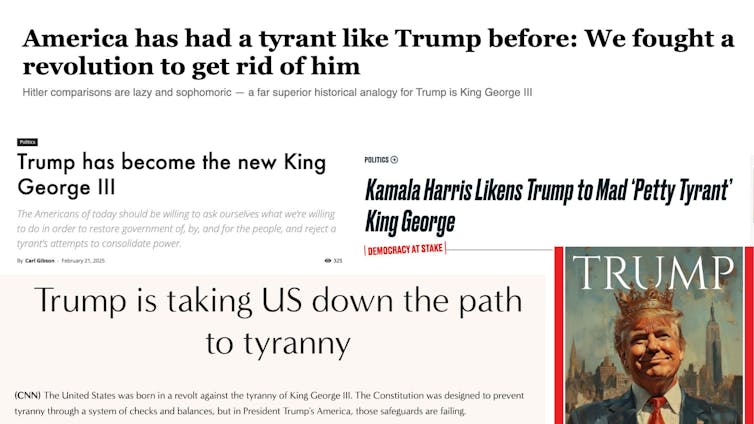

Trump has been compared with King George III by many writers and commentators; the White House on Feb. 19, 2024, issued the fake magazine cover of Trump crowned like a king.  Various


No kingly tyranny


Britons, whether in Great Britain or the colonies, did fear a tyrant, a controlling and abusive leader.

Some fears came from their study of political theory, which taught that government worked best when composed of various branches that represented the concerns of the different political classes.

As this theory went, an unbalanced government would descend into tyranny with a too-powerful monarch; oligarchy under a dominant aristocratic class; or anarchy with the people out of control. They believed these perils could be avoided only by maintaining balance.

Even though the British did not fear imbalance or a tyrant king in their own case, they could see the danger threatening elsewhere in Europe.

France represented a worst-case scenario. Its absolutist kings had ruled without France’s legislature – the Estates General – for more than a century and a half at the time of the American Revolution. British poet Robert Wolseley’s often reprinted poem declared: “Let France grow proud beneath the tyrant’s lust, While the rackt people crawl and lick the dust. The mighty Genius of this isle disdains Ambitious slavery and golden chains.”

Within a few years, Anglo-American criticism of kingly tyranny in France would be validated: That country descended into a violent revolution that resulted in decades of warfare and political violence, including the execution of the entire royal family.

This experience confirmed for the British and Americans that a balanced system was best and that they should count their blessings.

Why revolt?


A list of grievances held by the American Colonies against King George III, set down in Thomas Jefferson’s first draft of the American Declaration of Independence, which ultimately included 27 grievances against the king.
MPI/Getty Images

If the American revolutionaries admired the British system and sought to copy it in the United States, why did they reject the link to Britain and revolt in the first place?

Americans did not revolt against the nature of British government. Rather they objected to their changing place within the British Empire. The revolutionary crisis had a number of roots, but most of them arose out of changes in the management of the relationship between the American Colonies and the imperial center.

From the 1760s, the British government took a more activist role in its American Colonies, limiting their geographical expansion and imposing taxes directly on the population. In the past, Colonists had been free to move west, challenged only by the indigenous residents who fought to defend their lands.

Now the British government, aiming to put an end to these wars, blocked expansion. At the same time, to pay down the debt accrued in recent war with France – and fought in part in North America – the government levied taxes not via the Colonial legislatures, as it had before, but directly on residents. This change sparked revolt and, eventually, revolution

Turning on the king    
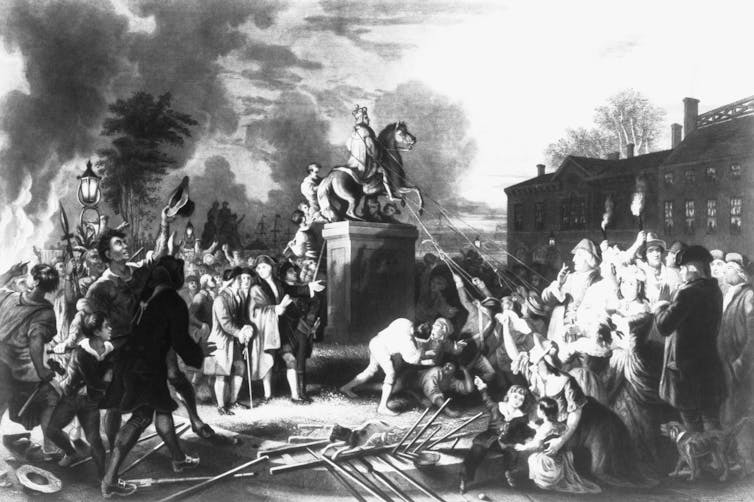

American Colonists pull down a statue of King George III in New York City during the American Revolution.
Corbis via Getty Images

Before 1776, the Colonists believed that George III would come to their rescue and halt these changes imposed by Parliament. They thought initially that he did not realize how the new policies affected them.

Only in 1776 did they accept that George III supported the policy changes and would not defend their rights. It was in that context that they turned on him and declared him tyrannical, blaming him for the new policies and calling for a break with Britain. As the Declaration of Independence said: “The history of the present King of Great Britain is a history of repeated injuries and usurpations, all having in direct object the establishment of an absolute Tyranny over these States.”

Although they complained about the tyranny of George III, their true objection was that their subordinate position within the empire gave them little leverage when opposing policies that king and Parliament agreed to impose on them.

Once independent, the founders created a system that imitated the British model of mixed governance and created barriers – the powers of Congress and the oversight of the Supreme Court – that they hoped would safeguard their liberties against the threat of renewed tyranny.

Carla Gardina Pestana, Professor and Joyce Appleby Endowed Chair of America in the World, University of California, Los Angeles

This article is republished from The Conversation under a Creative Commons license. Read the original article.
'Why us, why now?': Farmers paying stiff price as Trump’s USDA cuts slam food banks and schools


Fresh produce being sold in August 2024 (Jason Wells/Shutterstock.com)

March 25, 2025
ALTERNET

The U.S. Department of Agriculture (USDA) is among the many federal government agencies being targeted for mass layoffs by the Trump Administration and the Department of Government Efficiency (DOGE), headed by billionaire SpaceX/Tesla/X.com leader Elon Musk.

The USDA cuts are affecting schools and food banks, and according to Baltimore Banner reporter Matti Gellman, they are also having a negative effect on farmers.

In an article published on March 25, Gellman explains, "At the end of this program's cycle in April, school districts will stop receiving the federal funding used to place large, bulk orders with local farms, including Moon Valley in Frederick County, (Maryland). The termination of the U.S. Department of Agriculture's Local Food for Schools Cooperative Agreement program comes amid a flurry of federal orders intent on cutting government waste and unnecessary spending. The Local Food Purchase Assistance program, for food banks to buy from local farmers, also was canceled for the upcoming cycle that begins in December. Without these programs, the small farms that make up the majority of Maryland's agricultural industry stand to lose some of their largest customers."

Meg Kimmel, chief operating officer for the Maryland Food Bank, told the Banner that she relied on the Local Food Purchase Assistance program to sustain a network of 1200 soup kitchens and food pantries in Maryland.

"In its last two years," Gellman reports, "the program has allowed the food bank to purchase local food at an average of $0.65 per pound — a fraction of the cost at grocers — allowing them to circumvent rising food prices while growing local farms, according to an impact evaluation report by the group. In its absence, Maryland Food Bank leaders worry about having to purchase less food, especially when it comes to fresh produce and meats, Kimmel said."

The Maryland Food Bank COO told the Banner, "It's the opposite of waste."

Jacob Lovett of the Lovett Farm in Dorchester County, Maryland told the Banner that Lovett would not be in business if the Maryland Food Bank weren't buying its potatoes.

Gellman told the Banner, "Once they realized this was going to affect the people growing the food, I expected (President Donald Trump), as a Christian, to say: slow down here. Why us, why now?"

Read the Baltimore Banner's full article at this link. ‘pernicious’ impact of Trump on swing state