Thursday, April 10, 2025


Sensors and Mapping: What China's Survey Ship May be Up To Off Australia
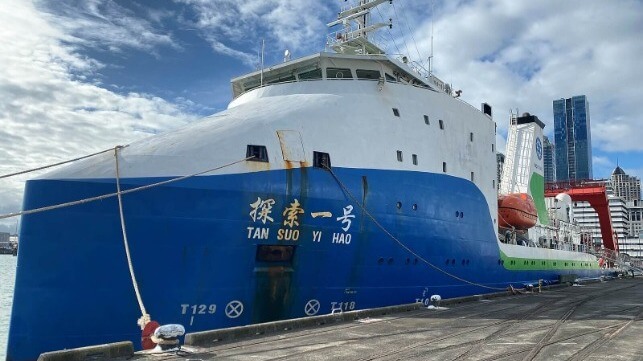
Tansuo Yi Hao
Tansuo Yi Hao (Kareen Schnabel / CC BY SA 4.0)

Published Apr 10, 2025 6:37 PM by The Strategist


[By Euan Graham and Ray Powell]

Civilian exploration may be the official mission of a Chinese deep-sea research ship that sailed clockwise around Australia over the past week and is now loitering west of the continent. But maybe it’s also attending to naval duties.

These could have included laying or servicing seabed acoustic sensors and possibly detailed mapping of parts of the ocean floor to support future submarine operations.

Open-source tracking data enables such educated guesses to be made, without discounting the possibilities of economic and scientific data-gathering.

The ship, Tansuo Yi Hao (Exploration 1) took a similar route around Australia in January 2023, investigating 1100km of the Diamantina Trench over 34 days. China’s state media later said this was the first time the bottom of the trench had been reached. The ship carries a crewed submersible, the Fendouzhe (Striver), capable of long-duration forays to the seabed in depths exceeding 10,000 metres.

As in 2023, rather than proceeding directly home from New Zealand, where it was conducting joint activities with a partner institution, the ship has again undertaken a long deviation around Australia. Its transitory presence in the Bass Strait and inside Australia’s 200 nautical mile exclusive economic zone (EEZ) was nonetheless permissible under international law, as long as the ship undertook no commercial survey activity and maintained continuous passage, showing ‘due regard’ to the coastal state.

However, speculation quickly grew that Tansuo Yi Hao could be gathering intelligence on Australia’s seabed cables. When questioned by media about its presence, Prime Minister Anthony Albanese said he ‘would prefer that it wasn’t there’.

Tansuo Yi Hao subsequently stayed mostly outside of the EEZ as it traversed the Great Australian Bight. Nor did it appear to loiter before reaching the Diamantina Trench, about 1100km off the Western Australian coast and well beyond Australia’s maritime jurisdiction.

Given the inherently dual-use nature of China’s marine scientific research assets, it would be prudent to assume that Tansuo Yi Hao and the submersible are subject to some level of military tasking. They belong to China’s Institute of Acoustics, which according to its own website has ties to the armed forces, dating back decades.

Sending a survey ship around Australia is less obviously coercive than similarly deploying a naval task group, as Beijing did in February and March, and China’s survey vessels are more common near Australia than generally known. But the passage is a further demonstration of China’s growing strategic reach and interest in operating beyond the first island chain.

According to automatic information system data from Starboard Maritime Intelligence, Tansuo Yi Hao has paused daily for 12 to 17 hours over the Diamantina Trench since 6 April. This is consistent with the reported underwater endurance of Fendouzhe of up to 15 hours. During that time, Fendouzhe could have deployed new devices or serviced acoustic arrays already on the seabed near the trench. The sensors could gather valuable military intelligence about signatures of ships that pass them.

The Diamantina Trench is too far away to be of obvious use for monitoring the approaches to HMAS Stirling, Australia’s sole submarine base and the main hub for future combined Australian, British and US submarine operations under AUKUS. It is also too deep for submarine operations. However, China reportedly has developed deep-sea surveillance networks that can operate in the extreme pressures of ocean trenches and use acoustic characteristics of the trenches to detect sounds from as far away as 1000km, including from passing ships and submarines. Listening devices are said to be attached to a seabed cable that is connected to a small buoy that in turn serves as a battery power source and relay for satellite communications. Around a decade ago, two arrays were reportedly laid in deep sea trenches near Guam and near Yap, an island in the Federated States of Micronesia. Since then, China’s sensing technology has continued to advance at an impressive pace.

The survey ship’s return visit to the Diamantina Trench after two years could be associated with a need to service or replace equipment and collect data gathered since 2023. Unfortunately, Australia has very limited capabilities for monitoring the seabed beyond its continental shelf, so it would likely be none the wiser if Tansuo Yi Hao deployed seabed devices during its current visit—or two years ago, for that matter.

To be sure, China’s deep-sea survey expeditions have economic and prestige motivations, which may even be preponderant. However, it would be foolhardy to discount the possibility that Tansuo Yi Hao and other specialised survey vessels are also used to support China’s naval ambitions.

China’s navy is probably interested in seabed mapping for its own future submarine operations, and while submersibles are able to map only limited areas, with emerging technologies they can do so in impressive detail.

In the public domain at least, it remains unclear whether Chinese submarines have previously operated south of Australia. But Tansuo Yi Hao’s two recent survey expeditions, taken together with China’s recent warship transit south about Australia, suggests Beijing’s strategic interest in Australia’s southern seaboard is rising. This is no surprise given the growing strategic importance of HMAS Stirling.

Australia must understand that China is paying it greater attention, in strategic terms, as a result of the AUKUS initiative and the developing footprint of the US force posture here. This is likely to motivate a more regular Chinese maritime presence in our vicinity, comprising not only military assets but dual-use capabilities such as survey ships. Assuming otherwise would be akin to burying our heads in the sand.

Euan Graham is a senior analyst at ASPI. Ray Powell is the director of SeaLight, a maritime transparency project at Stanford University. He was the US defence attache to Australia from 2017 to 2020.

This article appears courtesy of The Strategist and may be found in its original form here

Top image: Tansuo Yi Hao (Kareen Schnabel / CC BY SA 4.0)

The opinions expressed herein are the author's and not necessarily those of The Maritime Executive.

 

Importers Begin to Cut Orders After 145 Percent Tariff on China

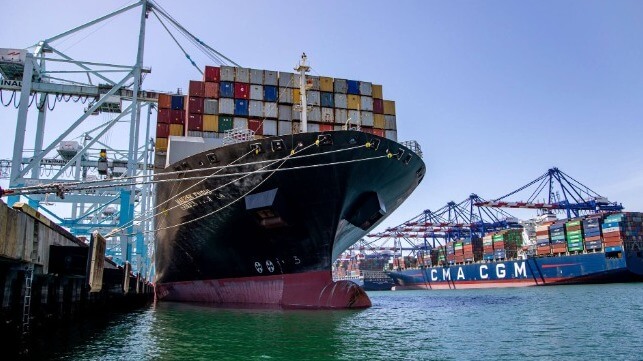
Port of LA boxships
File image courtesy Port of Los Angeles

Published Apr 10, 2025 4:15 PM by The Maritime Executive


American importers are beginning to delay or cancel orders in China due to the White House's new 145 percent tariff on Chinese goods - and some U.S. firms may even abandon import cargo on the dock because they can't afford to pay the extra duties, though the White House has promised an exemption for goods already in transit. 

Even before the latest hike, Chinese manufacturers faced a tariff of 20 percent from earlier White House actions. Many have already discounted their goods to the lowest profitable price in order to offset the effects. "It is a deal breaker," toy factory owner Chen Qingxin told the Wall Street Journal. "No room for doing business anymore, for both sides."

Given the effective doubling of their wholesale costs, American retailers are already beginning to cancel or defer orders. E-commerce giant Amazon began to revoke orders this week, according to Bloomberg, and has already canceled shipments of summer goods like air conditioners, beach chairs and scooters. 

Exporters in China are also adapting to a new reality. "All factory orders are suspended. Any goods that have not been loaded will be cancelled and goods that are already at sea will be re-priced," one manufacturing executive told SCMP. "The loss on each container we ship is now greater than the profit we used to make on two containers." He added that his firm has heard from at least one U.S. client that the goods would be abandoned on the dock when they arrived because the tariffs make them too expensive to sell.

"The major trend we see is shippers looking to not accept their freight," supply chain consultant Joseph Esteves told CNBC. "A lot of these companies are levered financially. They don’t have the working capital requirements and they don’t have the cash. So they simply cannot just take on this [tariff] and hope to see what happens."

The steep tariff on China may force U.S. importers to diversify their supply chains to other alternatives, like Cambodia and Vietnam, already popular options for the "China plus one" diversified sourcing strategy. But there is little chance that more low-end consumer goods will end up being produced in America, some in the supply chain business say. 

"They’re absolutely not going to go back to the United States," said Casey Barnett, president of the American Chamber of Commerce in Cambodia, told CNBC. "I can’t imagine that Americans want to sit down and sew a pair of sweatpants for long hours of the day."

China has also imposed its own retaliatory tariff of 84 percent on U.S. goods, and the increased cost is expected to hit agricultural interests hard, particularly soybean farmers. U.S. manufacturers may also feel the effects of a slowdown. In California, a leading maker of CNC industrial machine tools - Haas Automation - has announced that it is scaling back hiring, production and overtime because of a "dramatic decrease in demand for our machine tools from both domestic and foreign customers."


White House Softens Proposal for Steep Port Fees on Chinese Ships

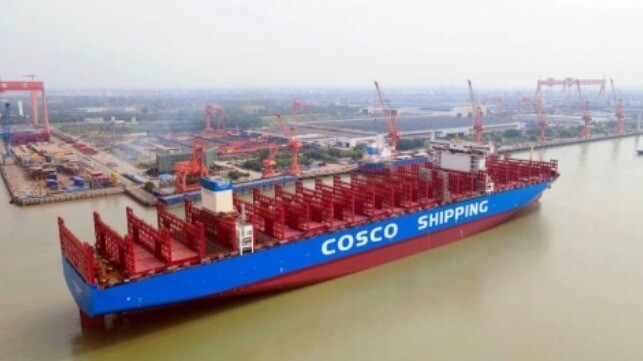
Chinese container ship
File image courtesy China COSCO

Published Apr 10, 2025 2:12 PM by The Maritime Executive


As markets continue to fall on the news of a 145 percent tariff on all Chinese goods, the White House has quietly signaled that it will soften its plans for multimillion-dollar port fees on Chinese ships - fees that U.S. oil companies, exporters and farmers strongly opposed. 

Six sources with knowledge of the matter told Reuters that the White House may delay or reduce the fees proposed by the Office of the U.S. Trade Representative (USTR). The head of the office, Trade Representative Jamieson Greer, confirmed Tuesday that some of the fees might not be put into action and might not be added together. 

The fees - which could have cost up to $3.5 million per port call for Chinese-built ships, under the original plan - drew protests from major domestic industries. The fees would have raised the cost of shipping for exporting oil, grain, machinery and other goods, making them less competitive or pricing them out of the global market, with broader effects on the U.S. economy. Some smaller U.S.-based carriers like Atlantic Container Line (ACL) warned that they would have to shut down American operations, and at least one major U.S. shipowner - Genco - said that it might cease calling in U.S. ports. Energy Products Partners, a leading U.S. midstream firm, warned that the fees would also have a devastating impact on oil and gas exports. If the fees take effect, "there will be no ‘drill baby drill’ [and] the ‘liquid gold’ under our feet would stay in the ground," EPP told Lloyd's List. 

Reuters' sources said that USTR had not considered all types and sizes of ships when it formulated the port fees. The multimillion-dollar flat-fee structure was designed only with the largest container ships in mind; the impacts on tankers, bulkers, ro/ros and smaller boxships were not taken into account before the policy proposal was released. Now that USTR is looking at the broader effects on shipping, the fee structure will likely be recalibrated based on vessel size, making it proportional to the amount of cargo carried.    

The administration's new executive order on revitalizing American maritime - a policy directive signed Tuesday - could be used as an alternative way to pursue USTR's domestic  objectives, instead of penalizing foreign-flag shipowners with fees on Chinese ships, according to World Shipping Council President & CEO Joe Kramek. 

"The Executive Order outlines several encouraging elements that reflect a serious focus on rebuilding the American maritime industry," Kramek said Thursday. "Measures to impose retroactive port fees would disadvantage all aspects of the supply chain - from consumers to farmers, from energy producers to manufacturers."

WSC previously raised the possibility of a legal challenge to USTR's fees. Last month, Kramek suggested that USTR's action was a plan to boost U.S. domestic shipbuilding, rather than a proposal to counter unfair trade practices. "Generating demand for domestic products and raising government revenue – whether to support a domestic industry or for other purposes – are not permissible bases for actions under Section 301," said Kramek in a statement last month, referring to the U.S. Trade Act of 1974. 


Ro/Ro Freighter Catches Fire in Philippines

Fire aboard ro/ro
Courtesy PCG

Published Apr 10, 2025 5:02 PM by The Maritime Executive


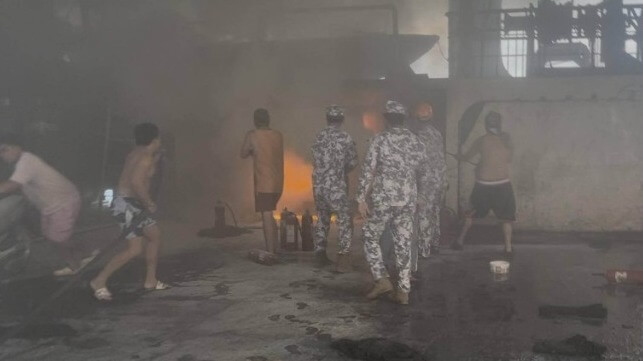
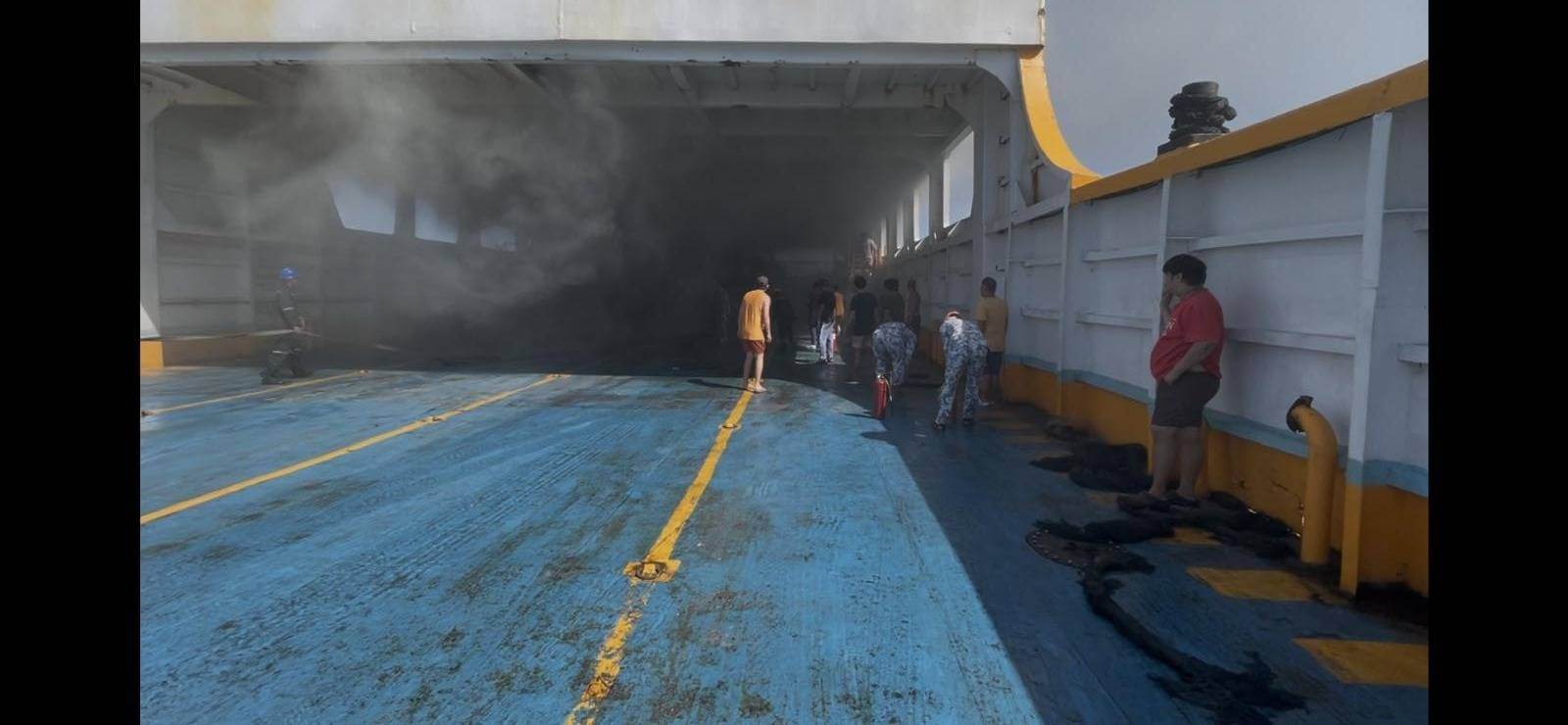
On Tuesday, the Philippine Coast Guard helped put out a fire aboard a ro/ro during loading operations at the port of Abra de Ilog, about 70 nautical miles south of Manila.

At about 0900 hours Tuesday, the Roro Master 2 was loading passengers and cargo for a routine transit to Batangas, Luzon. A fire broke out in a generator on deck near the fantail, inside a vehicle bay. 33 passengers were on board at the time, along with 34 crewmembers and 21 trucks.  

Courtesy PCG

The Philippine Coast Guard outpost at Abra de Ilog responded to the scene after receiving a report of an ongoing fire. In the meantime, the ship's crew began firefighting measures, applying water to the burning generator. PCG officers worked with the local Philippine Ports Authority office to find extra firefighting equipment, but the situation was under control and the fire extinguished by 0920. 

No injuries or casualties were reported. The PCG has recommended detaining the vessel for a thorough safety inspection.  

Roro Master 2 is an open deck roll-on / roll-off cargo vessel with a bow ramp and a house-aft arrangement. It does not appear in international shipping databases, as is common for coastal vessels in Southeast Asian trades. 


Video: Feeder Suffers Explosion and Fire in the North Sea

Victoria L
Courtesy Kustwatch

Published Apr 9, 2025 3:59 PM by The Maritime Executive


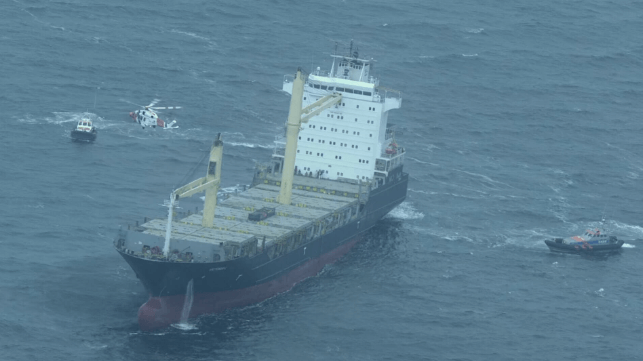
Dutch responders have successfully extinguished a vessel fire after an explosion aboard a boxship off Hoek van Holland. 

At about 1300 hours local time, the Dutch coast guard received an alert of a blast aboard the small container feeder Victoria L, which was headed for Rotterdam on a ballast voyage. The crew was engaged in fighting the resulting fire, and no injuries were reported.

After initial gains in combating the blaze, the fire reflashed at about 1330 hours. A fire crew from shore joined the ship by helicopter to assist in the effort, and multiple response boats arrived on scene, including the tug Multraship Protector and two lifeboats of the KNRM rescue service. Video from the scene released late Wednesday appeared to show the boxship trimmed heavily by the stern and pumping water over the side. 

As of Wednesday evening, the fire was extinguished and the first responders disembarked the vessel. Victoria L is expected to resume her voyage to Rotterdam under her own power. 

It is the second major casualty involving a feeder in European coastwise trade in as many months, following the allision of the boxship Solong with the tanker Stena Immaculate off the UK in March. 


Saya de Malha: Far Away From Human Rights

The Sri Lankan fishing vessel Hasaranga Putha at Saya de Malha, 2022 (Monaco Expeditions)

Published Apr 10, 2025 8:08 PM by Ian Urbina


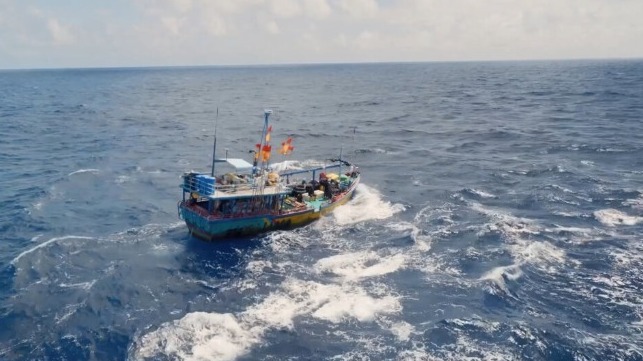
In October 2022, a British-American couple, Kyle and Maryanne Webb, were sailing their yacht through a remote area of the Indian Ocean between Mauritius and Seychelles, just south of the Saya de Malha Bank, the world’s largest seagrass field. The Webbs were sailing enthusiasts and had covered tens of thousands of miles on their vessel, the Begonia, over the previous years. As they passed the Bank, they spotted a small fishing vessel, about 55 feet in length, painted bright yellow and turquoise, with about a dozen red and orange flags billowing from the roof of its cabin. It was a Sri Lankan gillnet boat called, in Sinhali, the Hasaranga Putha.

Looking gaunt and desperate, the crew told the Webbs that they had sailed roughly 2,000 miles from their home port, in Beruwala, Sri Lanka. They had been at sea for two weeks, they said, but had only caught four fish. They begged the Webbs for food, soda, and cigarettes. The Webbs gave them what they could, including fresh water, then headed on their way. “They were clearly in a struggling financial position,” Mrs. Webb said. “It broke my heart to see the efforts they feel they must go to provide for their families.”

A month later, again near the Saya de Malha Bank, the Hasaranga Putha hailed another vessel—the South African ocean research and supply ship, S.A. Agulhas II, which was on an expedition in Saya de Malha for the environmental non-profit Monaco Explorations. By this time, the Sri Lankan crew was almost out of fuel and begged for diesel. The scientists did not have the right type of petrol to offer but they still boarded a dinghy and brought the fishers water and cigarettes. Grateful, the Sri Lankans gave them fish in return. The Hasaranga Putha would remain at sea for another six months before returning to Colombo in April 2023.

Hundreds of miles from the nearest port, the Saya de Malha Bank is one of the most remote areas on the planet, which means it can be a harrowing workplace for the thousands of fishers from a half dozen countries that make the perilous journey to reach it. The farther from shore that vessels travel, and the more time they spend at sea, the more the risks pile up. Dangerous storms, deadly accidents, malnutrition, and physical violence are common threats faced by distant-water crews. Each year, a fleet of several dozen Sri Lankan gillnetters makes some of the longest trips made to the area, often in the least equipped boats.

Some of the vessels that fish the Saya de Malha Bank engage in a practice called transshipment, where they offload their catch to refrigerated carriers without returning to shore, so that they can remain fishing on the high seas for longer periods of time. Fishing is the most dangerous occupation in the world, and more than 100,000 fishermen die on the job each year. When they do, particularly on longer journeys far from shore, it is not uncommon for their bodies to be buried at sea.

Sri Lankan gillnetters are not the only fishing vessels making perilous journeys to reach the rich and biodiverse Saya de Malha Bank. Thai fishmeal trawlers also target these waters, traveling more than 2,500 nautical miles from the port of Kantang. In January 2016, for example, three Thai trawlers left the Saya de Malha Bank and returned to Thailand. During the journey, 38 Cambodian crew members fell ill, and by the time they returned to port, six had already died. The remaining sick crew were hospitalized and treated for beriberi, a disease caused by a deficiency of Vitamin B1 or thiamine. Symptoms include tingling, burning, numbness, difficulty breathing, lethargy, chest pain, dizziness, confusion, and severe swelling.

Easily preventable, yet fatal if left untreated, beriberi has historically appeared in prisons, asylums, and migrant camps, but it has largely been stamped out. Experts say that when it occurs at sea, beriberi often indicates criminal neglect. One medical examiner described it as “slow-motion murder” because it is so easily treatable and avoidable.

The disease has become more prevalent on distant-water fishing vessels in part because ships stay so long at sea, a trend facilitated by transshipment. Working practices involving hard labor and extensive working hours cause the body to deplete vitamin B1 at a faster metabolic rate to produce energy, the Thai government concluded in a report on the deaths. Further research by Greenpeace found that some of the workers were victims of forced labor.

Today, fewer vessels from the Thai fleet are traveling to Saya de Mahla, but some still make the trip, and questions about their working conditions linger. In April 2023, one of those vessels, the Chokephoemsin 1, a bright blue 90-foot trawler, set out for the Saya de Malha Bank with a crew member named Ae Khunsena, who boarded the ship in Samut Prakan, Thailand, for a five-month tour, according to a report compiled by Stella Maris, a non-profit organization that helps fishers. As is typical on high-seas vessels, the hours were long and punishing. Khunsena earned 10,000 baht, or about $288, per month, according to his contract.

In one of his last calls to his family through Facebook, Khunsena said he had witnessed a fight that resulted in more than one death. He said the body of a crew member who was killed was brought back to the ship and kept in the freezer. When his family pressed for details, Khunsena said he would tell them more later. He added that another Thai crew member who also witnessed the killing had been threatened with death and so he fled the ship while it was still near shore along the Thai coast. Khunsena’s family spoke to Khunsena for the last time on July 22, 2023. A company official contested this claim and said no such fight happened and added that there was an observer from the Department of Fisheries aboard the vessel, who would have reported such an incident had it happened.

On July 29, while working in waters near Sri Lanka, Khunsena went overboard, off the stern of the ship. The incident was captured on a ship security camera. A man listed as Khunsena’s employer on his contract named Chaiyapruk Kowikai told Khunsena’s family that he had jumped. The ship’s captain then spent a day unsuccessfully searching the area to rescue him, before returning to fishing, Kowikai said.

The vessel returned to port in Thailand roughly two months later. Police, company and insurance officials eventually concluded that Khunsena’s death was likely a suicide. This claim seemed to be backed up by the onboard footage, which did not show anyone near him when he went over the side of the boat.

In September 2024, a reporting team from the Outlaw Ocean Project visited Khunsena’s village. Settled by rice farmers about a century ago, Non Siao is located in Bua Lai District, Nakhon Ratchasima, roughly two hundred miles to the northeast of Bangkok. The reporting team interviewed Khusena’s mother and cousin as well as the local labor inspector, police chief, aid worker and an official from the company that owned the ship. While the police and company officials said the death was likely a suicide, Khusena’s family avidly disagreed. “Why would he jump?” said Palita, Khunsena’s cousin, explaining why she highly doubted that Khusena took his own life. “He didn't have any problems with anyone.” Sitting on the ground under an overcast sky as she spoke with the reporter in a follow-up conversation by video chat, Palita went silent and looked down at her phone. “He wanted to see me,” added Khusena’s mother, Boonpeng Khunsena, who also doubted his suicide, since he kept saying in calls that he intended to be home by Mother’s Day. His family instead speculated that Khusena had likely witnessed a violent crime and therefore to silence him, he had been coerced to jump overboard.

As is often the case with crimes at sea, where evidence is limited, witnesses are few and frequently unreliable, it is difficult to know whether Khusena died due to foul play. Perhaps, as his family speculated in interviews with The Outlaw Ocean Project, he had witnessed a violent crime and, consequently, had been forced to jump overboard. Perhaps, instead, he jumped willingly from the ship, a suicidal gesture likely driven by depression or mental health issues. In either scenario, the point remains the same: these distant-water ships are traveling so far from shore that the working and living conditions are brutal and sometimes violent. And these very conditions are likely playing a role in sinister outcomes.

And yet, the human tragedy that criss-crosses this remote patch of high seas is not just tied to fishers. The Saya de Malha Bank has also become a transit route for migrants fleeing Sri Lanka. Since 2016, hundreds of Sri Lankans have attempted to make the perilous journey on fishing boats to the French-administered island of Reunion in the Indian Ocean, some making the journey directly from Saya de Malha. Those who do succeed in making landfall on Reunion are often repatriated. In one case, on December 7, 2023, a Sri Lankan vessel that had spent the previous three months fishing in Saya de Malha, the Imul-A-0813 KLT, illegally entered the waters around Reunion. The seven crew members were apprehended by local authorities and repatriated to Sri Lanka two weeks later. Joining them on the repatriation flight were crew members of two other Sri Lankan fishing vessels that had previously been detained by Reunion authorities.

With near-shore stocks overfished in Thailand and Sri Lanka, vessel owners send their crews further and further from shore in search of a worthwhile catch. That is what makes the Saya de Malha—far from land, poorly monitored, and with a bountiful ecosystem—such an attractive target. But the fishers forced to work there live a precarious existence, and for some, the long journey to the Saya de Malha is the last they ever take.

Ian Urbina is the director of The Outlaw Ocean Project, a non-profit journalism organization based in Washington D.C. that produces investigative stories about human rights, environment and labor concerns on the two thirds of the planet covered by water. 

Reporting and writing was contributed additionally by Outlaw Ocean Project staff, including Maya Martin, Joe Galvin, Susan Ryan, and Austin Brush.

The opinions expressed herein are the author's and not necessarily those of The Maritime Executive.
 

How much food can the world grow? International team calls for new yield potential estimates


"This is a call to set the record straight," researcher says


University of Nebraska-Lincoln

Patricio Grassini 

image: 

Patricio Grassini, professor of agronomy and horticulture at the University of Nebraska-Lincoln, co-authored a paper published in the journal Nature Food that outlines a different way to estimate crop yields and yield gaps. 

view more 

Credit: Aaron Nix/University Communication and Marketing/University of Nebraska-Lincoln


An international team of agronomists is calling for a new approach to estimate crop yield potential and gaps — information that is critical in planning how to meet growing food demand. 

University of Nebraska–Lincoln researchers made major contributions to the study, published online April 8 in the journal Nature Food

“We are in a race to feed the world and to try to feed the population with the available agricultural land that we have,” said Patricio Grassini, Sunkist Distinguished Professor of Agronomy and one of the paper’s authors.

To do so requires estimates that predict both yield potential, as determined by weather and soil properties, and yield gaps, which is the difference between yield potential and current farm yields, which indicates the room that exists to increase food production on existing cropland. Those estimates are essential in making investments in agricultural research and development, both from public and private sources.

At issue is how best to compile those estimates. 

In the Nature Food paper, a team that includes scientists from Nebraska and three other institutions calls into question the statistical methods now widely used. In addition to Grassini, Husker authors of the study included Fatima Tenorio, Fernando Aramburu Merlos and Juan Rattalino Edreira, research assistant professors of agronomy.

In the United States, for example, current statistical models tend to rely too heavily on best-case scenarios — the most productive counties with the most fertile soils in a year with the most favorable weather, Grassini said. The methods also extrapolate a single yield potential across large regions with a wide diversity of climates and soils that likely would produce a similarly wide range in yield potential. 

“Therefore, if you use that year as a reference, you are going to be overestimating your production potential because the best county with the best soils in the best year doesn’t really represent your average climate or your most typical soil across the state,” Grassini said.

But in other parts of the world — Africa, for example — these models might underestimate crop yield. There, farmers may have limited access to inputs compared to producers in other areas, thus attaining yields far below what the climate can support.

This statistical approach also leads to conflicting results, with production potential estimates almost doubling from one method to another. Grassini said this approach — driven mostly by geographers and statisticians, not agronomists — has been largely accepted, and more rigorous analysis is needed.

The research team’s conclusions are explained in the paper, titled “Statistical approaches are inadequate for accurate estimation of yield potential and gaps at regional level.”

The study compared estimates of yield potential and yield gaps of major U.S. rainfed crops — corn, soybeans and wheat — derived from four statistical models against those derived from a “bottom-up” spatial scaling approach based on robust crop modeling and local weather and soil data, such as the Global Yield Gap and Water Productivity Atlas developed at Nebraska.

Process-based crop models used in this study have been rigorously validated for their capacity to estimate yield potential based on experimental data from well-managed crops grown across a wide range of environments. This bottom-up approach, which better incorporates long-term data and regional variations, is clearly superior, the team found.

“I expect some controversy,” Grassini said of the team’s conclusions challenging the conventional wisdom. 

The approach recommended by the team should better capture yield gaps, which “can help identify regions with largest room to increase crop production, which, in turn provides a basis to orient agricultural research and development programs.”

“This is a call to set the record straight because if we are going to use this information to inform policy and our investments, we better make sure that the information is sound and has been validated,” Grassini said. 

Additional team members included Romulo Lollato, associate professor of agronomy, Kansas State University; Sotirios Archontoulis, professor of agronomy, Iowa State University; and Antoine Couëdel, who completed his postdoctoral research at Nebraska and is a researcher at the French Agricultural Research Centre for International Development, France.


Colourful city birds


Bird species that do well in urban areas are more colorful and less brown


Max-Planck-Gesellschaft

Blue-faced Honeyeater 

image: 

The Blue-faced Honeyeater (Entomyzon cyanotis) successfully colonized urban areas in Australia. Like many urban-dwelling bird species, it is characterized by conspicuous plumage colouration.
 

view more 

Credit: MPI for Biological Intelligence/ Kaspar Delhey


Urbanization has a huge impact on the ecosystem and poses enormous challenges to animals and plants. The ongoing, worldwide increase in urbanization is considered one of the main causes of the steady decline in biodiversity.

Urban ecology is the field of research that focuses on the effects of urbanization on different organisms. For example, many studies have investigated how urban noise affects communication in birds. However, little is still known about the relationship between urbanization and plumage colour in birds.

Plumage colour serves many important functions: it can play a role in keeping an animal warm or avoid overheating (thermoregulation), in camouflage, in competitive interactions, or in mate choice. Cities tend to be warmer, have fewer predators, more artificial light and novel background colours like that of concrete and asphalt. It is therefore quite conceivable that the urban environment can affect the colour of animals.

Abundance of 1200 bird species

Led by Bart Kempenaers, researchers at the Max Planck Institute for Biological Intelligence and the University of Granada wanted to get to the bottom of this issue. They used a global dataset on the abundance of over 1200 bird species in habitats with different levels of urbanization and combined it with data on plumage colour. The team then analysed the extent to which plumage colour could predict the relative abundance of the species in urban areas.

The study showed that species that thrive in urban areas are less brown. 'Brown shades are more common in natural environments than in cities. We suspect that brown birds are at a disadvantage in a rather grey city. The predominant colours of a city and the lack of suitable habitats can therefore determine which bird species are successful there,' explains Kaspar Delhey, one of the two lead authors of the study.

In addition, successful urban bird species have more elaborate colours in their plumage, which is especially true for females. Cities seem to favour more colourful birds – probably because there are fewer predators in urban areas and ‘being seen’ poses a lower risk than in rural areas.

Previous studies suggested that colour diversity is lower in urban bird communities, but the team showed that the opposite is true. 'There are fewer species in urban areas than in rural areas. When we take this into account, the bird communities in cities actually have greater colour diversity,' says Juan Diego Ibáñez-Álamo, first author of the study.

The study clearly shows that successful urban birds differ in colour from those that fail to thrive in the city – urbanization and bird colouration are therefore linked. Future research will need to show whether this also holds true for other animal groups.