Friday, April 11, 2025

Visualizing Palestine 


Fund Care Not Killing


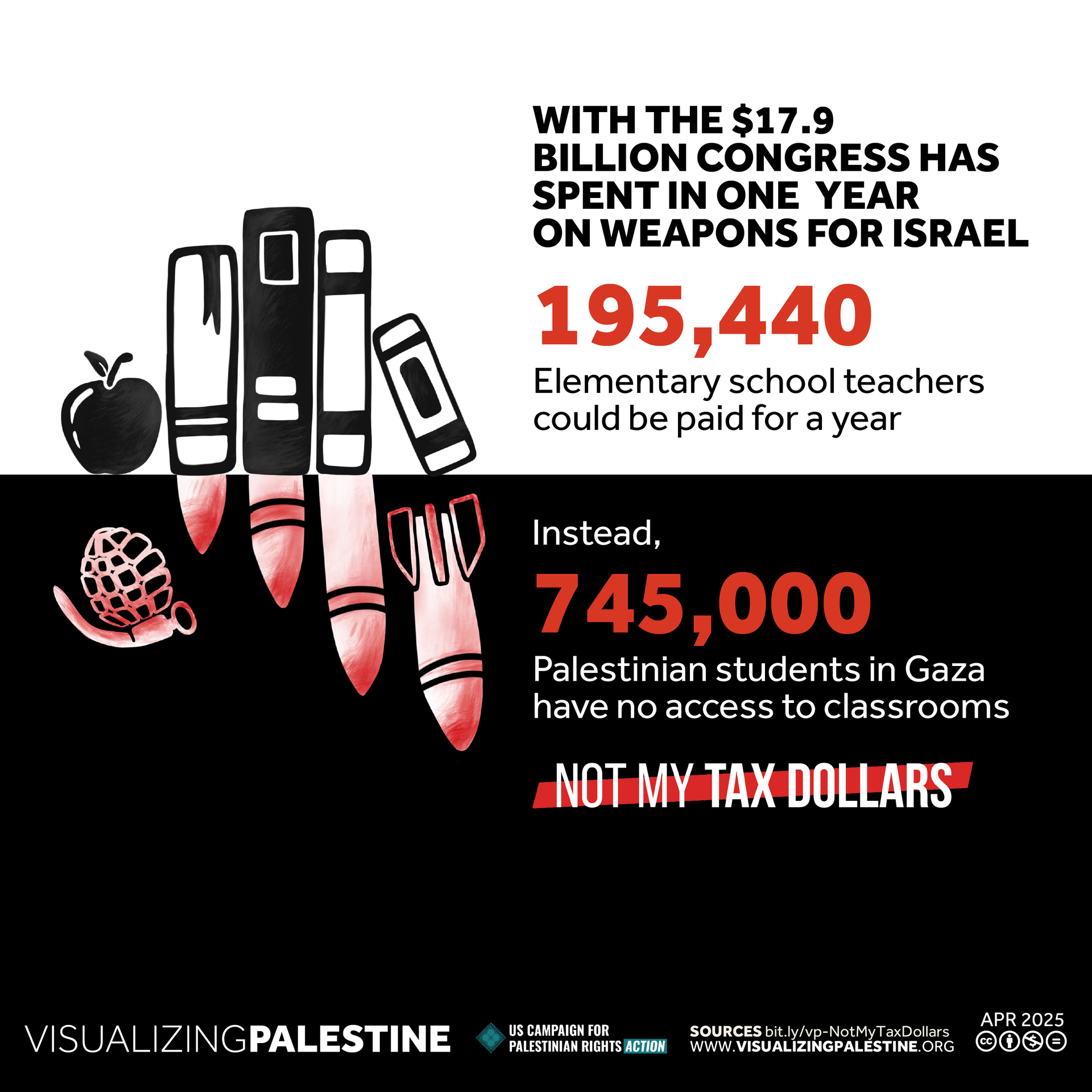
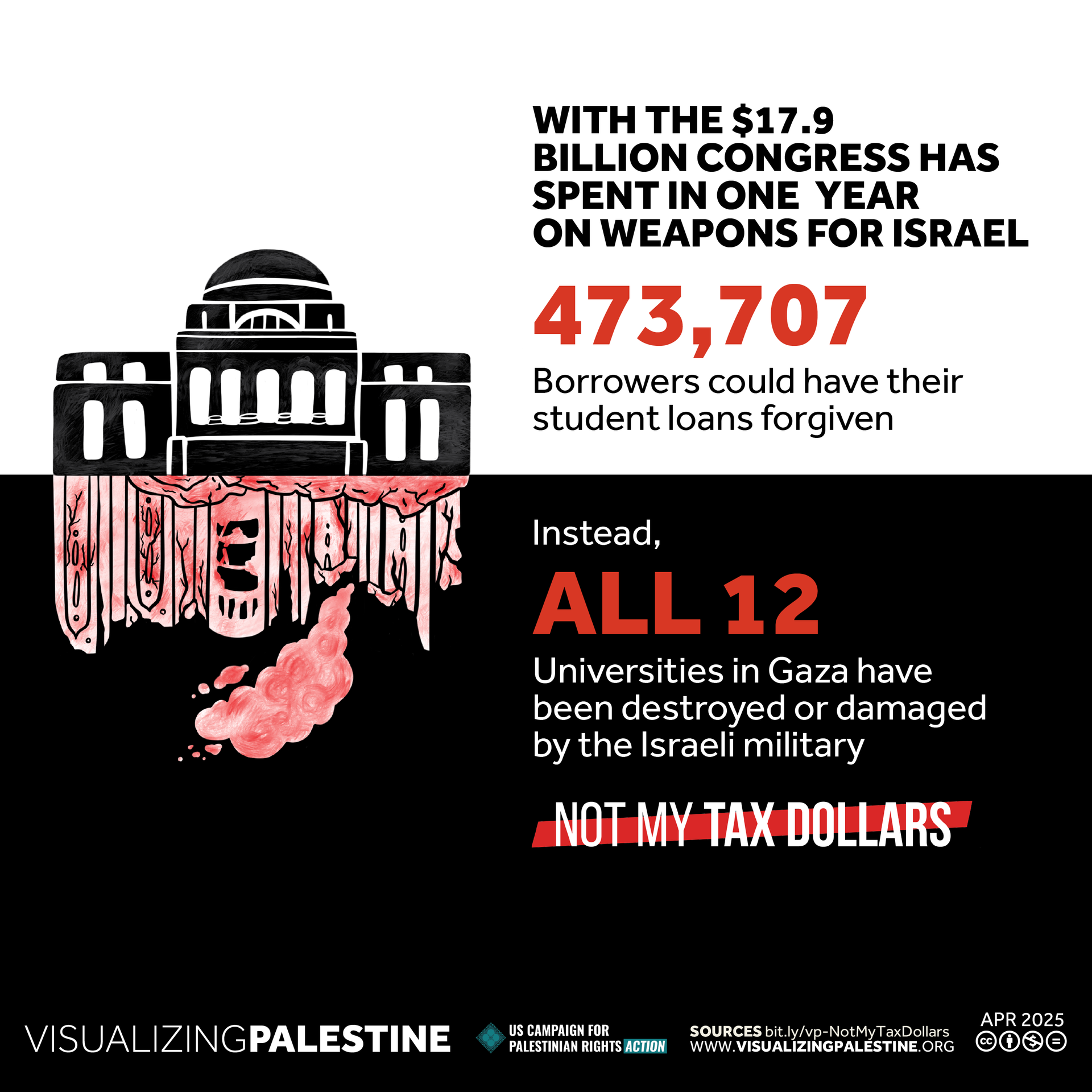
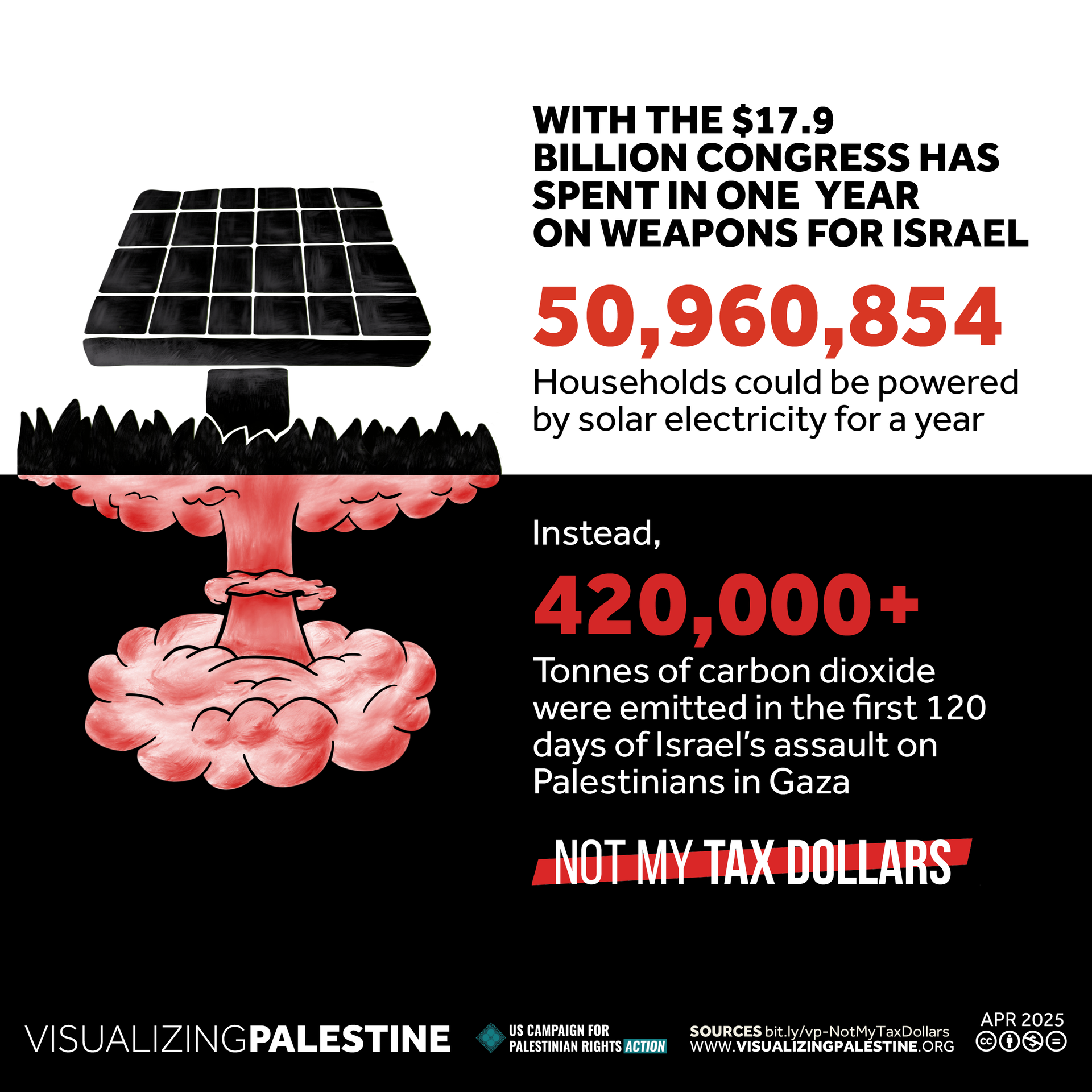
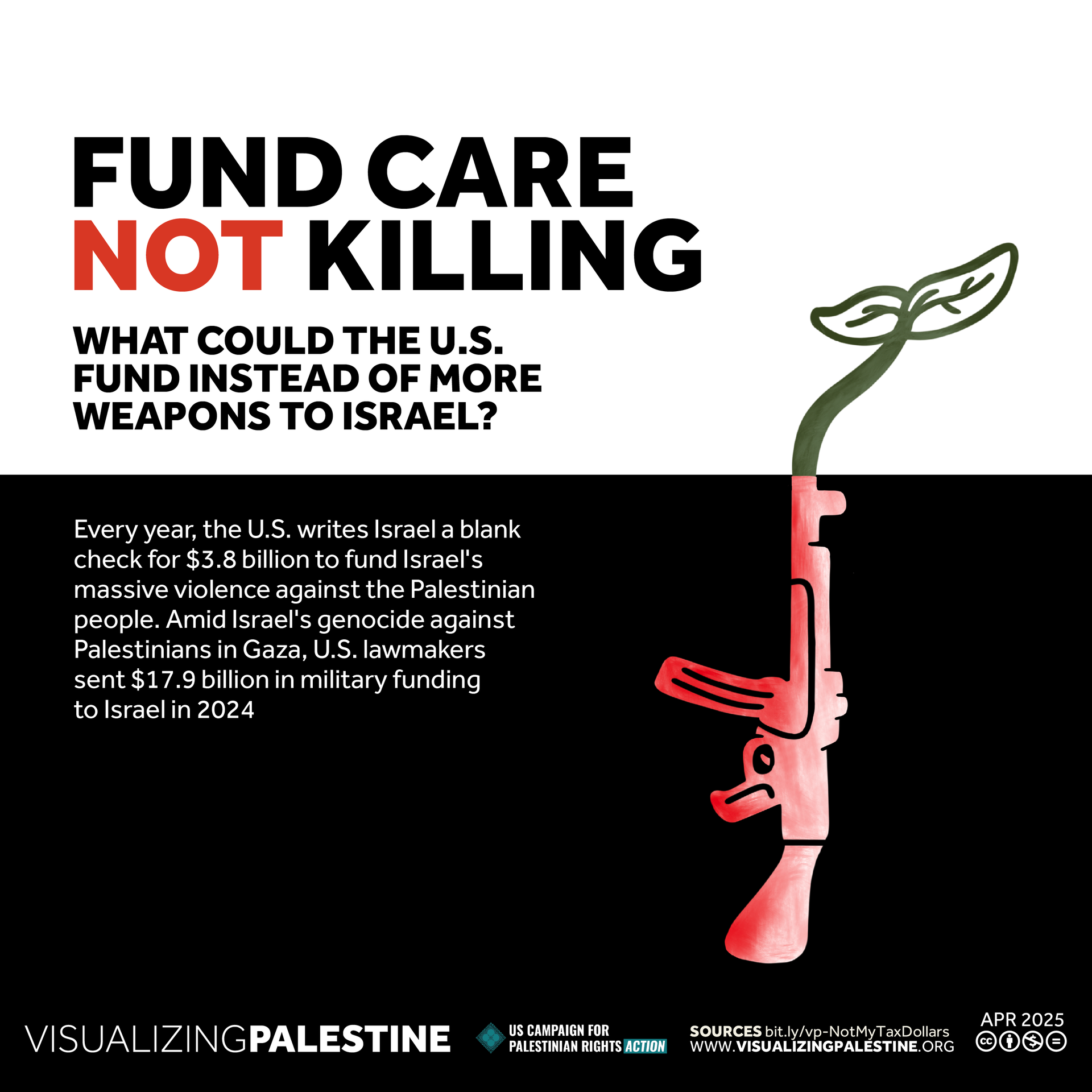
As Americans prepare their taxes for Tax Day on April 15, remember that the U.S. government continues to spend the citizen’s money to fund mass violence against Palestinians. What could the U.S. fund instead of more weapons to Israel? In collaboration with our partners, U.S. Campaign for Palestinian Rights-Action (USCPRA), we updated our visual series, Fund Care Not Killing, to show that the $17.9 billion in military funding that U.S. lawmakers sent to Israel to fuel genocide in 2024 could have been used to fund housing, healthcare, education, and solar electricity for millions of Americans instead.
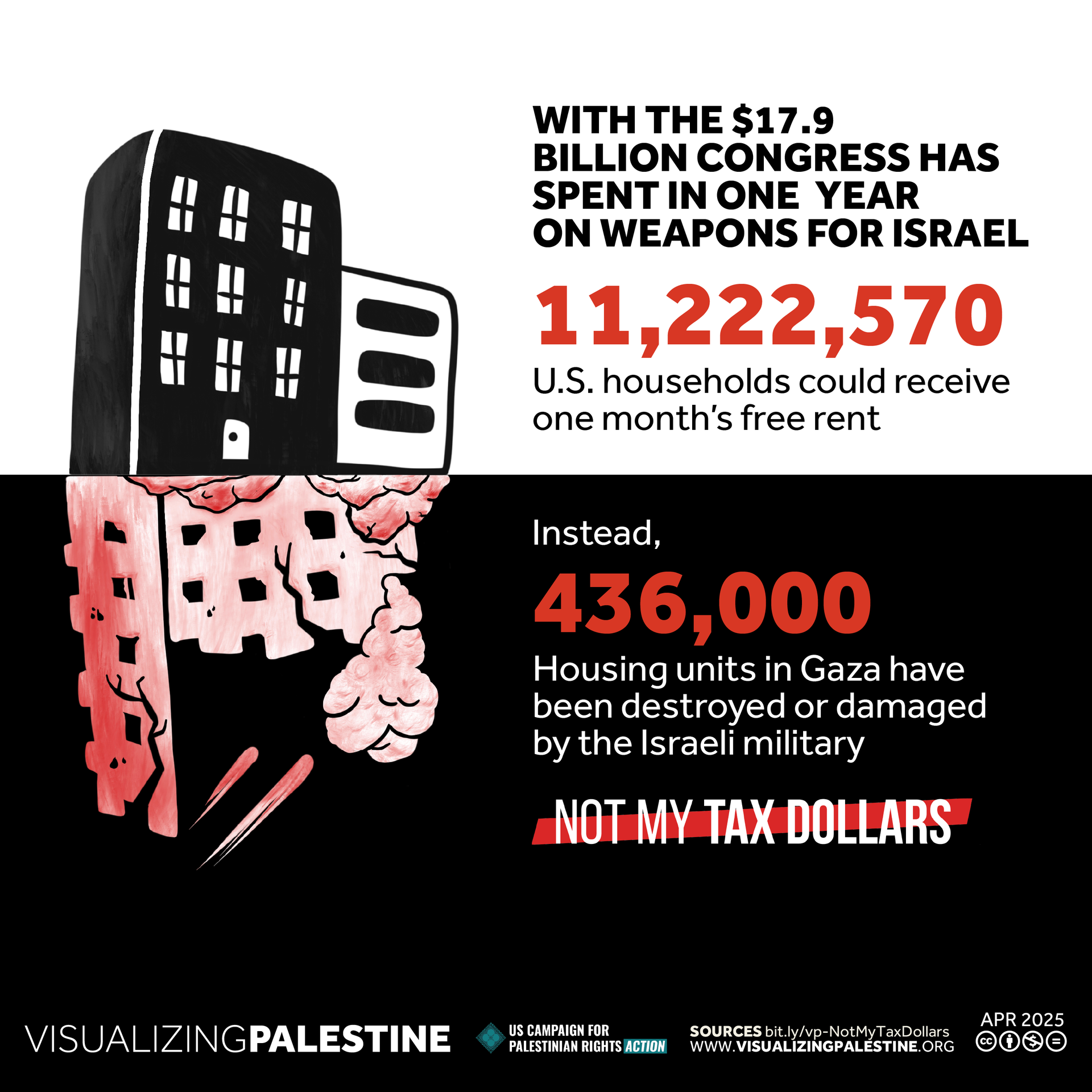
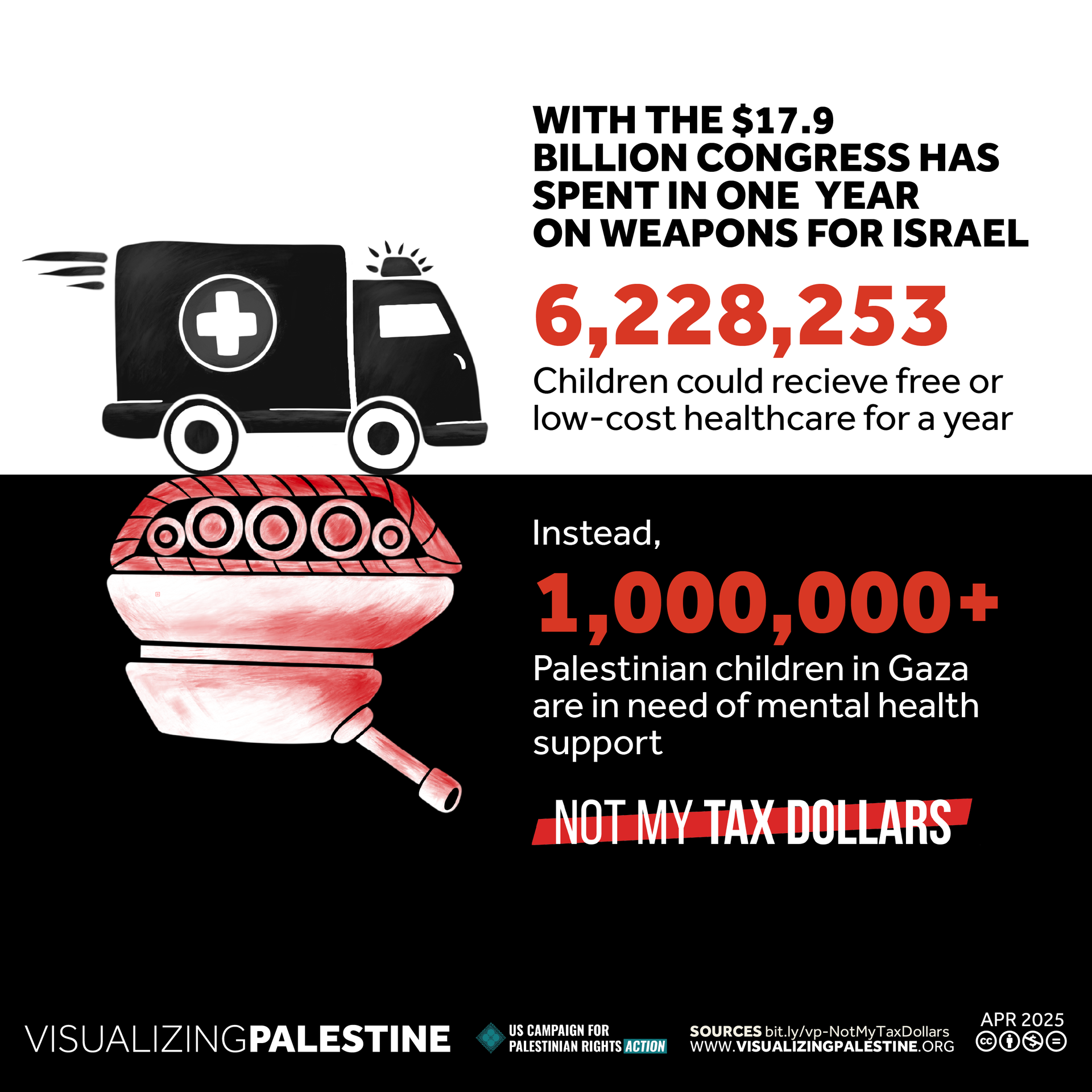
th=”50%”>

Despite support from over 60% of Americans to halt military funding to Israel, the U.S. continues to aid and abet Israel’s genocide against Palestinians with the American people’s tax dollars. In February, the Trump administration approved an additional $8 billion in arms sales to Israel to fuel its genocidal campaign in Gaza.

While Senator Bernie Sanders attempted to block the sale, it was rejected by the majority of the U.S. Senate.

It is important to continue to push U.S. Congress members to represent the will of the American people. If you are an American citizen or resident, you can take action by emailing your members of Congress to call for an arms embargo on Israel. USCPRA’s site, NotMyTaxDollars.org, has more graphics and posters you can use to tell Americans how much of their tax money is spent fueling Israeli violence.

Visualizing Palestine is the intersection of communication, social sciences, technology, design and urban studies for social justice. Visualizing Palestine uses creative visuals to describe a factual rights-based narrative of Palestine/Israel. Read other articles by Visualizing Palestine, or visit Visualizing Palestine's website.

Divesting from Genocide and US 

Authoritarianism

War tax resisters are taking to the streets to call for an end to genocide and protest a president who is exceeding his authority. They are divesting from the taxes that fund war and investing in people, planet, and justice.

The US supports Israel with over $3 billion in military aid each year and has provided more military aid to Israel than any other country since the end of World War II. The endless US war on terror continues with drone warfare in Afghanistan and Yemen. This is often forgotten, but a certain text thread recently reminded the public of this reality. And the US continues its military presence outside its borders with over 800 military bases. In addition, the recently signed National Defense Authorization Act approved $895 billion in funding for fiscal year 2025.

Since US military spending only continues to increase with no end in sight, we are divesting from war by refusing to pay the federal tax dollars that fund it.  Some will refuse all or a portion of their tax debt while others live below the taxable income level. We invite everyone to join us in this public campaign of civil disobedience to end war and war funding.

Thousands of people across the United States—from Berkeley to Manhattan—are protesting the US military budget on or around Tax Day (April 15). They will promote war tax resistance and highlight the deep flaws of our current budget.

Local actions include a panel discussion on “Breaking Free from the War Machine: Stories of Tax Resistance” in Washington DC, “Burma Shave” sign display during rush hour in Portland, Oregon, a vigil outside the IRS in Manhattan, and redirection ceremonies where activists will redirect tens of thousands of withheld federal tax dollars to underfunded organizations. Redirection ceremonies are set to take place in Berkeley, California; Portland, Oregon; Madison, Wisconsin; Harrisonburg, Virginia; and Boston, Massachusetts.

FY2026-pie-chart-for-web

The federal budget for fiscal year 2026 will continue to take our country in the wrong direction. With Trump’s stated goals to eliminate the Dept. of Education, in addition to major cuts in Medicaid, housing assistance, food aid, energy credits, EPA, USAID, Labor, NSF, NASA, Interior, FEMA, IRS, as well as other departments and agencies, we expect that when Trump finally releases his proposed budget for 2026, that military spending will consist of 50% of the overall budget, with $2.7 trillion dedicated to past and present military expenses.

With the invasion of Gaza with US weapons, we saw a historic increase in people calling our office, visiting our website, and attending war tax resistance trainings online and in person. This increased interest in war tax resistance has only continued with the Trump administration’s attempt to dismantle helpful government programs while deporting US residents. We have also seen new groups form that are supportive of war tax resistance. For example, Choose Democracy, We the People, and the Tax Resistance Collective have all adopted war tax resistance platforms during the past eighteen months. (On Instagram, these groups can be found at @choosedemocracy@wtp.resist and @tax.resistance.collective.) We have also seen Healthcare Workers for Palestine-Bay Area and the National Lawyers Guild—along with many others—host information sessions on war tax resistance.

The National War Tax Resistance Coordinating Committee (NWTRCC) has coordinated tax day actions since 1983. NWTRCC is a coalition of local, regional, and national groups providing information and support to people who are conscientious objectors to paying taxes for war. NWTRCC partners with the Global Days of Action on Military Spending coordinated from Barcelona, Spain to join protests of war spending with a demand for global disarmament and a shift in priorities to sustainable development. Read other articles by National War Tax Resistance Coordinating Committee, or visit National War Tax Resistance Coordinating Committee's website.


Luke Thomas: Fighting for Palestine, UFC’s Monopoly, Saudi Sportswashing


 April 11, 2025

Combat sports journalist Luke Thomas joins Eric Draitser on CounterPunch for a discussion of the politics of MMA, Boxing, and combat sports broadly. The discussion explores the inspiration of Belal Muhammad for Palestinian solidarity and resistance, the right-wing politics and culture of the UFC, the motivations for the Saudi government’s move into sports, the role of MMA in promoting fascist politics to young men, the rise and fall of Conor McGregor, and much more. Follow Luke’s work on Substack @lukethomasnews.


Eric Draitser is an independent political analyst and longtime CounterPuncher. You can find his exclusive content including video interviews and analyses, articles, podcasts, commentaries, poetry and more at patreon.com/ericdraitser and on Substack @ericdraitser.

Netanyahu’s Shin Bet Scandal: Who Holds the Power?


April 11, 2025
Facebook

Image by Jorge Fernández Salas.

In just 24 hours, Israeli Prime Minister Benjamin Netanyahu nominated Eli Sharvit as the new chief of Shin Bet, Israel’s internal security agency, only to quickly retract the nomination.

This episode highlights the lack of coherence in Netanyahu’s leadership, reinforcing the perception that decisions at the highest levels of government are made impulsively and without a clear plan.

It also serves as further proof that Netanyahu is easily manipulated—not just by his right-wing extremist allies in the coalition, but also by external forces, foreign governments, and, as reported by Israeli media, even his wife, Sara.

This chaotic decision-making process helps explain the deep lack of trust Israelis have in their leadership. Recent public opinion polls show that a significant percentage of Israelis lack faith in their government and are calling for new elections or Netanyahu’s resignation.

This distrust has been attributed to Netanyahu’s failure to prevent the October 7 attacks and his inability to win the war-turned genocide in Gaza.

But the issue goes beyond these failures. Israelis have lost confidence in Netanyahu because they do not see him as a leader acting in the national interest. He has become so entrenched in power that he is willing to incite civil strife in Israel just to maintain his position.

As a result, it should come as no surprise that Netanyahu is also willing to sacrifice the lives of over 15,000 children in Gaza, along with tens of thousands of innocent civilians, just to buy himself more time in office.

The Shin Bet scandal, however, is the clearest example to date of Netanyahu’s corruption and poor judgment.

Israeli politics are notoriously unstable, and coalitions rarely last long. In that context, Netanyahu’s fractious government could be seen as a reflection of Israel’s history of political instability.

The ongoing conflict between the government and the military, while unusual, can also be understood as part of a growing trend in which the Israeli right seeks to control all institutions—including the military, which has historically been seen as separate from politics.

The events of October 7, and the failed war that followed—both of which are now the subject of critical investigations—have shattered the fragile balance that allowed Netanyahu and his right-wing coalition to hold power without provoking mass dissent.

Israeli public pressure has proven to be a key factor in this balancing act. For example, the public outcry forced Netanyahu to restore former Defense Minister Yoav Gallant to his position in April 2023.

However, 18 months of war in Gaza, Lebanon, and now Syria have given Netanyahu the leverage to use the state of emergency as a tool to crush opposition, stifle dissent, and ignore calls for the war to end and for a final agreement to be reached.

He has now turned the war into a platform for pursuing an internal political agenda that he had failed to implement in the years leading up to October 7. But Shin Bet is another matter entirely.

Founded by Israel’s first Prime Minister, David Ben-Gurion, in 1949, Shin Bet has long been the cornerstone of Israel’s internal security.

While the agency’s primary mission is counterterrorism, intelligence gathering, and providing security for Israeli officials, its role carries much greater significance for the stability of the state.

One of Shin Bet’s primary objectives is to prevent espionage and internal subversion. Given the intelligence failures exposed by the October 7 events, any significant restructuring of such a critical agency could be disastrous for Israel.

Though the head of Shin Bet reports directly to the prime minister, it has always been understood that the position should remain above political infighting. Netanyahu’s decision to fire Ronen Bar on March 2, therefore, sent shockwaves through Israeli society, even more so than his decisions to dismiss former chief of staff Herzi Halevi or Defense Minister Gallant.

Netanyahu’s actions have violated a longstanding taboo, further exacerbating Israel’s already unprecedented internal crisis.

Former Shin Bet chief Nadav Argaman has even threatened to reveal secret information, signaling that the agency is prepared to engage in this internal power struggle, which some fear could escalate into a civil war.

But the cancellation of Sharvit’s nomination, which would have filled Bar’s position, is perhaps the most revealing aspect of this crisis. It underscores Netanyahu’s erratic decision-making and empowers his opponents, who are eager to bring him down. As Israel’s opposition leader Yair Lapid has put it, Netanyahu has become “an existential threat to Israel”.

Some analysts have suggested that Netanyahu’s reversal was due to US pressure, especially since Sharvit had written an article criticizing US President Donald Trump.

While some see this as evidence that Netanyahu’s agenda is largely dictated by the US, such conclusions are oversimplified. Although the US wields significant influence, Netanyahu’s decisions are shaped by a complex array of factors.

Netanyahu is keen on presenting the withdrawal of Sharvit’s nomination not as a sign of political subservience, but rather as a strategic concession or overture to Trump. His aim is to win continued full US support for his war agenda in Gaza and across the Middle East.

Ultimately, this perpetual war agenda is not driven by any coherent political ideology. Netanyahu’s singular focus remains on maintaining his political coalition and ensuring his political survival—nothing more, nothing less.

Ramzy Baroud is a journalist and the Editor of The Palestine Chronicle. He is the author of five books. His latest is “These Chains Will Be Broken: Palestinian Stories of Struggle and Defiance in Israeli Prisons” (Clarity Press, Atlanta). Dr. Baroud is a Non-resident Senior Research Fellow at the Center for Islam and Global Affairs (CIGA), Istanbul Zaim University (IZU). His website is www.ramzybaroud.net