Friday, April 11, 2025

Trump’s foreign policy: The method behind the madness
Published \
Trump foreign policy

First published at International Socialism Project.

The disclosure of the deliberations over a military strike on Yemen among top Trump administration officials — only known because National Security Adviser Mike Waltz added journalist Jeffrey Goldberg to the group chat on the Signal app — gave the foreign policy establishment an opening to slam Trump’s amateurish foreign policy. Former Secretary of State Hillary Clinton’s New York Times op ed summed up this view. “How much dumber can this get?” Clinton asked.

Of course, Clinton has no objection with the U.S. using its military power to attack another nation in a raid that killed dozens of civilians. It’s that she and the foreign policy establishment she represents prefer smart people like themselves to carry them out. For liberals and establishment types, “Signalgate” exposes Trump’s foreign policy as the province of people in way over their heads, and whose actions threaten to unravel the U.S.’s position as the main world superpower.

That assessment may be true, but it’s also shot through with a conceit that Trump and his administration have no strategy or theory behind what they are doing. Trump’s foreign policy plays are seen simply as the whims of a fool who is interested in his own personal aggrandizement.

Even if Trump tends to see U.S. foreign policy as little more than an extension of his reality TV persona, the changes that his administration are initiating are momentous.

In the traditional mainstream understanding that Clinton encapsulates, U.S. foreign policy is the summation of three main prongs: its external economic policy, its “hard power” (expressed through its military and political clout), and its “soft power,” or its ideological and cultural influence.

Since the end of Second World War, the U.S. has achieved most of its goals through the construction of — and U.S. dominance over — an array of global institutions, such as the United Nations, the North Atlantic Treaty Organization (NATO), the World Bank and the World Trade Organization, to name a few. Since the end of the Cold War and the establishment of the U.S.’s “unipolar moment,” the U.S. has projected its military, economic and political hegemony under the guise of maintaining the “rules based international order” ostensibly dedicated to the promotion of democracy and human rights.

This self-projection of U.S. aims was always more rhetorical than real. The U.S. never allowed international political institutions to constrain its unilateral actions. And it continues to spend more on its military than the rest of the world combined. U.S. promotion of global economic trade and U.S. corporate expansion around the world always relied on U.S. ‘hard power,” to back it up, as the famous quip from the New York Times’ muse of Empire, Thomas Friedman, put it:

The hidden hand of the market will never work without a hidden fist. McDonald’s cannot flourish without McDonnell Douglas, the designer of the F-15, and the hidden fist that keeps the world safe for Silicon Valley’s technology is called the U.S. Army, Air Force, Navy and Marine Corps.

The wars in Gaza and Ukraine exposed the utter hypocrisy of U.S. dedication to the “rules-based international order.” U.S. leaders, from President Joe Biden on down, denounced Russian bombings of Ukrainian hospitals and schools as “crimes against humanity,” while providing Israel with the weapons and political cover it used to carry out identical atrocities in Gaza.

For 80 years, the existing alliances and institutions of global politics have served U.S. imperial policy well. Now we are faced with what appears to be the unprecedented situation in which the “hegemonic power” has become the main “revisionist power,” in the world system, as New Left Review contributor Dylan Riley put itIn other words, it appears than the U.S., the global “hegemon” who has benefited so richly from the existing framework of international politics, is, paradoxically, the main actor (the “revisionist power” in the language of international relations) seeking to overturn that order.

The question is why. The answer lies in the challenge, emerging dramatically in the last 20 years, that China now poses to U.S. economic and political leadership in the world.

By most mainstream accounts the U.S. maintains military superiority over China for now. But it is rapidly losing its economic and technological edge to China, where more scientific research is now published than in the U.S. The January stock market panic over the announced success of Chinese artificial intelligence (AI) firm DeepSeek suggested that the U.S. is on the way to come in second to China on the cutting-edge technology of the 21st century.

These challenges, combined with US-led disasters in Afghanistan and Iraq that weakened the U.S., punctured the “unipolar moment,” leading to more fragmented and multipolar world. The results have been an increase in nationalism and protectionism, and the ratcheting up of military budgets across the globe. On these indices, Biden built off initial moves in these directions under the first Trump administration. For example, Biden did not lift tariffs on Chinese manufactured goods that Trump imposed in 2018. Now Trump appears to want to blow up the whole system.

Following the Greek left Keynesian economist Yanis Varofakis, let’s take Trump’s tariff obsession seriously to find a method in Trump’s apparent madness. Trump’s critique of the postwar global order starts with the observations that, the U.S. has extended its nuclear and security umbrella over its NATO allies and has acted as the “importer of last resort” for the global trade system. U.S. corporations have offshored and downsized their productive capacity. In exchange, and because the U.S. dollar is the world exchange current, other leading powers finance the U.S.’s debt and allow it to run huge deficits and maintain a military machine that would bankrupt any other country.

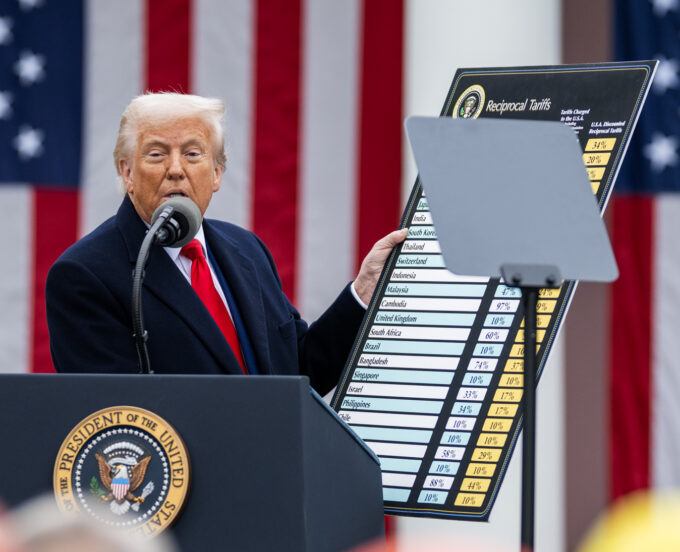
While this system has benefited the U.S. enormously, Trump argues instead that “other countries are ripping off” the US. Trump would like to see the U.S. dollar depreciate — to encourage U.S. exports, and to cut the U.S. trade and government deficits — while maintaining the dollar’s role as the world’s reserve currency. He uses tariffs and threats to withdraw U.S. military protection to get other countries to accept those terms.  Using various trade carrots and sticks, Trump thinks he can make multiple deals with individual countries or groups of countries. He rejects global institutions and multilateral “grand bargains” because he thinks he can win better terms with fewer constraints on U.S. actions.

Whether this is a correct diagnosis of the U.S.’s standing in the global political economy or a correct prescription for what the U.S. should do is beside the point. The WTO has been largely non-functional since the first Trump term as both the Trump and Biden administrations have refused to appoint U.S. representatives to appeals boards who are supposed to resolve trade disputes between the two countries. The current obsession of the U.S. ruling class with a coming conflict with China has augured in an era of protectionism in economic affairs and greater political competition and conflict between the leading powers.

In this environment, Trump’s “America First” and “U.S. against the world” outlook will be tested. Liberals tag him with the 1930s epithet of “isolationist.” But he’s less committed to disengaging with the rest of the world, as he is prepared to throw around the U.S.’s weight to advance its own interests. He has more of a “gunboat diplomacy” nineteenth century colonial/imperial mentality. So, if he thinks that Greenland contains minerals the U.S. wants, or its possession will allow the U.S. to dominate the Arctic, other nations will be wary of the U.S., even if annexing the island appears to be a Trump fantasy. Historically, the “America First” strain of U.S. politics has considered the land mass between the Atlantic and Pacific oceans, from pole to pole, as being fair game for U.S. hemispheric domination.

Consolidating a U.S.-dominated sphere of influence in the region supports “America Firsters’” aggressive posture against other spheres, such as Europe or Asia. This is the twisted logic behind Trump’s pressure on Mexico and Canada, as well as his threats to Panama and Greenland. Trump’s saber rattling against Panama has in March already produced the sale of the canal’s operational contract from the Hong Kong-based CK Hutchinson to a Blackrock-led consortium. Beyond this, Trump has allies among the Latin American far-right, from Argentina’s Milei to Brazil’s Bolsonaro, to El Salvador’s Bukele.

The most shocking development to the foreign policy establishment has been the Trump regime’s shift on Ukraine to an essentially pro-Putin position in enforcing a ceasefire in the war. In February, the U.S. cast an amazing vote alongside such champions of democracy as North Korea and Belarus against a UN resolution identifying Russia as he aggressor in the Ukraine war.

How to explain this? Trump and his MAGA allies promised this, so it didn’t come out of blue. It is part of a piece with Trump’s break with global alliances such as NATO and seeing the EU as more of a competitor than ally. Trump certainly has more affinity with petrostate dictators like Putin or Saudi Arabia’s Mohammed bin-Salman than he has with the U.S’s traditional allies. The administration’s antagonism to Europe appears deep-seated, as Signalgate’s revelations of Vice President Vance’s anti-EU comments showed.

It also appears to fit with Trumpism’s nineteenth century view that great powers have their “spheres of influence” that they carve up between them. So, Russia gets Ukraine. China gets Taiwan. And the U.S. gets Greenland.

Whether this Trumpian shift in U.S. foreign policy will produce the “golden age” that Trump promises is doubtful. But what we can predict is that world politics is entering a much more dangerous and unstable time in which wars, conflict and repression will be more on the order of the day that they have been for decades.

Lance Selfa is the author of The Democrats: A Critical History (Haymarket, 2012) and editor of U.S. Politics in an Age of Uncertainty: Essays on a New Reality (Haymarket, 2017).

Stages of An Abusive Relationship with the United States

 April 11, 2025
Facebook

Image by Basma Alghali.

I believe that countries in the Global South are in an abusive relationship with the United States. We don’t want to be in this domineering cycle of abuse but unfortunately the US government will never cease in its ambition to control our lives and resources, which forces us to endlessly resist its aggression.

Through personal experience I’ve come to recognize patterns of manipulation and coercion and how these are reflected in the wider dynamics of imperialism. More importantly, I am acutely aware of the role played by the enablers who contribute to the perpetuation and escalation of these abuses. US foreign policy cannot exist without the mainstream media peddling it.

An abusive relationship often develops through a series of distinct stages, starting with subtle manipulation by lavishing excessive (conditioned) kindness and attention on the victim. A notable example is the way Washington has been grooming Guyana since the discovery of significant oil deposits in the disputed Essequibo region.

However, the initial charms eventually wear off, especially when the victim becomes uncooperative as was the case in Venezuela when Hugo Chávez came to power in 1998, with a sovereign anti-imperialist project that led to oil nationalization a few years later. With this shift, the US initiated the phases of manipulation, interference, isolation, intimidation and violence—experiences that many countries in the Global South know all too well.

Explaining the full scope of the US abusive tactics against Venezuela would require more than a single article, but to provide a broad overview, we can summarize them as follows:

1) The US has lobbied or coerced governments and multinational organizations into adopting hostile positions against Venezuela. This includes accusing the Venezuelan government of human rights abuses and trying to isolate Caracas in multilateral forums. In addition, Washington has threatened secondary sanctions and import tariffs against countries that do business with Venezuela’s oil and gas sector.

2) Abusers often have their loyal minions who carry out some of their dirty work. From Juan Guaidó’s self-proclaimed interim government to mercenary invasion attempts, Washington has politically and financially supported Venezuela’s right-wing sectors’s coup endeavours.

3) Since 2017, the US has imposed sanctions on the oil industry and other state entities, and seized Venezuelan assets abroad, including US-based oil subsidiary CITGO. This blow ignited the country’s economic and migration crisis. These sanctions, which have led to the death of hundreds of thousands, are the most violent outcome of Washington’s regime change operation against the South American country.

3) US Secretary of State Marco Rubio has threatened military action against Venezuela as Washington sides with ExxonMobil and Guyana to exploit the disputed, oil-rich Essequibo Strip. His statement echoed Trump’s 2019 “all options are on the table” comment. The intimidating talk comes alongside the US Southern Command conducting military exercises in the Caribbean, all while the US has placed a $25 million bounty for the arrest of President Nicolás Maduro.

These abuses against Venezuela have only been possible thanks to the mainstream media’s promotion of Washington’s agenda. In many cases it absolves the US of responsibility for its crimes against humanity, in others, it offers justifications and even support for further crimes.

Enabling abuse

Mainstream media has a long history of promoting negative and misleading narratives about Venezuela, often depicting the Chávez and Maduro governments as corrupt and dictatorial. More importantly, the media downplays the impact of US sanctions, largely disconnecting them from the economic and migration crises that the Venezuelan people have endured—even though these sanctions are the main culprits.

No other outlet does the job as well as The New York Times (NYT). For context, let’s reminisce on the NYT past hits advocating for US military intervention, sanctions, coups and more against countries labeled enemies of the US: “Should the US Intervene in Libya?” (2011), “Bomb Syria, Even if It Is Illegal” (2013), “Stronger Sanctions on Russia, at Last” (2014) and “We Absolutely Need to Escalate in Iran” (2024).

The newest gem to add to this decades-long collection is an article titled “Depose Maduro” written by NYT columnist Bret Stephens and published in January. The piece provides a perfect example of how the media enables Washington’s abusive foreign policy.

Ironically, the article in question advocates for “democracy” while advocating for undemocratic methods. It begins by stating that Maduro should be overthrown “through coercive diplomacy or force if necessary.” Stephens presents this proposal as “morally right” based on what can only be seen as colonial standards, and disregards the “lives lost” from a hypothetical military invasion as long as it overthrows Venezuela’s protagonistic and participatory democracy.

It is difficult to see a truly democratic outcome from such a scenario, especially when US political and military interventions in Latin America have historically propped up fascist dictators who served as US allies in the region, with Rafael Trujillo in the Dominican Republic, the Somoza family in Nicaragua and Augusto Pinochet in Chile being just a few examples.

Stephens even attempts to draw parallels between Venezuela and Panama, praising the 1989 US invasion as a success, conveniently omitting the thousands of unaccounted deaths, the thousands of displaced families and the long-term effects on the country’s economy and sovereignty. Not to mention that Manuel Noriega was on the CIA’s payroll until he no longer conformed to US interests.

The NYT article goes on to repeat the typical falsehoods about Venezuela to justify an invasion, claiming that this would put an end to “a criminal regime that is a source of drugs,” perpetuating the unsubstantiated accusation that the government is tied to drug trafficking. Not only has there never been any evidence to support this accusation, but the US has a long history of using allegations of drug trafficking as a tool for political leverage, particularly against governments that challenge Washington’s foreign policy interests.

But when it comes to lies and half-truths, these statements are particularly disturbing: “Nearly eight million Venezuelans have fled the country since Maduro took power [and] millions are suffering from malnutrition,” meanwhile “punitive” economic sanctions imposed during the first Trump administration “didn’t work,” according to Stephens, pointing to Maduro’s continued rule as proof.

These claims overlook the main culprit: US unilateral coercive measures, commonly known as sanctions, and their devastating consequences.

While it is true that some seven million Venezuelans have migrated over the past decade (according to UN estimates), the flow began to grow in 2017, coinciding with the introduction of the first US sanctions, which led to a dramatic drop in oil revenues and a severe economic contraction. People fled the very conditions created by the US economic siege, with many migrating to the US itself, only to be later criminalized and forcibly expelled.

For the NYT columnist, these tragedies are merely collateral damage. Moreover, he employs a classic DARVO (Deny, Attack, Reverse Victim and Offender) tactic by claiming that these dire circumstances are solely the result of the Maduro government’s actions, thus proposing the final stage of abuse: a military invasion.

A military invasion appears unlikely as the Trump administration seems to be pursuing a repeat of its 2017-2020 “maximum pressure” campaign. Recently, Washington revoked permits that allowed several foreign companies to operate in Venezuela’s oil sector, a move that will ultimately have significant repercussions for the Venezuelan people.

Finally, the NYT article concludes with a question whose obvious answer is conveniently ignored by its writer: “How much more suffering should Venezuelans endure?” Ending US sanctions, halting support for violent coup attempts and not encouraging invasions would undoubtedly alleviate much of that suffering.

Despite ongoing economic challenges and military threats, Venezuela has vowed to continue to recover from its downturn and is advancing its sovereign project. A key aspect of this resistance is the understanding that criminal empires are never to be trusted and that true power and liberation lie in the hands of the people.

Andreína Chávez Alava is a Venezuelan journalist based in Caracas, currently serving as a staff writer for Venezuelanalysis.com

We Need a Trade Policy That Works for People

 April 11, 2025
FacebookTwitter

Photograph Source: The White House – Public Domain

As someone who strongly opposed disastrous unfettered free trade deals with China, Mexico and other low-wage countries, I understand that we need trade policies that benefit American workers, not just large corporations. Targeted tariffs can be a powerful tool to stop corporations from outsourcing American jobs. They can help level the playing field for American autoworkers or steelworkers to compete fairly against companies who have moved production to countries where they can pay starvation wages.

But Trump’s chaotic across-the-board tariffs are not the way to do it.

Imposing steep tariffs on countries like Germany or France will not bring jobs back to America. These are not low-wage countries. Corporations are not shutting down plants in America and moving them to Switzerland. Trump’s blanket tariffs will just raise prices for American consumers and hurt our relationships with allies, undermining our global position.

Trump’s trade chaos – changing policy from day to day – is rapidly undermining our economy and making it impossible for households and small businesses to function. How can you plan for next week, let alone next year, when the rules might change tomorrow? People in my home state of Vermont are hurting.

This is exactly why the Constitution gives Congress sole authority to raise taxes and “to regulate Commerce with foreign Nations,” not the President. What Trump is doing is unconstitutional. Trump has claimed supposed “emergency” powers to bypass Congress and impose unilateral tariffs on hundreds of countries. The last president to try something like this was Richard Nixon, and his overreach prompted Congress to pass the law Trump is now abusing. This is another step toward authoritarianism.

And let’s be clear about why Trump is doing all this: to give massive tax breaks to billionaires. These tariffs will cost working families thousands of dollars a year, and Trump plans to use that revenue to help pay for a huge tax break for the richest people in America. That is what Trump and Republicans in Congress are working on right now: If they have their way on the tariffs and their huge tax bill, most Americans will see their taxes go up, while those on top will get a huge tax break.

Enough is enough. We need a coherent trade policy that puts working people first.

Bernie Sanders is a US Senator, and the ranking member of the Senate budget committee. He represents the state of Vermont, and is the longest-serving independent in the history of Congress.


Tariffs and the Constitution

“No doctrine involving more pernicious consequences was ever invented by the wit of man than that any of [the Constitution’s] provisions can be suspended during any of the great exigencies of government.”
Ex Parte Milligan, Supreme Court of the United States, 1866

President Donald Trump has recently imposed a national sales tax on nearly all goods emanating from outside the United States to be paid by the ultimate consumer. Thus, if you buy a Ford pickup truck in the U.S., because it contains parts from Canada, Mexico and South Korea, according to The Wall Street Journal, it will cost you an additional $3,000. The $3,000 was initially paid piecemeal by the foreign exporters of the parts to the U.S. Treasury as a condition for the parts entering the United States. When you pay the local Ford dealer, you are actually reimbursing the foreign exporters.

The same is the case for a toaster made in China. Last week, that toaster cost $25. Next week, it will cost $37.50, or, if Trump follows through on a threat made earlier this week, $50. If your budget for the toaster is $25 to $30, you probably won’t spend $50. If you do, you will be reimbursing the Chinese exporter for his 100% tariff that he has already paid to the Treasury. Or, you will search in vain for an American-made toaster.

These sales taxes were added to the price of the Ford Pickup and the toaster not by an act of Congress, but by an act of the president alone. Can the president alone impose taxes on the American people? The short answer is: NO.

Here is the backstory.

In 1977, Congress enacted the International Economic Emergency Powers Act. This law permitted the president to impose tariffs on goods emanating from outside the U.S. in the case of an economic emergency. The statute defined an emergency as a sudden and unexpected event that adversely affects U.S. national security or economic prosperity.

Cognizant of the “emergency” trigger for the exercise of this unique power, the Trump administration initially offered that the introduction of fentanyl into the U.S. by foreign persons was the emergency. When advisers related to the president that the tariffs he contemplated would affect dozens of foreign countries producing hundreds of goods and services as to which there is no connection to fentanyl, the administration claimed the U.S. imbalance of trade as the emergency trigger.

The imbalance of trade means that persons and businesses in the U.S. spend more money on the goods and services that they buy from foreign sellers than they receive from sales of goods and services to foreign buyers. The executive order signed last week by Trump reflects that the U.S. has experienced this trade imbalance since 1934! Thus, by definition, it is not a sudden or unexpected event, and thus, it is not an emergency as defined in the statute.

No emergency means there is no lawful basis for Trump’s imposition of the tariffs.

There is also no constitutional basis for the statute. The Constitution reposes the power to tax exclusively into the hands of Congress. The Framers were so determined to keep that power there that they even required in the Constitution that all taxes emanate in the House of Representatives. Since this Trump sales tax emanated in the White House, it violates the Constitution.

Can Congress give the power to tax to the president? In a word: NO.

Congress cannot give away any of its core functions – among which is the power to tax. James Madison, who was the scrivener at the Constitutional Convention in 1787 and, during his lifetime, its most authentic interpreter of what the Framers’ original understanding of the document was, argued that the separation of powers – the Congress sets taxes, the president collects them – was written to preserve personal freedom by preventing the accumulation of too much power in any one of the three branches.

His argument was followed 200 years later by the late Justice Antonin Scalia, who wrote that delegated core powers cannot be redelegated to another branch.

This is an example of why we have a life-tenured and unelected judiciary. It is the anti-democratic branch of government. Its duty is not to reflect the will of the voters, rather to protect their lives, liberties and properties from the popular branches when either of them exceeds the powers granted by the Constitution or tampers with its structure.

Congress can no more allow the president to impose taxes than he can allow the judiciary to command troops in wartime.

But here we are with a pliant Congress, one of whose predecessors gave away limited taxing power to the president, and a president heedless of the Constitution he has sworn to uphold and the federal laws he has sworn to enforce. Can Congress impose tariffs? Of course it can, and it did so as the primary revenue source for the federal government until the War Between the States.

The constitutional trouble comes, however, when presidents argue that it’s time to employ the emergency doctrine. As the Supreme Court has made clear, there is no emergency doctrine. But presidents from John Adams to Donald Trump have argued that “emergency” enhances their powers, and they have argued that they can determine when an emergency arises. This is a trick used by tyrants throughout history.

Congress has defined emergency. It is the duty of the Congress to rein in its wrongful use. This is not a pro-Trump or anti-Trump issue; nor is it a Republican or Democratic issue. It is one of fidelity to the supreme law of the land and to the laws written pursuant to it.

For without that fidelity, we have no democracy, just rule by the contemporary whims of whomever is in the government. One of the complaints that the colonists had about the British Parliament was taxation without representation. Good God, are we back to that?

Andrew P. Napolitano, a former judge of the Superior Court of New Jersey, is the senior judicial analyst at Fox News Channel. Judge Napolitano has written seven books on the US Constitution. The most recent is Suicide Pact: The Radical Expansion of Presidential Powers and the Lethal Threat to American Liberty. To learn more about Judge Andrew Napolitano, visit https://JudgeNap.com.

COPYRIGHT 2021 ANDREW P. NAPOLITANO – DISTRIBUTED BY CREATORS.COM