Friday, April 11, 2025


Britain: Is the working class back?
Published 

New Socialist graphic

First published at New Socialist.

As the welfare state wobbled in the late 1970s, the spectres of rapid deindustrialisation, automation and the parallel explosion of white-collar service work led Andre Gorz to do the unthinkable and question the historic role of the proletariat as the revolutionary subject, the historic force that would bring a new socialist society into being. Shortly after Gorz published Farewell to the Working Class: An Essay on Post-Industrial Socialism, in 1982, Reagan and Thatcher attacked — and then crushed — the most militant sections of the organised labour movement.

Following the destruction of the union movement and the open abandonment of the working class by their traditional political representatives, the working class disappeared from the political scene by (largely) ceasing to vote — in the 2024 General Election, fewer than 50% of working class adults voted, 1 leading to an enormous gulf or ‘void’ between the people on the one hand and ‘politics’ on the other. This void, as Peter Mair argues, is constituted by political parties becoming detached from wider society and their traditional bases. “The age,” he writes, “of party democracy has passed”.2

As the working class exited stage left, a new subject came to take their place. To the extent that ‘politics’ involves any actual engagement with ordinary people outside a technocratic elite, it has been the middle or intermediate classes, not the working classes, who have driven both establishment and insurgent politics since the nineties. Labour’s landslide victory in 1997 had little to do with working class power, but was substantially the result of Tony Blair having won over the lower middle class voters who previously had been the bedrock of Thatcherism.3 Corbynism (like Syriza and Podemos) was, at least in its activist core, the political movement of the younger new petty bourgeoisie.4

The last fifty or so years have arguably been the lowest point for working class struggle and class consciousness since the Industrial Revolution. Gorz’s heretical hypothesis had, until recently, seemed to have been vindicated: the forward march of labour, the inevitable rise of the proletariat, had ground to a halt. Yet class struggle ebbs and flows. As the late, great Mike Davis reminds us, capitalism’s cyclical crises periodically opens (although it can also close off) the possibilities for proletarian advance.5 Organised labour responded belatedly to the interlocking crises of contemporary capital, culminating, in 2022, in the biggest wave of strikes in Britain for 30 years. This period of sustained and coordinated industrial action was itself a significant achievement given the severity of Britain’s anti-union laws and given the traditionally craven and partisan attitudes of the British trade union bureaucracy. At the height of the strikes, Mick Lynch — the de facto leader of the labour movement — famously proclaimed: “the working class is back”.

Given the torrid time the left has had, aspects of the recent strike wave certainly felt invigorating in some ways. Although striking is difficult, it is good and healthy to get away from the sewer of social media, to escape the frustration at the blocked possibilities of electoral politics, and speak to people face to face; to feel and experience the sense of solidarity and comradeship that tends to resurface during strike action. Unionism and strikes can build class consciousness, build new subjectivities, and very often reveal the true nature of class society to those who were previously on the sidelines.

Above all, the strikes were a long overdue — and relieving — reminder that the organised working class retains significant structural power and leverage in society. It still retains the potential to shut down capital and hurt profits. Undoubtedly the recent strike wave was an important period in the class struggle, and will go down in the history of the labour movement in this country. But it is also crucial that we accurately understand the actual ‘balance of forces’ that exist in Britain at present. This is not being miserablist for the sake of it. Corbynism as a movement was defined by naivety. It did not grasp the scale of the challenge it faced or the powerful forces lined up against it. It didn’t even understand the glaringly obvious threat from its own right wing, let alone the power of the British state. Following Lynch’s speech, in the excitement of the early part of the strike waves, some of these tendencies resurfaced: the confusion of political slogans with reality; the desperate longing for a shortcut to power through a charismatic figurehead who will make everything better; a tendency to dramatically overstate the ‘radicalism’ of the present moment and the strength of the trade union movement, best evidenced by repeated calls for a general strike.

For all the positives surrounding the strikes, they were — and are — ultimately defensive struggles. Since the optimism of 2022, hopes that the political left might seize the initiative have ebbed away. In mid-September, after two years of struggle, both the RMT. and ASLEF. voted to accept a pay deal from the new Labour government. In the postal and higher education disputes, workers were forced back to work after accepting ‘deals’ which reduced workers’ terms and conditions. Although the potential capacity of working class power was on display, what was ultimately revealed was the strength and confidence of capital relative to labour in the current conjuncture. Across the board, partnership agreements were torn up. Employers didn’t, as union leaders had hoped, respond to pleas about being reasonable, or fold in the face of bad publicity. Royal Mail, for example, was content to absorb bad publicity (its CEO being humiliated by MPs) and to openly run down the public service in pursuit of its ultimate, long-standing goal — breaking a militant, highly-organised union. Belated threats regarding an all-out strike did not prevent the closure of the Port Talbot blast furnaces, which shut their doors for good at the end of September.

Given the vanguard role played by the CWU over the last 25 years — ‘the miners of the 90s’ — the Royal Mail dispute was a particularly important barometer for understanding the true position of the labour movement in Britain. The scale of Royal Mail’s union busting, and its very real threats to derecognise the CWU, harked back to a different period, and shocked even the most experienced unionists. None of this bodes well for the future of British trade unionism.

The crisis of proletarianisation

Now that the dust has seemingly settled, we can take stock of where we are as a movement. We should return to Lynch’s claim and the questions it raises. Who and what is the working class? Is it back? If it is back, what should we do? If it isn’t, then what next? Who is the revolutionary subject that will carry out societal change?

Much of the modern discourse around class is focused on class in itself; i.e. determining what a class is ‘objectively’, or mapping out what the different classes are and who belongs to which class. It tends to neglect the crucial idea of class consciousness (or class for itself). It is one thing to just describe the working class and their hypothetical potential size and power, but another entirely to think about the conditions and institutions which produce the thorny (and much-debated) process of transubstantiation from merely existing to acting as a collective, coherent and revolutionary body.

As Richard Hoggart argued, in The Uses of Literacy,6 socialist intellectuals have a tendency towards hagiographic portrayals of the working class’s revolutionary tendencies. But romantic, sepia imagery of mining, manufacturing and the welfare state obscures a confrontation with reality: that the working class has been recomposed (or more accurately, decomposed). The era of ‘the job’ (in the sense of steady, secure ‘collectivised’ waged work) seems to be over. It makes more sense to think of the period between 1945-1979 as a historical anomaly, a blip that is not coming back. And as the world of work has changed, so the idealised proletariat of the bygone era is also not coming back, either in appearance or behaviour.

Not only has the working class shrunk in size, it is currently hopelessly divided and scattered by the modern labour process — by short-term, part-time contracts, bogus self-employment, and modern forms of piecework, now carried out by a growing lumpen strata. On top of this, working class communities, and the institutions which historically sustained working class culture and political class consciousness beyond work — sports clubs, libraries, community halls — have similarly been destroyed, very often (of course) by Labour-run councils. The way we work and live is becoming increasingly fragmented and isolated. As Anton Jaeger argues, we live and work more and more like Marx’s French peasants, as ‘potatoes in a sack of potatoes,’ whose relation to their mode of production isolates them from one another.

Changes to work, to communities, to how we live, matter because class consciousness — or coherent politics — does not simply emerge from being poor, however much we might want it to. It requires conscious, boring, long-term organisation, and to be scaffolded by institutions. If we understand proletarianisation purely as ‘lots of people are getting poorer’ or becoming deskilled and stripped of their autonomy, then optimistic accounts of how ‘the working class is growing’ as more and more professionals and white-collar workers slip into it make perfect sense. This understanding of proletarianisation stands behind the discourse of ‘the 99%’ or the wage-earner thesis: the idea that society is polarising into two camps, and that deskilled and degraded professionals and white-collar workers like junior doctors and early career academics can now be identified as part of the working class.

But if we understand the concept of proletarianisation as Mike Davis interprets it in Old Gods, New Enigmas, as the social process of transubstantiation by which workers developed a collective conscience (whereby workers are concentrated in greater masses in workplaces, where they ‘feel their strength more’, and where they get organised) then what is happening under neoliberalism — not just in the developed world, but to a large extent across the globe — is in fact a ‘crisis of proletarianisation’.7 Alejandro Portes and BR Roberts have similarly argued that the rise in the informal, grey economy and of bogus self-employment represents a global trend of ‘deproletarianisation’, as we move away from ‘collective’ workers concentrated in larger workplaces.

In previous epochs there were always sectors and groups which union organisers regarded as impossible to organise. Today, with work and social life fragmenting into isolated bubbles, much of the workforce occupies similar conditions. While workers are becoming poorer and deskilled, they are also becoming harder to organise, and the capacity for class consciousness and coherent action as a collective is declining. Even in our remaining huge workplaces — for example Amazon warehouses — the workforce is transient and vulnerable, and hence the noble efforts to organise these sectors have thus far come to nothing. Davis uses the metaphor of a ‘power grid’ to describe the modern working class, with the organised, class-conscious workers as the core which keeps the grid powered and which provides the main challenge to capital.8 Today, workers like the RMT and the CWU are the ever shrinking, flickering core — an ideal type of politically educated, motivated, experienced and disciplined worker which also has leverage in key industries (and this is precisely the reason they were targeted by the Government) — but the rest of the grid is dimly illuminated indeed. Despite public support for the strikes, union density continues to fall. Among the 27 million workers in the private sector, only 12% are unionised. Unions are now more popular among foremen and supervisors than workers. In most industries, and in former trade union heartlands, union density is falling.

Today, most working-class people are not in unions — many people don’t know what they are: the political culture and residual familial links to unions have largely disappeared. Even in the vanguard industries and unions, something akin to a blood transfusion is taking place, with older, militant workers leaving en masse, being replaced by younger workers on worse terms and conditions — meaning less security, and so less capacity to act — and with less awareness of their rights and the role of unions.

Modern class politics: Anger without organisation

Under conditions of fragmentation, class politics takes on incoherent forms. Most people possess an enduring class identity as well as class instinct — the ‘muscle memory’ and knowledge of what class you are in, an innate dislike of the bosses, and a feeling of unfairness. The majority of people still identify as the working class or ‘the people’, and understand that society is unfair and that social mobility is a lie. Moreover, Resistance is still widespread, but as Daniel Zamora notes, this now tends to be individualised rather than collective: walking off the job, quitting, sickness, etc. We have class struggle, but an atomised form, which allows the status quo to continue.

Without the direction and ‘discipline’ that was previously provided by mass parties and unions, and with the right frequently, however disingenuously, speaking the language of class better than the left, class politics no longer takes the forms we are used to. As Sherry Ortner argues, class is increasingly hidden in other issues, and popular anger is frequently being harnessed by right wing forces. This is clear in the rise in conspiracy theories and in the uptick in non-unionised, anti-state, anti-globalisation protests such as the Gilets Jaunes, the Canadian Trucker Protests, and the rise of farmer protests across Europe. Modern class politics is coalescing into an often chaotic but deeply- rooted (and justified) anti-statism and anti-liberalism among growing sectors of the population that feel ignored, silenced and angry.

The class structure under neoliberal, deindustrialised capitalism increasingly mirrors the complexity of the historical period during the messy initial transition to industrialisation: a mélange of rootless seasonal workers, artisans and hand-workers in cottage industries — semi-proletarians — before industrial factory workers emerged as the idealised vanguard. And just as the class structure has returned to the period immediately preceding the Industrial Revolution, so class struggle increasingly mirrors the dangerous unpredictability of early semi-proletarians. Influenced and moulded by peasant and artisan culture, this group was simultaneously deeply radical yet also unpredictable, spontaneous and violent, acting without the ‘discipline’ of the industrial unions, and often combining composite elements of radicalism and national chauvinism. Yet of course, whether one is a revolutionary agent has nothing to do with one’s individual politics, but is about one’s actions vis a vis the status quo.

Such is the scale of the proletarianisation crisis that Davis wrestles with the idea — raised by Hobsbawm and, of course, Gorz — of whether there is even a historical agent or force that still exists to support socialism in the modern period. If there is still something approaching the idealised proletariat, then it is in militant workers like the RMT and the CWU; but they are outposts, anomalies. ‘The working class’ of course remains, as a cultural category and identity — but is increasingly not the ‘idealised’ factory proletariat of sepia-toned nostalgia, and we also cannot guarantee whether its instincts will align with ‘left’ values.

What next? Organising during times of chaos

Broadly, there are two possible responses to these changes. The first is aiming for renewal: organising and rebuilding within this new society, using the tools and methods of the past in order to try and achieve what was achieved in previous decades — a mass trade union movement, strong communities with anchor institutions, a new mass left party with roots in these communities. Moulding the new, inchoate class structure into the ideal proletariat would require (at least) a decades-long programme of deep organising : new unions, new community institutions, new parties. I would imagine this is the vision of most socialists who are now thinking of a new left party. But is this realistic, or even desirable? The scale of the work needed may simply be too great, which may explain the emergence of a strain of nihilism and despair among some sections of the left, and, from others, the tendency to stick with the shortcut of the Labour Party, or to imagine that a new left party, without any of the limits of Labour, can easily be formed. I have a recurring, nagging feeling that we may be trying to force the new, changed society into forms of organising and praxis that were developed in and for a different period, and which were never successful anyway. The objective basis for these forms of politics may well be past. Perhaps we need to relieve ourselves of nostalgia for that kind of politics, as well as the perennial nostalgia for an older form of working class life of the kind that Hoggart critiques.

We must also reflect on whether we are in fact pining for a past that never was: one could certainly argue that, barring 1926 (the impact of which has itself been overstated), movements comprised of the ‘ideal’ proletarian subject were never as revolutionary or oppositional as is commonly claimed, and of course have often been unsuccessful and unpopular. David Edgerton and Ross McKibbin have repeatedly pointed out that the British socialist movement—or at least its parliamentary form—never commanded the broad electoral support of the majority of workers.

Indeed, as Craig Calhoun famously noted, throughout history, community-based social movements have existed alongside ‘pure’ class-based movements. These movements, which we would today call ‘populist’, were often far more radical in their demands and actions than the ‘ideal’ organised class-based movements. In Britain, the first wave of the Industrial Revolution—a period of proto-industrialisation—represented the most dangerous period for the British state: the Merthyr rising, the Chartists, Peterloo. This period of social insurrection was not led by ‘the proletariat’, but by a mixture of artisans, farmers, and semi-proletarians.

In fact, across the world, the majority of social change and protest has never in fact been led by the ‘proletariat’, but by cross-class movements in which ‘class’ alone has never been the sole locus. This was the case in national liberation movements, including the Cuban revolution; in race- and gender-focused civil rights movements across the West; and in recent years has also been the case for the Arab spring. Today, environmental movements and pro-Palestine movements have been far more willing to take on the state and imperialism than the union hierarchy, using innovative forms of direct action which replicate the disruption of strikes. Whilst sometimes incoherent, many of these movements have been more ‘oppositional’ vis a vis capital and the state than purely class-based movements. Indeed, the ‘discipline’ of the formal, organised, class-based movements has often acted as a dampener on action, tending towards a narrow ‘trade union consciousness’ and compromise through the incorporation of the unions and social democratic parties into the state, including into the imperialist state. This is not to claim that these movements or intermediate classes are innately more revolutionary or progressive, but rather to say that there is clearly no perfect revolutionary subject or method of organising: proletarian movements have failed, and so have non-proletarian ones.

The class structure has changed, and so has the ‘revolutionary subject’. But rather than despair, there is cause for optimism. The problem is not with ‘the people’: there is widespread hostility to the state, to politicians, and to war, and mass support for redistributive politics. Perhaps we should not try to go back, to use the rigid tools of the past for a changed, chaotic class structure; to try and cram the existing, chaotic class society into outdated political categories, frameworks and organising methods developed for a simpler class society. The task facing us now is to find the right tools with which to organise, and to discover how to embed ourselves in a milieu with which we are not familiar.

Dan Evans is a writer and academic based in South Wales. He is the author of A Nation of Shopkeepers: The Unstoppable Rise of the Petty Bourgeoisie (Repeater, 2023).

  • 1

    The IPPR’s report “Half of Us: Turnout Patterns At the 2024 Election” found that 52.8% of the working age population voted in 2024 (this is lower than the 59.9% “turnout” figures which account for the percentage of registered voters). The report also found that “the less wealthy” were significantly less likely to vote. Other work by the report’s authors, shows a widening turnout gap between the university and non-university educated, between top and bottom income terciles, and between homeowners and renters. Whilst none of this can precisely be treated as a proxy for “class”, the classed tendencies ought to be clear.

  • 2

    Peter Mair. 2013. Ruling the Void: The Hollowing of Western Democracy. London: Verso, p.1

  • 3

    For Blair’s success in winning over lower middle class voters see Robin Blackburn’s 1997 NLR essay “Reflections on Blair’s Velvet Revolution”.

  • 4

    I argue this in more depth in my 2023 book, A Nation of Shopkeepers: The Unstoppable Rise of the Petty Bourgeoisie. London: Repeater, p.77, 279

  • 5

    Mike Davis. 2018. Old Gods, New Enigmas: Marx’s Lost Theory. London: Verso, pp.25-33

  • 6

    Richard Hoggart. [1957]. 1958. The Uses of Literacy: Aspects of Working Class Life. Harmondsworth: Pelican, p.14

  • 7

    Davis. Old Gods, New Enigmas, pp.5-6

  • 8

    Davis. Old Gods, New Enigmas, p.24


Turkey: Political crisis and democratic movement


Published 

Protest in Turkey

First published in French at Contretempes Revue de Critique Communiste. Translation from International Viewpoint. Edited for clarity.

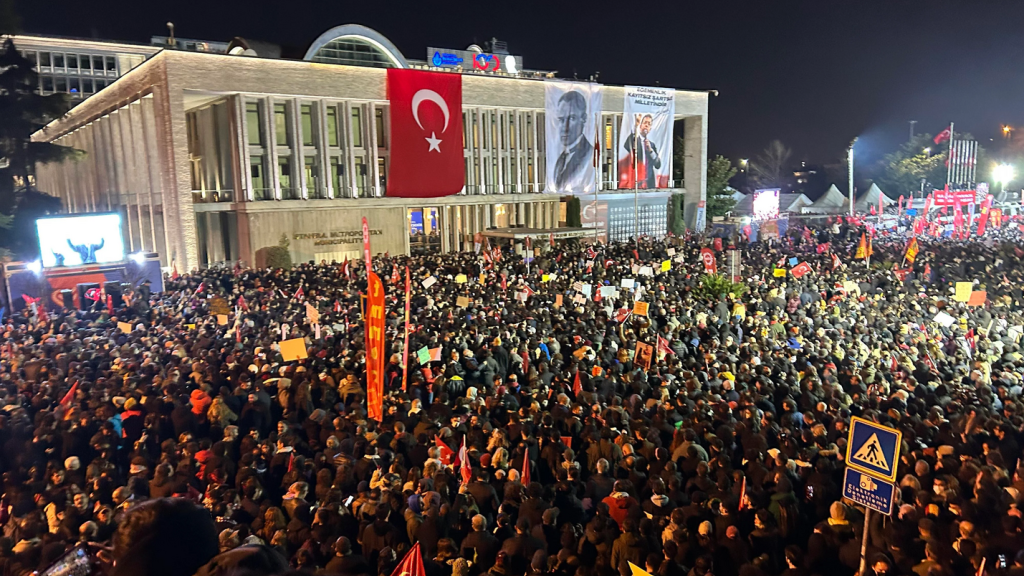
The mass democratic movement in Turkey following the arrest of Ekrem ImamoÄŸlu, mayor of Istanbul and candidate of the centre-left Republican People’s Party (CHP), is a major social and political event on the doorstep of the European Union. Rallies and demonstrations are taking place throughout the country, with very large turnouts, particularly in Saraçhane Square in Istanbul in front of the town hall.

The hardening of the Recep Tayyip ErdoÄŸan regime, which crossed an unprecedented red line with this arrest, coincides with the information from recent months on a peace process initiated with the Kurdish national movement of Turkey, in particular the central political-military organization within this movement: the Kurdistan Workers’ Party (PKK). It is a question of understanding this context, with two seemingly contradictory dynamics, to grasp the potentials and pitfalls this ongoing movement faces, the consequences of which would be very risky to predict at the time of writing.

From one election to another

It is important to remember one fundamental fact: elections in Turkey have so far been competitive and attract very strong civic participation from a highly politicized society. I have previously referred to a “minimal but solid democratic culture” among the Turkish population of Turkey. It is true that this has not prevented the majority of the population from remaining generally passive about the deeply unequal conditions of elections, not only in socio-economic terms, as in any liberal democracy, but, above all, in terms of direct and indirect repression against opposition forces, especially if it affects the Kurdish minority, which experiences colonial oppression.

This population has thus accepted — without necessarily approving, but at least acquiescing to — that the results of the past two local elections in Kurdish localities have been, for the most part, annulled and that, in a purely colonial logic, elected mayors have been imprisoned and replaced by administrators appointed by the government. This culture, however, also leads to granting crucial importance to competitive elections as a “justice of the peace” to determine the direction of the state, with many heavily investing in these issues. Proof of this is that the participation rate in an election has never fallen below 76% (a figure not subject to fraud, as voter mobilization has been systematically observed) and has been regularly above 85% for 45 years.

After the resounding failure of the 2023 general elections, which saw the re-election of ErdoÄŸan and a weakened but renewed majority, the CHP decided to hold a congress, with Kemal KiliçdaroÄŸlu at its head who, faithful to the tradition of his party’s leaders not to accept any failure, was preparing to be re-elected party president. However, the shock of the failure, and the calamitous management of the period between the general elections and the congress1 caused him to lose large part of his political credibility. This resulted in an unprecedented electroshock within the CHP, with the formation of an opposition of “renovators” grouped around the mayor of Istanbul elected in 2019, ImamoÄŸlu, and his ally, parliamentary group chairperson Özgür Ozel.

In November 2023, for the first time in a century of the party’s existence, an incumbent party president was defeated at a congress and the CHP was taken over by the duo of Özel, as president, and ImamoÄŸlu, the main public figure. What changes has this new leadership of “renovators”, coming nonetheless from the apparatus, implemented? Essentially two. On the one hand, greater professionalism in the leadership of the party, and the shaking up of a heavy apparatus with 1.5 million members. On the other, a more explicit opening towards the Kurds of Turkey. The new leadership refuses to ostracize the DEM (People’s Equality and Democracy Party, born from the Kurdish national movement and democrats), and ImamoÄŸlu considered, for example, during a public debate that it would be “madness” to consider a party that received 5 million votes as “terrorist”.2

It was with this renewed team that the CHP approached the 2024 local elections, which ErdoÄŸan had pledged to win on the very evening of his re-election, with the particular aim of recapture Istanbul. Opposition analysts did not approach this election with much hope, the main focus being on preserving the gains of 2019. The surprise was the opposite of that of 2023: a huge snub for the regime and a resounding success for the CHP, symbolically taking the lead in the poll.

For his part, ImamoÄŸlu easily outstripped his AKP opponent and secured a large majority in the municipal council (which he had not previously enjoyed). The momentum of the CHP apparatus happen to combine with the end of the regime’s countercyclical measures in favour of a classic austerity policy and, to a certain extent, the exposure of the regime’s hypocrisy on the Palestinian question, with business circles close to the government trading with Israel (and even its army).

The situation thus seems to have become clearer over the past year: the CHP is the country’s main political force and, in ImamoÄŸlu, it has a popular candidate capable of defeating ErdoÄŸan. This poses an immense danger for a regime whose leaders derive considerable personal benefits from their hold on political power.

A peace process?

It is in this context that the “peace process” comes into play. It has taken an unexpected form: Devlet Bahçeli, the old leader of the ultranationalist Nationalist Movement Party (MHP) which is allied with ErdoÄŸan, put forward the proposal for a process leading to the disarmament and dissolution of the PKK, in exchange for an amnesty including for the historic PKK leader, founder and emblematic figure, Abdullah Öcalan, detained on the island prison of Imrali for 26 years.

A process of exchanges and negotiations began, including meetings between government officials and a delegation of DEM MPs acting as intermediaries with Imrali and Mount Qandil in Iraqi Kurdistan, where the PKK leadership is located. This culminated in Öcalan’s “historic” February 27 declaration, calling for the PKK to lay down its arms and dissolve.

Three weeks later, the ErdoÄŸan regime decided to cross a line that had never been crossed before: preventing an opponent from running in the presidential election. This first resulted in the cancellation of ImamoÄŸlu’s degree, decades after he had received it, as, according to the Turkish constitution, a university degree is a prerequisite for running in the presidential election.

This decision was immediately followed by his arrest, along with that of a large part of his general staff, for corruption and support for terrorism (classic regime accusations against its adversaries). The timing of this operation was not due to chance: scalded by the catastrophic sequence of presidential candidate selection during the 2023 election, the CHP held its primary on March 23 to designate its candidate for the next election, with the only candidate being ImamoÄŸlu.

How can we understand the concomitance between this “peace process” and this authoritarian offensive targeting a Turkish centre-left party? It is possible to make a hypothesis and an observation about the reality of this “peace process”.

The hypothesis is that, faced with the greater than ever risk of losing power to the CHP, the regime decided to criminalize it, counting on divisions that would arise within it. However, since the operation is on such a large scale (it concerns the party ruling the largest cities in the country), it could involve separately resolving the other major issue — the “Kurdish question” — in the expectation that the Kurdish national movement would remain neutral in the face of the criminalization of the CHP and prioritize the “peace process”. However, assuming this is the motivation behind the large-scale manoeuvre initiated by the regime, it has only encountered major obstacles, the first being the very situation of the “peace process”.

Indeed, Öcalan’s spectacular statement was widely commented on in the international media, but which omitted a detail: after reading Öcalan’s text at a media conference, the delegation of DEM MPs added verbally: “A. Abdullah Öcalan then told us: ‘Without a doubt, the disarmament and self-dissolution of the PKK will require in practice the recognition of civil politics and a legal dimension’.” This “footnote,” considered as part of Öcalan’s statement by the entire Kurdish national movement, obviously changes the situation since it is no longer a question of unilateral self-dissolution but of an option conditioned by counterparts, namely tangible democratic guarantees.

But this is where the problem lies: there has been absolutely no positive political gesture towards the Kurds since the beginning of this “process”. Not a single Kurdish locality placed under guardianship has had its legitimate mayor reinstated, and no mayor imprisoned during the past two mandates and no political leader of the DEM (and its predecessor the Peoples’ Democratic Party, HDP) has been released. When ImamoÄŸlu was arrested, there was certainly a “peace process” underway, but without the slightest concrete progress on the part of the Turkish government.

That makes Devlet’s March 21 statement all the more astonishing, in which the ultranationalist leader proposed that a PKK congress to self-dissolve be held on May 5, in the territory of the Turkish state, in Malazgirt, with the logistical assistance of the local DEM mayor. It is difficult to imagine the PKK General Staff coming from Mount Qandil in a little over a month without the slightest guarantee of any kind (neither political nor otherwise) and laying down their arms to leave with their hands in their pockets. Especially since the other part of Bahçeli’s statement was a very violent attack against the CHP (of which the MHP was an ally 10 years ago, before allying with the AKP), criminalizing the Turkish centre-left party with formulations that hardly allow the possibility of a democratic evolution to transpire.

Kurdish leaders (whether civilian politicians with the DEM, the PKK’s political-military apparatus, or others) are aware that this lack of democratization makes any peace process more than precarious. They cannot fail to remember that the previous peace process in 2015 was suddenly thrown in the dustbin by ErdoÄŸan, who even denied its existence afterwards. The legitimate mistrust of the DEM leaders was summed up by its co-president, Tülay Hatimogullari: “Who says that tomorrow we will not be prosecuted because of our meetings with Öcalan as part of the delegation for the peace process?”

ErdoÄŸan’s failure

Consequently, since the beginning of this crisis, DEM has maintained a principled position of defending the peace process and democratic rights as a whole, far from the stereotypical and baseless accusations made by nationalist opposition circles that it is giving ErdoÄŸan a free hand in exchange for peace. DEM’s leadership supported ImamoÄŸlu during the cancellation of his diploma and subsequent arrest, and also met with CHP leaders at Istanbul City Hall, which has become a rallying point for the opposition. The party’s Istanbul branch called for people to go to Saraçhane Square, where Istanbul City Hall is located and where huge rallies have been taking place since ImamoÄŸlu ’s arrest.

Even more symbolic were the Newroz festivities, a holiday traditionally celebrated by the Kurds and an annual gathering of the Kurdish national movement for mass meetings. The Newroz celebration in Amed /Diyarbakir is considered a very important political moment. However, contrary to expectations, there was no new message from Öcalan read from the podium, as the DEM delegation was prevented from meeting him, which is a definite setback for the peace process.

DEM co-chair Tuncer Bakırhan’s speech was highly anticipated. He targeted the regime by declaring: “What is being done to the opposition is contrary to the spirit of [Öcalan’s] February 27 statement and is unacceptable,” after explicitly denouncing ImamoÄŸlu’s imprisonment. All this is in line with DEM’s position from the start, but it is likely that the regime was hoping for a more “neutral” statement.

The regime’s divisive manoeuvre seems to have already failed, largely due to the lucidity of the DEM leaders. It should be noted, however, that the CHP leaders also sought to rise to the occasion by not leaving the hand extended by the DEM leaders hanging in the air. Özel also sent a statement for Newroz (a first for a CHP chairman): “These lands are ancient lands where different cultures, languages and beliefs live together in brotherhood, where solidarity and hope flourish. No tyrant, no Dehak3 will be able to break our brotherhood!” 

He concluded his text with the traditional Kurdish slogan: “Newroz piroz be!”

He later greeted a large number of political prisoners, including former HDP leaders. Similarly, in a statement written in detention and published on social media, ImamoÄŸlu said: “As long as the Kurds say there is a problem, then there is a Kurdish problem.”

Mobilized youth and CHP

Since the beginning of the movement, the CHP has also sought to establish a link with mobilized society, unlike what happened during the last democratic mass movement that Turkey experienced in 2013 (the so-called Gezi movement). In addition to an open discourse towards the Kurds, its leadership formally recognized the importance of students in this mobilization by offering them a platform in Saraçhane Square.

Indeed, student youth constitute the vanguard of the movement. This is recognized by all actors, whether the CHP or the personalities, artists, athletes and media celebrities who all refer to the importance of the country’s youth in their declarations of indirect or explicit support for the movement. It is also “recognized” by the regime, with the repression primarily targeting them. For example, at the time of writing, Selinay Uzuntel, a student leader who spoke in Saraçhane Square on behalf of the struggling students (and also a member of the Labour Party (EMEP), a Marxist-Leninist with Hoxhaist tendencies) has been arrested along with other student leaders.

There are 7 million students in Turkey, representing 8.2% of the population (compared to 4.4% in France). These young people have only known the AKP in power, in its corrupt and nepotistic version. They study but cannot hope to find a career path in most cases. Faced with arbitrary power structures, the vast majority would like to live abroad if they could. They witness daily the immense gap between the virtues advocated by the regime and the ostentatious and arrogant cynicism of those who benefit from it.

Some remember the older brothers and sisters who “made Gezi,” despite having to confront arbitrary and intrusive authorities. Twelve years ago, a young comrade told me during the Gezi movement: “Being young in Turkey means being yelled at by ErdoÄŸan on television every morning and night." This striking phrase is more true today, even as the regime loses more legitimacy each day.

This vanguard role of student mobilization goes hand-in-hand with a desire for autonomy. Thus, for the first time in Istanbul, on March 24, there was a separate rally called by struggling students in Besiktas, not Saraçhane. Earlier in the day, “academic boycotts” (the equivalent of “student strikes”) were launched at many universities.

Returning to the CHP, it successfully conducted its primary, but opened it up to all citizens who were able to participate in “solidarity” votes. The CHP leadership announced the colossal figure of 15 million people who participated in the polls (the vote was not electronic) for a primary that became a plebiscite. It is impossible to confirm this figure, as no media outlet with sufficient resources was authorized by the regime to cover this event.

Nevertheless, local media coverage indicates participation was strong. While the weakness of the labour movement, difficult living standards, and obstacles to organization make a huge strike seem out of reach, the CHP has called for a boycott of certain economic groups and media outlets. Since the beginning of the movement, the regime has spent 11% of its foreign currency reserves ($20 billion) to prevent a collapse of the Turkish lira, while the Istanbul stock market has recovered after an initial collapse.

Saraçhane rallies are colossal, but will they be able to maintain this pace if there is no progress? Neighbourhood assemblies have already been set up in Istanbul, if only because Saraçhane is far for millions of residents of this vast metropolis. It is impossible to predict the future of the current movement, but it is possible to address some of the contradictions within it.

Kemalism versus Kemalism?

From this polyphony proclaiming its aspiration for the unity of the people beyond its traditional divisions and its relations of oppression, however, rises a dissonance which does not cover the other sounds but cannot be ignored either: that of Turkish supremacism. Although there are other ultranationalist soloists in opposition to ErdoÄŸan (the leaders of the Iyi, the “Good Party”, or the neo-fascists of the Victory Party, ZP), the most strident sound is produced by the CHP mayor of Ankara, Mansur YavaÅŸ.

A former ultranationalist leader who joined the CHP, he won the Ankara mayoralty in 2019, at the same time as ImamoÄŸlu won in Istanbul. He then confirmed his victory by crushing his AKP opponent in 2024. During his speech in Saraçhane, he denounced a “double standard” against the demonstrators in Istanbul while a “party in the East of the country” organizes rallies (Newroz) in which a “rag” (Kurdish/PKK flags) are waved and where cotton candy is offered to young people (in reference to a widely circulated video of a police officer distributing candy to children in a Kurdish locality on the occasion of Newroz) while “here” (in Istanbul or Ankara, but the subtext being “Turks”) “young people are being beaten up.”

This crude discourse equates a micro-event with decades of colonial oppression and reverses historical roles. Insensitive to any prospect of peace, it wants to maintain the supremacist status quo, that is, democracy only for Turks, and therefore ultimately no democracy for anyone. This discourse is not that of the movement’s leadership, especially since YavaÅŸ, as a defector from another party, has never had powerful networks in the CHP (which was capable of having this kind of discourse in its worst right-wing periods), but it exists.

Behind Yavas stands the nationalist opposition milieu of the small parties mentioned above, but also some other mayors, such as Tanju Özcan in Bolu and Burcu Köksal in Afyonkarahisar, as well as other CHP cadres. They not only represent a risk of deviation for the movement, they weaken it. Because of YavaÅŸ’s speech, Özel was booed during her intervention at Newroz in Istanbul. As a shrewd politician, ErdoÄŸan did not fail to denounce YavaÅŸ’s remarks to present the current movement as that of the enemies of peace and supporters of the status quo.4

Any observer of the current movement will notice the portraits of Mustafa Kemal Atatürk accompanied by Turkish flags that abound at rallies and demonstrations. The same was true in 2013 for the Gezi movement. Even among the youth, the mobilization is justified by some students and by a large number of those who support them by mobilizing the figure of Atatürk, with many extracts from his “Speech to Youth”, or from his “Great Speech” entrusting the Republic to the youth, or simply raising his slogan “sovereignty belongs without condition or restriction to the nation” (as opposed to a single individual, ErdoÄŸan).

The use of the tutelary figure of the founder of the Republic of Turkey legitimises an oppositional discourse, situating it in a patriotic continuity while mobilising it for something else. What is retained from the argument is what can be linked to a collective sovereignty, on the one hand, and, on the other, to the historical mission of Turkish youth, thus validating the discourse carried today concretely by this youth. Just as during the Gezi movement, but even more explicitly since it is a question of opposing an operation explicitly calling into question an electoral process (whose importance in Turkey was previously mentioned), Atatürk is mobilised for a democratic aspiration.5

This is, at bottom, a form of performative discourse in relation to the past: if Atatürk entrusts the Republic to the youth, it is because this Republic and the gesture of the war of liberation carry within them our democratic aspiration. Özel does not proceed any differently when he proclaims: “These lands are ancient lands where different cultures, languages and beliefs live together in brotherhood”, while these lands experienced the Armenian genocide and the wealth tax law6, even before the colonial oppression of the Kurds. But, since the objective now stated is an inclusive republic, it is appropriate to reinvent a past that corresponds to it and a fidelity to Kemalism that validates the political aspirations of the day.

In the face of this, YavaÅŸ lies about today’s social relations by presenting the Kurds as privileged compared to the Turks oppressed in their own country. But he is faithful to the practical content of genuine Kemalism, the product of a war of national liberation that was heroic while refusing to recognize Turkey’s national plurality, forgetting the promises made in this regard, repressing the Kurdish revolts and quickly putting an end to any form of controlled political pluralism.

There is, however, little doubt that for the radical left organisations involved in the mobilisation — and some of them are playing a role of catalyst among the youth, such as the Workers' Party of Turkey (TİP), which has four members of parliament, one of whom is in prison —that the priority is not to give a history lesson but to push the movement forward in concrete terms, since “every step forward in the real movement is worth more than a dozen programmes”, as Karl Marx said, or a dozen history lessons.

The function of the lie of the mass democratic movement is to pave the way for confronting historical truth in order to deepen democracy and, as a class struggle strategy, remove divisive weapons from the hands of the bourgeoisie. But we are still far from that. Today, every step taken by a student demonstrating for respect for democracy in the conservative stronghold of Konya is more precious than these considerations. Our support must not fail them.

  • 1

    For example, he declared that he had concluded a secret agreement with the ultranationalist Ümit Özdag of the Victory Party (ZP), whose candidate had finished third in the first round with 5%, which, going beyond their official agreement, made huge concessions to this party. An agreement was concluded without the knowledge of his own staff, even though the ZP is deeply hostile to the Kurds, who had overwhelmingly voted for Kemal Kiliçdaroğlu. The latter achieved the feat of having reaped both dishonour and defeat.

  • 2

    There had been timid advances in this direction by Kemal Kiliçdaroglu before he decided to betray the Kurds between the two rounds. It must be remembered that the CHP has come a long way in this area since, under the sinister leadership of Deniz Baykal between 1995 and 2010, its discourse was scarcely different from that of the ultranationalists of the MHP.

  • 3

    Evil tyrant in Kurdish mythology

  • 4

    He also accused the protesters of ransacking a mosque and drinking alcohol there, repeating a classic slander propagated by the regime since 2013.

  • 5

    In a way, there is a similarity with the students of the 1960s who began their political journey with Kemalism, insisting on the deepening of independence, then dug the furrow of anti-imperialism and sailed towards the shores of Marxism (or rather of various Marxist currents).

  • 6

    Discriminatory provision of 1942 against non-Muslims, establishing a de facto wealth tax at exorbitant rates for these categories in order to ruin the Armenians and constitute a Turkish and Muslim bourgeoisie in their place.