Friday, April 11, 2025


Danger in Trump’s Mind


On 7 April, a Mondoweiss headline ran as “Trump announces surprise Iran talks during Netanyahu meeting.”

United States president Donald Trump had met with Israeli prime minister Benjamin Netanyahu to discuss “Gaza, tariffs, and the alleged nuclear threat of Iran.” As for the latter, Trump said that the US is having direct talks with Iran on nuclear weapons and announced that there would be a “very big meeting” with important officials on April 12.

Said Trump: “I think everybody agrees that doing a deal would be preferable to doing the obvious.”

What is the obvious? If one abhors war and wants to avoid it, then it seems the obvious thing to do is to stop bullying Iran, stop provoking it, and stop issuing threats and engaging in belligerent rhetoric.

Trump continued: “And the obvious is not something that … we’re going to see if we can avoid it. But it’s getting to be very dangerous territory.”

Dangerous? How so? Just on Trump’s say-so? One would presume that Iran having nuclear arms is what Trump considers dangerous. If so, then what is the nuclear-armed Israel that Trump openly courts, funds, and fetes compared to Iran whose supreme leader Ali Khamenei issued a never-rescinded fatwa against acquiring nuclear weapons decades ago? How dangerous is Iran, which has avoided war for several decades, in comparison to Israel which is perennially provoking and at war with its neighbors, and is in the midst of a scaled-up genocide? Professor Gideon Polya writes of the “the US-backed, Zionist Israeli mass murder of about 0.6 million Indigenous Palestinian[s]” — a number elided by legacy media. Why has Trump not described Israel as “dangerous”? And why isn’t the US dangerous since it has been constantly at war since its inception, and it is the only country that has used nukes against another nation?

Trump: “If the talks aren’t successful with Iran …”

But US nuclear talks with Iran already were successful. The Obama administration already achieved what constitutes a successful nuclear deal with Iran — the Joint Comprehensive Plan of Action (JCPOA) — since the deal was agreed to by both sides. It was the Trump administration which scuttled the deal, i.e., reversed a success. So the current situation exists because Trump undermined a previous deal, and the very fact that a deal was reached should be considered a success.

“… I think Iran is going to be in great danger,” Trump continued. “And I hate to say it, great danger, because they can’t have a nuclear weapon. You know, it’s not a complicated formula. Iran cannot have a nuclear weapon. That’s all there is.”

That is hardly a compelling argument. Because Trump says so. He may point to the Nuclear Nonproliferation Treaty (NPT), but the US is also non-compliant with article 6 of the NPT.

Which nation is dangerous?

It is Israel and the US that are committing genocide in Gaza; Iran is not committing a genocide. Moreover, if you try to stop the genocide, then Trump will bomb you, civilian housing or not, as is the case in Yemen.

It is Israel murdering paramedics, covering up its crime, and lying about it.

It is Trump and Netanyahu’s aggressive moves toward Iran that are dangerous.

Indeed, an Israeli official said that Netanyahu wants “the Libya model” in Iran, which would require a complete tearing down of Iran’s nuclear program.

What was the outcome of the Libya model? Libya was disarmed, and the US and its Nato followers destroyed Africa’s wealthiest country, turning it into a dysfunctional state. That is likeliest the result that Israel wants for Iran.

Is the world to be based on inequality among its nations? If not, then a progressivist principle holds that each nation has an inalienable right to self-defense. One way to avert war is to balance the power. North Korea knows what happened to Libya. It is now nuclear armed and this serves as a deterrent to aggressive nations who might otherwise attack it. Iran knows this as well. Ask yourself: if Iran was nuclear armed would Israel and the US be foolish enough to attack Iran?

Kim Petersen is an independent writer. He can be emailed at: kimohp at gmail.com. Read other articles by Kim.

Talking to America: How Far Will Iran Go?


In March, U.S. President Donald Trump sent a letter directly to Iran’s supreme leader, Ayatollah Ali Khamenei, informing him that Iran has two months to negotiate a nuclear deal with the U.S. and that, if he refuses to do so, the risk of military action against Iran’s civilian nuclear facilities would dramatically increase. “If they don’t make a deal,” Trump said, “there will be bombing. It will be bombing the likes of which they have never seen before.”

Trump hinted at that threat again on April 7, saying, “You know, it’s not a complicated formula. Iran cannot have a nuclear weapon. That’s all there is,” and that “I think if the talks aren’t successful with Iran, I think Iran is going to be in great danger.”

Iran has been willing to negotiate a new nuclear agreement with the United States. Iran’s president, Masoud Pezeshkian, was elected on a promise of direct negotiations with the United States, and Khamenei supported him.

But that hope exploded on February 4 when Trump signed a presidential memorandum endorsing maximum pressure sanctions on Iran. Pezeshkian reversed his policy, declaring that Iran “will not yield to foreign pressure.” A month later, Pezeshkian responded to U.S. threats, insisting that “the language of threats and coercion is absolutely unacceptable… It is unacceptable for someone to come along and say, ‘Don’t do this, don’t do that, or else.’ I won’t come to negotiate with you. Go do whatever the hell you want.”

Direct negotiations with the U.S. have been ruled out by Iran until “there is a change in the other side’s approach.” However, commenting on Iran’s response to Trump’s letter, Pezeshkian said that “Although in our response the topic of direct negotiation between the two sides has been rejected, it has been stated that the path to indirect talks is open.”

On April 7, Trump stunned everyone by announcing that the U.S. and Iran would meet for “direct talks” on April 12 and that the talks would be held at “almost the highest level.” It has now been reported that Trump’s envoy Steve Witkoff will lead the U.S. delegation, and foreign minister Abbas Araghchi will lead Iran’s.

Though confirming the talks, Iran denies that they will be direct. Iranian officials say that officials from the U.S. and Washington will meet in Oman on April 12 for “indirect talks.” American and Iranian negotiators will be in separate rooms, and Omani diplomats will carry their messages back and forth. According to Iran, subsequent direct talks would be contingent upon the indirect talks going well. Though Araghchi maintains that “[f]or the time being, indirect is our preference. And we have no plan to alter it to direct.”

Iran’s reluctance to negotiate directly has two sources. The first is Pezeshkian refusal to “yield to foreign pressure” and negotiate under threats. The second is Khamenei’s attention to history. Khamenei has pointed to the U.S. illegally pulling out of the JCPOA nuclear agreement, saying, “One must not negotiate with a government like the US government. Negotiations with it is not wise, it is not intelligent, and is not honorable.” Later, Khamenei would further in a post that “[t]his same US president tore up the signed JCPOA agreement. How could we hold negotiations with US when we know they don’t fulfill their commitments?”

But the negotiations over the structure of the negotiations will be less challenging than the negotiations over what will be up for negotiations. Iran will be willing to negotiate verifiable limits on its nuclear program in exchange for sanction relief and an open door back to relations with the West because they continue to insist that they do not have a nuclear weapons program, an insistence with which the latest U.S. intelligence agrees. The just published 2025 Annual Threat Assessment states that the intelligence community “continue[s] to assess Iran is not building a nuclear weapon and that Khamenei has not reauthorized the nuclear weapons program he suspended in 2003.”

But, as a signatory to the the Nuclear Non-Proliferation Treaty, Iran has “the inalienable right to a civilian program that uses “nuclear energy for peaceful purposes.” Iran will not surrender this right. And that could be a problem because National Security Advisor Mike Waltz recently explained that the U.S. position is that Iran would have to dismantle its civilian nuclear program. He told CBS’s Face the Nation that the U.S. demands “full disarmament.” He says Iran “has to give up its program” and stop “enrichment,” seemingly meaning that Iran must cease enriching uranium even for civilian purposes. “The full program,” he said, “give it up or there will be consequences.”

The second obstacle would appear if the U.S. insists, as Waltz has suggested that they will, that Iran also has to give up its “strategic missile program.” Iran’s missile program is integral to its defense strategy, and its value has gone up with the recent degradation of its front-line proxy defense partnerships. Iran is unlikely to put its missiles on the negotiating table.

That the U.S. and Iran will open the door to talks this weekend is a very positive development. Though the media focus is on whether those talks will be direct or indirect, what will really determine their chance of success is not their format but their scope. If the talks remain tightly focused on verifiable limitations on Iran’s peaceful, civilian nuclear program, they have a real chance of succeeding; if they widen the focus to dismantling Iran’s legal civilian nuclear program, then the talks are likely dead before they even begin.

Ted Snider is a regular columnist on U.S. foreign policy and history at Antiwar.com and The Libertarian Institute. He is also a frequent contributor to Responsible Statecraft and The American Conservative as well as other outlets. To support his work or for media or virtual presentation requests, contact him at tedsnider@bell.net.


Have Militaristic “Culture,” Enemy Images, and Threats of War Become the Unifying Force in our Society?


Have militaristic ‘culture,’ enemy images, and threats of war become the unifying force in our society?

9 April marked the 80th Anniversary of Hitler’s invasion of Denmark.

Denmark’s Radio reports today on how the country’s war museums have become ‘attractions’ where people queue to get in and go on guided tours, and ticket sales are booming.

Of course, it never occurs to anyone to ask why Denmark and so many other countries are so preoccupied with war – monuments, anniversaries, museums, have so many bookshops with lots of books about war, war history, weapons, uniforms – use military-inspired fashion or drive city jeeps and other modern cars that look like armoured vehicles. Not to mention why there aren’t the same peace-inspired things – peace monuments, peace museums, bookshops with peace books…

The answer is simple enough. The West as a culture, as a social cosmology and a collective way of thinking and behaving, is a terrible violence-based apparatus of world wars, armament, colonialism, imperialism, occupations, genocide, nuclear weapons, global bases and intercontinental missiles – you name it.

It is a ‘civilisation’ so steeped in violence – political, economic, structural, gender, cultural, entertainment, psychological, racial – that most people take it for granted and don’t even realise the extent to which we are a culture of violence and not peace.

If the Danish government and parliament had been in favour of peace, in such a culture, they would have caused an outcry and heated public debate. But in a culture of war, they are completely politically correct – and Danes don’t see alternatives because politics, the media and research/experts are on the same war line. The same deadly groupthink – a concept that involves not thinking but following the herd in the delusional mood that you are right – simply cannot be wrong – and that everyone else is wrong.

Denmark does not have a MIMAK – a Military-Industrial-Media-Academic Complex. Denmark is a MIMAK, and it must be sold to taxpayers in every possible – and ethically impossible – way. Danish businesses are now tasked with streamlining and designing the militarism of the future, just look at how the world-renowned A. P. Møller Maersk is leading the way. Moller Maersk is heading a ministerial committee to make the Danish military – I refuse to call it ‘defence’ – ‘well-run.’

Interestingly, only one member of that committee has any relevant expertise; the rest – one must assume – know nothing special about international politics, defence theories, doctrines, security theories, threat analysis, etc., and I am quite sure that none of them can spell the word ‘peace.’

Nor do they need to. Today’s “peace” equals the ability to deter, to hate, to see threats around every corner, to arm without a target or purpose but as a percentage of GDP, to wage war – verbally (diplomacy no longer exists) and physically. We have Danish PM Mette Frederiksen’s word that peace can be more dangerous than war.

*****

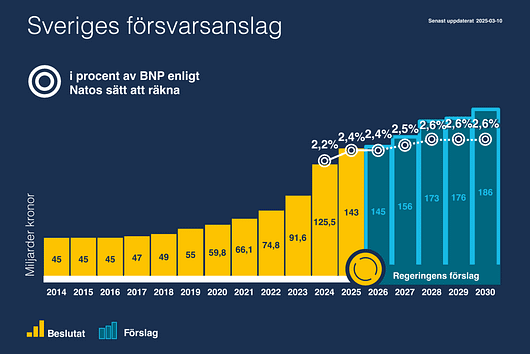
8 April – Swedish Television, SVT, reports that Prime Minister Kristersson will call all the Swedish parliamentary parties for talks next week. The reason is this – ‘The government is now calling for new party leader talks on the continued rearmament of the Swedish defence. The background is the proposal for a loan-financed rearmament of SEK 300 billion, which the government and the Sweden Democrats have announced.’

They want to borrow SEK 300 billion – US$ 30 bn – to finance Sweden’s future rearmament, which comes on top of a rearmament that saw Sweden spend SEK 45 billion on its ‘defence’ ten years ago and today spending SEK 143 billion, an increase of 318%. More details on the Government Chancellery page – showing this development:

Sweden must rearm to satisfy the absurd, anti-intellectual and irrelevant yardstick: military spending as a percentage of GDP, which I have criticised to no end here. The planned rearmament has no – no – relation to any serious, qualified analysis of likely civil and military threats to Sweden in the coming decades. It suffices these days to state that Putin is the cause of all problems, that he is evil or that he is this or that personality and, therefore, to maintain out of the blue that he aims to take most of Europe. No one asks a question, because critical journalism has also disappeared, at least in this field.

This is how you lie and how you install and increase fear in the population. Fear – fearology – is known to be extremely effective in getting people to believe or do anything. Because ‘we’ are threatened!

But apart from this kakistocratic mindset, one should note that Swedish Prime Minister Kristersson is quoted as saying this:

‘In serious times, it’s important that we stick together as a country, says Prime Minister Ulf Kristersson.’

Is he afraid that Sweden will not stay together as a country? Is he afraid that the propaganda that ‘the Russians are coming’ will be seen through? Is he afraid that Sweden will not hold together when Swedes realise how destructive this insane militarisation – and borrowing for it – is for Swedes in the future? Is he afraid that at some point he’ll be seen as a peacetime traitor because his government is apparently more loyal to NATO and the US (even under the Trump regime!) than to the people who elected him?

I wonder if there’s something – deeper – in the thought I express in the headline of this article?

I fear that there is – and that this is a convincing sign of the West’s decay from within – while legitimising the chaos of inner emptiness by looking mad at external non-existent threats. Psychologists call this kind of psychology ‘projection’ – ‘projecting your own dark sides onto your opponent.’ I would call it psycho-political projection.

We – Western societies – simply have no vision of the future to rally around, so the illusory and self-created war must become the thing that makes us stand together and gives us meaning.

PS Much more can indeed be said about this hypothesis – militarism as filling the void of modern Western society, offering a meaning and cohesion, albeit absurd and dangerous. I intend to think more and write more about this, so any views you, dear reader, may have on this relationship, please drop them below. Thanks!

Jan Oberg is a peace researcher, art photographer, and Director of The Transnational (TFF) where this article first appeared. Reach him at: oberg@transnational.orgRead other articles by Jan.

Junk Science and Bad Policing: The Homicide Prediction Project

The law enforcement breed can be a pretty dark lot.  To be paid to think suspiciously leaves its mark, fostering an incentive to identify crimes and misdemeanours with instinctive compulsion.  Historically, this saw the emergence of quackery and bogus attempts to identify criminal tendencies.  Craniometry and skull size was, for a time, an attractive pursuit for the aspiring crime hunter and lunatic sleuth.  The crime fit the skull.

With the onset of facial recognition technologies, we are seeing the same old habits appear, with their human creators struggling to identify the best means of eliminating compromising biases.  A paper published by IBM researchers in April 2019 titled “Diversity in Faces” shows that doing so ends up returning to old grounds of quackery, including the use of “craniofacial distances, areas and ratios, facial symmetry and contrast, skin color, age and gender predictions, subjective annotations, and pose and resolution.”

The emergence of artificial intelligence (AI) tools in identifying a form of predictive criminality perpetuates similar sins.  Police, to that end, have consistently shown themselves unable to resist the attractions supposedly offered by data programs and algorithmic orderings, however sophisticated.  These can take such crude forms as those advanced by Pasco County Sheriff Chris Nocco, a devotee of that oxymoronic pursuit “intelligence-led policing,” stacked with its snake oil properties.  A 2020 Tampa Bay Times piece on the exploits of that Florida county’s sheriff’s office made it clear that Nocco was keen on creating “a cutting-edge intelligence program that could stop crime before it happened.”

The counter to this was impressive in its savagery.  Such forms of law enforcement featured, in the view of criminologist David Kennedy of the John Jay College of Criminal Justice, “One of the worst manifestations of the intersection of junk science and bad policing”, in addition to its utter lack of “common sense and humanity”.

The trend towards data heavy systems that supposedly offer insight into inherent, potential criminality has captured police departments in numerous countries.  A recommendation paper from the European Crime Prevention Network notes the use of “AI tools in hopes of rendering law enforcement more effective and cost-efficient” across the European Union.  Predictive policing is singled out as particularly attractive, notably as a response to smaller budgets and fewer staff.

In the United Kingdom, the government’s Ministry of Justice has taken to AI with gusto through the Homicide Prediction Project, a pilot program that hoovers up data from police and government data sets to generate profiles and assess the risk of a person committing murder.  The program, commissioned by the Prime Minister’s Office in 2023 and involving the MoJ, the Home Office, Greater Manchester Police (GMP) and the Metropolitan Police in London, only came to light because of a Freedom of Information request by the charity Statewatch.

According to the Data and Analysis unit within the MoJ the data science program explores “the power of MOJ datasets in relation to assessment of homicide risk”, the “additional power of the Police National Computer dataset” in doing the same, and “the additional power of local police data”.  It also seeks to review the characteristics of offenders that increase such a risk, exploring “alternative and innovative data science techniques to risk assessment and homicide.”

What stands out in the program is the type of data shared between the agencies.  These include types of criminal convictions, the age a person first appeared as a victim (this includes domestic violence), and the age a person had their first encounter with the police. But also included are such matters as “health markers which are expected to have predictive power”, be they on mental health, addiction issues, suicide, self-harm and disability.

The use of predictive models is far from new for the wonks at the MoJ.  Those used in the Offender Assessment System (OASys) have been previously found to profile people differently in accordance with their ethnicities.  The National Offender Management service noted in a 2015 compendium of research and analysis of the system between 2009 and 2013, “Relative predictive validity was greater for female than male offenders, for White offenders than offenders of Asian, Black and Mixed ethnicity, and for older than  younger offenders.”

Statewatch researcher Sofia Lyall has little to recommend the program, renamed for evidently more palatable consumption the Sharing Data to Improve Risk Assessment program. “Time and again, research shows that algorithmic systems for ‘predicting’ crime are inherently flawed.”  The Homicide Prediction Project was “chilling and dystopian”, profiling individuals “as criminals before they have done anything.”  She is also convinced that the system will, as with others, “code in bias towards racialized and low-income communities” while posing grave threats to privacy.

The unit claims that the work is only intended for dry research purposes, with “no direct operational or policy changes” arising because of it, or any individual application to a “person’s journey through the justice system.”  This is a nonsensical assertion, given the sheer temptations open to officials to implement a program that uses hefty data sets in order to ease the task of rigorous policing.  The representatives of law enforcement crave results, even those poorly arrived at, and algorithmic expediency and actuarial fantasy is there to aid them.  The “precrime” dystopia portrayed in Philip K. Dick’s The Minority Report (1956) is well on its way to being realised.


Binoy Kampmark was a Commonwealth Scholar at Selwyn College, Cambridge. He lectures at RMIT University, Melbourne. Email: bkampmark@gmail.comRead other articles by Binoy.


Jul 21, 2020 ... A collection of eighteen science fiction short stories features The Minority Report, in which Commissioner John Anderton's clever use of precogs, people who&nb...


Globalization, its Demise, and its Consequences


There is very, very much to like about the recent (3-24-2025) article in Jacobin by Branko Milanović entitled “What Comes After Globalization?”

First, Milanović explores historical comparisons between the late-nineteenth-century expansion of global markets and trade (what he calls Globalization I and dates from 1870 to 1914) and the globalization of our time (what he calls Globalization II and dates from 1989 to 2020). The search for and exposure of historical patterns are the first steps in scientific inquiry, what Marxists mean by historical materialist analysis.

Unfortunately, many writers — including on the left — take the more recent participation of new and newly engaged producers and global traders, a revolution in logistics, the success of free-trade politics, and the subsequent explosion of international exchange as signaling the arrival of a new, unique capitalist era, even a new stage in its evolution.

Recognizing a growing share of trade in global output, but burdened with a limited historical horizon (the end of the Second World War), left theorists drew unwarranted, speculative conclusions about a new stage of capitalism featuring a decline in the power of the nation state, the irreversible domination of “transnational capital,” and even the coming of a borderless “empire” contested by an amorphous “multitude.”

Countering these views, writers like Linda Weiss (The Myth of the Powerless State, 1998) and Charles Emmerson (1913: In Search of the World Before the Great War, 2013) bring some sobriety to the question and remind us that we have seen the explosive growth of world trade before, generated by many of the same or similar historic forces. Weiss tells us that “the ratios of export trade to GDP were consistently higher in 1913 than they were in 1973.” Noting the same historical facts, Emmerson wryly concludes “Plus ça change”.

Milanović’s recognition of this parallel between two historic moments gives his analysis a gravitas missing from many leftists, many self-styled Marxist interpretations of the globalization phenomenon.

Secondly, Milanović — an acknowledged expert in comparative economic inequality — makes an important observation regarding the asymmetry between Globalization I and II. While they are alike in many ways, they differ in one important, significant way: while Globalization I benefited the Great Powers at the expense of the colonial world, the workers in the former colonies were actually benefited by Globalization II. In Milanović’s words:

Replacing domestic labor with cheap foreign labor made the owners of capital and the entrepreneurs of the Global North much richer. It also made it possible for the workers of the Global South to get higher-paying jobs and escape chronic underemployment…  It is therefore not a surprise that the Global North became deindustrialized, not solely as the result of automation and the increasing importance in services in national output overall, but also due to the fact that lots of industrial activity went to places where it could be done more cheaply. It’s no wonder that East Asia became the new workshop of the world.

While he misleadingly uses the expression “coalition of interests,” Milanović elaborates:

This particular coalition of interests was overlooked in the original thinking regarding globalization. In fact, it was believed that globalization would be bad for the large laboring masses of the Global South — that they would be exploited even more than before. Many people perhaps made this mistake based on the developments of Globalization I, which indeed led to the deindustrialization of India and the impoverishment of the populations of China and Africa. During this era, China was all but ruled by foreign merchants, and in Africa farmers lost control over land — toiled in common since time immemorial. Landlessness made them even poorer. So the first globalization indeed had a very negative effect on most of the Global South. But that was not the case in Globalization II, when wages and employment for large parts of the Global South improved.

Milanović makes an important point, though it risks exaggeration by his insistence that because Globalization II brought a higher GDP per worker, the workers are better off and exploited less.

They may well be better off in many ways, but they are likely exploited more.

Because he forgoes a rigorous class analysis, he assumes that gain in GDP per worker goes automatically to the worker. Most of it surely does not; if it did, capital would not have shifted to the Global South. Instead, most of the GDP per capita goes to the capitalist — foreign or domestic. Capital would not migrate to the former colonies if it garnered a lower rate of exploitation.

But engagement with manufacturing in Globalization II, rather than resource extraction or handicraft, certainly provides workers in the former colonies with greater employment, better wages, and more opportunity to parlay their labor power into a more advantageous position — a fact that nearly all development theorists from right to left should concede.

Structural changes in capitalism — the rapid mobility and ease of mobility of capital, the opening of new lower wage markets, a revolution in the means and costs of transportation — have shifted manufacturing and its potential benefits for workers from its location in richer countries to a new location in poorer countries, creating a new leveling between workers in the North and South.

Denying or neglecting this reality has led many leftists — like John Bellamy Foster — to support the “labor aristocracy” thesis as a reason to ignore or demean the potentially militant role of workers in the advanced capitalist countries. As one of the strongest voices in support of the revolutionary potential of the colonial workers and peasants, Lenin was scathingly critical of elements of the working class who were indirectly privileged by the wealth accumulated from the exploitation of the colonies. Those “labor aristocrats” constituted an ideological damper on the class politics of Lenin’s time (and even today), but by no means gave a reason to deny the class’s revolutionary potential. Certainly, the ruling classes of the Great Powers employed that relative privilege and many other ploys to further exploit their domestic workers to the fullest extent and discourage their rebellion.

Bellamy and others want to deny the revolutionary potential of the workers in the advanced capitalist countries in order to support the proposition that the principal contradiction today is between the US, Europe, and Japan and the countries of the Global South. Bellamy endorses the Monthly Review position taken as far back as the early 1960s: “Some Marxist theorists in the West took the position, most clearly enunciated by Sweezy, that revolution, and with it, the revolutionary proletariat and the proper focus of Marxist theory, had shifted to the third world or the Global South.”

While frustration with the lack of working-class militancy (worldwide) is understandable and widespread, it does not change the dynamics of revolutionary change — the decisive role of workers in replacing the existing socio-economic system. Nor does it dismiss the obligation to stand with the workers, the peasants, the unemployed, and the déclassé wherever they may be — within either the Great Powers or the former colonies.

Just as revolutionary-pessimism fostered the romance of third-world revolution among Western left-wing intellectuals in the 1960s, today it is the foundation for another romantic notion — multipolarity as the rebellion of the Global South. Like its Cold War version, it sees a contradiction between former colonies and the Great Powers of our time as superseding the contradiction between powerful monopoly corporations and the people.

Of course, richer capitalist states and their ruling classes do all they can to protect or expand any advantages they may enjoy over other states — rich or poor — including economic advantages. But for the workers of rich or poor states, the decisive question is not a question of sovereignty, not a question of defending their national bourgeoisie, or their elites, but of ending exploitation, of combatting capital.

The outcome of the global competition between Asian or South American countries and their richer Western counterparts over market share or the division of surplus value has no necessary connection with the well-being of workers in the sweatshops of the various rivals. This is a fact that many Western academics seem to miss.

Thirdly, Milanović clearly sees the demise of Globalization II — the globalization of our time:

The international wave of globalization that began over thirty years ago is at its close. Recent years have seen increased tariffs from the United States and the European Union; the creation of trade blocs; strong limits on the transfer of technology to China, Russia, Iran, and other “unfriendly” countries; the use of economic coercion, including import bans and financial sanctions; severe restrictions on immigration; and, finally, industrial policies with the implied subsidization of domestic producers.

Again, he is right, though he fails to acknowledge the economic logic behind the origins of Globalization II, the conditions leading to its demise, and the forces shaping the post-globalization era. For Milanović, globalization’s end comes from policy decisions — not policy decisions forced on political actors — but simply policy preferences: “Trump fits that mold almost perfectly. He loves mercantilism and sees foreign economic policy as a tool to extract all kinds of concessions…” Thus, Trump’s disposition “explains” the new economic regimen; we need to look no deeper.

But Trump did not end globalization. The 2007-2009 economic crisis did.

Globalization was propelled by neoliberal restructuring combined with the flood of cheap labor entering the global market from the “opening” of the People’s Republic of China and the collapse of Eastern Europe and the USSR. Cheaper labor power means higher profits, everything else being the same.

With the subsequent orgy of overaccumulation and capital running wildly looking for even the most outlandish investment opportunities, it was almost inevitable that the economy would crash and burn from unfettered speculation.

And when it did in 2007-2009, it took trade growth with it and marked “paid” on globalization.

As I wrote in 2008:

 As with the Great Depression, the economic crisis strikes different economies in different ways. Despite efforts to integrate the world economies, the international division of labor and the differing levels of development foreclose a unified solution to economic distress. The weak efforts at joint action, the conferences, the summits, etc. cannot succeed simply because every nation has different interests and problems, a condition that will only become more acute as the crisis mounts…

“Centrifugal forces” generated by self-preservation were operant, pulling apart existing alliances, blocs, joint institutions, and common solutions. Trade agreements, international organizations, regulatory systems, and trust greased the wheels of global trade; distrust, competition, and a determination to push economic problems on others threw sand on those wheels.

Anticipating the period after the demise of globalization, I wrote in April of 2009:

To simplify greatly, a healthy, expanding capitalist order tends to promote intervals of global cooperation enforced by a hegemonic power and trade expansion, while a wounded, shrinking capitalist order tends towards autarky and economic nationalism. The Great Depression was a clear example of heightened nationalism and economic self-absorption.

The aftermath of the 2007-2009 Great Recession was one such example of “a wounded, shrinking capitalist order.”  And predictably, autarky and economic nationalism followed.

The tendency was exacerbated by the European debt crisis that drove a wedge between the European Union’s wealthier North and the poorer South. Similarly, Brexit was an example of the tendency to go it alone, substituting competition for cooperation. Ruling classes replaced “win-win” with zero-sum thinking.

The pace and intensity of international trade has never recovered.

While Milanović does not attend to it, this cycle of capitalist expansion, economic crisis, followed by economic nationalism (and often, war) recurs periodically.

In the late-nineteenth century, the global economy saw a vast restructuring of capitalism, with new technologies and rising productivity (and concomitant rises in rates of exploitation).The era also saw what economists cite as “a world-wide price and economic recession” from 1873 to 1879 (the Long Depression). In its wake, protectionism and trade wars broke out as everyone tried to dispose of their cheaper goods in other countries, only to be met with tariff barriers.

The imperialist “scramble for Africa” — so powerfully described by John Hobson and V. I. Lenin — raised the intensity of international competition and rivalry, while generating the foundation for economic growth and global trade with newly acquired colonies. This is the period that Milanović characterizes as Globalization I. A further aspect and stimulus of the rebirth of growth and trade was the massive armament programs mounted by the Great Powers. The unprecedented armament race — the “Dreadnought race” — served as an engine of growth, while exponentially increasing the danger of war (from 1880 to 1914 armament spending in Germany increased six-fold, in Russia three-fold, in Britain three-fold, in France double, source: The Bloody Trail of Imperialism, Eddie Glackin, 2015).

One could argue, similarly, that the 1930s were a period of depression and economic nationalism, following a broad, exuberant economic expansion. And as with the pre-World War I Globalization I, the contradictions were resolved with World War.

Is War our Destiny after the Demise of Globalization II?

Certainly, the historical parallels cited above suggest that wars often follow pronounced economic disruptions and the consequent rise of economic nationalism, though we must remember that events do not follow a mechanical pattern.

Yet if history is a great teacher, it certainly looks like the mounting contradictions of today’s capitalism point to intensifying rivalry and conflict. A March 24 Wall Street Journal headline screams: Trade War Explodes Across World at a Pace Not Seen in Decades!

The article notes that the infamous Smoot-Hawley (tariff) Act of 1930– a response to the Great Depression– was only rescinded after the war.

It also notes — correctly — that tariffs are not simply a Trump initiative. As of March 1, the Group of 20 have imposed 4500 import restrictions — up 75% since 2016 and increased 10-fold since 2008.

The World Trade Organization, responsible for organizing Globalization II has failed its calling. As the WSJ reports:

In February, South Korea and Vietnam imposed stiff new penalties on imports of Chinese steel following complaints from local producers about a surge of cut-price competition. Similarly, Mexico has begun an antidumping probe into Chinese chemicals and plastic sheets, while Indonesia is readying new duties on nylon used in packaging imported from China and other countries.

Even sanctions-hit Russia is seeking to stem an influx of Chinese cars, despite warm relations between Russian President Vladimir Putin and Chinese leader Xi Jinping. Russia in recent weeks increased a tax on disposing of imported vehicles, effectively jacking up their cost. More than half of newly sold vehicles in Russia are Chinese-made, compared with less than 10% before its 2022 invasion of Ukraine.

As tensions mount on the trade front, rearmament and political tensions are growing. War talk mounts and the means of destruction become more effective and greater in number. The US alone accounts for 43% of military exports worldwide, up from 35% in 2020. France is now the number two arms exporter, surpassing Russia. And, in over a decade, NATO has more than doubled the value of weapons imported.

European defense spending is expanding at rates unseen since the Cold War, in some cases since World War II. According to the BBC, “On 4 March European Commission President Ursula Von der Leyen announced plans for an €800bn defence fund called The ReArm Europe Fund.”  Germany has eliminated all restraints on military spending in its budget. Likewise, the UK plans to increase military spending to 2.5% of GDP in the next two years, while Denmark is aiming for 3% of GDP in the same period (growth rates consistent with those of the Great Powers before World War I, except for Germany).

Dangerously, centrist politicians in the EU are beginning to see rising military spending as a boost to a stuttering economy. As military Keynesianism takes hold, the possibility of global war increases, especially in light of the shifting alliances in the proxy war in Ukraine.

Even more ominously, Europe’s two nuclear powers — France and the UK — are seriously discussing the development of a European nuclear force independent of the US-controlled NATO nuclear capability.

At the same time, the incoming chair of the US Joint Chiefs of Staff announced readiness to supply more NATO powers with a nuclear capacity.

As war cries intensify, the EU Commission has issued a guidance that EU citizens should maintain 72 hours of emergency supplies to meet looming war dangers.

Of course, the continually escalating wave of tariffs, sanctions, and hostile words directed at The People’s Republic of China by the US and its allies threatens to break into open conflict and wider war, a war for which the PRC is quite understandably actively preparing.

As with previous World Wars, it is not so much — at this moment — who is right or wrong, but when the momentum toward war will become irreversible. Another imperialist war — for, in essence, that is what it would be — will be an unimaginable disaster. No issue is more vital to our survival than stopping this momentum toward global war.

Greg Godels writes on current events, political economy, and the Communist movement from a Marxist-Leninist perspective. Read other articles by Greg, or visit Greg's website.